Avatar
Andreas Griffin
06bc9ab7c06cbaa8fb9089ea326736340473fc54b77ae1e093766b70427c48f5
Bitcoin-Safe.org A bitcoin savings wallet for the entire family. Community: https://chorus.community/group/34550%3Af8827954feef0092c8afec0be4cae544a9ed93dce9a365596e75b19aa05f0c84%3Abitcoin-safe-meiqbfki Youtube: https://www.youtube.com/@BitcoinSafeOrg Github: https://github.com/andreasgriffin/bitcoin-safe X: https://x.com/BitcoinSafeOrg Nostr: https://yakihonne.com/users/npub1g9uhysae68vhvwwqel8v9enr9mg43rn4tpurs6a9g4jsrw6nl7lsplhs9v Languages: ๐Ÿ‡บ๐Ÿ‡ธ ๐Ÿ‡จ๐Ÿ‡ณ ๐Ÿ‡ช๐Ÿ‡ธ ๐Ÿ‡ฏ๐Ÿ‡ต ๐Ÿ‡ท๐Ÿ‡บ ๐Ÿ‡ต๐Ÿ‡น ๐Ÿ‡ฎ๐Ÿ‡ณ ๐Ÿ‡ฎ๐Ÿ‡น ๐Ÿ‡ซ๐Ÿ‡ท ๐Ÿ‡ฉ๐Ÿ‡ช ๐Ÿ‡ฒ๐Ÿ‡ฒ ๐Ÿ‡ฐ๐Ÿ‡ท ๐Ÿ‡น๐Ÿ‡ญ ๐Ÿ‡ฎ๐Ÿ‡ท ๐Ÿ‡ต๐Ÿ‡ฑ ๐Ÿ‡ช๐Ÿ‡ธ ๐Ÿ‡ฎ๐Ÿ‡ฉ ๐Ÿ‡น๐Ÿ‡ท

I cannot find the video I originally watched, but here she mentiones it too: 6:30 https://www.youtube.com/watch?v=1WqBhQS_DPU

Replying to Avatar jimmysong

# "Free" is Slavery

Thae Young Ho is the highest ranking defector to ever have come out of North Korea. He was an ambassador to Sweden and then to England. At the Oslo Freedom Forum back in 2019, I got to talk to him for a few hours, and it's a conversation I'll never forget.

It's rare that we get such a high ranking official to come out of the country to tell us how they operate, but Mr. Thae is one of those people. He was able to enlighten many of us what North Korea's process for the currency revaluation was and why they backtracked. He also told us about how they had to execute someone so that the regime wouldn't get blamed. If you read any works of Rene Girard, that shouldn't surprise you, especially given that it's an atheist country.

## Kim's Rise to Power

But the story that struck me the most was about Kim Il Sung's rise to power. Mr. Thae explained that after being installed as the hand-picked leader of North Korea in 1945, he wasn't that popular. His Korean was marginal as he had grown up mostly in China. His education was a scant 8 years, all of it in Chinese and communist guerrilla tactics weren't exactly beloved by the people. Yet if we look at how he's looked at in North Korea today, he's essentially viewed as a divinity. Somehow, this poorly educated, barely comprehensible puppet of the Soviet Union became the god of North Korea.

So what happened? How did he gain all that power? What did he do to take control? You would think that given what we're generally told about communism that it would be based completely on fear and ruthlessness that consolidated his power. And certainly, there was plenty of that. But according to Mr. Thae, Kim Il Sung relied on something else: free stuff.

## The Cult of Free

Everyone loves free stuff. Think about how popular the free stuff section on your local craigslist is. I'll bet you anything it's the most visited and monitored part of the site and rarely will you find stuff that's that valuable that someone hasn't taken already. It's part of the human instinct to try to get something for nothing and Kim Il Sung exploited it.

As with most socialist/communist programs, the way he won over the North Korean people was with lots of entitlements. They got free health care, free food, free housing, a guaranteed job. They got everything they needed. And with Soviet subsidization, it worked great. People supported him and for a time, a lot of international observers thought that North Korea was doing better than the South.

But there's a darker side to "free stuff." What happens when they run out of a scarce resource? How do you determine who gets it? Say there's medicine that will help two different people, but there's only enough for one. Who gets it?

In a free market, prices help you decide that, and a high price spurs greater production of the scarce resource so that the prices come down. But if it's free, what do you do? When you have a central controller of everything, the answer is obvious. You reward those that are loyal and punish those that are not. Instead of money being your currency, it was loyalty to the regime that was your currency.

## Markets Build Community

Soon, the only people that really got the free stuff were near the top of the ideological hierarchy. Instead of prices determining what you got, it was your perceived compliance and loyalty to the regime that determined it.

In the absence of a market, compliance was what determined who got what. Mr. Thae's point of the story was that there's something sacred about market transactions. Market transactions cause both parties to have obligations to the other. There's a mutual desire to satisfy the other party and it binds us together in a community. That's precisely what they lacked in North Korea and why the regime was so powerful.

It's easy to listen to these stories and think of it as "out" there, that it's got nothing to do with us. But after listening to this story, I started thinking about what stuff I got for free from centralized entities. I get GMail for free. I get Facebook for free. I get YouTube for free. I realized that the cost of getting these things was indeed compliance. In these walled gardens, they can kick you out at any time and that is indeed what they do. The reason why these companies have so much power is because they give you this stuff in exchange for compliance. They give you this stuff to *enslave* you.

## Western Governments

Fact is, there's way more of the communist/socialist system of free embedded in our supposed democracies than we think. Remember during the pandemic how you had to get a vax to keep your job, visit your sick relatives or travel? There were people in the US suggesting that unvaxxed people should be denied health care services. Such tactics really only work when the service is "free." The central controller of the resource extracts its pound of flesh, just not in money. Many governments have gone down this route. We're much closer to communism in western societies than we'd like to believe.

Prices and paying for things are a good thing. They obligate both parties to the trade to satisfy the other. The instinct to get something for nothing is not one that builds civilization. The reason communism has led to tyranny every single time is because the central government ends up with all the resources and wields absolute power through "free" stuff.

Reject free. Pay for value.

Yeonmi Park said exactly the same in one of her shows.

Is Bitcoin/Lightning splitting into the approved tracked version and the freedom version?

๐Ÿ˜ขThe slow government rugging will continue until the people care. So sad.

In 1000 years Indiana Jones will look for cans in long lost citadels.

OK, the interaction with a coordinator is another point, that's relevant for security.

I meant once the devices generated a secret to display it as a seed for a paper backup. (electronic devices can break)

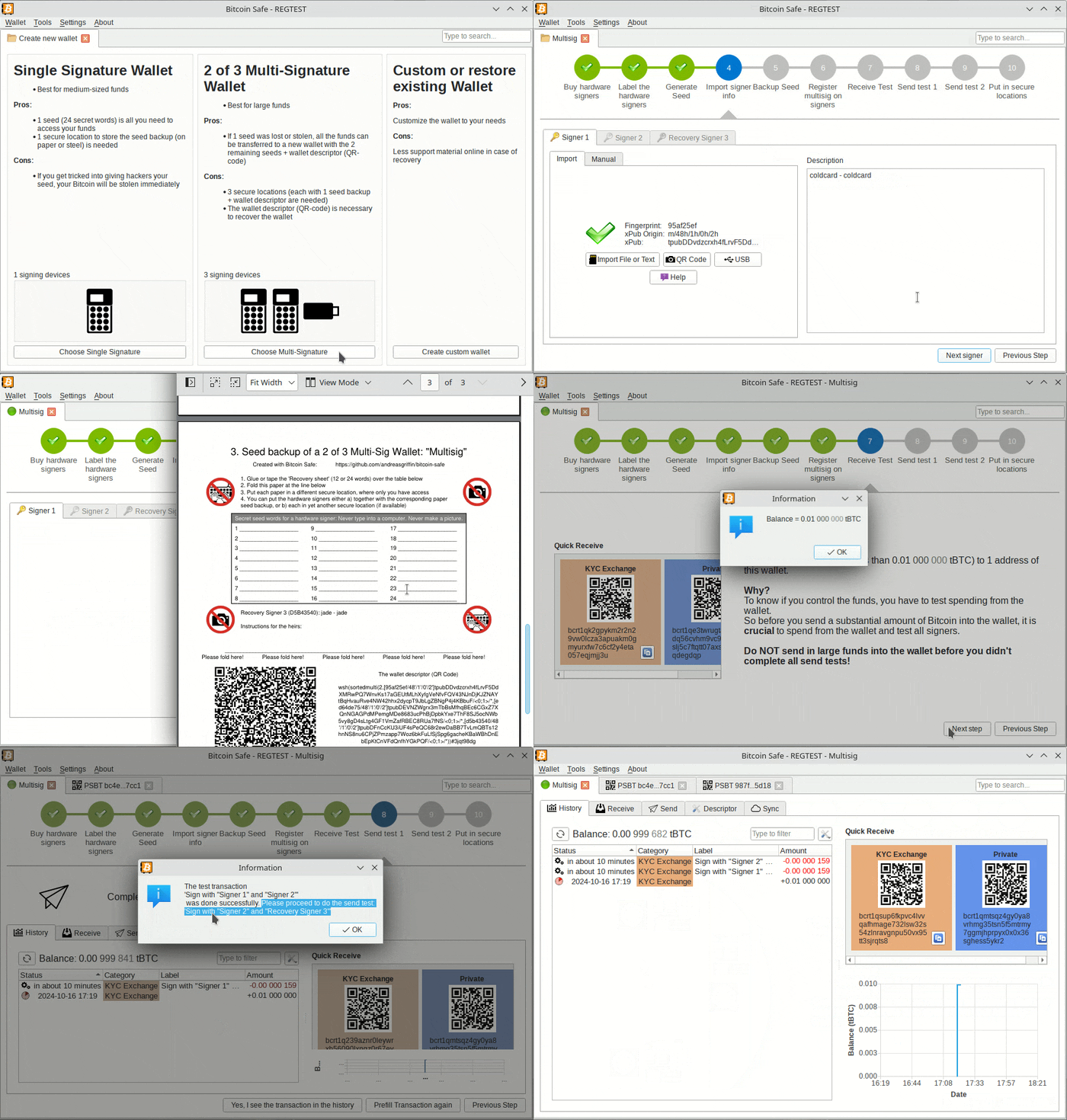
Thanks for the feedback. Only when I created the guided setup I noticed how many steps you have to do in the right order to get a secure multisig setup.

This guided setup is my attempt at making multisig straight forward (even for non technical people) .

On the contrary they state:

- Platforms need to analyse their specific risks, and put in place mitigation measures โ€“ for instance, to address the spread of disinformation and inauthentic use of their service.

I wonder why the following is not one of the DSA statements:

- Platforms must ensure free speech despite pressure or coercion of governments

Replying to Avatar fiatjaf

WebRTC might be the biggest scam in all the "web" (aka Google Chrome) technologies.

I don't know about the ideas behind creation of WebRTC, but the way it was sold, and has been consistently sold for the last 10 years, is that it is a thing that you can plug in your code and it will magically work.

Oh, right, it also requires a STUN server, but look, you don't have to host anything, there are dozens of free public STUN servers on the internet -- and after that the WebRTC connection is established and you can freely transfer data, voice, video, everything!

Turns out WebRTC is useless without TURN servers, which just relay the entire bulk of the data and, most importantly, are not hosted for free by anyone for anyone else.

To this day developers keep dreaming of a magic peer-to-peer web that can be powered by WebRTC and wasting their weekends writing super nice projects that rely on WebRTC -- without TURN servers -- and therefore do not work at all. The worst part is that they always work when tested locally, generally in the same computer, two different browser tabs or even two different browsers (although in the second case no always).

I'm writing this because I just saw an anonymous developer talking about doing WebRTC signaling over Nostr as if that was the hard part. There is also a WebRTC signaling over Nostr NIP proposal. These things are everywhere. I have myself written at least two projects that relied on WebRTC in the past hoping that time it would be different and p2p would work.

Thanks for the info. That sounds like a terribly designed spec.

It would be great if we could get real p2p video chat (like Keet as a rust library).