Profile: 1f5e1055...
How to properly taste whisky with Richard Paterson https://t.co/rMfqPtEPpv https://video.twimg.com/ext_tw_video/1835186280344236032/pu/vid/avc1/648x580/dRplrKfnhqUgR8Oj.mp4?tag=12
Muhammad Ali's head movement was truly one of a kind https://t.co/5geSb8XOYy https://video.twimg.com/ext_tw_video/1835186166431141888/pu/vid/avc1/650x460/PW295NJVVkfkbDx-.mp4?tag=12
Adam Sandler doing stand-up comedy at age 23 https://t.co/cBd0X9dPzZ https://video.twimg.com/ext_tw_video/1835174472451592196/pu/vid/avc1/646x490/2bwg9NG3nmLyR1a-.mp4?tag=12
Victorian era train station, 1898 https://t.co/SGYuzwMVCN https://video.twimg.com/ext_tw_video/1835173740327395328/pu/vid/avc1/480x410/adD6nDFMkpW4UlJN.mp4?tag=12
This product can save your life if you get lost in the ocean https://t.co/rXaxuAtl3O https://video.twimg.com/ext_tw_video/1835173234678861824/pu/vid/avc1/646x430/ZCdYeNlmkv0cEXKj.mp4?tag=12
20 years ago, George Carlin shared his views on what America was turning into (2004) https://t.co/iECh4RYest https://video.twimg.com/ext_tw_video/1835172757962674176/pu/vid/avc1/718x552/MndWqARqdKn50Ivx.mp4?tag=12
Predjama Castle in Slovenia has stood on a 123-meter cliff for 800+ years, making it the largest cave castle in the world https://t.co/XS3dWQJysP 
When Halo theme tune meets a real Gregorian style vocal ensemble https://t.co/w8UCUDZrKs https://video.twimg.com/ext_tw_video/1835110617654394880/pu/vid/avc1/658x600/jfDzrogQVGlWhBnJ.mp4?tag=12
For a decade, a beekeeper named Isidoros Țiminis, living in the region of Kapandriti, near Athens, has kept a tradition: every spring, he slips icons of Christ, the Holy Virgin and different saints in his beehives, in order to bless his bees and his yearly honey production.
Every year, the very same mysterious phenomenon occurs: bees make their honeycomb cells around the pious images, meticulously avoiding covering them.
Scientifically it can simply be a phenomenon related to some effect in the painting itself or chemical materials used to create the pictures which might prevent bees from building their honeycombs on them. The work of these peculiar Greek bees never got studied officially by scientific community and remains an interested fact. https://video.twimg.com/amplify_video/1835185922112954368/vid/avc1/708x876/gCiehup9tC3GqTkw.mp4?tag=16
There is a real tradition in the Netherlands, known as "dropping" (or "droppings" in Dutch). It involves leaving children, usually in groups, in a remote forest or rural area, typically at night, with the goal of finding their way back to a designated meeting point or base camp. The practice is a form of adventure and team-building exercise meant to foster independence, resilience, and navigation skills among the children.
The tradition is often organized by scouting groups, youth organizations, or even families, and it usually involves children aged around 10 to 15. While it might sound alarming to those unfamiliar with it, droppings are conducted under controlled conditions, with adults keeping a close eye on the children from a distance to ensure their safety. The tradition is considered a rite of passage and an exciting challenge for many Dutch children. 
Mozart passed away at 35, and wrote around 800 pieces, 22 pieces every year he lived. https://t.co/FnROe7udsl 
I'd rather a doctor tell me straight up, cut the bullshit https://t.co/cvAWKcr28n https://video.twimg.com/ext_tw_video/1835022156964532224/pu/vid/avc1/616x590/dMIcfSoAtAngMEgM.mp4?tag=12
We were too young to understand this Tom and Jerry episode from 1949 where three drowned kittens arrive in Heaven https://t.co/Z0mQ0oiQKd https://video.twimg.com/ext_tw_video/1835021475767631872/pu/vid/avc1/612x518/OqvC6OFEkfRbpVfr.mp4?tag=12
The top picture captures Dr. Zbigniew Religa, a heart surgeon, taking a much-needed break after an epic 23-hour surgery. He's just completed Poland's first successful heart transplant back in 1987. You can spot his assistant catching some Z's in the background, totally wiped out from the marathon operation.
Looking at the bottom photo, we see Tadeusz Zitkevits, the patient who received that pioneering heart, still going strong 25 years after his transplant. He lived until 2017, which means he outlived Dr. Religa by 8 years. The doctor who gave him a second chance at life passed away in 2009. 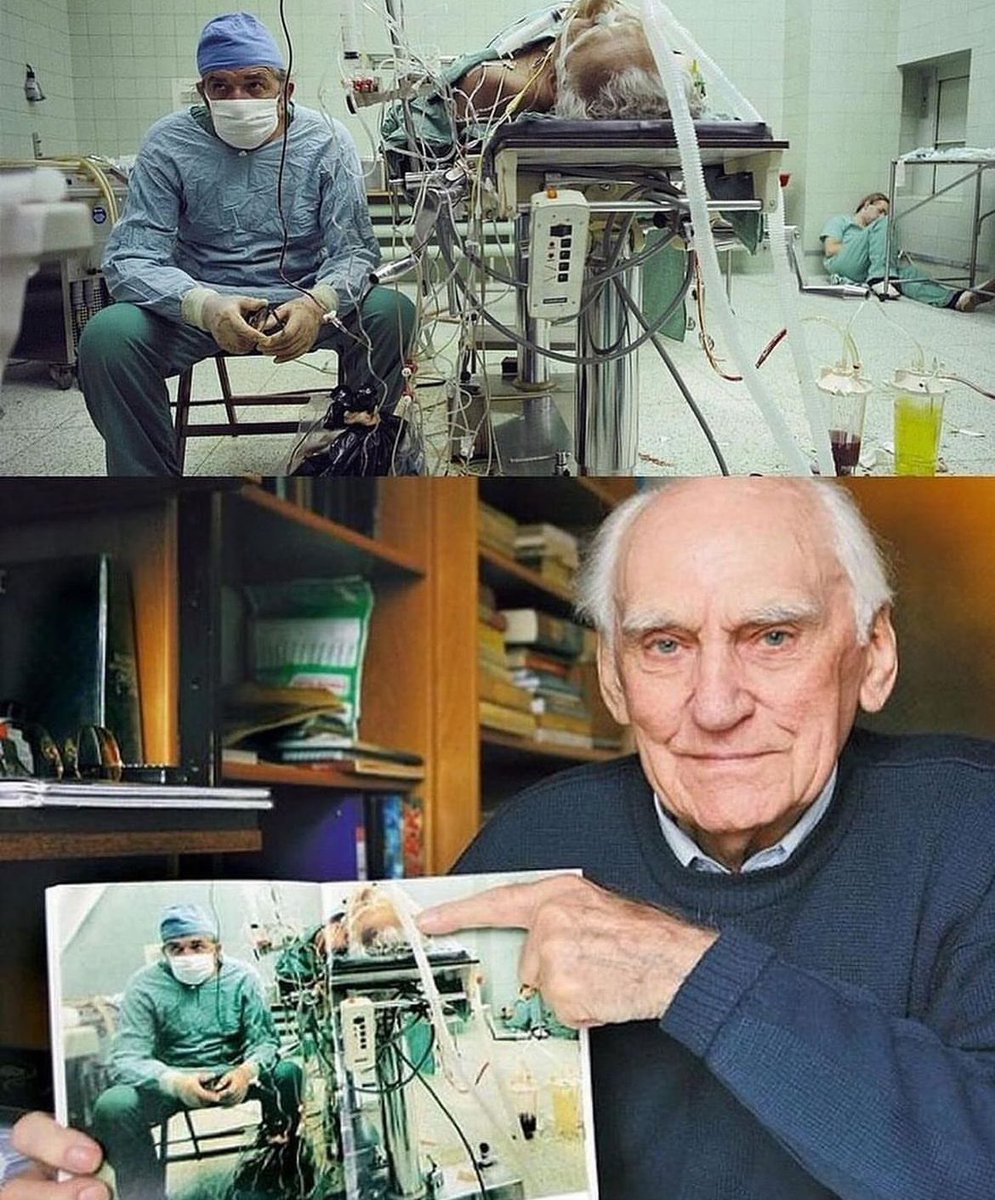
Boxer tests out indestructible TV screen https://t.co/5MCfmYf3Qp https://video.twimg.com/ext_tw_video/1835020130176118784/pu/vid/avc1/634x822/LxlUe6swAMc49ALF.mp4?tag=12
Jon Bon Jovi saves a distraught woman from jumping off a bridge https://t.co/YwAGRlcxe9 https://video.twimg.com/ext_tw_video/1835019801925685248/pu/vid/avc1/666x688/LGkpcKGlixOl44-N.mp4?tag=12
President George Bush gives a speech and then proceeds to pipe a drive https://t.co/OJEYVO5Zly https://video.twimg.com/ext_tw_video/1835018967401795586/pu/vid/avc1/674x562/4I8K4Om1ozqUab-M.mp4?tag=12
This show deserved an Emmy just for this scene alone https://t.co/cHSuaVeXYv https://video.twimg.com/ext_tw_video/1835017788848472064/pu/vid/avc1/624x606/8SFBQOHZsloHFg4k.mp4?tag=12