Back to determinism and probabilities. What do strange attractors have to say about determinism? As described by Ilya Prigogine and Isabelle Stengers in their essay Entre le temps et l’éternité, these systems blur, or make disappear altogether, the causal link between causes and effects. Indeed, the notion of cause and effect presupposes the ability to define trajectories. 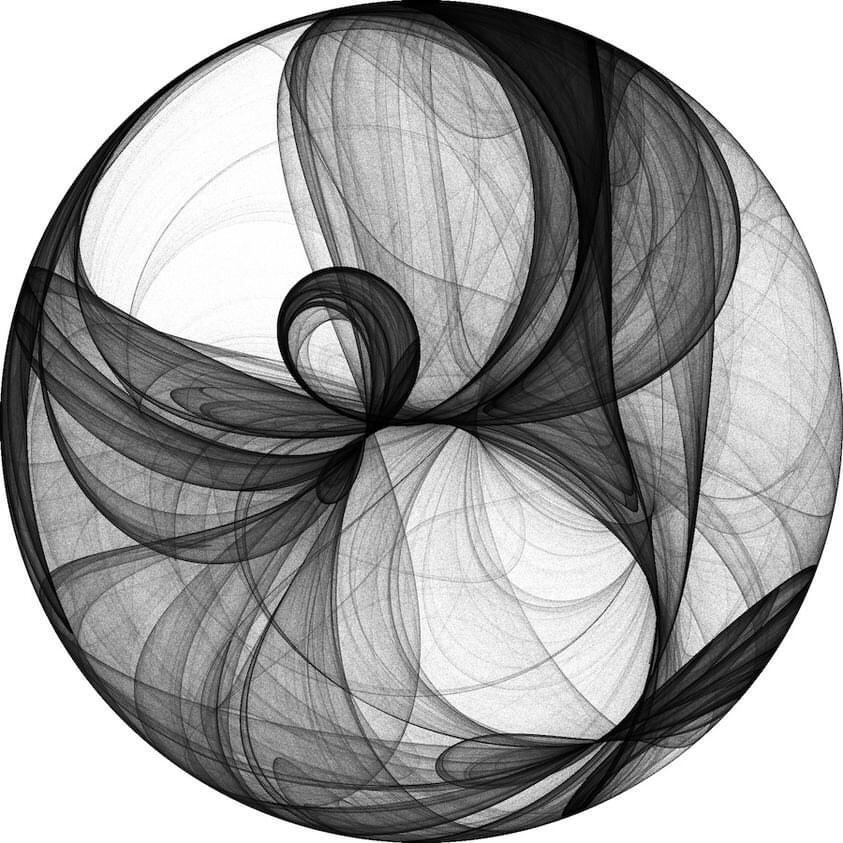
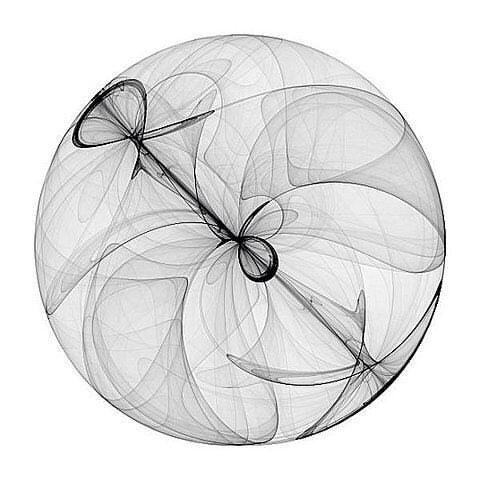
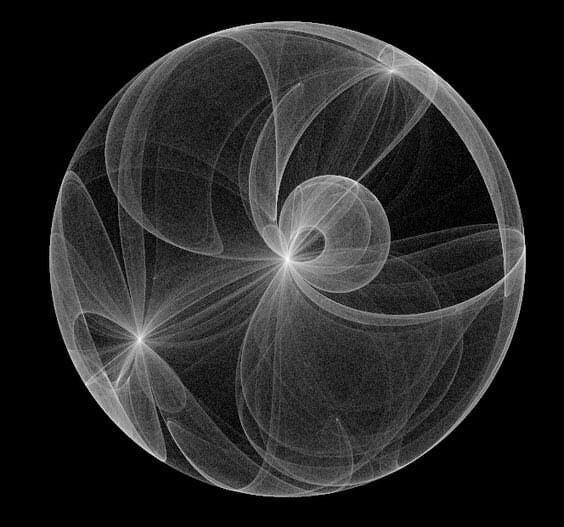
Strange attractors are dynamical systems that exhibit a set of states towards which the system converges that exhibits a fractal structure. Because most of them rely on chaotic dynamics, they display fascinating properties. Two points, no matter how arbitrarily close they originally are, will become arbitrarily far apart after enough iterations. Counter-intuitively, a global macroscopic structure that confines the attractor will also emerge from these same dynamics.
This vision is very intuitive to me. As a human, my intellect (quite under-developed compared to the one described above) allows me to capture the mechanics between some causes and effects. If, for example, I press a light switch, I can guess pretty accurately what its future position will be. In other cases, the causes are unobservable, or too multiple for me, making any prediction on the effect unsurmontable; typically, I cannot predict the outcome of throwing a die.
This makes the definition of probability theory very empowering, and motivated me to study it in my Masters degree. With probabilies, we can seemingly overcome our causal blindness and learn directly about the world from the observed effects. In the case of the previous example, the assumption of a balanced die instruct us that the outcomes of a throw are equiprobable. This in turns allows us to infer properties about the effects that we might observe. We know for example that obtaining 5 times the same outcome in a row is very unlikely.
This hope for understanding the occurence of effects, despite our complete knowledge of causes is nevertheless hindered by chaotic dynamical systems.
This vision is very intuitive to me. As a human, my intellect (quite under-developed compared to the one described above) allows me to capture the mechanics between some causes and effects. If, for example, I press a light switch, I can guess pretty accurately what its future position will be. In other cases, the causes are unobservable, or too multiple for me, making any prediction on the effect unsurmontable; typically, I cannot predict the outcome of throwing a die.
In the early XIXe century, in its seminal essay Essai philosophique sur les probabilités, French mathematician Pierre-Simon de Laplace laid the foundation of probabilities as the theory for capturing the universe’s dynamics conditioned on our own inability to observe all of its machinery.
He envisioned that an intellect, that could at any moment know all the physical properties of every component of the universe, and all forces that apply to them, could predict perfectly both the future and past evolution of the universe. Recognising the inaccessibility of such knowledge in practice, he thereupon suggested to use probabilities to generate informed guesses on the occurence of future effects. This strongly ties his intuition to hard determinism, or linear causality; ∀e,∃C,e=f(C)
, with e
an effect and C
a set of causes.

I'm very new here and I don't understand much, but I'm following many users, I think it's the only way to grow.