
Demystifying the USB Type-C connector: A talk from EMF 2022 by Tyler Ward
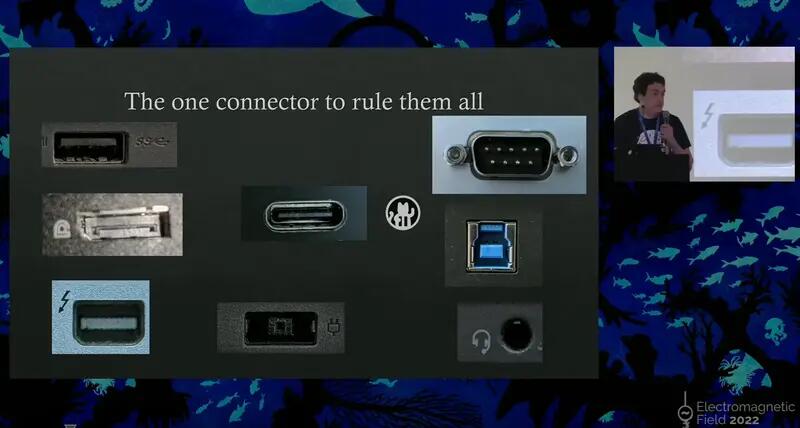
The USB type-C connector has become the universal connector for modern devices. It is able to transmit USB, video, power, and more, often doing several of these at the same time. All, while maintaining backwards compatibility with older hardware using relatively simple adapters.
This talk by Tyler Ward explores the methods used to make this possible and the consequences of not following the spec (e.g. Invalid charging cables, or the issues on the Raspberry Pi type 4). Some basic electronics knowledge will be beneficial to understand everything in the talk, but definitely not essential. For those looking to start using the connector in their own projects, the talk will give the knowledge to do so.
See https://www.emfcamp.org/schedule/2022/324-demystifying-the-usb-type-c-connector
#technology #USB-C
How to install an M.2 SSD in a PC: A SATA SSD drive is not your only option

The best thing about installing an M.2 SSD is that it doesn't demand a lot of space inside the PC case or requires any cables for connection. These SSD modules are small enough to be installed directly on the motherboard itself, and it only takes a few minutes to secure one of them in place. In fact, you can install an M.2 SSD very easily even on PCs that are already assembled. Installing an M.2 SSD is usually quite simple, even in a PC that's already been assembled.
Don't just default to buying an SSD drive that connects with a SATA cable. It is worth considering your options. But be aware that you may have to choose between using either some SATA connectors or a M.2 SSD connector. I've seen on one of my boards it mentioned that if I used one of the M.2 SSD connectors, then I'd forfeit, I think, two SATA connectors.
See https://www.xda-developers.com/how-to-install-m2-ssd/
#technology #SSD #harddrives
Open source CockroachDB tempts legacy databases to crawl into the cloud age

CockroachDB is a distributed SQL database built on a transactional and strongly-consistent key-value store. It scales horizontally; survives disk, machine, rack, and even datacenter failures with minimal latency disruption and no manual intervention; supports strongly-consistent ACID transactions; and provides a familiar SQL API for structuring, manipulating, and querying data. CockroachDB is wire-compatible with PostgreSQL.
CockroachDB has released its 23.2 iteration containing new features designed to tempt mainframe and other legacy database users to shift workloads to its distributed cloud-based system.
In the new release, the database-as-a-service company, whose customers include Comcast, audio company Bose, and cosmetics firm Lush, said it had rebuilt stored procedures to be significantly more powerful.
See https://www.theregister.com/2024/01/29/cockroachdb_23_2/
#technology #databases #opensource

It's similar innovations as to when we learnt to write letters, use telephones, etc - all innovative ways of interacting without having to walk to visit someone.

Certainly not from a supplier/business perspective. I don't think they know what it is - they know PDF and password protected PDF.
There is a real need for encrypted e-mails but instead we have lots of encrypted PDF attachments

More and more of my accounts are all arriving now with password encrypted PDFs. It's good that an open standard is being used, but the passwords are really getting complicated as some use my ID number, one uses my bond account number, and some others again use their own unique account numbers. Apart from my ID number, the others I have no easy way of remembering, so it means constantly having to look up what the password is for that particular PDF. This gets worse if you are travelling. Also, it means that when saving the PDF to my computer I want it decrypted for ease of access and searching, so it is another step to print to PDF, for that to happen.
Given that the whole point of this is the protection of private information (in South Africa, the POPI Act) this could have been seamlessly achieved with proper encrypted e-mail being used. That would have been a once-off trust to set up, and after that it just works seamlessly and securely.
But, clearly, encrypted e-mail is just way beyond the ordinary business or user... They have been so geared up for using PDF attachments, so now encrypting the PDF was the only easy way to go. I get that encrypted e-mail is a bit of an initial learning curve (unless you use Proton Mail or similar easy to use encrypted e-mail). But think about where all this encrypted PDF stuff is going in the future, and the fact that the rest of the e-mail content is wide open and unencrypted.
Have you ever tried responding to one of the businesses by sending your encrypted PDF form back to them (as it should be)? They don't then always know how to open it on their side, so you need to e-mail the password to them, which defeats the whole exercise.
The other folly I've picked up just today, is I log into a secure portal to download the PDFs that are online in my account, but those are also encrypted with a password! Even my bank has the PDFs unencrypted on the portal, as you've just logged in with a password and 2FA to access the PDF statement.
It's getting messier, and I really do think we should be making the effort in 2024 to move to proper encrypted e-mail. But the reality of it is, that needs every business and every end user to actually be able to use encrypted e-mail. But that would mean also that Microsoft, Google, Apple, the NSA, and other middle-people would not be able to search or read any of those e-mails any more. That is not in Big Tech or Government's own interests.
The realist in me says this is just really not going to happen any time soon. We have the technology, but we'll have to move at the snail's pace of the lowest common denominator in the chain, in order to get there.
#technology #privacy #encryption #PDF #email
LibrePhotos - a self-hosted open-source photo management service

Unlike commercial service that store your photos in the cloud and scan/index them to train their machine learning models and collect ad targeting data on you, LibrePhotos keeps all your photos and metadata on your local machine. Your data is never sent to or stored on a 3rd party server. Get the same power as those commercial services without giving up your personal data and privacy.
In this video I contrast this service with Immich and Piwigo, looking at some of the features as well as potential shortcomings, before touring through the interface and the available menu settings.
Watch at https://youtu.be/OR9woMt5fHQ
#technology #librephotos #opensource
How to set up a VPN on your home router

Choosing a secure VPN app for your Android phone or tablet is a great way to enhance your security and privacy on that device. However, setting up a VPN on your router protects every device connected to the router's network. This is an efficient way of protecting devices that don't leave the house, like your smart TV or desktop computer.
I do have to disagree with most of the Cons presented in this article though, as the encryption on your local network is not such a major issue, it is not that difficult to configure (and you do it once), and the difficulty point is actually duplicated.
Regarding routers that don't support VPNs it is also well worth seeing if there is third party firmware for your existing router that will provide this functionality. For example, on my Asus router I have Asuswrt-Merlin firmware installed which provides lots of extra functionality including easy to activate VPN services for client or server functionality.
See https://www.androidpolice.com/how-to-set-up-vpn-on-your-router/
#technology #VPN #privacy
Beware selling your unused 'free' Rain 5G router in South Africa

Many of these 'free' routers are often 'free to use' not 'free to keep'. I found this out when I cancelled my fixed LTE contract with Telkom. Luckily I'd given away my router to a friend, but I had to go fetch it, or else pay the 'inflated' cost back to Telkom.
It's not always the case though with other ISPs, but it is best to check first, and especially so if you cancel a contract before its mandatory period has expired.
This is also why you want to be careful of ISPs who want to tie you into a 2-year contract. You pay penalties if you cancel before that period has passed.
See https://mybroadband.co.za/news/hardware/522765-beware-selling-your-unused-rain-5g-router.html
#technology #SouthAfrica
Mobile phone USSD shortcodes to know for South Africa’s mobile networks

The Unstructured Supplementary Service Data (USSD) is a Global System for Mobile (GSM) protocol that has been around since 1997.
It allows users to enter a combination of numbers, asterisks, and hashes in their regular dialling app to execute various actions on their mobile network account.
Although GSM, which includes 2G and 3G technologies, is set to be shut down over the next few years, USSD can be supported on LTE and 5G.
If you know the shortcodes your mobile operator uses for the various services, then USSD is often the fastest option for managing your cellular plan.
It also does not require an Internet connection or consume mobile data. When you’ve run out of airtime or data, the right USSD code can be a lifesaver.
Some are really useful, like being able to send a "please call me back" message, or sending airtime to another user, or requesting airtime from another user.
#technology #SouthAfrica #USSD
Apple iOS 17.3: You need to Turn on iPhone's New Stolen Device Protection

Apple today launched a new tool for iPhones to help reduce what a thief with your phone and passcode can access. The feature, called Stolen Device Protection, adds extra layers of protection to your iPhone when someone tries to access or change sensitive settings on your device. If someone tries to access passwords stored in Apple’s keychain, for instance, they won’t be able to unless they also use a fingerprint or the phone’s face recognition to prove they’re the legitimate owner.
When you turn on Stolen Device Protection, Apple puts extra limits on some settings when your iPhone isn’t at a familiar location, such as your home or work. If someone unlocks your phone and tries to change these settings, they’ll have to use Face ID or Touch ID.
I'm not too sure why this is not the default, actually? Samsung seems to have long taken the reverse stance in that it will prompt for additional verification, unless you've activated some safe settings such as your home location, on body detection, etc.
But it is worth Apple iOS users knowing they should activate this.
See https://www.wired.com/story/apple-ios-17-3-iphone-stolen-device-protection/
#technology #Apple #theft
Withings BeamO is an all-in-one thermometer, ECG and stethoscope costing US$250

The device is still waiting for US FDA approval, but is planned to be shipped from June 2024.
Dubbed a “multiscope,” the $250 device will tell you how warm (or not) you’re feeling, measure your blood oxygenation, run a one-lead ECG and even act as a digital stethoscope. Put this to your chest, and you can listen to the sounds your chest is making, or send the file to your physician for further analysis.
I have to say that compared to Fitbit (bought out by Google), Withings does appear to be innovating on the smartwatch, smart scale, and other health devices on a regular basis.
So, it will be interesting to see what the testing shows once the various reviewers have had a chance to test this device. There is nothing groundbreaking per se, but it is a compact and convenient device, and it is always useful to be able to have automated readings over time to determine trends.
The big question will be whether it has any relevancy as a telemedicine device. It could help doctors for the evaluation of conditions such as asthma or COPD. But their website does state that the BeamO has not been clinically/medically validated yet. The plan is to clinically validate the device and obtain CE marking and FDA clearance to bring BeamO to market as a medical device.
#technology #health #Withings
South Africans were the most addicted to screen time per person than any other country in 2023

Smartick gathered data from DataReportal.com on digital behaviour to put together maps showing who's the most online.
South Africa spends the most time on desktop and mobile, averaging nearly 10 hours a day per internet user. Brazil, Philippines, Argentina and Colombia also average more than nine hours a day. South Africa also wins the award for most internet usage via a computer, with almost 4.5 hours per day. Russia, Brazil, Argentina and Colombia were also quite close to the four-hour mark.
I dug through the DataReportal website to try to find out why this is. This specific dataset is sourced from GWI, but DataReportal does not go into the actual specifics of the "why"., except to state: "this may suggest that users in lower- and middle-income countries (LMICs) have increased the amount of time that they spend online, even as users in more developed economies reduce their online activity". They also go on to say: "the median age of the population is also a key factor. Overall, average daily internet time tends to decrease with age, which may explain why Japan sits at the bottom end of this ranking".
The median age of South Africa's population is 27.5 years old. One interesting statistic in South Africa is that the unemployment rate is just under 40%, and if I remember correctly, for the youth it is around 60%. But there is no evidence presented that this has any correlation with Internet usage.
Social media usage shows the highest numbers of South Africans on Facebook (22.15 million but has decreased by 8.5%), YouTube (25.8 million), and TikTok (11.83 million which is a massive 83% increase). LinkedIn is also well represented with 11.00 million users, but Twitter is as low as 3.65 million users (65% skewed towards males, although the Twitter data seems to vary quite a bit).
South African Instagram's users are now at 5.65 million, but is a 9.9% decline in numbers. Snapchat users have also declined by 6.4% to now show 5.85 million South Africans.
So, it does look like users are using Facebook a bit less, and using YouTube and TikTok a lot more. Would this mean that this is where South African Internet users are spending their time?
Bearing in mind that 2024 is going to be an interesting election year in South Africa, the release of the ad reach per platform is quite topical (as it is for other countries with elections in 2024).
A last thought of mine is, so, what happens when most users have veered off onto decentralised social media platforms that do not make a point of gathering and reporting on all this user data? It's going to be a whole new, intriguing challenge to reach populations in 5 to 10 years' time.
#technology #onlineaddition #SouthAfrica
Like Chrome's 'Incognito' mode iCloud Private Relay doesn't work the way you think it does

Google's Chrome web browser is set to warn users that private browsing does not prevent them from being tracked. Many users were under the impression that 'incognito' meant no tracking.
Similarly, many Apple users think that Private Relay is some sort of private VPN service.
However, some core differences exist between regular VPN services and Apple's solution. While they share a couple of aspects, they cater to different types of customers and use cases. iCloud Private Relay is a basic VPN that only works in Safari, so it won't protect you in other apps or browsers.
A regular VPN offers broader support and finer controls, allowing you to choose server locations and bypass regional restrictions. If you only use Safari and are only concerned about web activity, iCloud Private Relay is fine. Otherwise, get a VPN app for broader protection.
I suppose both Google and Apple are aware that most users take the PR wording very much as face value, that users usually think private actually means private. We've actually seen this so many times also with other providers talking about end-to-end-encryption, except that it excludes the server in the middle.
One could almost forgive marketing people for wanting to up-sell the attractiveness of the offering, and stuffing in all the current buzzwords (next thing it will be AI-driven privacy), except that these are actually technology companies, and they should know better.
See https://www.xda-developers.com/icloud-private-relay-doesnt-work-way-you-think/
#technology #privacy

Those Feathers are quite a bit more expensive, but you should really try buying a sample pack as you may be surprised to find one or two alternative blades that work really well for you. But if the grocery store ones work well enough, that is good.
My Edwin Jagger DE89 shaves great, but I did find the original handle could be a bit slippery. The iKon handle has been for a solid grip, and looks like it will last forever as it is solid stainless steel without any coatings.
Tired of Gillette Razor blades costing US$3.58 each then try Safety Razor Blades costing only US$0.08 Each

There's a lot more to traditional wet shaving than just price, but for many, price is the big deciding factor. Safety razor blades work out to being 44x cheaper than Gillette Fusion5 blades (both as bulk buy items).
It's true that a quality safety razor is going to set you back about US$45 for Merkur 34C, and a bit more if you want to buy say an Edwin Jagger DE89 and fit that with an iKon solid stainless-steel knurled handle. But these razors are going to last you a lifetime. For example, my father's Gillette Fatboy razor which he used in the mid-1960's, still works perfectly well today, 65 years later.
Safety razors come in an unlimited variety of types and styles to express any individual whim. I've found the Edwin Jagger DE89 heads to be quite good, and they will accommodate a number of different handles with the standard screw thread.
A key takeaway, though, too, is that there is a unique combination of skin type vs razor vs blade. So, the aggressiveness of the razor head needs to be paired with a blade that suites your skin type. It may sound daunting, but a Merkur 34C is a fairly mild razor, whilst the Edwin Jagger DE89 is a more medium aggressive razor. Blades such as the Feather brand are quite sharp (read less forgiving) than say the Astra Platinum which are smoother. If you can get one, it is well worth buying a sample pack of blades to try out with your razor, as you'll be surprised to find that they will all give a slightly different shave.
See my webpage at https://gadgeteer.co.za/myotherinterests/traditional-wet-shaving/
#traditionalwetshaving #savings #shaving
It's not like the dollar is backed by gold any more... it has in effect been digital for a long time.
It is a safety razor but one of the very super cheapies. I bought one like this, made by Bic, and it gave a bit of a rough shave. My first experience of safety razor shaving was a bit spoilt by this.
A really good starter safety razor is something like the Merkur 34C - it is a quality razor that is not aggressive.
One also wants to try use reasonably good blades as well - and many suggest getting a starter/sample pack of different blades to try, as they all shave differently according to the razor and your own skin.
But have a look at my webpage at https://gadgeteer.co.za/myotherinterests/traditional-wet-shaving/ that I did about traditional wet shaving and some lessons and tips I've learnt.
This ‘digital twin’ of the planet could rival Google Earth — here’s how you can try it: Google needs Competition

French startup Kermap has developed a ‘digital twin’ of the Earth that claims to offer the most up-to-date views of our home planet.
The programme is called Nimbo Earth Online and it is the only platform providing new satellite views of the world every month, without clouds. Google Earth refreshes its imagery every several months to years, depending on location.
There’s one caveat though: Nimbo offers a resolution of only 10 metres per pixel. This is far less precise than what is offered by Google Earth.
But then Google Earth has really not been moving forward in leaps and bounds for the last few years. I wanted to find a specific location a few months ago, which contained a shooting range. The problem I had with Google Earth was that more than one of the recent images had cloud concealing that area. Going back in time, went too far back. Nimbo is using AI to remove the clouds. So maybe there is something with this AI-powered mapping.
Nimbo also includes a split & swipe function, which allows you to compare before and after images in one single view.
Although Nimbo states a resolution of 10 m per pixel, the interface has an HD button which says it is coming soon. So, it looks like that will improve.
But this does go to show that Google needs competition in order for them to improve. Google could have already been doing some of this AI-powered mapping if they'd felt the need to.
See https://thenextweb.com/news/digital-twin-rival-google-earth-nimbo
#technology #mapping #AI
No Surprise: Each Facebook User is Monitored by Thousands of Companies

By now most internet users know their online activity is constantly tracked. No one should be shocked to see ads for items they previously searched for, or to be asked if their data can be shared with an unknown number of “partners.”
Using a panel of 709 volunteers who shared archives of their Facebook data, Consumer Reports found that a total of 186,892 companies sent data about them to the social network. On average, each participant in the study had their data sent to Facebook by 2,230 companies. That number varied significantly, with some panelists’ data listing over 7,000 companies providing their data.
The study was able to examine a form of tracking that is normally hidden: so-called “server-to-server” tracking, in which personal data goes from a company’s servers to Meta’s servers.
One company appeared in 96% of participants’ data: the San Francisco-based data broker LiveRamp.
“This type of tracking which occurs entirely outside of the user’s view is just so far outside of what people expect when they use the internet,” Caitriona Fitzgerald, Deputy Director of the Electronic Privacy Information Center, told The Markup in an interview. Fitzgerald said that while users are likely aware that Meta knows what they are doing while they are on Facebook and Instagram, “they don’t expect Meta to know what stores they walk into or what news articles they’re reading or every site they visit online.”
The very sad part about this is, the data being sourced (and where it comes from) has little to nothing to do with Facebook. This is just Facebook buying data for it to create more comprehensive profiles and context about its users. It's also pretty certain that none of these users expected this data to find its way back to Facebook, as it is 3rd parties actually collecting the data and passing t on to Facebook.
How this is still legal in 2024, with all the privacy protections and laws that many countries have in place, is also quite a mystery.
Interestingly, Google is not in the top 10 of companies found passing data to Facebook. But this could also be because Google itself does not really sell user data to others. They collate data more for advertiser effectiveness (reach), and various ads are embedded by 3rd party app developers in their free apps on Google platforms.
#technology #Facebook #privacy #tracking