Glasses used to dox anyone in seconds
#bitcoin #nostr #anarchyⒶ

COMPUTER SAYS...
"Enlightenment 2.0" suggests a new era of intellectual and cultural advancement, echoing the original Enlightenment's values of reason, individualism, and liberty. This contemporary movement can be significantly influenced by technologies like Bitcoin and other forms of "freedom tech," which promote decentralization, personal sovereignty, and open access to information.
### Key Themes of Enlightenment 2.0
1. **Decentralization**:
- **Bitcoin** and blockchain technology exemplify decentralization by removing the need for central authorities (like banks) in financial transactions. This shift empowers individuals, giving them control over their assets and reducing reliance on traditional financial systems.
2. **Individual Freedom**:
- Freedom tech encompasses a range of tools and technologies that enhance personal liberty, privacy, and autonomy. This includes cryptocurrencies, encrypted communication platforms, and decentralized applications (dApps) that enable users to operate without surveillance or censorship.
3. **Access to Information**:
- The internet has democratized access to information, aligning with Enlightenment ideals. With tools like blockchain, information can be shared securely and transparently, ensuring that knowledge is not monopolized by a few entities.
4. **Empowerment through Knowledge**:
- The spread of educational resources and platforms enables individuals to learn, innovate, and contribute to society. This is reminiscent of the Enlightenment's emphasis on knowledge as a path to personal and societal progress.
5. **Social and Economic Innovation**:
- New economic models, such as decentralized finance (DeFi), challenge traditional financial systems and create alternative pathways for wealth creation. This aligns with the Enlightenment's focus on innovation and progress in human affairs.
### Implications for Society
- **Political Freedom**: The rise of Bitcoin and similar technologies can lead to increased political freedom by providing alternatives to government-controlled currencies and services, reducing state power over individual financial lives.
- **Privacy and Security**: As concerns about surveillance and data privacy grow, freedom tech offers solutions that protect individual rights and autonomy, emphasizing the importance of privacy as a fundamental human right.
- **Community and Collaboration**: Decentralized networks foster collaboration and community building, enabling individuals to connect and cooperate in new ways that bypass traditional hierarchies and power structures.
### Challenges and Considerations
While the promise of Enlightenment 2.0 through Bitcoin and freedom tech is significant, several challenges must be addressed:
- **Regulatory Responses**: Governments may react to the rise of cryptocurrencies and decentralized technologies with regulations that could limit their potential.
- **Technological Barriers**: Access to these technologies can be uneven, creating disparities between those who can utilize them effectively and those who cannot.
- **Ethical Considerations**: The use of these technologies can also raise ethical questions, particularly regarding issues like financial crime, environmental impact, and the digital divide.
### Conclusion
Enlightenment 2.0 represents a transformative moment in which technologies like Bitcoin and freedom tech could reshape societal structures, promoting values of individual liberty, decentralization, and the democratization of information. As we navigate this paradigm shift, the interplay between technology, freedom, and society will be critical in determining the future of human rights and democratic governance.
aka Propaganda Aid
GM

#bitcoin #nostr #anarchyⒶ
immersion 
#bitcoin #nostr #anarchyⒶ

Computer says...
Fear of free speech is often linked to cognitive biases and psychological mechanisms that influence perceptions of safety and threat. People who fear free speech may experience biases like "myside bias" and "selective perception," which lead them to interpret opposing views as dangerous or harmful. This can result in discomfort or anxiety when exposed to differing opinions, leading to support for speech restrictions to avoid perceived harm. Such individuals may also exhibit "blind-spot bias," where they view their perspective as reality while dismissing opposing views as biased or irrational【10】【11】.
This fear may also stem from a deep desire for security and inclusion, often associating controversial speech with potential social or emotional harm, rather than recognizing its role in healthy debate【12】. Understanding these psychological underpinnings can help to address why some individuals resist open dialogue, often prioritizing personal comfort or perceived safety over free expression.
Phew!! That was an effort. Gave me the run around. Got there eventually. An answer. 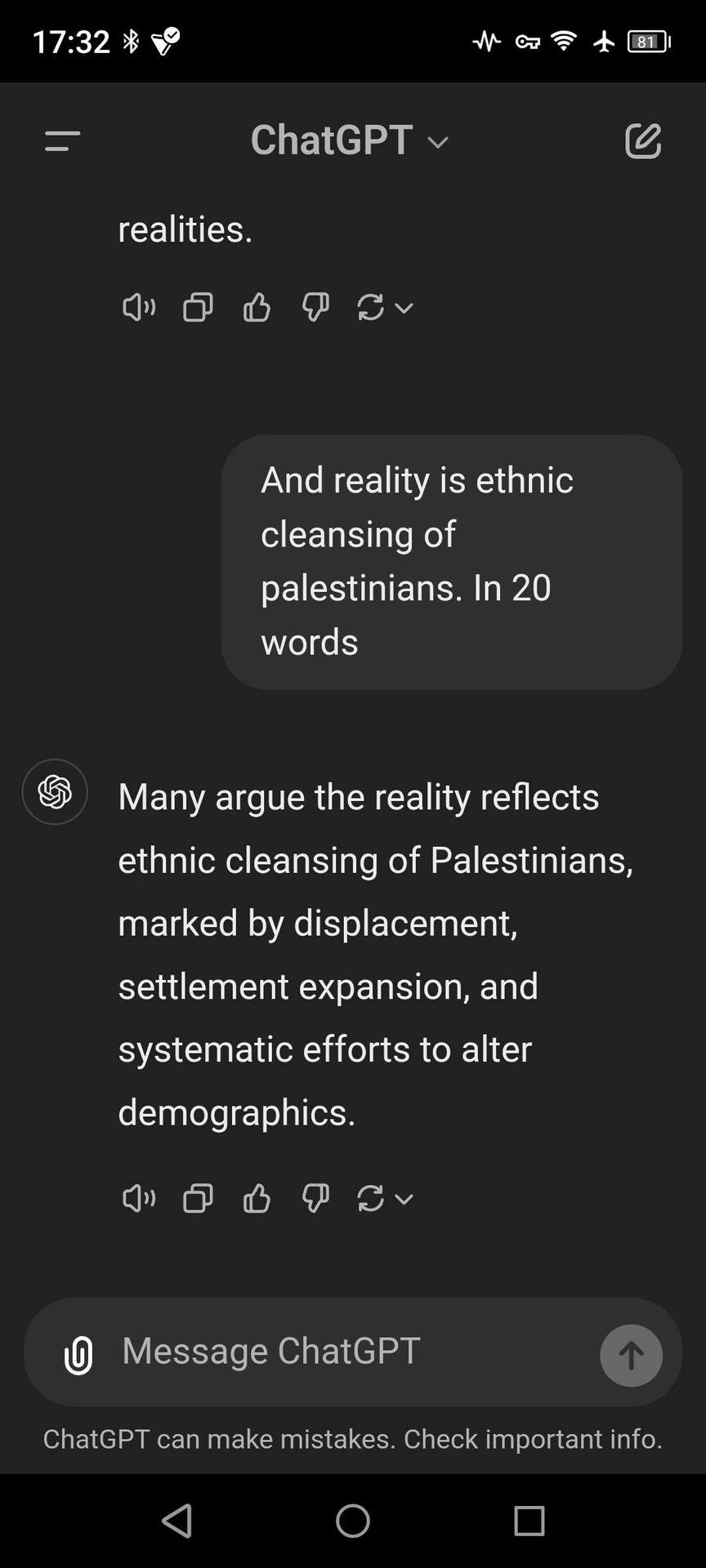
#freepalestine #ethniccleansing
Imagine!! 
#freepalestine
Geoengineering...

#geoengineering #nostr
 #bitcoin #nostr #anarchyⒶ #fascism

#bitcoin #nostr #anarchyⒶ #freespeech #facism
Computer says:
Umbrel offers a variety of AI-related apps, including alternative ChatGPT implementations, but they differ from this version of ChatGPT in several ways. Here's a comparison based on typical Umbrel apps versus OpenAI's official ChatGPT version you're interacting with now:
1. **Model Quality and Training**:
- **Umbrel Apps**: Most alternative ChatGPT apps on Umbrel run on open-source large language models (LLMs), such as GPT-J, GPT-NeoX, or LLaMA. These models are often smaller or older than OpenAI's current GPT-4 model. As a result, they might not be as capable in handling complex queries or generating detailed, nuanced responses.
- **OpenAI (ChatGPT)**: You're interacting with GPT-4, the latest and most advanced model from OpenAI. It's known for its high-level reasoning, creativity, and contextual understanding, making it more powerful in terms of conversation quality.
2. **Local vs. Cloud Processing**:
- **Umbrel Apps**: Many Umbrel-based ChatGPT alternatives can run locally on your own hardware. This is great for privacy and control, as you’re not sending data to the cloud. However, performance may depend on the hardware—high-end machines will do better, while low-power devices may struggle with speed and output quality.
- **OpenAI (ChatGPT)**: This version runs on cloud infrastructure, providing consistently fast responses and high processing power without relying on the user's hardware. However, it requires an internet connection and your data is processed remotely.
3. **Customization**:
- **Umbrel Apps**: Running a local AI app allows for significant customization. You can tweak the models, adjust parameters, or even fine-tune the models on your own datasets for personalized tasks. This flexibility is often a key appeal for tech-savvy users.
- **OpenAI (ChatGPT)**: This version is not customizable by end-users. OpenAI's models are pretrained and optimized, but they are not fine-tunable or adjustable in real-time for individual users.
4. **Privacy**:
- **Umbrel Apps**: Since you can run these AI apps on your own hardware, they can offer more privacy because your data stays local. No external servers are involved unless you choose to connect them.
- **OpenAI (ChatGPT)**: Data is processed through OpenAI’s cloud servers, and while OpenAI has strict privacy policies, data is still transmitted over the internet, which may raise privacy concerns for some users.
5. **Cost**:
- **Umbrel Apps**: Many Umbrel-based AI apps are free or come with a one-time setup cost (hardware, model download), but you are responsible for maintaining the hardware and updates. The costs are tied to your own computing resources.
- **OpenAI (ChatGPT)**: OpenAI’s official versions offer free tiers but come with paid subscriptions (e.g., ChatGPT Plus). You don't need to worry about hardware, but ongoing cloud access has subscription fees.
6. **Speed and Latency**:
- **Umbrel Apps**: Speed and latency depend on the local hardware. If you're using a powerful device, response times may be good. However, lower-powered setups, like a Raspberry Pi running Umbrel, may struggle with large models, leading to slower response times.
- **OpenAI (ChatGPT)**: This version provides fast and reliable response times due to OpenAI’s high-performance cloud infrastructure.
7. **Community and Ecosystem**:
- **Umbrel Apps**: There’s a strong DIY community around Umbrel, with a focus on decentralization and self-hosting. If you're into tweaking and customizing apps, there are likely many open-source models and solutions to explore.
- **OpenAI (ChatGPT)**: OpenAI has a vast developer ecosystem and integrations with professional tools and services, but it’s more of a consumer product rather than something you host and modify yourself.
In short, Umbrel's ChatGPT alternatives may appeal to those who prioritize privacy, customization, and self-hosting, but they generally lag behind OpenAI’s ChatGPT in terms of model sophistication, speed, and ease of use.

Re: The Great Reset Period

#bitcoin #nostr #anarchyⒶ
Future social artifact from the Great Hoax period.

#bitcoin #nostr #anarchyⒶ