
The control of the production of wealth is the control of human life itself.
- Hilaire Belloc
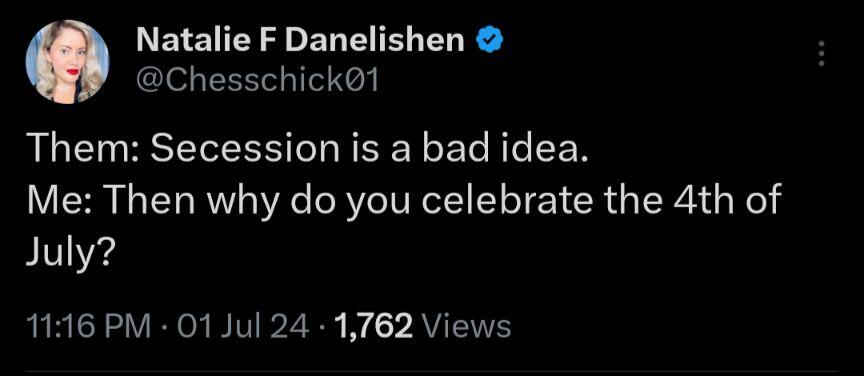
Love peace more than you love force, conflict, compulsion, and intolerance. Work toward a society in which individuals choose to do right because they want to, not because they’re forced to.
— Lawrence W. Reed
The point which is so important is the basic fact that it is impossible for any man to survey more than a limited field, to be aware of the urgency of more than a limited number of needs. Whether his interests center round his own physical needs, or whether he takes a warm interest in the welfare of every human being he knows, the ends about which he can be concerned will always be only an infinitesimal fraction of the needs of all men.
This is the fundamental fact on which the whole philosophy of individualism is based. It does not assume, as is often asserted, that man is egoistic or selfish or ought to be. It merely starts from the indisputable fact that the limits of our powers of imagination make it impossible to include in our scale of values more than a sector of the needs of the whole society, and that, since, strictly speaking, scales of value can exist only in individual minds, nothing but partial scales of values exist--scales which are inevitably different and often inconsistent with each other. From this the individualist concludes that the individuals should be allowed, within defined limits, to follow their own values and preferences rather than somebody else's; that within these spheres the individual's system of ends should be supreme and not subject to any dictation by others. It is this recognition of the individual as the ultimate judge of his ends, the belief that as far as possible his own views ought to govern his actions, that forms the essence of the individualist position.
- F.A. Hayek
It is no exaggeration to say that if we had had to rely on conscious central planning for the growth of our industrial system, it would never have reached the degree of differentiation, complexity, and flexibility it has attained. Compared with this method of solving the economic problem by means of decentralization plus automatic coordination, the more obvious method of central direction is incredibly clumsy, primitive, and limited in scope. That the division of labor has reached the extent which makes modern civilization possible we owe to the fact that it did not have to be consciously created but that man tumbled on a method by which the division of labor could be extended far beyond the limits within which it could have been planned. Any further growth of its complexity, therefore, far from making central direction more necessary, makes it more important than ever that we should use a technique which does not depend on conscious control.
- F.A. Hayek
The first lesson of economics is scarcity: There is never enough of anything to satisfy all those who want it. The first lesson of politics is to disregard the first lesson of economics.
- Thomas Sowell

Much of the secret of life consists in knowing how to laugh, and also how to breathe.
- Alan Watts
Debate Recap: The Funeral of Joe Biden

The inflation was so intense that people began to celebrate the soaring stock market, seeing it as a sign of prosperity rather than a symptom of economic collapse.


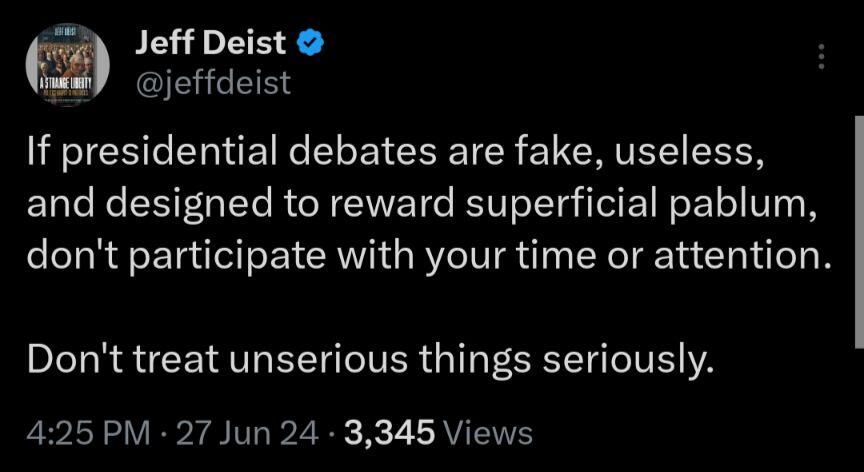
The generation to which we belong is now learning from experience what happens when men retreat from freedom to a coercive organization of their affairs. Though they promise themselves a more abundant life, they must in practice renounce it; as the organized direction increases, the variety of ends must give way to uniformity. That is the nemesis of the planned society and the authoritarian principle in human affairs.
- Walter Lippmann
What has always made the state a hell on earth has been precisely that man has tried to make it his heaven.
- Hölderlin
Live your life as though politics is but a corner of it, not consumed by it. Recognize the incalculable value of intact families, vibrant and voluntary associations, community engagement, loving relationships, and institutions created and sustained outside the divisive realm of politics.
https://fee.org/articles/16-things-individuals-can-do-to-help-bring-america-together/
When the course of civilization takes an unexpected turn—when, instead of the continuous progress which we have come to expect, we find ourselves threatened by evils associated by us with past ages of barbarism—we naturally blame anything but ourselves. Have we not all striven according to our best lights, and have not many of our finest minds incessantly worked to make this a better world? Have not all our efforts and hopes been directed toward greater freedom, justice, and prosperity? If the outcome is so different from our aims— if, instead of freedom and prosperity, bondage and misery stare us in the face—is it not clear that sinister forces must have foiled our intentions, that we are the victims of some evil power which must be conquered before we can resume the road to better things? However much we may differ when we name the culprit—whether it is the wicked capitalist or the vicious spirit of a particular nation, the stupidity of our elders, or a social system not yet, although we have struggled against it for half a century, fully overthrown—we all are, or at last were until recently, certain of one thing: that the leading ideas which during the last generation have become common to most people of good will and have determined the major changes in our social life cannot have been wrong. We are ready to accept almost any explanation of the present crisis of our civilization except one: that the present state of the world may be the result of genuine error on our own part and that the pursuit of some of our most cherished ideals has apparently produced results utterly different from those which we expected.
- F.A. Hayek
Yet, though the road be long, it is one on which it becomes more difficult to turn back as one advances. If in the long run we are the makers of our own fate, in the short run we are the captives of the ideas we have created. Only if we recognize the danger in time can we hope to avert it.
Contemporary events differ from history in that we do not know the results they will produce. Looking back, we can assess the significance of past occurrences and trace the consequences they have brought in their train. But while history runs its course, it is not history to us. It leads us into an unknown land, and but rarely can we get a glimpse of what lies ahead. It would be different if it were given to us to live a second time through the same events with all the knowledge of what we have seen before. How different would things appear to us; how important and often alarming would changes seem that we now scarcely notice! It is probably fortunate that man can never have this experience and knows of no laws which history must obey.
Yet, although history never quite repeats itself, and just because no development is inevitable, we can in a measure learn from the past to avoid a repetition of the same process. One need not be a prophet to be aware of impending dangers. An accidental combination of experience and interest will often reveal events to one man under aspects which few yet see.
- F.A. Hayek
The Total State, why myths have a very strong influence on people’s faith in government, and how humans inherently need to surround ourselves with those that share a similar world view.