
Here’s the advantages of Rust over Markdown:
1. Memory safety for your text
2. Type safety for your content
3. Concurrency for rendering
4. Crates for extensibility
5. Compile-time guarantees
6. Rustacean credibility
7. Ownership of formatting
Applying Rust’s principles to text processing and documentation could address many of Markdown’s shortcomings, such as type safety, ambiguous syntax, and limited extensibility.
By leveraging Rust’s strengths, documentation systems could become more robust efficient, and reliable.
This is why all README files should be written, by hand, in Rust. 😉
Why doesn’t Epic Games rebuild Unreal Engine in Rust?
I’ve become, for better or worse, a collector.
At this point, I own tens of thousands of video games. Thankfully, most of them are digital, not physical, but still—yeah, it’s a lot. I wish I could say it’s just “stuff,” but all of it means something to me. Each game ties to a specific memory or moment in my life.
The same goes for music. I have thousands of songs, most stored on my digital audio player, but I also collect physical media—vinyl, cassettes, and CDs. I probably own at least a thousand of those.
Then there’s the hardware. I have way too much of it. Laptops I should get rid of, a desktop tower sitting in the basement collecting dust, and even an all-in-one touchscreen unit that’s practically useless.
And yet, I hold on to my consoles—they’re untouchable. As a kid, I dreamed of owning an NES, but my mom wouldn’t let me. Now that I finally have one, there’s no way I’m letting it go.
And it’s not just games and gadgets. I have CRT TVs, VHS tapes, tablets, books—so many books—and paintings. Yes, I even collect paintings. Some of it has deep personal meaning, while other things… well, why do I still own an old second-gen Echo Dot? I have no idea. It just exists.
I’m not a hoarder, though. I can throw out trash, and I do. In fact, getting rid of things feels amazing. When I let go of something, it’s like reclaiming space—physical and mental. But as I get older, it’s harder to part with objects. They’ve absorbed meaning over time.
When I was a teenager, I wasn’t sentimental at all. I mocked sentimentality and embraced minimalism. My life was all about essentials: a pan, a few meals, a computer, maybe a chair or two. That phase lasted a few years, but now it feels like a different life.
Take my Sony turntable, for instance. It’s cheap and plasticky—$180 when I bought it new—but it’s been with me through so much. I used to play it every day after work, a ritual that kept me grounded. When my daughter was a baby, I’d play music for her on that turntable. We still listen to music together every day. It’s our time to connect—she shares what she’s into, and we talk. Those moments mean the world to me.
She’s turning 12 this year, and I keep thinking, “Five more years until she’s legally old enough to leave.” Life moves so fast.
Today, I was playing Crazy Taxi on my Steam Deck, and it brought me back to those solo trips to the arcade. Hearing The Offspring on the soundtrack was a trip. Moments like that stick with you.
Maybe objects gain a kind of soul over time. Maybe it’s not about the things themselves but the meaning we give them—the memories, the experiences. It’s hard to explain why I hold on to certain things, except to say they’re part of what made me… me.
LOL. Feminine energy is the only reason Facebook mad money. Specifically, Sheryl Sandberg.
She’s the one who actually made that company profitable.
The funny thing? She even wrote a feminist book called “Lean In”.
I’m not a Sandberg fan, but come on.
I don’t understand gym science.
But it blows my mind that I can lift 225lbs while looking like a completely normal dude—no Hulkmania-style pythons.
8 years ago, I made this song.
To this day, it makes me laugh. Especially the ending.
How about some Righteous Brothers? 
If you want to simplify ActivityPub integration with your project, here are libraries for the following languages:
* Go: https://github.com/go-fed/activity
* Ruby: https://github.com/rauversion/activitypub
* Rust: https://github.com/LemmyNet/activitypub-federation-rust
* JavaScript: https://github.com/immers-space/activitypub-express
* Python: https://github.com/dsblank/activitypub
Just had this horrible dream where I’m alone, haven’t had a date for 23 years, and am constantly trying explain to my family why I don’t have a girlfriend.
When I woke up and told my wife about this, she laughed and said it’s just my brain trying to create drama because I don’t have any.
Not going to lie, I was supposed to finish my book this month.
But I’m postponing it till February.
Until someone creates a completely novel app idea that utilizes the Fediverse, the growth of the Fediverse will remain asynchronous and depend largely on being an alternative to bigger walled-garden social networks.
What do I mean by that? Let’s look at the apps on the Fediverse right now, the ones with traction. Mastodon is an alternative to Twitter. Lemmy is an alternative to Reddit. PixelFed—love it, been talking about it all day—is an alternative to Instagram. PeerTube is an alternative to YouTube.
I love these apps. I think they’re fantastic. But here’s the truth: growth on the Fediverse is asynchronous because it depends on dissatisfaction with bigger walled-garden apps. People come to Mastodon when they’re pissed off at Twitter. This has been less and less true over the past two years, though, because that pissed-off user base has been moving to Threads and Bluesky instead. That’s just how it goes.
About a year ago, Reddit pissed off a lot of people, so there was a movement toward Lemmy. Right now, a lot of people are pissed off at Mark Zuckerberg and everything Meta-related, so Instagram users are looking for alternatives. Typically, they would end up on Lemon8, ByteDance’s Instagram alternative. But here’s the problem: TikTok and, by extension, Lemon8, are on the verge of being banned by the U.S. government. That’s happening this week. They’re pulling the plug.
So when you look at all the apps, you realize there isn’t really an Instagram alternative right now—except PixelFed.
Now, I want to highlight something: a certain class of user is attracted to the Fediverse. It’s not just people who are dissatisfied. It’s people who are dissatisfied and no longer trust walled-garden software run by big corporations. They don’t trust them. These users want an alternative with an escape hatch, something that allows them to leave when things go wrong. That’s why they come to the Fediverse. They don’t want to be prisoners of walled gardens anymore. They also know that if they do end up trapped, they want the exit to be as easy as possible.
When these spikes in registrations happen, they follow a trend. There’s a big rush of enthusiasm, and then it abates. A lot of people return to the bigger app. Why? Because, as much as they might hate the walled garden, they love their social graph. If you have a million followers on Instagram, it’s nearly impossible to give that up and start from scratch. Those metrics, engagements, and the dopamine hit when the numbers go up—those are hard to leave behind.
There’s another reason people go back to the walled gardens: the lack of feed algorithms on the Fediverse. For the past decade, people have been trained to write posts for algorithms, not for humans. Posting for an algorithm is a skill, almost like SEO. You phrase things in a way that gets picked up by the algorithm. That’s a skill you can’t use on the Fediverse because it doesn’t exist—or, when it does, it’s decentralized. I’ve seen feed algorithms on clients, but not servers. So people return to the walled gardens because they’re more comfortable there.
But here’s the thing: a certain percentage of users—maybe 25%—stick around. These are the ones who figure out how the Fediverse works. It takes them time to adjust and develop a new mental map, but they stay and become true believers. And that’s how the Fediverse grows: through this asynchronous, dissatisfaction-driven process, pulling users away from the Instagrams, Pinterests, Facebooks, TikToks, and whatever else.
I think this asynchronous growth will always happen. It’s just the nature of big social platforms—they’ll always piss people off. Every time Mark Zuckerberg or Elon Musk screws up, people will come to the Fediverse. But at some point, I hope someone makes a completely unique social media app that’s ActivityPub-enabled—something we’ve never even considered, with a use case no one’s thought of yet.
There are still plenty of opportunities for innovation. The Fediverse gives you so much freedom to develop an app quickly because you don’t have to build the social graph from scratch—it’s already there. At some point, someone’s going to create something truly novel, and when that happens, the Fediverse will finally grow in a non-asynchronous, sustained way.
My favourite thing about Pixelfed is that it actually feels like Instagram circa 2011.
It’s just good vibes—no bullshit.
And the beautiful thing? Nobody even cares about Fedidrama on there.
By the way, it’s better for Mastodon’s long-term survival that its share of Fediverse distribution software falls.
It means more diversity: that ActivityPub use cases have increased, and that there’s less expectation for Twitter-like (microblog) experiences. nostr:note125af7c8vgsn7vee9kl09nce5k2ug0m9zk4sfwkqfx304nn04ppuq39zkfm
For the first time ever, Mastodon’s share of Fediverse Distribution software has dropped below 70%.
This is due to Pixelfed’s sudden growth. 50,000 people joined today.
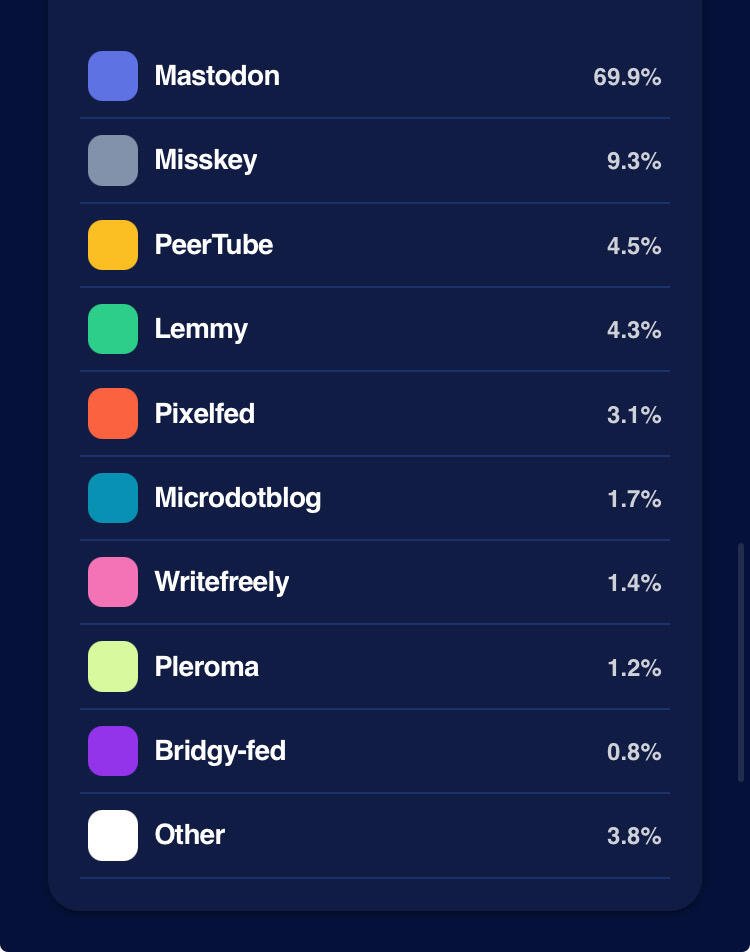
You know Pixelfed has made it when people—who’ve never used Pixelfed before—suddenly show up and are like, “Pixelfed is dead, go follow me on this Chinese app…” 😂
WHOA! The development of Fortune’s Run is on indefinite hiatus—stuck in Early Access—because the developer is going to prison!
https://store.steampowered.com/news/app/1692240/view/532087801681805318?l=english
Loblaws, Wal-Mart, and Sobeys deserve to be sued.
The fact this became a common practice in the grocery industry—they broke the law—is infuriating.
This is a sign that food pricing is out of control.
https://globalnews.ca/news/10958812/loblaw-walmart-sobeys-underweighted-meat-lawsuit/

The only time I ever use Nostr is with a dedicated FLOSS client stored locally on my hard drive.
I’m never giving a web app my private key. Nope, that’s just too risky.