🏙️ New York Disagreement Day
The Bitcoin scaling agreement, better known as the "New York Agreement", jointly proposed by over 50 companies at the Consensus 2017 conference, added fuel to the "block size war" in 2017.
The New York Agreement was intended to end the long-standing debate about #Bitcoin #scaling by increasing block capacity through the activation of Segregated Witness and doubling the block size (i.e., SegWit2X). Read more about these events in Jonathan Bier's book: https://blog.bitmex.com/the-blocksize-war-chapter-18-new-york-agreement/
🏙️ New York Disagreement Day
The Bitcoin scaling agreement, better known as the "New York Agreement", jointly proposed by over 50 companies at the Consensus 2017 conference, added fuel to the "block size war" in 2017.
The New York Agreement was intended to end the long-standing debate about #Bitcoin #scaling by increasing block capacity through the activation of Segregated Witness and doubling the block size (i.e., SegWit2X). Read more about these events in Jonathan Bier's book: https://blog.bitmex.com/the-blocksize-war-chapter-18-new-york-agreement/
🗣️ Satoshi on Messages via Bitcoin
On May 20, 2010, Satoshi explains why the #Bitcoin network does not provide the ability to attach encrypted messages to payments. 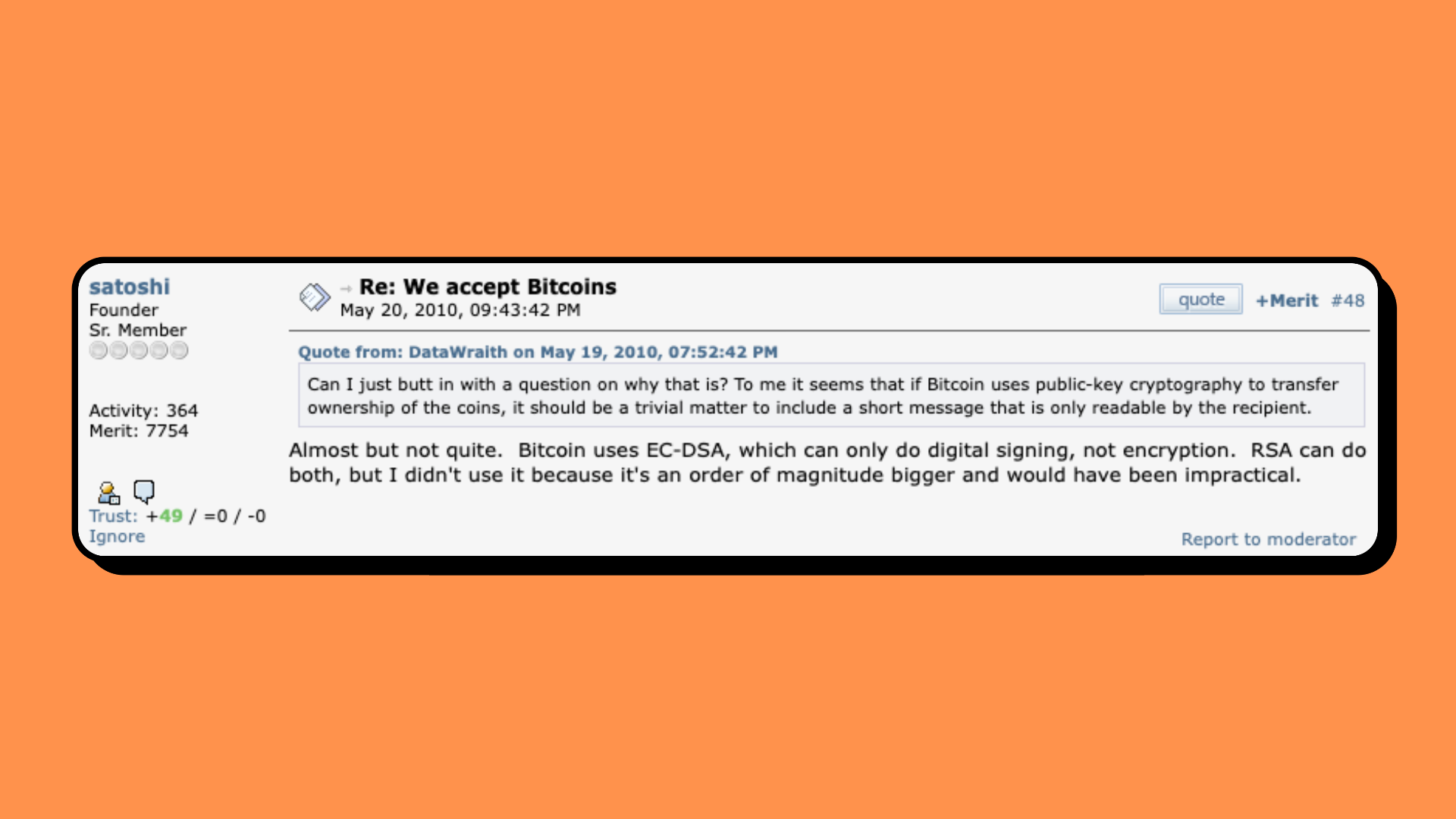 https://web.archive.org/web/20231202014046/https://bitcointalk.org/index.php?topic=30.msg1169#msg1169
🤡 Bitcoin Skepticism
On May 19, 2017, influential financial advisor John Lohr warned his followers against buying #bitcoin:
"In my opinion, Monopoly money is safer." 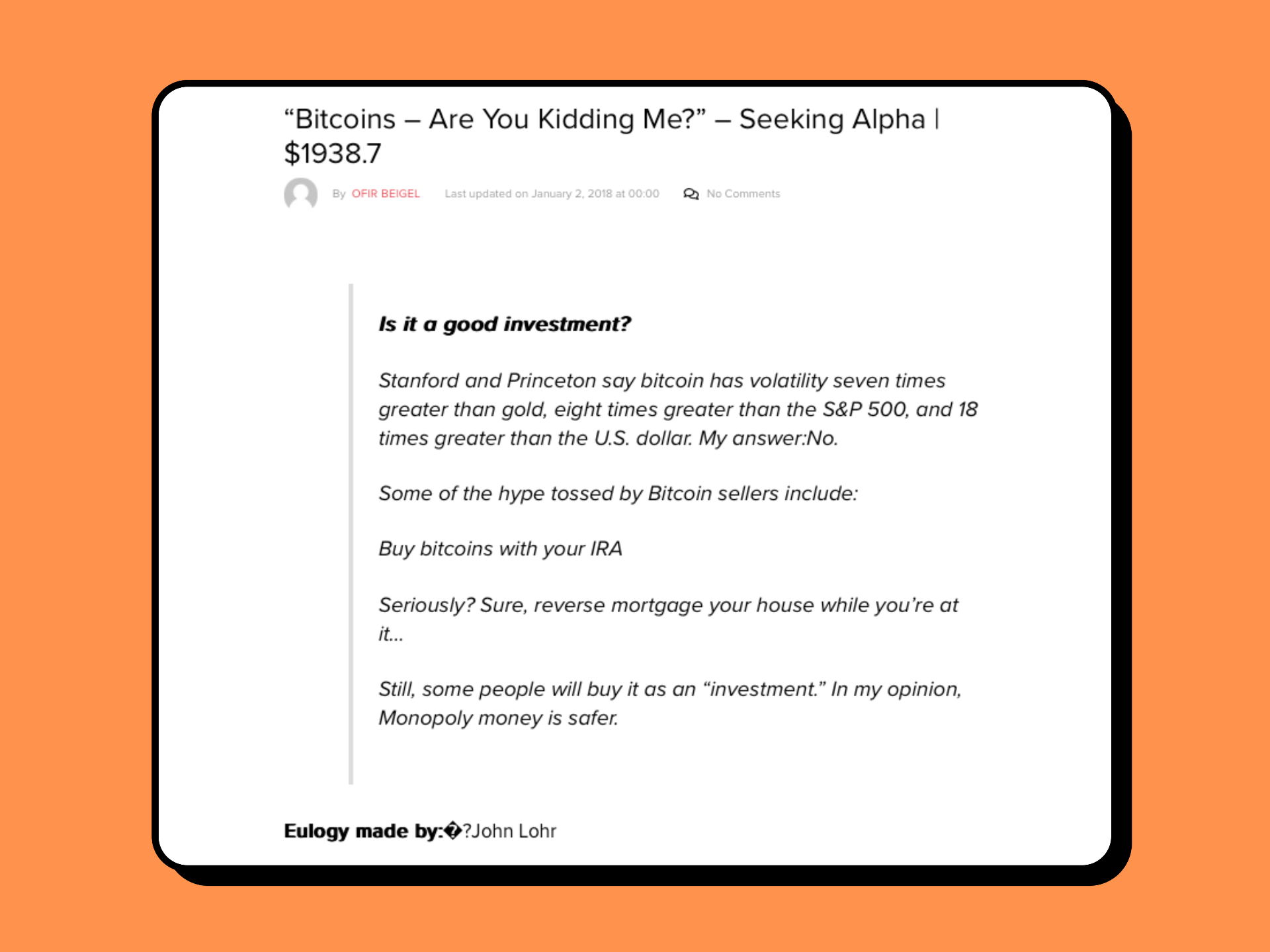 https://web.archive.org/web/20230530002238/https://99bitcoins.com/bitcoins-are-you-kidding-me/
🤡 Bitcoin Skepticism
On May 19, 2017, influential financial advisor John Lohr warned his followers against buying #bitcoin:
"In my opinion, Monopoly money is safer." https://web.archive.org/web/20230530002238/https://99bitcoins.com/bitcoins-are-you-kidding-me/
🏧 Bitcoin ATM Day
On May 2, 2013, the first-ever #Bitcoin #ATM was installed in a Vancouver coffee shop. It was equipped with a palm scanner designed to prevent users from processing more than 3,000 Canadian dollars per day.
1 BTC = $116.38 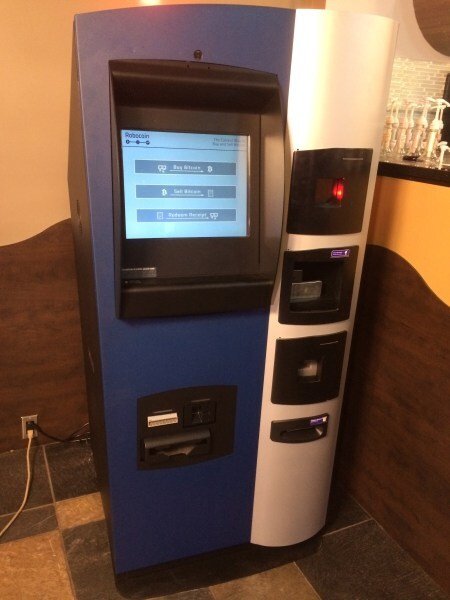 https://web.archive.org/web/20130702171110/https://robocoinkiosk.com/
🪦 Bitcoin Obituary | April 3, 2013
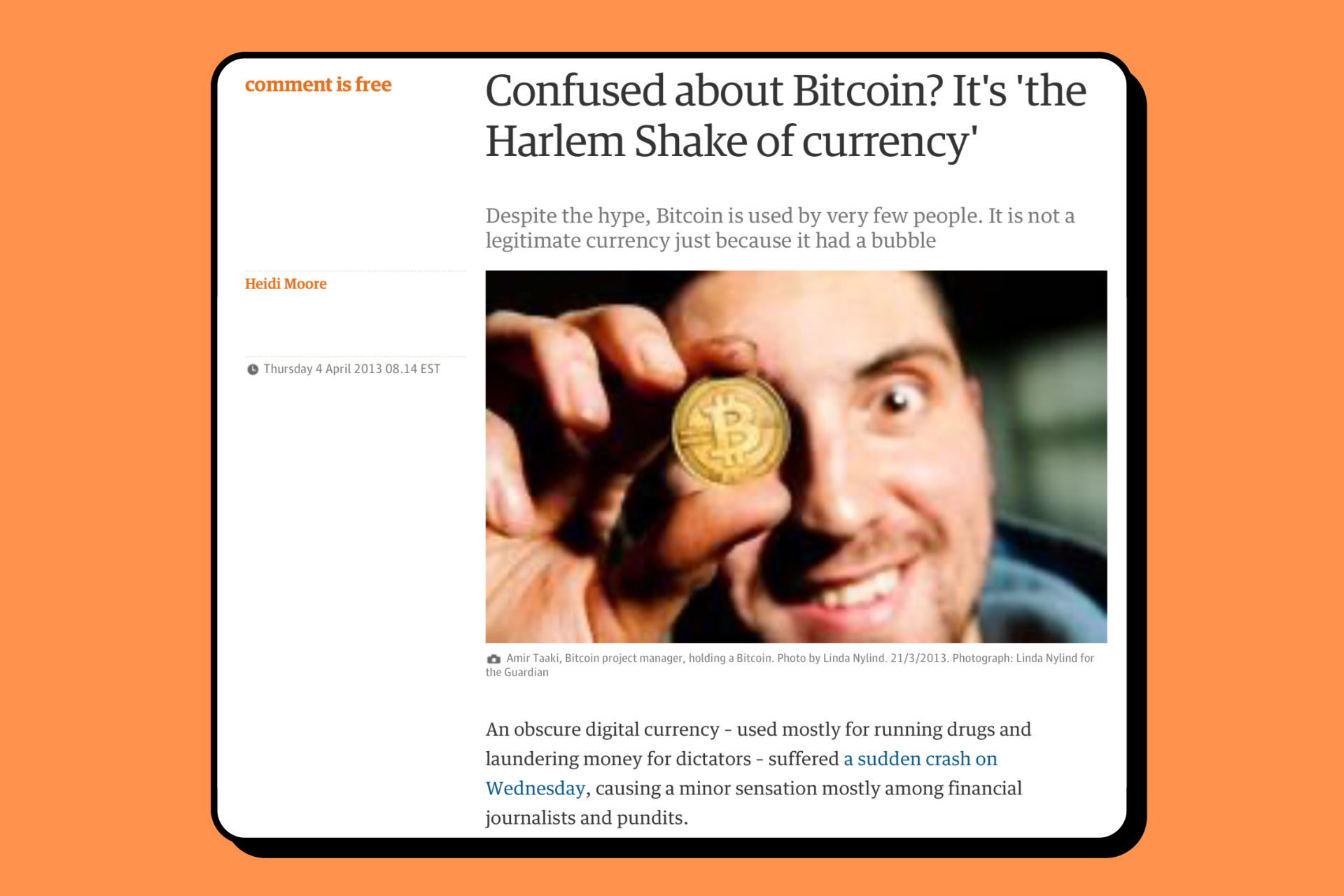
The Guardian publishes an article "Bitcoin is the Harlem Shake of currency". As you might have noticed, it didn't not age well:
"Despite the hype, #Bitcoin is used by very few people. It is not a legitimate currency just because it had a bubble"
⛏️BitPenny Mining Pool Shutdown
On April 3, 2011, the BitPenny mining pool shut down. The pool operator cited "ongoing losses preventing sustainable development" as the reason for closure. In reality, the issue seemed to stem from a poorly designed miner reward system.  https://web.archive.org/web/20160328181634/http://bitcoinminer.com/post/4304120696/bitpenny-closes-indefinitely
👨💻 P2SH Goes Live | April 1, 2012
Bitcoin got smarter at block 173805 — P2SH went live. Instead of locking coins to a single key, it let users send funds to a script hash. The spending rules? Hidden until needed, enabling #multisig wallets and more flexible transactions.
Find out more about P2SH and other Bitcoin address types: https://21ideas.org/en/bitcoin-address-types/#p2sh
Bitcoin Wiki: https://en.bitcoin.it/wiki/Pay_to_script_hash
💾 Cypherpunks Archives |March 3, 1994
Timothy C. May responds to a Cypherpunks mailing list discussion on digital cash, highlighting double-spending as a critical challenge. He proposes online clearing and blinding protocols as potential solutions, though neither fully resolves the issue.
Almost 15 years later, Satoshi Nakamoto shared the Bitcoin whitepaper on the same mailing list, presenting the first complete solution to the double-spending problem. https://i.nostr.build/SE5raM5dLttcJS1k.webp https://mailing-list-archive.cryptoanarchy.wiki/archive/1994/03/b9bcc330ef67da0f0ac96a71799523011f06c61d54ac21b2e381a30a4143e366/