
I want to enable bitcoin payments on my substack newsletter
Anyone had experience doing that?
I checked out the help centre at opennode. Looks non-trivial!
In case you missed it: the Bitcoin ESG Forecast is out. Featuring:
📈 Analysis shows bad ESG data helped end the last #Bitcoin bullrun
❓ Could that happen again?
♻ New chart contrasts the ESG trend for Bitcoin, Gold Industry & Banking
👼 An unlikely new supporter of Bitcoin mining: WEF
www.batcoinz.com/p/issue-007-making-bitcoin-bullruns
Financial Times continues to publish mildly positive stories about Bitcoin. A huge reversal from earlier years.
https://www.ft.com/content/4d869e6a-a974-45fe-b204-cb5f85838352

It is capital intensive. But the 1c/kWh electricity means that the economics work for bitcoin mining (but not for traditional datacenters)

Absolutely. 1000 cows = 1/4 MW. Get four farms together with 1000 cows and you have a potentially financially viable project.
Posted without comment 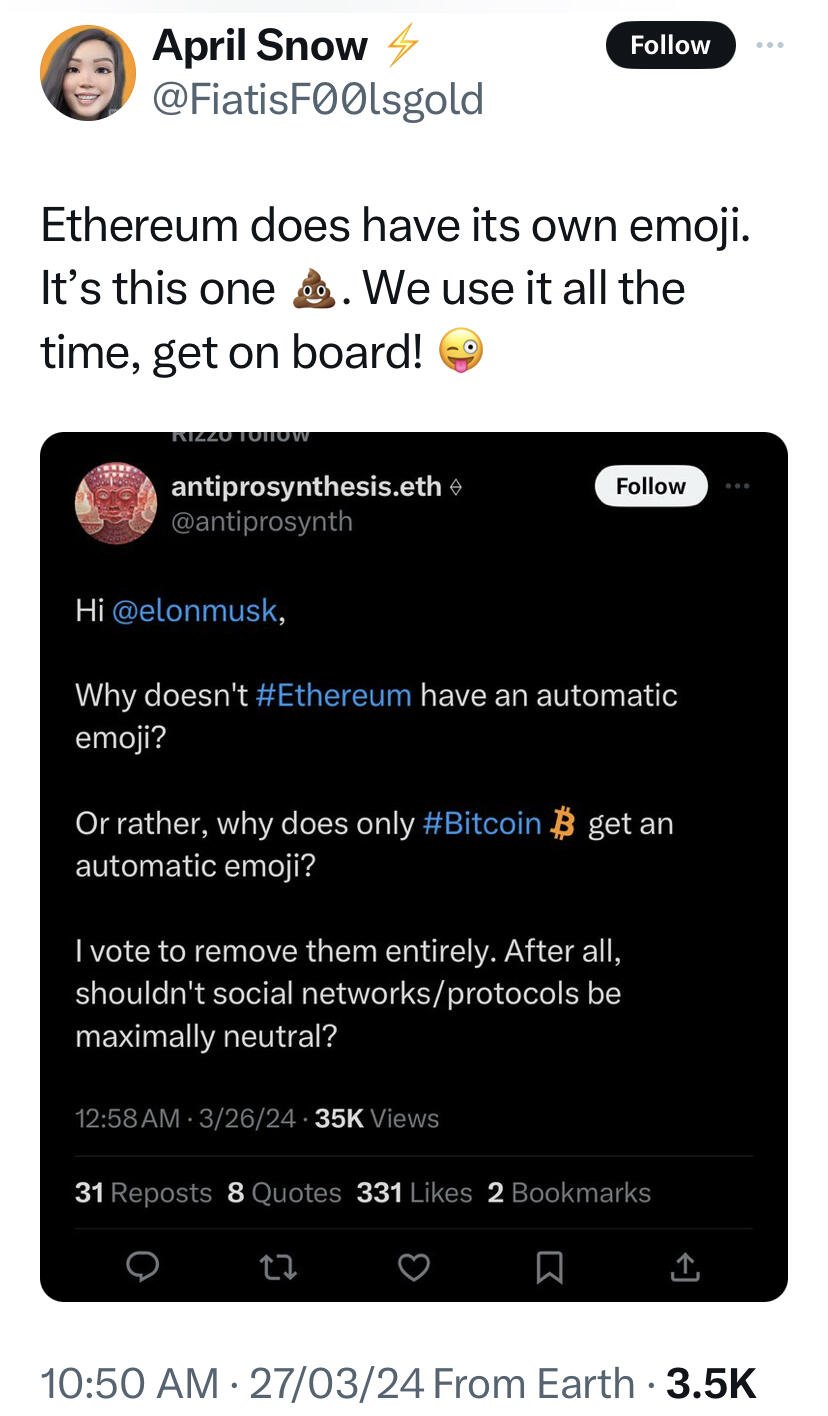
Nostr first announcement:
We’ve now have the capital backing for our first landfill-gas-powered bitcoin mining project
One small step closer to taking the bitcoin network emission negative and ending Bitcoin energy FUD
We’re now turning our attention to identifying as many landfill sites as we can that fit our brief.
If you have contacts in waste management and want to know more about what we’re looking for, send me a Nostr message.
Bitcoin mining methane mitigation just keeps on growing
https://www.coinspeaker.com/bitcoin-miners-argentinian-firms/amp/
How Bitcoin is solving the methane problem
(Transcript of the talk I gave at Bitcoin Atlantis)
https://bitlyrics.co/transcripts/bitcoin-solving-the-methane-problem/
All the crypto media are now holding GreenpeaceUSA to account
https://www.ccn.com/news/greenpeace-ripple-donation-allegations-puts-charity-under-scrutiny/ 
Love this headline because it captures a real shift in the bitcoin mining community.
Gone are the days when bitcoin mining companies tried to apologetically defend themselves.
They are now counterpunching with interest.
This strategy only works because there is now a huge body of peer-reviewed research, independent reports, revisions to old models (Bloomberg Intelligence and Cambridge), and narrative flips from previous antagonists (UN, WEF, Financial Times) now supporting Bitcoin’s environmental merits.
Yes, not just saying “it’s not that bad” like in the past but saying either “it is, or has the realistic potential to be very net-positive for the environment.”
Bitcoin mining companies are simply no longer taking 101-level nonsense from misinformed legacy NGOs, who have made no effort to learn about bitcoin or engage with bitcoin miners, and instead continue to peddle myths that are out-of-date, out-of-evidence and frankly out-of-integrity (funded by Ripple’s chair to run a smear campaign)
GreenpeaceUSA had the chance at the start of this year to review their anti-bitcoin campaign’s (many) mistakes and failures and reach out to the bitcoin community. But have chosen instead to double down on more misinformation, more mistakes, and with it even more loss of credibility with a generation of crypto-native millennials - the very people it should be cultivating as its future base.
We are no longer talking about a difference of opinion, we are talking about a grassroots movement of Bitcoiners who have taken the time to understand the nuances of a technology deeply, and a UUHNWI-funded former grassroots movement called GreenpeaceUSA who has not.
https://decrypt.co/222655/greenpeace-bitcoin-energy-environmental-debate 
Nostr seems to encourage both authenticity and more holistic self-expression via the simple act of not manipulating human behavior through an algorithmic incentives.
Here, less truly is more.

Well done for stating your reasons. It helped !
You’ve probably seen GreenpeaceUSA's Bitcoin report by now, and my response (if you haven't been blocked).
Here’s six things that every environmentalist, Bitcoin advocate, regulator, policymaker and media representative should know about GreenpeaceUSA.
I've had this information for over a year, but have held back on going public with it until now because there were initially signs that GreenpeaceUSA would be open to engaging with environmentalists within the Bitcoin community.
With them now blocking me from commenting on their tweets, all hope of that has now ended. So here's what I can tell you about GreenpeaceUSA, and their campaign that have not been aired publicly until now, and which may surprise you.
Firstly, some context: I’m a former volunteer environmental campaigner with Greenpeace. I once risked arrest to stand up for causes I believed in, including an anti-GMO campaign against McDonalds which was successful within 6 weeks, and hailed as an example of how creative direct action can yield fast results. One of the differences: we talked to McDonalds (something no one at GreenpeaceUSA is currently doing with the Bitcoin community).
I know a number of people in the environmental movement, and I would like to thank them for their honesty in whistleblowing on a thoroughly misguided campaign from GreenpeaceUSA from start to finish.
1. GreenpeaceUSA’s campaign does NOT have the backing of Greenpeace International. In fact, other branches have asked questions of GreenpeaceUSA’s tactics, and even said that their campaign is damaging the Greenpeace brand, and has resulted in the loss of subscriptions.
2. Within GreenpeaceUSA, there are a growing number of voices of discontent. There is a growing division between some of the younger crypto-neutral or crypto-friendly millennial in their base, and the directorship of GreenpeaceUSA
3. As we know, GreenpeaceUSA did receive a $5Million donation from Ripple’s chair Chris Larsen to run an anti-Bitcoin campaign. What you probably do not know is that within Greenpeace, several staff have questioned whether this is ethical, or in the spirit of an organization that says it relies only on grassroots funding in its sign-up pledge.
4. Some members of EWG and SierraClub, particularly younger members, were not enamoured with their organization’s collusion with GreenpeaceUSA’s “Change the Code” campaign. EWG has not engaged in anti-Bitcoin rhetoric since 6 April ‘23.
5. The head of GreenpeaceUSA’s “Change the Code” campaign has stepped down and is no longer any part of GreenpeaceUSA. At the time of his stepping down he was reported by a source within GreenpeaceUSA to be questioning the wisdom of the campaign.
6. Within GreenpeaceUSA, we know from multiple inside sources that the Change the Code campaign has been widely acknowledged to have been “not particularly successful”. GreenpeaceUSA’s campaign got off on the wrong foot right from the start, by antagonising environmentalists within the Bitcoin community, such as me. Here’s its half-time report (TL;DR, the worst performing environmental campaign I’ve ever witnessed). https://bitcoinmagazine.com/culture/greenpeace-environment-attacks-help-bitcoin… Now, the campaign is in more disarray than ever, resorting to tenuous ad hominem attacks against Satoshi Action, based on the discover that one of their supporters is a climate denier. True. Well, guess what: one of their supporters is also a plant-based, tree-hugging, climate-activist & meditation teacher: me. That’s the beauty of Bitcoin: it pulls people in from across the political spectrum: we are as diverse as society itself, and that’s what makes us strong. As I wrote recently, “when the ship you’re standing on is sinking: it doesn’t matter if you’re on the left of right side of it.”
I hoped GreenpeaceUSA would end their anti-Bitcoin campaign before their credibility and relevance to the new generation of millennials they are currently disenfranchising is completely severed.
But it seems at the moment they are more intent on doubling down on misinformation. Their leadership must change for them to ever have hope of becoming a true voice for the environment again.
Just dropped a 20-min high intensity pod with Nik Bhatia. Together we cover:
♻ Bitcoin Energy misinformation: ignorance or propaganda?
❓ What surprising institutes now support bitcoin mining
🔥 How to permanently end #Bitcoin energy FUD
⛏ How to end BTC mining regulatory hostility
📈 Why future ESG funds will have to invest in #BTC

Correct. It’s an intergalactic orange spaceship.
The algorithm for writing environmental FUD about Bitcoin.
Readers of these articles may use this as a scoring system to see how high the writer's FUD-factor is.
1. Avoid objectivity Only publish negative stories. Ignore all positive environmental and social externalities, or even acknowledging they exist to readers
2. Use only old datasets
Up-to-date datasets such as Bloomberg Intelligence will reveal that Bitcoin is mostly powered by sustainable energy, and that emissions have not increased in the last 4 years. Avoid these studies. Using Cambridge's 26-month old dataset is good. Using UN University's 3-year old dataset is better.
3. Recycle already debunked methodologies
For example, while Alex de Vries' resource-use per transaction has been debunked by peer reviewed research and Cambridge Judge Business School, most people don't know it, so use this metric with impunity.
4. Selectively use of peer reviewed research In the last 18 months there have been 6 papers examining the positive environmental externalities of Bitcoin, 2 that focused on negative externalities. But because only The Independent picked up any of the 6 positive papers, most people are still unaware of positive externalities. So keep selectively quoting from the negative ones.
5. No engagement with, or faux-engagement with the BTC mining community While objectively they are the only ones who understand Bitcoin mining well enough to educate readers, it is better to paint them as a self-interested group of lobbyists. If you do engage with them, make sure you only quote token sound bites, which you then allow your own carefully selected "experts" to contradict (see below on what constitutes an "expert")
6. Reference unqualified energy experts To you an "expert" should be thought of a person who understand energys, grids but has no understanding of bitcoin mining). Definitely eshew qualified energy experts (people who deeply understand energy grids AND bitcoin mining)
7. Withhold relevant context Noise pollution is a good candidate. Find an example of a bad actor and, through omission, make it look as though all Bitcoin mining companies behave this way. Do not mention statistics such as the number of mining companies causing noise pollution relative to total number, or do cross-industry comparisons.
8. Don't zoom out For example, if Bitcoin is responsible for emissions, then that should be lambasted. Do not point out that like eVs it has no direct emissions, or that every novel technology has emissions. Definitely do not examine trend that show Bitcoin heading to be the world's first emission negative network.
9. Encourage "inside the box" thinking "Bitcoin consumes a lot of energy" should be neuro=associated wherever possible with "is bad for the environment". Don't mention that without more energy, particularly flexible users of energy, there can be no renewable transition. Do not mention that Bitcoin uses wasted energy. Definitely do not point out that it is emissions rather than energy use which primarily decides whether a technology is good for the environment or not.
10. Actively practice error by omission Under no circumstances should the utility of Bitcoin as a technology be examined. To do so would be very dangerous to your narrative. People will tend to judge a technology as "wasteful" only when they do not see the value. Ensure that your readers stay uneducated about the value of Bitcoin.
Instead, you should scatter the occasional negative statement about Bitcoin such as “it is only used by criminals”, "it is just a only speculative asset” wherever possible. While these statements have been debunked, most people are still unaware that they have been debunked, so you should feel confident to use them everywhere except Twitter (where you will be community noted) and Nostr (where people will be more educated about Bitcoin’s value).
Attribute these phrases to "experts" so your article does not look too obviously one-sided.
Happy writing. We trust this will make your task easier.
Left or right?
I was recently reflecting that since getting involved in bitcoin, a lot of the debates I used to have no longer make sense to me. Here’s my attempt to capture why.
You are a passenger on a ship. Your captain informs you "I have good news and bad news for you. Which would you like to hear first?"
Being an pragmatist, you opt for the bad news.
"The ship is sinking" he informs you
"Well, what's the good news?" you venture
"We have decided to give you the choice of which side of the ship you would like your cabin to be on"
In a world where the ship of the global fiat economy is sinking fast - old concepts like "left" and "right" are meaningless.
The question is not, “is the left or right side better”.
The question is "Where's the #%^*^‰ liferaft - and how can I get as many of my friends and family onto it as possible!?"
Of course, if you don't believe the ship is sinking, you'll stay on the ship and have debates with other passengers about which side of the ship is better.
Lifeboats tend to be colored orange. There are more seats on the boat available. But they are starting to fill up: their supply is, after all, limited.
PSA: The Bitcoin ESG Forecast #7 is now out.
Check your inboxes and spam filters. Or read it online:
www.batcoinz.com/p/issue-007-making-bitcoin-bullruns