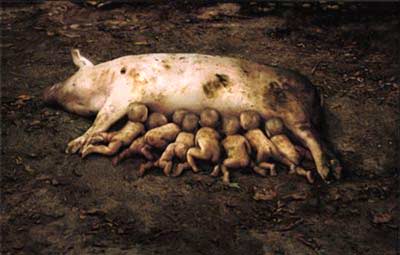

I liked andreas antonopoulos' analogy of bitcoin as a sewer rat vs the legacy system as a "boy in a bubble" (zero immune system)
whatever happened to that guy?

It's incredibly bullish.
The most mainstream bastion of normie finance acknowledging explicitly that bitcoin is not a bubble, and stating that it cannot be stopped.
They're beginning to realize what game they're actually in.
This, as they used to say, is gentlemen.
Chopping off their heads does not work: cockroaches can live without one for as long as a week. Whacking them is no guarantee either: their flexible exoskeletons can bend to accommodate as much as 900 times their body weight. Nor is flushing them down the toilet a solution: some breeds can hold their breath for more than half an hour. To most, roaches are an unwelcome pest. Their presence is made all the worse because they are indestructible.
An unwelcome pest is how many financiers and regulators would describe the crypto industry. Criminals use cryptocurrencies to launder money. Terrorists use them to make payments. Hackers demand ransoms in bitcoin. Many crypto coins are created simply so their makers can make off with the money.
The industry also appears to be indestructible. Crypto prices were crushed by higher interest rates in 2022. The industry’s head has been chopped off: Changpeng Zhao and Sam Bankman-Fried, the founders of the world’s biggest and second-biggest crypto exchanges, now both await sentencing for financial crimes (breaking anti-money-laundering laws and fraud, respectively). Regulators are cracking down. Yet not only has crypto survived, it is once again soaring: bitcoin climbed to a two-year high of almost $45,000 on December 11th, up from just $16,600 at the start of the year.
What is going on? For one thing, indestructibility is built into the technology. Bitcoin, ether and other coins are not companies—they cannot go bankrupt and be shut down. They employ blockchains, which maintain a database of transactions. Their lists are verified by a decentralised network of computers that are incentivised to keep maintaining them by the promise of new tokens. Only if the tokens fall to zero does the whole architecture collapse. And there continue to be lots of reasons to believe some crypto tokens are worth more than nothing.
The first is that holding crypto is a bet on a future in which use of the technology is widespread. People in despotic countries already use bitcoin and stablecoins (tokens pegged to a hard currency, like the dollar) to store savings and sometimes to make payments. These could be used more widely. Artists and museums are still creating or collecting non-fungible tokens (nfts). As are those looking to flog an image. Donald Trump is selling his mugshot for $99 a piece. He plans to have the suit he was booked in cut into pieces, made into cards and given to punters who buy at least 47 nfts in a single transaction.
During the boom times, the crypto industry raised a lot of money and hired plenty of smart developers. Those that remain are working on new uses, like social-media applications or play-to-earn games. Perhaps these will never be widely adopted. But even the small chance that they work out is worth something.
The second reason is that, with each boom-and-bust cycle, it becomes clearer crypto is not a bubble like tulip mania in the 1630s or the craze for Beanie Babies in the 1990s. Although bitcoin is a volatile asset, its price history looks more like a mountain range than a single peak, and appears closely correlated with tech stocks. Yet it is only moderately correlated with the broader market. An asset that swings up and down, and not in parallel with other things people might have in a portfolio, can be a useful diversifier.
That bitcoin has established itself as a serious asset seems to be the source of the latest surge. In August an American court ruled that the Securities and Exchange Commission, America’s main markets regulator, had been “arbitrary and capricious” when rejecting an effort by Grayscale, an investment firm, to convert a $17bn trust invested entirely in bitcoin into an exchange-traded fund (etf). Doing so would make investing in bitcoin easier for the average punter.
In October the court upheld its ruling—in effect ordering the sec to give way. The biggest fund managers, including BlackRock and Fidelity, have also applied to launch etfs. Given the returns bitcoin has offered in the past, and its correlations with other assets, the result could be a rush of cash into bitcoin, as even sensible investors consider putting small slices of their pension pots or portfolios into crypto for diversification.
Many feel instinctive revulsion when they spy a roach. But in spite of their flaws, the bugs have uses—they turn decaying matter into nutrients and eat other pests, such as mosquitoes. Crypto has its uses, too, such as portfolio diversification and keeping money safe under despotic regimes. And, as has been shown, it is just about impossible to kill.
Cockroach works for me, except for the shitcoins obviously..

It's an important nuclear threat which means that miners can never control bitcoin

I agree with most of what you say, that most peoples lives are basically insane, self-destructive and detached from what I would think of as reality - including nature.
But I'm really not sure "all this must have an impact on our “little” planet" is right.
Obviously if you build a car park on a field, that is a direct, local effect of itself. But I think it's easy to go without justification to believing the whole planet is in some way damaged, and that the effect of humans is some how more than the sum of its parts.
Because that's how they get you, and what i think triggers me about your argument. This vague globalization of your actions and the damage you are causing - which can never be really atoned for because it's not really defined.
Worth noting that this kind of sentiment, that humans are wrecking things and it can't last, has been prevalent throughout history - eg, most obviously with Malthus in 17th century. He and his followers were wrong then, and everyone since has been wrong - I think for the reason that we have some inbuilt psychological tendency to guilt, and belief that our actions must have some larger negative consequences which we extrapolate to a permanently looming global catastrophe.
But the good news is - we really don't need to worry about it! Even if we suppose the doommongering is correct (it's really not), then we are simply doomed - there's nothing we can do about it, no conceivable possibility that we could organize in a rational way to prevent it. So the worry is for nothing..
..except that I think the worry is actually the primary thing, and the doommongering is the effect of it, not the cause. Humans have this predisposition to worry in this way, and it's a big part of how they self-organize into controlled groups. The physical reality is unimportant and the issues chosen to worry about are entirely arbitrary, they're just a means to the end of social control.
So I invite you to consider this, and if you agree - you can be free! You really don't have to worry about this stuff!
"Nature is getting silent. Just go into nature, listen to the diminishing bird sounds, and search for the dragonflies you saw plenty of as a child."
I suspect you are noticing population variation - I'm not aware of any reason this should actually be true overall, except eg in places where a lot of development has occurred locally. I have often noticed, for example, that a certain type of bird seems to have disappeared - only to come back after a few years.
I'm all for protecting nature and spend most of my leisure time enjoying natural places and escaping from (local) human development. But there's just no evidence I'm aware of that shows humans are (yet) having any meaningful global effect on the natural world.
Plus of course the people pushing the climate agenda are actually completely uninterested in nature or the climate - all they want is a pretext for gaining status in the herd / enriching themselves / gratifying their urge to bully anyone who disobeys the herd etc.
It's an important step but jeans are cotton too
Yeah but never forget these people are psychotic - capable of any cruelty in order to go along with the herd

it's much safer as well as feeling not like "a robot slave"
seriously try it for 2 min
try driving without a seatbelt too, its a minor revelation
well now I know what side of the road they driver on in russia but only because i had to google it after watching this

I find the key is to never forget they are literally NPCs 😄
Just a quick reminder that Israel had foreknowledge of 9/11 and let it happen, at the least - even if they didn't actively participate or direct it, which seems more likely.
OK but the normies don't need to "buy it" - they will go along with any nonsense at all, even if they openly agree its nonsense, as long as it means staying with the herd.
(Of course one day the herd might reject it..)
I don't even think the blue-haired students or struggling boomers buy it. It's just an outlet for their own emotional baggage - low self esteem, inability to feel valued without peer recognition or superiority over others, sibling anger etc etc
None of them is remotely interested in the actual issue, and if it wasn't climate itd be something else, as we see with covid, trans, ukraine etc.
But climate boiling threatens to imminently wipe out all life on the planet earth..
..so no amount of cost is unjustifiable
The arms trade is now classified as ESG 😂😂😂

Yes waking up has been fun!
911 probably more Israel tbf
Jeffrey Epstein and all that.
Dinosaurs (and other mesozoic life) was far too massive for earth's current gravity.
Particle physics is probably a scam, and science generally has mainly ground to a halt as only politics and money matter now.
When it happens it ain't gonna happen slowly..