

Unfortunately, in this day and age, the guy with the biggest voice (or his highest bidder) gets the attention. It's tough to reach organically.
I'm a brand strategist and copywriter, and I also build websites for my clientele. Mind chatting? If it does what you claim, you and those who need what you offer deserve a nicer sales site.
The obvious solution is to let Bitcoin be the lightweight timechain it's meant to be and install a proof scheme for another data storage mechanism.
Keep the supply cap, make sure coins aren't double-spent, publish proofs globally, and that's it.
Then, make L2's and L3's to accelerate and expand. Use larger and more frequent blocks on a side chain that get's purged to 1-year, and publish the top-level proof on Bitcoin, including swaps with Bitcoin and sibling chains. Make lightning channels on the side chains, bridge them, etc. Bitcoin get's to stay lightweight and secure while getting scaled.

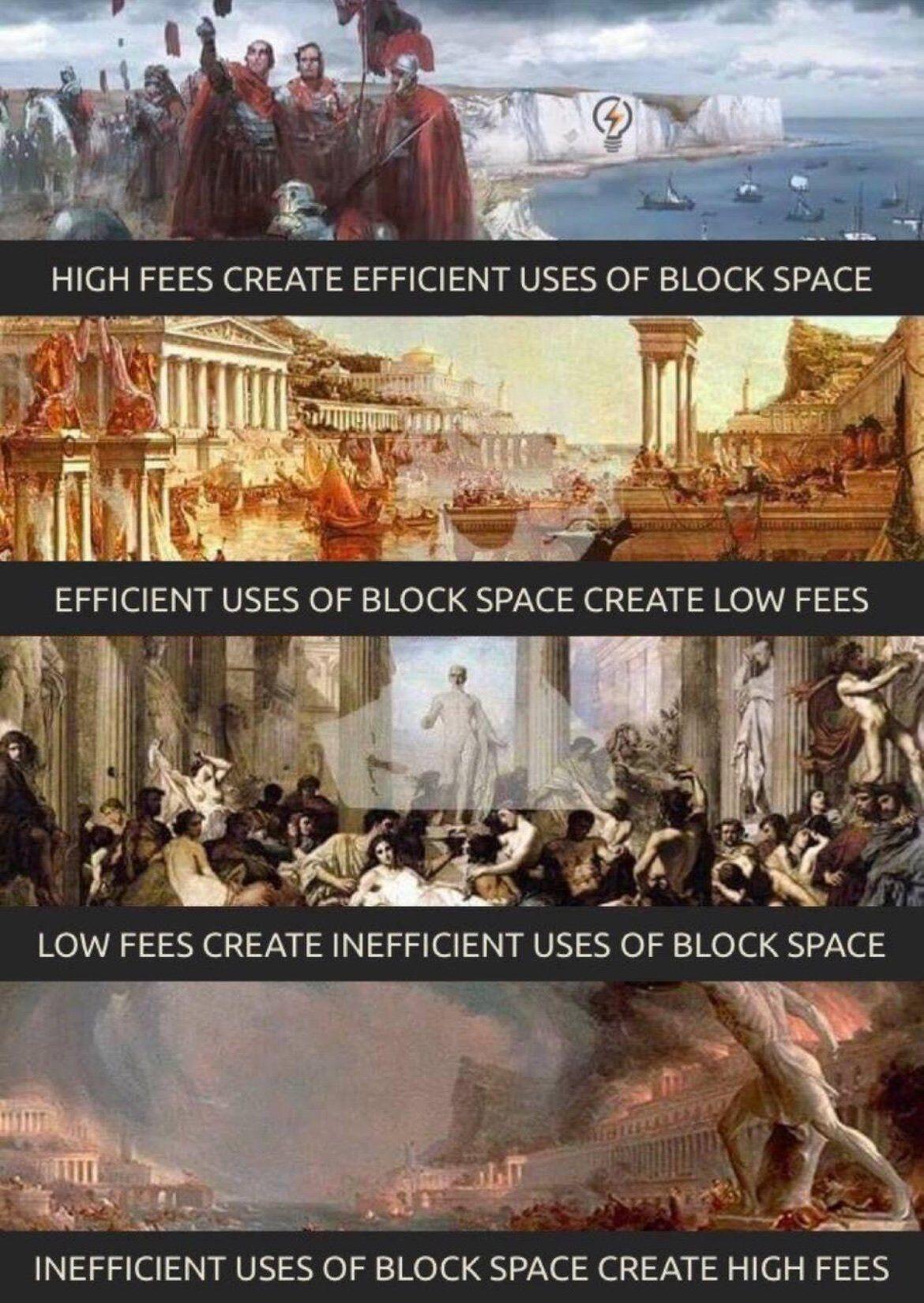
The Timechain™️ is meant to be a reliable clock, not a file storage device. Embedding another DLT, or an array of more specialized ones, into it will make it scale.

The basic problem is two-fold. The first is corporatism and the tendancy for big companies to reduce quality of goods and services while increasing pricing. The second is that those big companies own the platforms, which becomes the marketplace itself. If they didn't own the platform and they delivered the goods and services through a protocol not owned by them, they wouldn't have the power to keep increasing process and reducing quality, because they would never own the marketplace itself.

Excellent! I prefer a pipe, but mostly because it's cheaper. I do enjoy a good cigar.
What kind of whiskey did you enjoy?
Hindsight being 2020, might it have been better to make the block reward function a more continuous function rather than quadrennial steps?
The fact that the halving schedule exists is important, but the importance is that it is a converging function. If the halving was not a change of block reward, but a change to the rate of change to the block reward, the 4-year cycle would be calmed. Maybe the supply shock is actually good for price action, and that price action is good for adoption. The world will never know.
Just for fun, I came up with a few alternate block subsidy schedules.
Imagine that the very first block reward starts at 100 units, and the subsidy decreased with each block by 90μ units until block height 1M, at which time the subsidy is 10 units. Then, the subsidy decreases by 9μ each block for the next 1M-block epoch, and this pattern repeats we run out of bits (the unit is biased by 10 or so digits, of course).
Subsidy ~= 10^(2 - epoch) - 10^(1 - epoch) * (blocks in epoch)/(epoch length)
This is very "base-10"-ish and not very Bitcoin-y, so we could take an inverse approach and calculate a block height that would result in a halving schedule approximating Bitcoin's, just as a continuous function.
Br: Block Reward
Bb: Block Bias
Bh: Block Height
El: Epoch Length
Eb: Epoch Bias
E: Epoch
S: Scale
Br = (Bb-Bh) % El * 2^(Eb - E) + El*S*(2^(Eb - E) - 1)
Eb = floor( Bb / El )
E = Eb - floor( (Bb-Bh) / El )
If you set the Block Bias to 3140165, and the Scale to 10^-8, the Epoch Length being the 210000, same as Bitcoin's, the supply cap is 20999993.36, pretty darn close to Bitcoin's.
I'm just a little disappointed that the block height bias didn't turn out to be π-million. That would have been an amazing! Pi turns up just so mathemagically often.


It's a bit simpler if your neighbor doesn't do it for a living. If you pay him less than $600, no reporting is needed. Even if it's greater, all you need is a 1099 and to include it on your annual tax filing. Only when you plan to hire people full time do taxes get tough. On the other hand, if he does it as a business, he should be the one to report it, not you. The tax code is messed up, and there's an untold number of dollars spent on trying to pay as little as possible that should really be put to use making things people need and want, but I digress.
The flat tax idea I have is to take 10% of the local poverty line and make that the flat tax, or 5% of income above 50% of poverty, whichever is less. I thought of treating it differently based on household size, like making the "above X%" line scale, but that's at least the basic idea.
Let's say poverty is $40k, as a round number, and the average contribution would be 8% of it. I think basic governance, police, and defense should easily run on $3.2M per 1000 households in today's dollars. A city of 100k people would be on the scale of 25k households, adding to $80M/yr.
I've also toyed with the idea of a small property tax. It seems right to have those who own property to contribute to its protection, right? A defense fund should be supported by owners of property, just like insurance to for home and autos. I'm thinking 0.25%/yr. A $400k home would have a $1k annual tax that goes to defense. The bigger the target, the more you contribute to its defense.
Would this be something only for business-customer transactions. Paying back for dinner shouldn't be taxed, and preventing that while also taxing payment for taxable sales in an automatic way will be difficult.
A flat tax is based on whether you live in an area, simply put. If you live/work here, you should support the community.
The issues I see with a transaction tax is that it incentivizes lower velocity and/or system skirting. We already have transaction tax on Bitcoin, and we "skirt" that system by making a "joint account," if you will, and making off-chain transactions that don't get taxed, then settling later. The same thing will happen on new layers. It may also create an incentive to use custodial wallets that will reduce the number of "taxable" transactions. A flat tax is a lot more doable and less "skirtable", and the same goes for property tax. I wouldn't mind taxes if they're quite small and I and my neighbors can talk directly to the people who decide what it is. If I don't like it, I can move outside the city or county. A national tax however... not so much.
Again, #localism
😂 Yes sir! I am an internet cloning DVM that studies you and gives you a replica with just enough differences so that I can pass off as another human.
I do want to incentivize procreation and adoption. Those who decide to not procreate nor adopt are already ill-incentivized for fostering the future of the world, and those who decide to procreate or adopt because of the voting advantage will grow as people in doing so, so I'd feel okay with that small fraction of society gaining some advantage in exchange for putting much more power into the hands of those already well incentivized to foster our future.
I think as well that children only should add to the household's voting weight if the head of household legally married. Divorce would only cause a half-point loss otherwise. Those who get divorced, it seems to me, can hardly run their own lives, so why give them power of governance?
I think we over-estimate how motivated the average person is to gain political power. I don't think people will often change the way they live based on voting advantage. Financial advantage is a little different, though. We ought to incentivize what would make a better society while being careful to not over-incentivize and cause a game-theory paradoxical scenario. We already incentivize marriage by joint-filing tax brackets and child tax credits, but that doesn't change those who choose to not marry, procreate, or adopt.
Noted 👍 Building A gets the ISP run, but it really only needs one or two Wi-Fi units, so the switch with fiber would only be useful for exiting the building (copper is plenty for within building A, and the modem has a 4-port router built-in). Building B also needs one Wi-Fi unit, and it gets full gigabit speeds already. Building C is where we have the co-working space and where having the fiber would be beneficial.
Replacing the current janky daisy chained setup of copper from A to B to C* is where the fiber becomes necessary. The 10G within building C is the nice-to-have upgrade that'll be down the road whenever we find it beneficial to build the NAS.
*in fact... we daisy chain within the building too with the little Wi-Fi mesh deals, and my BIL's PC is wired into the last in the chain!😂 Latency doesn't seem to be an issue yet, so we've got that going for us.

You're right. It's copper, currently, on a daisy chain (we have a third, small building between). The first 150ft is working great at full gigabit speeds, but the second got downgraded by the hardware to 100Mbps 😡 Same cable, and it ran at gigabit on install. The run is out-of-doors, so I got direct-bury grade copper lines.
I was 🤏 this close to getting a couple media converters just for that 300-ft line about a month ago (copper → MC → 300-ft fiber → MC → copper). The modem is copper-only, and I don't know if the ISP would like it if I swapped it for my own (including that I'm not sure I could get it set up because of vendor locking by the ISP).
One link between buildings, about 250-300ft (I only want to pay the ISP once 🤷♂️😂), 1G needed but 2.5G preferred for upgradability.
Once in the building, I think we want 10G between the NAS/Server and 4 workstations (maybe up to 6 in the future). Those runs don't need any more than about 50-ft, most probably in the 10-25ft range, depending on placement. The use case is videography, photography, video podcasting, and local website hosting for development. I already do that last one from my laptop, but it'd be nice to host it where it can always run.
Also, while were out and about, we might tunnel into the NAS for footage and photo dumps so we're never walking around with all our data.
Sweet!
I noticed the ridiculous price gradient from 1G through 25G. It didn't make any sense to me. 1G networking is fifteen years old, now! And it really hasn't gone down in price much at all.
> ...if you know where to buy...
So... where to buy?
I've been looking into installing 10G in our coworking space. My brother-in-law does videography, and a nice, big NAS with plenty of space and and hard-drive speed LAN would be perfect.
I agree votes should be household based not individual.
You can never convince me some genetic dead who hates man kind in their late 40s, is on loads of medicine , hates kids, could have societies best interest in mind when going to vote.
They will slowly destroy it until the barbarians eventually take over removing any right to vote.
https://video.nostr.build/018b2018ada211e0024fd6293216b90cadec9c890f9cc0c54fbac7688b45d70e.mp4
Heck yes! One household, one voice, and that voice has weight according to their stake in the future of society. One adult? A weight of one. A married couple? A weight of 2.5. With children? 0.5 per child*.
#Patriarchy is the future.
*Children should be legally under the roof of the father, that is living at home or otherwise fully financially supported by the father. Includes any child not independently living.
While we're at it. Let's agree that the federal government should have no business with individuals and should be financially supported by the states that compose it. And those states should be financially supported by cities and counties, and those are supported by households.
#subsidiarity and #localism

"Close encounters of the 30023 kind" should be a Nostr-published novel.

I think there's a different between organic, personal marketing versus paid ads.

True if you don't count the 💩🪙 comment spam

The-finger pour of a medium proof whiskey? Better make it last awhile! Or a high proof rum? That might put you on the floor.