
Mine free crypto airdrop
Just click on the link https://t.me/hAmster_kombat_bot/start?startapp=kentId2104664431
These mushrooms are called ‘Dead Man’s Fingers’ 🧟♂️ 
Cardwell Higgins, "Out Of The Earth You Came" (1930) 
The staircase at San Francisco City Hall, built in the late 19th and early 20th centuries, is one of the most prominent and beautiful features of the city hall. Designed by architect Arthur Brown Jr., this staircase is an icon of grandeur and elegance in architecture.
📸The stunning photograph by nicolejkimphotography. 
Shiprock, a towering rock formation known as a volcanic neck in New Mexico, rises nearly 1,583 feet above the desert plain. Composed of fractured volcanic breccia and black dikes of igneous rock, it is an erosional remnant of an ancient volcano's throat.
A volcanic neck forms when magma hardens within a vent on an active volcano, sometimes leading to explosive eruptions. Shiprock's peak elevation reaches 7,177 feet, making it a prominent and culturally significant landmark on the Navajo Nation.
Photo Credits: Lee Mumford 
This is not stained glass, it's a wing.
- Just one dragonfly can consume over one hundred mosquitos in a day
- Dragonflies can fly backwards
- They have nearly 360-degree vision
- Their wings inhibit bacterial growth due to their natural structures - They're very beautiful 
“Orange Variee”, orange perfume set with eight spikes inside.
Made in 1925 for the company Le Parfum de Marcy, Les Lilas, Paris, it is in painted ceramics, glass and enamel, 6 cm tall, private collection.
(From the page "The Hidden Library") 
The “Alice through the Looking Glass” sculpture by Jeanne Argent, erected on the Guildford Castle Grounds in Surrey, England. 
While photographing this female Ruby-throated Hummingbird yesterday, I noticed that she appeared to be purposely flying into and out of a spiderweb. When I got home, a google search came up with the following information:
When a female Ruby-throated Hummingbird is building her nest, she collects the spider silk she needs by sticking it all over her beak and breast. When she reaches the nest site, she'll press and stretch the silk onto the other materials, such as lichen and moss, creating a tough, tiny cup. The unique flexibility of spiderweb silk allows the nest to expand as the baby hummers grow from the size of jellybean eggs to full-grown birds in the space of just a few weeks.
The nesting hummingbird in her nest was photographed during my trip to Costa Rica. The flight shot was taken yesterday here on Long Island, NY. Close examination of both photographs will reveal the spiderweb silk. 

Bringer of light.
__________________________
Magdalena Dorina Such 
Orion’s belt aligned with the Giza pyramids. 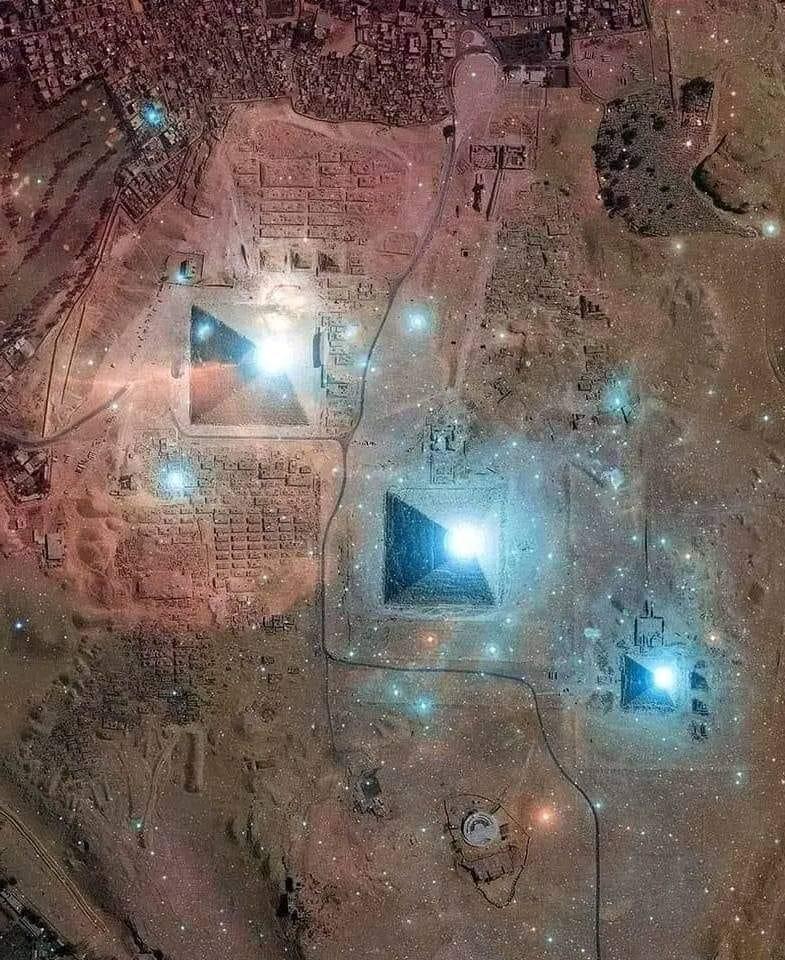
Forgiveness means giving up hope for a different past. It means knowing that the past is over, the dust has settled and the destruction left in its wake can never be reconstructed to resemble what it was. It’s accepting that there’s no magic solution to the damage that’s been caused. It’s the realization that as unfair as the hurricane was, you still have to live in its city of ruins. And no amount of anger is going to reconstruct that city. You have to do it yourself. ~Heidi Priebe
(Book [ad]: This Is Me Letting You Go https://amzn.to/3yQSm57)
(Art: 'Double Single', 1999 by Clive Smith) 
Don’t Give Up 
Time you enjoy wasting,
is not wasted time…
Art ≈ “swim to the moon” by Rafał Olbiński 
Coraline and Wybie 
"The Egyptian Blue"
Egyptian Blue is the oldest known artificial pigment. The Blue color has been throughout the history of humanity one of the most quoted, identified by it with royalty and divinity, due to the difficulty of its obtaining.
Blue pigments were used from very old, but more late than others such as red, Black, brown or ochre, easier to get in nature and used already in the art art. But the most quoted blue pigment came from minerals such as lapis, scarce and rare, and therefore very expensive. The largest lapis deposits are located in the hindukush of Afghanistan, where they are still exploited with procedures very similar to employees more than 3.000 years ago.
The Egyptians cared about those mines large amounts of lapis to obtain the azurite, the dust that provided the blue pigment with which they adorned their artistic works. Its price was so high that even in medieval times still cuadriplicaba the gold. That's why towards 3000 BC they sought a way to make their own blue pigment. Little by little they were perfecting the technique, which consisted of grinding silica, lime, copper and an alkaline base, and heat it at 800-900 degrees Celsius. The result obtained is considered the first synthetic pigment in history.
The Egyptians used it to paint wood, papyri and canvases, coloring enamels, inlays and vessels. But especially in the funerary field in masks, statues and paintings of the graves, as they believed that the blue color protected the dead from evil in the other life. The oldest known example of the pigment dates from about 5000 years ago and was found in the painting of a tomb of the reign of ka-Sen, the last Pharaoh of the first dynasty. In the new kingdom the Egyptian Blue was used abundantly as a pigment being found in statues, paintings of tombs and sarcophagi. 
Just wanna sit and relax here with someone and talk about life. 
A Cathar Castle - Château de Quéribus in Aude, Languedoc, France - is often considered to be the last stronghold for Cathars, to fall in 1255. 
This photo was taken by a Turkish photographer when a goat gave birth to a baby on an icy mountain. To save the life of the goat and the baby, a village girl (shepherdess) carried the mother on her shoulder and the girl's dog saved the newborn goat by carrying her too. This photo is a living example of humanity. 