
The she-wolf has this habit of wrapping herself around the neck of her wolf because the neck is the most vulnerable part of the animal.
By doing so, she shows him her unconditinal love.
For ethologists: Wolves are the most loyal and loving animals: they have only one partner throughout their life. The wolf is known to have an almost extraordinary tendernss and affection towards his she-wolf...which she knows perfetly well to return.
Credits goes to the respective owner 
When the snapdragon flowers die, the dried seed pods that remain look like tiny, brown, shrunken skulls.
The skull-like appearance of the seed pods is due to the snapdragon’s flower structure and its bilateral symmetry. They are often used in Halloween decorations and other spooky-themed events.
Snapdragons are named after their flower structure: Snapdragons are named after the blooms that resemble little dragon jaws that open and close when you gently squeeze the sides of the flowers.
The segmented blooms of some species of snapdragons must be pollinated by big, strong bumblebees because honeybees aren’t sturdy enough to open the jaws. So, if you ever see a bumblebee struggling with a snapdragon flower, you’ll know why! 😂 
In the Miyazaki Prefecture in southern Japan, groups of Japanese cedar trees appear to be arranged in concentric circles, strangely similar to crop circles and it’s not the work of green-thumbed aliens. The formation is actually the result of a meticulous project begun in 1973, centered around forest growth and spacing. The area was designated as “experimental forestry,” with one experiment calling for the planting of trees in 10-degree radial increments to form 10 concentric circles.
45 years later, the trees have grown in a unique convex shape, creating a beautiful formation and proving that tree spacing does indeed affect growth patterns 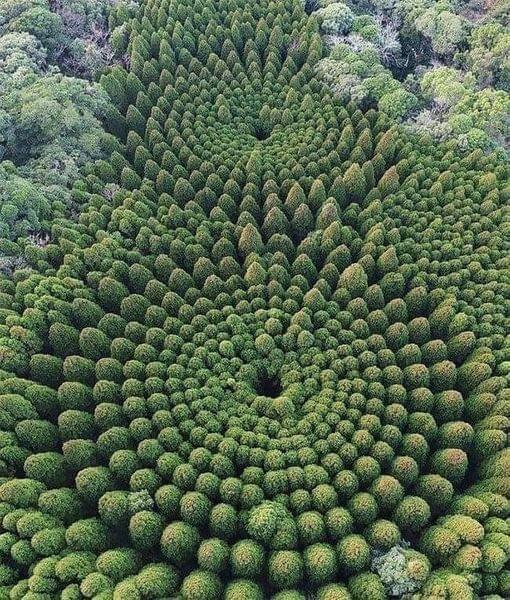
Split Apple Rock, Kaiteriteri, New Zealand.
Split Apple Rock is a giant stone what looks like a granite apple neatly cut with an otherworldly knife. The naturally occurring rock formation is estimated to be around 120 million years old.
According to Māori legend, the boulder was split by two feuding gods who were fighting to possess it. To resolve the issue, they used their huge godlike strength to break it in half. As such, the Māori name for the rock is *Tokangawhā*, which means “burst open rock.” A more scientific theory is that water seeped into a crevice in the rock and then froze during an ice age, expanding and thus splitting the stone. 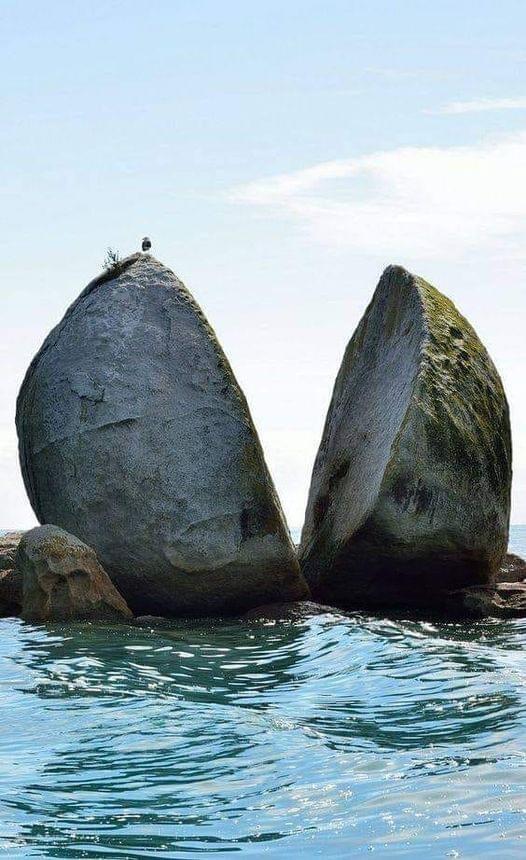
Eltz Castle, nestled in the hills above the Moselle River in Germany, is a prime example of medieval architecture and history.
Built in the 12th century, it has been meticulously preserved, remaining in the hands of the same family for over 850 years.
The castle features a stunning blend of Romanesque, Gothic, and Baroque styles, with its fairy-tale turrets and half-timbered structures. Inside, visitors can explore rooms filled with original furnishings, historical artifacts, and intricate artwork, providing a glimpse into the lives of its noble inhabitants.
Surrounded by lush forests and offering picturesque views, Eltz Castle remains a must-visit for history enthusiasts and tourists alike... 
In July 2024, RMS Titanic, Inc. will lead a groundbreaking expedition to the Titanic wreck site, the first since 2010. Utilizing cutting-edge technology, the team will employ remotely operated vehicles (ROVs) to capture high-resolution images and videos of the wreck and its surrounding debris field. The primary goal of this expedition is to document the current state of the Titanic, providing valuable data for conservation efforts and future studies. This mission is expected to reveal new insights into the ship's deterioration and the environmental conditions affecting the wreck.
This expedition marks a significant leap in underwater exploration technology. The ROVs will be equipped with advanced imaging systems to create detailed 3D models of the wreck, which will help scientists and historians analyze the site with unprecedented accuracy. The mission will also involve deploying new techniques in deep-sea mapping and photography, contributing to a broader understanding of the Titanic's historical and maritime significance.
In addition to the scientific and historical aspects, there are ongoing efforts to make this data accessible to the public. The high-resolution imagery and 3D models generated by the expedition will be used to create interactive exhibits and educational materials, ensuring that the legacy of the Titanic continues to captivate and educate future generations.
In parallel, billionaire Larry Connor is funding the development of a new submersible, the Triton 4000/2 Abyssal Explorer, which aims to set new standards in deep-sea exploration. Unlike previous submersibles, this new vessel will prioritize safety and reliability, with a design capable of reaching depths greater than those of the Titanic wreck. While this submersible is still in development, it highlights the ongoing interest and investment in exploring the Titanic and other deep-sea sites.
The Titanic wreck remains a site of immense historical interest and scientific value. These expeditions not only honor the memory of those who perished but also push the boundaries of underwater technology and exploration. 
"Aliens? Vegetables? Nope, vegetable and animal bridge mushrooms. They're the myxomycetes, and they can move and hunt for prey or look for the best environment for them. They are born from spores, like mushrooms.
Myxomycetes move like huge amoebas, like pulsating masses; their movements seem to be dependent on microfibrils that remember the fibers of the muscles. These "blobs′′ crawl (at a speed of 1 cm per hour) phagocusing bacteria, algae, yeasts, protozoa and other organic material as they go; they digest them and expel the remains outside. Not randomly, mixomycetes proliferate where there are plenty of prey - on decomposing logs or on carpets of dead, wet leaves. And so they're often found in the woods, yellow, purple, blue, red, thanks to the pigments they contain." 
Be safe out there guys.. 
Four legged tree in Cedar Falls, Iowa.
One hundred years ago (1915), John Henning planted 4 linden tree saplngs—2 on either side of the walk—leading up to his front door. Mr. Henning, a farmer who had immigrated from Germany as a young man, had moved into town when he retired. With lots of expereince grafting apple trees, he aimed to imitate the archways of lindens he recalled from Berlin. First, the two on the same side of the walk were lashed together and graftd. Then when each pair was tall enough to arch over the walk, he grafted the pairs. Over time, a towering trunk grew from the original four.
The four-legged tree of Cedar Falls has weathered two major setbacks in its long life. Not too many years after Mr. Henning started his project, the front right tree died and a replacemnt was grafted in. Thus the lesser girth of that trunk.
Source: Marcia Milner-Brage/Urban Sketchers 
Hiroyuki Sanada is a highly respected Japanese actor and martial artist known for his versatile talent and dynamic screen presence. Born on October 12, 1960, in Tokyo, Japan, he began his acting career as a teenager with the Himawari Theatre Group. Sanada's early roles in samurai and action films showcased his exceptional martial arts skills, particularly in the "Shogun's Samurai" and "The Twilight Samurai," which earned him critical acclaim and numerous awards.
Sanada's international breakthrough came with his role in "The Last Samurai" (2003), where he starred alongside Tom Cruise. This performance opened doors in Hollywood, leading to roles in diverse genres, including horror ("The Ring"), action ("Speed Racer"), and science fiction ("Sunshine"). His ability to portray complex characters with depth and intensity has made him a sought-after actor in both Eastern and Western cinema.
In addition to his film career, Sanada has made significant contributions to television and stage. Notable TV appearances include "Lost" and "Westworld," where he brought gravitas and authenticity to his roles. He also performed with the Royal Shakespeare Company, further proving his versatility and dedication to the craft.
Sanada's career is marked by a blend of physical prowess and emotional depth, making him a unique and enduring figure in the entertainment industry. His contributions have bridged cultural gaps and brought a rich representation of Japanese artistry to global audiences. 
Located in New Zealand, Mount Taranaki National Park showcases a distinct visual feature with its near-perfectly circular perimeter. The notable disparity in vegetation surrounding the base serves as a demonstration of the park's effective ecological stewardship. 

🌿 Purple Heart Vine (Gynura aurantiaca) 🌿
Stunning vines with rich, velvety purple leaves that cascade beautifully. Perfect for adding a touch of vibrant color to any wall or trellis!
Light: Bright, indirect light.
Water: Keep soil consistently moist but not soggy.
Soil: Well-draining potting mix.
Temperature: 60-85°F (16-29°C).
Humidity: Moderate to high.
Fertilizer: Monthly with a balanced 20-20-20 fertilizer. 
Lindos is located on the east coast of the island at a distance of 50 kilometers from the capital of Rhodes. Lindos, like the Old Town of Rhodes, is one of the monuments that have been declared subject to conservation and has therefore managed to maintain its traditional color. According to Homer, Lindos was built by the Dorians at the same time as Kamiros and Ialisos in the 12th century. Rhodes sent nine ships to the Trojan War and it is very likely that all of them came from Lindos. The development of the village was due to its naval power. Its two ports, like its impenetrable acropolis, were unique in Rhodes...Greece...🇬🇷 
I like seeing fresh fruits
Especially when i know the source. 


They pay to post content on your platform that insane
Lake Baikal, in eastern Siberia, is the oldest (20-25 million years) and deepest (5,315 feet) freshwater lake globally. It holds 20% of Earth's freshwater. You can see objects 40 meters deep in its clear waters. In winter, it freezes into stunning turquoise ice shards, some towering up to 39 feet, due to heavy winds. 

lt is called Chicama, the longest wave series in the world, occurs at a single point on the Peruvian is the only wave in the world that is legally protected by the law : Nothing can be built within the radius of two kilometersfrom that place ,so that nothing can affect its natural formation 