
Day 19: Wasn't a particularly epic one today, but got a solid amount done, and this was after getting a decent amount done yesterday at work.
I keep on thinking though that I'm 22 pages into a book on Bitcoin and I haven't talked about Bitcoin at all. I'm still on the introduction yeah, but for me Bitcoin is connected to absolutely everything, and so that's what I want to talk about: Bitcoin and everything. Shoving things into silos is classic fiat thinking and I am trying to think my way out of that.

Day 18: two weeks in a row with only Thursday being "dedicated" to writing, but today was a pretty light one.
Still, quality work was done, if only a tiny bit, and I'm still on pace for more than a page a day. I've been knocking out little bits at work or at home when I'm inspired.
Seeing the end of the introduction in the near future, and have a better idea for organising the main body of the book so still feeling positive despite the very light work day.

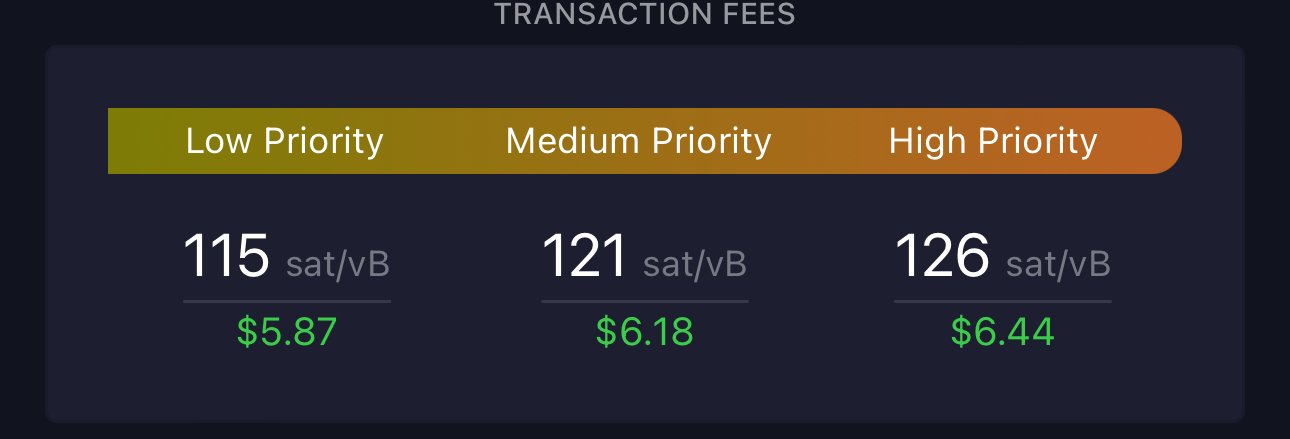
actually, if you look at the latest transactions, 70% of them are negligible amounts being sent for high (120-140s/vb) fees so it looks like blocks are being filled with spam of some kind. Is that what ordinal spam looks like?
You're the first person to comment on this in my feed. Fees up 10X in a week, yipes, but you get the feeling that something big is about to go down.


Day 17: Having trouble getting into a groove, had to work Tuesday so no work on the book.
Today was mostly unproductive; had some fun watching Bitcoin rip (modestly) and got a new gym membership at a 24hr gym as October had been rough for my exercise regimen (7 workouts all month, vs 15 in September, which doesn't sound like that much either, but yeah). Working out while the sun's up jives with my internal clock though, and I had been basically forced to go to the gym at 10pm-12am because the old one was so busy, so I have big hopes that this will be a really positive change for me.
And that will help me write more because... reasons?
Day 16: pretty good day, overall felt good and got a decent amount of work done. Feel like I'm very nearly done the introduction; on a pace of more than a page a day, which ain't nothin' to sneeze at despite it feeling like I don't get much done on my working days.
don't forget, words get repurposed all the time, and you really have to consider whether getting hung up on them is worth the effort
Day 15: There was nominal attention paid to the manuscript, but the day was spent finishing a follow up to my mom's email that I started writing last week.
I posted the first one here as a kind of 'proof-of-work' mini-essay, and the second one is kind of the same: some basic orange-pilling, explaining some concepts of Bitcoin as it relates to me personally and my book, and other more personal stuff.
No sense in pointing the second one, but trust me when I say that it involved a lot of work, as relationships often do. I've never had the best relationship with my mom so it was great that she travelled across the world to see me, and now we can have a correspondence that both helps me to sort my shit out, and my mom to understand me better.
I'm a 40-something married man, but let me repeat the same advice I've heard everyone else give on the subject: take every opportunity you can to build relationships with your parents/kids if and when they arrive, because there's really nothing like having someone you can actually relate to in this world who is willing and able to talk to you.

Day 14: Officially two working weeks (over a period of two months lol) on my book, and I really feel like the Lindy effect is starting to take over and this thing will just take on a life of its own. I took some time off, which definitely did derail progress a little bit, but I'm hoping it was just like a market dip that sets off the next rip, and my momentum just gets catapulted from here.
Today was the first full day that I really committed most of my time towards getting new material down on the page, and it culminated in a real crescendo of words, and a real moment of clarity in my head.
Whatever happens, I'm gonna stick to my guns and see this through, even if "my book" becomes a barely legible PDF that no one reads.
Hah, I saw that it was trendy to add 'The' to your username because, you know, 'The nostr' and all that.
Anyways, I'm ahead of the trend for once.

Yeah ok I'm not insane, you can't see it either.
I think that's the joke, he's referencing twitter and showing how nostr is different and therefore doesn't care about 'mainstream' relevance.
Or we're idiots, or missing something, or both.

I thought this was some kind of clever meta-commentary because I clicked on the note, and there's no thread visible, so that's why nostr will never become mainstream?
I want to read the thread though.
On the 'reddit' situation:
First of all, the current drama isn't relevant to r/bitcoin or the concept of reddit as a social media platform at all. Both of those things are mutually problematic and useful resources in their own ways. The reddit 'API' drama from a few months ago was much more germane to the broader discussion of taking control of your social media identity, and so if r/cryptocurrency users weren't already aware of the dangers of trusting your online identity and its inherent value to an unaccountable centralised entity, well caveat emptor fuckheads.
Second, as the name implies, r/cryptocurrency is a place for shitcoiners, and the current drama stems from reddit rugging the shitcoin that got paid out to subreddit contributors. Now I would never say that shitcoiners are irredeemable, far from it, I just think it's important to acknowledge the fundamental difference in mindset that needs to take place in order for a shitcoiner to understand a truly v4v platform. There was a lot of 'value' created at r/cryptocurrency by a lot of talented users, if you consider fiat-brained shitcoin hype to be valuable. Again, I'm not saying this to disparage the users who brought the energy and vibrancy to the subreddit that, for example, r/bitcoin lacks. The problem is the mindset of desperation engendered by the fiat system that causes them to fall into the trap of v4nothing that undermines the productive potential of humanity within this system, and that Bitcoin exists to try and counter.
First one needs to understand that Bitcoin is not crypto, to break the affinity in the massive affinity scam that the word 'crypto' has come to represent, and then one can appreciate true v4v.
Obviously anyone who can make this transition in mindset could bring a lot of value to nostr, and who knows what contributions will come from disaffected r/cryptocurrency users. A dumbfuck like me, who contributes basically nothing but long-winded screeds that nobody reads, made the mindset transition so there has to be a lot of actually talented people who will figure it out as well.

Or verbs, in the case of snort...
ie. I snort nostr
It was nice to have someone to talk to about the kinds of things that I spend a lot of time thinking about, but still, every time I meet someone who is sympathetic to conversation on topics that I haven't put to words before, I end up so disappointed in the way they come out. It's just yet another paradox that plagues human life in general: you can't get a job because you don't have any experience, but you don't have any experience because you can't get a job; I struggle to articulate my thoughts in speech because I lack a community within which I can essay my thoughts, but I lack a community within which I can essay my thoughts because I struggle to articulate them.
With writing on the other hand, it's always this sick bipolar sense that I'm either so far above the fray, or so far below it, especially when it comes to online discussion, and it's hard not to see how disillusioned we all are when it comes to online discourse, yet we can't stop engaging with it in some way because it has become a part of life, and so I've held back from trying to write too much on the internet. If the internet ever represented a renewal in the hope for freedom in our lives, then paradoxically it now represents a massive constraint on what constitutes valid or authentic self-expression. The contradiction is heightened even further for me because I see in Bitcoin, freedom money by and for the internet, the key to unlock some of the paradoxes at the heart of human life concerning time, work, money, power, truth, and freedom, and yet I feel totally removed from the conversation because it all happens through social media, which as I said I can't wrap my head around. I don't find any authenticity in the community, not because it isn't there, but because I lack the context of authenticity in my own life, and of course the medium itself is inherently inauthentic which makes finding authenticity that much harder. And so I feel that if I can establish a context for authentic engagement with the community by writing something that articulates my thoughts better than I ever could in person, I can kind of bypass some of the intractable paradoxes that have been holding me back personally, and maybe shed some insight on the bigger picture.
I've been using the term 'authenticity' which might seem like the kind of vague, wishy washy thing that people just throw around for rhetorical purposes to make them sound like they give a shit or something, but the concept acts as the underlying basis for the patterns of commonality that I've traced through everything that I've been reading recently and everything that I want to connect with in my writing. Actually it's funny that the last book I read way back in early 2019, during the time I started working six days a week, naively thinking that I was getting ahead in life even though I was completely starved of intellectual stimulation or curiosity, and before the pandemic turned the world on its head and I was begrudgingly forced to come out of my little anti-thought cocoon, was Nassim Taleb's Skin in the Game, which dealt precisely with the subject of how authenticity and accountability could act as forces for social justice in the face of the crises unveiled by the 2009 GFC. Ripped straight from Wikipedia, his point in the book was "that skin in the game—i.e., having a shared risk when taking a major decision—is necessary for fairness, commercial efficiency, and risk management, as well as being necessary to understand the world." He built his name on popularising terms that he coined around that time and created a whole little cottage industry for himself writing books like Black Swan and Antifragile, and going on cable news shows to discuss economics and politics, and while his ideas and concepts are valid and remain useful, he himself has turned out to be a cautionary tale for how hypocrisy and lack of accountability undermine discussions on how to fix our broken institutions, or act with authenticity in a corrupt system. Reading his work it's clear, if he's not a full-blown egomaniac, he seems to think quite highly of himself and he has a lot of contempt for institutions and the people he sees as blindly propping them up, and there's nothing at all wrong with this if he was just using it as a means to further the project of somehow contributing to the improvement of humanity, except it has become increasingly clear that he didn't believe a whit of what he said in terms of living a life that followed the precepts that he preached, and that all the attention that his ideas garnered simply contributed to the further inflation of his ego. Sadly this pattern is one that we see endlessly repeating itself -- Musk, Trump, Kanye are all prominent examples, but as I said, the pattern is endless -- where ambitious people use the media to disseminate a self-promotional message that ostensibly has a concern for the improvement of humanity at its heart, despite the fact that it's just pushing a product, and everyone overlooks the egomania and the hypocrisy because they love the product and how it makes them feel, all while they continue funneling the money that represents their adulation into the pockets of such individuals who in turn become more corrupt, powerful, and disconnected from whatever authentic connection to humanity that they had, or thought they had. This loss of connection to the rest of humanity by powerful individuals is not new, but is just increasingly visible these days, especially through social media. The phenomenon falls under the philosophical concept of subjectivity and I hope that by analysing and framing modern subjectivity accurately and succinctly, and then discussing the feasibility of alternate forms of subjectivity such as my idea of "peer to peer subjectivity", I can start to build a kind of authentic connection to the world for myself and others.
The idea is based on the structure of network connectivity, where users on the network govern each other's behaviour based on their adherence to a protocol. It's inspired, of course, by Bitcoin, and while it's far from being fleshed out, and obviously will need to differ from actual computer network protocols, as human subjectivity isn't something that can be forced to conform to the relatively simple protocols that they run on, it's an idea that I've been slowly figuring out in my head in little fits and spurts, and I won't know what it's really worth until I put the work in, get it down on the page, and see what kind of feedback it gets. The key point is to outline a system that prioritises maintaining the authenticity of a message by preventing a subject from manipulating the system in its favour in order to leech value out of the system and grow its influence, giving all of its peers a system of checks and balances to keep it honest, and making sure that there's something tangible at stake in order to distribute risk across the network. Bitcoin has set an important example here in the way that it ties energy to value because that's how it makes the value tangible: it's worth the price of energy, simple as, no manipulation possible. Under the current system of government issued currencies, only the power of coercion makes value tangible, American power outstripping the rest of the globe and therefore being the most valuable, and so all manner of manipulation is possible, including all manner of deception, fraud, and criminality. I believe that this lack of accountability for deception and manipulation, and the lack of tangibility in value generation are at the heart of many of the existential crises that humanity seems unable to even begin to tackle because of conflicting political interests.
So far in my writing I've been trying to outline how we arrived here, what kind of historical events directly contributed to what a lot of people online refer to as "the worst timeline", and I've been focusing a lot on the early 20th century, specifically what is commonly called the modern and pre-modern eras, the inflection point where the scientific developments spurred on by a European arms race culminated in the mass liquidation of European empires, and the consolidation of western imperialism under the aegis of the American empire. I'm less concerned with establishing a timeline of events but rather with establishing the effects of history on subjectivity and the intellectual movements that inform it. Basically, it boils down to something very much like what we're dealing with now: a sense of alienation in a world where technology has developed faster than institutions can attempt to balance out their deleterious effects, to the benefit of unaccountable autocratic forces, and that those effects have been asymmetrically offset onto the powerless. The difference from today is that in the 20th century, scientific developments in energy unlocked the greatest material surpluses in productivity that humanity has ever known, many powerful interests that had been able to manipulate the distribution of material surpluses in the past had been deprived of their influence by the destruction of capital during the two great wars, and that consequently of both of these facts, living conditions had improved so enormously that there was an enormous amount of faith that the world was developing in a positive and just manner, unlike today. The past echoes in the present and it has much to teach us, but we still have to ask the question of exactly where the project of "modernity" went wrong. Many have proposed that it had to do with Nixon taking America off the gold standard in 1971, the establishment of the Petro-dollar to guarantee America's energy reserves while entrenching the corrupt power of the planet-destroying oil industry, or even Kissinger's gamble to undermine the Soviets by opening up diplomatic and trade relations with China, thereby massively empowering the CCP, which has turned out to be the largest threat to human existence in the 21st century, except maybe the excesses of American imperialism fueled by the oil industry. All of those are very compelling factors, and the best way that I've found to holistically understand them as a historical moment came from Mark Fisher, the British leftist writer I told you about briefly when we were on the subway last week, and his framing of the failure of modernity as "post-Fordism". I don't really have time to get into all the implications of why he chose "Fordism" as the term to best characterise the early modern period, as this has taken me all day to write and certainly must be becoming onerous to read if you even have read this far, but it suffices to say that it really made a lot of sense to me in explaining the shift in feeling between the modern and postmodern periods, beyond what I had understood those terms to mean from studying literature, art, and history. The crux of his argument was that there was a fundamental shift in the economy during this period --Fisher actually nails it down to the precise moment in 1979 when Jacob Volcker raised the interest rate by 22% in a day, he says, thereby instituting supply-side economics-- from a duty/class-based system, to a control based system, and the implications of this are all the dysfunction and uncertainty that plagues discourse surrounding politics and the economy, around the world today. Ford is a particularly apt figure to define that period as his famous goal of having a Ford in every driveway is almost synonymous with the "American Dream", and the loss of which is synonymous with pessimism at the state of the decaying world order. He represents a kind of capitalist who, while not benign or desirable by any means, at least recognised that mass demand needed to be facilitated in order for faith in the economy to propel growth. I also like the use of his name to represent this period because of a little episode that mostly only Bitcoiners will know about, where Ford proposed to use an old NY power plant to implement a new kind of energy-backed currency, that would deprive the world's government of the incentive to control money, and thus end war. Obviously he never followed through with this, and war only became increasingly incentivised once the gold standard was abolished, but it remains an interesting thought to keep coming back to: could an energy-backed currency help establish a sustainable and peaceful world order that leads humanity toward a new era of hope and prosperity? No, I don't believe that it could ever happen, but that doesn't mean I don't want to explore how it could happen, what it could look like, and in the meantime what living the kind of authentic life, based on the ethical premises of such a currency, looks like.
Day 13: Got a bit of work done today after a little bonus time on Friday owing to my total lack of progress Thursday (day 12), but otherwise a bit of a wonky one. As mentioned on day 12, I had been on vacation for two weeks and therefore had a bit of trouble getting back into it. During that time I managed to share a bit of what I was thinking and working on with my mom, but not in much detail.
Today I spent most of the day writing a massive email, which I will include in my next note.