
🚀 **Upcoming Space Launch** 🚀
🌌 **Mission Name**: Falcon 9 Block 5 | Starlink Group 6-74
🗓️ **Launch Date**: 2025-04-25T01:52:40Z
🚀 **Rocket**: Falcon 9
📖 **Details**: A batch of 28 satellites for the Starlink mega-constellation - SpaceX's project for space-based Internet communication system.
#SpaceLaunch #RocketScience
🚀 **Upcoming Space Launch** 🚀
🌌 **Mission Name**: Long March 2F/G | Shenzhou 20
🗓️ **Launch Date**: 2025-04-24T09:17:31Z
🚀 **Rocket**: Long March 2
📖 **Details**: Ninth crewed flight to the Chinese space station.
#SpaceLaunch #RocketScience
🚀 **Upcoming Space Launch** 🚀
🌌 **Mission Name**: Falcon 9 Block 5 | Starlink Group 11-9
🗓️ **Launch Date**: 2025-04-27T20:55:00Z
🚀 **Rocket**: Falcon 9
📖 **Details**: A batch of satellites for the Starlink mega-constellation - SpaceX's project for space-based Internet communication system.
#SpaceLaunch #RocketScience
🚀 **Upcoming Space Launch** 🚀
🌌 **Mission Name**: Long March 3B/E | Unknown Payload
🗓️ **Launch Date**: 2025-04-27T15:55:00Z
🚀 **Rocket**: Long March 3
📖 **Details**: Details TBD.
#SpaceLaunch #RocketScience
🚀 **Upcoming Space Launch** 🚀
🌌 **Mission Name**: Firefly Alpha | FLTA006 (Message in a Booster)
🗓️ **Launch Date**: 2025-04-27T13:37:00Z
🚀 **Rocket**: Firefly Alpha
📖 **Details**: Sixth flight of the Firefly Alpha small satellite launcher, launching the demonstration mission for Lockheed Martin's new LM400 satellite bus, which will carry a communications payload. The satellite bus is customizable to support different missions, including remote sensing, communications, imagery and radar Earth observations. It can also support different kinds of orbits and launch configurations.
#SpaceLaunch #RocketScience
🚀 **Upcoming Space Launch** 🚀
🌌 **Mission Name**: Falcon 9 Block 5 | Starlink Group 6-74
🗓️ **Launch Date**: 2025-04-25T01:52:40Z
🚀 **Rocket**: Falcon 9
📖 **Details**: A batch of 28 satellites for the Starlink mega-constellation - SpaceX's project for space-based Internet communication system.
#SpaceLaunch #RocketScience
🚀 **Upcoming Space Launch** 🚀
🌌 **Mission Name**: Long March 2F/G | Shenzhou 20
🗓️ **Launch Date**: 2025-04-24T09:17:00Z
🚀 **Rocket**: Long March 2
📖 **Details**: Ninth crewed flight to the Chinese space station.
#SpaceLaunch #RocketScience
❓ **Space Quiz**
Which planet has the strongest winds in the Solar System?
1️⃣ Neptune
2️⃣ Saturn
3️⃣ Jupiter
4️⃣ Mars
Answer in the comments! 🚀
#SpaceQuiz #AstronomyTrivia #LearnSpace
🚀 **Mars Fact**
Mars is home to the tallest volcano in the Solar System, Olympus Mons, standing at 22 km high! 🗻
#Mars #SpaceFacts #MarsTrivia
📸 **Mars Photo**
🌌 **Sol 3411**
📷 Camera: MAST
Guarda la foto: 
#Mars #Space #NASA
NASA Astronomy Picture of the Day (2025-04-24): NGC 6164: A Dragon's Egg
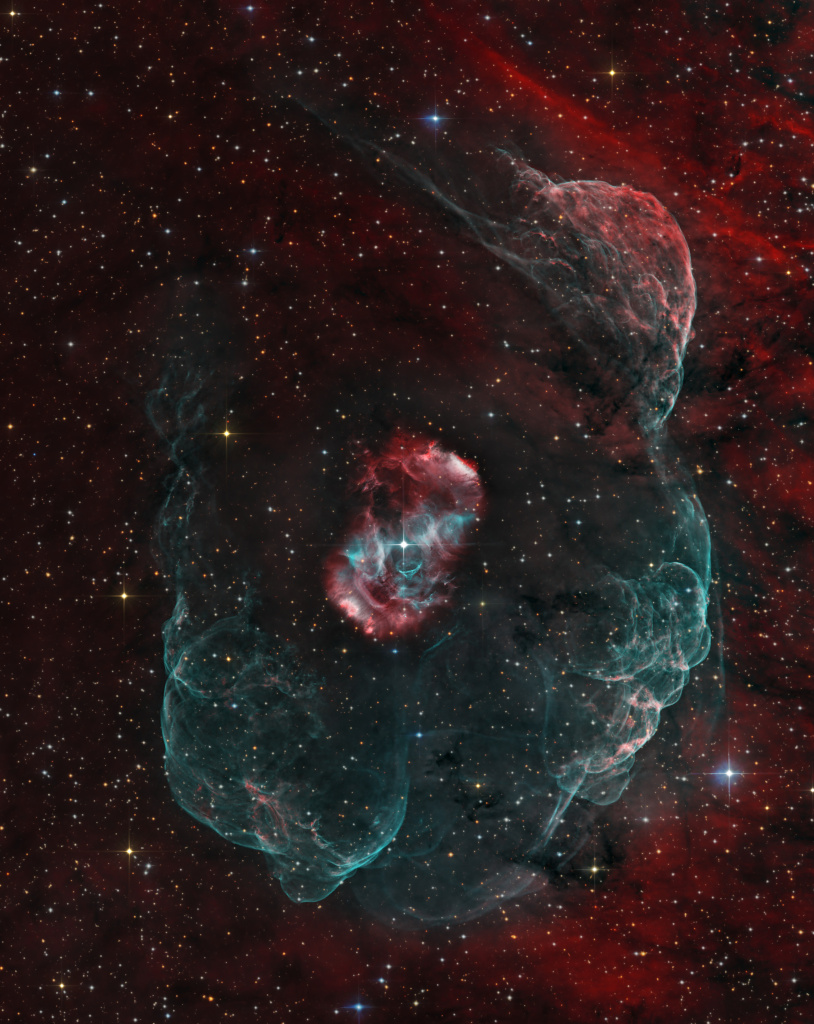
Beautiful emission nebula NGC 6164 was created by a rare, hot, luminous O-type star, some 40 times as massive as the Sun. Seen at the center of the cosmic cloud, the star is a mere 3 to 4 million years old. In another three to four million years the massive star will end its life in a supernova explosion. Spanning around 4 light-years, the nebula itself has a bipolar symmetry. That makes it similar in appearance to more common and familiar planetary nebulae - the gaseous shrouds surrounding dying sun-like stars. Also like many planetary nebulae, NGC 6164 has been found to have an extensive, faint halo, revealed in this deep image of the region. Expanding into the surrounding interstellar medium, the material in the halo is likely from an earlier active phase of the O star. This gorgeous telescopic view is a composite of extensive narrow-band image data, highlighting glowing atomic hydrogen gas in red and oxygen in greenish hues, with broad-band data for the surrounding starfield. Also known as the Dragon's Egg nebula, NGC 6164 is 4,200 light-years away in the right-angled southern constellation of Norma.
Dangerous Asteroids Near Earth:
- (2002 JQ100) (Size: 651.6883821679 meters)
- (2011 DV) (Size: 424.6586539002 meters)
- (2013 GR38) (Size: 241.0127281611 meters)
- (2013 HJ19) (Size: 297.8790627982 meters)
- (2014 UV) (Size: 472.1064988055 meters)
- (2014 YE1) (Size: 124.1766612574 meters)
- (2018 RW1) (Size: 124.1766612574 meters)
- (2019 FY2) (Size: 19.6806745089 meters)
- (2019 SW9) (Size: 74.8238376074 meters)
- (2020 HX4) (Size: 32.6617897446 meters)
- (2020 MK3) (Size: 41.1187571041 meters)
- (2021 GC1) (Size: 13.3057689797 meters)
- 612362 (2002 JQ100) (Size: 633.9280645215 meters)
- (2022 LA3) (Size: 37.5007521798 meters)
- (2023 AR) (Size: 58.8897863577 meters)
- (2023 LO) (Size: 18.1986837803 meters)
- (2023 UP2) (Size: 27.2922900914 meters)
- (2024 HZ) (Size: 10.8652563862 meters)
- (2024 WC15) (Size: 398.1438198091 meters)
- (2025 HM) (Size: 167.5868657563 meters)
- (2025 HX) (Size: 18.1401126114 meters)
- (2025 HF1) (Size: 32.2136531891 meters)
NASA Astronomy Picture of the Day (2025-04-24): NGC 6164: A Dragon's Egg
Beautiful emission nebula NGC 6164 was created by a rare, hot, luminous O-type star, some 40 times as massive as the Sun. Seen at the center of the cosmic cloud, the star is a mere 3 to 4 million years old. In another three to four million years the massive star will end its life in a supernova explosion. Spanning around 4 light-years, the nebula itself has a bipolar symmetry. That makes it similar in appearance to more common and familiar planetary nebulae - the gaseous shrouds surrounding dying sun-like stars. Also like many planetary nebulae, NGC 6164 has been found to have an extensive, faint halo, revealed in this deep image of the region. Expanding into the surrounding interstellar medium, the material in the halo is likely from an earlier active phase of the O star. This gorgeous telescopic view is a composite of extensive narrow-band image data, highlighting glowing atomic hydrogen gas in red and oxygen in greenish hues, with broad-band data for the surrounding starfield. Also known as the Dragon's Egg nebula, NGC 6164 is 4,200 light-years away in the right-angled southern constellation of Norma.
🚀 **Upcoming Space Launch** 🚀
🌌 **Mission Name**: Falcon 9 Block 5 | Starlink Group 11-9
🗓️ **Launch Date**: 2025-04-27T20:55:00Z
🚀 **Rocket**: Falcon 9
📖 **Details**: A batch of satellites for the Starlink mega-constellation - SpaceX's project for space-based Internet communication system.
#SpaceLaunch #RocketScience
🚀 **Upcoming Space Launch** 🚀
🌌 **Mission Name**: Long March 3B/E | Unknown Payload
🗓️ **Launch Date**: 2025-04-27T15:55:00Z
🚀 **Rocket**: Long March 3
📖 **Details**: Details TBD.
#SpaceLaunch #RocketScience
🚀 **Upcoming Space Launch** 🚀
🌌 **Mission Name**: Firefly Alpha | FLTA006 (Message in a Booster)
🗓️ **Launch Date**: 2025-04-27T13:37:00Z
🚀 **Rocket**: Firefly Alpha
📖 **Details**: Sixth flight of the Firefly Alpha small satellite launcher, launching the demonstration mission for Lockheed Martin's new LM400 satellite bus, which will carry a communications payload. The satellite bus is customizable to support different missions, including remote sensing, communications, imagery and radar Earth observations. It can also support different kinds of orbits and launch configurations.
#SpaceLaunch #RocketScience
🚀 **Upcoming Space Launch** 🚀
🌌 **Mission Name**: Falcon 9 Block 5 | Starlink Group 6-74
🗓️ **Launch Date**: 2025-04-25T01:52:40Z
🚀 **Rocket**: Falcon 9
📖 **Details**: A batch of 28 satellites for the Starlink mega-constellation - SpaceX's project for space-based Internet communication system.
#SpaceLaunch #RocketScience
🚀 **Upcoming Space Launch** 🚀
🌌 **Mission Name**: Long March 2F/G | Shenzhou 20
🗓️ **Launch Date**: 2025-04-24T09:17:00Z
🚀 **Rocket**: Long March 2
📖 **Details**: Ninth crewed flight to the Chinese space station.
#SpaceLaunch #RocketScience
🚀 **Upcoming Space Launch** 🚀
🌌 **Mission Name**: Falcon 9 Block 5 | Starlink Group 11-9
🗓️ **Launch Date**: 2025-04-27T20:55:00Z
🚀 **Rocket**: Falcon 9
📖 **Details**: A batch of satellites for the Starlink mega-constellation - SpaceX's project for space-based Internet communication system.
#SpaceLaunch #RocketScience
🚀 **Upcoming Space Launch** 🚀
🌌 **Mission Name**: Long March 3B/E | Unknown Payload
🗓️ **Launch Date**: 2025-04-27T15:55:00Z
🚀 **Rocket**: Long March 3
📖 **Details**: Details TBD.
#SpaceLaunch #RocketScience