
Leah Stauffer, head of Half A Million Kids, a charity dedicated to foster kids, talks the foster children factor of human trafficking with Mercedes Schlapp on America Uncanceled.
20,000 children in foster care go missing each year, a startling statistic that is often dismissed, but is explained by another statistic that shows that 60% of children rescued by the Commercial Sexual Exploitation of Children have a history in the foster system.
Upon discovering these statistics, Stauffer was inspired to use her charity to take a new approach to helping foster kids who are victims of human trafficking. She noticed an established system to respond to the needs of foster care victims of human trafficking but lacking efforts to prevent foster children from being trafficked in the first place. She decided to take the prevention approach and focus on getting foster children adopted into stable families.
“There’s a lot of rescue, a lot of trauma, a lot of therapeutic work. I’m like, ‘Yes, but if we get the kids adopted, they don’t get trafficked in the first place. So, let’s start working in prevention.’ So, I tied trafficking into our mission. So, now we’re dedicated to foster and trafficked children because there’s such an intersection with both,” said Stauffer.
Stauffer and Half A Million Kids have a three-step plan intended to prevent or repair the major areas of instability in the lives of foster children. Her plan starts by encouraging more families to adopt and then proceeds by empowering social and case workers with modern resources and training and then revolutionizing the group home setting.
Watch the full conversation with Stauffer on Rumble and social media @CPAC. https://video.twimg.com/ext_tw_video/1823716641051484160/pu/vid/avc1/720x1280/Q9bmQ9r1WA_chpRV.mp4?tag=12
America UnCanceled: Leah Stauffer joins @mercedesschlapp to discuss the importance of ending child trafficking in America https://t.co/npEI9Vfayg https://video.twimg.com/amplify_video/1823472659767742464/vid/avc1/1280x720/Pq7Phbhn3uz-Qvat.mp4?tag=14
Listen Now: @realDonaldTrump with @ElonMusk on X Spaces
"We have a modern day Axis of Evil."
For more visit https://t.co/zuAkf6vEYT https://t.co/rj7yzNG04U https://video.twimg.com/ext_tw_video/1823465446265233408/pu/vid/avc1/720x1280/BeR3zbtH9rtzPlM-.mp4?tag=12
CPAC Endorses Bryan Leib for election to U.S. Congress (FL-25) https://t.co/PKov76qZIR 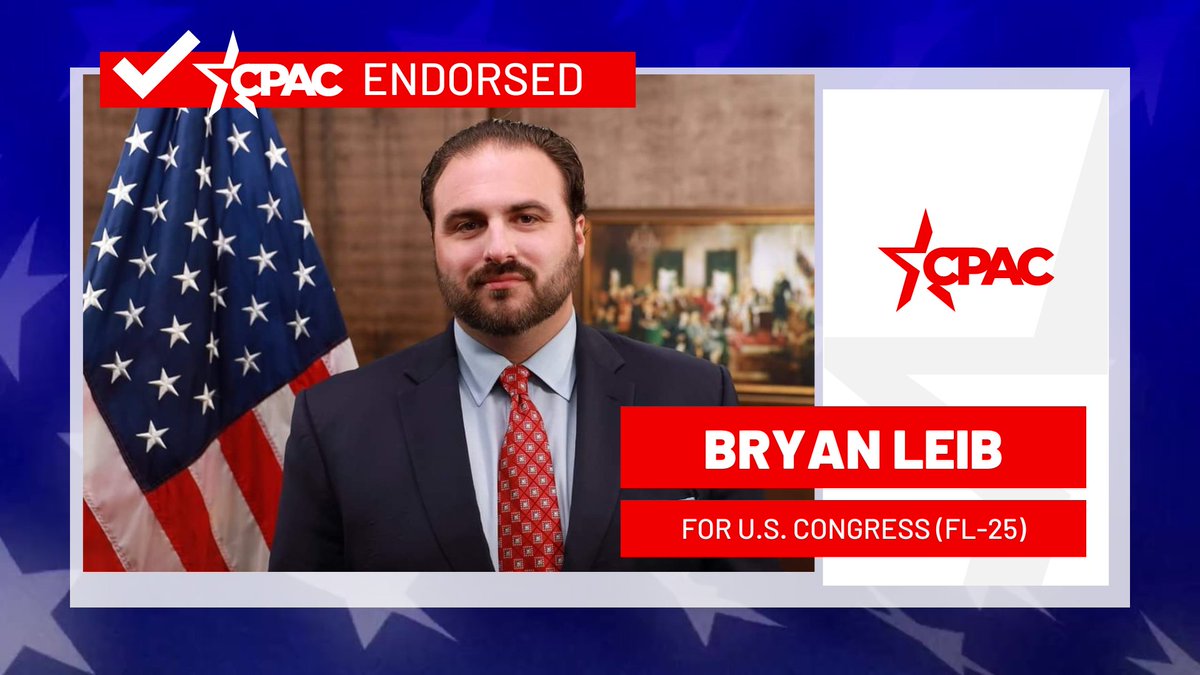
Kamala Harris and Joe Biden swiped more than a QUARTER-TRILLION dollars from #Medicare to fund a so-called EVs Americans don't want, health care for illegals, and to pay off their big insurance buddies. Premiums skyrocketed and access to care fell. America's seniors demand that @KamalaHarris end the IRA's Medical raid!
Sign the petition at https://t.co/xwNRe0mJxR. @CPAC @GOP
Link to: https://t.co/MP75gLxD5t
Listen Now: @realDonaldTrump with @ElonMusk on X Spaces
"These are criminals that make our criminals look like nice people."
For more visit https://t.co/zuAkf6vEYT https://t.co/YEzZXf7nr8 https://video.twimg.com/ext_tw_video/1823435204238745600/pu/vid/avc1/720x1280/fGvKMGBnlyOafuW9.mp4?tag=12
Listen Now: @realDonaldTrump with @ElonMusk on X Spaces
"Biden shut down the Keystone XL pipeline and approves the Russian pipeline!"
For more visit https://t.co/zuAkf6vEYT https://t.co/vgqeDUSQ2X https://video.twimg.com/ext_tw_video/1823424414534234112/pu/vid/avc1/720x1280/SlouOAMfY3Skm2JW.mp4?tag=12
Listen Now: @realDonaldTrump with @ElonMusk on X Spaces
"There's never been a country in history that's had a catastrophe like this."
For more visit https://t.co/zuAkf6v79l https://t.co/5uD24pyzuR https://video.twimg.com/ext_tw_video/1823413361289154560/pu/vid/avc1/720x1280/mBWQKfkelp0bIE6N.mp4?tag=12
Listen Now: @realDonaldTrump with @ElonMusk on X Spaces
"We don't have a president right now and she's [Kamala Harris] will be worse than him [Joe Biden]"
For more visit https://t.co/zuAkf6v79l https://t.co/1ALve2Hqug https://video.twimg.com/ext_tw_video/1823400785155170312/pu/vid/avc1/720x1280/QYKFr1JVbNslpKcS.mp4?tag=12
Listen Now: @realDonaldTrump with @ElonMusk on X Spaces
"We're going to have the best Iron Dome in the world. We need it and we're going to make it all in the United States. We're going to have protection."
For more visit https://t.co/zuAkf6v79l https://t.co/bb4XrDTJ4l https://video.twimg.com/ext_tw_video/1823392857756971010/pu/vid/avc1/720x1280/Rsy44AlQx2hdxTxV.mp4?tag=12
Listen Now: @realDonaldTrump with @ElonMusk on X Spaces
“They hired 88,000 IRS agents and many of them were assigned go get waitresses’ and caddies’ tips… And then all of a sudden for politics she comes out with what I said.”
For more visit https://t.co/zuAkf6v79l https://t.co/atbIT8pfSw https://video.twimg.com/ext_tw_video/1823383354659438592/pu/vid/avc1/720x1280/liRiRE6OiJwb4X3K.mp4?tag=12
Listen Now: @realDonaldTrump with @ElonMusk on X Spaces
"I said to Vladimir Putin don't do it, you can't do it Vladimir. If you do it, it's gonna be a bad day"
For more visit https://t.co/zuAkf6v79l
#TrumpOnX #TeamTrump #MAGA https://t.co/7FHHxYdOev https://video.twimg.com/ext_tw_video/1823374711163682816/pu/vid/avc1/720x1280/EtwQI5h_QKzwxaUU.mp4?tag=12
Kamala Harris has zero policies that would make America great, so she is cherry-picking from President Trump’s agenda instead @coletonfurlow https://t.co/nScbqR6Rid https://video.twimg.com/amplify_video/1823116422618161153/vid/avc1/1080x1920/k0gp8dIdlLIEaMs7.mp4?tag=16
The spread of Bitcoin has become a global phenomenon @mercedesschlapp https://t.co/rscLgHH12l https://video.twimg.com/ext_tw_video/1821901120366604288/pu/vid/avc1/1280x720/I0c53c7QgkW9B3TL.mp4?tag=12
Listen to Matt Kita's advice to those who are wanting to start investing in Bitcoin! @mercedesschlapp https://t.co/y3nIiTNgl9 https://video.twimg.com/ext_tw_video/1821900890057383936/pu/vid/avc1/1280x720/6MSqAmfClLVf0zgj.mp4?tag=12
President Trump is absolutely right.
What the Democrats did to disenfranchise their voters was about as undemocratic as it gets.
Voters didn't choose Kamala Harris. She was chosen for them. https://t.co/6LmRwvACJi https://video.twimg.com/ext_tw_video/1821702566318895105/pu/vid/avc1/640x360/fT7toM-C4XQInv3p.mp4?tag=12
Kamala Harris has been the worst Border Czar in history. https://t.co/tfCGt0XZWs https://video.twimg.com/ext_tw_video/1821643879247990784/pu/vid/avc1/1280x720/uq6WPoNcdjTiVeZR.mp4?tag=12
A Kamala Harris presidency will be more destructive than Joe Biden's. https://t.co/spT6VgmkGo https://video.twimg.com/ext_tw_video/1821625754024583168/pu/vid/avc1/1280x720/CKrlLYClavP3cP1U.mp4?tag=12
🚨WATCH: As District Attorney, Kamala Harris turned San Francisco into a sanctuary city for illegal aliens.
Then the criminal gangs took over.
The future of America is on the ballot.
Vote accordingly. https://t.co/vtGksztHM0 https://video.twimg.com/ext_tw_video/1821621071759482880/pu/vid/avc1/960x520/nMz77RQhszVzXSDs.mp4?tag=12
In late June, near the very end of their 2023-2024 term, the Supreme Court made a landmark decision in the case of Loper Bright Enterprises v. Raimondo, overturning the Chevron Doctrine by a decisive 6-2 vote, with one Justice recused. This ruling represents a significant shift in the relationship between federal agencies and the courts, particularly in how statutory interpretations are handled. However, it has sparked a wave of alarmist rhetoric from prominent figures like Senator Elizabeth Warren and Senator Chuck Schumer, who claim that this decision will severely hamper federal agencies’ ability to regulate. These claims, while sensational, are not entirely accurate. The reality is that federal agencies can still regulate, but they can no longer make questionable statutory interpretations and expect courts to defer to them uncritically.
The Chevron Doctrine: A Brief Overview
To understand the significance of this ruling, it is crucial to revisit the origins of the Chevron Doctrine. Established in 1984 in the case of Chevron U.S.A., Inc. v. Natural Resources Defense Council, Inc., this doctrine effectively granted federal agencies significant latitude in interpreting ambiguous statutes. If a law was unclear, courts were instructed to defer to the agency’s interpretation, provided it was "reasonable." Over the years, this deference allowed agencies to expand their regulatory reach, often to the detriment of clear statutory language and, arguably, democratic principles.
The doctrine led to several controversial interpretations and actions by federal agencies, often resulting in regulations that seemed to stretch the boundaries of statutory authority. The power granted by Chevron deference effectively allowed unelected bureaucrats to wield legislative-like powers, crafting regulations that carried the force of law, with little judicial oversight.
The Reality Post-Chevron: Agencies Can Still Regulate
Contrary to the claims made by some political figures, the Supreme Court’s decision in Loper Bright does not strip federal agencies of their regulatory powers. Instead, it simply redefines the boundaries within which they must operate. The core of the Court’s ruling is a return to the pre-Chevron standard, where courts, not agencies, are the ultimate interpreters of statutory meaning. This shift ensures that regulations are grounded in a clear and accurate reading of the law, rather than the potentially biased or expansive interpretations of agency officials.
Importantly, the Administrative Procedure Act (APA) still governs the regulatory process. Under the APA, agencies must ensure that their regulations are not "arbitrary, capricious, an abuse of discretion, or otherwise not in accordance with the law." This standard remains intact and continues to provide a robust framework for the creation and enforcement of regulations. Agencies are still free to use their subject-matter expertise in crafting regulations, but those regulations must align with a reasonable and fair interpretation of the underlying statutes. Courts will not substitute their judgment on technical matters, such as science or engineering, but they will now have a greater say in ensuring that regulations do not stray beyond what the law actually permits.
Dispelling the Alarmism: The Role of Courts and Agencies
The notion that courts, by rejecting Chevron deference, will begin to "second-guess" agencies on complex technical matters is a misconception. What the Supreme Court has made clear is that while agencies have expertise in specific areas, this expertise does not extend to interpreting statutory language in a way that significantly alters the intent of Congress. The judiciary’s role is to ensure that the statutes are applied as intended, not to defer blindly to agency interpretations that may go beyond what Congress envisioned.
This does not mean that agencies are powerless or that regulations will become ineffective. Agencies will still be able to draw on their expertise to address complex issues within their regulatory domain. What changes is that their interpretations of ambiguous statutes will now be subject to greater judicial scrutiny. This move restores a critical check on executive power, ensuring that agencies cannot unilaterally expand their authority without clear statutory backing.
The LoperBright and Relentless Cases: A Victory for Judicial Responsibility
The Loper Bright case, along with the Relentless Inc. v. Department of Commerce case, which also involved challenges to agency interpretations, represents a significant victory for judicial responsibility and the separation of powers. By overturning the Chevron Doctrine, the Court has reaffirmed the judiciary's role in interpreting laws, a role that had been diminished under Chevron. This ruling restores the balance of power, ensuring that agencies cannot act as both interpreters and enforcers of laws without meaningful judicial oversight.
Chief Justice John Roberts, writing for the majority in Loper Bright, emphasized that "courts must exercise their independent judgment in deciding whether an agency has acted within its statutory authority." This decision signals a return to a more balanced approach to regulation, where agencies must operate within the clear bounds of their statutory mandates, and where courts play a critical role in safeguarding those boundaries.
The Implications for Federal Regulation
The decision to overturn Chevron will undoubtedly have significant implications for federal regulation, but these implications are far from the doomsday scenarios painted by some political figures. Instead of leading to regulatory chaos, this ruling will likely result in more carefully crafted regulations that are closely aligned with congressional intent. Agencies will need to be more precise in their statutory interpretations, and regulations will need to be more clearly justified within the scope of the law.
This shift may lead to an initial period of adjustment, as agencies recalibrate their approaches to regulatory interpretation. However, this adjustment is a necessary correction to decades of regulatory overreach. It will result in a more transparent and accountable regulatory process, where the limits of agency authority are more clearly defined and respected.
Moreover, the ruling does not invalidate past regulations or interpretations that were made under Chevron. The principle of statutory stare decisis means that existing regulations will remain in place unless directly challenged. This continuity ensures that the regulatory system will not be upended overnight, but will instead evolve towards a more balanced and lawful framework.
A New Era of Accountability and Transparency
The Supreme Court’s decision in Loper Bright marks the beginning of a new era of accountability and transparency in the federal regulatory process. By reining in the power of federal agencies, the Court has taken a crucial step towards restoring the constitutional balance of power and ensuring that regulations are crafted and enforced with greater respect for the rule of law.
This ruling is a victory for all who believe in limited government and the importance of maintaining clear and effective checks and balances. It reaffirms the principle that agencies must operate within the bounds of their statutory authority and that any ambiguities in the law must be resolved by the courts, not the agencies themselves.
As we move forward, it is important to recognize that the ability of federal agencies to regulate effectively has not been diminished by this ruling. What has changed is the standard by which their interpretations will be judged. This change is a positive development that will lead to more accountable and law-abiding governance, ultimately benefiting the American people.
Celebrating a Return to Constitutional Principles
The Supreme Court’s decision to overturn the Chevron Doctrine is a momentous occasion that should be celebrated by all who cherish freedom and the principles of limited government. By restoring the judiciary’s role in statutory interpretation, the Court has taken a bold step to return power to the people and ensure that federal agencies operate within the limits set by Congress.
This ruling is not a threat to effective regulation; it is a necessary correction that will lead to a more balanced and transparent regulatory process. The myths and alarmism surrounding this decision are just that—myths. In reality, the Supreme Court has paved the way for a regulatory system that respects the rule of law and the rights of individuals, ensuring that our government remains accountable to the people it serves. https://video.twimg.com/ext_tw_video/1821585633040596992/pu/vid/avc1/720x1280/SMTj7Y99ksJY82iV.mp4?tag=12