
**Astronomy Picture of the Day**
05 June 2023
**In the Center of the Trifid Nebula**
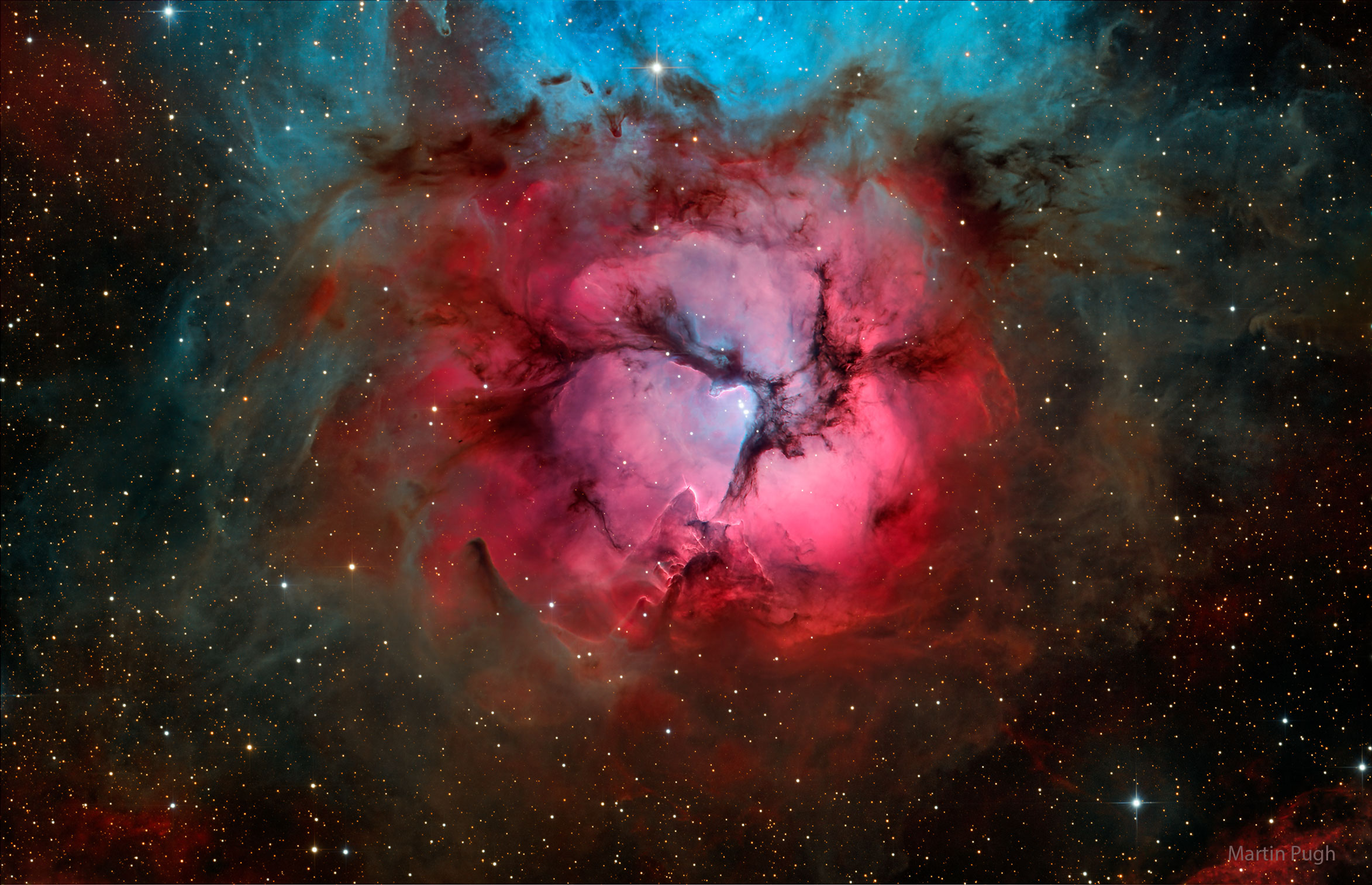
*Image Credit & Copyright: Martin Pugh*
What's happening at the center of the Trifid Nebula? Three prominent dust lanes that give the Trifid its name all come together. Mountains of opaque dust appear near the bottom, while other dark filaments of dust are visible threaded throughout the nebula. A single massive star visible near the center causes much of the Trifid's glow. The Trifid, cataloged as M20, is only about 300,000 years old, making it among the youngest emission nebulas known. The star forming nebula lies about 9,000 light years away toward the constellation of the Archer (Sagittarius). The region pictured here spans about 20 light years.
#APOD #Science #Universe #Astrogeek #Nebula
Posted manually due to troubles at NASA API (503)
**Astronomy Picture of the Day**
04 June 2023
**Color the Universe**
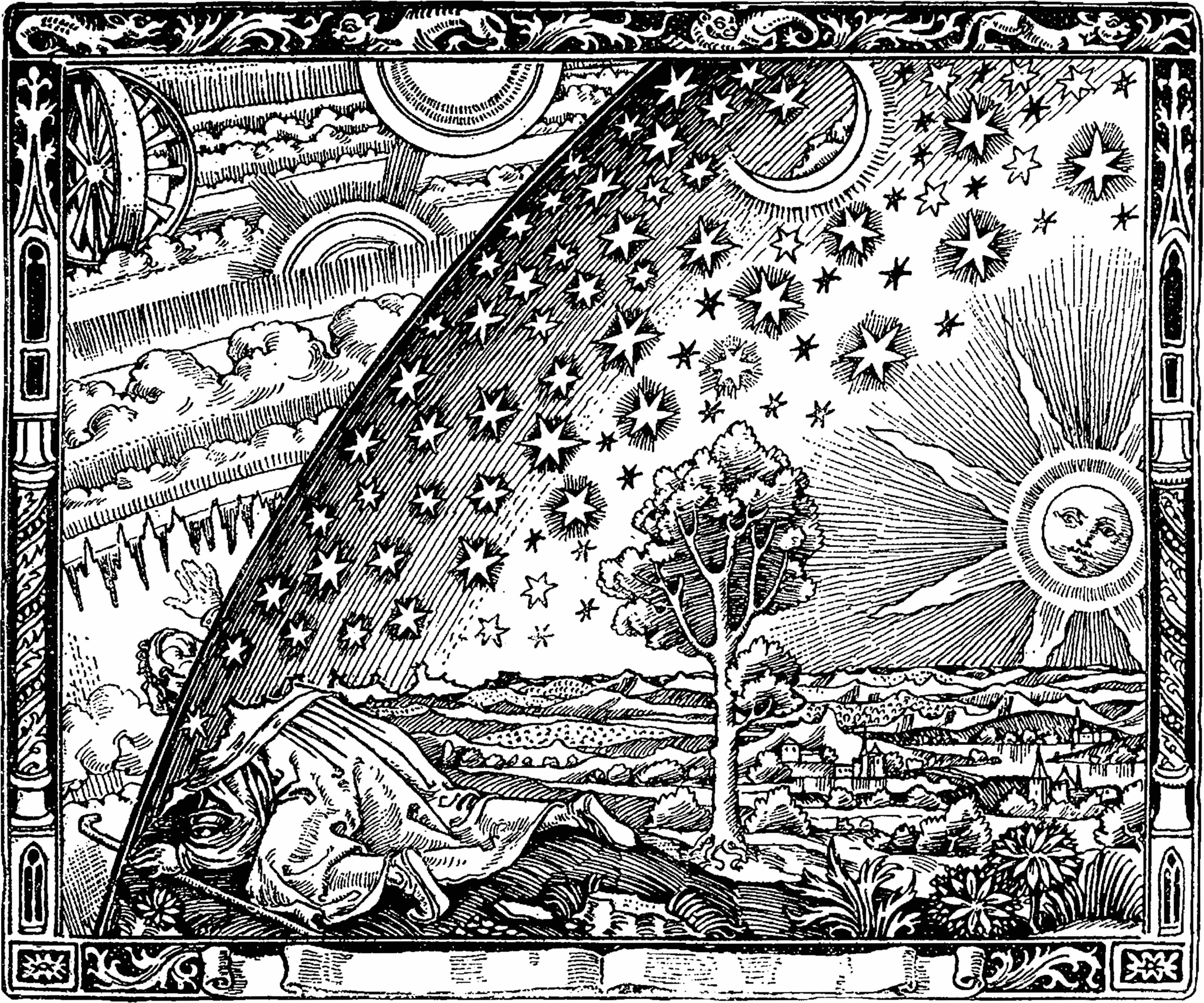
*Image creditor details unavailable via API. Visit linked page below for full info.*
Wouldn't it be fun to color in the universe? If you think so, please accept this famous astronomical illustration as a preliminary substitute. You, your friends, your parents or children, can print it out or even color it digitally. While coloring, you might be interested to know that even though this illustration has appeared in numerous places over the past 100 years, the actual artist remains unknown. Furthermore, the work has no accepted name -- can you think of a good one? The illustration, first appearing in a book by Camille Flammarion in 1888, is frequently used to show that humanity's present concepts are susceptible to being supplanted by greater truths.
#APOD #RocketScience #Astrophoto #Astrogeek #SpaceAdventures
**Astronomy Picture of the Day**
03 June 2023
**Charon: Moon of Pluto**
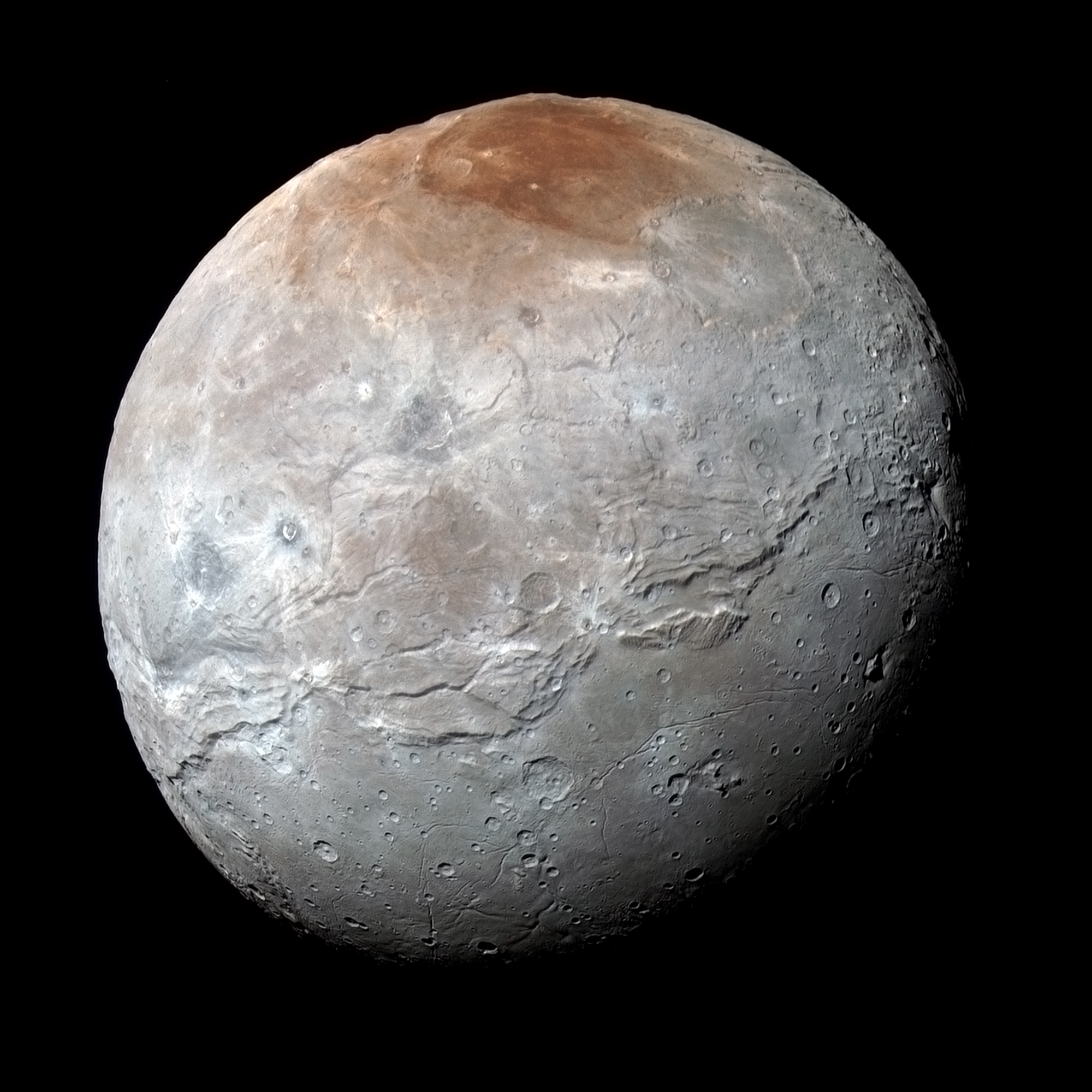
*Image creditor details unavailable via API. Visit linked page below for full info.*
A darkened and mysterious north polar region known to some as Mordor Macula caps this premier high-resolution view. The portrait of Charon, Pluto's largest moon, was captured by New Horizons near the spacecraft's closest approach on July 14, 2015. The combined blue, red, and infrared data was processed to enhance colors and follow variations in Charon's surface properties with a resolution of about 2.9 kilometers (1.8 miles). A stunning image of Charon's Pluto-facing hemisphere, it also features a clear view of an apparently moon-girdling belt of fractures and canyons that seems to separate smooth southern plains from varied northern terrain. Charon is 1,214 kilometers (754 miles) across. That's about 1/10th the size of planet Earth but a whopping 1/2 the diameter of Pluto itself, and makes it the largest satellite relative to its parent body in the Solar System. Still, the moon appears as a small bump at about the 1 o'clock position on Pluto's disk in the grainy, negative,telescopic picture inset at upper left. That view was used by James Christy and Robert Harrington at the U.S. Naval Observatory in Flagstaff to discover Charon in June of 1978.
#APOD #Astrobiology #SpaceIndustry #SpaceDiscovery #Astrozone
**Astronomy Picture of the Day**
02 June 2023
**Messier 101**
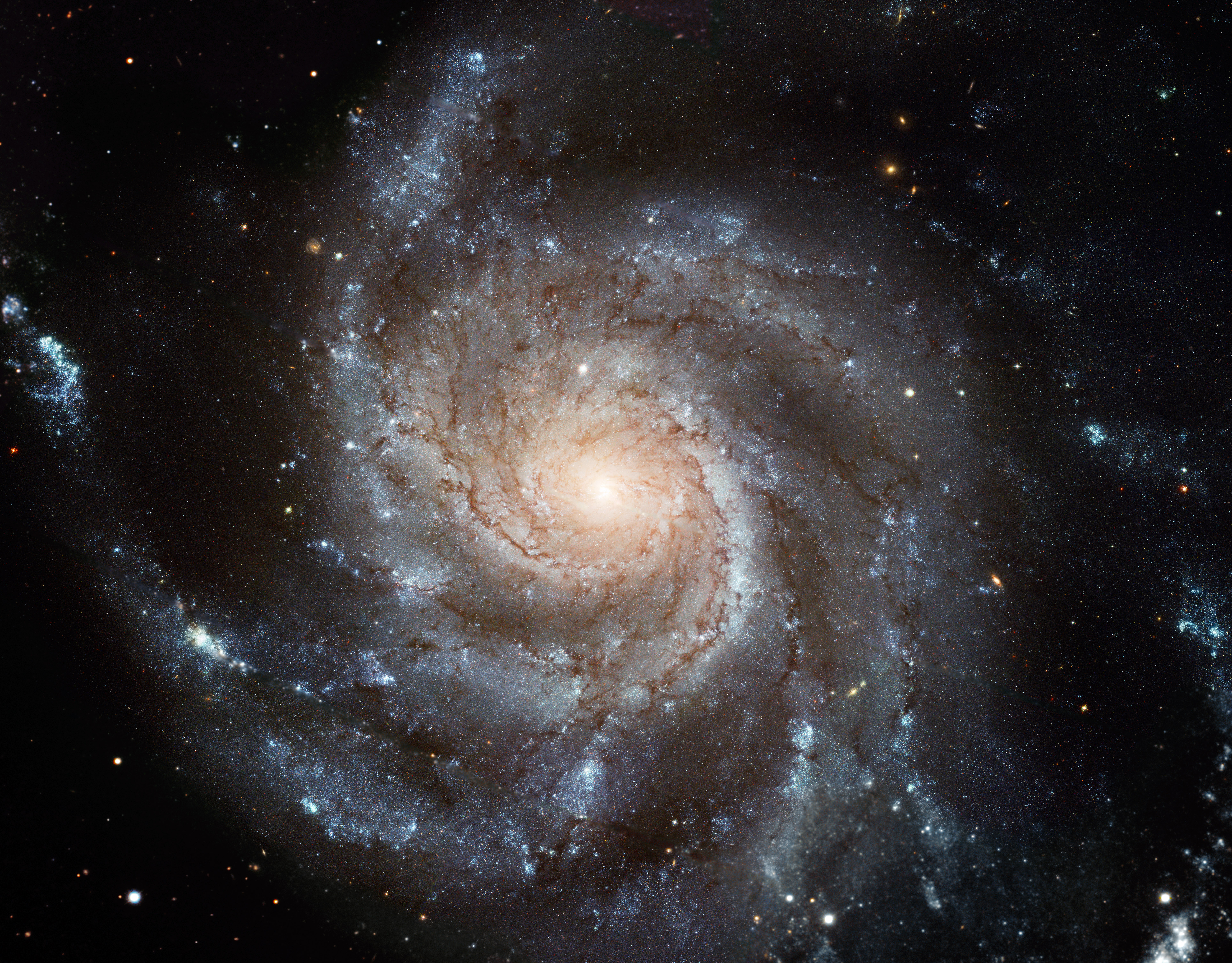
*Image creditor details unavailable via API. Visit linked page below for full info.*
Big, beautiful spiral galaxy M101 is one of the last entries in Charles Messier's famous catalog, but definitely not one of the least. About 170,000 light-years across, this galaxy is enormous, almost twice the size of our own Milky Way. M101 was also one of the original spiral nebulae observed by Lord Rosse's large 19th century telescope, the Leviathan of Parsontown. Assembled from 51 exposures recorded by the Hubble Space Telescope in the 20th and 21st centuries, with additional data from ground based telescopes, this mosaic spans about 40,000 light-years across the central region of M101 in one of the highest definition spiral galaxy portraits ever released from Hubble. The sharp image shows stunning features of the galaxy's face-on disk of stars and dust along with background galaxies, some visible right through M101 itself. Also known as the Pinwheel Galaxy, M101 lies within the boundaries of the northern constellation Ursa Major, about 25 million light-years away.
#APOD #CosmosJourney #CosmicWonders #Space #Exoplanets
**Astronomy Picture of the Day**
01 June 2023
**Recycling Cassiopeia A**
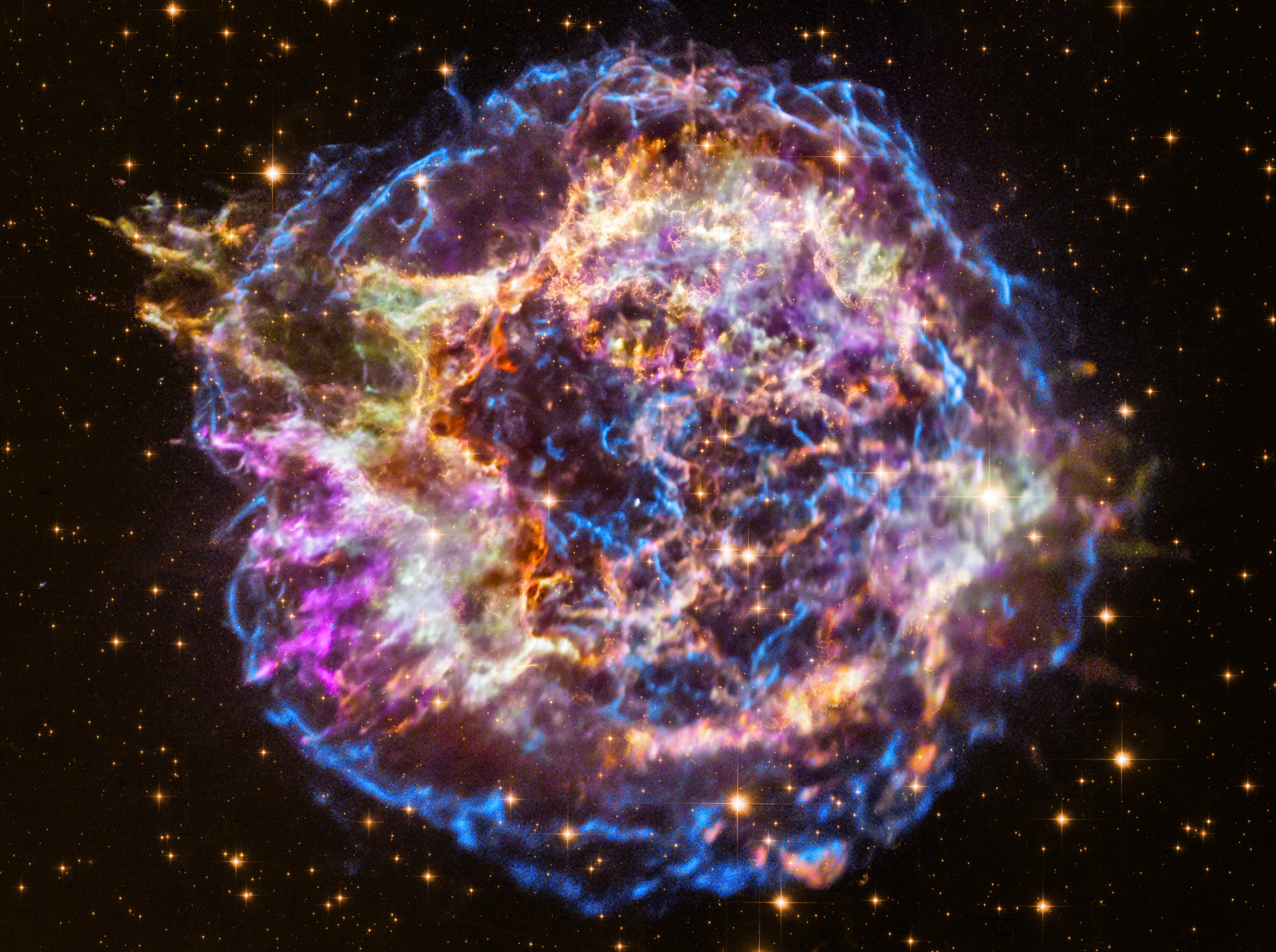
*Image creditor details unavailable via API. Visit linked page below for full info.*
Massive stars in our Milky Way Galaxy live spectacular lives. Collapsing from vast cosmic clouds, their nuclear furnaces ignite and create heavy elements in their cores. After a few million years, the enriched material is blasted back into interstellar space where star formation can begin anew. The expanding debris cloud known as Cassiopeia A is an example of this final phase of the stellar life cycle. Light from the explosion which created this supernova remnant would have been first seen in planet Earth's sky about 350 years ago, although it took that light about 11,000 years to reach us. This false-color image, composed of X-ray and optical image data from the Chandra X-ray Observatory and Hubble Space Telescope, shows the still hot filaments and knots in the remnant. It spans about 30 light-years at the estimated distance of Cassiopeia A. High-energy X-ray emission from specific elements has been color coded, silicon in red, sulfur in yellow, calcium in green and iron in purple, to help astronomers explore the recycling of our galaxy's star stuff. Still expanding, the outer blast wave is seen in blue hues. The bright speck near the center is a neutron star, the incredibly dense, collapsed remains of the massive stellar core.
#APOD #LunarMission #Astrospace #GalacticAdventures #Astrophoto
**Astronomy Picture of the Day**
31 May 2023
**Simulation: A Disk Galaxy Forms**
https://www.youtube.com/embed/X4UF9Akman0?rel=0
*Image creditor details unavailable via API. Visit linked page below for full info.*
How did we get here? We know that we live on a planet orbiting a star orbiting a galaxy, but how did all of this form? Since our universe moves too slowly to watch, faster-moving computer simulations are created to help find out. Specifically, this featured video from the IllustrisTNG collaboration tracks gas from the early universe (redshift 12) until today (redshift 0). As the simulation begins, ambient gas falls into and accumulates in a region of relatively high gravity. After a few billion years, a well-defined center materializes from a strange and fascinating cosmic dance. Gas blobs -- some representing small satellite galaxies -- continue to fall into and become absorbed by the rotating galaxy as the present epoch is reached and the video ends. For the Milky Way Galaxy, however, big mergers may not be over -- recent evidence indicates that our large spiral disk Galaxy will collide and coalesce with the slightly larger Andromeda spiral disk galaxy in the next few billion years. Open Science: Browse 3,000+ codes in the Astrophysics Source Code Library
#APOD #SpaceTravel #Astrophysics #Stars #AstronomyFacts
**Astronomy Picture of the Day**
30 May 2023
**M27: The Dumbbell Nebula**
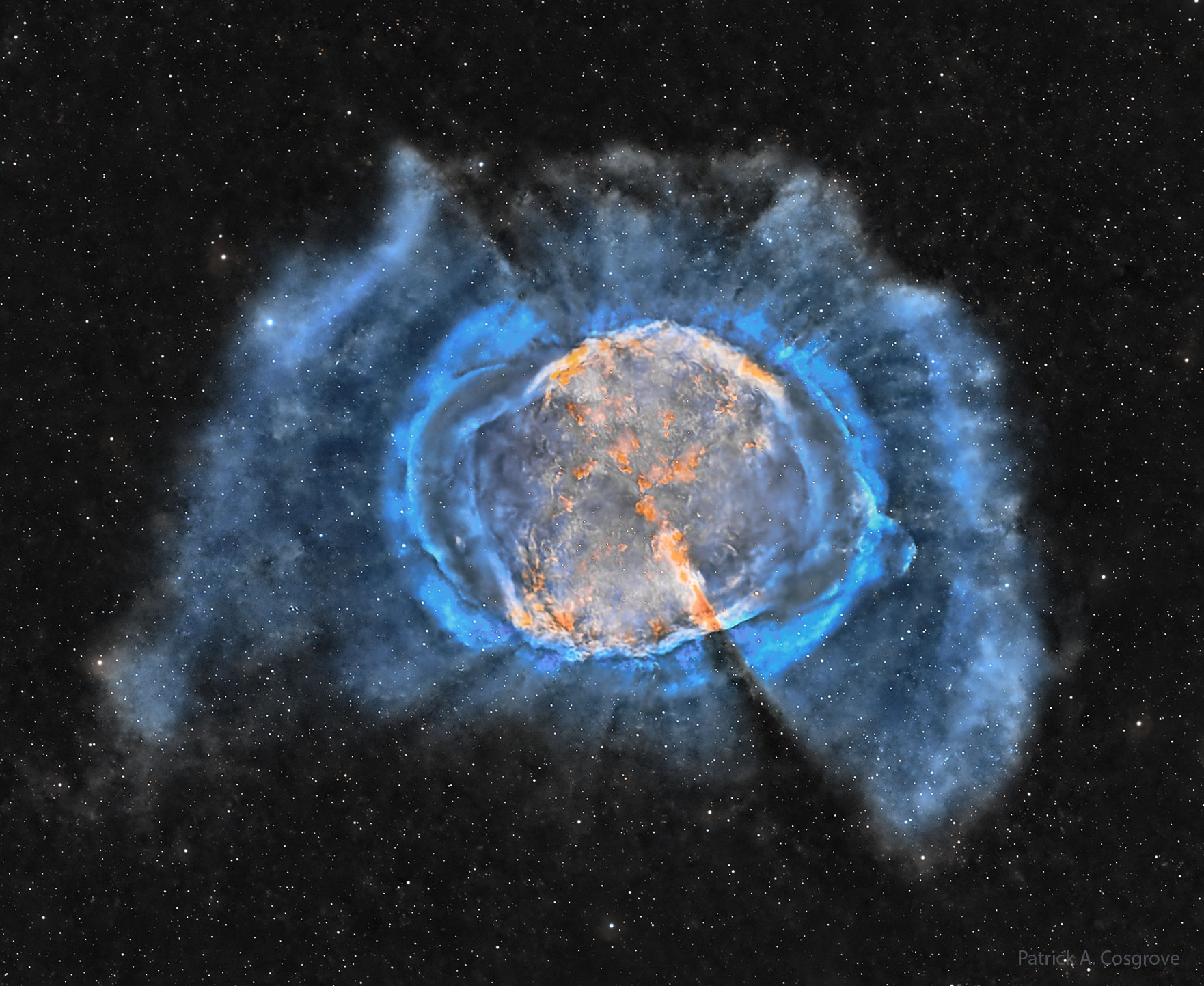
Image Credit & Copyright: Patrick A. Cosgrove
Is this what will become of our Sun? Quite possibly. The first hint of our Sun's future was discovered inadvertently in 1764. At that time, Charles Messier was compiling a list of diffuse objects not to be confused with comets. The 27th object on Messier's list, now known as M27 or the Dumbbell Nebula, is a planetary nebula, one of the brightest planetary nebulae on the sky and visible with binoculars toward the constellation of the Fox (Vulpecula). It takes light about 1000 years to reach us from M27, featured here in colors emitted by sulfur (red), hydrogen (green) and oxygen (blue). We now know that in about 6 billion years, our Sun will shed its outer gases into a planetary nebula like M27, while its remaining center will become an X-ray hot white dwarf star. Understanding the physics and significance of M27 was well beyond 18th century science, though. Even today, many things remain mysterious about planetary nebulas, including how their intricate shapes are created.
#APOD #Exoplanets #SpaceMissions #GalaxyExploration #Stellar
**Astronomy Picture of the Day**
29 May 2023
**Milky Way over a Turquoise Wonderland**

Image Credit & Copyright: Petr HorálekInstitute of Physics in Opava
What glows there? The answer depends: sea or sky? In the sea, the unusual blue glow is bioluminescence. Specifically, the glimmer arises from Noctiluca scintillans, single-celled plankton stimulated by the lapping waves. The plankton use their glow to startle and illuminate predators. This mid-February display on an island in the Maldives was so intense that the astrophotographer described it as a turquoise wonderland. In the sky, by contrast, are the more familiar glows of stars and nebulas. The white band rising from the artificially-illuminated green plants is created by billions of stars in the central disk of our Milky Way Galaxy. Also visible in the sky is the star cluster Omega Centauri, toward the left, and the famous Southern Cross asterism in the center. Red-glowing nebulas include the bright Carina Nebula, just right of center, and the expansive Gum Nebula on the upper right.
#APOD #CosmicWonders #Astrozone #RocketScience #Astroinformatics
**Astronomy Picture of the Day**
28 May 2023
**Ida and Dactyl: Asteroid and Moon**
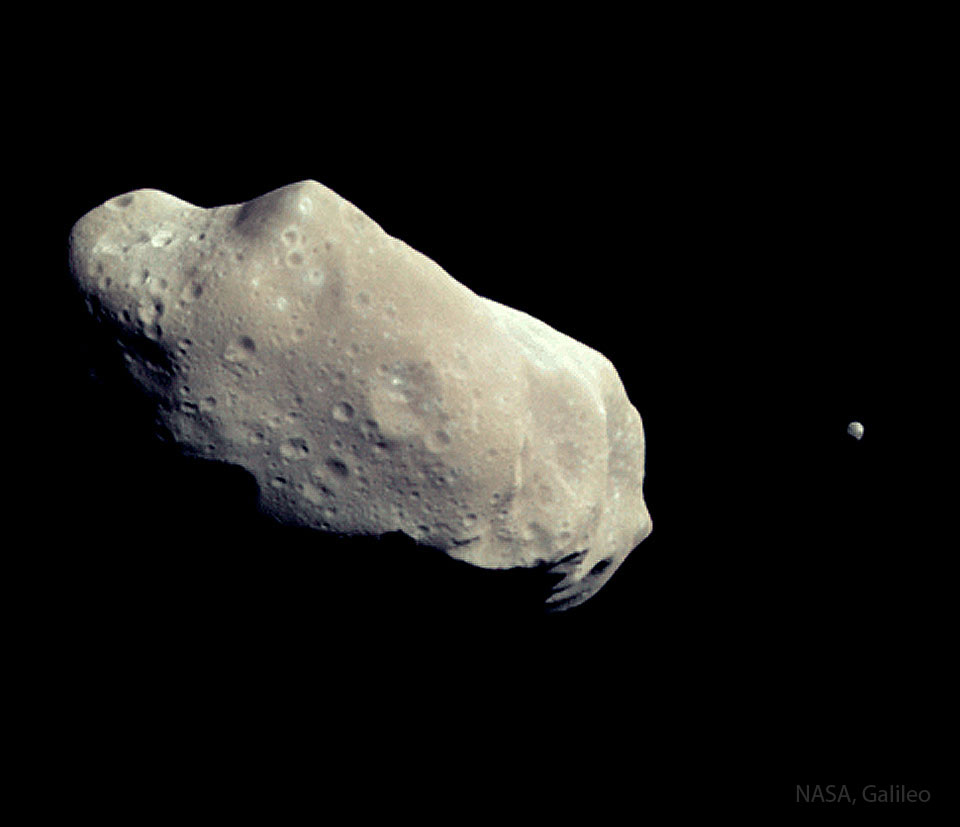
*Image creditor details unavailable via API. Visit linked page below for full info.*
This asteroid has a moon. The robot spacecraft Galileo on route to Jupiter in 1993 encountered and photographed two asteroids during its long interplanetary voyage. The second minor planet it photographed, 243 Ida, was unexpectedly discovered to have a moon. The tiny moon, Dactyl, is only about 1.6 kilometers across and seen as a small dot on the right of the sharpened featured image. In contrast, the potato-shaped Ida is much larger, measuring about 60 kilometers long and 25 km wide. Dactyl is the first moon of an asteroid ever discovered -- now many asteroids are known to have moons. The names Ida and Dactyl are from Greek mythology.
#APOD #LunarMission #PlanetExploration #SpaceWeather #Astronomy
**Astronomy Picture of the Day**
27 May 2023
**Crescent Neptune and Triton**
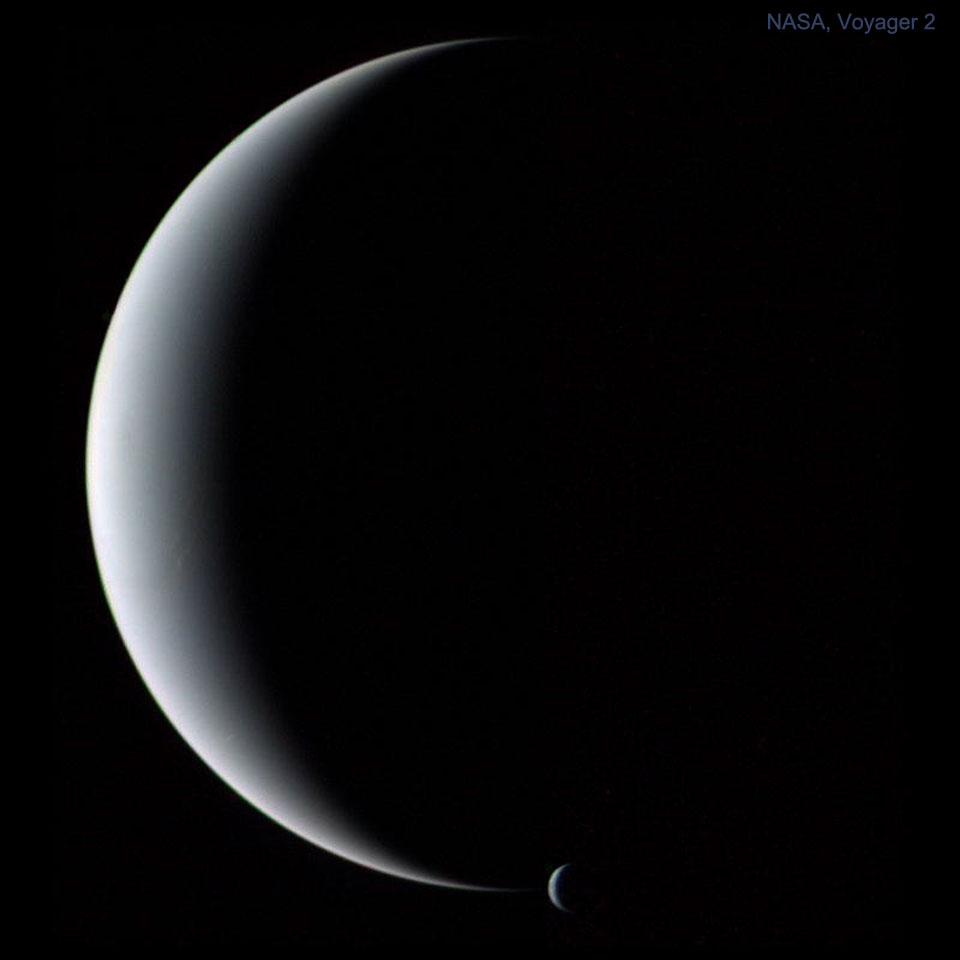
*Image creditor details unavailable via API. Visit linked page below for full info.*
Gliding through the outer Solar System, in 1989 the Voyager 2 spacecraft looked toward the Sun to find this view of most distant planet Neptune and its moon Triton together in a crescent phase. The elegant image of ice-giant planet and largest moon was taken from behind just after Voyager's closest approach. It could not have been taken from Earth because the most distant planet never shows a crescent phase to sunward eyes. Heading for the heliopause and beyond, the spacecraft's parting vantage point also robs Neptune of its familiar blue hue.
#APOD #Astroinformatics #Celestial #AstronomyFacts #Astronauts
**Astronomy Picture of the Day**
26 May 2023
**Virgo Cluster Galaxies**
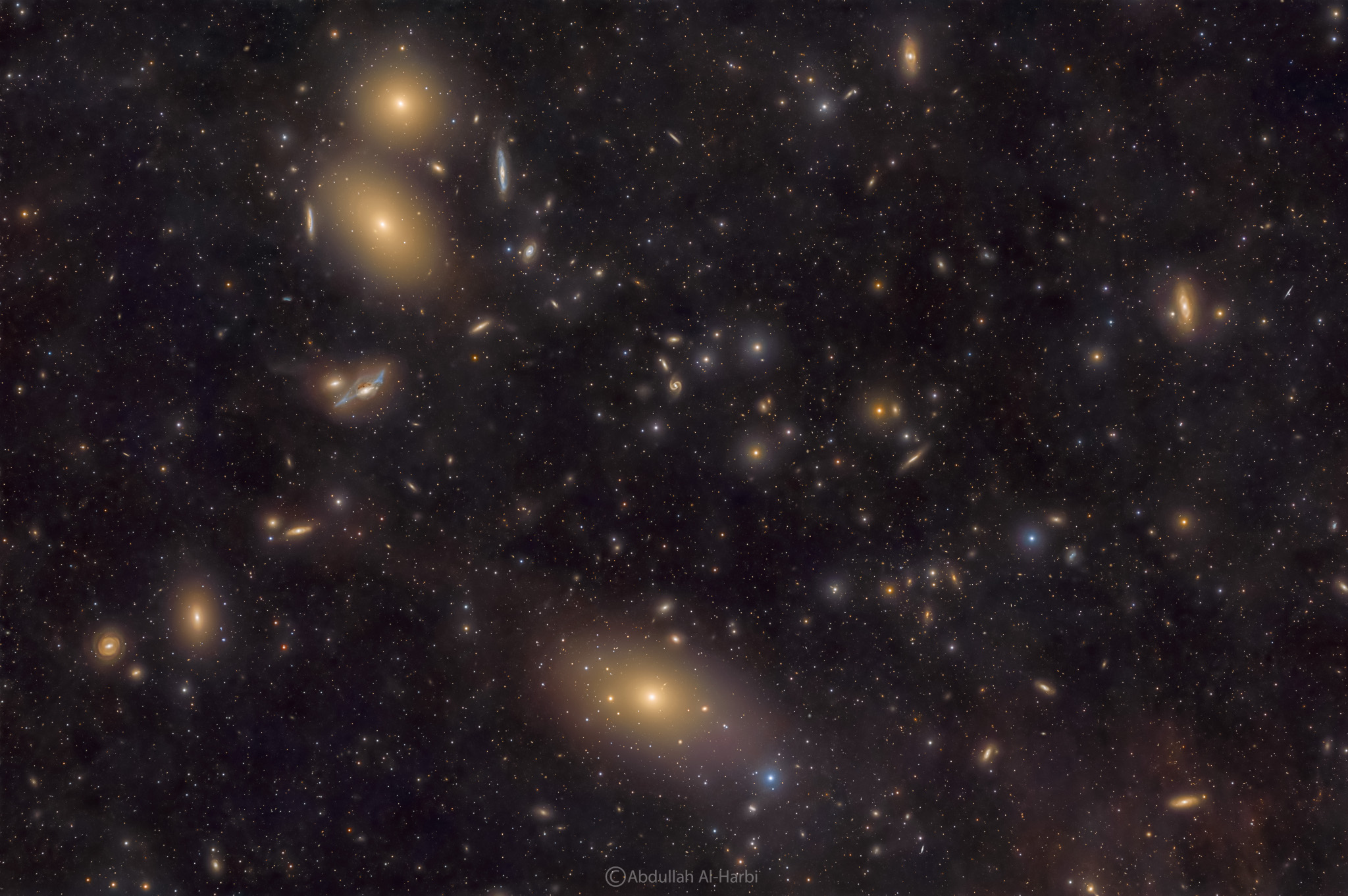
Image Credit & Copyright: Abdullah Alharbi
Galaxies of the Virgo Cluster are scattered across this nearly 4 degree wide telescopic field of view. About 50 million light-years distant, the Virgo Cluster is the closest large galaxy cluster to our own local galaxy group. Prominent here are Virgo's bright elliptical galaxies Messier catalog, M87 at bottom center, and M84 and M86 (top to bottom) near top left. M84 and M86 are recognized as part of Markarian's Chain, a visually striking line-up of galaxies on the left side of this frame. Near the middle of the chain lies an intriguing interacting pair of galaxies, NGC 4438 and NGC 4435, known to some as Markarian's Eyes. Of course giant elliptical galaxy M87 dominates the Virgo cluster. It's the home of a super massive black hole, the first black hole ever imaged by planet Earth's Event Horizon Telescope.
#APOD #Astrophoto #GalaxyExploration #SpaceResearch #AstronomyClub
**Astronomy Picture of the Day**
25 May 2023
**Cat's Eye Wide and Deep**
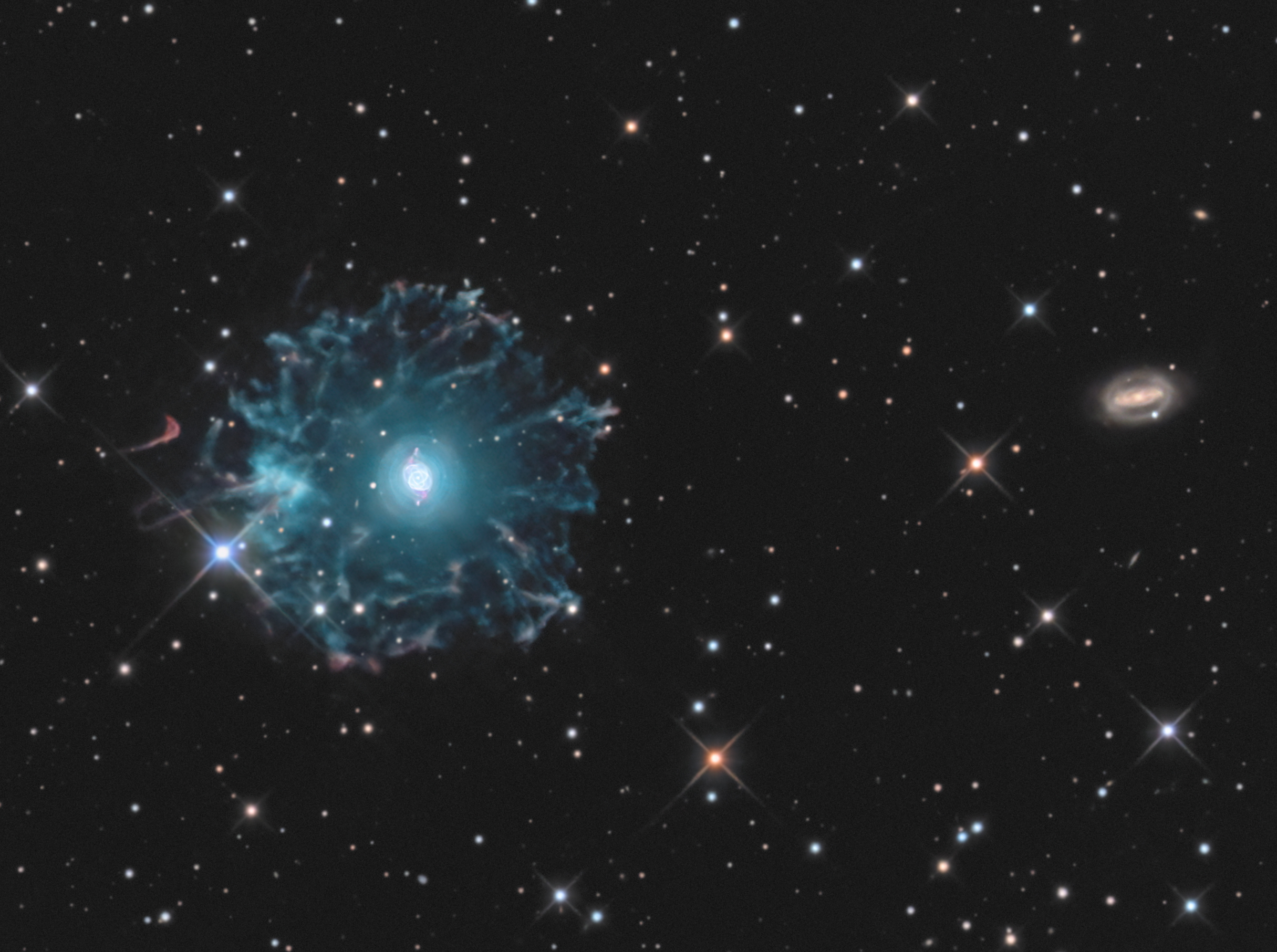
Image Credit & Copyright: Jean-François Bax
The Cat's Eye Nebula (NGC 6543) is one of the best known planetary nebulae in the sky. Its more familiar outlines are seen in the brighter central region of the nebula in this impressive wide-angle view. But this wide and deep image combining data from two telescopes also reveals its extremely faint outer halo. At an estimated distance of 3,000 light-years, the faint outer halo is over 5 light-years across. Planetary nebulae have long been appreciated as a final phase in the life of a sun-like star. More recently, some planetary nebulae are found to have halos like this one, likely formed of material shrugged off during earlier episodes in the star's evolution. While the planetary nebula phase is thought to last for around 10,000 years, astronomers estimate the age of the outer filamentary portions of this halo to be 50,000 to 90,000 years. Visible on the right, some 50 million light-years beyond the watchful planetary nebula, lies spiral galaxy NGC 6552.
#APOD #Astrophoto #AstronautLife #SpaceExploration #Astrotheory
**Astronomy Picture of the Day**
24 May 2023
**Observatory Aligned with Moon Occulting Jupiter**
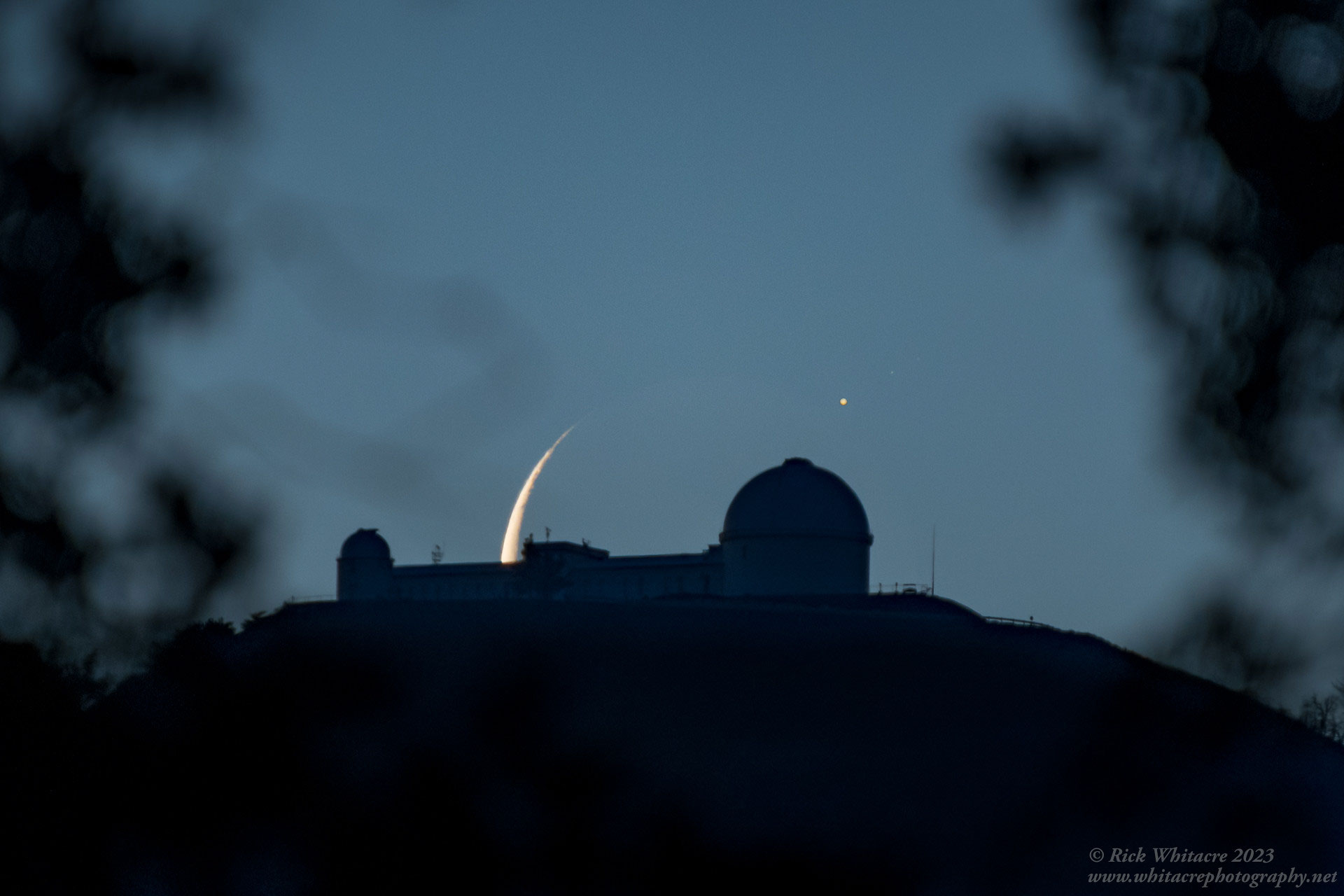
Image Credit & Copyright: Rick WhitacreNatalia LewandowskaSUNY Oswego
Sometimes we witness the Moon moving directly in front of -- called occulting -- one of the planets in our Solar System. Earlier this month that planet was Jupiter. Captured here was the moment when Jupiter re-appeared from behind the surface of our Moon. The Moon was in its third quarter, two days before the dark New Moon. Now, our Moon is continuously half lit by the Sun, but when in its third quarter, relatively little of that half can be seen from the Earth. Pictured, the Moon itself was aligned behind the famous Lick Observatory in California, USA, on the summit of Mount Hamilton. Coincidentally, Lick enabled the discovery of a moon of Jupiter: Amalthea, the last visually detected moon of Jupiter after Galileo's observations. Gallery: Moon Occults Jupiter in 2023 May: Notable Submissions to APOD
#APOD #Astrobiology #Astrobiology #Astrodata #AstronomyFacts
**Astronomy Picture of the Day**
23 May 2023
**Jupiter's Swirls from Juno**
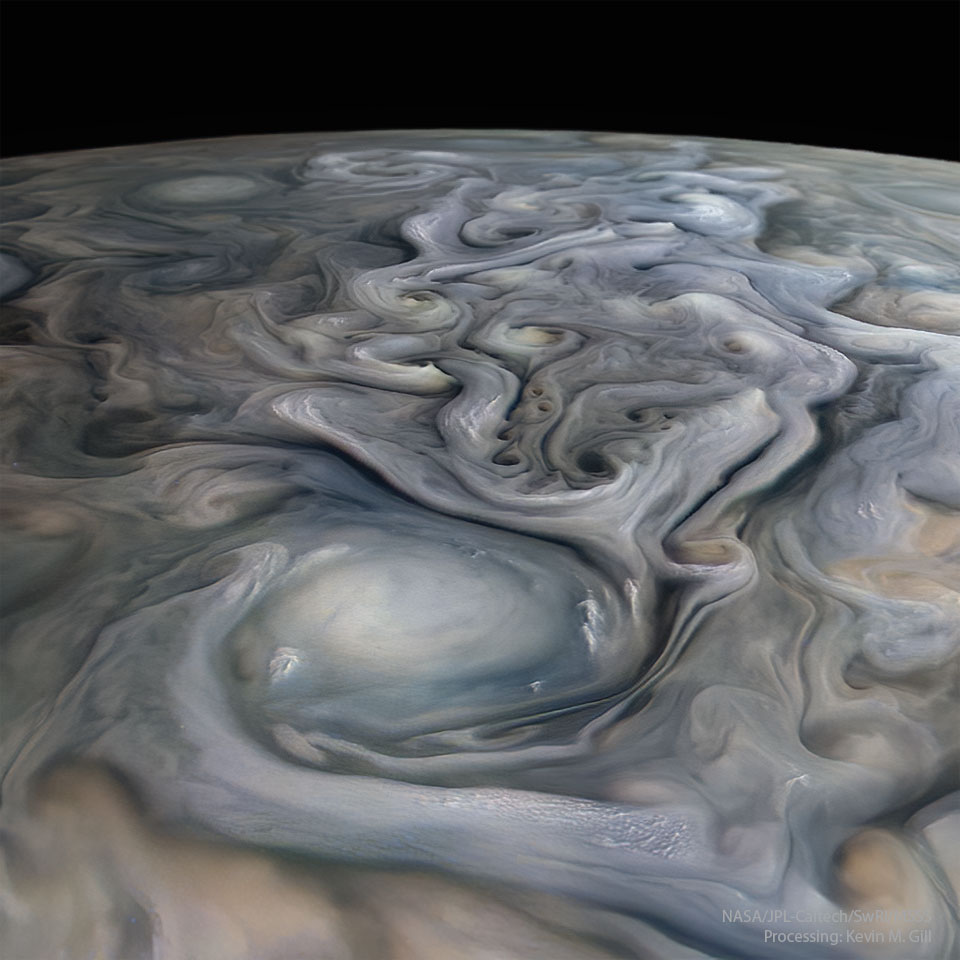
*Image creditor details unavailable via API. Visit linked page below for full info.*
Big storms are different on Jupiter. On Earth, huge hurricanes and colossal cyclones are centered on regions of low pressure, but on Jupiter, it is the high-pressure, anti-cyclone storms that are the largest. On Earth, large storms can last weeks, but on Jupiter they can last years. On Earth, large storms can be as large as a country, but on Jupiter, large storms can be as large as planet Earth. Both types of storms are known to exhibit lightning. The featured image of Jupiter's clouds was composed from images and data captured by the robotic Juno spacecraft as it swooped close to the massive planet in August 2020. A swirling white oval is visible nearby, while numerous smaller cloud swirls extend into the distance. On Jupiter, light-colored clouds are usually higher up than dark clouds. Despite their differences, studying storm clouds on distant Jupiter provides insights into storms and other weather patterns on familiar Earth. Surf the Universe: Random APOD Generator
#APOD #NASA #Research #Astrogeology #Cosmological
**Astronomy Picture of the Day**
22 May 2023
**Supernova Discovered in Nearby Spiral Galaxy M101**
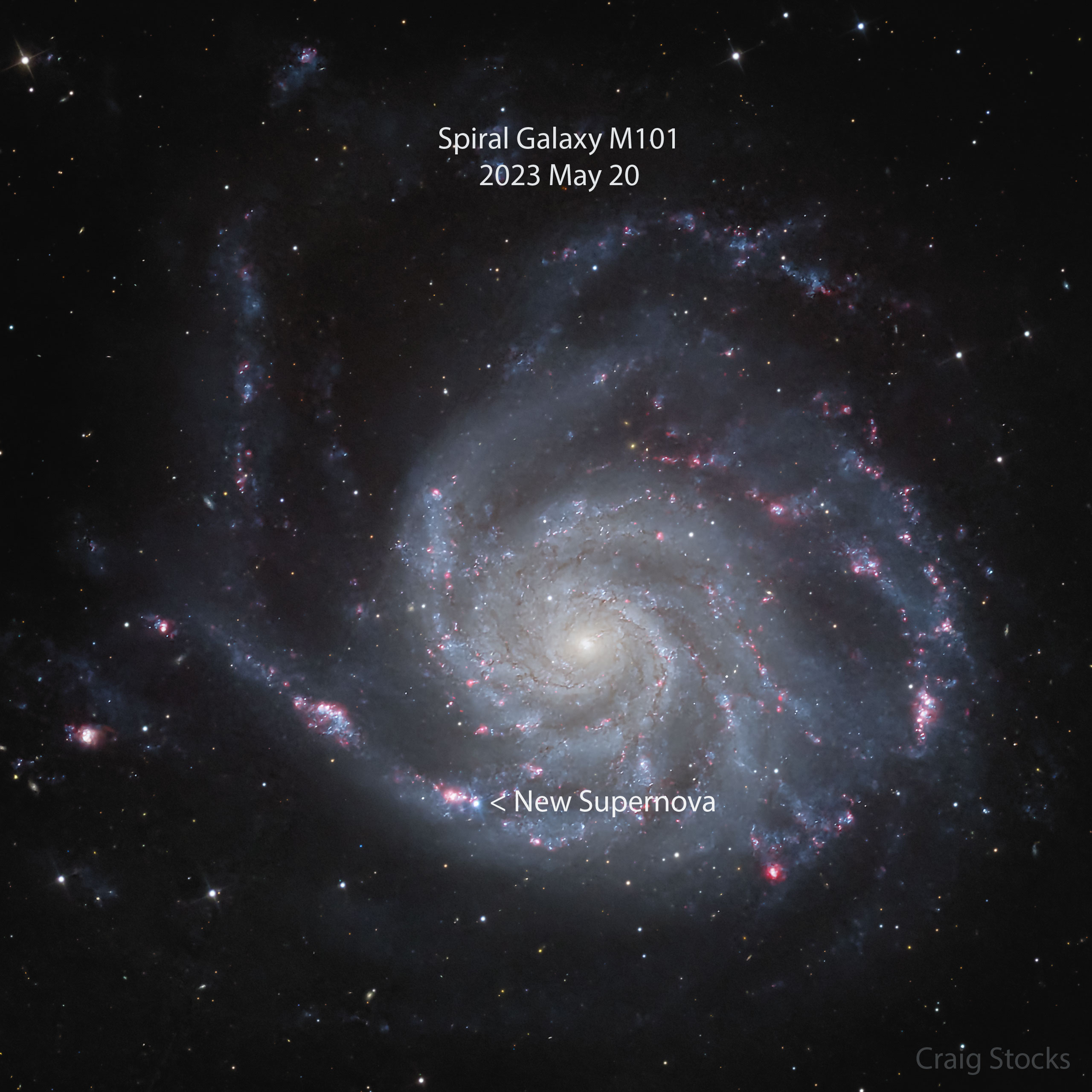
Image Credit & Copyright: Craig Stocks
A nearby star has exploded and humanity's telescopes are turning to monitor it. The supernova, dubbed SN 2023ifx, was discovered by Japanese astronomer Koichi Itagaki three days ago and subsequently located on automated images from the Zwicky Transient Facility two days earlier. SN 2023ifx occurred in the photogenic Pinwheel Galaxy M101, which, being only about 21 million light years away, makes it the closest supernova seen in the past five years, the second closest in the past 10 years, and the second supernova found in M101 in the past 15 years. Rapid follow up observations already indicate that SN 2023ifx is a Type II supernova, an explosion that occurs after a massive star runs out of nuclear fuel and collapses. The featured image shows home spiral galaxy two days ago with the supernova highlighted, while the roll-over image shows the same galaxy a month before. SN 2023ifx will likely brighten and remain visible to telescopes for months. Studying such a close and young Type II supernova may yield new clues about massive stars and how they explode.
#APOD #BlackHoleDiscovery #PlanetaryExploration #Exploration #Astroeducation
**Astronomy Picture of the Day**
21 May 2023
**Tardigrade in Moss**

Image Credit & Copyright: Science Source Images
Is this an alien? Probably not, but of all the animals on Earth, the tardigrade might be the best candidate. That's because tardigrades are known to be able to go for decades without food or water, to survive temperatures from near absolute zero to well above the boiling point of water, to survive pressures from near zero to well above that on ocean floors, and to survive direct exposure to dangerous radiations. The far-ranging survivability of these extremophiles was tested in 2011 outside an orbiting space shuttle. Tardigrades are so durable partly because they can repair their own DNA and reduce their body water content to a few percent. Some of these miniature water-bears almost became extraterrestrials in 2011 when they were launched toward to the Martian moon Phobos, and again in 2021 when they were launched toward Earth's own moon, but the former launch failed, and the latter landing crashed. Tardigrades are more common than humans across most of the Earth. Pictured here in a color-enhanced electron micrograph, a millimeter-long tardigrade crawls on moss. Your Sky Surprise: What picture did APOD feature on your birthday? (post 1995)
#APOD #PlanetaryScience #Galaxy #Astrophoto #SpaceMission
**Astronomy Picture of the Day**
20 May 2023
**Galileo's Europa**
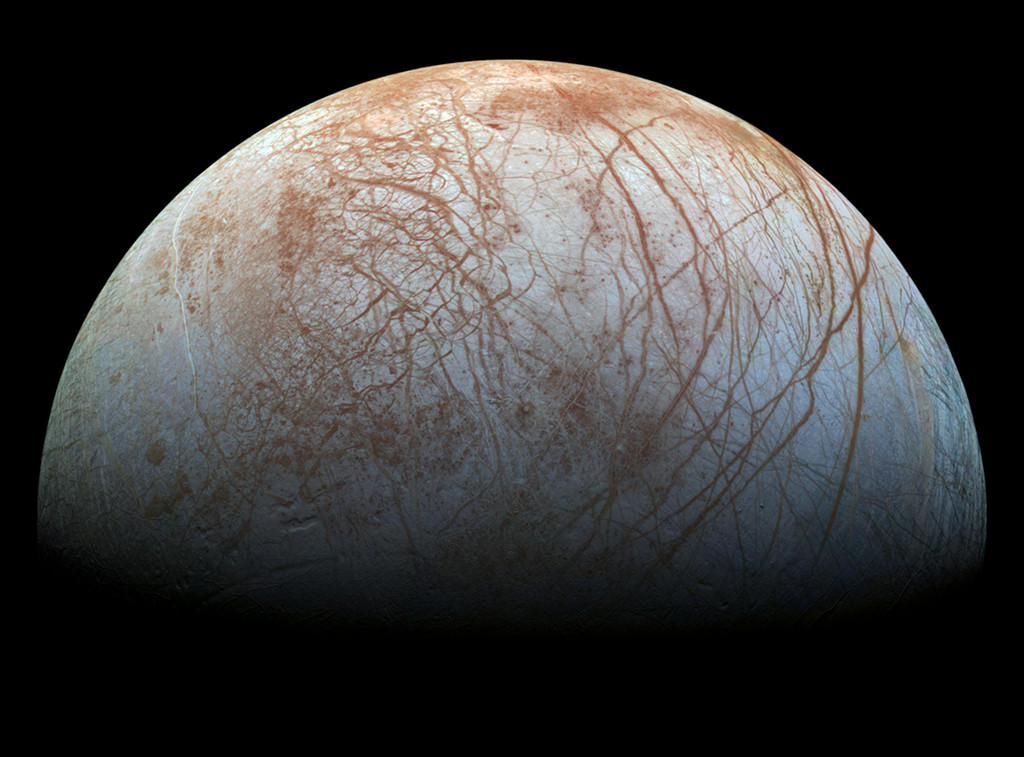
Image Credit & Copyright: API request failed to get copyright holder
Looping through the Jovian system in the late 1990s, the Galileo spacecraft recorded stunning views of Europa and uncovered evidence that the moon's icy surface likely hides a deep, global ocean. Galileo's Europa image data has been remastered here, with improved calibrations to produce a color image approximating what the human eye might see. Europa's long curving fractures hint at the subsurface liquid water. The tidal flexing the large moon experiences in its elliptical orbit around Jupiter supplies the energy to keep the ocean liquid. But more tantalizing is the possibility that even in the absence of sunlight that process could also supply the energy to support life, making Europa one of the best places to look for life beyond Earth. What kind of life could thrive in a deep, dark, subsurface ocean? Consider planet Earth's own extreme shrimp.
#APOD #RocketLaunch #Astrogeology #SpaceResearch #SpaceExploration
**Astronomy Picture of the Day**
19 May 2023
**Curly Spiral Galaxy M63**
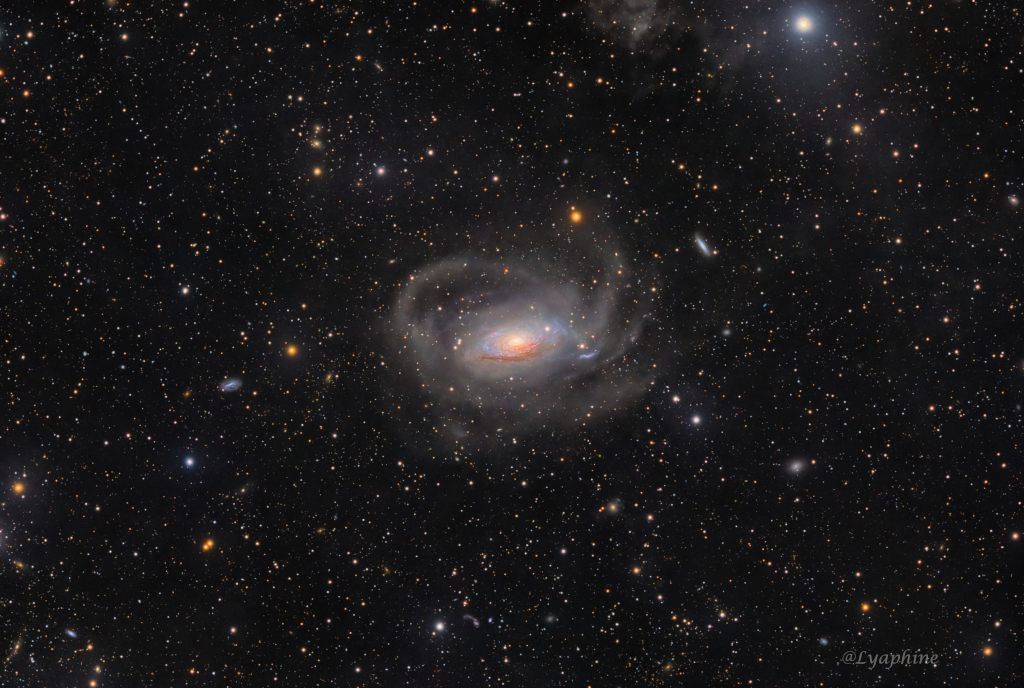
Image Credit & Copyright: Sophie Paulin
A bright spiral galaxy of the northern sky, Messier 63 is nearby, about 30 million light-years distant toward the loyal constellation Canes Venatici. Also cataloged as NGC 5055, the majestic island universe is nearly 100,000 light-years across, about the size of our own Milky Way. Its bright core and majestic spiral arms lend the galaxy its popular name, The Sunflower Galaxy. This exceptionally deep exposure also follows faint, arcing star streams far into the galaxy's halo. Extending nearly 180,000 light-years from the galactic center, the star streams are likely remnants of tidally disrupted satellites of M63. Other satellite galaxies of M63 can be spotted in the remarkable wide-field image, including faint dwarf galaxies, which could contribute to M63's star streams in the next few billion years.
#APOD #Astrotheory #Stellar #SpaceMission #SpaceObservatory
**Astronomy Picture of the Day**
18 May 2023
**WR 134 Ring Nebula**
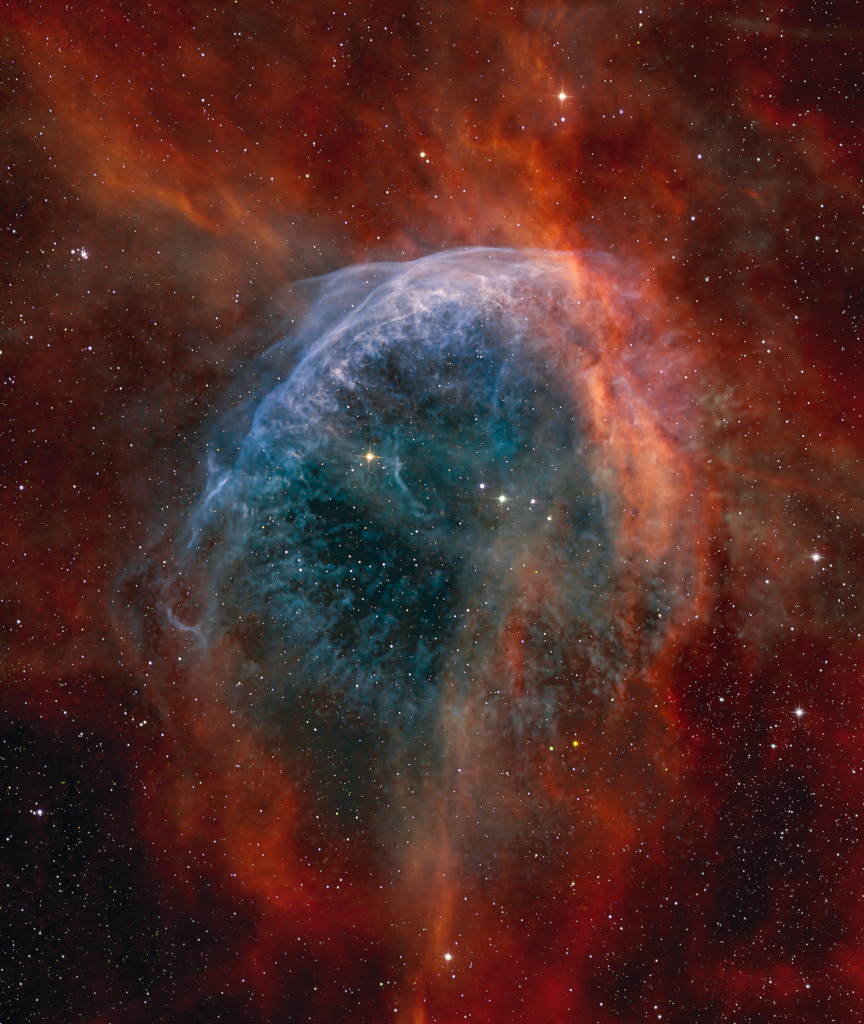
Image Credit & Copyright:Craig Stocks
Made with narrowband filters, this cosmic snapshot covers a field of view about the size of the full Moon within the boundaries of the constellation Cygnus. It highlights the bright edge of a ring-like nebula traced by the glow of ionized sulfur, hydrogen, and oxygen gas. Embedded in the region's interstellar clouds of gas and dust, the complex, glowing arcs are sections of bubbles or shells of material swept up by the wind from Wolf-Rayet star WR 134, brightest star near the center of the frame. Distance estimates put WR 134 about 6,000 light-years away, making the frame over 50 light-years across. Shedding their outer envelopes in powerful stellar winds, massive Wolf-Rayet stars have burned through their nuclear fuel at a prodigious rate and end this final phase of massive star evolution in a spectacular supernova explosion. The stellar winds and final supernovae enrich the interstellar material with heavy elements to be incorporated in future generations of stars.
#APOD #SpaceResearch #Galactic #BlackHoles #CosmicWonders
**Astronomy Picture of the Day**
17 May 2023
**Sunspot with Light Bridge**
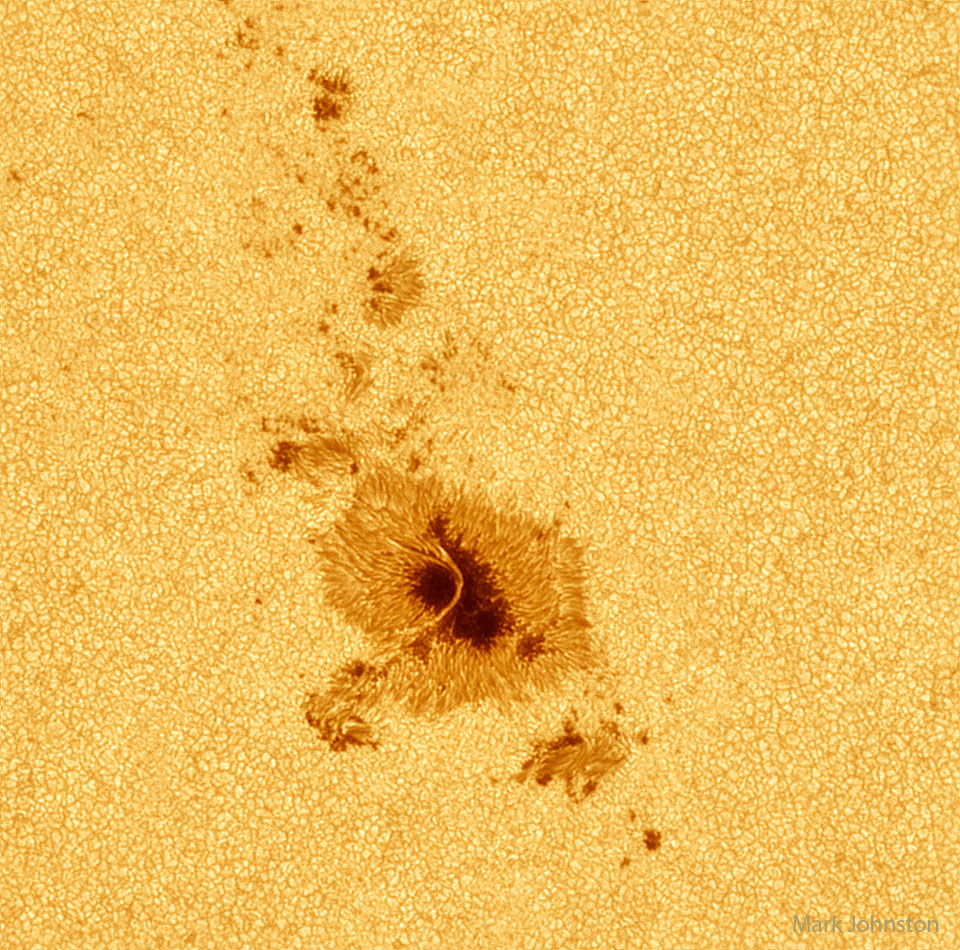
[Image Credit & Copyright:](Mark Johnston)
Why would a small part of the Sun appear slightly dark? Visible is a close-up picture of sunspots, depressions on the Sun's surface that are slightly cooler and less bright than the rest of the Sun. The Sun's complex magnetic field creates these cool regions by inhibiting hot material from entering the spots. Sunspots can be larger than the Earth and typically last for about a week. Part of active region AR 3297 crossing the Sun in early May, the large lower sunspot is spanned by an impressive light bridge of hot and suspended solar gas. This high-resolution picture also shows clearly that the Sun's surface is a bubbling carpet of separate cells of hot gas. These cells are known as granules. A solar granule is about 1000 kilometers across and lasts for only about 15 minutes. Your Sky Surprise: What picture did APOD feature on your birthday? (post 1995)
#APOD #Cosmos #Astrozone #BlackHoles #SpaceExploration
[apod.nasa.gov](https://apod.nasa.gov/apod/astropix.html)