
**Astronomy Picture of the Day**
11 March 2024
**A Full Plankton Moon**
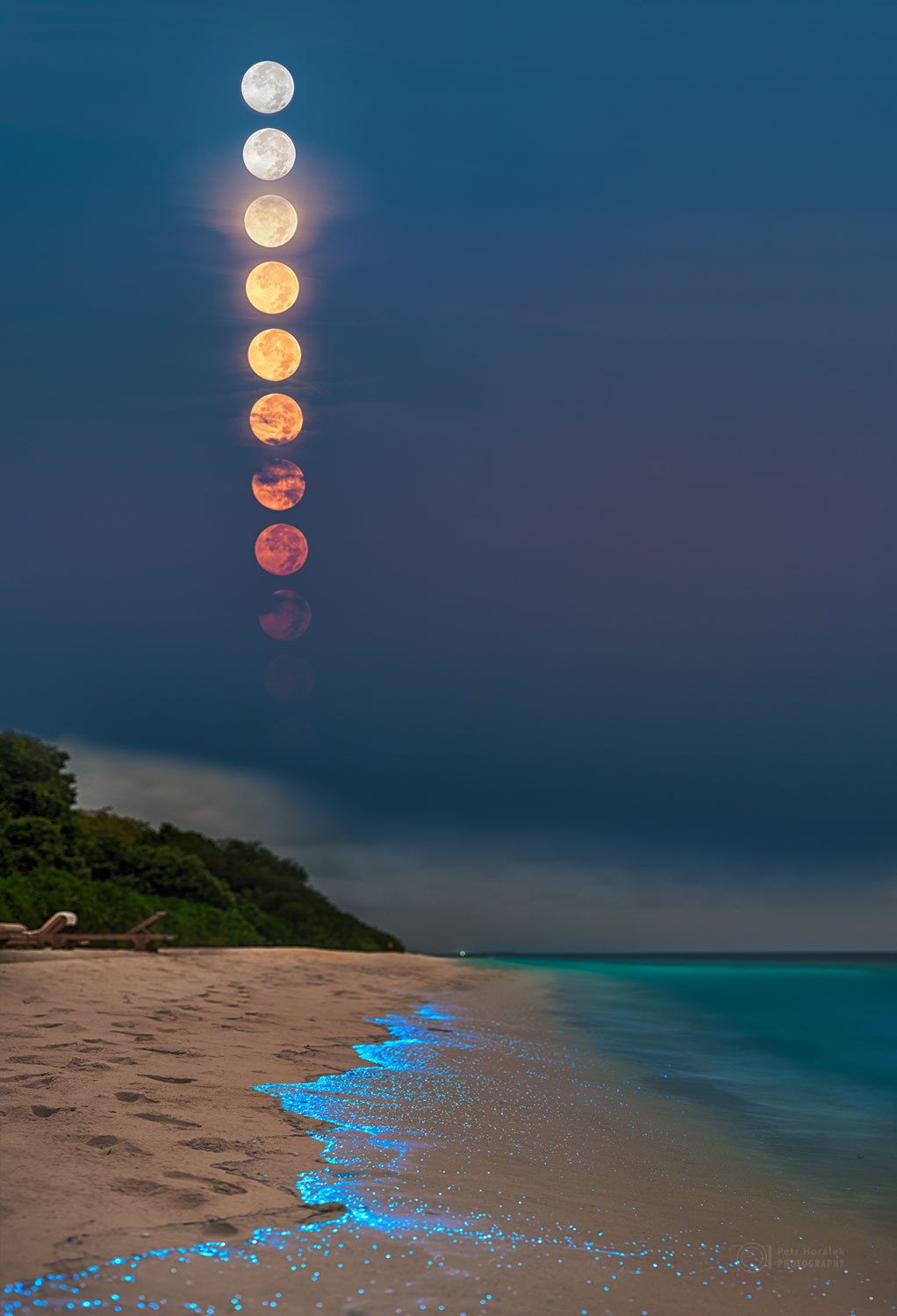
Image Credit & Copyright:
Petr Horálek /
Institute of Physics in Opava
What glows in the night? This night featured a combination of usual and unusual glows. Perhaps the most usual glow was from the Moon, a potentially familiar object. The full Moon's nearly vertical descent results from the observer being near Earth's equator. As the Moon sets, air and aerosols in Earth's atmosphere preferentially scatter out blue light, making the Sun-reflecting satellite appear reddish when near the horizon. Perhaps the most unusual glow was from the bioluminescent plankton, likely less familiar objects. These microscopic creatures glow blue, it is thought, primarily to surprise and deter predators. In this case, the glow was caused primarily by plankton-containing waves crashing onto the beach. The image was taken on Soneva Fushi Island, Maldives just over one year ago. Your Sky Surprise: What picture did APOD feature on your birthday? (post 1995)
#APOD #Astrodata #SpaceExploration #BlackHoleDiscovery #SpaceMission
**Astronomy Picture of the Day**
10 March 2024
**A Total Eclipse at the End of the World**
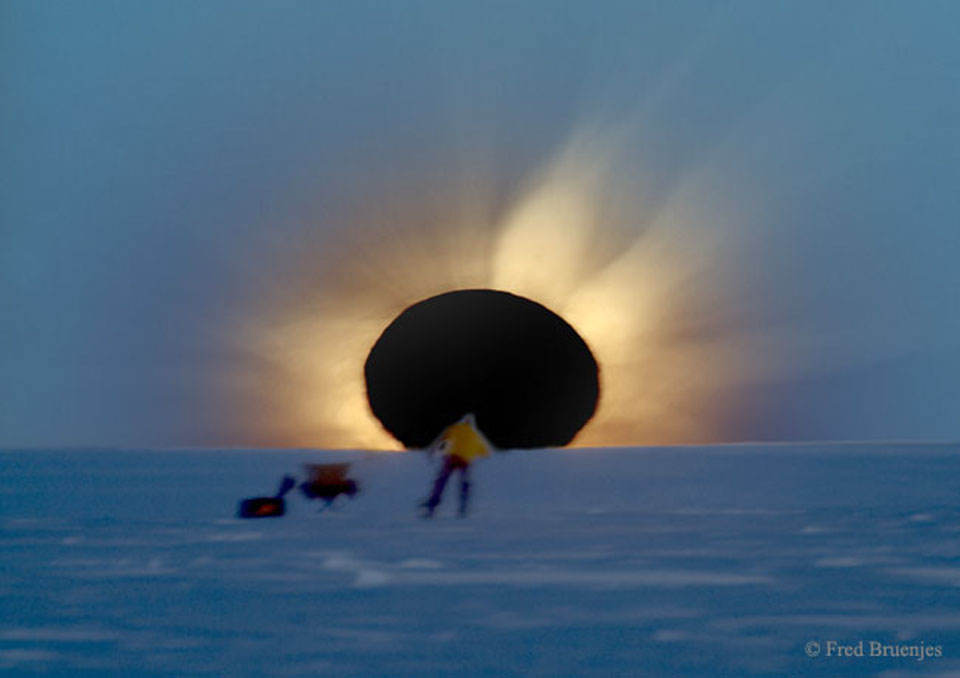
Image Credit & Copyright:
Fred Bruenjes
(moonglow.net)
Would you go to the end of the world to see a total eclipse of the Sun? If you did, would you be surprised to find someone else there already? In 2003, the Sun, the Moon, Antarctica, and two photographers all lined up in Antarctica during an unusual total solar eclipse. Even given the extreme location, a group of enthusiastic eclipse chasers ventured near the bottom of the world to experience the surreal momentary disappearance of the Sun behind the Moon. One of the treasures collected was the featured picture -- a composite of four separate images digitally combined to realistically simulate how the adaptive human eye saw the eclipse. As the image was taken, both the Moon and the Sun peeked together over an Antarctic ridge. In the sudden darkness, the magnificent corona of the Sun became visible around the Moon. Quite by accident, another photographer was caught in one of the images checking his video camera. Visible to his left are an equipment bag and a collapsible chair. A more easily visible solar eclipse will occur in just under four weeks and be visible from a long, thin swath of North America.
#APOD #MeteorShowers #LunarExploration #StarFormation #OuterSpace
**Astronomy Picture of the Day**
09 March 2024
**Comet Pons-Brooks in Northern Spring**
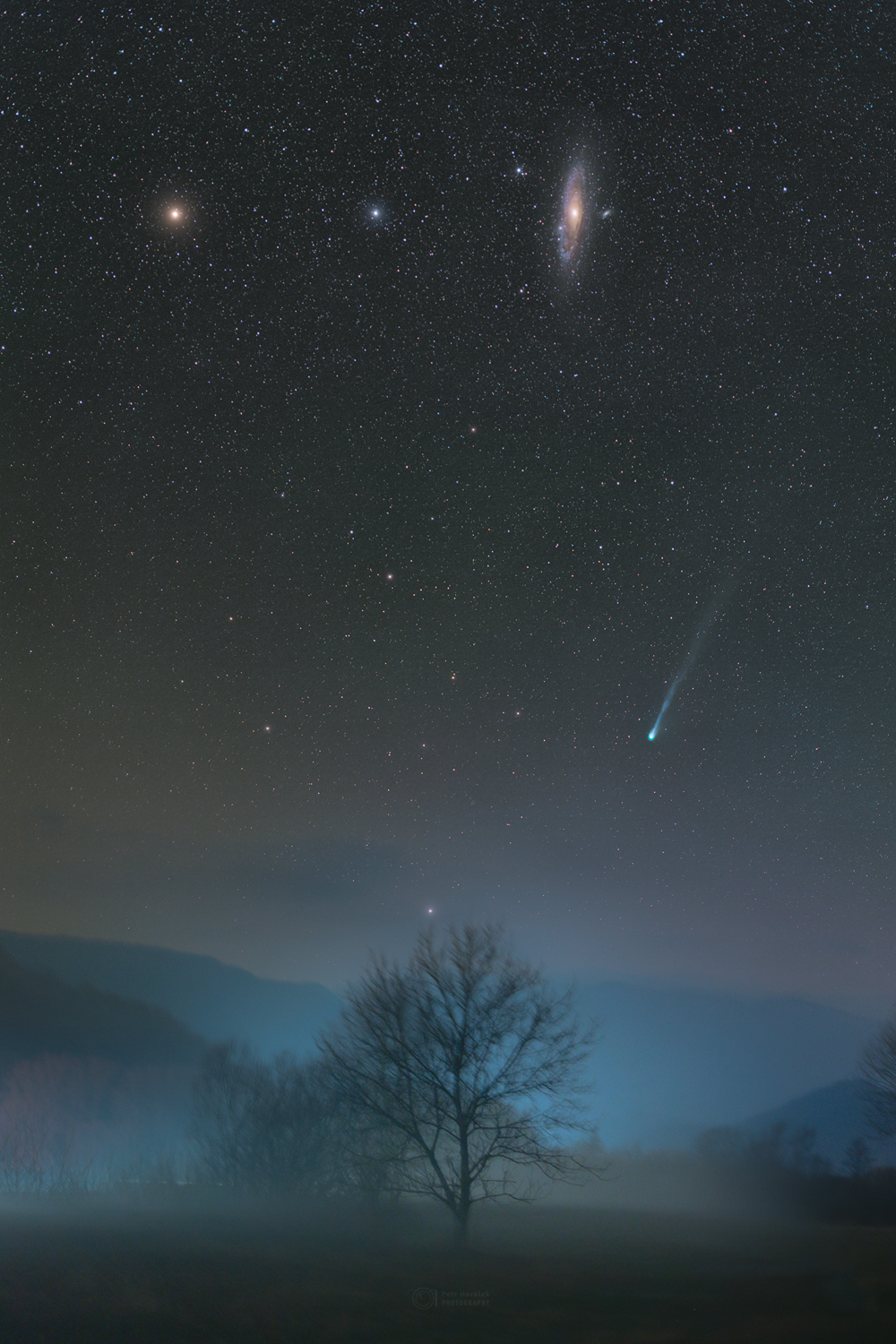
Image Credit & Copyright: Petr Horálek
As spring approaches for northern skygazers Comet 12P/Pons-Brooks is growing brighter. Currently visible with small telescopes and binoculars the Halley-type comet could reach naked eye visibility in the coming weeks. Seen despite a foggy atmosphere, the comet's green coma and long tail hover near the horizon, in this well-composed deep night skyscape from Revuca, Slovakia recorded on March 5. In the sky above the Halley-type comet, the Andromeda (right) and Triangulum galaxies flank bright star Mirach, beta star of the constellation Andromeda. The two spiral galaxies are members of our local galaxy group and over 2.5 million light-years distant. Comet Pons-Brooks is a periodic visitor to the inner Solar System and less than 14 light-minutes away. Reaching its perihelion on April 21, this comet should be visible in the sky during the April 8 total solar eclipse.
#APOD #Astroeducation #SpaceTech #RocketLaunch #Astrotheory
**Astronomy Picture of the Day**
08 March 2024
**The Tarantula Zone**
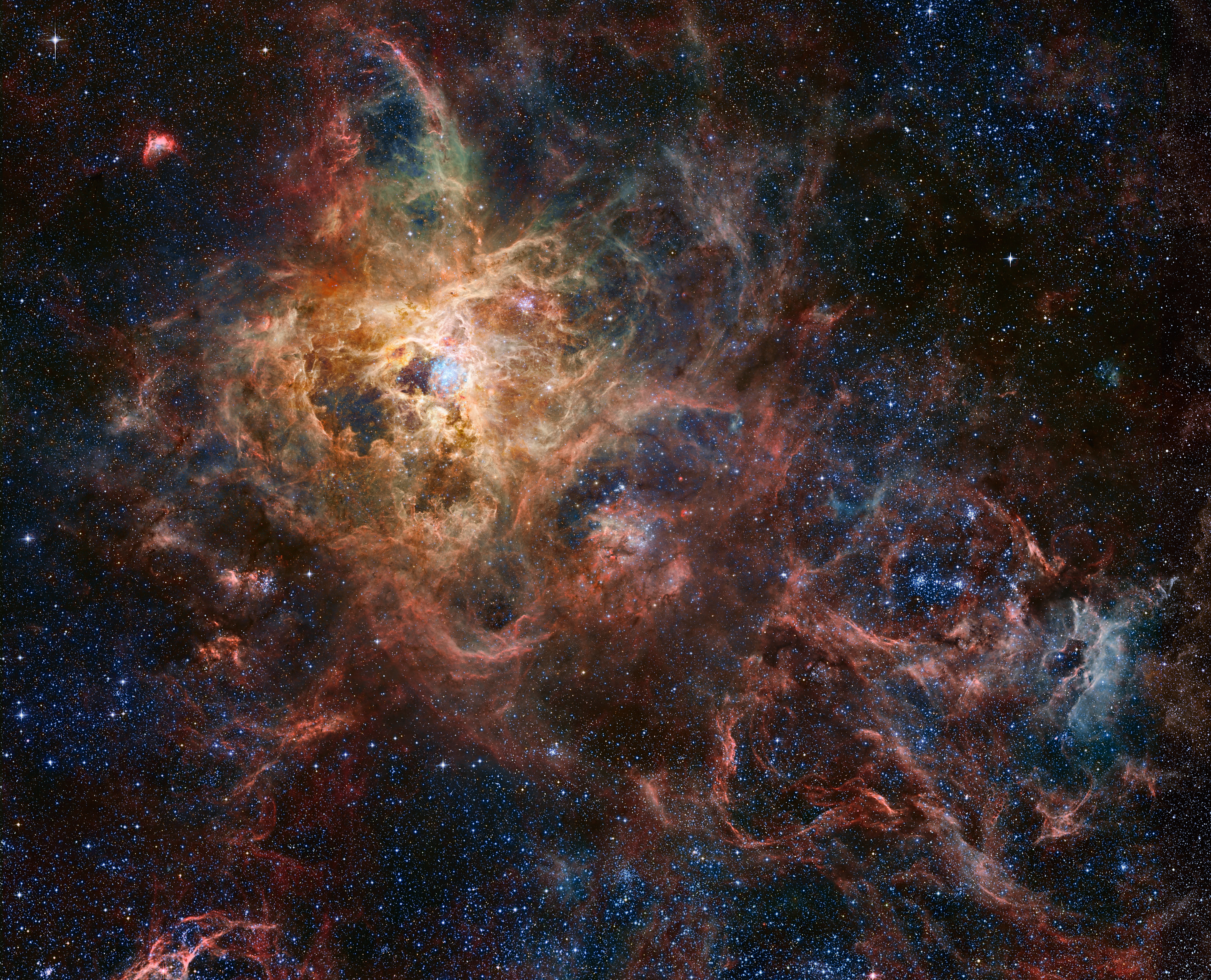
Image Credit & Copyright: Robert Gendler
The Tarantula Nebula, also known as 30 Doradus, is more than a thousand light-years in diameter, a giant star forming region within nearby satellite galaxy the Large Magellanic Cloud. About 180 thousand light-years away, it's the largest, most violent star forming region known in the whole Local Group of galaxies. The cosmic arachnid sprawls across this magnificent view, an assembly of image data from large space- and ground-based telescopes. Within the Tarantula (NGC 2070), intense radiation, stellar winds, and supernova shocks from the central young cluster of massive stars cataloged as R136 energize the nebular glow and shape the spidery filaments. Around the Tarantula are other star forming regions with young star clusters, filaments, and blown-out bubble-shaped clouds. In fact, the frame includes the site of the closest supernova in modern times, SN 1987A, at lower right. The rich field of view spans about 2 degrees or 4 full moons in the southern constellation Dorado. But were the Tarantula Nebula closer, say 1,500 light-years distant like the Milky Way's own star forming Orion Nebula, it would take up half the sky.
#APOD #Astronauts #Stellar #SpaceExploration #SpaceMissions
**Astronomy Picture of the Day**
07 March 2024
**The Crew-8 Nebula**
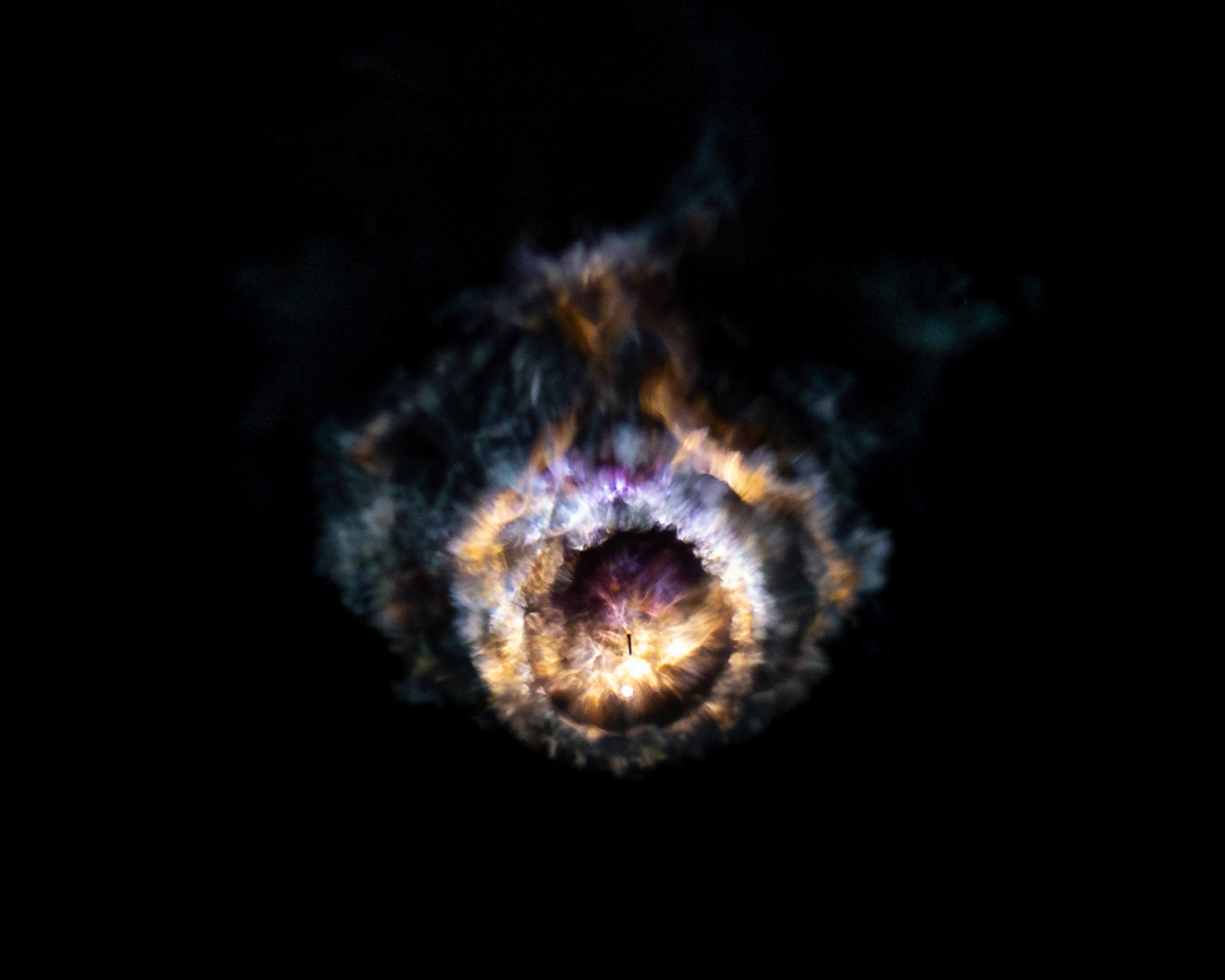
Image Credit & Copyright: Michael Seeley
Not the James Webb Space Telescope's latest view of a distant galactic nebula, this cloud of gas and dust dazzled spacecoast skygazers on March 3. The telephoto snapshot was taken minutes after the launch of a Falcon 9 rocket on the SpaceX Crew-8 mission, to the International Space Station. It captures plumes and exhaust from the separated first and second stage, a drifting Rorschach pattern in dark evening skies. The bright spot near bottom center within the stunning terrestrial nebulosity is the second stage engine firing to carry 4 humans to space in the Crew Dragon spacecraft Endeavour. In sharp silhouette just above it is the Falcon 9 first stage booster orienting itself for return to a landing zone at Cape Canaveral, planet Earth. This reuseable first stage booster was making its first flight. But the Crew Dragon Endeavour capsule has flown humans to low Earth orbit and back again 4 times before. Endeavour, as a name for a spacecraft, has also seen reuse, christening retired Space Shuttle Endeavour and the Apollo 15 command module.
#APOD #Astrozone #Astrospace #Galactic #Cosmological
**Astronomy Picture of the Day**
06 March 2024
**M102: Edge-on Disk Galaxy**
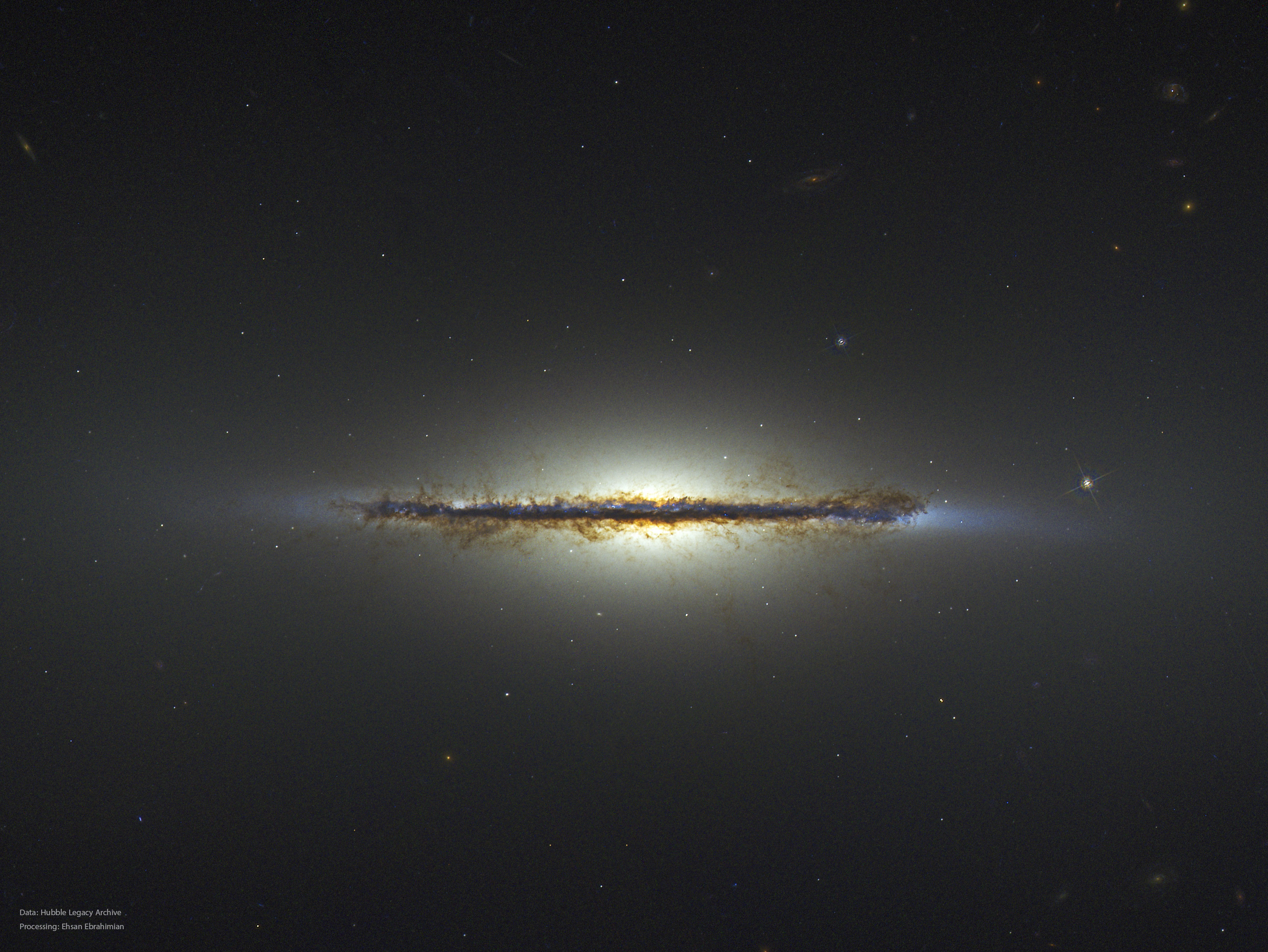
*Image creditor details unavailable via API. Visit linked page below for full info.*
What kind of celestial object is this? A relatively normal galaxy -- but seen from its edge. Many disk galaxies are actually just as thin as NGC 5866, the Spindle galaxy, pictured here, but are not seen edge-on from our vantage point. A perhaps more familiar galaxy seen edge-on is our own Milky Way galaxy. Also cataloged as M102, the Spindle galaxy has numerous and complex dust lanes appearing dark and red, while many of the bright stars in the disk give it a more blue underlying hue. The blue disk of young stars can be seen in this Hubble image extending past the dust in the extremely thin galactic plane. There is evidence that the Spindle galaxy has cannibalized smaller galaxies over the past billion years or so, including multiple streams of faint stars, dark dust that extends away from the main galactic plane, and a surrounding group of galaxies (not shown). In general, many disk galaxies become thin because the gas that forms them collides with itself as it rotates about the gravitational center. The Spindle galaxy lies about 50 million light years distant toward the constellation of the Dragon (Draco).
#APOD #Astrophysics #SpaceTech #Astroeducation #MilkyWay
**Astronomy Picture of the Day**
05 March 2024
**NGC 2170: Angel Nebula Abstract Art**
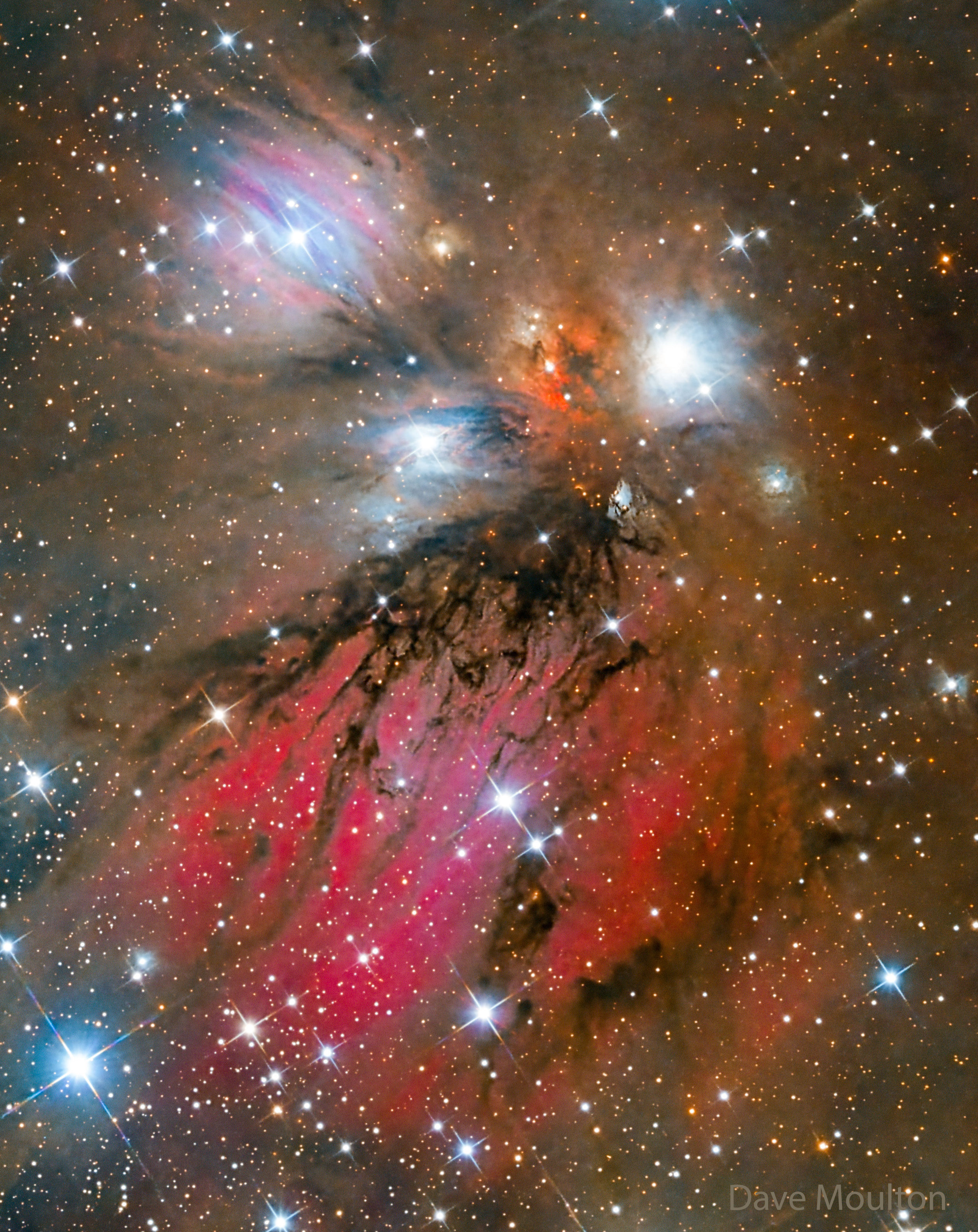
Image Credit & Copyright:
David Moulton
Is this a painting or a photograph? In this celestial abstract art composed with a cosmic brush, dusty nebula NGC 2170, also known as the Angel Nebula, shines just above the image center. Reflecting the light of nearby hot stars, NGC 2170 is joined by other bluish reflection nebulae, a red emission region, many dark absorption nebulae, and a backdrop of colorful stars. Like the common household items that abstract painters often choose for their subjects, the clouds of gas, dust, and hot stars featured here are also commonly found in a setting like this one -- a massive, star-forming molecular cloud in the constellation of the Unicorn (Monoceros). The giant molecular cloud, Mon R2, is impressively close, estimated to be only 2,400 light-years or so away. At that distance, this canvas would be over 60 light-years across.
#APOD #Astrogeology #AstronautLife #Astrozone #AstronomyFacts
**Astronomy Picture of the Day**
04 March 2024
**Light Pillars Over Inner Mongolia**
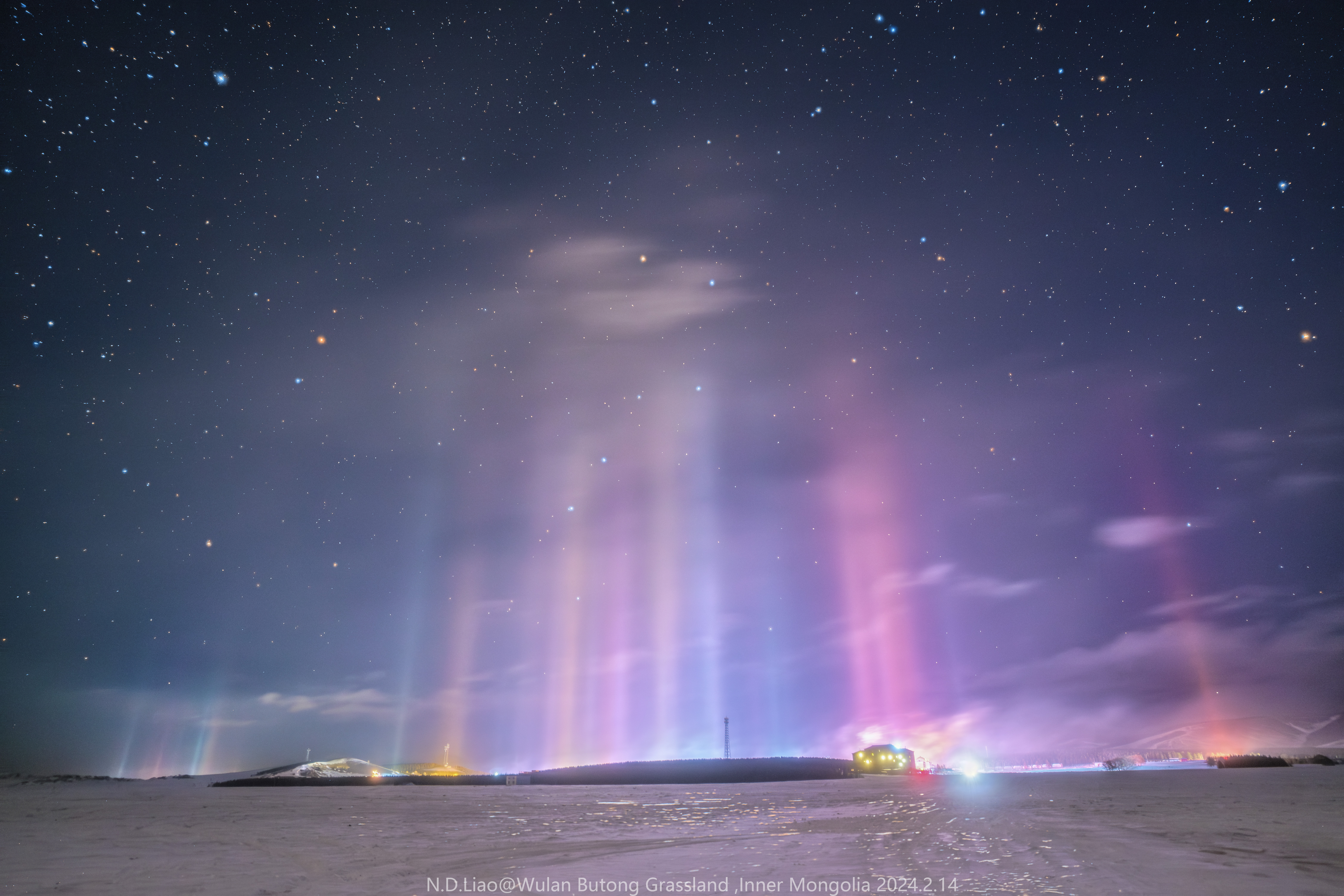
Image Credit & Copyright:
N. D. Liao
What's happening across that field? Pictured here are not auroras but nearby light pillars, a phenomenon typically much closer. In most places on Earth, a lucky viewer can see a Sun pillar, a column of light appearing to extend up from the Sun caused by flat fluttering ice-crystals reflecting sunlight from the upper atmosphere. Usually, these ice crystals evaporate before reaching the ground. During freezing temperatures, however, flat fluttering ice crystals may form near the ground in a form of light snow sometimes known as a crystal fog. These ice crystals may then reflect ground lights in columns not unlike a Sun pillar. The featured image was taken last month across the Wulan Butong Grasslands in Inner Mongolia, China.
#APOD #SpaceTech #Astrofans #Astrophotography #Universe
**Astronomy Picture of the Day**
03 March 2024
**A Total Solar Eclipse Close-Up in Real Time**
https://www.youtube.com/embed/5D9j-8Vhyto?rel=0&showinfo=0
Image Credit & Copyright:
Jun Ho Oh (KAIST,
HuboLab);
Music:
Flowing Air by
Mattia Vlad Morleo
How would you feel if the Sun disappeared? Many eclipse watchers across the USA surprised themselves in 2017 with the awe that they felt and the exclamations that they made as the Sun momentarily disappeared behind the Moon. Perhaps expecting just a brief moment of dusk, the spectacle of unusually rapid darkness, breathtakingly bright glowing beads around the Moon's edge, shockingly pink solar prominences, and a strangely detailed corona stretching across the sky caught many a curmudgeon by surprise. Many of these attributes were captured in the featured real-time, three-minute video of 2017's total solar eclipse. The video frames were acquired in Warm Springs, Oregon with equipment specifically designed by Jun Ho Oh to track a close-up of the Sun's periphery during eclipse. As the video ends, the Sun is seen being reborn on the other side of the Moon from where it departed. Next month, on April 8th, a new total solar eclipse will be visible in a thin band across North America.
#APOD #Astroeducation #MeteorShowers #SpaceObservatory #Planetarium
**Astronomy Picture of the Day**
02 March 2024
**Odysseus on the Moon**
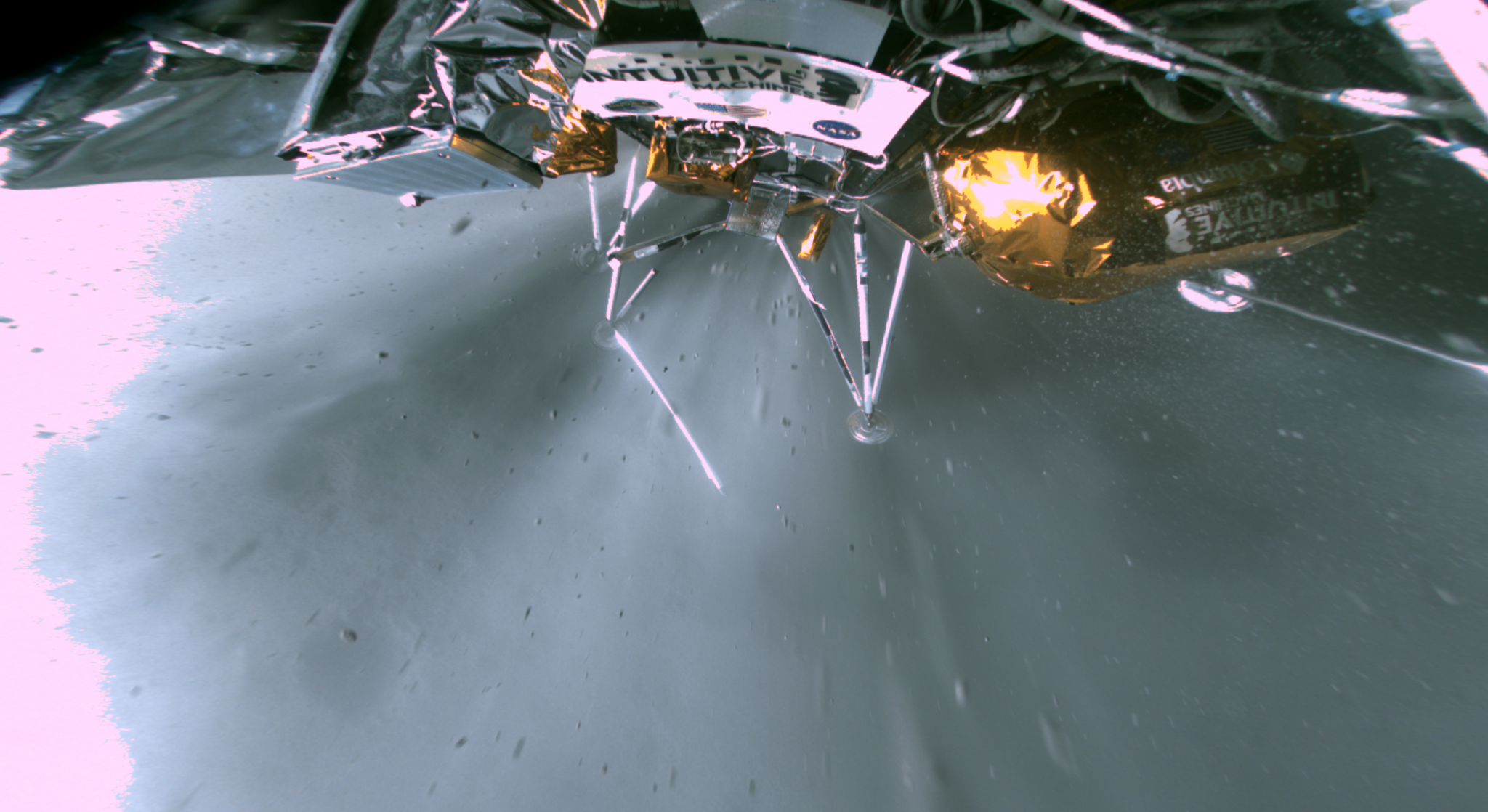
*Image creditor details unavailable via API. Visit linked page below for full info.*
Methalox rocket engine firing, Odysseus' landing legs absorb first contact with the lunar surface in this wide-angle snapshot from a camera on board the robotic Intuitive Machines Nova-C moon lander. Following the landing on February 22, broken landing legs, visible in the image, ultimately left the lander at rest but tilted. Odysseus' gentle lean into a sloping lunar surface preserved the phone booth-sized lander's ability to operate, collect solar power, and return images and data to Earth. Its exact landing site in the Moon's far south polar region was imaged by NASA's Lunar Reconnaissance Orbiter. Donated by NASA, the American flag seen on the lander's central panel is 1970 Apollo program flight hardware.
#APOD #Astronomy #Astroinformatics #Science #Astrogeology
**Astronomy Picture of the Day**
01 March 2024
**Odysseus and The Dish**
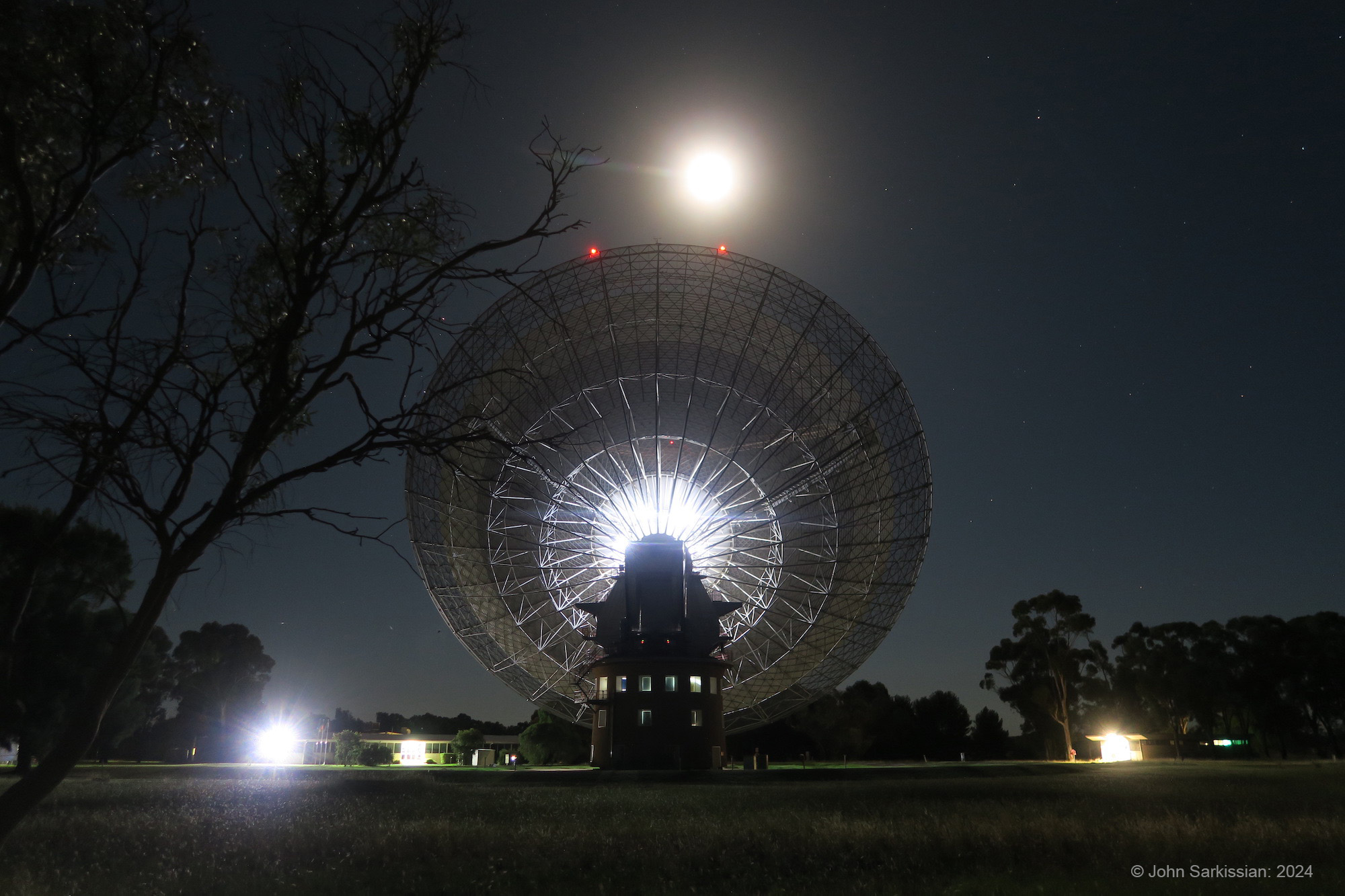
Image Credit & Copyright: John Sarkissian
Murriyang, the CSIRO’s Parkes radio telescope points toward a nearly Full Moon in this image from New South Wales, Australia, planet Earth. Bathed in moonlight, the 64 meter dish is receiving weak radio signals from Odysseus, following the robotic lander's February 22 touch down some 300 kilometers north of the Moon's south pole. The landing of Odysseus represents the first U.S. landing on the Moon since the Apollo 17 mission in 1972. Odysseus' tilted orientation on the lunar surface prevents its high-gain antenna from pointing toward Earth. But the sensitivity of the large, steerable Parkes dish significantly improved the reception of data from the experiments delivered to the lunar surface by the robotic moon lander. Of course the Parkes Radio Telescope dish became famous for its superior lunar television reception during the Apollo 11 mission in 1969, allowing denizens of planet Earth to watch the first moonwalk.
#APOD #Cosmology #SpaceIndustry #Astrochemistry #Astronomy
**Astronomy Picture of the Day**
29 February 2024
**Julius Caesar and Leap Days**

*Image creditor details unavailable via API. Visit linked page below for full info.*
In 46 BC Julius Caesar reformed the calendar system. Based on advice by astronomer Sosigenes of Alexandria, the Julian calendar included one leap day every four years to account for the fact that an Earth year is slightly more than 365 days long. In modern terms, the time it takes for the planet to orbit the Sun once is 365.24219 mean solar days. So if calendar years contained exactly 365 days they would drift from the Earth's year by about 1 day every 4 years and eventually July (named for Julius Caesar himself) would occur during the northern hemisphere winter. By adopting a leap year with an extra day every four years, the Julian calendar year would drift much less. In 1582 Pope Gregory XIII provided the further fine-tuning that leap days should not occur in years ending in 00, unless divisible by 400. This Gregorian Calendar system is the one in wide use today. Of course, tidal friction in the Earth-Moon system slows Earth's rotation and gradually lengthens the day by about 1.4 milliseconds per century. That means that leap days like today will not be necessary, about 4 million years from now. This Roman silver coin, a denarius, depicts Julius Caesar (left) and Venus, Roman goddess of love.
#APOD #BlackHoleDiscovery #SpaceFacts #SpaceTech #Astroinformatics
**Astronomy Picture of the Day**
28 February 2024
**Shades of Night**
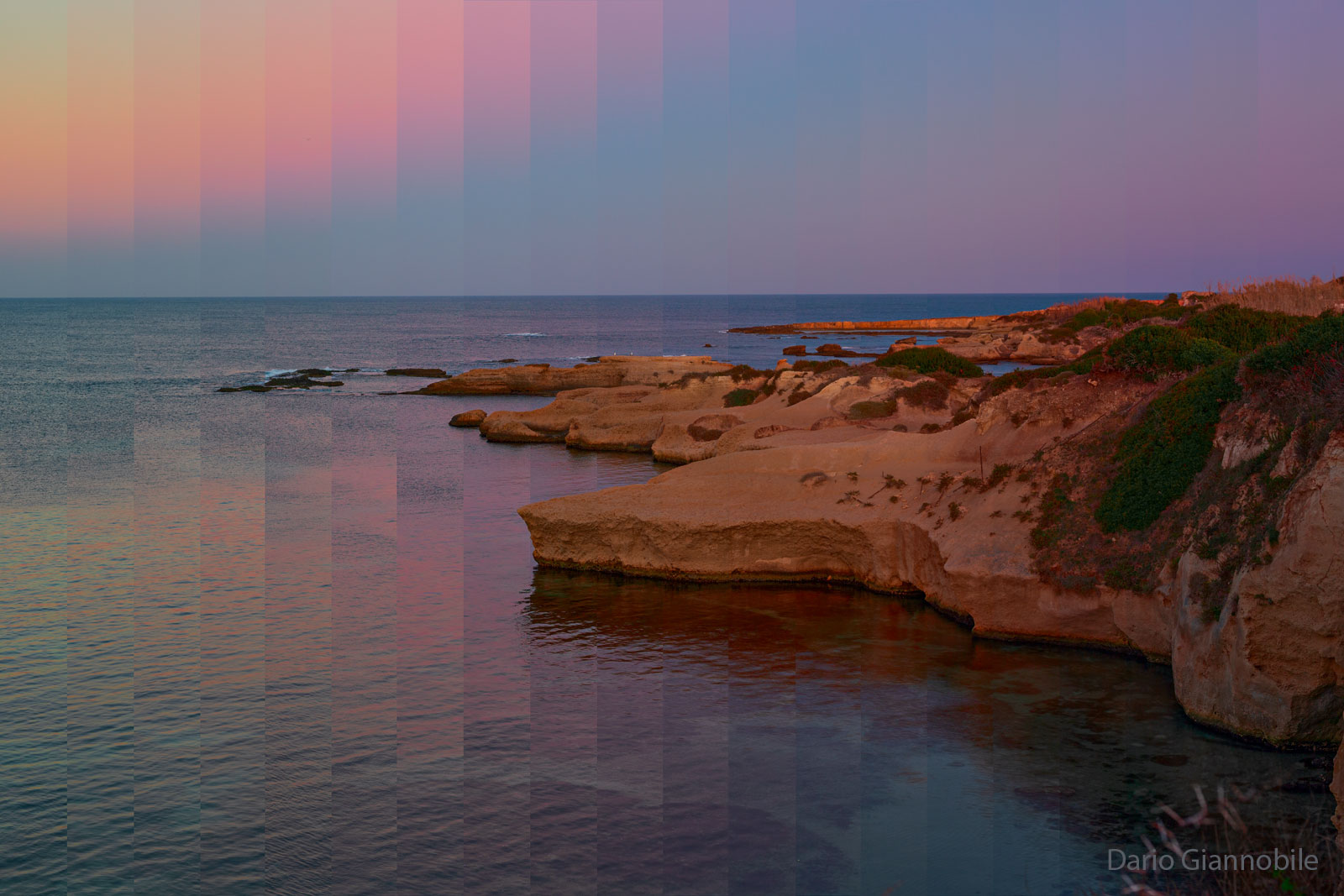
Image Credit & Copyright:
Dario Giannobile
How does the sky turn dark at night? In stages, and with different characteristic colors rising from the horizon. The featured image shows, left to right, increasingly late twilight times after sunset in 20 different vertical bands. The picture was taken last month in Syracuse, Sicily, Italy, in the direction opposite the Sun. On the far left is the pre-sunset upper sky. Toward the right, prominent bands include the Belt of Venus, the Blue Band, the Horizon Band, and the Red Band. As the dark shadow of the Earth rises, the colors in these bands are caused by direct sunlight reflecting from air and aerosols in the Earth's atmosphere, multiple reflections sometimes involving a reddened sunset, and refraction. In practice, these bands can be diffuse and hard to discern, and their colors can depend on colors near the setting Sun. Finally, the Sun completely sets and the sky becomes dark. Don't despair -- the whole thing will happen in reverse when the Sun rises again in the morning.
#APOD #CosmosJourney #Meteorology #Astrophysics #GalaxyExploration
**Astronomy Picture of the Day**
27 February 2024
**Supernova Remnant Simeis 147**
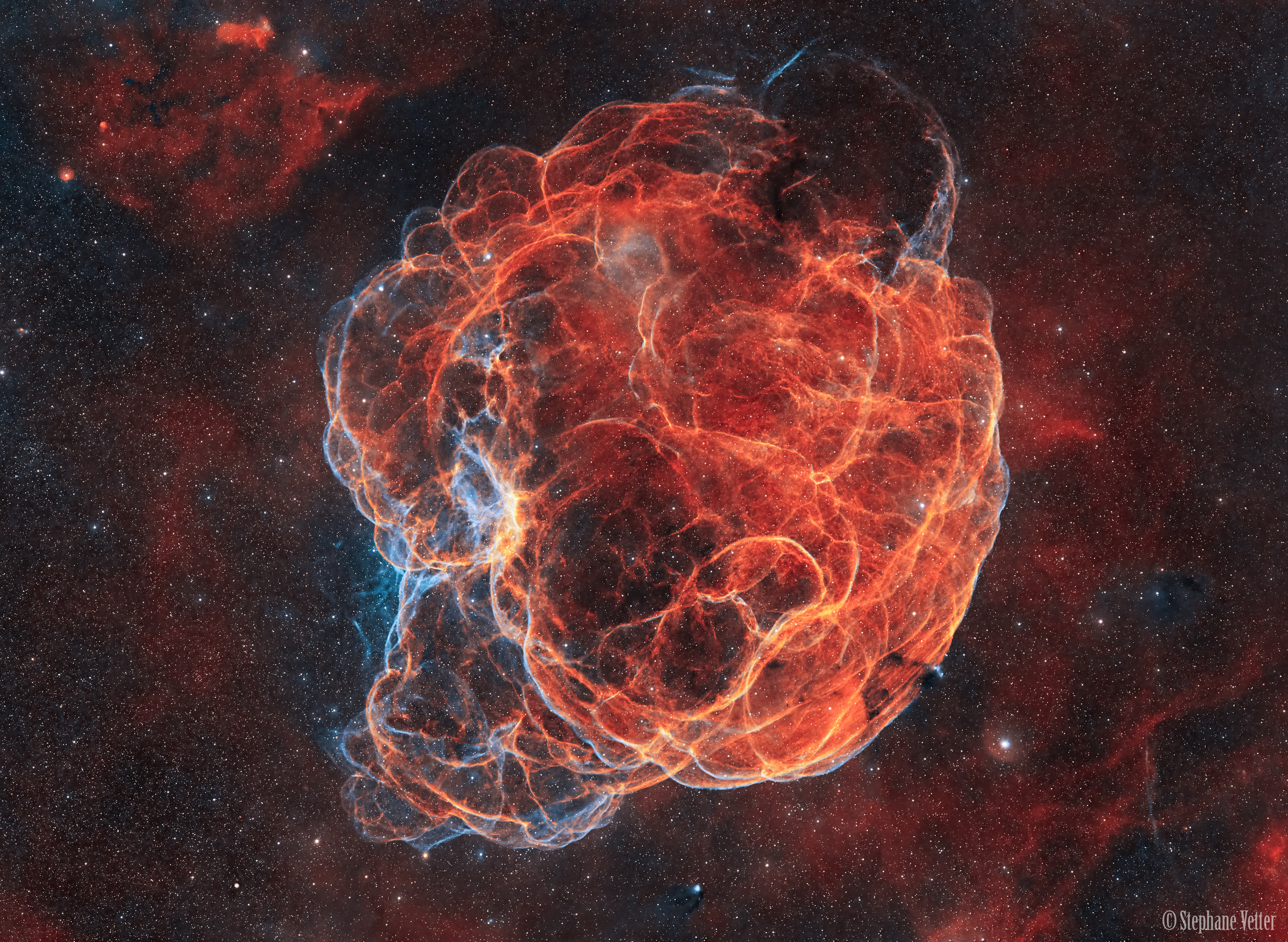
Image Credit & Copyright:
Stéphane Vetter
(Nuits sacrées)
It's easy to get lost following the intricate, looping, and twisting filaments of supernova remnant Simeis 147. Also cataloged as Sharpless 2-240, the filamentary nebula goes by the popular nickname the Spaghetti Nebula. Seen toward the boundary of the constellations of the Bull (Taurus) and the Charioteer (Auriga), the impressive gas structure covers nearly 3 degrees on the sky, equivalent to 6 full moons. That's about 150 light-years at the stellar debris cloud's estimated distance of 3,000 light-years. This composite image includes data taken through narrow-band filters isolating emission from hydrogen (red) and oxygen (blue) glowing gas. The supernova remnant has an estimated age of about 40,000 years, meaning light from this massive stellar explosion first reached the Earth when woolly mammoths roamed free. Besides the expanding remnant, this cosmic catastrophe left behind a pulsar: a spinning neutron star that is the remnant of the original star's core.
#APOD #Celestial #Astrotheory #GalaxyExploration #Planetarium
**Astronomy Picture of the Day**
26 February 2024
**Martian Moon Eclipses Martian Moon**
https://youtube.com/embed/hwQTH0IGrwE?rel=0
*Image creditor details unavailable via API. Visit linked page below for full info.*
What if there were two moons in the sky -- and they eclipsed each other? This happens on Mars. The featured video shows a version of this unusual eclipse from space. Pictured are the two moons of Mars: the larger Phobos, which orbits closer to the red planet, and the smaller Deimos, which orbits further out. The sequence was captured last year by the ESA’s Mars Express, a robotic spacecraft that itself orbits Mars. A similar eclipse is visible from the Martian surface, although very rarely. From the surface, though, the closer moon Phobos would appear to pass in front of farther moon Deimos. Most oddly, both moons orbit Mars so close that they appear to move backwards when compared to Earth's Moon from Earth, both rising in west and setting in the east. Phobos, the closer moon, orbits so close and so fast that it passes nearly overhead about three times a day.
#APOD #Astroengineer #Astronomy #SpaceTravel #SpaceAdventures
**Astronomy Picture of the Day**
25 February 2024
**A Phoenix Aurora over Iceland**
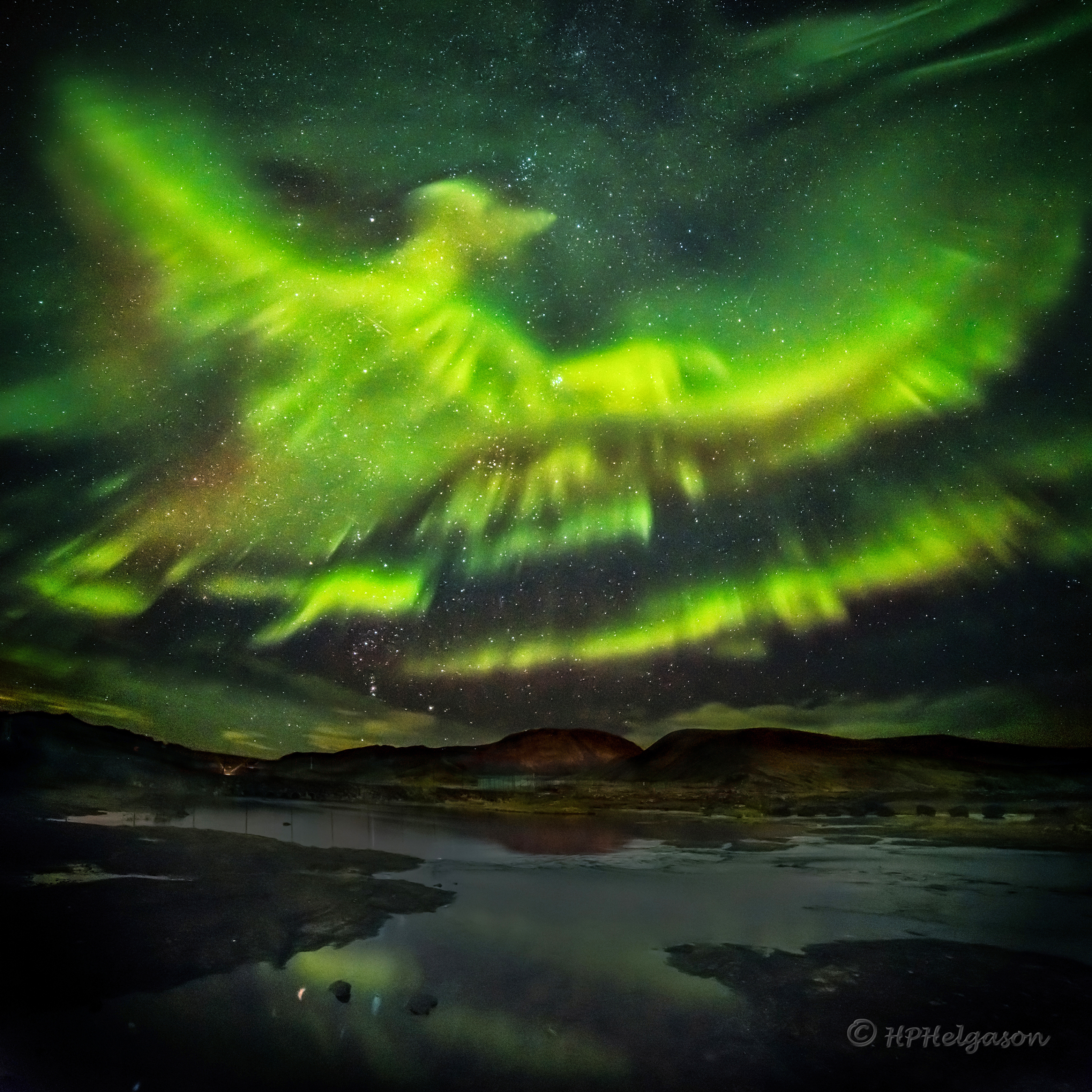
Image Credit & Copyright:
Hallgrimur P. Helgason;
Rollover Annotation:
Judy Schmidt
All of the other aurora watchers had gone home. By 3:30 am in Iceland, on a quiet September night, much of that night's auroras had died down. Suddenly, unexpectedly, a new burst of particles streamed down from space, lighting up the Earth's atmosphere once again. This time, surprisingly, pareidoliacally, the night lit up with an amazing shape reminiscent of a giant phoenix. With camera equipment at the ready, two quick sky images were taken, followed immediately by a third of the land. The mountain in the background is Helgafell, while the small foreground river is called Kaldá, both located about 30 kilometers north of Iceland's capital Reykjavík. Seasoned skywatchers will note that just above the mountain, toward the left, is the constellation of Orion, while the Pleiades star cluster is also visible just above the frame center. The 2016 aurora, which lasted only a minute and was soon gone forever -- would possibly be dismissed as a fanciful fable -- were it not captured in the featured, digitally-composed, image mosaic. Your Sky Surprise: What picture did APOD feature on your birthday? (post 1995)
#APOD #GalacticAdventures #Astrozone #BlackHoleDiscovery #GalaxyExploration
**Astronomy Picture of the Day**
24 February 2024
**To the Moon**
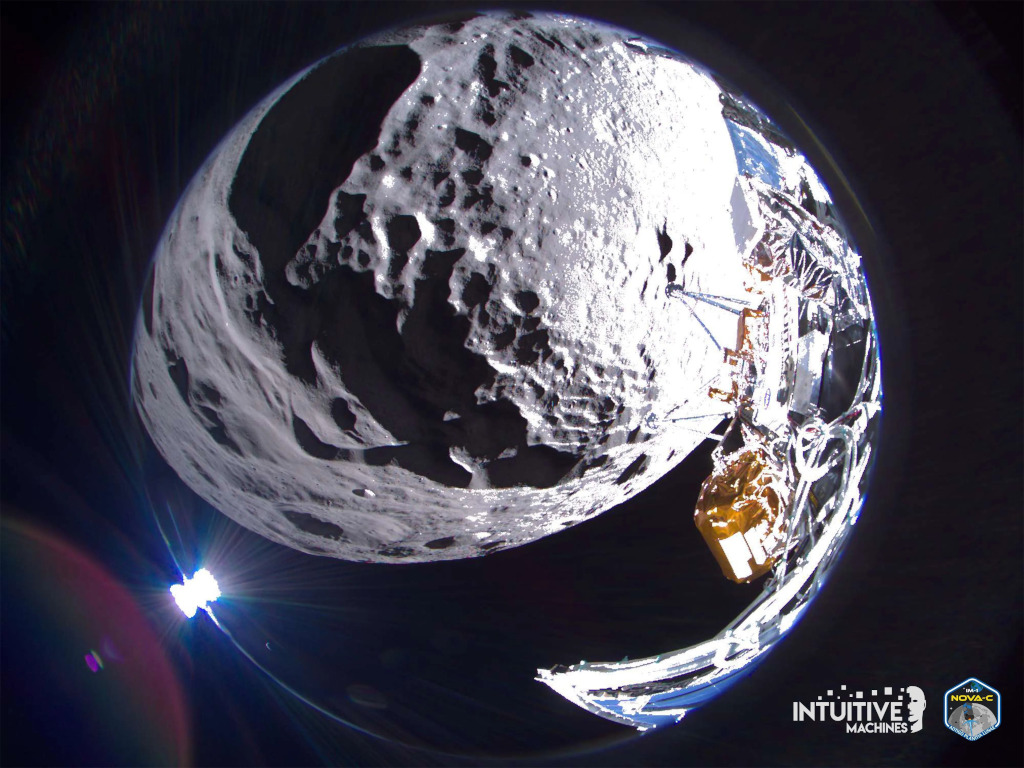
*Image creditor details unavailable via API. Visit linked page below for full info.*
Intuitive Machines' robotic lander Odysseus has accomplished the first U.S. landing on the Moon since the Apollo 17 mission in 1972. Launched on a SpaceX rocket on February 15, the phone booth sized lander reached lunar orbit on the 21st and touched down on the lunar surface at 6:23 pm ET on February 22nd. Its landing region is about 300 kilometers north of the Moon's south pole, near a crater designated Malapert A. The lander is presently collecting solar power and transmitting data back to the Intuitive Machines' mission control center in Houston. The mission marks the first commercial uncrewed landing on the Moon. Prior to landing, Odysseus’ camera captured this extreme wide angle image (landing legs visible at right) as it flew over Schomberger crater some 200 kilometers from its landing site. Odysseus was still about 10 kilometers above the lunar surface.
#APOD #Stars #Science #SpaceInnovation #SpaceMissions
**Astronomy Picture of the Day**
23 February 2024
**The Pencil Nebula Supernova Shock Wave**
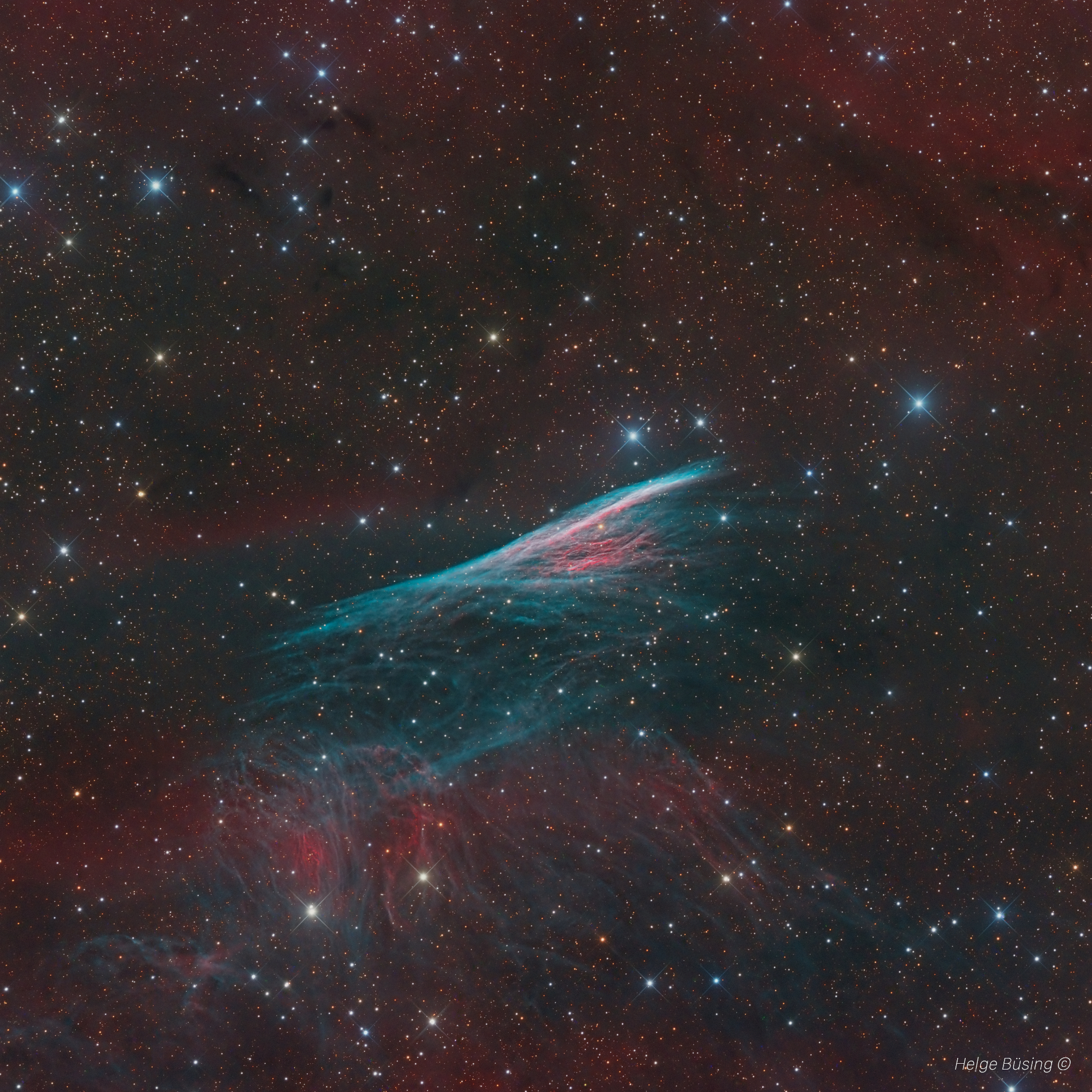
Image Credit & Copyright: Helge Buesing
This supernova shock wave plows through interstellar space at over 500,000 kilometers per hour. Centered and moving upward in the sharply detailed color composite its thin, bright, braided filaments are actually long ripples in a cosmic sheet of glowing gas seen almost edge-on. Discovered in the 1840s by Sir John Herschel, the narrow-looking nebula is sometimes known as Herschel's Ray. Cataloged as NGC 2736, its pointed appearance suggests its modern popular name, the Pencil Nebula. The Pencil Nebula is about 800 light-years away. Nearly 5 light-years long it represents only a small part of the Vela supernova remnant though. The enormous Vela remnant itself is around 100 light-years in diameter, the expanding debris cloud of a star that was seen to explode about 11,000 years ago. Initially, the section of the shock wave seen as the Pencil nebula was moving at millions of kilometers per hour but has slowed considerably, sweeping up surrounding interstellar material.
#APOD #Celestial #SpaceMission #Astrocosmos #BlackHoleDiscovery
**Astronomy Picture of the Day**
22 February 2024
**A View Toward M106**
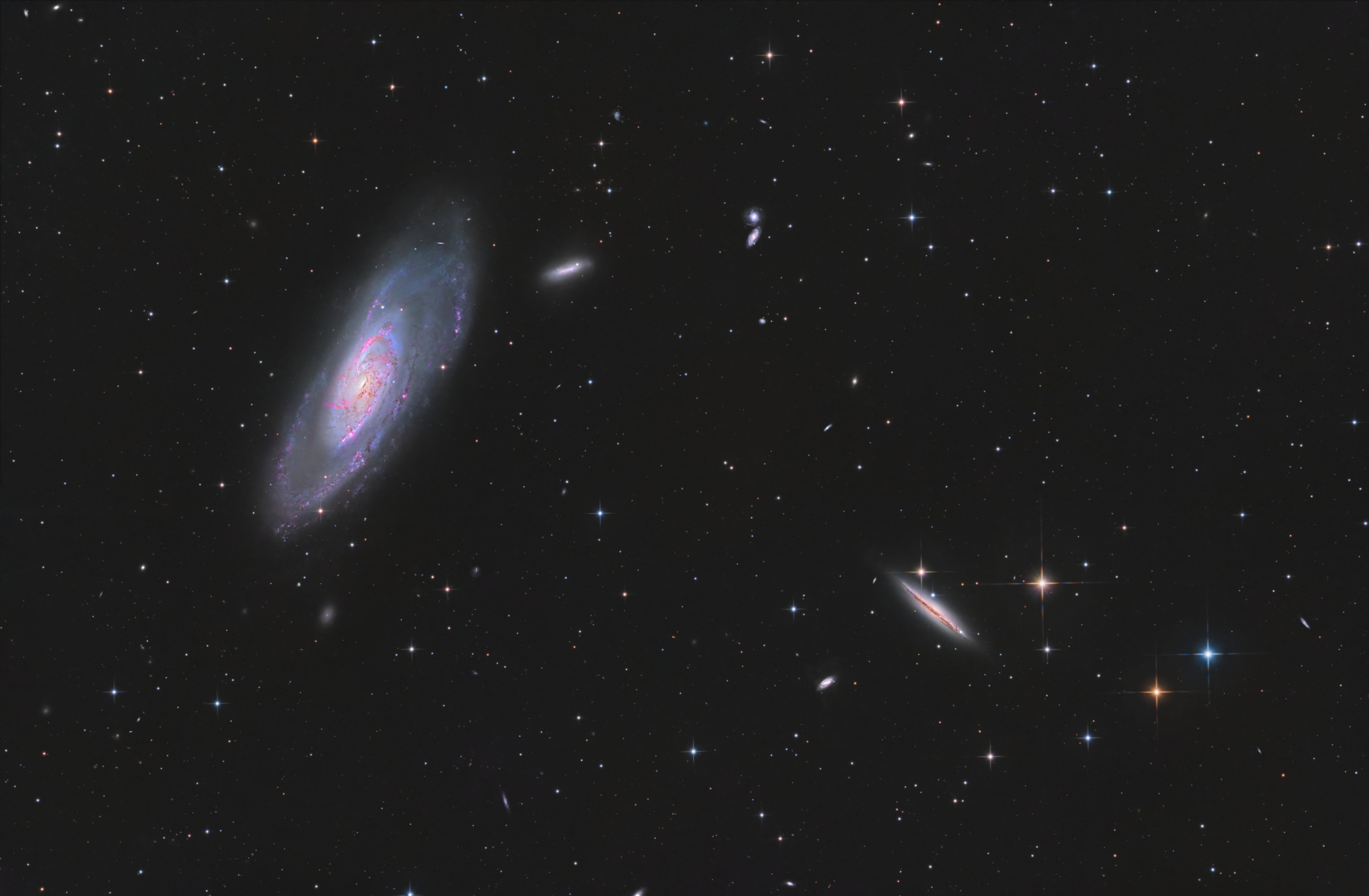
Image Credit & Copyright: Kyunghoon Lim
Big, bright, beautiful spiral, Messier 106 dominates this cosmic vista. The nearly two degree wide telescopic field of view looks toward the well-trained constellation Canes Venatici, near the handle of the Big Dipper. Also known as NGC 4258, M106 is about 80,000 light-years across and 23.5 million light-years away, the largest member of the Canes II galaxy group. For a far far away galaxy, the distance to M106 is well-known in part because it can be directly measured by tracking this galaxy's remarkable maser, or microwave laser emission. Very rare but naturally occurring, the maser emission is produced by water molecules in molecular clouds orbiting its active galactic nucleus. Another prominent spiral galaxy on the scene, viewed nearly edge-on, is NGC 4217 below and right of M106. The distance to NGC 4217 is much less well-known, estimated to be about 60 million light-years, but the bright spiky stars are in the foreground, well inside our own Milky Way galaxy.
#APOD #OuterSpace #Astrogeology #Meteorology #SpaceTechnology
**Astronomy Picture of the Day**
21 February 2024
**Seagull Nebula over Pinnacles' Peak**
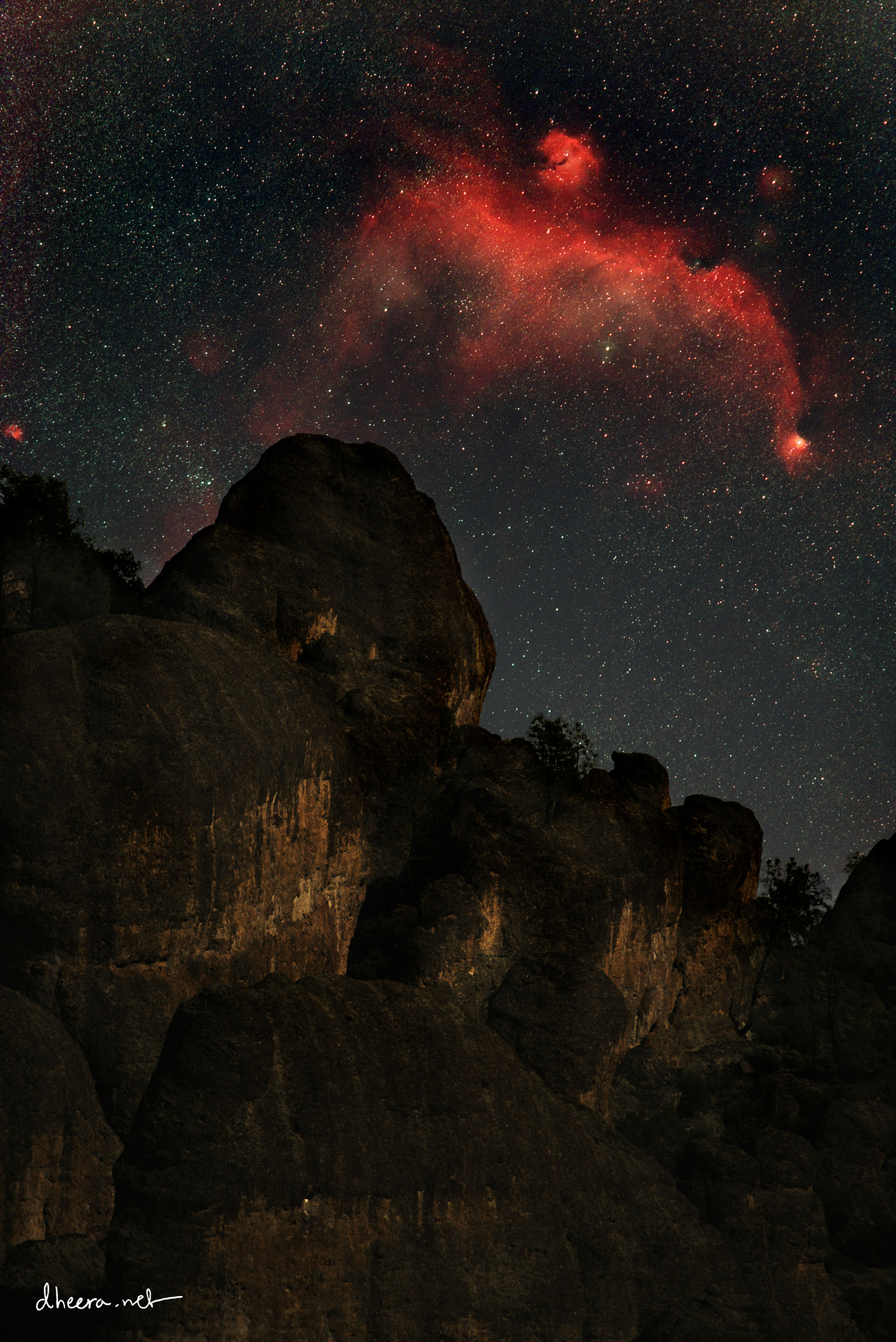
Image Credit & Copyright:
Dheera Venkatraman
The bird is bigger than the peak. Nicknamed for its avian shape, the Seagull Nebula is an emission nebula on the night sky that is vast, spanning an angle over five times the diameter of the full moon and over 200 light years. The head of the nebula is catalogued as IC 2177, and the star cluster under its right wing is catalogued as NGC 2343. Consisting of mostly red-glowing hydrogen gas, the Seagull Nebula incorporates some dust lanes and is forming stars. The peak over which this Seagull seems to soar occurs at Pinnacles National Park in California, USA. The featured image is a composite of long exposure images of the background sky and short exposure images of the foreground, all taken consecutively with the same camera and from the same location. Explore Your Universe: Random APOD Generator
#APOD #CosmicWonders #Meteorology #Astrophoto #Astrophotography