
**Astronomy Picture of the Day**
30 May 2024
**A Lunar Corona over Paris**

Image Credit & Copyright:
Valter Binotto
Why does a cloudy moon sometimes appear colorful? The effect, called a lunar corona, is created by the quantum mechanical diffraction of light around individual, similarly-sized water droplets in an intervening but mostly-transparent cloud. Since light of different colors has different wavelengths, each color diffracts differently. Lunar coronae are one of the few quantum mechanical color effects that can be easily seen with the unaided eye. Solar coronae are also sometimes evident. The featured image was taken last month from Paris, France. The blue beacon emanating from the Eiffel Tower did not affect the colorful lunar corona. Portal Universe: Random APOD Generator
#APOD #Stargazing #Astroknowledge #Astrophysics #AstronautLife
**Astronomy Picture of the Day**
29 May 2024
**Stairway to the Milky Way**

Image Credit & Copyright:
Marcin Rosadziński
What happens if you ascend this stairway to the Milky Way? Before answering that, let's understand the beautiful sky you will see. Most eye-catching is the grand arch of the Milky Way Galaxy, the band that is the central disk of our galaxy which is straight but distorted by the wide-angle nature of this composite image. Many stars well in front of the Milk Way will be visible, with the bright white star just below the stellar arch being Altair, and the bright blue star above it being Vega. The air glows green on the left, just above the yellow cloud deck. The featured image was taken last month on Portugal's Madeira Island in the North Atlantic Ocean. Oh, and what happens after you reach the top of these stairs and admire the amazing sky is, quite probably, that you then descend down the stairs on the other side. Your Sky Surprise: What picture did APOD feature on your birthday? (post 1995)
#APOD #RocketScience #Astrophotography #SpaceWeather #SpaceIndustry
**Astronomy Picture of the Day**
28 May 2024
**Solar X Flare as Famous Active Region Returns**
https://www.youtube.com/embed/yt7uwWzSTw0?rel=0
*Image creditor details unavailable via API. Visit linked page below for full info.*
It's back. The famous active region on the Sun that created auroras visible around the Earth earlier this month has survived its rotation around the far side of the Sun -- and returned. Yesterday, as it was beginning to reappear on the Earth-facing side, the region formerly labeled AR 3664 threw another major solar flare, again in the highest-energy X-class range. The featured video shows the emerging active region on the lower left, as it was captured by NASA's Earth-orbiting Solar Dynamics Observatory yesterday in ultraviolet light. The video is a time-lapse of the entire Sun rotating over 24 hours. Watch the lower-left region carefully at about the 2-second mark to see the powerful flare burst out. The energetic particles from that flare and associated CME are not expected to directly impact the Earth and trigger impressive auroras, but scientists will keep a close watch on this unusually active region over the next two weeks, as it faces the Earth, to see what develops.
#APOD #LunarMission #Galaxy #Astrotheory #SpaceTech
**Astronomy Picture of the Day**
27 May 2024
**Chamaeleon I Molecular Cloud**
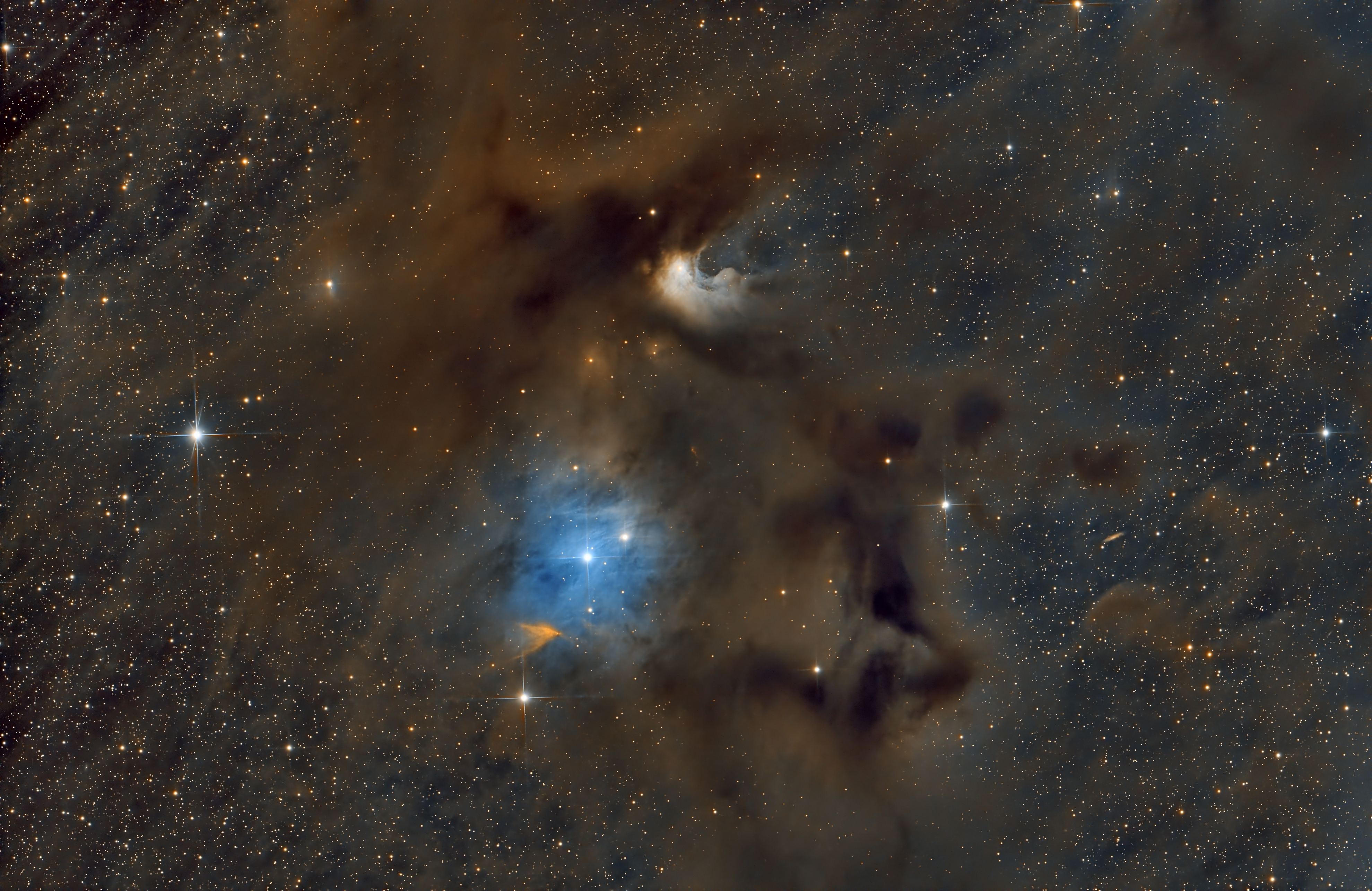
Image Credit & Copyright: Amiel Contuliano
Dark markings and bright nebulae in this telescopic southern sky view are telltale signs of young stars and active star formation. They lie a mere 650 light-years away, at the boundary of the local bubble and the Chamaeleon molecular cloud complex. Regions with young stars identified as dusty reflection nebulae from the 1946 Cederblad catalog include the C-shaped Ced 110 just above and right of center, and bluish Ced 111 below it. Also a standout in the frame, the orange tinted V-shape of the Chamaeleon Infrared Nebula (Cha IRN) was carved by material streaming from a newly formed low-mass star. The well-composed image spans 1.5 degrees. That's about 17 light-years at the estimated distance of the nearby Chamaeleon I molecular cloud.
#APOD #MilkyWay #SpaceIndustry #Astroinformatics #LunarMission
**Astronomy Picture of the Day**
26 May 2024
**A Solar Filament Erupts**
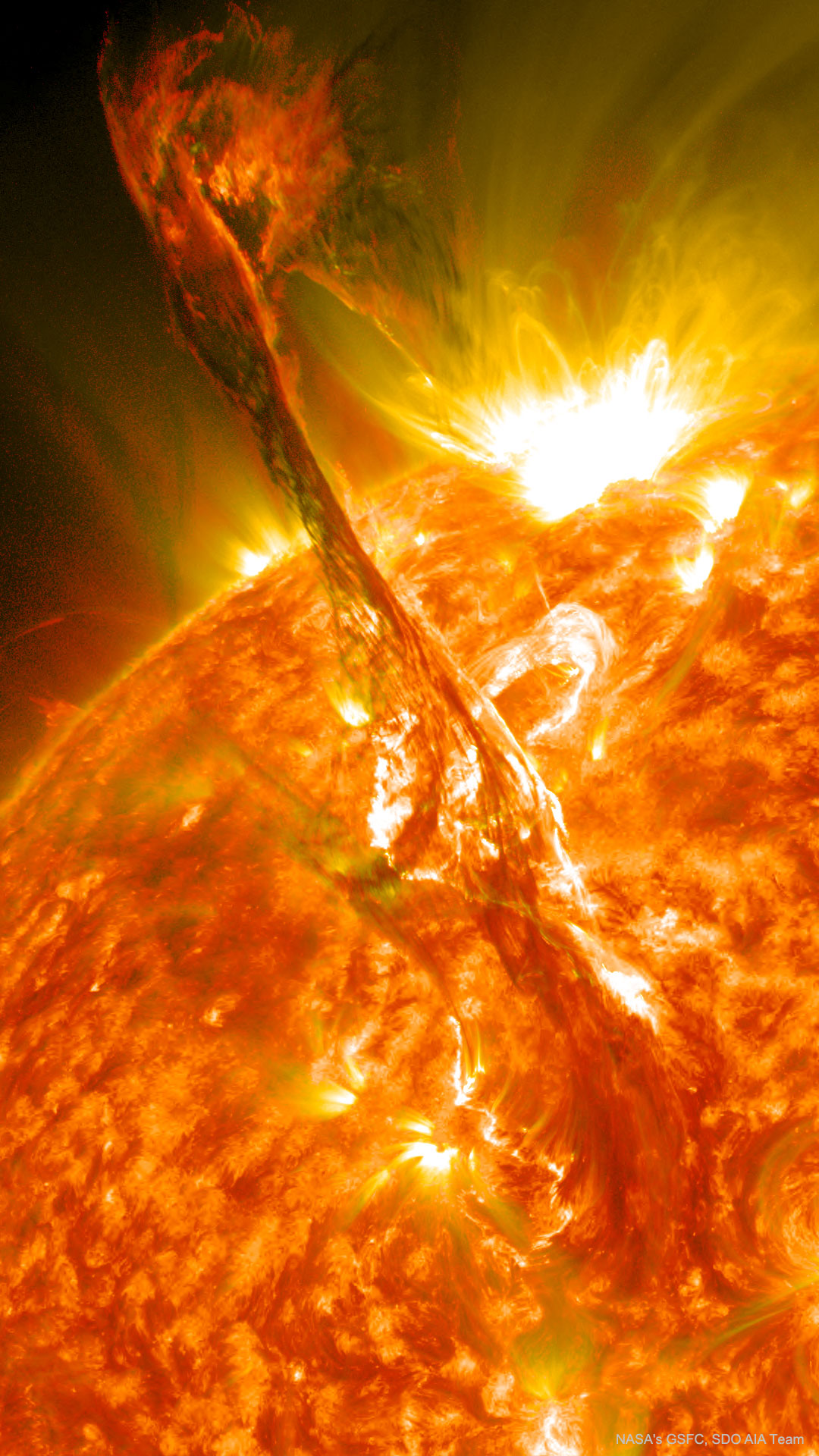
*Image creditor details unavailable via API. Visit linked page below for full info.*
What's happened to our Sun? Nothing very unusual -- it just threw a filament. Toward the middle of 2012, a long standing solar filament suddenly erupted into space, producing an energetic coronal mass ejection (CME). The filament had been held up for days by the Sun's ever changing magnetic field and the timing of the eruption was unexpected. Watched closely by the Sun-orbiting Solar Dynamics Observatory, the resulting explosion shot electrons and ions into the Solar System, some of which arrived at Earth three days later and impacted Earth's magnetosphere, causing visible auroras. Loops of plasma surrounding the active region can be seen above the erupting filament in the featured ultraviolet image. Our Sun is nearing the most active time in its 11-year cycle, creating many coronal holes that allow for the ejection of charged particles into space. As before, these charged particles can create auroras. Your Sky Surprise: What picture did APOD feature on your birthday? (post 1995)
#APOD #Galactic #SpaceTech #Planetarium #SpaceTechnology
**Astronomy Picture of the Day**
25 May 2024
**Manicouagan Impact Crater from Space**
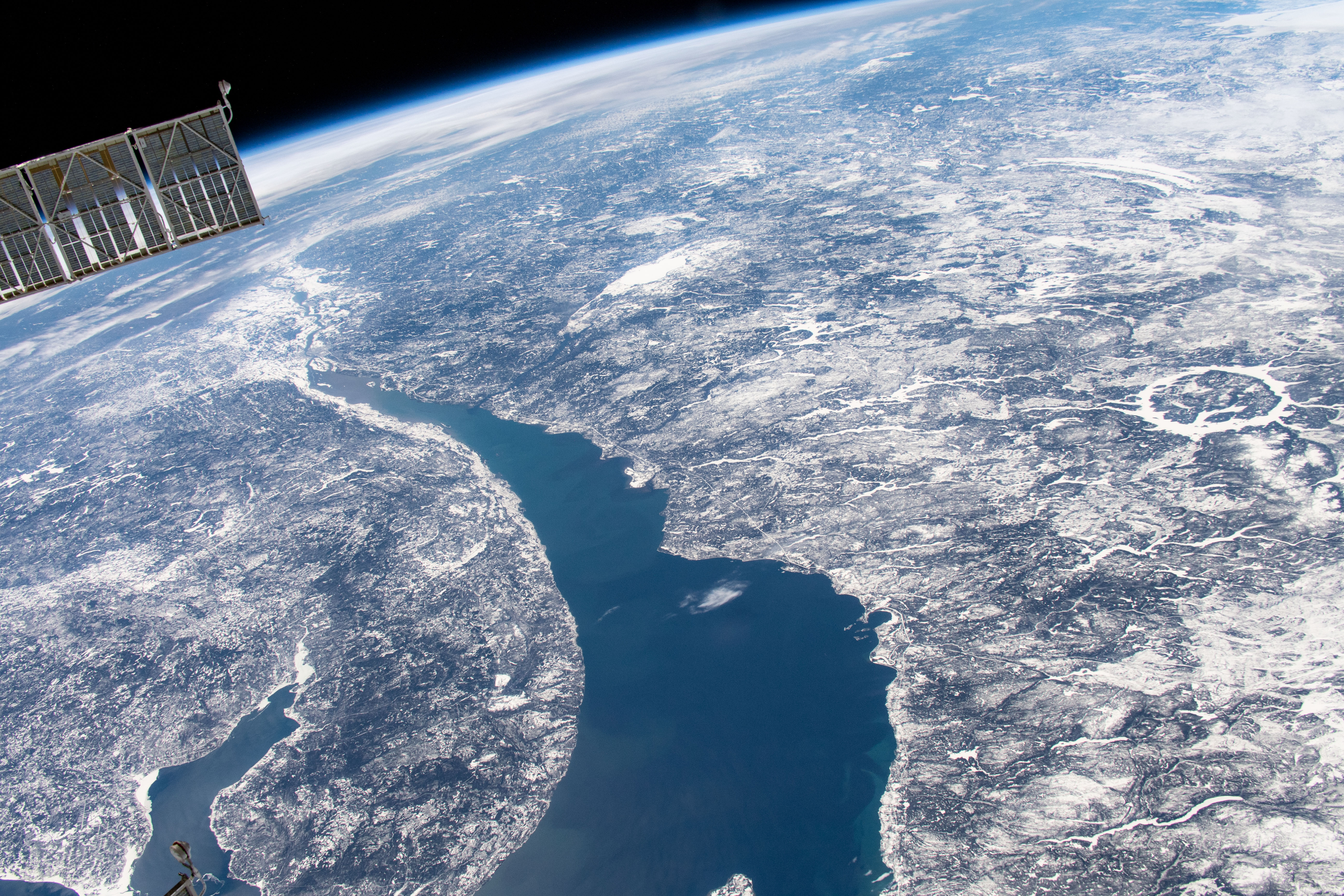
*Image creditor details unavailable via API. Visit linked page below for full info.*
Orbiting 400 kilometers above Quebec, Canada, planet Earth, the International Space Station Expedition 59 crew captured this snapshot of the broad St. Lawrence River and curiously circular Lake Manicouagan on April 11. Right of center, the ring-shaped lake is a modern reservoir within the eroded remnant of an ancient 100 kilometer diameter impact crater. The ancient crater is very conspicuous from orbit, a visible reminder that Earth is vulnerable to rocks from space. Over 200 million years old, the Manicouagan crater was likely caused by the impact of a rocky body about 5 kilometers in diameter. Currently, there is no known asteroid with a significant probability of impacting Earth in the next century. Each month, NASA’s Planetary Defense Coordination Office releases an update featuring the most recent figures on near-Earth object close approaches, and other facts about comets and asteroids that could pose a potential impact hazard with Earth.
#APOD #SpaceFacts #Astrospace #RocketLaunch #Astrobiology
**Astronomy Picture of the Day**
24 May 2024
**M78 from the Euclid Space Telescope**

*Image creditor details unavailable via API. Visit linked page below for full info.*
Star formation can be messy. To help find out just how messy, ESA's new Sun-orbiting Euclid telescope recently captured the most detailed image ever of the bright star forming region M78. Near the image center, M78 lies at a distance of only about 1,300 light-years away and has a main glowing core that spans about 5 light-years. The featured image was taken in both visible and infrared light. The purple tint in M78's center is caused by dark dust preferentially reflecting the blue light of hot, young stars. Complex dust lanes and filaments can be traced through this gorgeous and revealing skyscape. On the upper left is associated star forming region NGC 2071, while a third region of star formation is visible on the lower right. These nebulas are all part of the vast Orion Molecular Cloud Complex which can be found with even a small telescope just north of Orion's belt. More Euclid Sky Candy: Recent images released from Euclid
#APOD #Astrophysics #Astrophoto #PlanetaryExploration #SpaceFacts
**Astronomy Picture of the Day**
23 May 2024
**Unraveling NGC 3169**
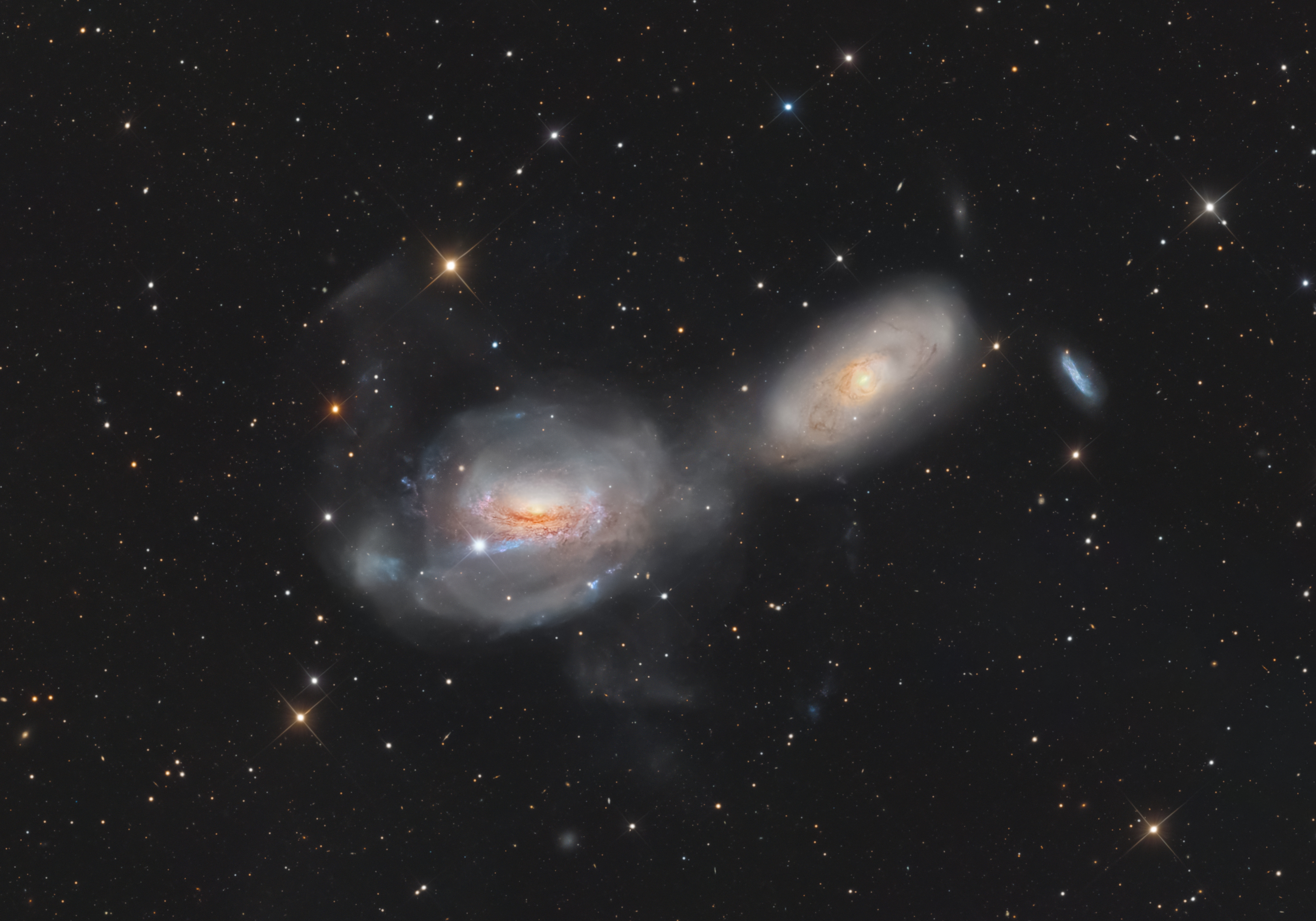
Image Credit & Copyright: Christophe Vergnes
Spiral galaxy NGC 3169 looks to be unraveling like a ball of cosmic yarn. It lies some 70 million light-years away, south of bright star Regulus toward the faint constellation Sextans. Wound up spiral arms are pulled out into sweeping tidal tails as NGC 3169 (left) and neighboring NGC 3166 interact gravitationally. Eventually the galaxies will merge into one, a common fate even for bright galaxies in the local universe. Drawn out stellar arcs and plumes are clear indications of the ongoing gravitational interactions across the deep and colorful galaxy group photo. The telescopic frame spans about 20 arc minutes or about 400,000 light-years at the group's estimated distance, and includes smaller, bluish NGC 3165 to the right. NGC 3169 is also known to shine across the spectrum from radio to X-rays, harboring an active galactic nucleus that is the site of a supermassive black hole.
#APOD #Astrospace #Astrochemistry #NASA #SpaceStation
**Astronomy Picture of the Day**
22 May 2024
**Green Aurora over Sweden**

Image Credit & Copyright:
Göran Strand
It was bright and green and stretched across the sky. This striking aurora display was captured in 2016 just outside of Östersund, Sweden. Six photographic fields were merged to create the featured panorama spanning almost 180 degrees. Particularly striking aspects of this aurora include its sweeping arc-like shape and its stark definition. Lake Storsjön is seen in the foreground, while several familiar constellations and the star Polaris are visible through the aurora, far in the background. Coincidently, the aurora appears to avoid the Moon visible on the lower left. The aurora appeared a day after a large hole opened in the Sun's corona, allowing particularly energetic particles to flow out into the Solar System. The green color of the aurora is caused by oxygen atoms recombining with ambient electrons high in the Earth's atmosphere. Your Sky Surprise: What picture did APOD feature on your birthday? (post 1995)
#APOD #Stellar #Exoplanets #Astrophysics #Astroengineering
**Astronomy Picture of the Day**
21 May 2024
**CG4: The Globule and the Galaxy**
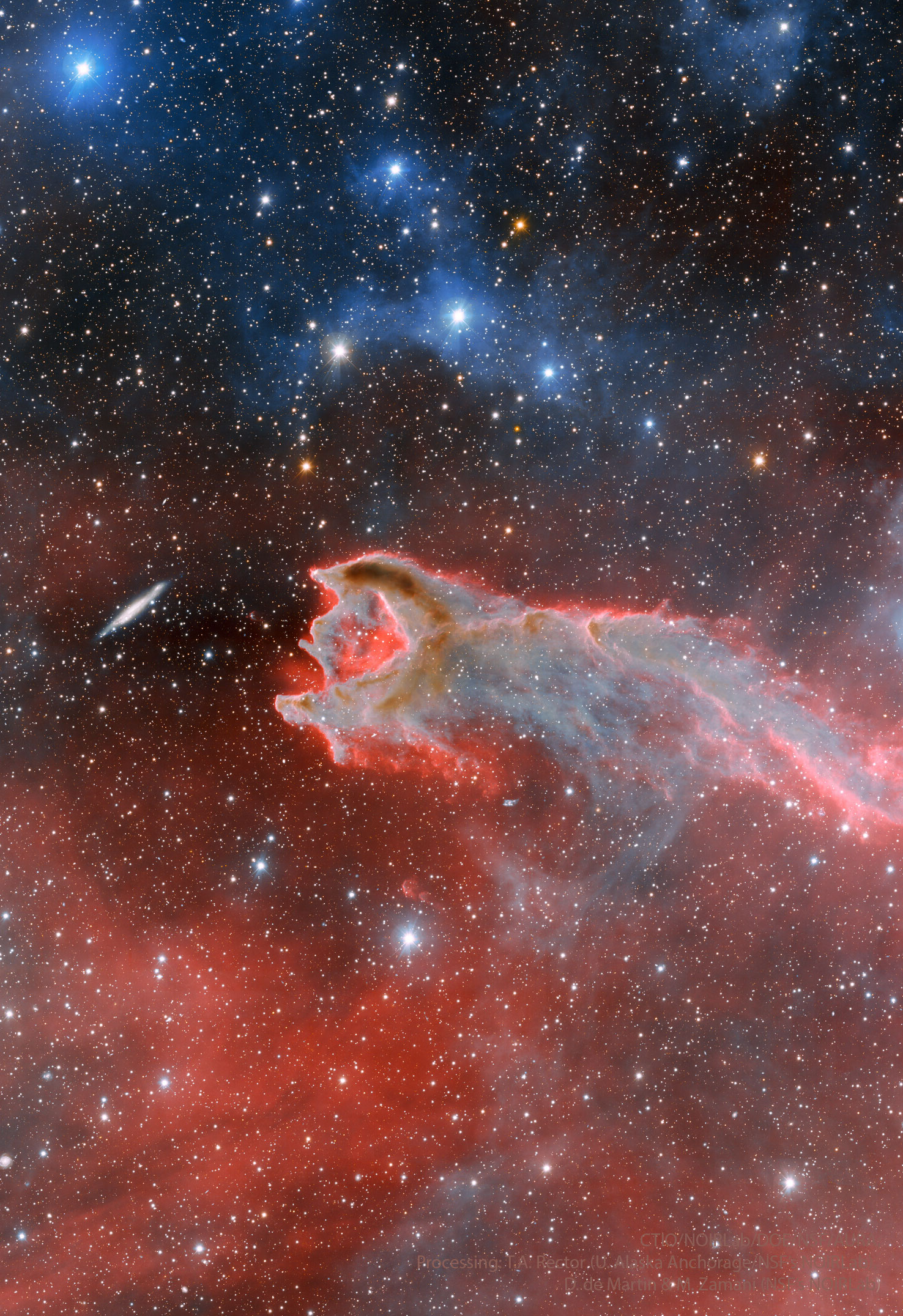
*Image creditor details unavailable via API. Visit linked page below for full info.*
Can a gas cloud eat a galaxy? It's not even close. The "claw" of this odd looking "creature" in the featured photo is a gas cloud known as a cometary globule. This globule, however, has ruptured. Cometary globules are typically characterized by dusty heads and elongated tails. These features cause cometary globules to have visual similarities to comets, but in reality they are very much different. Globules are frequently the birthplaces of stars, and many show very young stars in their heads. The reason for the rupture in the head of this object is not yet known. The galaxy to the left of the globule is huge, very far in the distance, and only placed near CG4 by chance superposition.
#APOD #Astrotheory #SpaceFacts #SpaceDiscovery #Astrogeology
**Astronomy Picture of the Day**
20 May 2024
**Aurora Dome Sky**
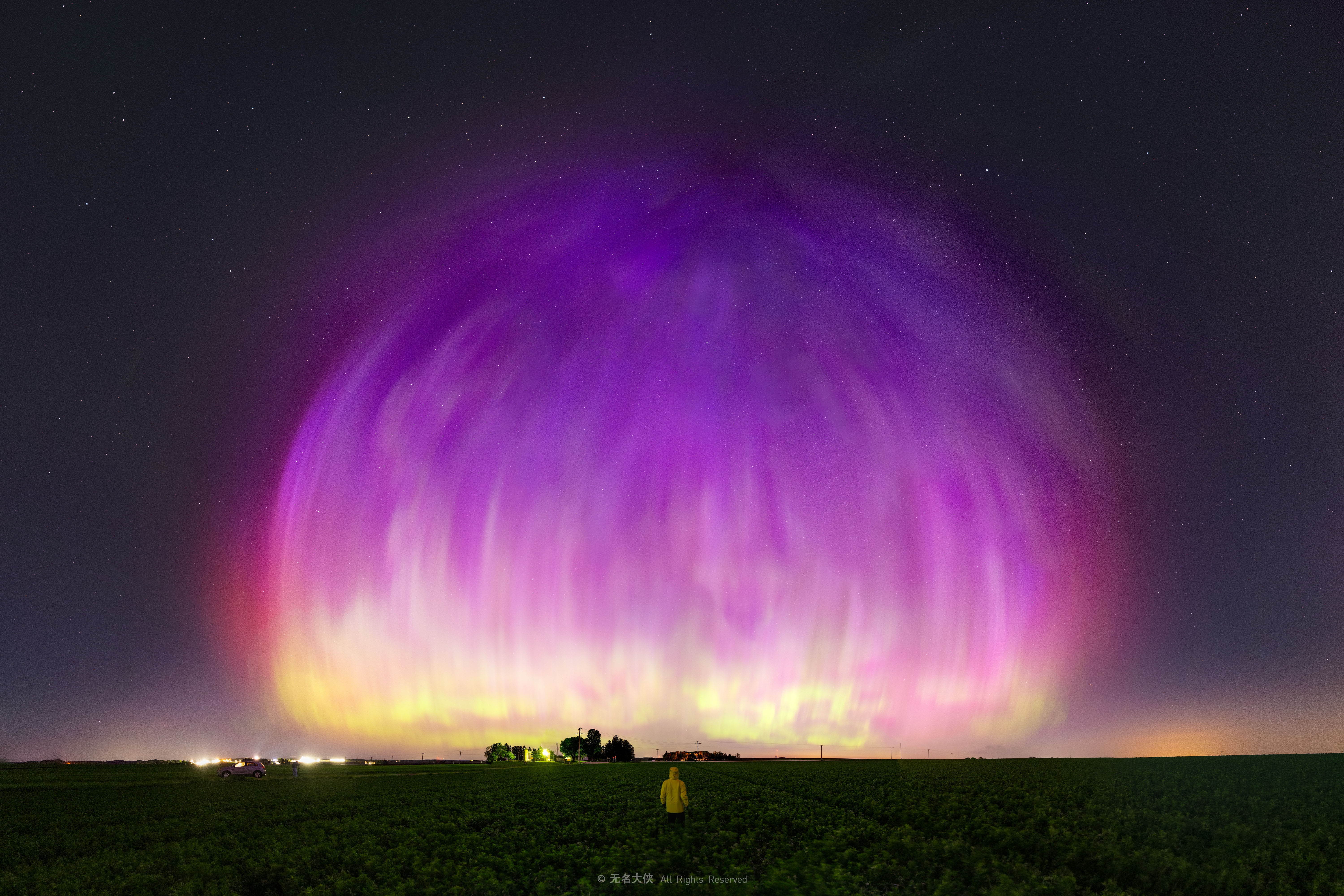
Image Credit & Copyright:
Xuecheng Liu &
Yuxuan Liu
It seemed like night, but part of the sky glowed purple. It was the now famous night of May 10, 2024, when people over much of the world reported beautiful aurora-filled skies. The featured image was captured this night during early morning hours from Arlington, Wisconsin, USA. The panorama is a composite of several 6-second exposures covering two thirds of the visible sky, with north in the center, and processed to heighten the colors and remove electrical wires. The photographer (in the foreground) reported that the aurora appeared to flow from a point overhead but illuminated the sky only toward the north. The aurora's energetic particles originated from CMEs ejected from our Sun over sunspot AR 6443 a few days before. This large active region rotated to the far side of the Sun last week, but may well survive to rotate back toward the Earth next week.
#APOD #AstronomyClub #Astronomy #Stargazing #SpaceStation
**Astronomy Picture of the Day**
19 May 2024
**Jupiter Diving**
https://www.youtube.com/embed/uj3Lq7Gu94Y?rel=0
*Image creditor details unavailable via API. Visit linked page below for full info.*
Take this simulated plunge and dive into the upper atmosphere of Jupiter, the Solar System's ruling gas giant. The awesome animation is based on image data from JunoCam, and the microwave radiometer on board the Jupiter-orbiting Juno spacecraft. Your view will start about 3,000 kilometers above the southern Jovian cloud tops, and you can track your progress on the display at the left. As altitude decreases, temperature increases while you dive deeper at the location of Jupiter's famous Great Red Spot. In fact, Juno data indicates the Great Red Spot, the Solar System's largest storm system, penetrates some 300 kilometers into the giant planet's atmosphere. For comparison, the deepest point for planet Earth's oceans is just under 11 kilometers down. Don't worry though, you'll fly back out again. Dive into the Universe: Random APOD Generator
#APOD #Astrogeology #LunarMission #NASAInspires #SpaceMission
**Astronomy Picture of the Day**
18 May 2024
**North Celestial Aurora**
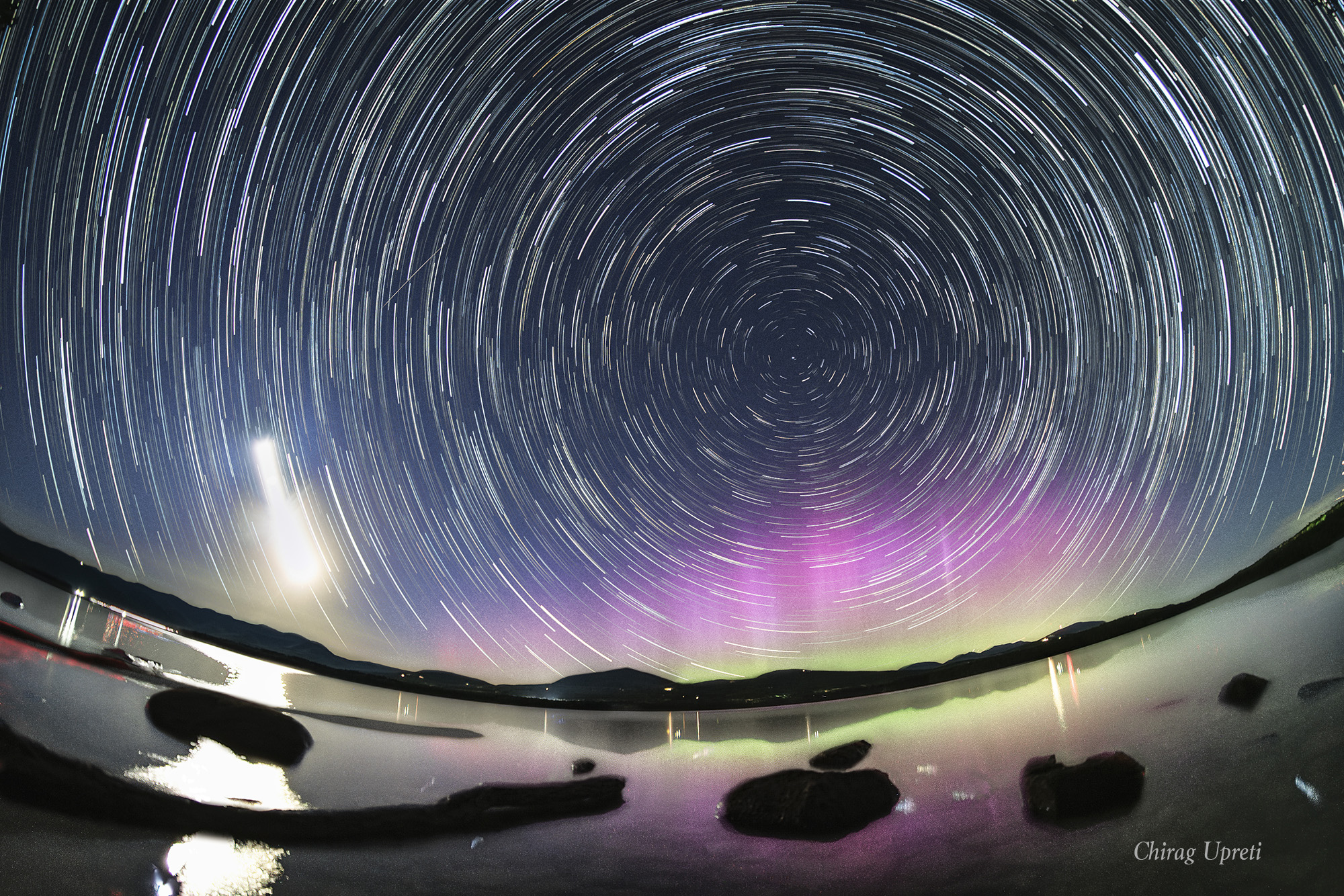
Image Credit & Copyright: Chirag Upreti
Graceful star trail arcs reflect planet Earth's daily rotation in this colorful night skyscape. To create the timelapse composite, on May 12 consecutive exposures were recorded with a camera fixed to a tripod on the shores of the Ashokan Reservoir, in the Catskills region of New York, USA. North star Polaris is near the center of the star trail arcs. The broad trail of a waxing crescent Moon is on the left, casting a strong reflection across the reservoir waters. With intense solar activity driving recent geomagnetic storms, the colorful aurora borealis or northern lights, rare to the region, shine under Polaris and the north celestial pole. AuroraSaurus: Report your aurora observations
#APOD #NASA #Astrochemistry #Cosmology #Meteorology
**Astronomy Picture of the Day**
17 May 2024
**Aurora Banks Peninsula**

Image Credit & Copyright: Kavan Chay
This well-composed composite panoramic view looks due south from Banks Peninsula near Christchurch on New Zealand's South Island. The base of a tower-like rocky sea stack is awash in the foreground, with stars of the Southern Cross at the top of the frame and planet Earth's south celestial pole near center. Still, captured on May 11, vibrant aurora australis dominate the starry southern sea and skyscape. The shimmering southern lights were part of extensive auroral displays that entertained skywatchers in northern and southern hemispheres around planet Earth, caused by intense geomagnetic storms. The extreme spaceweather was triggered by the impact of coronal mass ejections launched from powerful solar active region AR 3664. AuroraSaurus: Report your aurora observations
#APOD #StarCluster #BlackHoles #Astroknowledge #Astrozone
**Astronomy Picture of the Day**
16 May 2024
**Aurora Georgia**
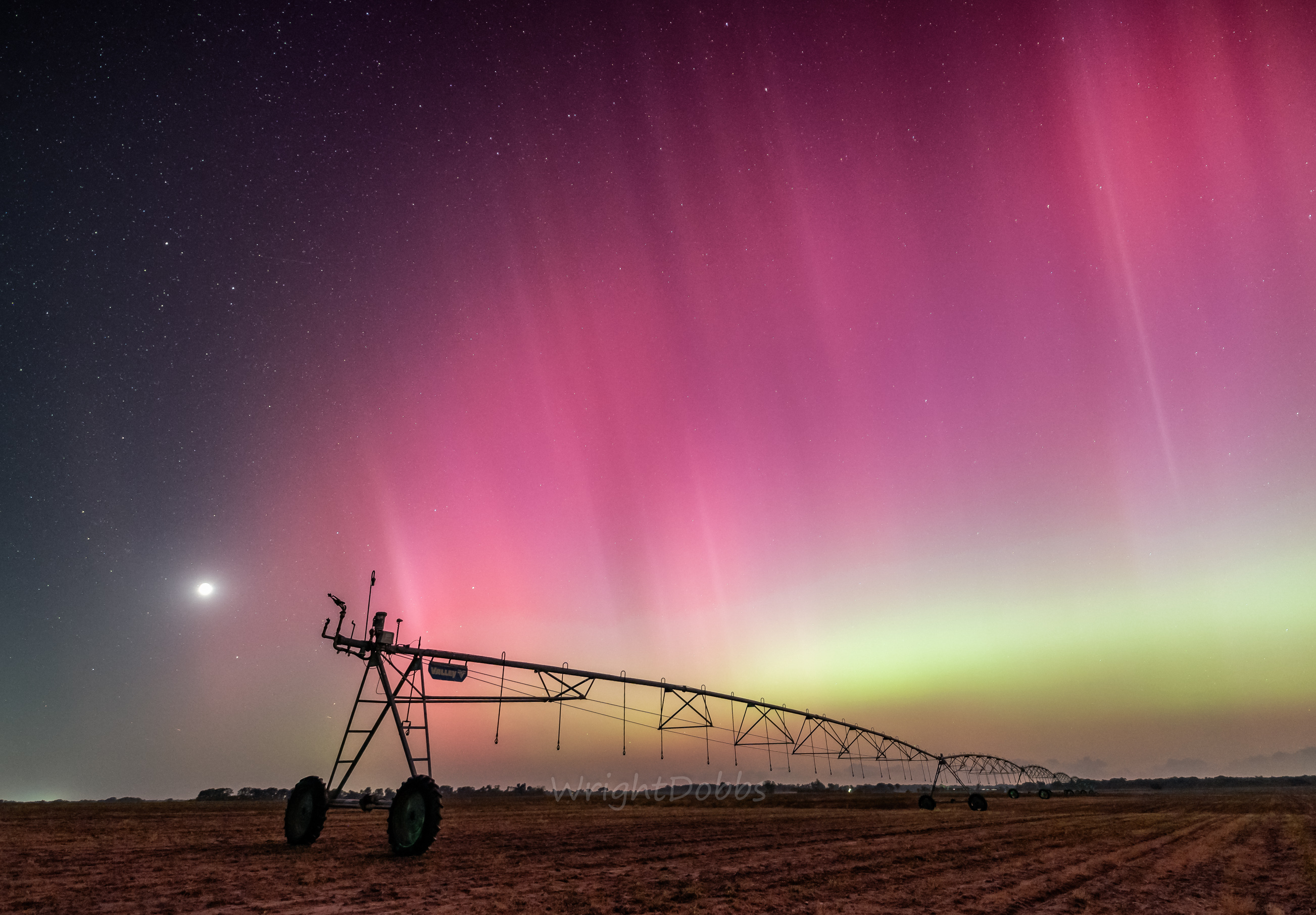
Image Credit & Copyright: Wright Dobbs
A familiar sight from Georgia, USA, the Moon sets near the western horizon in this rural night skyscape. Captured on May 10 before local midnight, the image overexposes the Moon's bright waning crescent at left in the frame. A long irrigation rig stretches across farmland about 15 miles north of the city of Bainbridge. Shimmering curtains of aurora shine across the starry sky though, definitely an unfamiliar sight for southern Georgia nights. Last weekend, extreme geomagnetic storms triggered by the recent intense activity from solar active region AR 3664 brought epic displays of aurora, usually seen closer to the poles, to southern Georgia and even lower latitudes on planet Earth. As solar activity ramps up, more storms are possible. AuroraSaurus: Report your aurora observations
#APOD #Stargazing #CosmosJourney #SpaceAdventures #Astrogeek
**Astronomy Picture of the Day**
15 May 2024
**AR 3664 at the Sun's Edge**
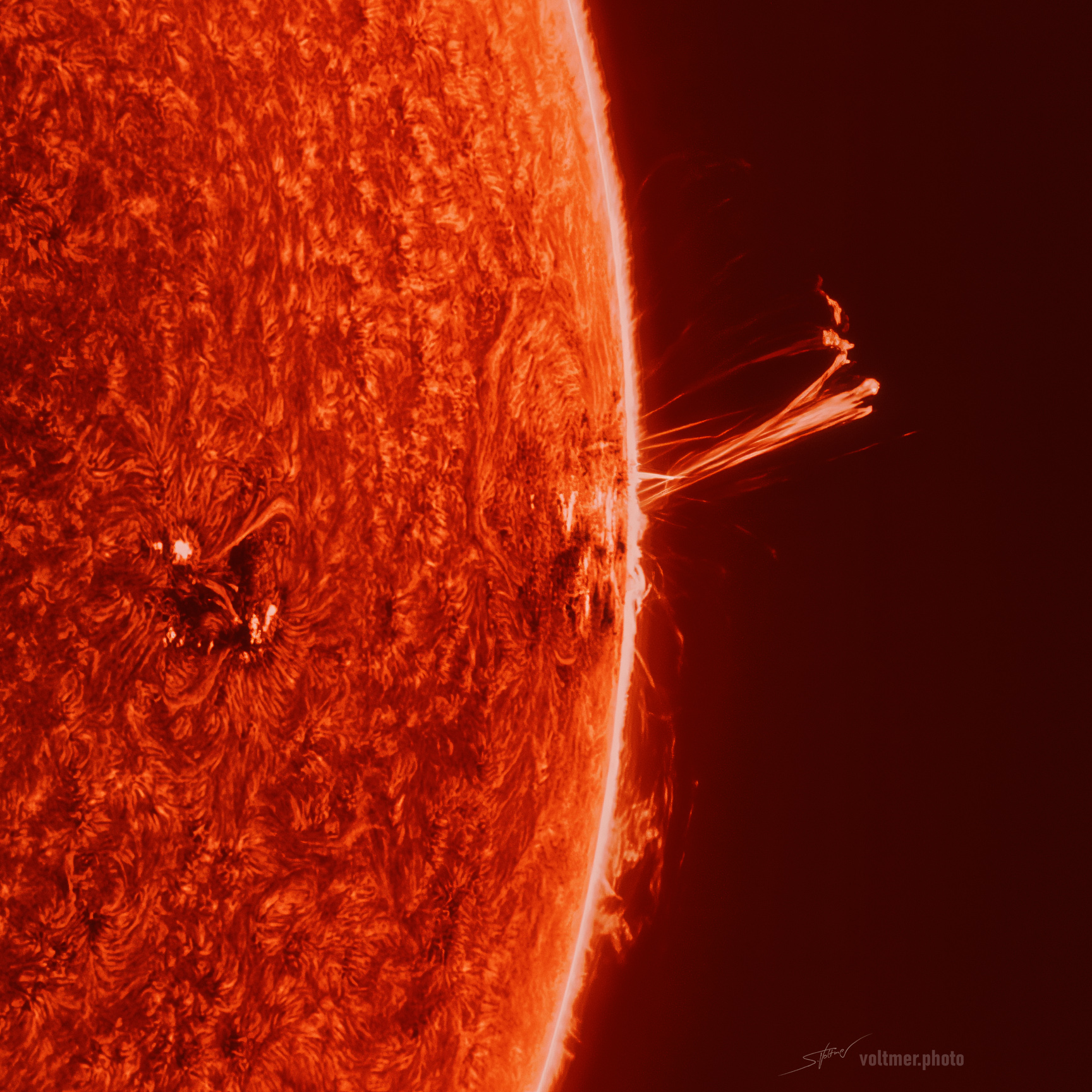
Image Credit & Copyright:
Sebastian Voltmer
What did the monster active region that created the recent auroras look like when at the Sun's edge? There, AR 3664 better showed its 3D structure. Pictured, a large multi-pronged solar prominence was captured extending from chaotic sunspot region AR 3664 out into space, just one example of the particle clouds ejected from this violent solar region. The Earth could easily fit under this long-extended prominence. The featured image was captured two days ago from this constantly changing region. Yesterday, the strongest solar flare in years was expelled (not shown), a blast classified in the upper X-class. Ultraviolet light from that flare quickly hit the Earth's atmosphere and caused shortwave radio blackouts across both North and South America. Although now rotated to be facing slightly away from the Earth, particles from AR 3664 and subsequent coronal mass ejections (CMEs) might still follow curved magnetic field lines across the inner Solar System and create more Earthly auroras. Gallery: Earth Aurora from Solar Active Region 6443
#APOD #Research #RocketLaunch #Astroinformatics #Astrocosmos
**Astronomy Picture of the Day**
14 May 2024
**The 37 Cluster**
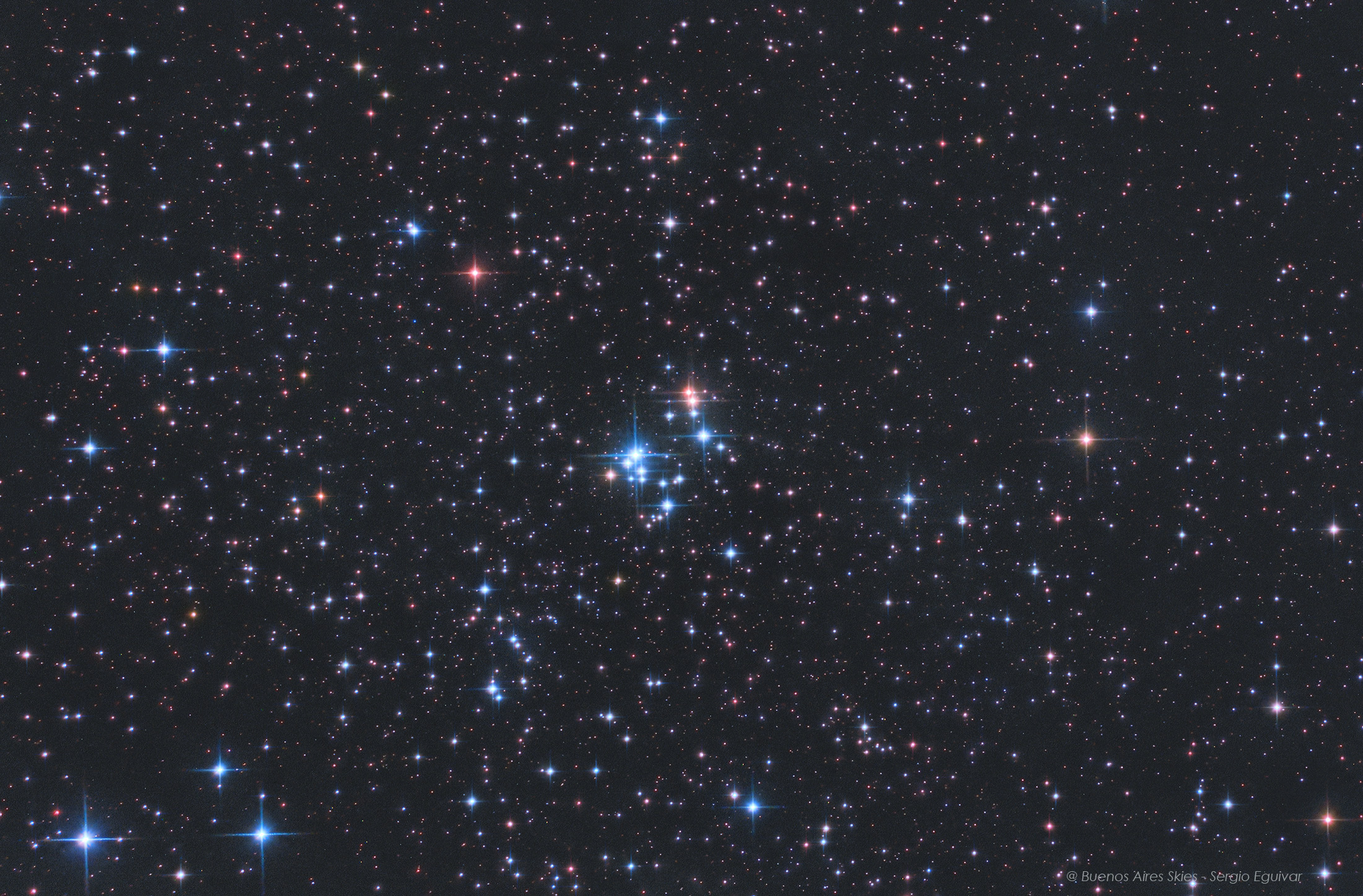
Image Credit & Copyright: Sergio Eguivar
For the mostly harmless denizens of planet Earth, the brighter stars of open cluster NGC 2169 seem to form a cosmic 37. Did you expect 42? From our perspective, the improbable numerical asterism appears solely by chance. It lies at an estimated distance of 3,300 light-years toward the constellation Orion. As far as galactic or open star clusters go, NGC 2169 is a small one, spanning about 7 light-years. Formed at the same time from the same cloud of dust and gas, the stars of NGC 2169 are only about 11 million years old. Such clusters are expected to disperse over time as they encounter other stars, interstellar clouds, and experience gravitational tides while hitchhiking through the galaxy. Over four billion years ago, our own Sun was likely formed in a similar open cluster of stars. Gallery: Earth Aurora from Solar Active Region 3664
#APOD #SpaceResearch #Astroeducation #PlanetaryExploration #LunarExploration
**Astronomy Picture of the Day**
13 May 2024
**AR 3664 on a Setting Sun**
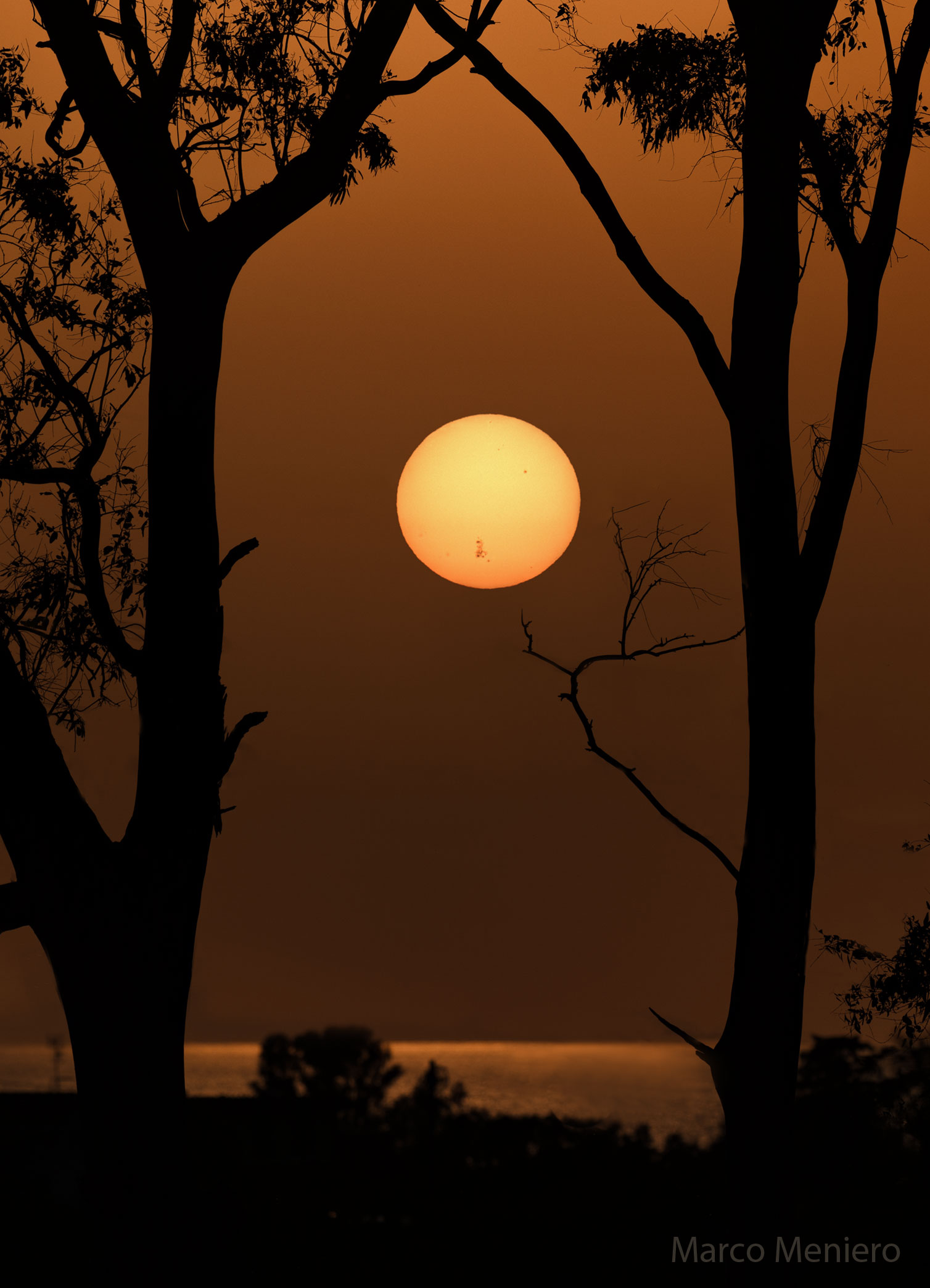
Image Credit & Copyright:
Marco Meniero
It was larger than the Earth. It was so big you could actually see it on the Sun's surface without magnification. It contained powerful and tangled magnetic fields as well as numerous dark sunspots. Labelled AR 3664, it developed into one of the most energetic areas seen on the Sun in recent years, unleashing a series of explosions that led to a surge of energetic particles striking the Earth, which created beautiful auroras. And might continue. Although active regions on the Sun like AR 3664 can be quite dangerous, this region's Coronal Mass Ejections have not done, as yet, much damage to Earth-orbiting satellites or Earth-surface electrical grids. Pictured, the enormous active region was captured on the setting Sun a few days ago from Civitavecchia, Rome, Italy. The composite image includes a very short exposure taken of just the Sun's surface, but mimics what was actually visible. Finally, AR 3664 is now rotating away from the Earth, although the region may survive long enough to come around again. Gallery: Earth Aurora from Solar Active Region 6443
#APOD #Cosmos #Astrozone #Astroinformatics #SpaceMission
**Astronomy Picture of the Day**
12 May 2024
**Red Aurora over Poland**

Image Credit & Copyright:
Mariusz Durlej
Northern lights don't usually reach this far south. Magnetic chaos in the Sun's huge Active Region 3664, however, produced a surface explosion that sent a burst of electrons, protons, and more massive, charged nuclei into the Solar System. A few days later, that coronal mass ejection (CME) impacted the Earth and triggered auroras that are being reported unusually far from our planet's north and south poles. The free sky show might not be over -- the sunspot rich AR3664 has ejected even more CMEs that might also impact the Earth tonight or tomorrow. That active region is now near the Sun's edge, though, and will soon be rotating away from the Earth. Pictured, a red and rayed aurora was captured in a single 6-second exposure from Racibórz, Poland early last night. The photographer's friend, seeing an aurora for the first time, is visible in the distance also taking images of the beautifully colorful nighttime sky. Gallery: Global Aurora from Solar Active Region 6443
#APOD #Astrophysics #Astroeducation #Astrophotography #Cosmological
**Astronomy Picture of the Day**
11 May 2024
**AR 3664: Giant Sunspot Group**
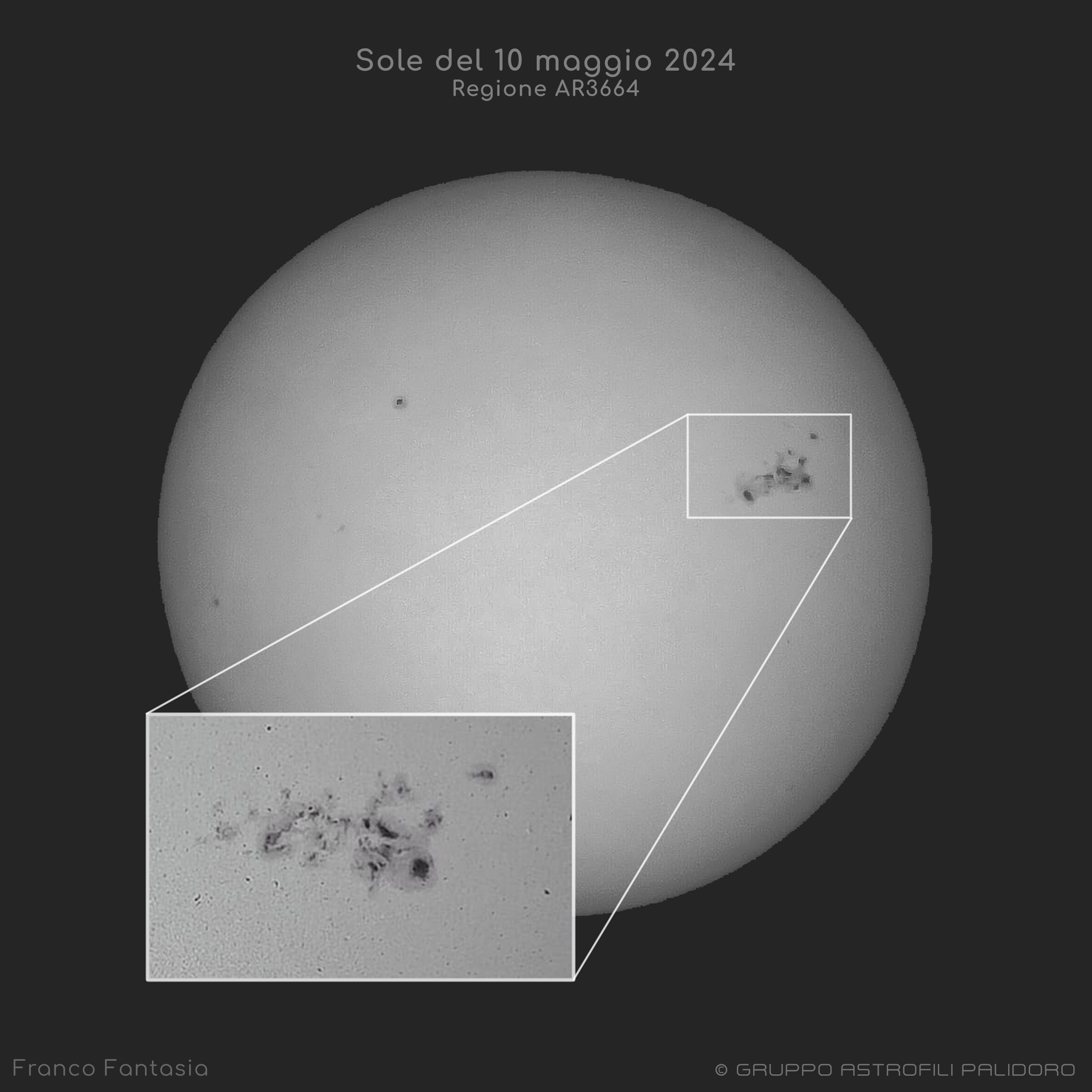
Image Credit & Copyright:
Franco Fantasia &
Guiseppe Conzo
(Gruppo Astrofili Palidoro)
Right now, one of the largest sunspot groups in recent history is crossing the Sun. Active Region 3664 is not only big -- it's violent, throwing off clouds of particles into the Solar System. Some of these CMEs are already impacting the Earth, and others might follow. At the extreme, these solar storms could cause some Earth-orbiting satellites to malfunction, the Earth's atmosphere to slightly distort, and electrical power grids to surge. When impacting Earth's upper atmosphere, these particles can produce beautiful auroras, with some auroras already being reported unusually far south. Pictured here, AR3664 and its dark sunspots were captured yesterday in visible light from Rome, Italy. The AR3664 sunspot group is so large that it is visible just with glasses designed to view last month's total solar eclipse. This weekend, skygazing enthusiasts will be keenly watching the night skies all over the globe for bright and unusual auroras. Gallery: Active Region 6443 on the Sun
#APOD #SpaceIndustry #BlackHoles #Astrophoto #Astrophysics