
**Astronomy Picture of the Day**
07 September 2024
**Small Moon Deimos**
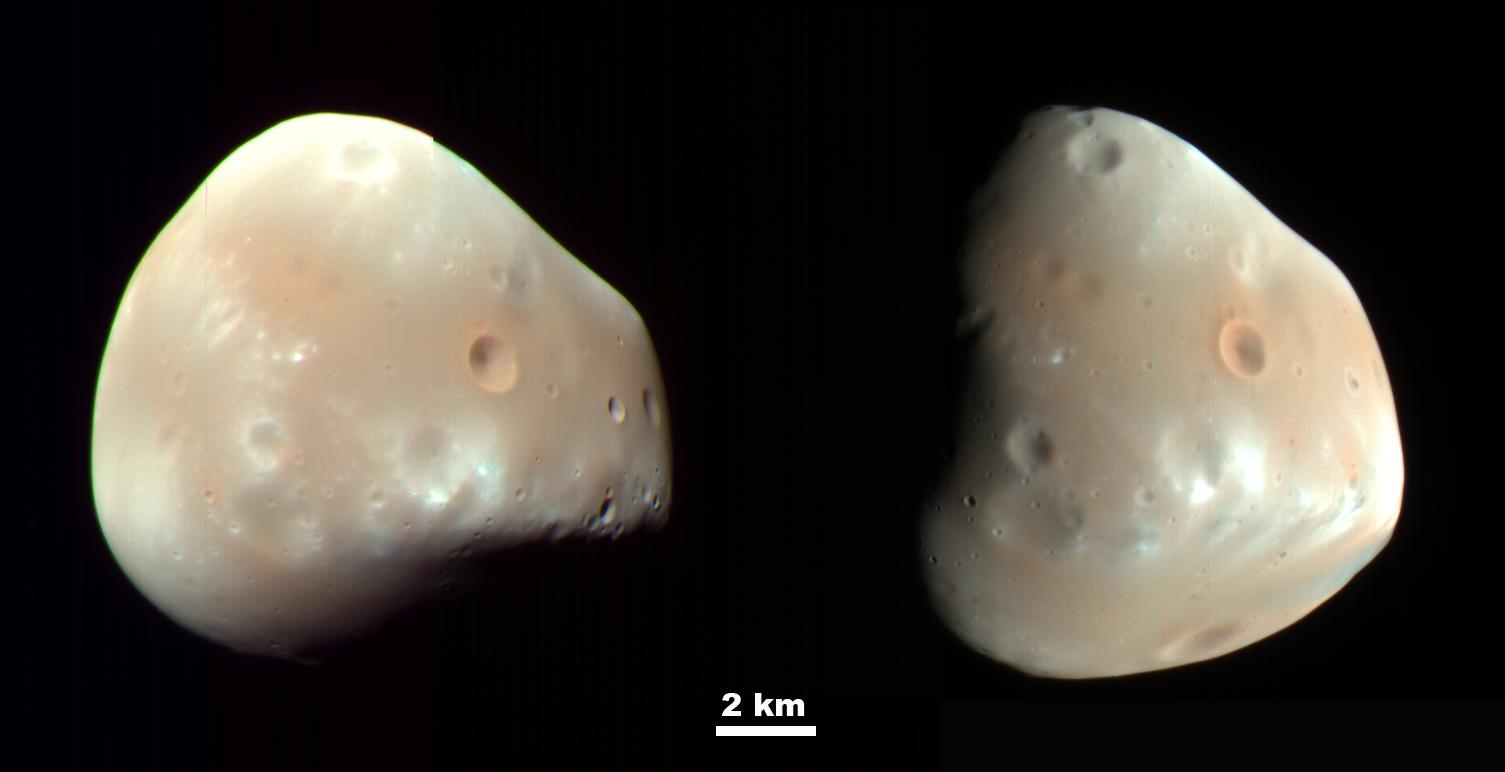
*Image creditor details unavailable via API. Visit linked page below for full info.*
Mars has two tiny moons, Phobos and Deimos, named for the figures in Greek mythology Fear and Panic. Detailed surface views of smaller moon Deimos are shown in both these panels. The images were taken in 2009, by the HiRISE camera on board the Mars Reconnaissance Orbiter spacecraft, NASA's long-lived interplanetary internet satellite. The outermost of the two Martian moons, Deimos is one of the smallest known moons in the Solar System, measuring only about 15 kilometers across. Both Martian moons were discovered in 1877 by Asaph Hall, an American astronomer working at the US Naval Observatory in Washington D.C. But their existence was postulated around 1610 by Johannes Kepler, the astronomer who derived the laws of planetary motion. In this case, Kepler's prediction was not based on scientific principles, but his writings and ideas were so influential that the two Martian moons are discussed in works of fiction such as Jonathan Swift's Gulliver's Travels, written in 1726, over 150 years before their discovery.
#APOD #SpaceAdventures #Astrodata #Astrophotography #Astrophysics
**Astronomy Picture of the Day**
06 September 2024
**Ringed Ice Giant Neptune**
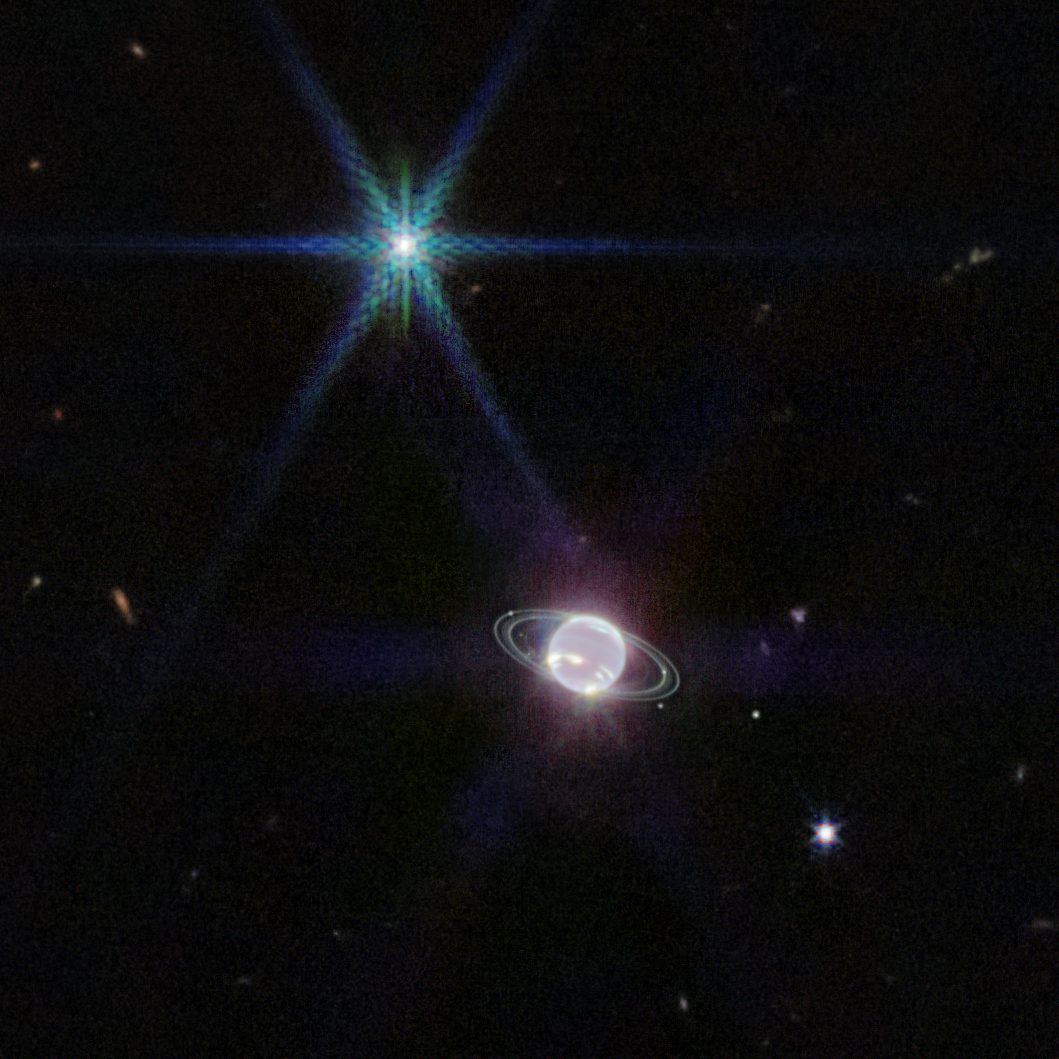
*Image creditor details unavailable via API. Visit linked page below for full info.*
Ringed ice giant Neptune lies near the center of this sharp near-infrared image from the James Webb Space Telescope. The dim and distant world is the farthest planet from the Sun, about 30 times farther away than planet Earth. But in the stunning Webb view, the planet's dark and ghostly appearance is due to atmospheric methane that absorbs infrared light. High altitude clouds that reach above most of Neptune's absorbing methane easily stand out in the image though. Coated with frozen nitrogen, Neptune's largest moon Triton is brighter than Neptune in reflected sunlight, seen at the upper left sporting the Webb telescope's characteristic diffraction spikes. Including Triton, seven of Neptune's 14 known moons can be identified in the field of view. Neptune's faint rings are striking in this space-based planetary portrait. Details of the complex ring system are seen here for the first time since Neptune was visited by the Voyager 2 spacecraft in August 1989.
#APOD #PlanetaryScience #Planets #SpaceTechnology #Celestial
**Astronomy Picture of the Day**
05 September 2024
**NGC 247 and Friends**
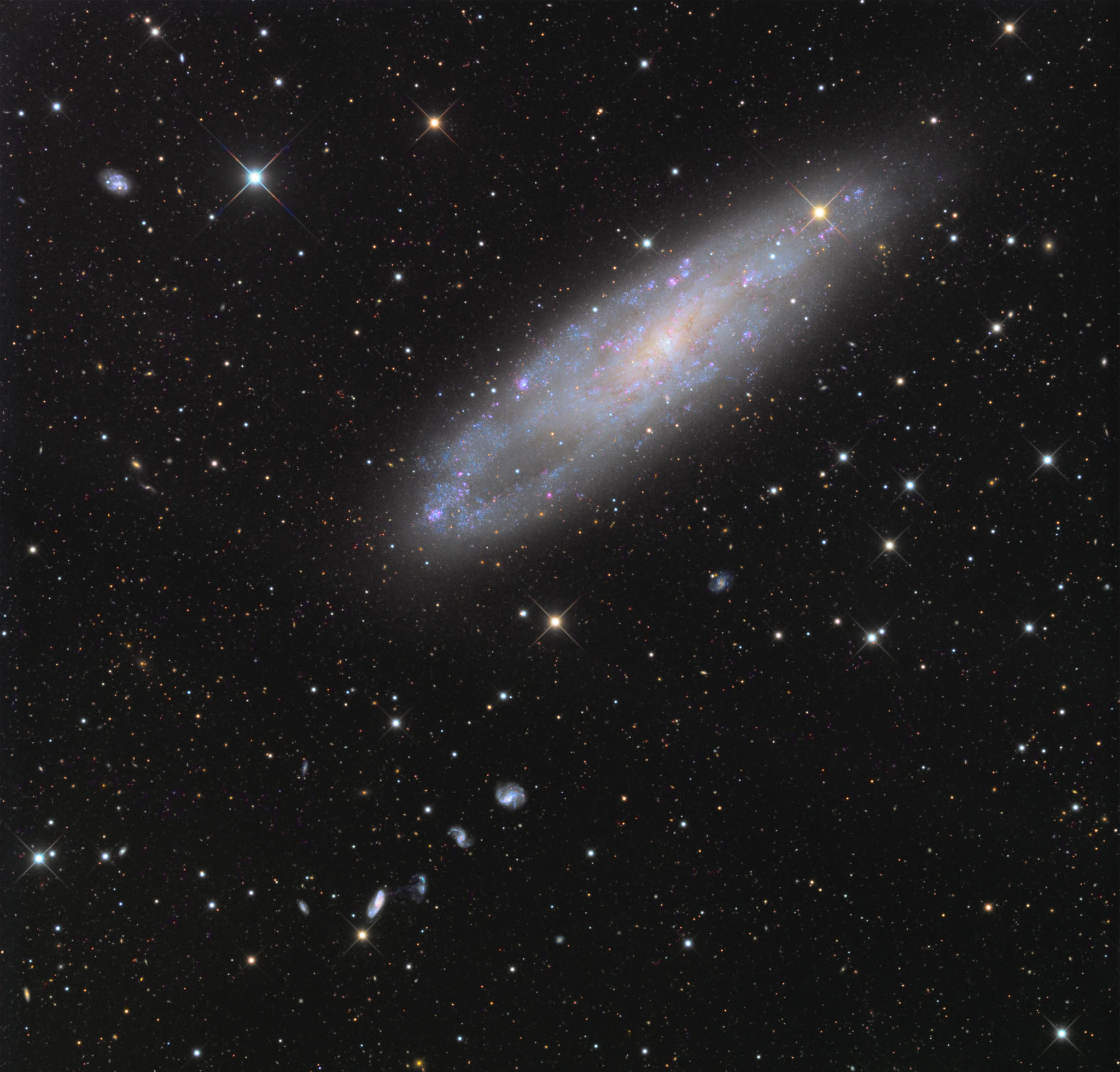
Image Credit & Copyright: Eric Benson
About 70,000 light-years across, NGC 247 is a spiral galaxy smaller than our Milky Way. Measured to be only 11 million light-years distant it is nearby though. Tilted nearly edge-on as seen from our perspective, it dominates this telescopic field of view toward the southern constellation Cetus. The pronounced void on one side of the galaxy's disk recalls for some its popular name, the Needle's Eye galaxy. Many background galaxies are visible in this sharp galaxy portrait, including the remarkable string of four galaxies just below and left of NGC 247 known as Burbidge's Chain. Burbidge's Chain galaxies are about 300 million light-years distant. NGC 247 itself is part of the Sculptor Group of galaxies along with shiny spiral NGC 253.
#APOD #SpaceInnovation #Stars #Universe #Planetarium
**Astronomy Picture of the Day**
04 September 2024
**NGC 6995: The Bat Nebula**
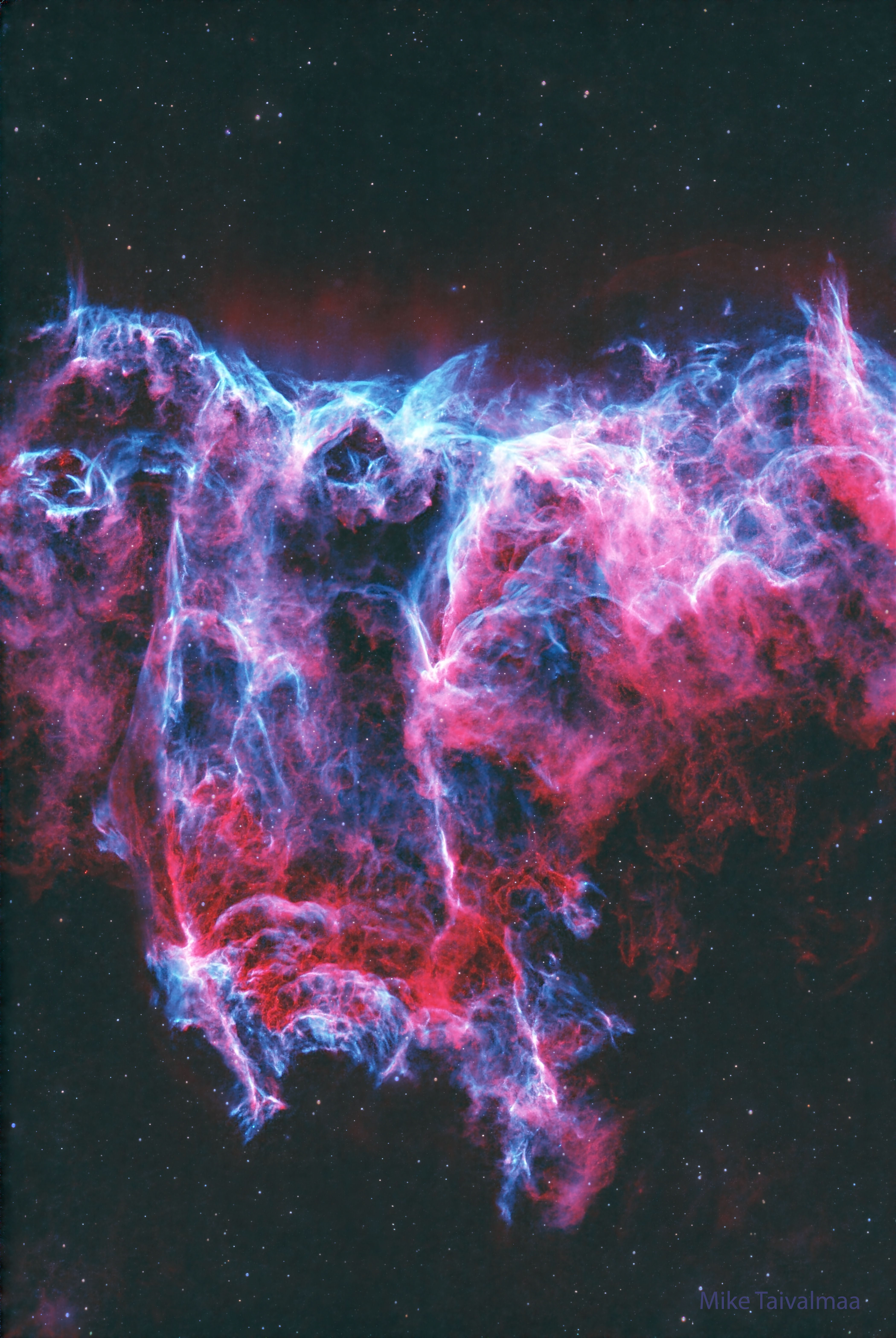
Image Credit & Copyright:
Mike Taivalmaa
Can you see the bat? It haunts this cosmic close-up of the eastern Veil Nebula. The Veil Nebula itself is a large supernova remnant, the expanding debris cloud from the death explosion of a massive star. While the Veil is roughly circular in shape and covers nearly 3 degrees on the sky toward the constellation of the Swan (Cygnus), NGC 6995, known informally as the Bat Nebula, spans only 1/2 degree, about the apparent size of the Moon. That translates to 12 light-years at the Veil's estimated distance, a reassuring 1,400 light-years from planet Earth. In the composite of image data recorded through narrow band filters, emission from hydrogen atoms in the remnant is shown in red with strong emission from oxygen atoms shown in hues of blue. Of course, in the western part of the Veil lies another seasonal apparition: the Witch's Broom Nebula. Teachers & Students: Ideas for using APOD in the classroom
#APOD #Astroinformatics #Astrobiology #Astrotheory #Astrodata
**Astronomy Picture of the Day**
03 September 2024
**Quarter Moon and Sister Stars**
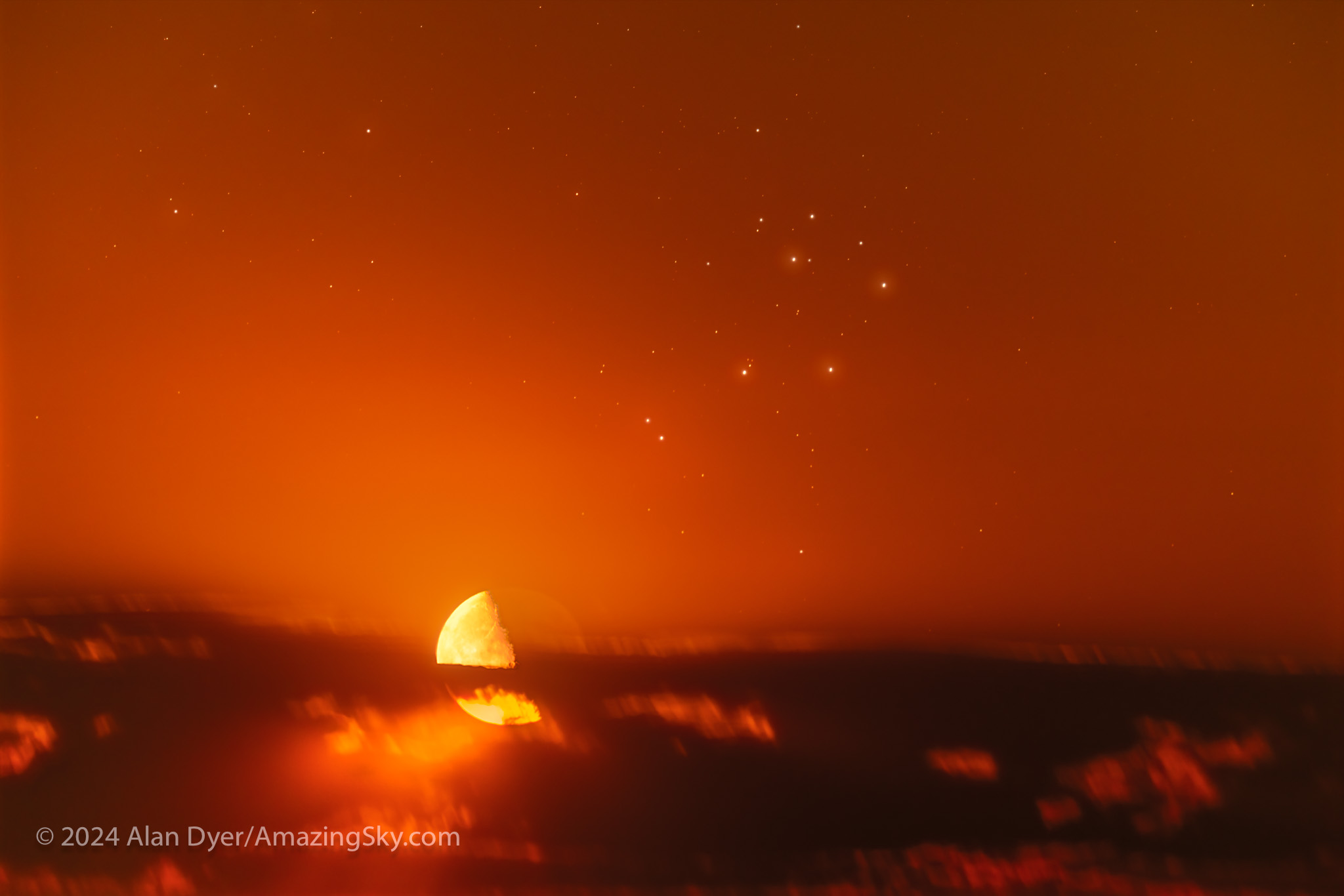
Image Credit & Copyright:
Alan Dyer,
TWAN
Nine days ago, two quite different sky icons were imaged rising together. Specifically, Earth's Moon shared the eastern sky with the sister stars of the Pleiades cluster, as viewed from Alberta, Canada. Astronomical images of the well-known Pleiades often show the star cluster's alluring blue reflection nebulas, but here they are washed-out by the orange moonrise sky. The half-lit Moon, known as a quarter moon, is overexposed, although the outline of the dim lunar night side can be seen by illuminating earthshine, light first reflected from the Earth. The featured image is a composite of eight successive exposures with brightnesses adjusted to match what the human eye would see. The Moon passes nearly -- or directly -- in front of the Pleaides once a month.
#APOD #SpaceMission #Meteorology #StarFormation #SpaceDiscovery
**Astronomy Picture of the Day**
02 September 2024
**A Triangular Prominence Hovers Over the Sun**
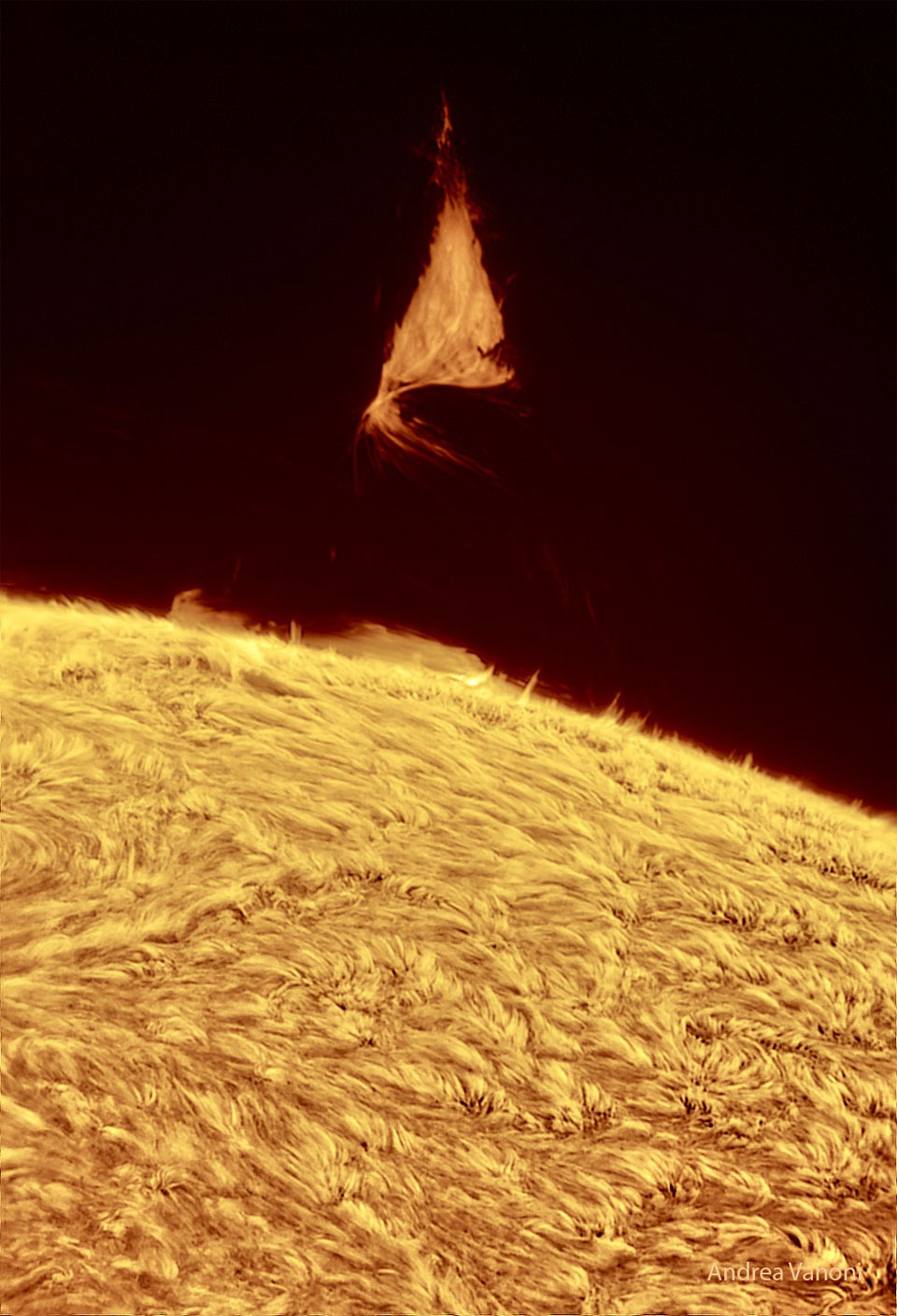
Image Credit & Copyright:
Andrea Vanoni
Why is there a triangle hovering over the Sun? Although the shape is unusual, the type of structure is not: it is part of an evolving solar prominence. Looping magnetic fields on the Sun channel the flow of energetic particles, sometimes holding glowing gaseous structures aloft for months. A prominence glows brightly because it contains particularly hot, dense, or opaque solar plasma. The surprising triangular structure occurred last week. Larger than our Earth, the iconic prominence was imaged by several solar photographers and documented by NASA's Solar Dynamic Observatory to form and violently dissipate in about a day. The featured image was captured in a color of red light emitted strongly by hydrogen. Below, solar fibrils carpet the Sun's chromosphere, while the background sky is so faint in comparison that no stars are visible. Our Sun's surface has been quite active this year.
#APOD #Research #MilkyWay #Stargazing #StarFormation
**Astronomy Picture of the Day**
01 September 2024
**The Moon Dressed Like Saturn**

Image Credit & Copyright:
Francisco Sojuel
Why does Saturn appear so big? It doesn't -- what is pictured are foreground clouds on Earth crossing in front of the Moon. The Moon shows a slight crescent phase with most of its surface visible by reflected Earthlight, known as Da Vinci glow. The Sun directly illuminates the brightly lit lunar crescent from the bottom, which means that the Sun must be below the horizon and so the image was taken before sunrise. This double take-inducing picture was captured on 2019 December 24, two days before the Moon slid in front of the Sun to create a solar eclipse. In the foreground, lights from small Guatemalan towns are visible behind the huge volcano Pacaya. Your Sky Surprise: What picture did APOD feature on your birthday? (post 1995)
#APOD #Astrobiology #SpaceStation #NASA #CosmicWonders
**Astronomy Picture of the Day**
31 August 2024
**IFN and the NGC 7771 Group**
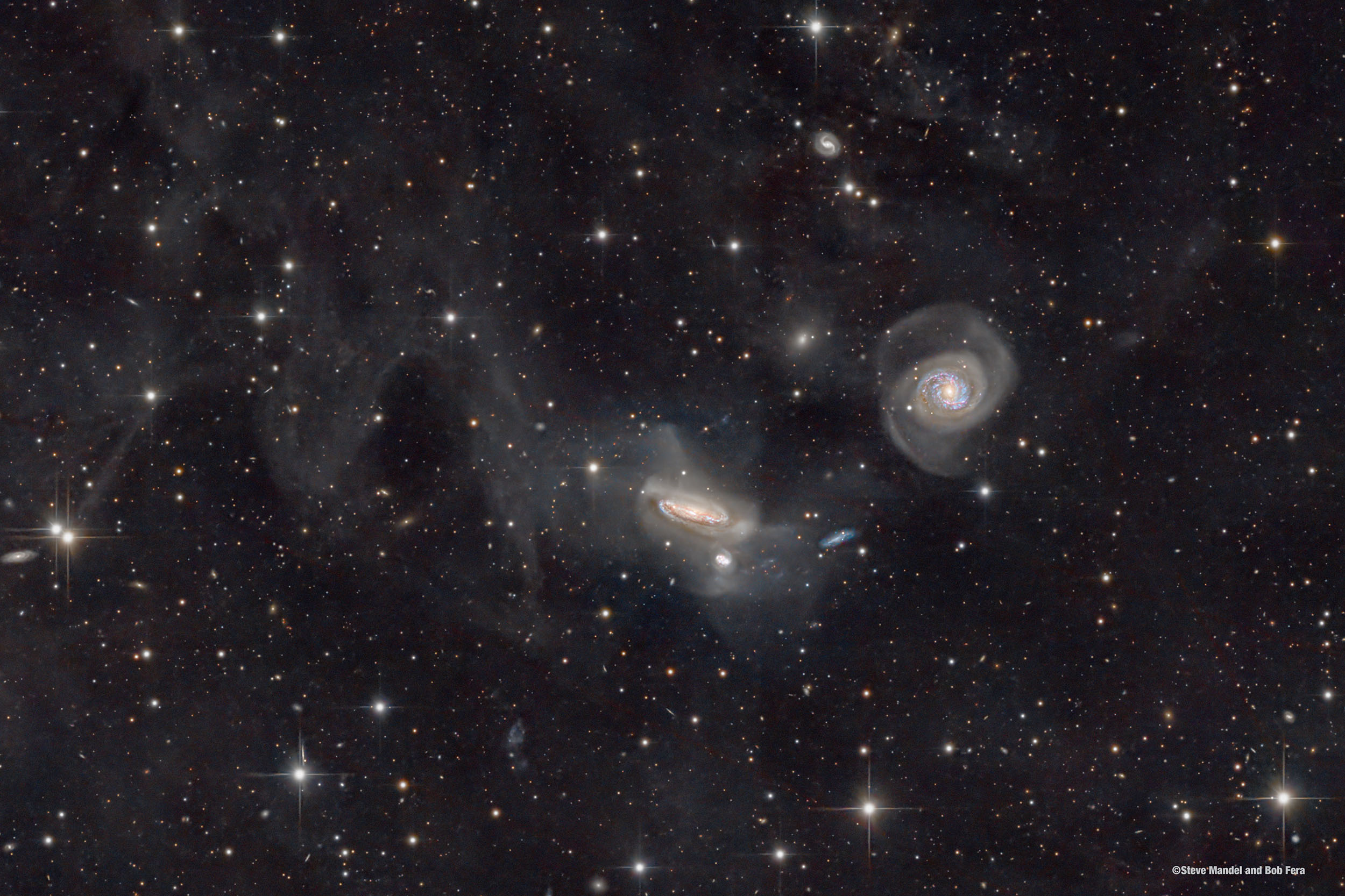
Image Credit & Copyright: Steve Mandel
Galaxies of the NGC 7771 Group are featured in this intriguing skyscape. Some 200 million light-years distant toward the constellation Pegasus, NGC 7771 is the large, edge-on spiral near center, about 75,000 light-years across, with two smaller galaxies below it. Large spiral NGC 7769 is seen face-on to the right. Galaxies of the NGC 7771 group are interacting, making repeated close passages that will ultimately result in galaxy-galaxy mergers on a cosmic timescale. The interactions can be traced by distortions in the shape of the galaxies themselves and faint streams of stars created by their mutual gravitational tides. But a clear view of this galaxy group is difficult to come by as the deep image also reveals extensive clouds of foreground dust sweeping across the field of view. The dim, dusty galactic cirrus clouds are known as Integrated Flux Nebulae. The faint IFN reflect starlight from our own Milky Way Galaxy and lie only a few hundred light-years above the galactic plane.
#APOD #SpaceResearch #Astrophoto #PlanetaryExploration #Astrofans
**Astronomy Picture of the Day**
30 August 2024
**Southern Moonscape**
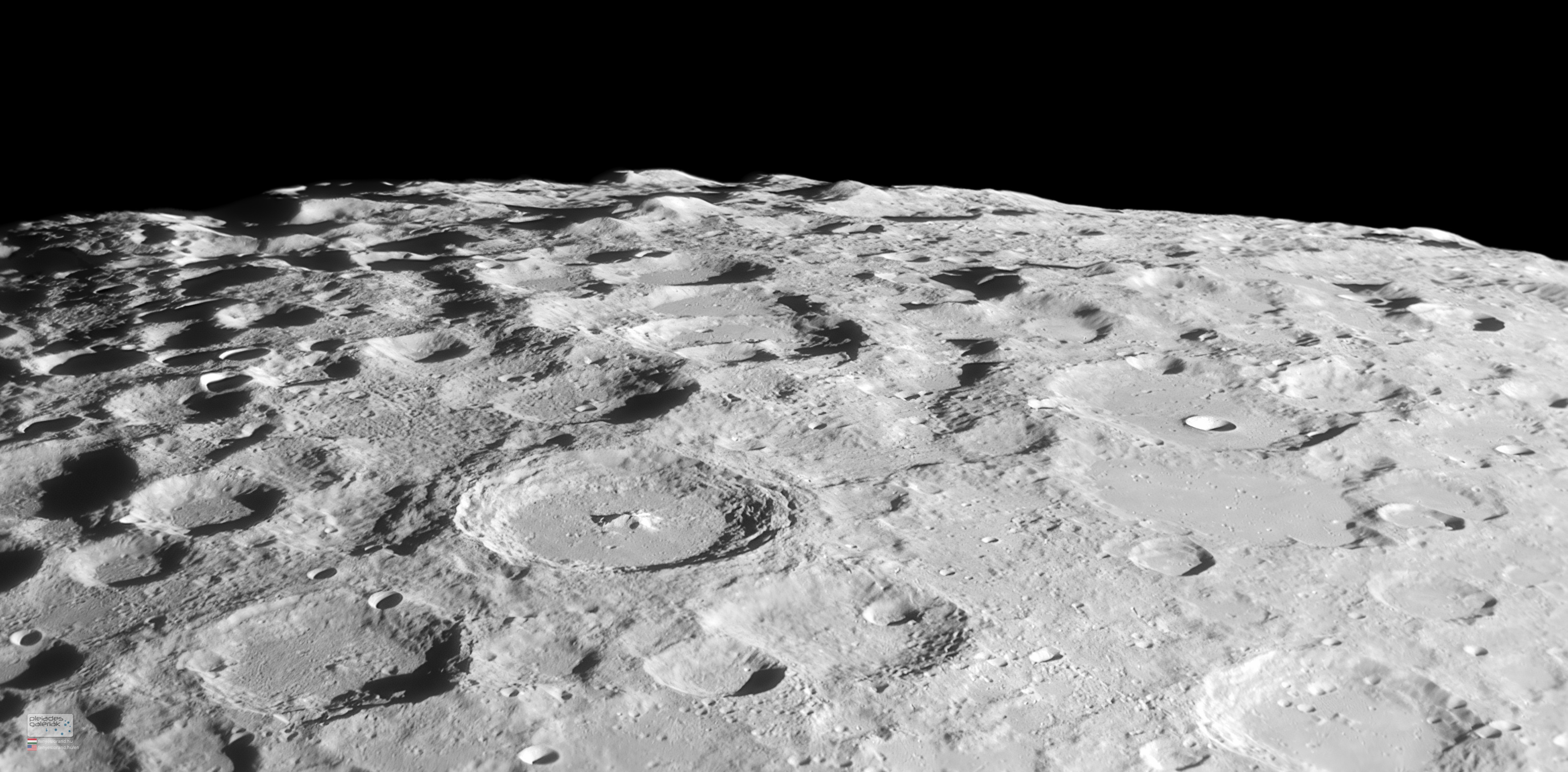
Image Credit & Copyright: Lorand Fenyes
The Moon's south pole is toward the top left of this detailed telescopic moonscape. Captured on August 23, it looks across the rugged southern lunar highlands. The view's foreshortened perspective heightens the impression of a dense field of craters and makes the craters themselves appear more oval shaped close to the lunar limb. Prominent near center is 114 kilometer diameter crater Moretus. Moretus is young for a large lunar crater and features terraced inner walls and a 2.1 kilometer high, central peak, similar in appearance to the more northerly young crater Tycho. Mountains visible along the lunar limb at the top can rise about 6 kilometers or so above the surrounding terrain. Close to the lunar south pole, permanently shadowed crater floors with expected reservoirs of water-ice have made the rugged south polar region of the Moon a popular target for exploration.
#APOD #Stargazing #Astrophotography #RocketScience #RocketScience
**Astronomy Picture of the Day**
29 August 2024
**Star Factory Messier 17**
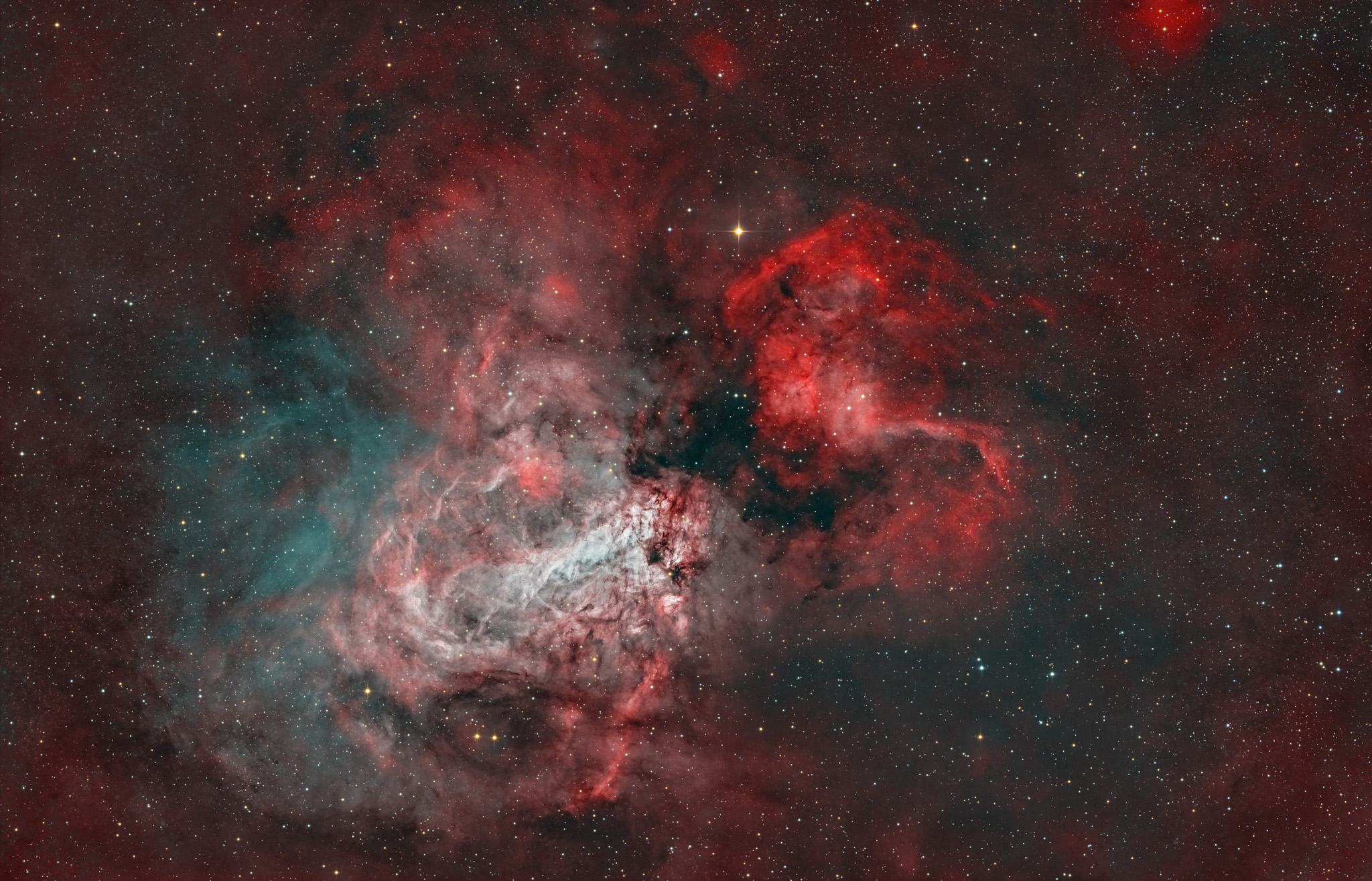
Image Credit & Copyright: Gaetan Maxant
A nearby star factory known as Messier 17 lies some 5,500 light-years away in the nebula-rich constellation Sagittarius. At that distance, this 1.5 degree wide field-of-view would span about 150 light-years. In the sharp color composite image faint details of the region's gas and dust clouds are highlighted with narrowband image data against a backdrop of central Milky Way stars. The stellar winds and energetic radiation from hot, massive stars already formed from M17's stock of cosmic gas and dust have slowly carved away at the remaining interstellar material, producing the nebula's cavernous appearance and the undulating shapes within. A popular stop on telescopic tours of the cosmos, M17 is also known as the Omega or the Swan Nebula.
#APOD #SpaceTravel #RocketLaunch #GalaxyExploration #SpaceObservatory
**Astronomy Picture of the Day**
28 August 2024
**Tulip Nebula and Black Hole Cygnus X-1**
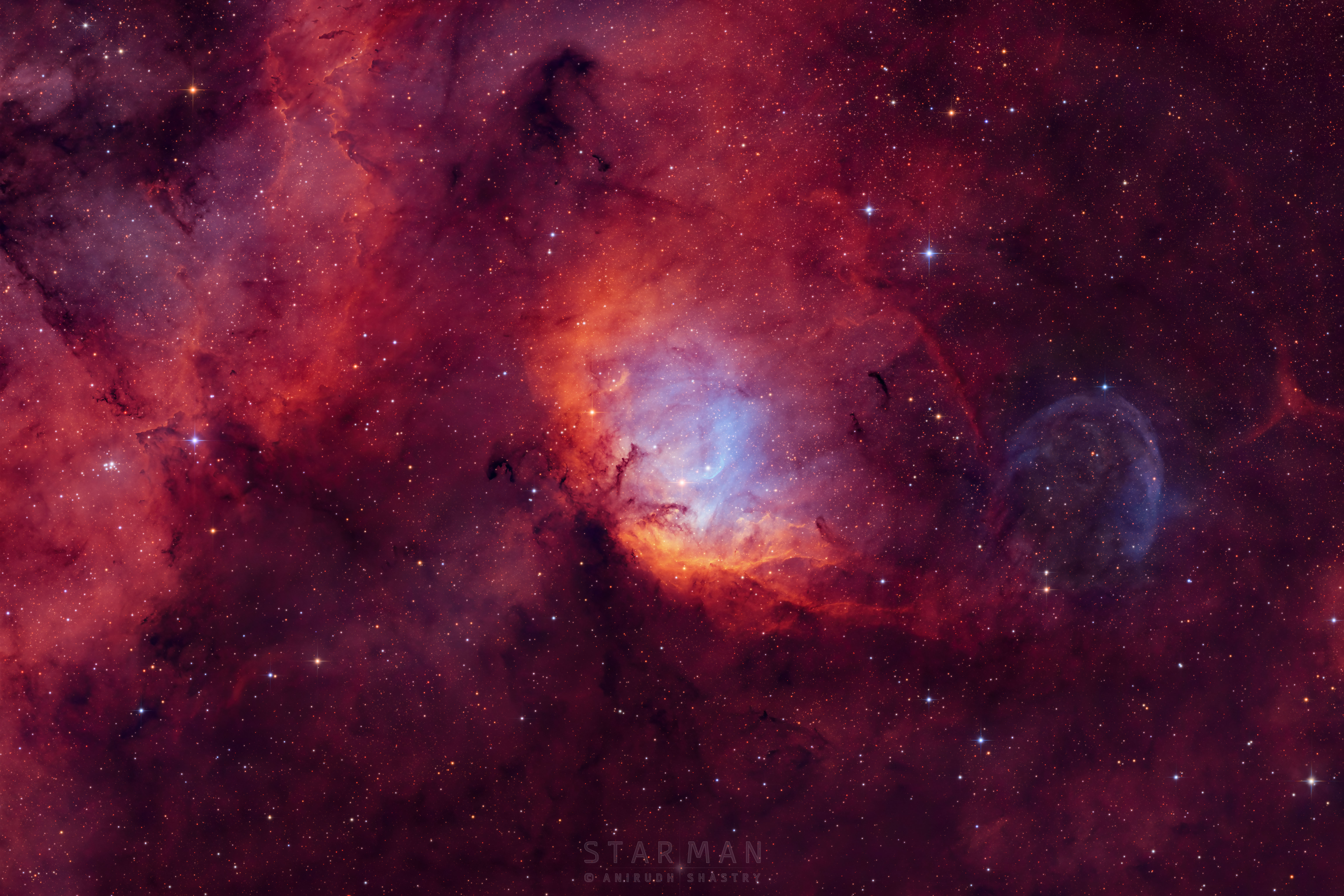
Image Credit & Copyright:
Anirudh Shastry
When can you see a black hole, a tulip, and a swan all at once? At night -- if the timing is right, and if your telescope is pointed in the right direction. The complex and beautiful Tulip Nebula blossoms about 8,000 light-years away toward the constellation of Cygnus the Swan. Ultraviolet radiation from young energetic stars at the edge of the Cygnus OB3 association, including O star HDE 227018, ionizes the atoms and powers the emission from the Tulip Nebula. Stewart Sharpless cataloged this nearly 70 light-years across reddish glowing cloud of interstellar gas and dust in 1959, as Sh2-101. Also in the featured field of view is the black hole Cygnus X-1, which to be a microquasar because it is one of strongest X-ray sources in planet Earth's sky. Blasted by powerful jets from a lurking black hole, its fainter bluish curved shock front is only faintly visible beyond the cosmic Tulip's petals, near the right side of the frame. Back to School? Learn Science with NASA
#APOD #Stellar #Astrophoto #Science #Astrogeology
**Astronomy Picture of the Day**
27 August 2024
**Moon Eclipses Saturn**

Image Credit & Copyright:
Pau Montplet Sanz
What if Saturn disappeared? Sometimes, it does. It doesn't really go away, though, it just disappears from view when our Moon moves in front. Such a Saturnian eclipse, more formally called an occultation, was visible along a long swath of Earth -- from Peru, across the Atlantic Ocean, to Italy -- only a few days ago. The featured color image is a digital fusion of the clearest images captured during the event and rebalanced for color and relative brightness between the relatively dim Saturn and the comparatively bright Moon. Saturn and the comparative bright Moon. The exposures were all taken from Breda, Catalonia, Spain, just before occultation. Eclipses of Saturn by our Moon will occur each month for the rest of this year. Each time, though, the fleeting event will be visible only to those with clear skies -- and the right location on Earth. Gallery: Moon Eclipses Saturn in August 2024
#APOD #CosmosJourney #Astrophotography #RocketScience #PlanetaryScience
**Astronomy Picture of the Day**
26 August 2024
**Perseid Meteors Over Inner Mongolia**
https://www.youtube.com/embed/CwrvN0Q9_Sg?rel=0
*Image creditor details unavailable via API. Visit linked page below for full info.*
Did you see it? One of the more common questions during a meteor shower occurs because the time it takes for a meteor to flash is similar to the time it takes for a head to turn. Possibly, though, the glory of seeing bright meteors shoot across the sky -- while knowing that they were once small pebbles on another world -- might make it all worthwhile, even if your observing partner(s) can't always share in your experience. The featured video is composed of short clips taken in Inner Mongolia, China during the 2023 Perseid Meteor Shower. Several bright meteors were captured while live-reaction audio was being recorded -- just as the meteors flashed. This year's 2024 Perseids also produced many beautiful meteors. Another good meteor shower to watch for is the Geminids which peak yearly in mid-December, this year with relatively little competing glow from a nearly new Moon. Your Sky Surprise: What picture did APOD feature on your birthday? (post 1995)
#APOD #LunarExploration #CosmosJourney #SpaceFacts #Astrodata
**Astronomy Picture of the Day**
25 August 2024
**Fresh Tiger Stripes on Saturn's Enceladus**
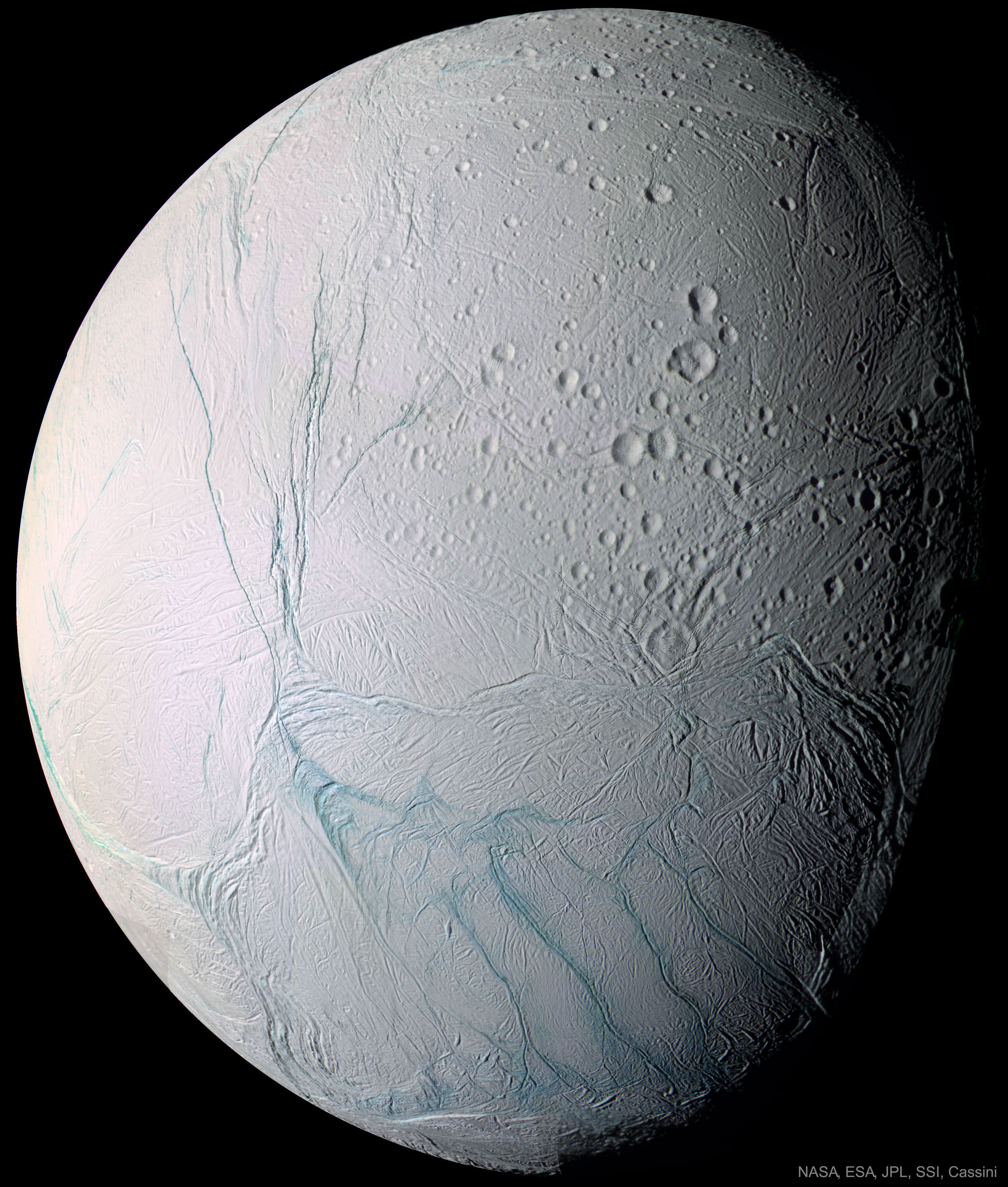
*Image creditor details unavailable via API. Visit linked page below for full info.*
Do underground oceans vent through canyons on Saturn's moon Enceladus? Long features dubbed tiger stripes are known to be spewing ice from the moon's icy interior into space, creating a cloud of fine ice particles over the moon's South Pole and creating Saturn's mysterious E-ring. Evidence for this has come from the robot Cassini spacecraft that orbited Saturn from 2004 to 2017. Pictured here, a high resolution image of Enceladus is shown from a close flyby. The unusual surface features dubbed tiger stripes are visible in false-color blue. Why Enceladus is active remains a mystery, as the neighboring moon Mimas, approximately the same size, appears quite dead. An analysis of ejected ice grains has yielded evidence that complex organic molecules exist inside Enceladus. These large carbon-rich molecules bolster -- but do not prove -- that oceans under Enceladus' surface could contain life. Explore Your Universe: Random APOD Generator
#APOD #GalacticAdventures #Astrofans #AstronautLife #Astroinformatics
**Astronomy Picture of the Day**
24 August 2024
**South Pacific Shadowset**
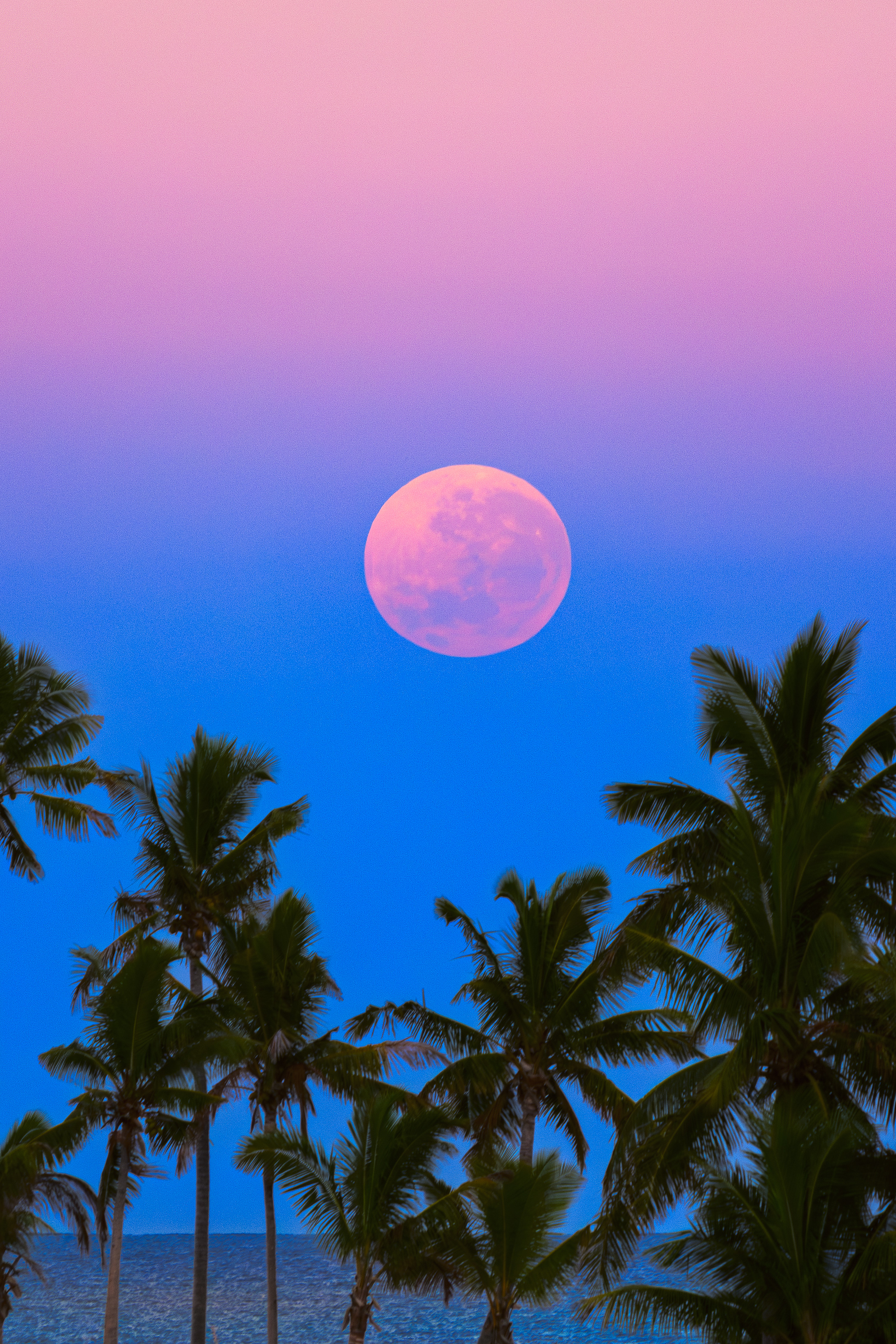
Image Credit & Copyright: full Moon
The full Moon and Earth's shadow set together in this island skyscape. The alluring scene was captured Tuesday morning, August 20, from Fiji, South Pacific Ocean, planet Earth. For early morning risers shadowset in the western sky is a daily apparition. Still, the grey-blue shadow is often overlooked in favor of a brighter eastern horizon. Extending through the dense atmosphere, Earth's setting shadow is bounded above by a pinkish glow or anti-twilight arch. Known as the Belt of Venus, the arch's lovely color is due to backscattering of reddened light from the opposite horizon's rising Sun. Of course, the setting Moon's light is reddened by the long sight-line through the atmosphere. But on that date the full Moon could be called a seasonal Blue Moon, the third full Moon in a season with four full Moons. And even though the full Moon is always impressive near the horizon, August's full Moon is considered by some the first of four consecutive full Supermoons in 2024.
#APOD #Astrogeek #Astrochemistry #Astrophoto #BlackHoles
**Astronomy Picture of the Day**
23 August 2024
**Supernova Remnant CTA 1**
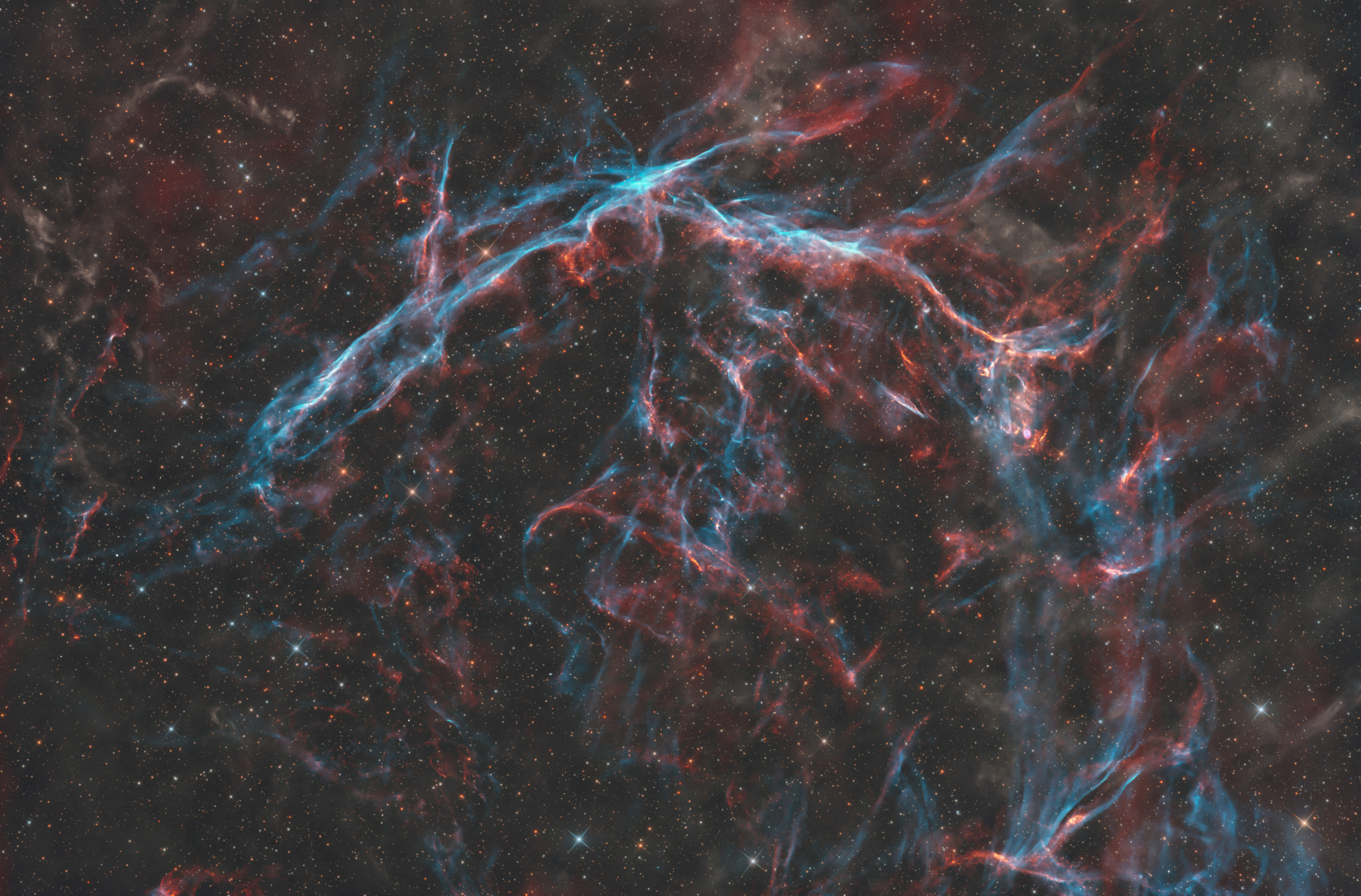
Image Credit & Copyright: Thomas Lelu
There is a quiet pulsar at the heart of CTA 1. The supernova remnant was discovered as a source of emission at radio wavelengths by astronomers in 1960 and since identified as the result of the death explosion of a massive star. But no radio pulses were detected from the expected pulsar, the rotating neutron star remnant of the massive star's collapsed core. Seen about 10,000 years after the initial supernova explosion, the interstellar debris cloud is faint at optical wavelengths. CTA 1's visible wavelength emission from still expanding shock fronts is revealed in this deep telescopic image, a frame that spans about 2 degrees across a starfield in the northern constellation of Cepheus. While no pulsar has since been found at radio wavelengths, in 2008 the Fermi Gamma-ray Space Telescope detected pulsed emission from CTA 1, identifying the supernova remnant's rotating neutron star. The source has been recognized as the first in a growing class of pulsars that are quiet at radio wavelengths but pulse in high-energy gamma-rays.
#APOD #Astrophysics #SpaceMission #SpaceStation #Astronauts
**Astronomy Picture of the Day**
22 August 2024
**The Dark Tower in Scorpius**
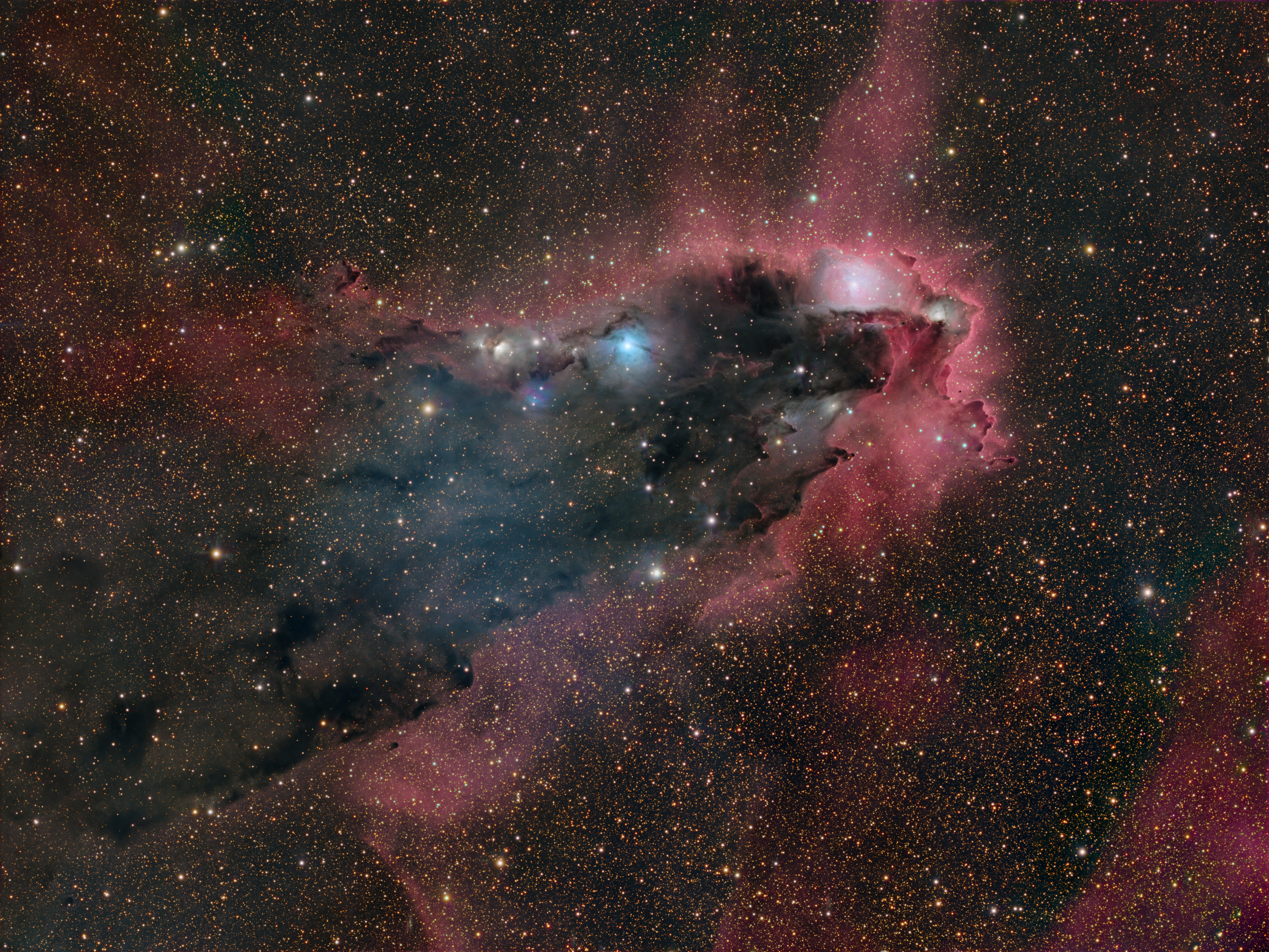
Image Credit & Copyright: Mike Selby
In silhouette against a crowded star field along the tail of the arachnological constellation Scorpius, this dusty cosmic cloud evokes for some the image of an ominous dark tower. In fact, monstrous clumps of dust and molecular gas collapsing to form stars may well lurk within the dark nebula, a structure that spans almost 40 light-years across this gorgeous telescopic portrait. A cometary globule, the swept-back cloud is shaped by intense ultraviolet radiation from the OB association of very hot stars in NGC 6231, off the upper right corner of the scene. That energetic ultraviolet light also powers the globule's bordering reddish glow of hydrogen gas. Hot stars embedded in the dust can be seen as bluish reflection nebulae. This dark tower and associated nebulae are about 5,000 light-years away. Growing Gallery: Moon Eclipses Saturn in August 2024
#APOD #CosmosJourney #Astrobiology #Cosmology #Stars
**Astronomy Picture of the Day**
21 August 2024
**Fermi's 12-year All-Sky Gamma-ray Map**
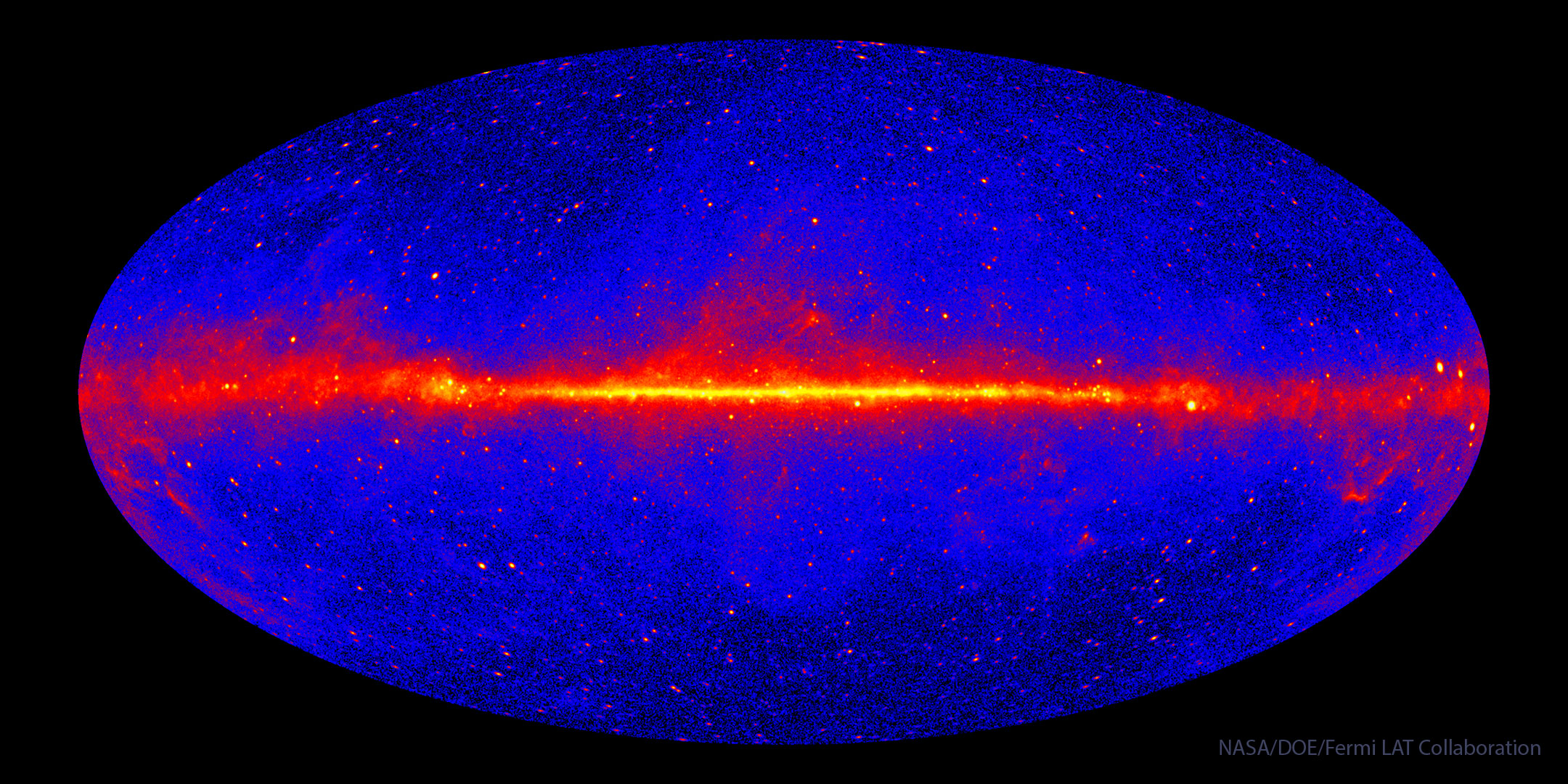
*Image creditor details unavailable via API. Visit linked page below for full info.*
Forget X-ray vision — imagine what you could see with gamma-ray vision! The featured all-sky map shows what the universe looks like to NASA's Fermi Gamma-ray Space Telescope. Fermi sees light with energies about a billion times what the human eye can see, and the map combines 12 years of Fermi observations. The colors represent the brightness of the gamma-ray sources, with brighter sources appearing lighter in color. The prominent stripe across the middle is the central plane of our Milky Way galaxy. Most of the red and yellow dots scattered above and below the Milky Way’s plane are very distant galaxies, while most of those within the plane are nearby pulsars. The blue background that fills the image is the diffuse glow of gamma-rays from distant sources that are too dim to be detected individually. Some gamma-ray sources remain unidentified and topics of research — currently no one knows what they are.
#APOD #AstronautLife #Astrophysics #Research #AstronomyLovers
**Astronomy Picture of the Day**
20 August 2024
**Supermoon Beyond the Temple of Poseidon**
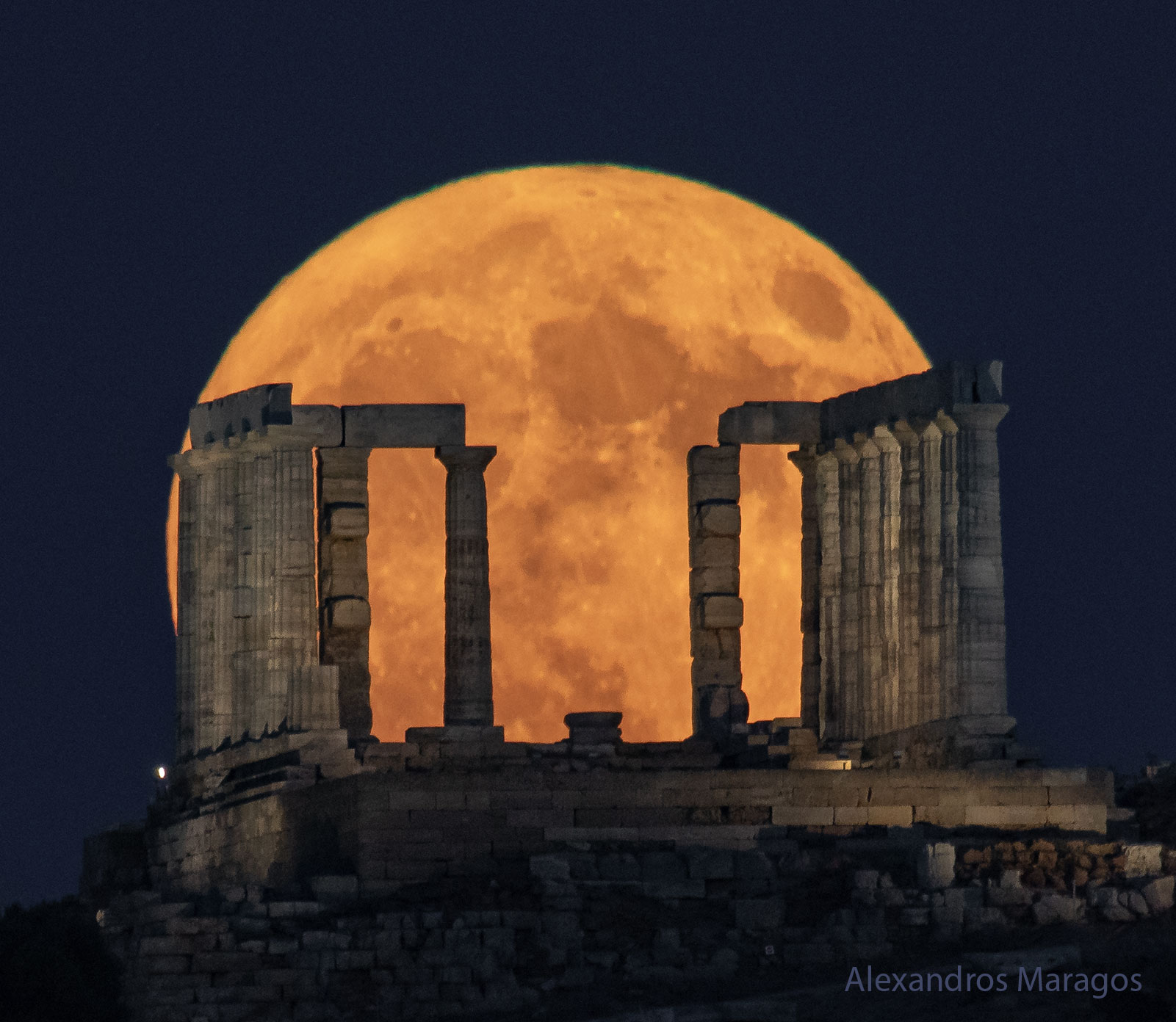
*Image creditor details unavailable via API. Visit linked page below for full info.*
A supermoon occurred yesterday. And tonight's moon should also look impressive. Supermoons appear slightly larger and brighter than most full moons because they reach their full phase when slightly nearer to the Earth -- closer than 90 percent of all full moons. This supermoon was also a blue moon given the definition that it is the third of four full moons occurring during a single season. Blue moons are not usually blue, and a different definition holds that a blue moon is the second full moon that occurs during a single month. The featured image captured the blue supermoon right near its peak size yesterday as it was rising beyond the Temple of Poseidon in Greece. This supermoon is particularly unusual in that it is the first of four successive supermoons, the next three occurring in September, October, and November.
#APOD #Astrophoto #Astrozone #SpaceMissions #Astroinformatics
**Astronomy Picture of the Day**
19 August 2024
**IC 5146: The Cocoon Nebula**
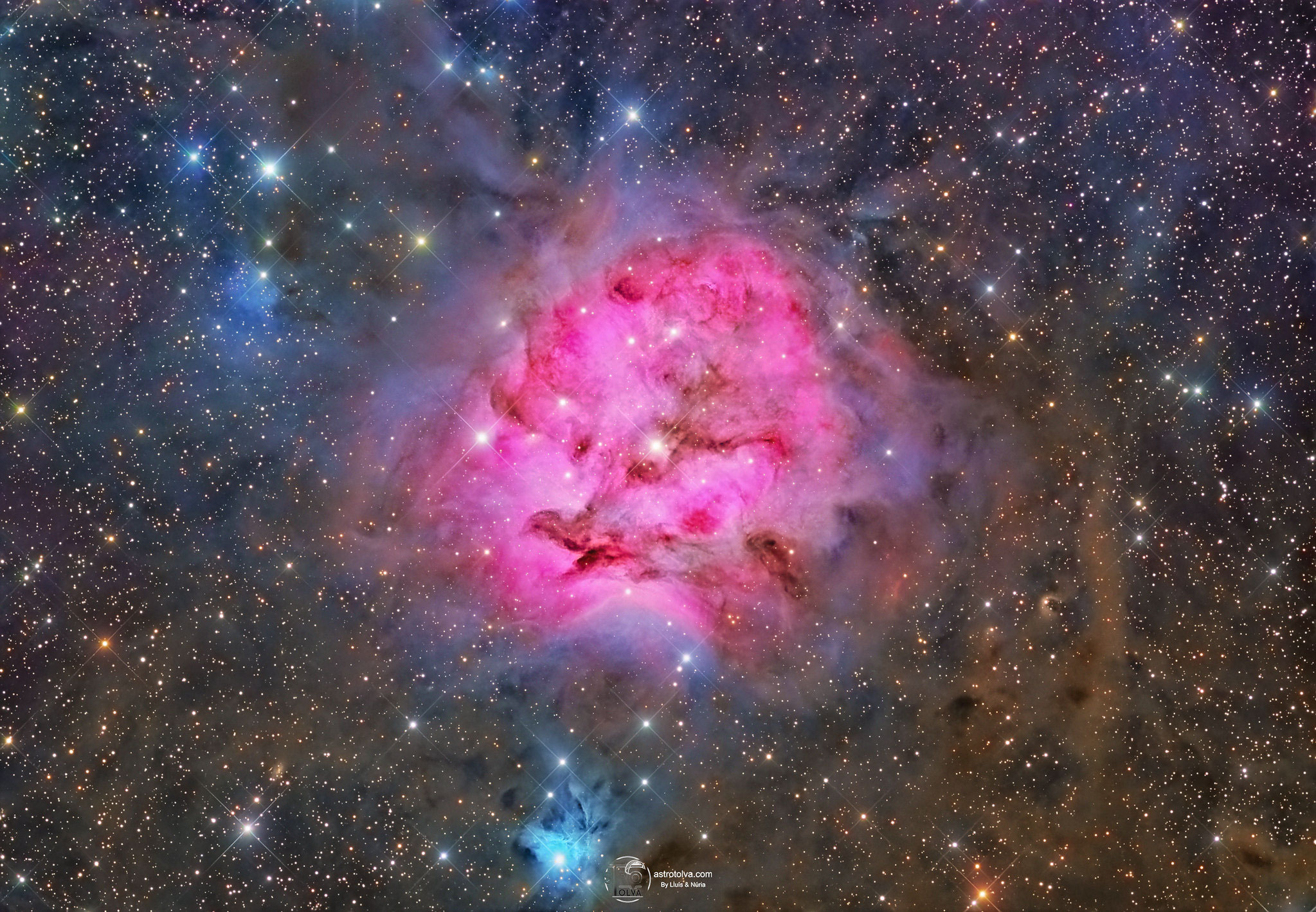
Image Credit & Copyright:
Luis Romero Ventura
Inside the Cocoon Nebula is a newly developing cluster of stars. Cataloged as IC 5146, the beautiful nebula is nearly 15 light-years wide. Soaring high in northern summer night skies, it's located some 4,000 light years away toward the constellation of the Swan (Cygnus). Like other star forming regions, it stands out in red, glowing, hydrogen gas excited by young, hot stars, and dust-reflected starlight at the edge of an otherwise invisible molecular cloud. In fact, the bright star found near the center of this nebula is likely only a few hundred thousand years old, powering the nebular glow as it clears out a cavity in the molecular cloud's star forming dust and gas. A 48-hour long integration resulted in this exceptionally deep color view tracing tantalizing features within and surrounding the dusty stellar nursery.
#APOD #Exoplanets #Astrophysics #PlanetaryScience #SpaceResearch