
**Astronomy Picture of the Day**
17 October 2024
**The Clipper and the Comet**
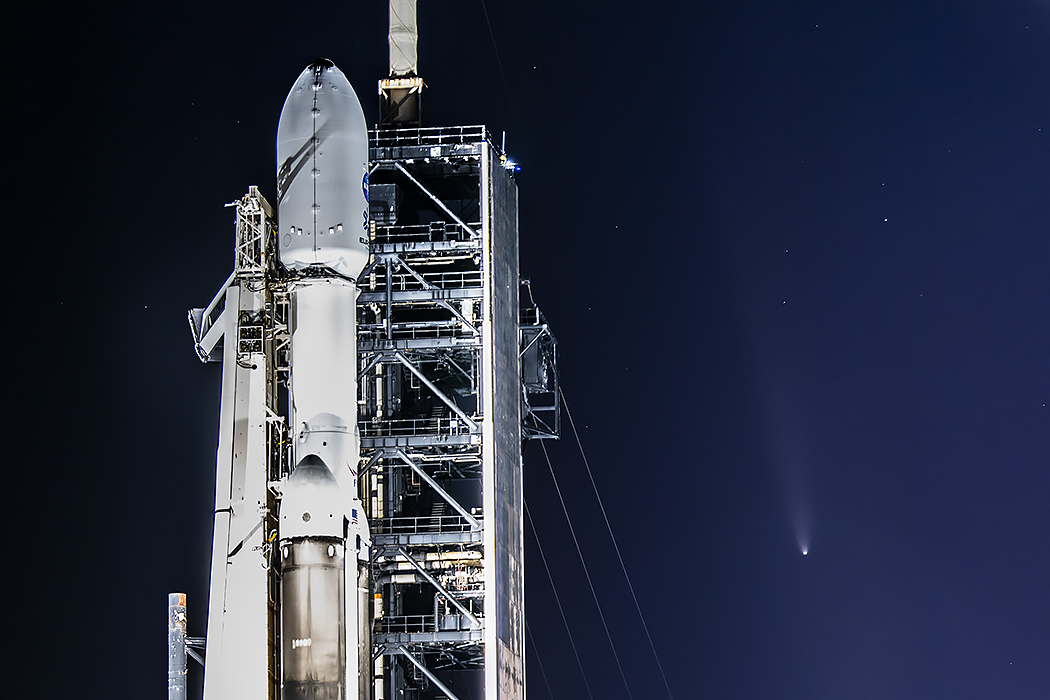
Image Credit & Copyright: Ben Cooper
NASA's Europa Clipper is now headed toward an ocean world beyond Earth. The large spacecraft is tucked into the payload fairing atop the Falcon Heavy rocket in this photo, taken at Kennedy Space Center the day before the mission's successful October 14 launch. Europa Clipper's interplanetary voyage will first take it to Mars, then back to Earth, and then on to Jupiter on gravity assist trajectories that will allow it to enter orbit around Jupiter in April 2030. Once orbiting Jupiter, the spacecraft will fly past Europa 49 times, exploring a Jovian moon with a global subsurface ocean that may have conditions to support life. Posing in the background next to the floodlit rocket is Comet Tsuchinsan-ATLAS, about a day after the comet's closest approach to Earth. A current darling of evening skies, the naked-eye comet is a vistor from the distant Oort cloud Growing Gallery: Comet Tsuchinshan-ATLAS in 2024
#APOD #Stellar #Astroenthusiast #SpaceTech #Astrogeek
**Astronomy Picture of the Day**
16 October 2024
**Colorful Aurora over New Zealand**

Image Credit & Copyright:
Tristian McDonald
Sometimes the night sky is full of surprises. Take the sky over Lindis Pass, South Island, New Zealand one-night last week. Instead of a typically calm night sky filled with constant stars, a busy and dynamic night sky appeared. Suddenly visible were pervasive red aurora, green picket-fence aurora, a red SAR arc, a STEVE, a meteor, and the Moon. These outshone the center of our Milky Way Galaxy and both of its two satellite galaxies: the LMC and SMC. All of these were captured together on 28 exposures in five minutes, from which this panorama was composed. Auroras lit up many skies last week, as a Coronal Mass Ejection from the Sun unleashed a burst of particles toward our Earth that created colorful skies over latitudes usually too far from the Earth's poles to see them. More generally, night skies this month have other surprises, showing not only auroras -- but comets. Jigsaw Challenge: Astronomy Puzzle of the Day
#APOD #Planetarium #Astrochemistry #Astroengineer #Astrophysics
**Astronomy Picture of the Day**
15 October 2024
**Animation: Comet Tsuchinshan-ATLAS Tails Prediction**
https://www.youtube.com/embed/dY6poe072_c?rel=0
Image Credit & Copyright:
Nico Lefaudeux
How bright and strange will the tails of Comet Tsuchinshan-ATLAS become? The comet has brightened dramatically over the few weeks as it passed its closest to the Sun and, just three days ago, passed its closest to the Earth. C/2023 A3 (Tsuchinshan–ATLAS) became of the brightest comets of the past century over the past few days, but was unfortunately hard to see because it was so nearly superposed on the Sun. As the comet appears to move away from the Sun, it is becoming a remarkable sight -- but may soon begin to fade. The featured animated video shows how the comet's tails have developed, as viewed from Earth, and gives one prediction about how they might further develop. As shown in the video, heavier parts of the dust tail that trails the comet have begun to appear to point in nearly the opposite direction from lighter parts of the dust tail as well as the comet's ion tail, the blue tail that is pushed directly out from the Sun by the solar wind. Growing Gallery: Comet Tsuchinsan-ATLAS in 2024
#APOD #Astrozone #Meteorology #CosmicWonders #MeteorShowers
**Astronomy Picture of the Day**
14 October 2024
**Comet Tsuchinshan-ATLAS Over the Lincoln Memorial**

Image Credit & Copyright:
Brennan Gilmore
Go outside at sunset tonight and see a comet! C/2023 A3 (Tsuchinshan–ATLAS) has become visible in the early evening sky in northern locations to the unaided eye. To see the comet, look west through a sky with a low horizon. If the sky is clear and dark enough, you will not even need binoculars -- the faint tail of the comet should be visible just above the horizon for about an hour. Pictured, Comet Tsuchinshan-ATLAS was captured two nights ago over the Lincoln Memorial monument in Washington, DC, USA. With each passing day at sunset, the comet and its changing tail should be higher and higher in the sky, although exactly how bright and how long its tails will be can only be guessed. Growing Gallery: Comet Tsuchinsan-ATLAS in 2024
#APOD #OuterSpace #SpaceTechnology #Stargazing #MeteorShowers
**Astronomy Picture of the Day**
13 October 2024
**Aurora Timelapse Over Italian Alps**
https://www.youtube.com/embed/uCbpHh_rTgc?rel=0
Image Credit & Copyright:
Cristian Bigontina
Did you see last night's aurora? This question was relevant around much of the world a few days ago because a powerful auroral storm became visible unusually far from the Earth's poles. The cause was a giant X-class solar flare on Tuesday that launched energetic electrons and protons into the Solar System, connecting to the Earth via our planet's magnetic field. A red glow of these particles striking oxygen atoms high in Earth's atmosphere pervades the frame, while vertical streaks dance. The featured video shows a one-hour timelapse as seen from Cortina d'Ampezzo over Alps Mountain peaks in northern Italy. Stars from our Milky Way Galaxy dot the background while streaks from airplanes and satellites punctuate the foreground. The high recent activity of our Sun is likely to continue to produce picturesque auroras over Earth during the next year or so. Gallery: Global aurora during October 10/11, 2024
#APOD #SpaceTechnology #Astrozone #Planets #SpaceMission
**Astronomy Picture of the Day**
12 October 2024
**Northern Lights, West Virginia**

Image Credit & Copyright: Jonathan Eggleston
A gravel country lane gently winds through this colorful rural night skyscape. Captured from Monroe County in southern West Virginia on the evening of October 10, the starry sky above is a familiar sight. Shimmering curtains of aurora borealis or northern lights definitely do not make regular appearances here, though. Surprisingly vivid auroral displays were present on that night at very low latitudes around the globe, far from their usual northern and southern high latitude realms. The extensive auroral activity was evidence of a severe geomagnetic storm triggered by the impact of a coronal mass ejection (CME), an immense magnetized cloud of energetic plasma. The CME was launched toward Earth from the active Sun following a powerful X-class solar flare. Growing Gallery: Global aurora during October 10/11, 2024
#APOD #LunarExploration #SpaceFacts #Astrozone #Astronomy
**Astronomy Picture of the Day**
11 October 2024
**Ring of Fire over Easter Island**
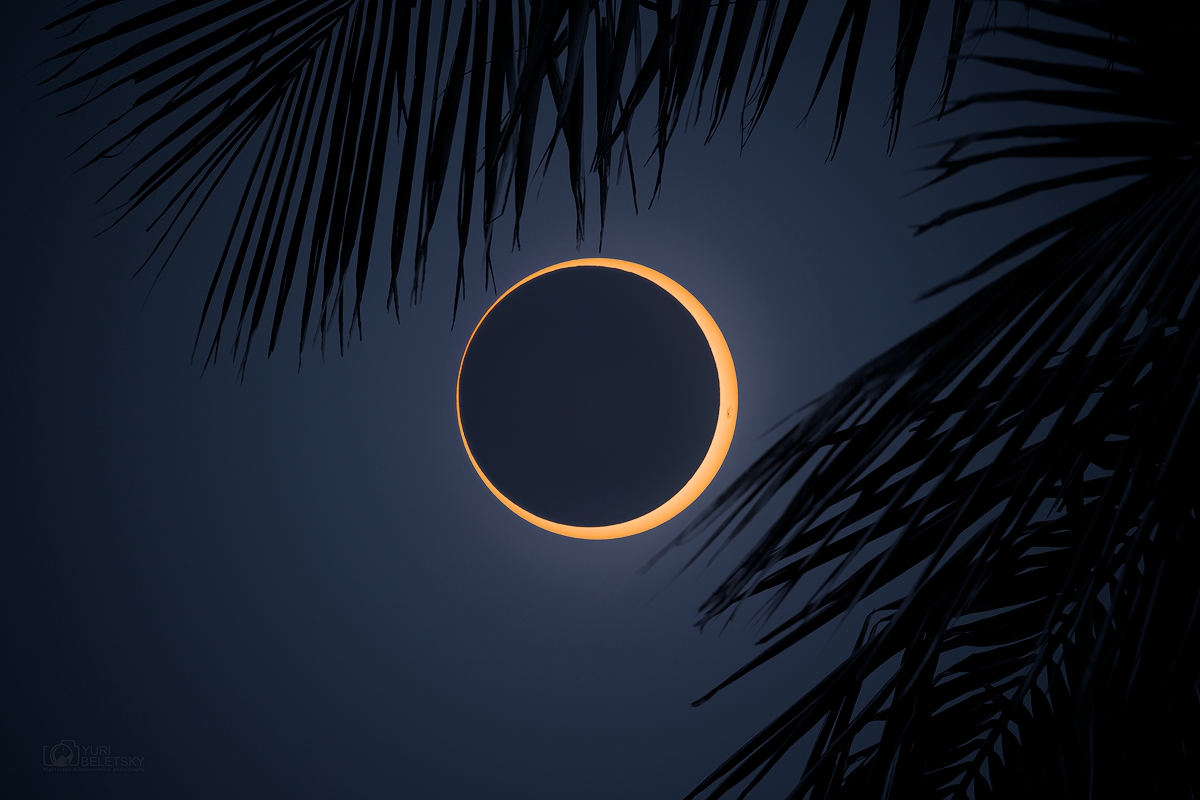
Image Credit & Copyright: Yuri Beletsky
The second solar eclipse of 2024 began in the Pacific. On October 2nd the Moon's shadow swept from west to east, with an annular eclipse visible along a narrow antumbral shadow path tracking mostly over ocean, making its only major landfall near the southern tip of South America, and then ending in the southern Atlantic. The dramatic total annular eclipse phase is known to some as a ring of fire. Also tracking across islands in the southern Pacific, the Moon's antumbral shadow grazed Easter Island allowing denizens to follow all phases of the annular eclipse. Framed by palm tree leaves this clear island view is a stack of two images, one taken with and one taken without a solar filter near the moment of the maximum annular phase. The New Moon's silhouette appears just off center, though still engulfed by the bright disk of the active Sun.
#APOD #Astrogeek #Astrophysics #Astrogeology #AstronautLife
**Astronomy Picture of the Day**
10 October 2024
**Five Bright Comets from SOHO**
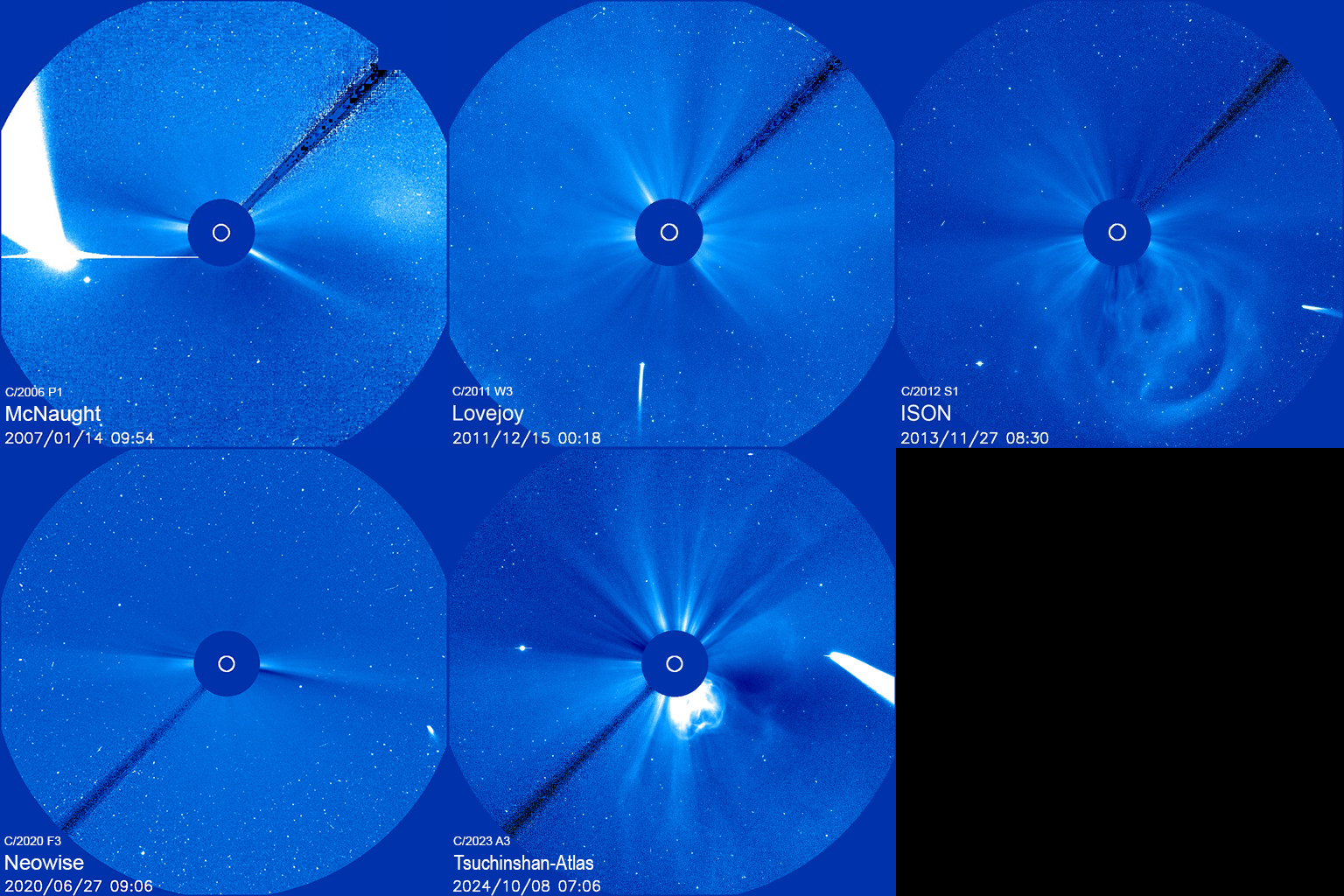
*Image creditor details unavailable via API. Visit linked page below for full info.*
Five bright comets are compared in these panels, recorded by a coronograph on board the long-lived, sun-staring SOHO spacecraft. Arranged chronologically all are recognizable by their tails streaming away from the Sun at the center of each field of view, where a direct view of the overwhelmingly bright Sun is blocked by the coronagraph's occulting disk. Each comet was memorable for earthbound skygazers, starting at top left with Comet McNaught, the 21st century's brightest comet (so far). C/2023 A3 Tsuchinshan-Atlas, approaching its perihelion with the active Sun at bottom center, has most recently grabbed the attention of comet watchers around the globe. By the end of October 2024, the blank 6th panel may be filled with bright sungrazer comet C/2024 S1 Atlas. ... or not.
#APOD #Astrogeology #Astroeducation #Astroinformatics #PlanetaryScience
**Astronomy Picture of the Day**
09 October 2024
**M106: A Spiral Galaxy with a Strange Center**
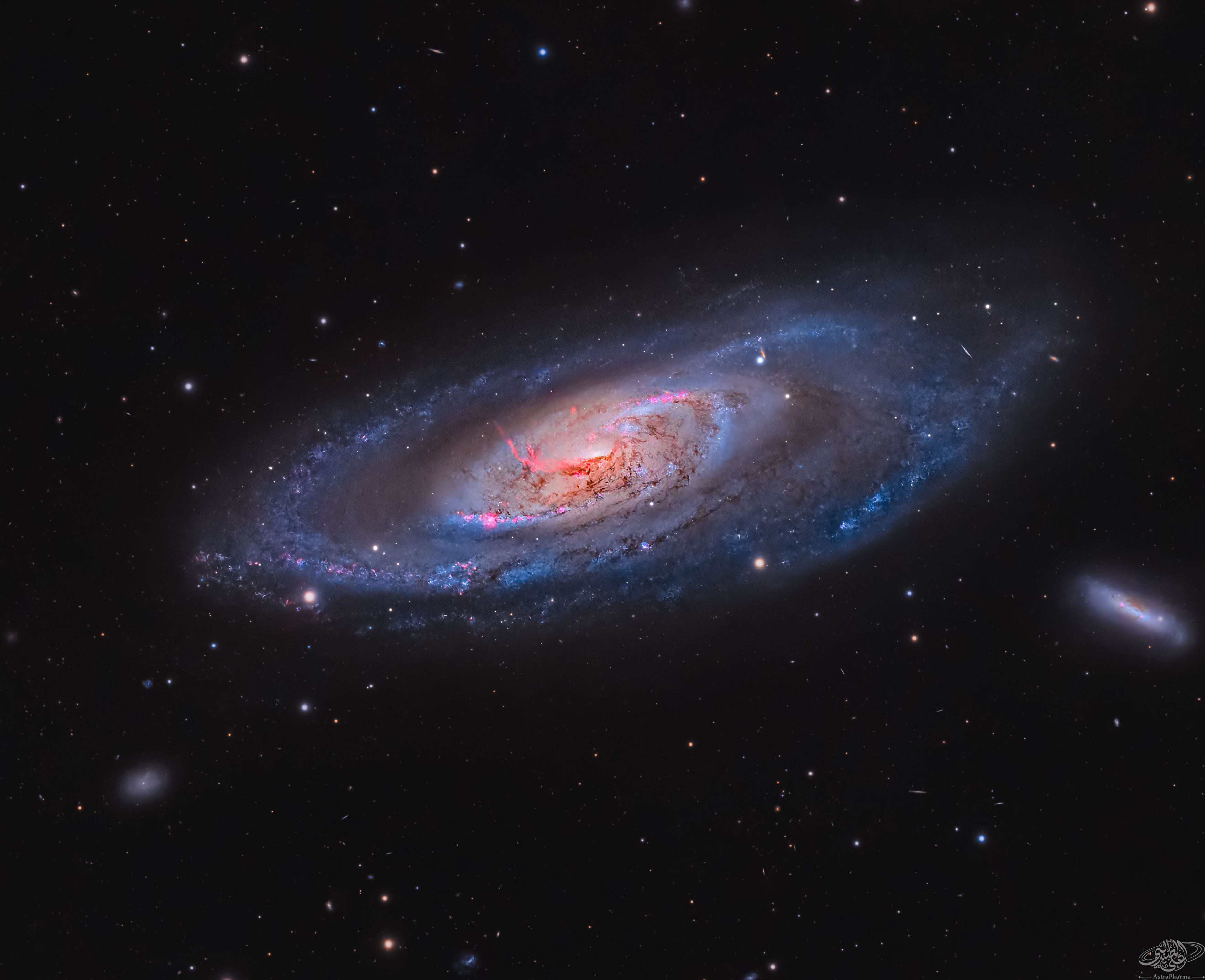
Image Credit & Copyright:
Ali Al Obaidly
What's happening at the center of spiral galaxy M106? A swirling disk of stars and gas, M106's appearance is dominated by blue spiral arms and red dust lanes near the nucleus, as shown in the featured image taken from the Kuwaiti desert. The core of M106 glows brightly in radio waves and X-rays where twin jets have been found running the length of the galaxy. An unusual central glow makes M106 one of the closest examples of the Seyfert class of galaxies, where vast amounts of glowing gas are thought to be falling into a central massive black hole. M106, also designated NGC 4258, is a relatively close 23.5 million light years away, spans 60 thousand light years across, and can be seen with a small telescope towards the constellation of the Hunting Dogs (Canes Venatici).
#APOD #Astrophoto #Celestial #Astrogeek #SpaceInnovation
**Astronomy Picture of the Day**
08 October 2024
**Annular Eclipse over Patagonia**

Image Credit & Copyright:
Alexis
Trigo
Can you find the Sun? OK, but can you explain why there’s a big dark spot in the center? The spot is the Moon, and the impressive alignment shown, where the Moon lines up inside the Sun, is called an annular solar eclipse. Such an eclipse occurred just last week and was visible from a thin swath mostly in Earth's southern hemisphere. The featured image was captured from Patagonia, Chile. When the Moon is significantly closer to the Earth and it aligns with the Sun, a total solar eclipse is then visible from parts of the Earth. Annular eclipses are slightly more common than total eclipses, but as the Moon moves slowly away from the Earth, before a billion more years, the Moon's orbit will no longer bring it close enough for a total solar eclipse to be seen from anywhere on Earth. Gallery: Annular Eclipse of October 2024
#APOD #Astrogeology #Stellar #Astrophotography #AstronautLife
**Astronomy Picture of the Day**
07 October 2024
**The Long Tails Comet Tsuchinshan-ATLAS**

Image Credit & Copyright:
Jose Santivañez Mueras
A bright comet is moving into the evening skies. C/2023 A3 (Tsuchinshan–ATLAS) has brightened and even though it is now easily visible to the unaided eye, it is so near to the Sun that it is still difficult to see. Pictured, Comet Tsuchinshan–ATLAS was captured just before sunrise from an Andes Mountain in Peru. Braving cold weather, this unusually high perch gave the astrophotographer such a low eastern horizon that the comet was obvious in the pre-dawn sky. Visible in the featured image is not only an impressively long dust tail extending over many degrees, but an impressively long and blue ion tail, too. This month, as the comet moves out from the Sun and passes the Earth, evening observers should be able to see the huge dirty ice ball toward the west just after sunset. Growing Gallery: Comet Tsuchinsan-ATLAS in 2024
#APOD #Astroknowledge #RocketLaunch #CosmicWonders #Astrophoto
**Astronomy Picture of the Day**
06 October 2024
**The Magnificent Tail of Comet McNaught**
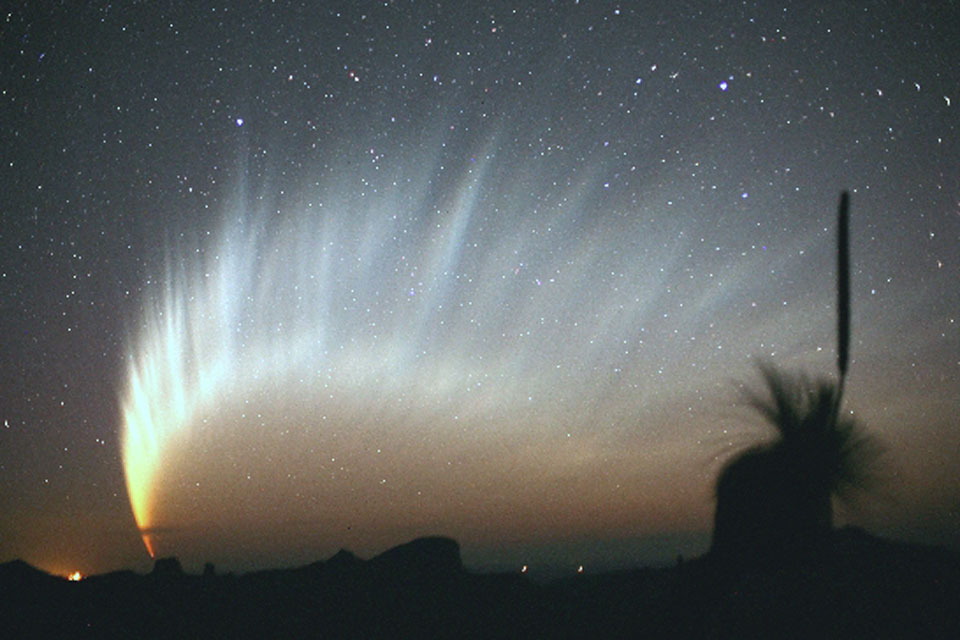
Image Credit & Copyright:
Robert H. McNaught
Comet McNaught, the Great Comet of 2007, grew a spectacularly long and filamentary tail. The magnificent tail spread across the sky and was visible for several days to Southern Hemisphere observers just after sunset. The amazing ion tail showed its greatest extent on long-duration, wide-angle camera exposures. During some times, just the tail itself was visible just above the horizon for many northern observers as well. Comet C/2006 P1 (McNaught), estimated to have attained a peak brightness of magnitude -5 (minus five), was caught by the comet's discoverer in the featured image just after sunset in January 2007 from Siding Spring Observatory in Australia. Comet McNaught, the brightest comet in decades, then faded as it moved further into southern skies and away from the Sun and Earth. Over the next month, Comet Tsuchinshan–ATLAS, a candidate for the Great Comet of 2024, should display its most spectacular tails visible from the Earth.
#APOD #Astrogeek #Research #Astroenthusiast #Astrogeology
**Astronomy Picture of the Day**
05 October 2024
**M27: Not a Comet**

Image Credit & Copyright: Francesco Sferlazza, Franco Sgueglia
While hunting for comets in the skies above 18th century France, astronomer Charles Messier diligently kept a list of the things encountered during his telescopic expeditions that were definitely not comets. This is number 27 on his now famous not-a-comet list. In fact, 21st century astronomers would identify it as a planetary nebula, but it's not a planet either, even though it may appear round and planet-like in a small telescope. Messier 27 (M27) is an excellent example of a gaseous emission nebula created as a sun-like star runs out of nuclear fuel in its core. The nebula forms as the star's outer layers are expelled into space, with a visible glow generated by atoms excited by the dying star's intense but invisible ultraviolet light. Known by the popular name of the Dumbbell Nebula, the beautifully symmetric interstellar gas cloud is over 2.5 light-years across and about 1,200 light-years away in the constellation Vulpecula. This impressive color image highlights details within the well-studied central region and fainter, seldom imaged features in the nebula's outer halo.
#APOD #Cosmos #SpaceFacts #SpaceMission #AstronomyLovers
**Astronomy Picture of the Day**
04 October 2024
**Comet at Moonrise**
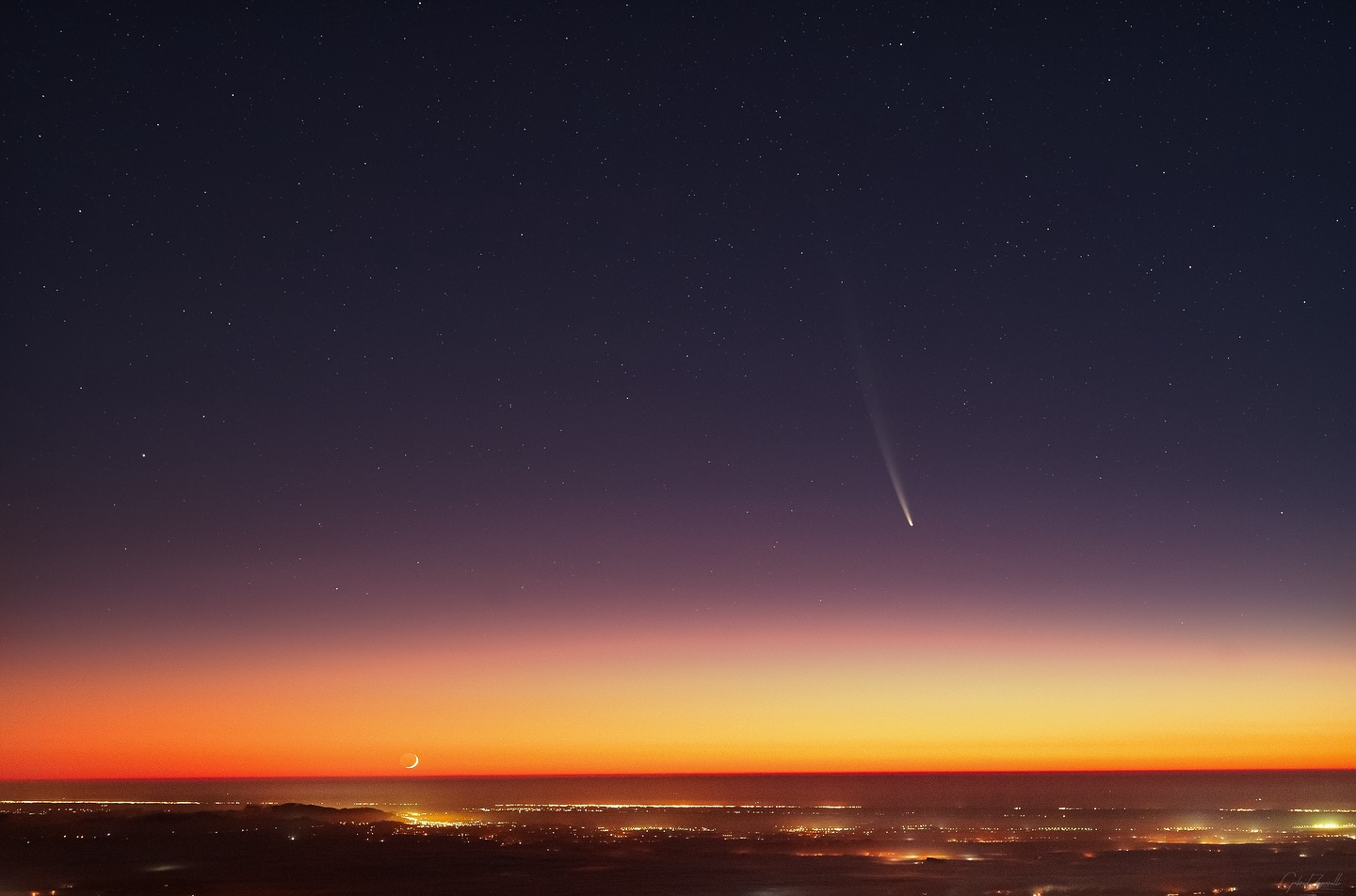
Image Credit & Copyright: Gabriel Zaparolli
Comet C/2023 A3 (Tsuchinshan–ATLAS) is growing brighter in planet Earth's sky. Fondly known as comet A3, this new visitor to the inner Solar System is traveling from the distant Oort cloud. The comet reached perihelion, its closest approach to the Sun, on September 27 and will reach perigee, its closest to our fair planet, on October 12, by then becoming an evening sky apparition. But comet A3 was an early morning riser on September 30 when this image was made. Its bright coma and already long tail share a pre-dawn skyscape from Praia Grande, Santa Catarina in southern Brazil with the waning crescent Moon just peeking above the eastern horizon. While the behaviour of comets is notoriously unpredictable, Tsuchinshan–ATLAS could become a comet visually rivaling C/2020 F3 (NEOWISE). Comet NEOWISE wowed skygazers in the summer of 2020. Growing Gallery: Comet Tsuchinsan-ATLAS in 2024
#APOD #SpaceTechnology #Cosmos #Astrophoto #RocketScience
**Astronomy Picture of the Day**
03 October 2024
**Eclipse at Sunrise**

Image Credit & Copyright: Wang Letian
The second solar eclipse of 2024 began in the Pacific. On October 2nd the Moon's shadow swept from west to east, with an annular eclipse visible along a narrow antumbral shadow path tracking mostly over ocean, crossing land near the southern tip of South America, and ending in the southern Atlantic. The dramatic total annular eclipse phase is known to some as a ring of fire. Still, a partial eclipse of the Sun was experienced over a wide region. Captured at one of its earliest moments, October's eclipsed Sun is seen just above the clouds near sunrise in this snapshot. The partially eclipsed solar disk is close to the maximum eclipse as seen from Mauna Kea Observatory Visitor Center, Island of Hawaii, planet Earth.
#APOD #Exploration #Universe #Astrodata #Astroengineer
**Astronomy Picture of the Day**
02 October 2024
**The Large Magellanic Cloud Galaxy**

Image Credit & Copyright:
Ireneusz Nowak;
Text: Natalia Lewandowska
(SUNY Oswego)
It is the largest satellite galaxy of our home Milky Way Galaxy. If you live in the south, the Large Magellanic Cloud (LMC) is quite noticeable, spanning about 10 degrees across the night sky, which is 20 times larger than the full moon towards the southern constellation of the dolphinfish (Dorado). Being only about 160,000 light years away, many details of the LMC's structure can be seen, such as its central bar and its single spiral arm. The LMC harbors numerous stellar nurseries where new stars are being born, which appear in pink in the featured image. It is home to the Tarantula Nebula, the currently most active star forming region in the entire Local Group, a small collection of nearby galaxies dominated by the massive Andromeda and Milky Way galaxies. Studies of the LMC and the Small Magellanic Cloud (SMC) by Henrietta Swan Leavitt led to the discovery of the period-luminosity relationship of Cepheid variable stars that are used to measure distances across the nearby universe. Survey: Color Blindness and Astronomical Images
#APOD #LunarExploration #Space #Galactic #Astrophotography
**Astronomy Picture of the Day**
01 October 2024
**Porphyrion: The Longest Known Black Hole Jets**
https://www.youtube.com/embed/ExGvwNuKyMc?ref=0
*Image creditor details unavailable via API. Visit linked page below for full info.*
How far can black hole jets extend? A new record was found just recently with the discovery of a 23-million light-year long jet pair from a black hole active billions of years ago. Dubbed Porphyrion for a mythological Greek giant, the impressive jets were created by a type of black hole that does not usually create long jets -- one that is busy creating radiation from infalling gas. The featured animated video depicts what it might look like to circle around this powerful black hole system. Porphyrion is shown as a fast stream of energetic particles, and the bright areas are where these particles are impacting surrounding gas. The discovery was made using data from the Keck and Mayall (DESI) optical observatories as well as LOFAR and the Giant Metrewave Radio Telescope. The existence of these jets demonstrates that black holes can affect not only their home galaxies but far out into the surrounding universe. Your Sky Surprise: What picture did APOD feature on your birthday? (post 1995)
#APOD #Astrophoto #RocketLaunch #AstronomyFacts #Astronauts
**Astronomy Picture of the Day**
30 September 2024
**Comet Tsuchinshan-ATLAS over Mexico**

Image Credit & Copyright:
Daniel Korona
The new comet has passed its closest to the Sun and is now moving closer to the Earth. C/2023 A3 (Tsuchinshan–ATLAS) is currently moving out from inside the orbit of Venus and on track to pass its nearest to the Earth in about two weeks. Comet Tsuchinshan-ATLAS, pronounced "Choo-cheen-shahn At-less,", is near naked-eye visibility and easily picked up by long-exposure cameras. The comet can also now be found by observers in Earth's northern hemisphere as well as the south. The featured image was captured just a few days ago above Zacatecas, Mexico. Because clouds were obscuring much of the pre-dawn sky, the astrophotographer released a drone to take pictures from higher up, several of which were later merged to enhance the comet's visibility. Although the future brightness of comets is hard to predict, there is increasing hope that Comet Tsuchinshan-ATLAS will further brighten as it enters the early evening sky. Growing Gallery: Comet Tsuchinsan-ATLAS in 2024
#APOD #Cosmological #SpaceDiscovery #SpaceExploration #Astrobiology
**Astronomy Picture of the Day**
29 September 2024
**Seven Dusty Sisters**

*Image creditor details unavailable via API. Visit linked page below for full info.*
Is this really the famous Pleiades star cluster? Known for its iconic blue stars, the Pleiades is shown here in infrared light where the surrounding dust outshines the stars. Here, three infrared colors have been mapped into visual colors (R=24, G=12, B=4.6 microns). The base images were taken by NASA's orbiting Wide Field Infrared Survey Explorer (WISE) spacecraft. Cataloged as M45 and nicknamed the Seven Sisters, the Pleiades star cluster is by chance situated in a passing dust cloud. The light and winds from the massive Pleiades stars preferentially repel smaller dust particles, causing the dust to become stratified into filaments, as seen. The featured image spans about 20 light years at the distance of the Pleiades, which lies about 450 light years distant toward the constellation of the Bull (Taurus).
#APOD #Astrophysics #Astroenthusiast #Science #Astrodata
**Astronomy Picture of the Day**
28 September 2024
**Rocket Eclipse at Sunset**

Image Credit & Copyright: Ben Cooper
Shockwaves ripple across the glare as a launch eclipses the setting Sun in this exciting close-up. Captured on September 17, the roaring Falcon 9 rocket carried European Galileo L13 navigation satellites to medium Earth orbit after a lift-off from Cape Canaveral on Florida's space coast. The Falcon 9 booster returned safely to Earth about 8.5 minutes later, notching the 22nd launch and landing for the reusable workhorse launch vehicle. But where did it land? Just Read the Instructions.
#APOD #Astrobiology #SpaceFacts #Astrophoto #SpaceTechnology