
**Astronomy Picture of the Day**
26 January 2025
**The Many Tails of Comet G3 ATLAS**

Image Credit & Copyright:
Martin Mašek
(FZU, Czech Academy of Sciences)
&
Jakub Kuřák
Why does this comet have so many tails? C/2024 G3 (ATLAS) has developed several long and intricate tails visible from Earth's southern hemisphere over the past two weeks. Many observers reported seeing the impressive comet without any optical aid above the western horizon just after sunset. At least six different tails appear in the featured image captured five days ago from the dark skies above Paranal Observatory in Chile. One possible cause for the multiple tails is dust and gas being expelled from the comet's rotating nucleus. The outward push of the Sun's complex solar wind may also play a role. The huge iceberg-like nucleus of Comet ATLAS appears to have broken up near its closest approach to the Sun two weeks ago. Unfortunately, Comet ATLAS and its tails are expected to fade significantly over the coming weeks. Your Sky Surprise: What picture did APOD feature on your birthday? (post 1995)
#APOD #Astrophysics #Cosmos #AstronomyLovers #Astrogeek
**Astronomy Picture of the Day**
25 January 2025
**Stardust in the Perseus Molecular Cloud**
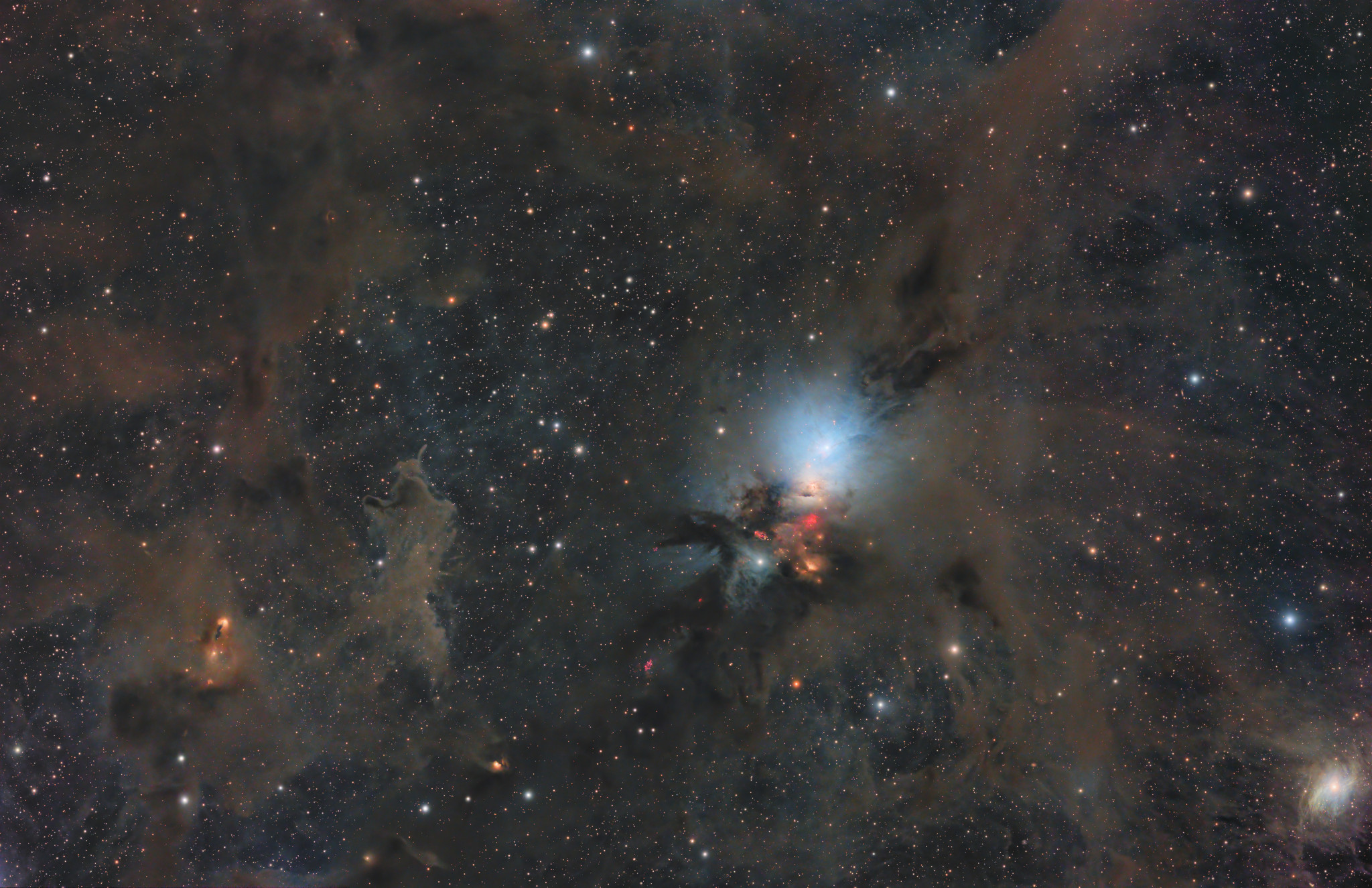
Image Credit & Copyright: Jeff Schilling
Clouds of stardust drift through this deep skyscape, across the Perseus molecular cloud some 850 light-years away. Dusty nebulae reflecting light from embedded young stars stand out in the nearly 4 degree wide field of view. With a characteristic bluish color reflection nebula NGC 1333 is prominent near center. Hints of contrasting red emission from Herbig-Haro objects, the jets and shocked glowing gas emanating from recently formed stars, are scattered across the dusty expanse. While many stars are forming in the molecular cloud, most are obscured at visible wavelengths by the pervasive dust. The chaotic environment surrounding NGC 1333 may be similar to one in which our own Sun formed over 4.5 billion years ago. At the estimated distance of the Perseus molecular cloud, this cosmic scene would span about 80 light-years. Growing Gallery: Comet ATLAS (G3)
#APOD #LunarMission #Space #Astrochemistry #BlackHoles
**Astronomy Picture of the Day**
24 January 2025
**Comet G3 ATLAS: a Tail and a Telescope**

Image Credit & Copyright: Yuri Beletsky
Comet C/2024 G3 ATLAS has made a dramatic appearance in planet Earth's skies. A visitor from the distant Oort Cloud, the comet reached its perihelion on January 13. On January 19, the bright comet was captured here from ESO Paranal Observatory in the Atacama desert in Chile. Sporting spectacular sweeping dust tails, this comet ATLAS is setting in the southern hemisphere twilight and was clearly visible to the unaided eye. In the foreground is the closed shell of one of the observatory's famous auxiliary telescopes. Still wowing southern hemisphere observers, the comet's bright coma has become diffuse, its icy nucleus apparently disintegrating following its close approach to the Sun. Growing Gallery: Comet ATLAS (G3)
#APOD #Astrobiology #Galactic #SpaceMissions #Galaxy
**Astronomy Picture of the Day**
23 January 2025
**NGC 7814: Little Sombrero**

Image Credit & Copyright: Mike Selby
Point your telescope toward the high flying constellation Pegasus and you can find this cosmic expanse of Milky Way stars and distant galaxies. NGC 7814 is centered in the sharp field of view that would almost be covered by a full moon. NGC 7814 is sometimes called the Little Sombrero for its resemblance to the brighter more famous M104, the Sombrero Galaxy. Both Sombrero and Little Sombrero are spiral galaxies seen edge-on, and both have extensive halos and central bulges cut by a thin disk with thinner dust lanes in silhouette. In fact, NGC 7814 is some 40 million light-years away and an estimated 60,000 light-years across. That actually makes the Little Sombrero about the same physical size as its better known namesake, appearing smaller and fainter only because it is farther away.
#APOD #SpaceExploration #GalaxyExploration #RocketLaunch #SpaceIndustry
**Astronomy Picture of the Day**
22 January 2025
**The North America Nebula**
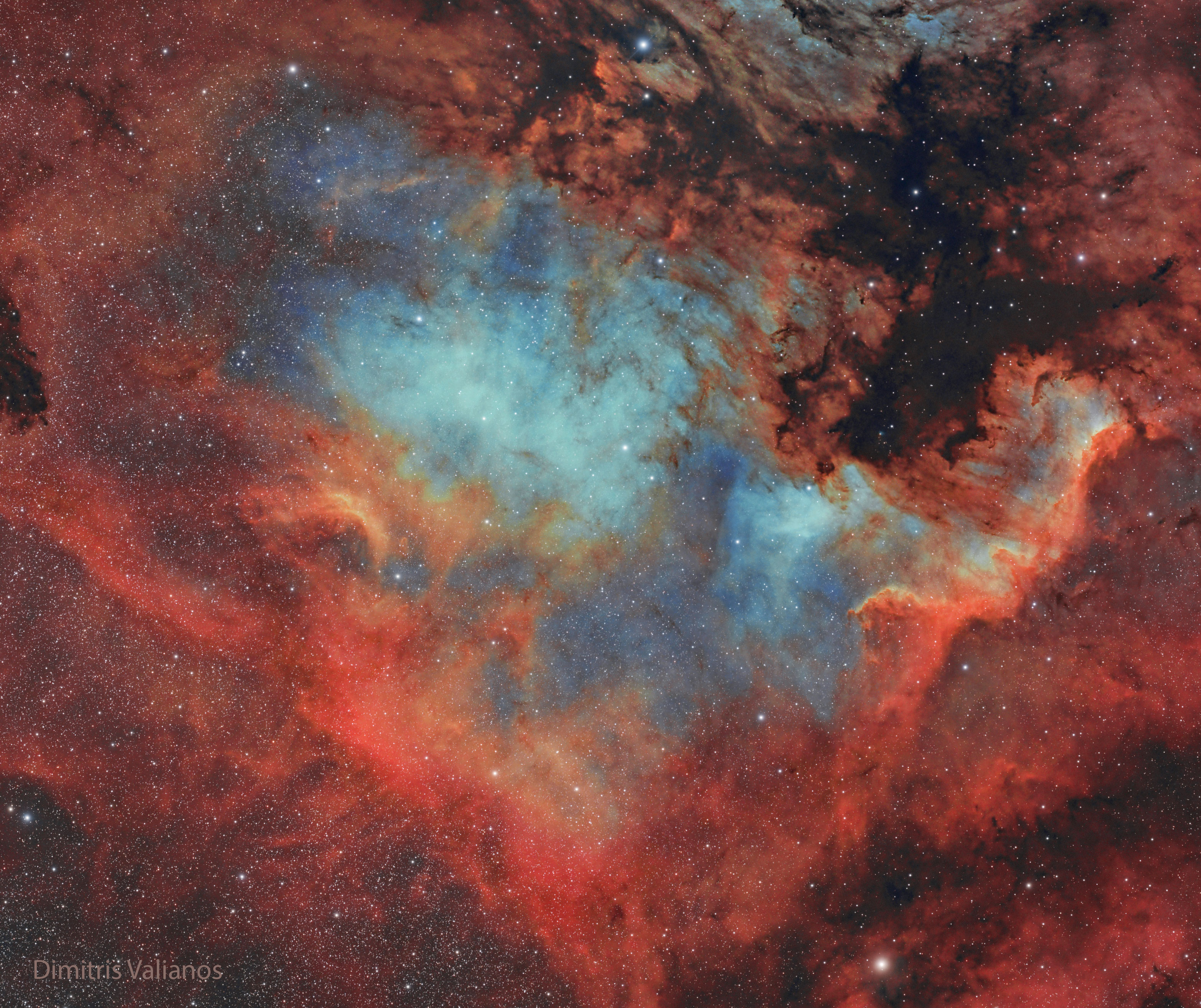
Image Credit & Copyright:
Dimitris Valianos
The North America nebula on the sky can do what the North America continent on Earth cannot -- form stars. Specifically, in analogy to the Earth-confined continent, the bright part that appears as the east coast is actually a hot bed of gas, dust, and newly formed stars known as the Cygnus Wall. The featured image shows the star forming wall lit and eroded by bright young stars and partly hidden by the dark dust they have created. The part of the North America nebula (NGC 7000) shown spans about 50 light years and lies about 1,500 light years away toward the constellation of the Swan (Cygnus). Jigsaw Challenge: Astronomy Puzzle of the Day
#APOD #Space #SpaceTechnology #SpaceMissions #Stars
**Astronomy Picture of the Day**
21 January 2025
**Comet ATLAS over Brasília**

*Image creditor details unavailable via API. Visit linked page below for full info.*
What's that in the sky? Above the city, above most clouds, far in the distance: it's a comet. Pictured, the impressive tail of Comet C/2024 G3 (ATLAS) was imaged from Brasília, Brazil four days ago. Last week the evolving comet rounded the Sun well inside the orbit of planet Mercury, going so close there was early concern that it might break up -- and recent evidence that it really did. At one point near perihelion, Comet ATLAS was so bright that sightings were even reported during the day -- over the bright sky near the Sun -- by careful observers. Over the past few days, Comet ATLAS has developed a long tail that has been partly visible with unaided eyes after sunset, most notably in Earth's southern hemisphere. Growing Gallery: Comet ATLAS (G3)
#APOD #Cosmological #Science #SpaceMission #Astrochemistry
**Astronomy Picture of the Day**
20 January 2025
**Comet ATLAS Rounds the Sun**

*Image creditor details unavailable via API. Visit linked page below for full info.*
Why does Comet ATLAS have such colorful tails? Last week Comet C/2024 G3 (ATLAS) passed its closest to the Sun -- well inside the orbit of Mercury -- and brightened dramatically. Unfortunately, the comet was then so angularly near the Sun that it was very hard for humans to see. But NASA's SOHO spacecraft saw it. Pictured is a SOHO (LASCO C3) image of Comet ATLAS that is a composite of several different color filters. Of the several tails visible, the central white tails are likely made of dust and just reflecting back sunlight. The red, blue, and green tails are likely ion tails with their colors dominated by light emitted by specific gases that were ejected from the comet and energized by the Sun. Currently, Comet ATLAS is showing long tails in southern skies but fading as it moves out of the inner Solar System. Growing Gallery: Comet ATLAS (G3)
#APOD #SpaceResearch #Astroenthusiast #Astrofans #Astrophoto
**Astronomy Picture of the Day**
19 January 2025
**Titan Touchdown: Huygens Descent Movie**
https://www.youtube.com/embed/msiLWxDayuA?rel=0
*Image creditor details unavailable via API. Visit linked page below for full info.*
What would it look like to land on Saturn's moon Titan? The European Space Agency's Huygens probe set down on the Solar System's cloudiest moon in 2005, and a time-lapse video of its descent images was created. Huygens separated from the robotic Cassini spacecraft soon after it achieved orbit around Saturn in late 2004 and began approaching Titan. For two hours after arriving, Huygens plummeted toward Titan's surface, recording at first only the shrouded moon's opaque atmosphere. The computerized truck-tire sized probe soon deployed a parachute to slow its descent, pierced the thick clouds, and began transmitting images of a strange surface far below never before seen in visible light. Landing in a dried sea and surviving for 90 minutes, Huygen's returned unique images of a strange plain of dark sandy soil strewn with smooth, bright, fist-sized rocks of ice.
#APOD #SpaceIndustry #PlanetExploration #Cosmology #SpaceMission
**Astronomy Picture of the Day**
18 January 2025
**Full Moon, Full Mars**

Image Credit & Copyright: On January 13
On January 13 a Full Moon and a Full Mars were close, both bright and opposite the Sun in planet Earth's sky. In fact Mars was occulted, passing behind the Moon, when viewed from some locations in North America and northwest Africa. As seen from Richmond, Virginia, USA, this composite image sequence follows the evening lunar occultation before, during, and after the much anticipated celestial spectacle. The telescopic time series is constructed from an exposure made every two minutes while tracking the Moon over the hours encompassing the event. As a result, the Red Planet's trajectory seems to follow a gently curved path due to the Moon's slightly different rate of apparent motion. The next lunar occultation of bright planet Mars will be on February 9 when the moon is in a waxing gibbous phase. Lunar occultations are only ever visible from a fraction of the Earth's surface, though. The February 9 occultation of Mars will be seen from parts of Russia, China, eastern Canada, Greenland and other (mostly northern) locations, but a close conjunction of a bright Moon with Mars will be more widely visible from planet Earth. Growing Gallery: Moon-Mars Occultation in January 2025
#APOD #Cosmological #Astrozone #Astroeducation #LunarMission
**Astronomy Picture of the Day**
17 January 2025
**Supernova Remnant Cassiopeia A**

*Image creditor details unavailable via API. Visit linked page below for full info.*
Massive stars in our Milky Way Galaxy live spectacular lives. Collapsing from vast cosmic clouds, their nuclear furnaces ignite and create heavy elements in their cores. After only a few million years for the most massive stars, the enriched material is blasted back into interstellar space where star formation can begin anew. The expanding debris cloud known as Cassiopeia A is an example of this final phase of the stellar life cycle. Light from the supernova explosion that created this remnant would have been first seen in planet Earth's sky about 350 years ago, although it took that light 11,000 years to reach us. This sharp NIRCam image from the James Webb Space Telescope shows the still hot filaments and knots in the supernova remnant. The whitish, smoke-like outer shell of the expanding blast wave is about 20 light-years across. A series of light echoes from the massive star's cataclysmic explosion are also identified in Webb's detailed images of the surrounding interstellar medium.
#APOD #RocketLaunch #BlackHoleDiscovery #Astrotheory #Astroengineer
**Astronomy Picture of the Day**
16 January 2025
**M83: The Southern Pinwheel**

*Image creditor details unavailable via API. Visit linked page below for full info.*
Beautiful and bright spiral galaxy M83 lies a some twelve million light-years away, near the southeastern tip of the very long constellation Hydra. Prominent spiral arms traced by dark dust lanes and blue star clusters lend this galaxy its popular name, The Southern Pinwheel. Still, reddish star forming regions that dot this cosmic pinwheel's spiral arms have suggested another nickname, the Thousand-Ruby Galaxy. A mere 40,000 light-years across, smaller than the Milky Way, M83 is a member of a group of galaxies that includes active galaxy Centaurus A. In fact, the core of M83 itself is bright at x-ray energies, showing a high concentration of neutron stars and black holes left from an intense burst of star formation. This sharp color image also features spiky foreground Milky Way stars and distant background galaxies. The image data was captured with the Dark Energy Camera and Blanco 4-meter telescope at Cerro Tololo Inter-American Observatory.
#APOD #AstronautLife #Astrophotography #SpaceObservatory #SpaceDiscovery
**Astronomy Picture of the Day**
15 January 2025
**Wolf Moon Engulfs Mars**
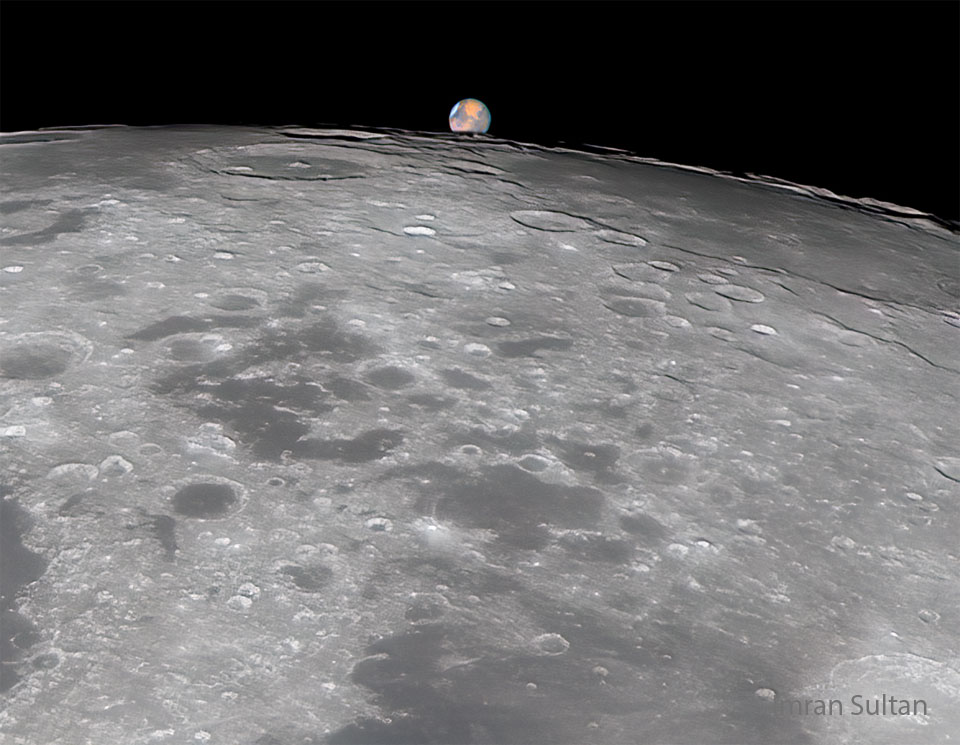
Image Credit & Copyright:
Imran Sultan
Does the Moon ever engulf Mars? Yes, but only in the sense that it moves in front, which happens on rare occasions. This happened just yesterday, though, as seen from some locations in North America and western Africa. This occultation was notable not only because the Moon was a fully lit Wolf Moon, but because Mars was near its largest and brightest, moving to opposition -- the closest to the Earth in its orbit -- only tomorrow. The engulfing, more formally called an occultation, typically lasting about an hour. The featured image was taken from near Chicago, Illinois, USA just as Earth's largest satellite was angularly moving away from the much more distant red planet. Our Moon occasionally moves in front of all of the Solar System's planets. Given the temporary alignment of orbital planes, the next time our Moon eclipses Mars will be a relatively soon February 9. Growing Gallery: Moon-Mars Occultation in January 2025
#APOD #Stars #Stargazing #Astrophotography #PlanetaryExploration
**Astronomy Picture of the Day**
14 January 2025
**North Star: Polaris and Surrounding Dust**

Image Credit & Copyright:
Davide Coverta
Why is Polaris called the North Star? First, Polaris is the nearest bright star toward the north spin axis of the Earth. Therefore, as the Earth turns, stars appear to revolve around Polaris, but Polaris itself always stays in the same northerly direction -- making it the North Star. Since no bright star is near the south spin axis of the Earth, there is currently no bright South Star. Thousands of years ago, Earth's spin axis pointed in a slightly different direction so that Vega was the North Star. Although Polaris is not the brightest star on the sky, it is easily located because it is nearly aligned with two stars in the cup of the Big Dipper. Polaris is near the center of the five-degree wide featured image, a digital composite of hundreds of exposures that brings out faint gas and dust of the Integrated Flux Nebula (IFN) all over the frame. The surface of Cepheid Polaris slowly pulsates, causing the famous star to change its brightness by a few percent over the course of a few days. Today: Zoom APOD Lecture hosted by the Amateur Astronomers of Association of New York
#APOD #Astroinformatics #Astroknowledge #Cosmos #Cosmology
**Astronomy Picture of the Day**
13 January 2025
**Comet ATLAS Before Sunrise**

Image Credit & Copyright:
Petr Horalek /
Institute of Physics in Opava
Comet ATLAS is really bright now, but also really close to the Sun. Outside the glow of the Sun, Comet C/2024 G3 (ATLAS) would be one of the more remarkable comet sights of recent years, reflecting about as much sunlight to Earth as Comet Tsuchinshan-ATLAS did in October, and now rivaling even planet Venus. But the giant snowball is now so close to the Sun that it can only be seen through the light of the early morning dawn or the early evening dusk. Today, Comet ATLAS is at perihelion -- its closest ever to the Sun. Although the future brightness of comets is notoriously hard to predict, there is hope that Comet ATLAS will survive its close pass near the Sun and remain bright enough to be seen with the unaided eye over the next few days -- and possibly a good camera comet for weeks. The featured image was taken early yesterday morning near Tornaľa, Slovakia. Tomorrow: Zoom APOD Lecture hosted by the Amateur Astronomers of Association of New York
#APOD #Astrophysics #Astroenthusiast #GalaxyExploration #SpaceAdventures
**Astronomy Picture of the Day**
12 January 2025
**Mimas: Small Moon with a Big Crater**

*Image creditor details unavailable via API. Visit linked page below for full info.*
Whatever hit Mimas nearly destroyed it. What remains is one of the largest impact craters on one of Saturn's smallest round moons. Analysis indicates that a slightly larger impact would have destroyed Mimas entirely. The huge crater, named Herschel after the 1789 discoverer of Mimas, Sir William Herschel, spans about 130 kilometers and is featured here. Mimas' low mass produces a surface gravity just strong enough to create a spherical body but weak enough to allow such relatively large surface features. Mimas is made of mostly water ice with a smattering of rock - so it is accurately described as a big dirty snowball. The featured image was taken during the closest-ever flyby of the robot spacecraft Cassini past Mimas in 2010 while in orbit around Saturn. Interactive: Take a trek across Mimas January 14: Zoom APOD Lecture hosted by the Amateur Astronomers of Association of New York
#APOD #PlanetaryExploration #Cosmological #RocketScience #Astroenthusiast
**Astronomy Picture of the Day**
11 January 2025
**An Evening Sky Full of Planets**

Image Credit & Copyright: Dario Giannobile
Only Mercury is missing from a Solar System parade of planets in this early evening skyscape. Rising nearly opposite the Sun, bright Mars is at the far left. The other naked-eye planets Jupiter, Saturn, and Venus, can also be spotted, with the the position of too-faint Uranus and Neptune marked near the arcing trace of the ecliptic plane. On the far right and close to the western horizon after sunset is a young crescent Moon whose surface is partly illuminated by earthshine. In the foreground of the composite panorama captured on 2 January, planet Earth is represented by Mount Etna's lower Silvestri Crater. Of course Earth's early evening skies are full of planets for the entire month of January. On 13 January, a nearly Full Moon will appear to pass in front of Mars for skywatchers in the continental U.S. and Eastern Canada.
#APOD #Science #Astroenthusiast #Astrozone #SpaceExploration
**Astronomy Picture of the Day**
10 January 2025
**Young Stars, Dark Nebulae**
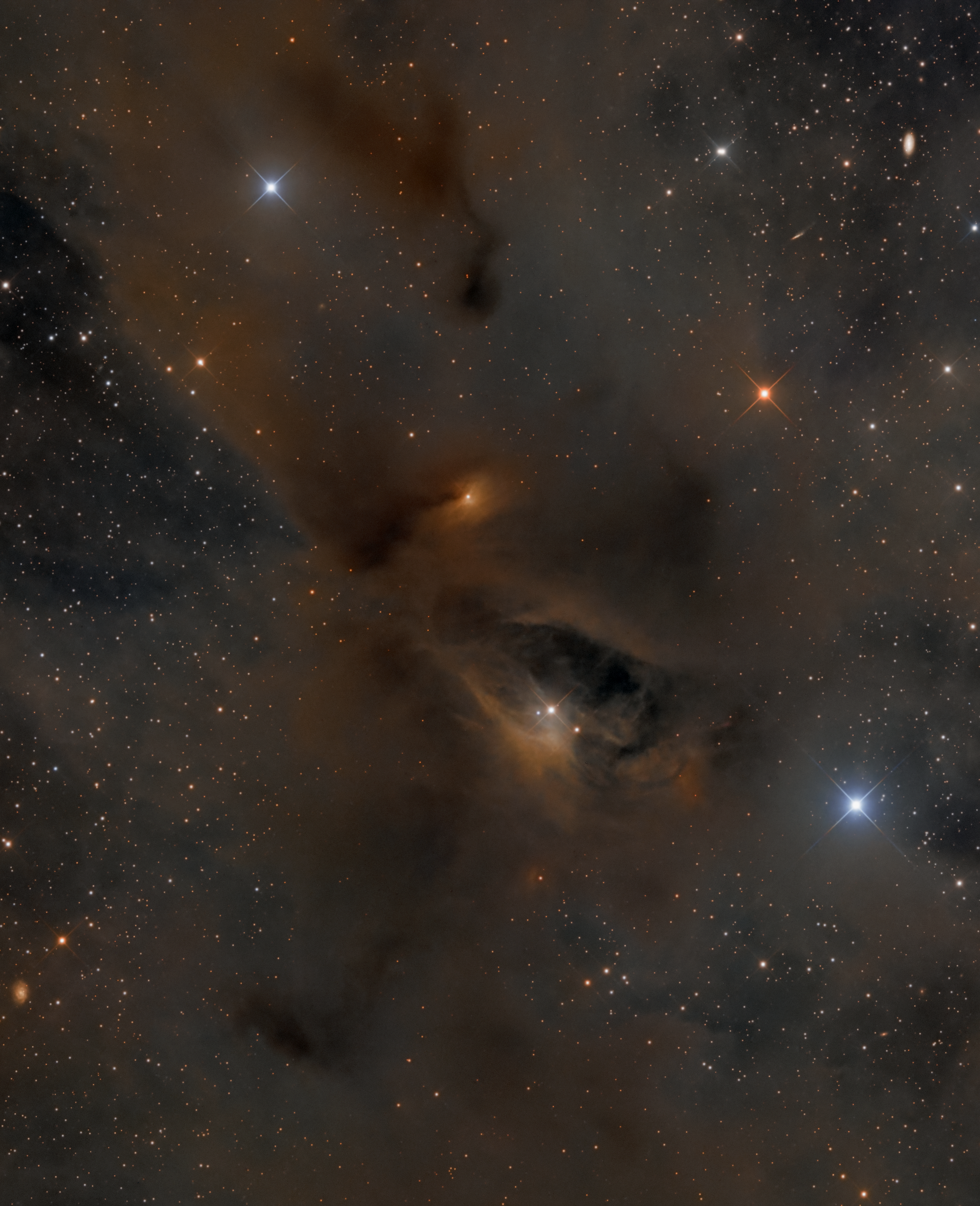
Image Credit & Copyright: Long Xin
An unassuming region in the constellation Taurus holds these dark and dusty nebulae. Scattered through the scene, stars in multiple star systems are forming within their natal Taurus molecular cloud complex some 450 light-years away. Millions of years young and still going through stellar adolescence, the stars are variable in brightness and in the late phases of their gravitational collapse. Known as T-Tauri class stars they tend to be faint and take on a yellowish hue in the image. One of the brightest T-Tauri stars in Taurus, V773 (aka HD283447) is near the center of the telescopic frame that spans over 1 degree. Toward the top is the dense, dark marking on the sky cataloged as Barnard 209.
#APOD #RocketScience #GalacticAdventures #OuterSpace #SpaceIndustry
**Astronomy Picture of the Day**
09 January 2025
**Peculiar Galaxies of Arp 273**

Image Credit & Copyright: Dave Doctor
The colorful, spiky stars are in the foreground of this image taken with a small telescope on planet Earth. They lie well within our own Milky Way Galaxy. But the two eye-catching galaxies in the frame lie far beyond the Milky Way, at a distance of over 300 million light-years. The galaxies' twisted and distorted appearance is due to mutual gravitational tides as the pair engage in close encounters. Cataloged as Arp 273 (also as UGC 1810), these galaxies do look peculiar, but interacting galaxies are now understood to be common in the universe. Closer to home, the large spiral Andromeda Galaxy is known to be some 2 million light-years away and inexorably approaching the Milky Way. In fact the far away peculiar galaxies of Arp 273 may offer an analog of the far future encounter of Andromeda and Milky Way. Repeated galaxy encounters on a cosmic timescale ultimately result in a merger into a single galaxy of stars. From our perspective, the bright cores of the Arp 273 galaxies are separated by only a little over 100,000 light-years.
#APOD #Science #BlackHoleDiscovery #Astrophotography #Astrozone
**Astronomy Picture of the Day**
08 January 2025
**Supernova Remnants Big and Small**

Image Credit & Copyright:
Stéphane Vetter
(Nuits sacrées)
What happens after a star explodes? A huge fireball of hot gas shoots out in all directions. When this gas slams into the existing interstellar medium, it heats up so much it glows. Two different supernova remnants (SNRs) are visible in the featured image, taken at the Oukaïmeden Observatory in Morocco. The blue soccer ball-looking nebula toward the upper left is SNR G179.0+02.6, which appears to be the smaller one. This supernova, about 11,000 light years distant, detonated about 50,000 years ago. Although composed mostly of hydrogen gas, the blue light is emitted by a trace amount of oxygen. The seemingly larger SNR, dominating the lower right of the frame, is the Spaghetti Nebula, cataloged as Simeis 147 and sh2-240. This supernova, only about 3,000 light years away, exploded about 40,000 years ago. Comparatively, even though they appear different sizes, both supernova remnants are not only roughly the same age, but about the same size, too.
#APOD #Astroinformatics #Planetarium #Astrochemistry #GalacticAdventures
**Astronomy Picture of the Day**
07 January 2025
**A New Year's Aurora and SAR Arc**

Image Credit & Copyright:
Alessandra Masi
It was a new year, and the sky was doubly red. The new year meant that the Earth had returned to its usual place in its orbit on January 1, a place a few days before its closest approach to the Sun. The first of the two red skyglows, on the left, was a red aurora, complete with vertical rays, caused by a blast from the Sun pushing charged particles into Earth's atmosphere. The second red glow, most prominent on the far right, was possibly a SAR arc caused by a river of charged particles flowing across Earth's atmosphere. Although both appear red, the slight color difference is likely due to the aurora being emitted by both oxygen and nitrogen, whereas the higher SAR arc was possibly emitted more purely by atmospheric oxygen. The featured image was taken on January 1 from near Pieve di Cadore in Italy. Portal Universe: Random APOD Generator
#APOD #LunarMission #Astroknowledge #Stellar #Astronomy