
Jails Have Become "Fentanyl Free-For-Alls" Thanks To Dem Bill That Banned Strip Searches
Jails Have Become "Fentanyl Free-For-Alls" Thanks To Dem Bill That Banned Strip Searches
Washington’s soft-touch jail policies have turned facilities into fentanyl hotspots, thanks to rules that make it harder to properly search inmates, according to https://mynorthwest.com/ktth/ktth-opinion/rantz-obese-inmates-are-smuggling-fentanyl-into-jails-thanks-to-new-policy/4066877
.
Rantz writes this week that Thurston County Sheriff Derek Sanders recently sounded the alarm after two overdoses at his jail tied to drugs smuggled in body fat.
“Once the drugs made their way in, a different inmate consumed the drugs and overdosed,” Sanders said. “Life-saving efforts from jail staff prevented the overdose from being fatal.”
Days later, it happened again—this time, fentanyl was found under an inmate’s breast.
“A Corrections Sergeant observed an inmate acting oddly and immediately called for medical,” Sanders reported. “CPR was performed for 10 minutes... Narcan deployment... The inmate will be booked on new felony charges.”
In his piece, https://mynorthwest.com/ktth/ktth-opinion/rantz-obese-inmates-are-smuggling-fentanyl-into-jails-thanks-to-new-policy/4066877
that It shouldn’t be this easy for an obese inmate to sneak drugs into jail—but thanks to misguided policies, it is.
 ?itok=8U-7HYVt
This stems from 2SSB 5695, a 2022 Democratic bill—ironically also backed by Republicans—that banned “dehumanizing” strip searches and mandated body scanners. But the Department of Health, tasked with setting scanner rules, imposed such weak radiation limits under WAC 246-230-040 that scanners can’t detect drugs hidden in body fat.
“The new rules under WAC 246-230-040, implemented in January 2025, force scanners to use laughably low radiation levels to appease activists screaming about ‘ALARA’ (As Low As Reasonably Achievable) principles,” wrote Sheriff Sanders.
Lawmakers say the new rules protect inmates from radiation—but that claim doesn’t hold up.
The previous scan dose—2.00 µSv—was already safer than a dental X-ray. Sheriff Sanders pointed out it would take 1,000 scans to hit the annual limit. “Strip searches cannot be conducted on every inmate who is booked... but its [the scanner’s] effectiveness isn’t nearly what it was post-law change,” he wrote.
Strip searches were unpleasant but worked. Lawmakers scrapped them without ensuring the scanners could actually do the job. And the same Department of Health that insisted COVID vaccines stopped transmission isn’t exactly a reliable authority on radiation safety.
https://cms.zerohedge.com/users/tyler-durden
Wed, 03/26/2025 - 22:10
RFK Jr. Is Pushing Big Pharma Ad Ban - And Corporate Media Is Panicking
RFK Jr. Is Pushing Big Pharma Ad Ban - And Corporate Media Is Panicking
https://www.thekylebecker.com/p/rfk-jr-is-pushing-big-pharma-ad-ban
,
Robert F. Kennedy Jr., Donald Trump’s Health and Human Services Secretary, is pushing a plan to ban pharmaceutical ads from television. He’s right to push for it—and not just because the U.S. is one of only two countries on earth that allows such advertising (the other being New Zealand).
America’s health system isn’t just flawed; it’s harming public health, distorting journalism, and fueling Big Pharma’s malignant influence over our daily lives.
Let’s start with the obvious: TV drug ads aren’t designed to inform—they’re designed to manipulate. The formula is always the same. Cue soft lighting and sappy piano music. A sad, listless person pops a pill and suddenly life is vibrant again. They’re running through fields, laughing with family, walking dogs across idyllic bridges.
Then, in a breathless voiceover, the side effects come tumbling out like a legal disclaimer roulette wheel—stroke, heart failure, suicidal thoughts. The goal? Make viewers want a drug before they even talk to their doctor. It’s emotional coercion dressed up as health education.
This completely inverts how medicine is supposed to work. Health care decisions should be made inside the exam room, not in a 60-second marketing spot. Patients should go to their doctors with symptoms, and those doctors—armed with clinical training and knowledge of the patient’s full health profile—should decide whether a drug is even necessary.
Many issues could be better addressed through lifestyle changes, diet, supplements, or preventative care. But instead, America has normalized a pill-for-everything culture, supercharged by the fact that doctors are often nudged by patients demanding whatever drug they saw advertised last night during a commercial break.
This isn’t just bad medicine—it’s dangerous. And it’s no accident.
Big Pharma isn’t spending billions on advertising because it cares about your health. It’s doing it because the return on investment is enormous. Studies estimate the ROI on direct-to-consumer (DTC) drug ads ranges from 100% to 500%, depending on the drug. In 2025 alone, pharmaceutical companies are projected to spend over $5 billion on national linear TV ads, according to iSpot.tv. That number balloons even higher when you include digital and streaming. Just a handful of blockbuster drugs—like Skyrizi, Jardiance, and Ozempic—are burning through tens of millions in TV ads every month.
This revenue isn’t just padding Big Pharma’s pockets—it’s quietly buying influence in the media. Nearly 31% of ad minutes on major nightly news broadcasts in 2024 came from pharmaceutical brands. That means a huge portion of media budgets depend on the very companies they should be holding accountable. And surprise, surprise: when Big Pharma misleads the public, many news outlets are either silent or hesitant to report critically. The financial conflict of interest is baked in.
 ?itok=dnZFVTbZ
We saw the worst-case version of this during the COVID-19 pandemic. The novel mRNA shots—rushed to market under emergency use—were sold to the public as miracle solutions. Government officials and media outlets claimed these vaccines would "stop infection," "prevent death entirely," and "end the pandemic." Younger, healthy individuals were told they needed them for everyone’s safety, despite already low statistical risk. None of these claims held up. As the data evolved, we learned the vaccines offered some reduction in severe disease, but not sterilizing immunity. Yet the media rarely corrected course.
Why would they? Pharma ads were paying the bills. Meanwhile, federal workers were mandated—and many private sector employees coerced—into getting injections under false pretenses. Billions of dollars flowed to Big Pharma. The American public was misled.
This pattern of deception is not new. Pfizer alone has paid billions in legal penalties over the years for unethical marketing, off-label promotion, and other violations. The most infamous: a $2.3 billion settlement in 2009—the largest health care fraud settlement in U.S. history at the time. Yet companies like Pfizer, AbbVie, and Johnson & Johnson still enjoy a polished image on TV, thanks in part to relentless ad spending and regulatory leniency.
RFK Jr.’s plan, while legally uphill, is not without precedent. In 1970, President Nixon signed the Public Health Cigarette Smoking Act, which banned tobacco ads from TV and radio. Cigarettes were legal, yet too dangerous to promote on air. The same principle should apply here. Just because a drug is FDA-approved doesn’t mean it should be marketed like soda. Approval doesn’t equal infallibility—just ask anyone who took Vioxx or OxyContin.
Critics, including the Wall Street Journal, have framed RFK’s proposal as a personal vendetta. That’s both lazy and misleading. In reality, there’s wide bipartisan and public support for reining in pharma ads. The American Medical Association called for a ban back in 2015. A STAT/Harvard poll found that 57% of Americans support banning TV drug ads. Even hosts on CNBC—hardly anti-business—agreed the ads are unnecessary. “Don’t you think doctors should prescribe it if you need it?” asked Joe Kernen. Exactly.
The pharmaceutical industry’s defenders like to invoke the First Amendment, claiming that banning ads would be unconstitutional. But commercial speech does not enjoy absolute protection. Under the Central Hudson test, the government can regulate ads if it has a substantial interest, the regulation directly advances that interest, and the restriction is narrowly tailored. Protecting public health from misleading pharmaceutical marketing clears all three hurdles. Even if a full ban doesn’t survive, tighter restrictions—like banning ads for certain drug classes, or requiring full price transparency—could pass muster.
More importantly, even the threat of a ban could pressure drugmakers to change course voluntarily. They did it before in 2008, when criticism led to updated self-regulatory guidelines. If Kennedy’s push forces them to rethink their practices, that alone is a win.
Pharma companies will no doubt fight this tooth and nail. But that’s not a reason to back down—it’s a reason to press harder. We’ve allowed an industry with an immense profit motive to shape our health decisions for too long. The result? A country drowning in prescriptions, mired in chronic disease, and confused about who to trust.
Enough is enough. RFK Jr.’s proposal to kick drug ads off TV isn’t radical—it’s responsible. And it’s long overdue.
~~~ KB
https://cms.zerohedge.com/users/tyler-durden
Wed, 03/26/2025 - 15:40
https://www.zerohedge.com/political/rfk-jr-pushing-big-pharma-ad-ban-and-corporate-media-panicking
Four Missing US Army Troops In Lithuania Found Dead: NATO
Four Missing US Army Troops In Lithuania Found Dead: NATO
An unusual and alrming headline is emerging out Europe, as a major search was underway since yesterday for four US Army soldiers who had gone missing in Lithuania. The Associated Press in a breaking headline is now reporting they are dead:
NATO CHIEF SAYS 4 MISSING US SOLDIERS WERE KILLED: AP
The incident of the missing personnel and military search operation was first reported by Lithuanian public broadcaster LRT and subsequently picked up in European media. They first disappeared on Tuesday, along with a military vehicle, and belonged to the US Army's 1st Brigade, 3rd Infantry Division.
 ?itok=gsPUtwH6
"A possible scene has now been identified, and a search and rescue operation is underway," the Lithuanian military said in a statement hours prior to the announcement of their deaths.
The troops had been undergoing tactical training at the time the went missing. According to https://www.theguardian.com/us-news/2025/mar/26/soldiers-missing-lithuania?CMP=share_btn_url
:
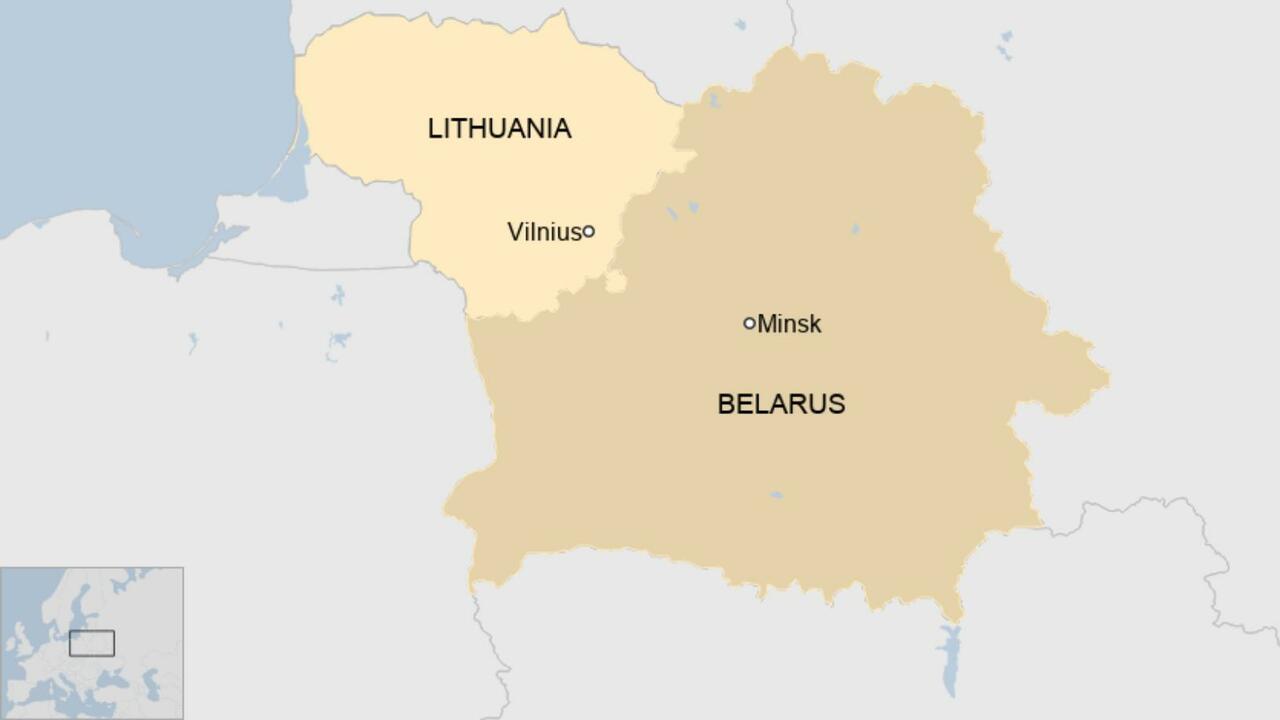
The Lithuanian public broadcaster LRT reported that four US soldiers and a vehicle were reported missing on Tuesday afternoon during an exercise at the General Silvestras Žukauskas training ground in Pabradė, a town located less than 10km (6 miles) from the border with Belarus.
The Belarus angle and the proximity of the border could be alarming, given the US essentially considers it an 'enemy' state given its support to the Russian side of the Ukraine war.
"A search operation is currently under way, involving military personnel, rescue services, and firefighters. Lithuanian police also have launched an investigation," US state-funded RFERL writes. According to further statements and https://www.rferl.org/amp/us-soldiers-missing-lithuania-belarus/33360885.html
:
Lithuanian officials have given few details, with Gintautas Ciunis, a military spokesman, confirming only that "these are foreign soldiers."
US Army Europe and Africa on March 26 https://www.europeafrica.army.mil/ArticleViewPressRelease/Article/4135345/press-release-us-soldiers-reported-missing-in-lithuania/
that the soldiers had gone missing, saying in a statement that they were "conducting scheduled tactical training at the time of the incident."
“I would like to personally thank the Lithuanian Armed Forces and first responders who quickly came to our aid in our search operations,” said Lt. Gen. Charles Costanza, the V Corps commanding general.
 ?itok=E0wJw8Ll
Lithuania has been a NATO member since 2004, and is one of the Baltic countries which has been outspoken and hawkish in condemning Moscow.
https://cms.zerohedge.com/users/tyler-durden
Wed, 03/26/2025 - 14:40
US Intelligence Says Iran Is 'Not Building A Nuclear Weapon'
US Intelligence Says Iran Is 'Not Building A Nuclear Weapon'
https://news.antiwar.com/2025/03/25/us-intelligence-says-iran-is-not-building-a-nuclear-weapon/
US intelligence agencies have reaffirmed that there’s no evidence Iran is developing nuclear weapons or that Iranian Supreme Leader Ali Khamenei has reversed his 2003 fatwah that banned the production of weapons of mass destruction.
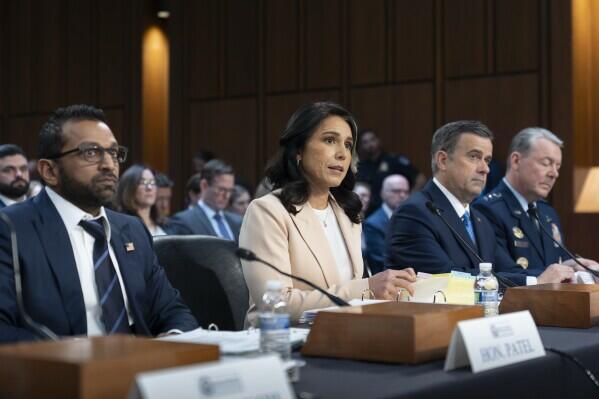
"The IC continues to assess that Iran is not building a nuclear weapon and Supreme Leader Khamenei has not authorized the nuclear weapons program he suspended in 2003," Director of National Intelligence Tulsi Gabbard https://jewishinsider.com/2025/03/gabbard-iran-is-not-currently-developing-nuclear-weapons/
a Senate Intelligence Committee hearing.
 ?itok=ioZ9RGC-
Gabbard’s comments were based on the https://www.dni.gov/index.php/newsroom/reports-publications/reports-publications-2025/4058-2025-annual-threat-assessment
, which is released by the ODNI with input from all US intelligence agencies. The report did note that there have been more calls inside Iran to reverse the ban on nuclear weapons, which have grown in response to Israeli aggression in the region.
"In the past year, there has been an erosion of a decades-long taboo on discussing nuclear weapons in public that has emboldened nuclear weapons advocates within Iran’s decision-making apparatus," the report reads.
"Khamenei remains the final decision maker over Iran’s nuclear program, to include any decision to develop nuclear weapons," it notes.
The threat assessment comes amid increasing US sanctions and threats of military action over Iran’s nuclear program. Iranian officials have rejected the idea of talks with the US in the face of President Trump’s "maximum pressure campaign," but have said https://news.antiwar.com/2025/03/24/iran-says-its-open-to-indirect-talks-with-the-us/
The hype over Iran’s nuclear program revolves around the https://news.antiwar.com/2025/02/27/hysteria-after-iaea-issues-quarterly-report-on-irans-uranium-enrichment/
against its Natanz nuclear facility, which was meant to sabotage talks between the Biden administration and Tehran.
Iran is still a signatory to the Non-Proliferation Treaty (NPT) and has told the International Atomic Energy Agency (IAEA) that it https://www.theguardian.com/world/2024/nov/20/iran-has-offered-to-keep-uranium-below-purity-levels-for-a-bomb-iaea-confirms
Amid increasing US and Israeli threats about its nuclear program, Iran has https://news.antiwar.com/2025/02/24/iran-says-israels-nuclear-weapons-are-a-grave-threat-to-the-world/
that Israel has a secret nuclear weapons stockpile, and its nuclear program is not subject to IAEA inspections since Israel is not a signatory to the NPT.
https://cms.zerohedge.com/users/tyler-durden
Wed, 03/26/2025 - 14:20
https://www.zerohedge.com/geopolitical/us-intelligence-says-iran-not-building-nuclear-weapon
Futures Rise As Tariff Uncertainty Grows Ahead Of "Liberation Day"
Futures Rise As Tariff Uncertainty Grows Ahead Of "Liberation Day"
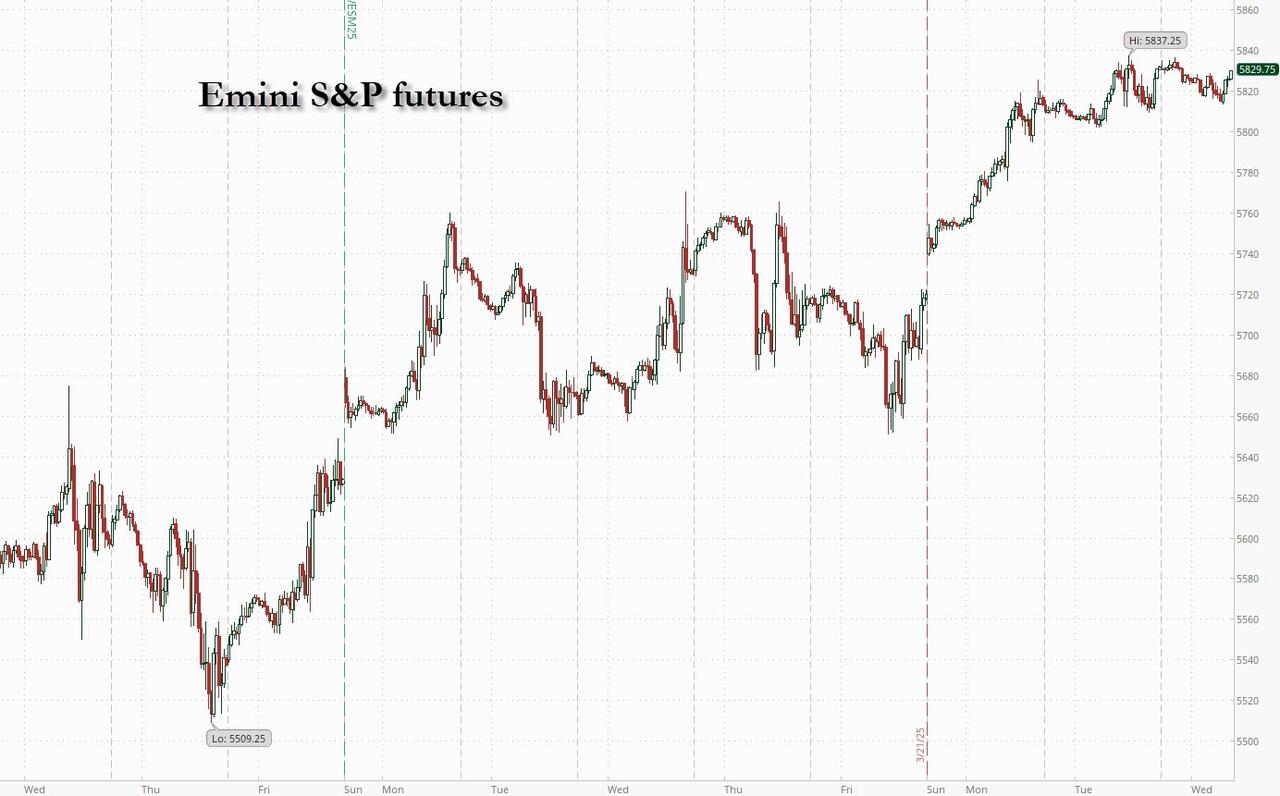
US equity futures are flat, reversing earlier losses while global markets were mixed (Europe down, Asia up) as investors awaited more clarity on US tariff plans and the economic outlook before Donald Trump’s April 2 "Liberation Day" deadline to impose a fresh reciprocal tariffs. As of 8:00am ET, S&P futures were up 0.1% following modest gains on the indexes on Tuesday, while Nasdaq futures were flat as Tesla and Nvidia shares edged lower, pressuring the Mag 7. Europe’s Stoxx 600 index dropped 0.5%. Bond yields are 1-3bp higher and USD is higher. Commodities are mostly higher led by oil and base metals. Copper futures in New York surged to a record high (up 1% now after easing off records) as traders priced in the possibility of hefty import tariffs that may come within several weeks. Headlines were mostly quiet since market close yesterday. Today's economic calendar includes Feb durable goods orders at 8:30am; Fed speaker slate includes Kashkari (10am) and Musalem (1:10pm).
 ?itok=bK956vS5
In premarket trading, video game retailer GameStop jumped 14% after the struggling video-game retailer that became a favorite of retail traders during the meme stock frenzy said its board approved a plan to add Bitcoin as a treasury reserve asset. Tesla and Nvidia lead losses among the Magnificent Seven stock (Alphabet -0.4%, Amazon +0.2%, Apple +0.1%, Microsoft -0.1%, Meta +0.1%, Nvidia -1.4% and Tesla -1.2%). Dollar Tree (DLTR) rises 2% as the company will sell its Family Dollar chain for about $1 billion to Brigade Capital Management and Macellum Capital Management a decade after buying the business. Here are some other notable movers:
Global-e Online (GLBE) rises 3% after Morgan Stanley upgraded the software firm to overweight, citing achievable growth targets.
Humacyte (HUMA) slides 26% after the biotech firm offers 25 million shares at $2 apiece, a discount of around 30% to its previous close.
Goldman Sachs (GS) rose 1% Tuesday for an 8th day, on its longest winning streak since November 2022.
Playtika (PLTK) rises 7% following a double upgrade of the mobile-games company at BofA, removing the only negative analyst view on the stock.
Summit Therapeutics (SMMT) rises 4% after Citi upgraded the biotech to buy on stronger conviction on the firm’s HARMONI-2 clinical trial.
The tariffs issue remains front and center for investors, who took comfort earlier this month from the Trump adminstration’s signal that the coming wave of levies may be less expansive and more targeted than originally feared. However, the president has since sown confusion by saying he didn’t want too many tariff exceptions, but he would “probably be more lenient than reciprocal.” All that has left investors struggling to work out how to position ahead of the April 2 deadline that Trump has dubbed “Liberation Day.”
“Uncertainty on the tariff front remains ridiculously high, leaving it incredibly tough for businesses or consumers to plan more than about a day into the future, and still making it nigh-on impossible for market participants to price risk,” said Michael Brown, a strategist at Pepperstone Group Ltd.
European stocks retreated on lingering jitters about US tariffs. UK mid-caps rise on an unexpected cooldown in inflation before a key budget statement from the government later in the day. The Stoxx 600 fell 0.6% to 549.21 with 366 members down, 223 up and 11 unchanged. In Britain, the FTSE 250 gauge of mid-sized stocks advanced about 0.5%, as data showing an unexpected inflation slowdown strengthened the case for the Bank of England to cut interest rates. Here are some of the biggest movers on Wednesday:
Ocado shares rise as much as 16% as the firm gets a positive analyst rating from JPMorgan for the first time in over seven years, with the broker upgrading to overweight from neutral to reflect a “turning tide” in the digital grocery sector.
Danieli shares gain as much as 11% after better-than-expected net cash results and FY targets confirmation for this year, analysts say, as the Italian metal-production company released 1H24/25 results on Tuesday after market close.
ProSieben shares rise as much as 5.7% after Reuters reported that MFE had called a board meeting for Wednesday to review a possible bid for the company.
TotalEnergies shares rise as much as 1.1% after being upgraded by analysts at Citi, who say the oil giant will increase cashflow at a much faster pace than key European peers over the coming years.
Avon rises as much as 9.2%, the most in over four months, after the maker of helmets and respirators raised its revenue growth and margin guidance for this year, as the firm announced new orders and contracts from European nations and a ramp-up of volumes for deliveries in the US.
Mips shares gain as much as 5.4%, the most since February, after the Swedish helmet technology firm was upgraded to buy from hold at SEB, citing an attractive risk/reward after a 30% share price drop since August.
Evoke shares sink as much as 19%, the most since July 2023. Though the William-Hill owner reported in-line results for fiscal year 2024, a soft start to 1Q25 is likely to raise concerns on whether the gambling operator can meet its guidance for 2025, JPMorgan notes.
Vistry shares drop as much as 11%, the biggest drop since December, after analysts warned of weak current trading and low visibility on the homebuilder’s 2025 financial results.
CD Projekt shares fall as much as 13%, the steepest drop since March 2021, after the video-games maker said its Witcher 4 game won’t be released before 2027, overshadowing strong 4Q earnings and news of a cooperation pact with US peer Scopely.
Wetherspoon slides as much as 4.7% after Deutsche Bank assigns the only sell rating on the pub operator, downgrading from neutral based on the impact of changes related to the UK Government’s budget.
Earlier in the session, Asian equities rose, heading for their first advance in four days, helped by gains in Chinese technology heavyweights and a rally in Indonesia’s market. The MSCI Asia Pacific Index climbed as much as 0.5%. Nintendo Co. was among the biggest contributors after Goldman Sachs reinstated coverage of the Japanese games maker with a buy rating. Samsung Electronics, Alibaba and Tencent were among other major stocks buoying the regional benchmark. The Jakarta Composite Index jumped 4%, the most in the region, after several state-owned banks increased their dividend payouts. Stocks in Australia closed higher after the government unveiled tax cuts and other sweeteners in a pre-election budget. Chinese equities listed in Hong Kong also gained. Morgan Stanley strategists raised their targets for the nation’s equities for the second time in a little more than a month, citing upside for valuations amid an improving outlook for earnings. A gauge of Chinese tech shares in Hong Kong rebounded after falling to the brink of a technical correction in the previous session.
In FX, the dollar is little changed, supported on the view that the US would limit exceptions to the next tranche of tariffs expected next week. The Bloomberg Dollar Spot Index rose 0.1% before paring gains during the European session; it is on track to gain for the five of the last six days.
USD/JPY gained as much as 0.5% to 150.62 as Bank of Japan Governor Kazuo Ueda indicated he aims to keep his options open ahead of the bank’s next policy meeting, adding to the view that Japan’s yield discount to the US will remain wide
GBP/USD fell 0.5% to the day’s low 1.2886 after data showed an unexpected slowdown in UK CPI; traders await the country’s fiscal statement later in the day
In rates, treasuries edged lower as investors await speeches by Federal Reserve officials later in the day for more steer into the US interest rate outlook. Treasury yields are 1bp-3bp cheaper across a slightly steeper curve, with 5s30s spread around 1bp wider on the day; 10-year, 3bp higher near 4.35%, trails bunds and gilts in the sector by 2bp and 5bp.
Gilts outperform, led by front-end tenors as swaps price in additional easing by Bank of England after UK February CPI data rose less than estimated. UK 2-year yields are more than 5bp lower on the day after the inflation data, steepening the gilts curve. Treasury auction cycle continues with $70 billion 5-year note sale at 1pm New York time, following good demand for 2-year notes on Tuesday. It concludes with $44 billion 7-year note auction Thursday
In commodities, copper futures in New York surged to a record high as traders priced in the possibility of hefty import tariffs that may come within several weeks. WTI oil edged higher after an industry report signaled a large decline in US crude stockpiles, while the market weighed the prospect of a Russia-Ukraine ceasefire in the Black Sea. Gold extended gains, rising 0.6% to $3,027.
Looking to the day ahead now, data releases include the preliminary durable goods orders for February. Meanwhile from central banks, we’ll hear from the Fed’s Kashkari and Musalem, along with the ECB’s Villeroy and Cipollone.
Market Snapshot
S&P 500 futures little changed at 5,822.50
STOXX Europe 600 down 0.2% to 551.61
MXAP up 0.4% to 189.10
MXAPJ up 0.4% to 590.15
Nikkei up 0.7% to 38,027.29
Topix up 0.5% to 2,812.89
Hang Seng Index up 0.6% to 23,483.32
Shanghai Composite little changed at 3,368.70
Sensex down 0.7% to 77,508.02
Australia S&P/ASX 200 up 0.7% to 7,998.97
Kospi up 1.1% to 2,643.94
German 10Y yield little changed at 2.78%
Euro little changed at $1.0792
Brent Futures up 0.4% to $73.29/bbl
Gold spot up 0.3% to $3,027.85
US Dollar Index little changed at 104.27
Top Overnight News
GOP leaders said they’re getting close to agreeing on a plan to pass an extension of Trump’s 2017 tax cuts and an increase to the debt ceiling. The CBO will today release its estimate for when the debt ceiling will be reached. BBG
Trump’s copper tariffs could arrive within the next several weeks, earlier than initially anticipated. BBG
Fed's Goolsbee (2025 voter) said it may take longer than anticipated for the next cut to come because of economic uncertainty and ‘wait and see’ is the correct approach when facing uncertainty. Goolsbee also commented that market angst over inflation would be a red flag and believes borrowing costs will be a fair bit lower in 12–18 months, while he noted that if investor expectations begin to converge with those of American households, the Fed would need to act: FT
China economic optimism rises, and the Street has raised their growth forecasts on back of stimulus, although tariffs loom as a risk. WSJ
China wields significant policy room to stimulate its economy this year while some reform was needed to boost consumption, Huang Yiping, an advisor to China's central bank and a professor at Peking University, said on Wednesday. China has unveiled fresh fiscal measures, including a rise in its annual budget deficit, to help hit an economic growth target of around 5% this year, which analysts have described as ambitious. The central bank has pledged to cut interest rates and pump more money into the economy at an appropriate time. RTRS
The Bank of Japan may consider monetary tightening if a surge in food prices causes broader and stronger inflation, the central bank governor said Wednesday, adding fuel to expectations for a near-term rate hike. WSJ
UK CPI cools by more than expected in Feb on headline (+2.8% vs. the Street +3% and vs. +3% in Jan) and core (+3.5% vs. the Street +3.6% and vs. +3.7% in Jan) while services held steady at +5% (vs. the Street +4.9% and vs. +5% in Jan). WSJ
Australia’s CPI in Feb ticks down to +2.4% (vs. the Street +2.5%), helped by a fall in electricity prices, while the continued easing in home building costs and rents supported fueling expectations for further RBA rate cuts. RTRS
Signs that investors in the US bond market are baking in higher inflation would be a “major red flag” that could upend policymakers’ plans to cut interest rates, Goolsbee warned. He added that the Fed is no longer on the “golden path,” and that the rate cuts will take longer than expected. “If you start seeing market-based long-run inflation expectations start behaving the way these surveys have done in the last two months, I would view that as a major red flag area of concern,” said Goolsbee. FT
Canada and India are taking steps to cool diplomatic tensions, including considering sending back envoys after tit-for-tat expulsions last year, people familiar said. The two nations are looking to strengthen trade ties to counter US tariff threats. BBG
A more detailed look at global markets courtesy of Newsquawk
APAC stocks traded with a mostly positive bias after the somewhat mixed performance stateside where the focus centred on tariffs, data and geopolitics including reports that Ukraine and Russia agreed with the US on a maritime ceasefire. ASX 200 was led higher by gains in the mining, resources and financial sectors in the aftermath of the recent budget announcement, while participants also digested softer-than-expected monthly inflation from Australia. Nikkei 225 reclaimed the 38,000 level with upside supported by a weaker currency and after slightly softer Services PPI data. Hang Seng and Shanghai Comp eked slight gains but with upside capped amid ongoing tariff uncertainty with a Chinese delegation to meet with the US Commerce Secretary and the USTR today to negotiate over tariffs in which they will also discuss fentanyl and trade barriers among other issues, while a PBoC adviser warned at the Boao Forum that changes in the global environment will be challenging for China and China must boost domestic demand, especially consumption.
Top Asian News
PBoC adviser said at the Boao Forum that changes in the global environment will be challenging for China and China must boost domestic demand, especially consumption, while it added that there is still very big macro policy space for supporting China's economy and reform measures alongside recent policy steps are needed to support consumption.
BoJ Governor Ueda said cost-push factors are likely to gradually dissipate but also noted that underlying inflation is likely to gradually converge towards the 2% target even when the temporary boost from food inflation disappears. Ueda said the BoJ will make a judgment call by looking at various indicators to determine whether underlying inflation has hit the target and underlying inflation is close to but has yet to move into the narrow band defined as sufficient achievement of the 2% price target. Furthermore, Ueda said the BoJ remains vigilant to the possibility that underlying inflation may accelerate faster than projected and expects to keep raising interest rates if the economy and prices move in line with forecasts in the quarterly outlook report but later commented that if price risks overshoot expectations, they will take stronger steps to adjust the degree of monetary support.
BoJ's Koeda says the Bank's mandate is to contribute to a healthy economy, various indicators show Japan's underlying inflation moving towards a sustainable achievement of BoJ's 2%.
Despite a steady and firmer open European bourses now find themselves mostly in the red, Stoxx 600 -0.6%. Selling pressure picked up after the cash open with no obvious catalyst for the price action at the time. Sectors began mixed but now have a negative bias with Health Care, Chemicals and Autos bottom of the pile; the latter seemingly hit on remarks from Trump about Europeans "freeloading", reports of copper tariffs and pressure in Porsche SE on an Volkswagen impairment.
Top European News
ECB's Villeroy says in the short-term, US President Trump's "lose-lose" strategy is harming the US as the Fed's downgrade of its forecast show. A 25pp increase in US tariffs in Q2 would have a limited impact on European inflation, but could reduce EZ GDP by 0.3pp in a year
FX
DXY is currently flat but with modestly diverging fortunes against peers, greenback softer vs. cyclicals and firmer vs. havens despite the pullback in European stocks seen since the cash open. Comfortably above 104.00 but at the lower-end of a 104.18-38 band.
EUR attempting to get back above the 1.08 mark and while it has tested the figure it is yet to convincingly breach it. Upside which comes despite the rhetoric from Trump and with incremental drivers light since the Ifo.
Cable the G10 laggard after cooler-than-expected inflation data this morning and ahead of the Spring Statement which commences from 12:30GMT. Cable back above 1.29 but only modestly so after slipping as low as 1.2887 early doors.
USD/JPY rebounded overnight from the prior day's trough and reclaimed the 150.00 handle with tailwinds amid the constructive APAC risk tone and following the softer Services PPI data from Japan; got to a 150.63 peak but has since pulled back towards the mentioned figure.
AUD was hit on soft domestic inflation data overnight which saw a 0.6279 low in AUD/USD print but it has since recovered back above the mark and to a high some 30 pips above.
PBoC set USD/CNY mid-point at 7.1754 vs exp. 7.2559 (Prev. 7.1788).
Riksbank Minutes (March): Thedeen says "...we have some scope to see through upturns in inflation if we judge that they are temporary".
Fixed Income
Gilts gapped higher by 33 ticks at the open after an almost entirely cooler-than-expected inflation series. A series which has sparked a modest dovish move in BoE pricing, though the overall narrative hasn’t shifted.
Got to as high as 91.58 though this proved short lived as we approach the Spring Statement from 12:30GMT where Reeves is expected to try and raise/save GBP 17bln, to plug the fiscal hole she finds herself in and then to provide headroom of just under the GBP 9.9bln she had in October; full preview available.
Bunds modestly firmer after picking up early doors on the above. Thereafter, hit a 128.36 session high which is a tick above Tuesday's best. Specifics light into supply which was strong but sparked no reaction in the benchmark. Leaving it marginally in the green around 128.20.
USTs in the red but only modestly so with action relatively steady in the European morning as we await updates to numerous catalysts in addition to Fed speak, data and supply with 70bln of 5yr Notes due and following the 2yr tap on Tuesday which was strong when compared to recent averages though not quite as well received as the outing in February.
Commodities
Crude continues to inch higher and is at highs of USD 69.54/bbl and USD 73.57/bbl respectively for WTI and Brent but remains within Tuesday's parameters. Upside driven by the private inventory report, absence of sanctions removal on oil tankers and Yemeni forces targeting the USS Truman.
Dutch TTF in the red with Ukraine-Russia geopols in focus and the most recent language from the Kremlin being that talks are continuing with the US and they are satisfied with the dialogue. There have been reports of drone strikes on/from both sides, with the Kremlin continuing to state that they will only comply with the Black Sea truce once specific sanctions are lifted.
Gold indecisive and flat on the session, around the mid-point of a USD 3013-3032/oz band. Copper was bid overnight after futures hit a record high in Tuesday's session which followed through into 3M LME and lifted it above the USD 10k mark on latest tariff reports; since, the metal has pulled back and is in the red as we await further updates.
Goldman Sachs maintains its 3-, 6- and 12-month copper price forecasts at USD 9,600, USD 10,000 and USD 10,700, respectively.
US Private Energy Inventories (bbls): Crude -4.6mln (exp -2.6mln), Distillate -1.3mln (exp. -2.2mln), Gasoline -3.3mln (exp. -2.2mln), Cushing -0.6mln.
TotalEnergies (TTE FP) CEO says he would not be surprised if two of the Nord Stream gas pipelines came back.
Reliance has paused purchases of Venezuelan crude following US President Trump's 25% tariff, according to Bloomberg.
Geopolitics: Middle East
Two Israeli raids were reported on the northeastern areas of Gaza City, according to Al Jazeera.
Houthi military spokesman said they targeted Israeli military sites in the Jaffa area with a number of drones and targeted US aircraft carrier Harry Truman.
Geopolitics: Ukraine
Russia's Foreign Minister Lavrov said the Black Sea deal is aimed at Russia making legitimate profit in fair competition and ensuring food safety in Africa and elsewhere. Lavrov also commented that Russia and the US are discussing other things than Ukraine in their talks, according to TASS.
Russian drone attacks caused major destruction in the central Ukrainian city of Kryvyi Rih, according to the local military administration. It was also reported that emergency power cuts were implemented in Ukraine's Mykolaiv port following reported drone attacks, according to the mayor.
Russia's Kremlin says the order on moratorium on energy strikes is still in force and Russia are compliant; are continuing contacts with the US, satisfied with the dialogue. Black sea initiative will be activated after a number of conditions are met.
US Event Calendar
07:00: March MBA Mortgage Applications , prior -6.2%
08:30: Feb. Durable Goods Orders, est. -1.0%, prior 3.2%
Feb. Durables-Less Transportation, est. 0.2%, prior 0%
Feb. Cap Goods Ship Nondef Ex Air, est. 0.2%, prior -0.3%
Feb. Cap Goods Orders Nondef Ex Air, est. 0.2%, prior 0.8%
Central Banks
10:00: Fed’s Kashkari Hosts Fed Listens, conversation
13:10: Fed’s Musalem Speaks on Economy, Monetary Policy
DB's Jim Reid concludes the overnight wrap
Markets put in a decent performance yesterday, with the S&P 500 (+0.16%) posting a third consecutive advance for the first time since early February. The moves came despite several obstacles, including an unexpectedly large drop in the US Conference Board’s consumer confidence indicator. But ultimately investors shrugged that off, as there were still no signs that this recent survey weakness was being reflected in the hard data. Moreover, the rally got further support thanks to hopes that next week’s reciprocal tariffs wouldn’t be as bad as previously feared. So that helped to lift sentiment around the US outlook, with signs of market stress continuing to ease after the S&P 500’s correction. Indeed, the VIX index of volatility fell to its lowest level in over a month yesterday, at 17.15pts.
That story had looked quite different around the US open, when the Conference Board’s indicator was released. It showed an unexpectedly large drop in consumer confidence to 92.9 in March (vs. 94.0 expected), leaving it at its lowest level since January 2021, back when the economy was still emerging from the pandemic. Moreover, the expectations measure fell to a 12-year low of just 65.2. So that took it beneath its 2022-lows, when the Fed were still hiking rates aggressively and CPI inflation was running above 8%. But despite the negative headlines, investors were reassured by the fact that the labour market measures were still holding up. For instance, the differential between those saying jobs were plentiful versus hard to get actually moved up slightly in March, to a net +17.9%. On top of that, investors also recognised that we still hadn’t seen this deterioration echoed in the hard data yet. So they’re still waiting for more evidence before they’re willing to price a more significant economic downturn.
That more positive tone led to a fresh pickup for US equities, with the Magnificent 7 (+1.23%) leading the way once again. That group are now up +6.21% over the last three sessions, making it their best 3-day performance since the news of Trump’s election victory in early November. However, the broader equity performance was more subdued, and even though the S&P 500 advanced (+0.16%), the equal-weighted version of the index was down -0.27% and the small cap Russell 2000 (-0.66%) lost ground after its Monday surge.
Equities also got support from a fresh drop in Treasury yields, with the 10yr yield coming off a one-month high of 4.37% intraday, before closing down -2.3bps at 4.31%. Near term market expectations for the Fed were little changed, but a modest decline in 2026 pricing helped 2yr yields post a similar -2.0bps decline to 4.02%. Otherwise, we didn’t hear from many Fed speakers, but Governor Kugler sounded a patient note, saying that “FOMC policy is well positioned”, and that they could keep policy on hold “at the current rate for some time”. Meanwhile, Chicago Fed President Goolsbee said in an FT interview that the Fed wasn’t on the “golden path” of 2023-24, and that “there’s a lot of dust in the air”.
Nevertheless, he still said he thought borrowing costs would be “a fair bit lower” in 12-18 months time. Overnight, 10yr Treasury yields have reversed course again, moving up +2.1bps to 4.33%.
Over in Europe, there was an even stronger risk-on tone yesterday, with the STOXX 600 (+0.67%) recovering after three consecutive declines. That got a boost from the Ifo’s latest business climate indicator in Germany, which moved up to an 8-month high of 86.7 in March, in line with expectations. However, sovereign bonds sold off, in contrast to their US counterparts, after some hawkish comments from several ECB officials. They cast doubt on the prospect of another rate cut at the April meeting, with Croatia’s Vujcic saying that he saw the next meeting “as a completely open question.” Separately, Slovakia’s Kazimir said that he was “open to discussing either further interest-rate cuts or holding steady”, while France’s Villeroy noted that “the easing cycle is neither finished nor automatic”. So all that contributed to a rise in yields, with those on 10yr bunds (+2.7bps), OATs (+2.3bps) and BTPs (+2.1bps) all moving higher.
Elsewhere, there was a clear market reaction after the US said yesterday that Russia and Ukraine had agreed to a ceasefire in the Black Sea, as well as on the previously signalled 30-day halt to strikes against energy infrastructure. President Zelenskiy said Ukraine would implement this partial ceasefire immediately. Oil prices fell back in response, as the news eased fears about supply disruptions, with Brent trading crude falling by about 1% following the headlines to trade -0.7% lower intra-day. However, it rose back to close +0.03% on the day at $73.02/bbl, perhaps reflecting some inconsistency in the signals from the different sides. Notably, the Kremlin said the maritime ceasefire was conditional on the lifting of sanctions against Russian banks and companies involved in agricultural trade, a detail that was absent from the US statement. Still, there was a positive reaction among Ukraine’s dollar bonds, with the 10yr yield down -22.5bps on the day. And given the Black Sea’s importance for grain shipments, wheat (-0.82%) and corn (-1.29%) futures also fell back.
Overnight in Asia, markets have continued their strong performance, with decent gains for the Nikkei (+1.13%) and the KOSPI (+1.14%). Meanwhile in Australia, the S&P/ASX 200 (+0.71%) is also higher, which comes after the February CPI print was a bit softer than expected, falling to +2.4% (vs. +2.5% expected). However, there’s been a weaker performance in mainland China, where the CSI 300 (-0.19%) has lost ground this morning, and the Shanghai Comp (+0.06%) has only seen a modest increase. Looking forward, European equity futures are broadly positive, with those on the DAX up +0.22%, but US futures are very slightly lower, with those on the S&P 500 down -0.01%.
In terms of today, one of the main highlights will be the UK Government’s Spring Statement. That includes a new set of forecasts from the Office for Budget Responsibility, who are the UK’s independent fiscal watchdog, and they judge if the government are on track to meet their fiscal rules. However, because the economy has been weaker than the OBR set out last autumn, and gilt yields have also moved higher, our UK economist thinks that will remove the fiscal headroom set out at the time of the budget. In his preview for today’s event (link here), he expects fiscal consolidation near £14.5bn, comprising of welfare savings, departmental efficiency savings, and NHS reforms. And from a market perspective, he says the focus is likely to be on the size and composition of the 2025/26 gilt remit, how much fiscal headroom the government now has, and the credibility of any medium-term fiscal consolidation.
To the day ahead now, and here in the UK, Chancellor Rachel Reeves will deliver the spring statement, and there’s the CPI report for February as well. In the US, data releases include the preliminary durable goods orders for February. Meanwhile from central banks, we’ll hear from the Fed’s Kashkari and Musalem, along with the ECB’s Villeroy and Cipollone.
https://cms.zerohedge.com/users/tyler-durden
Wed, 03/26/2025 - 08:24
https://www.zerohedge.com/markets/futures-rise-tariff-uncertainty-grows-ahead-liberation-day
Vance Cautioned Against Bombing Yemen, Calling It A 'Mistake'
Vance Cautioned Against Bombing Yemen, Calling It A 'Mistake'
https://news.antiwar.com/2025/03/24/vance-cautioned-against-bombing-yemen-calling-it-a-mistake/
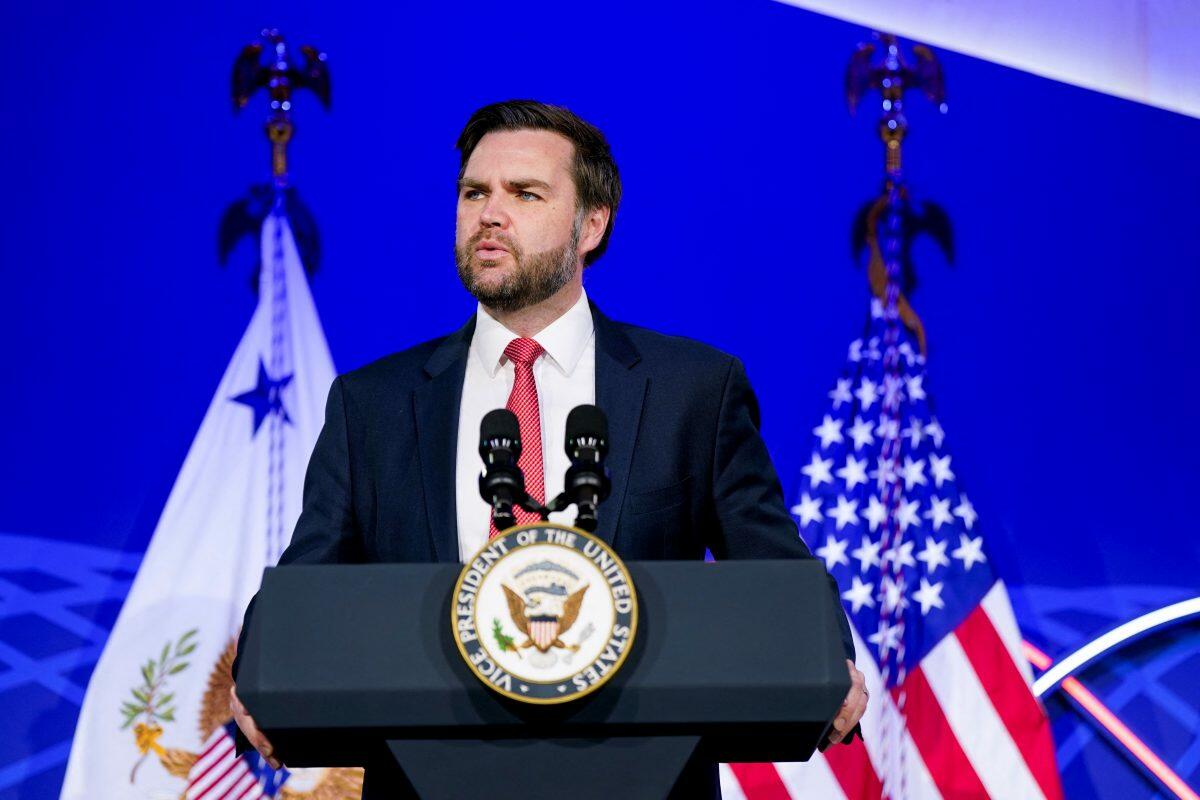
Vice President JD Vance cautioned against bombing Yemen before the US restarted its airstrikes on the country, calling it a "mistake," and suggested delaying the attack by one month, according to a https://archive.vn/JEYep
between administration officials.
Jeffrey Goldberg, a reporter for The Atlantic, was included in the Signal thread, apparently by accident, which is how he obtained the conversation. An account believed to be Secretary of Defense Pete Hegseth shared details of the March 15 airstrikes on Yemen two hours before they happened, and the White House confirmed that the Signal conversation appeared to be authentic.
A day before the airstrikes, an account labeled "JD Vance" expressed misgivings about the idea of targeting the Houthis. "Team, I am out for the day doing an economic event in Michigan. But I think we are making a mistake," the Vance account said.
 ?itok=6nPvkVKi
Vance framed his opposition to the airstrikes based on President Trump’s policies toward Europe, which have involved pressuring the Europeans to pay more for their own militaries to be less reliant on the US. Vance pointed out that only a small percentage of US shipping goes through the Suez Canal compared to European trade.
The message said: "3 percent of US trade runs through the suez. 40 percent of European trade does. There is a real risk that the public doesn’t understand this or why it’s necessary. The strongest reason to do this is, as POTUS said, to send a message."
Vance continued, "I am not sure the president is aware how inconsistent this is with his message on Europe right now. There’s a further risk that we see a moderate to severe spike in oil prices. I am willing to support the consensus of the team and keep these concerns to myself. But there is a strong argument for delaying this a month, doing the messaging work on why this matters, seeing where the economy is, etc."
An account believed to be Joe Kent, President Trump’s nominee to lead the National Counterterrorism Center, replied to Vance, saying, "There is nothing time sensitive driving the time line. We’ll have the exact same options in a month."
Hegseth responded to Vance by saying the messaging to the American people about the war would focus on President Biden failing to deter Yemeni attacks and the Houthis being "Iran funded." Iran is aligned with the Houthis, but it’s unclear how much support they give to the group, and US officials https://news.antiwar.com/2025/03/17/trump-says-us-will-hold-iran-accountable-for-houthi-attacks/
the Houthis wouldn’t take orders from Tehran and have their own weapons supply.
"VP: I understand your concerns – and fully support you raising w/ POTUS. Important considerations, most of which are tough to know how they play out (economy, Ukraine peace, Gaza, etc). I think messaging is going to be tough no matter what – nobody knows who the Houthis are – which is why we would need to stay focused on: 1) Biden failed & 2) Iran funded," Hegseth said.
Hegseth also disputed the idea that the strikes could wait, saying he wanted it to happen before the Gaza ceasefire fell apart and before Israel attacked Yemen. The US launched the March 15 airstrikes just a few days after the Houthis, officially known as Ansar Allah, https://news.antiwar.com/2025/03/11/yemens-houthis-announce-renewed-blockade-on-israeli-ships-due-to-lack-of-gaza-aid/
they would reimpose their blockade on Israeli shipping in response to Israel’s ceasefire violations, which included imposing a full blockage on all goods entering Gaza.
"Waiting a few weeks or a month does not fundamentally change the calculus. 2 immediate risks on waiting: 1) this leaks, and we look indecisive; 2) Israel takes an action first – or Gaza cease fire falls apart – and we don’t get to start this on our own terms. We can manage both. We are prepared to execute, and if I had final go or no go vote, I believe we should," Hegseth said.
Hegseth also claimed bombing Yemen wasn’t really "about the Houthis" and suggested the messaging would focus on protecting shipping. "This [is] not about the Houthis. I see it as two things: 1) Restoring Freedom of Navigation, a core national interest; and 2) Reestablish deterrence, which Biden cratered. But, we can easily pause. And if we do, I will do all we can to enforce 100% OPSEC [operations security]. I welcome other thoughts," he said.
National Security Advisor Mike Waltz, who added Goldberg to the chat, made his argument for bombing Yemen, saying it would "have to be the United States that reopens these shipping lanes" and that the administration would figure out a way to get Europe to pay. "Per the president’s request we are working with DOD and State to determine how to compile the cost associated and levy them on the Europeans," he said.
Vance said that he would agree with whatever Hegseth’s decision was. "If you think we should do it let’s go. I just hate bailing Europe out again," he said.
The first round of US airstrikes on Yemenhttps://news.antiwar.com/2025/03/16/yemen-us-airstrikes-kill-31-including-women-and-children/
, including five children and two women, according to Yemen’s Health Ministry. Administration officials celebrated the strikes in the chat, including Waltz, who sent a fist emoji, a flame emoji, and an American flag emoji.
Since those initial airstrikes, the Houthis have carried multiple attacks targeting the US aircraft carrier USS Harry Truman, which US officials have said were intercepted. The Houthis also began https://news.antiwar.com/2025/03/23/houthis-target-israel-with-missile-as-us-pounds-yemen/
in response to Israel restarting its massive bombing campaign on Gaza.
JD Vance recognizes war on Yemen as “a mistake” that doesn’t advance US interests, but agrees to go along with the consensus
The discussion leaked thanks to Mike Waltz, who inexplicably added the editor of one of the most rabidly anti-Trump outlets to a chat of natsec principals https://t.co/omgv2VrLQj
— Max Blumenthal (@MaxBlumenthal) https://twitter.com/MaxBlumenthal/status/1904254547209458051?ref_src=twsrc%5Etfw
The Houthis ceased their attacks on Israel and Israel-linked shipping when the Gaza ceasefire went into effect on January 19. The group has maintained that the only way to stop its attacks now is for another truce in Gaza and the end to the Israeli blockade on aid entering the Strip.
While the Trump administration officials’ conversation was focused on the impact on shipping, the US bombing campaign in Yemen is more about backing Israel. The Israeli news site Ynet https://www.ynetnews.com/article/skre6ttnjx
that the US has told Israel not to worry about retaliating against the Houthis for their recent missile attacks, saying US forces will handle it.
President Trump is threatening the Houthis with "annihilation," but a year-long US bombing campaign launched by President Biden from January 204 to January 2025 did not stop the Houthis, and a brutal US-backed Saudi-led war on Yemen from 2015 to 2022 also failed to remove the group from power.
https://cms.zerohedge.com/users/tyler-durden
Tue, 03/25/2025 - 14:20
https://www.zerohedge.com/geopolitical/vance-cautioned-against-bombing-yemen-calling-it-mistake
Philly Fed Services Survey Crashes To Weakest Since COVID
Philly Fed Services Survey Crashes To Weakest Since COVID
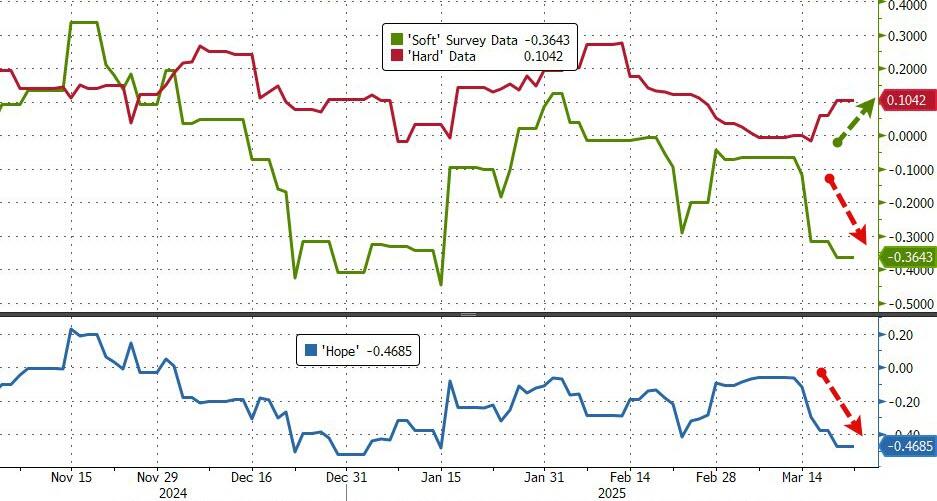
Continuing the trend of 'soft' data deterioration...
 ?itok=YscYK8EV
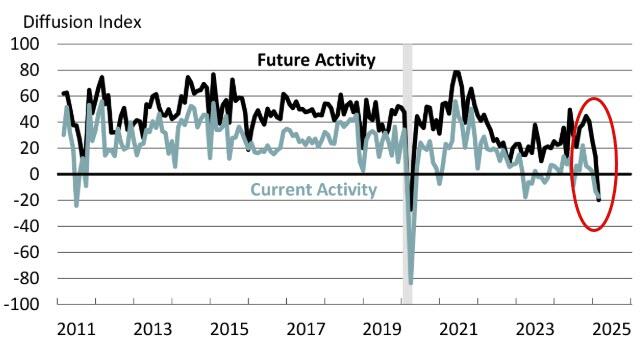
The Philly Fed Services Sector survey Current Activity collapsed from -13.1 to -32.5 - its weakest since May 2020. And at the same time, Future Activity plunged even more...
 ?itok=mQFZIF9f
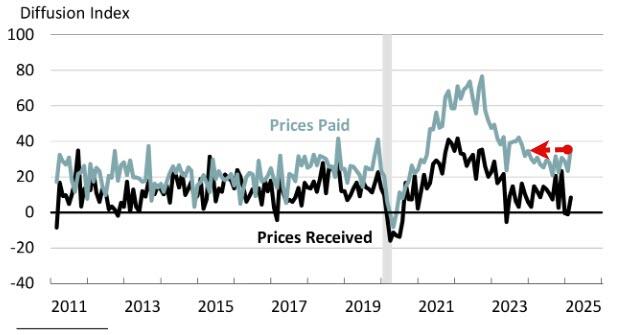
The indexes for general activity, new orders, and sales/revenues remained negative, with the former two declining further. Both price indexes rose and indicate overall increases in prices.
 ?itok=JAucbxJI
The full-time employment index fell 10 points to -7.5, its first negative reading since August.
It looks like the post-election honeymoon is over (in the soft data)... even if the hard data keeps improving.
https://cms.zerohedge.com/users/tyler-durden
Tue, 03/25/2025 - 08:41
https://www.zerohedge.com/personal-finance/philly-fed-services-survey-crashes-weakest-covid
Futures Rise As Global Markets Extend Monday's Torrid Rally
Futures Rise As Global Markets Extend Monday's Torrid Rally
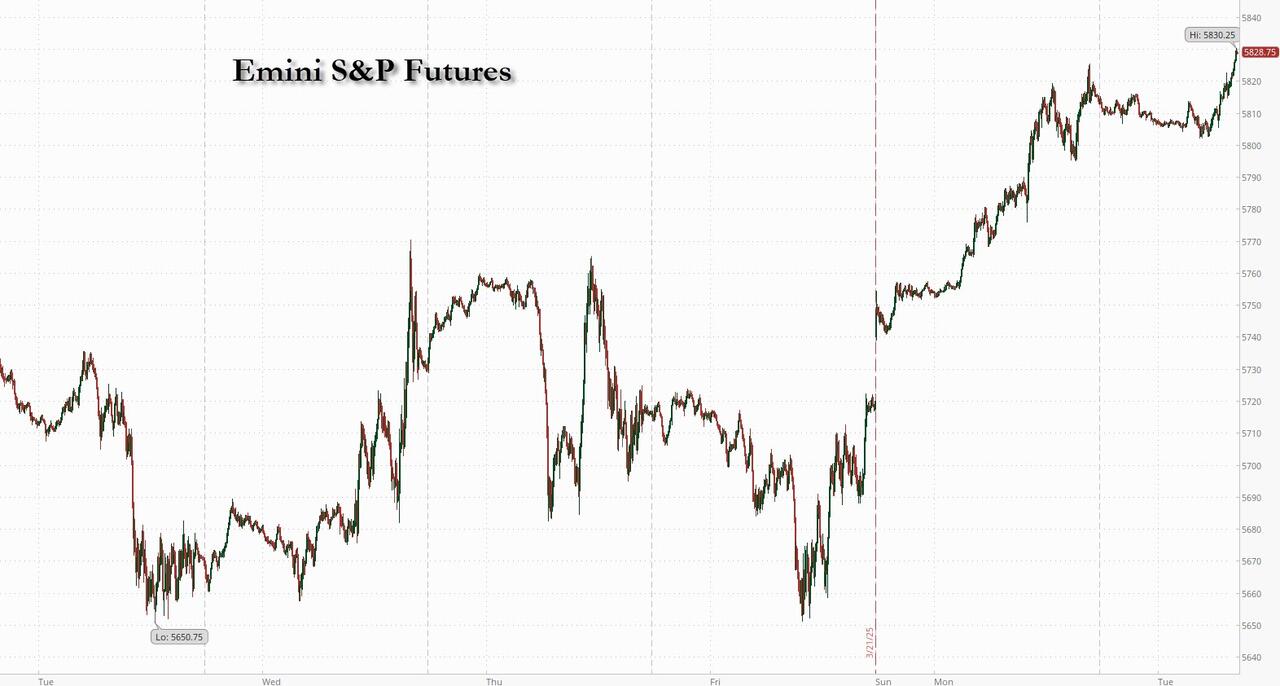
US equity futs are little changed, erasing a modest loss earlier in the session when investors took some profits from yesterday’s torrid rally which pushed the S&P 1.8% higher. As of 8:00am ET, S&P and Nasdaq futures are both up 0.2%, with Mag 7 stocks all higher pre-market, led by TSLA (+1.4%). European stocks gained as the Estoxx 50 rises 1.1% led by energy and financials, although Asian stocks dropped for a third straight day of losses, driven by Chinese tech shares trading in Hong Kong slid 2.6%, weighed down by a drop in Xiaomi after its $5.5 billion share sale. Investors were also rattled by Trump’s new threat of “secondary tariffs” on countries that buy oil from Venezuela. Bond yields are 1-3bp higher. Commodities are mostly higher led by precious metals (silver) and oil. WTI crude oil futures add about 0.5% to Monday’s 1.2% gain. Today, we will receive consumer confidence at 10am ET (est 94.0 survey vs. 98.3 prior).
 ?itok=DsADQm_L
In premarket trading, Tesla whipsawed, first sliding as data showed fresh sales declines in Europe, only to rebound 1.4% higher making it the top gainer among the Mag7 stocks (Alphabet +0.3%, Amazon +0.1%, Apple +0.05%, Microsoft +0.1%, Meta +0.5%, Nvidia -0.4% and Tesla +1.4%). Ally Financial declines 2% after BTIG downgraded the auto-lender to sell, projecting that the company won’t meet its net interest margin and return on equity targets in the near term due to macroeconomic headwinds and increased competition. Carvana rises 4% after Morgan Stanley raised the used-car retailer to overweight, saying the pullback in shares creates an attractive entry point for the used-car retailer. Here are some other notable premarket movers:
Cloudflare (NET) climbs 6% as BofA double-upgrades the software company to buy on improving fundamentals, saying it’s set to be an “AI winner.”
Faraday Future (FFAI) climbs 13% after the mobility ecosystem company secured $41m in new cash financing commitments.
KB Home (KBH) falls 9% after the homebuilder cut its fiscal 2025 revenue guidance amid a soft start to the spring selling season.
McCormick (MKC) slips 3% as the maker of spices posted 1Q profit that missed expectations.
Mobileye Global (MBLY) gains 9% after Volkswagen Group said it is working with the maker of software and hardware technologies for automobiles to enhance driver assistance in future MQB vehicles.
Oklo (OKLO) slides 7% after the nuclear fission reactors firm reported disappointing quarterly results.
Smithfield Foods Inc. (SFD) rises 3% after the world’s largest pork producer said it expects 2025 sales growth in the “low-to-mid-single-digit percent range”.
Trump Media (DJT) jumps 7% after signing a non-binding agreement to partner with Crypto.com for a series of ETFs through its Truth.Fi brand.
UniFirst (UNF) drops 10% after Cintas (CTAS) terminated discussions to acquire the workplace uniform rental company.
Markets have been unnerved by a fresh tariff salvo from Trump, who threatened a 25% levy on any nation purchasing crude from Venezuela. Brent crude rose 0.5%, adding to Monday’s gain. Trump also said he will announce tariffs on automobile imports in the coming days — and indicated nations will receive breaks from next week’s “reciprocal” tariffs, further adding to confusion about the plan for sweeping levies to kick in on April 2.
“Between now and the 2nd of April, it’s just a phase of wait and see,” said Michael Nizard, head of multi-asset at Edmond de Rothschild Asset Management. “If Trump is doing exactly what he’s saying in terms of reciprocal tariffs, it should be negative both for Wall Street and Main Street.”
Investors also remain unclear on how tariffs might impact inflation and economic growth, with most recent data hinting at softer economic momentum alongside still-elevated price pressures. While swaps still price the Federal Reserve to cut rates twice this year, Atlanta Fed chief Raphael Bostic said Tuesday he sees just one 25 basis-point reduction, due to “very bumpy” inflation.
Meanwhile, Turkish markets continued to stabilize after a rout fuelled by the arrest of a key opposition leader. Stocks rose as much as 5.5% and the lira currency was steady, after a series of emergency measures helped calm markets. Top economic officials are due to speak with foreign investors later on Tuesday.
Investors will now watch out for US consumer confidence data which is expected to have eased slightly in March from the previous month.
The oil price rise fueled a rally in the shares of European oil majors including Shell Plc, BP Plc and TotalEnergies SE, lifting the Stoxx 600 index by 0.8%, and ending three straight sessions of losses as investors focus on the potential for a global trade war ahead of a US tariff deadline next week. Energy and insurance sectors lead gains while retail falls. Here are some of the biggest movers on Tuesday:
Shell shares climb as much as 2.2% in London after the oil giant said it would boost investor returns through the end of this decade and strengthen its global leading position as an LNG trader.
Morgan Sindall shares jump as much as 10% after the construction firm said that it expects 2025 results to be slightly ahead of market expectations thanks to an acceleration in trading momentum at its Fit Out division.
Medacta shares gain as much as 6.8% as the Swiss medical-implant firm’s guidance offers scope for performance to exceed expectations, according to Stifel.
Johnson Matthey shares drop as much as 4.1% after BofA Global Research cut its recommendation on the chemicals firm to neutral, saying its Clean Air business could be disrupted by the impact of tariffs on North American auto and truck production.
Baloise shares rise as much as 7.5%, to a new record high, after the Swiss insurer reported FY24 results. Analysts praised the better-than-expected profit and the initiation of a CHF100 million buyback program.
Warehouse REIT shares rise as much as 5.9% after funds managed by Blackstone made a final proposal to buy the UK industrial landlord.
Bellway shares rise as much as 4.1% after delivering reassuring interim results and reiterating its full year guidance.
Gamma’s shares climbed as much as 5.3% after the communication service provider published positive results with a reassuring outlook and announced a buyback program.
Kuehne+Nagel falls as much as 4.7% after the Swiss freight company presented 2025 targets that underwhelmed investors.
Hermes shares slip as much as 0.9% as Oddo analysts trim their price target on the luxury goods maker on expectation that growth in the first quarter is set to be modest. Oddo also cuts its target for LVMH.
Kingfisher shares fall as much as 13% after the British home improvement firm reported a disappointing 2026 outlook, analysts note, with its French and Polish businesses weighing particularly.
Earlier in the session, Asian equities are heading for a third straight day of losses, driven by selloff in Hong Kong as investors remain cautious about forthcoming US tariffs on China. The MSCI Asia Pacific Index declined as much as 0.4%, reversing a gain of 0.5%. Chinese internet stocks Alibaba and Tencent were among the biggest drags. Taiwan’s tech-heavy market tracked gains in US peers, while Japan’s gauges closed higher amid optimism over possible breaks from President Donald Trump’s levies. An index of Chinese shares trading in Hong Kong slid 2.6%, weighed down by a drop in Xiaomi after its $5.5 billion share sale. Investors were also rattled by Trump’s new threat of “secondary tariffs” on countries that buy oil from Venezuela. Investors in Chinese stocks are cautious ahead of the April 2 tariff announcement, said Gary Tan, a fund manager at Allspring Global Investments. “Chinese companies during their post 2024 results conference calls mostly guided cautiously on the growth outlook for this year. Both factors probably drove some near term profit-taking.” Elsewhere, Australian stocks rose ahead of the nation’s annual budget announcement later. Stock benchmarks also advanced in Singapore, New Zealand and Malaysia, while Philippine equities dropped. Indian stocks were little changed after Monday’s rally.
In FX, the Bloomberg Dollar Spot Index dropped 0.2% as investors also seek more clarity on “secondary tariffs” US President Donald Trump has threatened to impose on countries that buy oil from Venezuela. CHF and NZD are the weakest performers in G-10 FX, SEK and AUD outperform. The Australian dollar rises 0.2% versus the greenback after the government unveiled an unexpected tax cut and an extension of energy rebates. “Markets have not priced enough bad news for the world economy from the upcoming tariff announcements,” Kristina Clifton of Commonwealth Bank wrote in a note. “Bad news for the US and global economies can ultimately support USD because of its safe haven status”
In rates, treasuries are lower for the third straight day, extending Monday’s aggressive selloff as US stock futures trade steady and European equities advance. Treasury yields are 1bp-3bp cheaper across maturities with the curve steeper; 10-year at around 4.36% outperforms Germany’s, cheaper by an additional 3bps. Fed rate-cut pricing continues to fade, with around 58bp of easing priced in by December vs 60bp at Friday’s close. Auction cycle begins with $69 billion 2-year note sale, and corporate new-issue slate has begun to build following Monday’s nearly $25b haul. The 2-year note auction at 1pm New York time has WI yield near 4.03%, about 14bp richer than February’s, which stopped through by 1.1bp, a strong result. The IG dollar new-issue slate includes a four-part offering from LG Energy; 16 companies priced a combined $24.2 billion across 30 tranches Monday.
In commodities, WTI futures reversed an earlier drop and rose 0.7% higher to trade near $69.60. Most base metals trade in the green. Spot gold rises roughly $12 to near $3,023/oz. Bitcoin trims loss.
Looking at today's calendar, US data slate includes March Philadelphia Fed non-manufacturing activity (8:30am), January FHFA house price index and S&P CoreLogic home prices (9am), February new home sales, March consumer confidence and Richmond Fed manufacturing index (10am). Fed speaker slate includes Kugler (8:40am) and Williams (9:05am)
Market Snapshot
S&P 500 futures down 0.2% to 5,804.00
STOXX Europe 600 up 0.3% to 550.77
MXAP down 0.3% to 188.08
MXAPJ down 0.6% to 587.85
Nikkei up 0.5% to 37,780.54
Topix up 0.2% to 2,797.52
Hang Seng Index down 2.3% to 23,344.25
Shanghai Composite little changed at 3,369.98
Sensex up 0.2% to 78,123.61
Australia S&P/ASX 200 little changed at 7,942.46
Kospi down 0.6% to 2,615.81
German 10Y yield little changed at 2.80%
Euro down 0.1% to $1.0788
Brent Futures up 0.4% to $73.26/bbl
Gold spot up 0.3% to $3,019.04
US Dollar Index up 0.11% to 104.38
Top Overnight News
A Trump administration proposal to impose stiff levies on Chinese-made ships entering US ports is sowing panic in the country’s agriculture industry, with farmers saying the added cost threatens to upend exports of wheat, corn, and soybeans. The US Trade Representative has recommended imposing fees of up to $1.5mm per prot call on ships built in China or operated by companies with Chinese-built vessels, and hearings on the matter are scheduled for this week. FT
Treasury Secretary Bessent said interest rates are going to keep declining as energy costs decline and noted that laid-off workers can go into the private sector.
Ukraine unconditionally supports the idea of a full ceasefire with Russia, Kyiv’s Ambassador to the US Oksana Markarova said. BBG
Tech chiefs and senior foreign officials are urging the Trump administration to reconsider its AI diffusion rule that limits AI chip exports before the deadline for compliance arrives in less than two months. BBG
Ifo’s German business optimism gauge rose more than expected, to the highest level since June 2024, as the government readied hundreds of billions of euros of spending. BBG
Chinese technology stocks fell from a three-year high to the brink of a correction in just five sessions, fueled by a lack of positive surprise in earnings & cooling sentiment. The Hang Seng Tech Index dropped 3.8% on Tuesday, extending its slide from a March 18 high to nearly 10%. BBG
China could broaden its consumer services stimulus plan to include services (such as travel and tourism) in addition to goods if the economy stays sluggish. FT
India is open to cutting tariffs on more than half of U.S. imports worth $23 billion in the first phase of a trade deal the two nations are negotiating, two government sources said, the biggest cut in years, aimed at fending off reciprocal tariffs. RTRS
Alibaba’s Joe Tsai warned of a potential bubble in datacenter construction, arguing that the buildout pace may outstrip initial demand for AI services. Tsai singled out US spending in particular. BBG
Tesla shares reversed premarket losses even as its European car sales plummeted 40% in February, marking the 10th drop in the past year. The figures contrast with a 31% rise in industrywide EV registrations. BBG
Tariffs/Trade
US President Trump signed an order imposing sanctions on countries importing Venezuelan oil and said tariffs for doing business with Venezuela will be on top of existing tariffs but added that not all tariffs will be included on April 2nd.
India proposed to remove the 6% tariff imposed on online advertisement services offered by companies such as Google (GOOG) and Meta (META), widely known as the Google tax from April 1st, which is a day before Trump's reciprocal tariffs take effect.
Subsequently, India is reportedly open to cutting tariffs on over half of US imports, worth USD 23bln, via Reuters citing sources; open to cutting tariffs to as low as 0 from a 5-30% range on 55% of US imports. Estimates a hit to USD 66bln worth of exports to the US from reciprocal tariffs. In return for tariff cuts, seeking relief from reciprocal tariffs.
South Korea's Acting President Han said their mission is to secure national interest in a trade war and will do everything to weather the tariff storm triggered by the US, while it was also reported that South Korea is to launch a special probe on 'made in Korea' violations ahead of US tariffs.
German Agriculture Ministry said Britain removed import restrictions on German animals and animal products imposed after the foot-and-mouth disease case.
A more detailed look at global markets courtesy of Newsquawk
APAC stocks trade mixed after the early momentum from the tariff-related optimism on Wall St wore thin. ASX 200 advanced at the open but then gave back most of its gains after stalling near the 8,000 level and as participants await Treasurer Chalmers's pre-election budget which is expected to return to a deficit. Nikkei 225 rallied at the start of trade and briefly climbed above the 38,000 level but has since pulled back from intraday highs with recent currency moves influencing price action. Hang Seng and Shanghai Comp were pressured with notable underperformance in Hong Kong as tech and auto names lost traction amid recent earnings releases and tariff risk, while there was a lack of details so far regarding the PBoC's MLF operation after the central bank recently unveiled a new method for how MLF operations will be conducted whereby banks will be able to bid for different prices on its one-year loans.
Top Asian News
China is considering including services in the multi-billion dollar subsidy program to stimulate consumption, according to FT.
BoJ January Meeting Minutes stated most members expressed the recognition that the likelihood of realising the outlook had been rising and some members shared the recognition that real interest rates were expected to remain significantly negative even after the rate hike. The minutes stated that a member expressed the view that if underlying inflation increased, the BoJ would need to raise the policy interest rate accordingly in a gradual manner and a member continued that it would be necessary for the BoJ to adjust the degree of monetary accommodation from the viewpoint of avoiding the yen’s depreciation and the overheating of financial activities. Furthermore, a member said the BoJ should be extremely careful about suggesting the pace of policy interest rate hikes and the terminal policy rate and a member said it would be desirable for the BoJ to bear in mind that the policy interest rate should be at around 1% in the second half of fiscal 2025.
BoJ Governor Ueda said they still need some time to consider what to do with the BoJ's ETF holdings and must think about valuation and market rout risks when offloading its ETF holdings. Ueda added that the BoJ's JGB holdings would continue to have a stock effect since the reduction pace is extremely slow and the massive JGB holdings have a stock effect that would slightly lower long-term yields.
European bourses defied the lead from futures and began the session on a firmer footing, Stoxx 600 +0.4%; no significant/fresh driver for the move with it seemingly an extension of Monday's US action. Sectors mostly in the green, Energy leads given benchmarks and with Shell (+2.0%) assisting. Retail lags, weighed on by Kingfisher (-11%) after weak results.
Top European News
UK Chancellor Reeves is to publish the forecast from the OBR which is to roughly halve the UK’s expected growth in 2025 from 2% to about 1%, while her GBP 9.9bln of headroom against her fiscal rule has been wiped out, leaving her about GBP 4bln in the red. Furthermore, Reeves's statement is expected to have more than GBP 5bln of extra cuts to UK public spending and she will claim that Britain is “uniquely positioned” to pursue favourable trading relations with the US and EU, according to FT.
ECB's Muller says rates are not restricting the economy or investments; tariffs are likely to mean faster inflation in the short term; any further cuts will be tariff dependent.
ECB's Kazimir says "services inflation is key", open to discuss rate cut or pause in April; already in the zone of the neutral rate.
FX
Relatively steady trade for the first part of the European morning but as we approach the US session slightly more pressured has emerged in the USD with the Index at a 104.15 trough. Overall, a session of slightly choppy FX action with moves turning around and extending in recent trade with no clear/overt fresh fundamental driving.
EUR benefitting from the above move, no specific/fresh driver behind it. Prior to this, the index got back towards the 1.08 mark on the latest Ifo metrics which improved from the prior. Most recently, the USD action has lifted the single currency to a fresh 1.0816 session high.
USD/JPY initially extended on the prior session's advances, but failed to breach the 151.00 mark and has been easing back since. Currently finds itself at a 150.32 low.
Again, GBP was steady for the first part of the session but Cable picked up further from the 1.29 handle and is at a 1.2944 high, benefitting from USD moves. Specifics focussed entirely on Wednesday's Spring Statement.
AUD saw little follow through from the pre-election budget announcement. Benefitting from the above moves and is just above the 0.63 mark in recent trade. Kiwi in the green, but not faring quite as well so far.
PBoC set USD/CNY mid-point at 7.1788 vs exp. 7.2630 (Prev. 7.1780).
Fixed Income
Benchmarks lower across the board. Bunds weighed on by the latest Ifo metrics with expectations and conditions printing above consensus while climate was in-line. A move which added to the bearish bias in fixed income and sent Bunds below the 128.00 mark around 10-minutes after the print. Currently just off a 127.84 base.
USTs in-fitting, in a continuation of the sizable moves from Monday, which sent USTs to a 110-15+ base, a low that has since been taken out to a 110-11+ WTD trough.
Gilts weighed on by the above and also as we count down to the Spring Statement. Fresh reporting ahead of this that the OBR’s growth forecast will be essentially cut in half from the 2% level outlined in the autumn. At a 91.05 base, lowest since March 6th when 90.71 printed.
Crude
Crude complex remains supported after Monday’s buying, which saw WTI and Brent settle around USD 0.80/bbl higher after numerous catalysts aided the benchmarks. The latter, settling at the highest since late February.
US remarks around Venezuela and tariffs in focus while we await an update on the geopolitical front.
On this, Dutch TTF is modestly lower, owing to the “constructive” talks in Riyadh, which US and Ukrainian teams are set to be extending.
Spot Gold has recouped some losses from overnight and is at a fresh session high of USD 3023/oz, seemingly benefiting from the initially tepid USD and US risk tone.
Geopolitics: Ukraine
Ukraine delegation in Saudi Arabia will meet with the US team on Tuesday, according to a Ukrainian broadcaster Suspilne citing an unnamed source in the Ukrainian delegation.
White House source says talks facilitated by the Trump administration's technical teams in Riyadh are going extremely well, and we expect to have a positive announcement in the near future.
Russia and US talks in Saudi Arabia were not simple but were useful, while their talks will continue with participation of international community including the UN, according to TASS.
Ukraine and US teams are said to be holding further Russia-Ukraine talks in Riyadh, according to Bloomberg.
Russia's Kremlin says there are no plans for a Russian President Putin-US President Trump call yet but it can be organised; the content of the talks will not be disclosed in public.
Geopolitics: Middle East
Israeli military says it struck targets at Syrian military bases.
Houthi military spokesman says they targeted US naval vessels in the Red Sea and Israel's Ben Gurion Airport, according to Al Jazeera and Sky News Arabia.
US Event Calendar
08:30: March Philadelphia Fed Non-Manufactu, prior -13.1
09:00: Jan. S&P Case-Shiller 20 City MoM SA, est. 0.40%, prior 0.52%
Jan. S&P Case-Shiller Composite-20 YoY, est. 4.80%, prior 4.48%
09:00: Jan. FHFA House Price Index MoM, est. 0.3%, prior 0.4%
10:00: March Conf. Board Consumer Confidenc, est. 94.0, prior 98.3
March Conf. Board Expectations, prior 72.9
March Conf. Board Present Situation, prior 136.5
10:00: March Richmond Fed Index, est. 1, prior 6
10:00: Feb. New Home Sales, est. 680,000, prior 657,000
Feb. New Home Sales MoM, est. 3.5%, prior -10.5%
DB's Jim Reid concludes the overnight wrap
Good morning from New York, where Friday's headlines that next week’s reciprocal tariffs are set to be more targeted than previously expected, have continued to help the recent US outperformance. My theory is that US stocks now underperform most when the tariff threat is the highest, because if you believe returns to capital have been greatest under global free trade, then the larger the threat to that, the larger the impact on the ultimate beneficiary of capitalism in recent years, namely US stocks. See my CoTD from two weeks ago here for more on this theory.
Friday's news meant US futures were already pointing towards a solid start yesterday, but markets then got a fresh burst of support after the March flash PMIs were much stronger than expected, which collectively led to a pushback against the weaker US growth/recession narrative that’s developed over recent weeks. In turn, that meant US assets did very well, with the Magnificent 7 (+3.46%) posting its biggest gain in over two months, which in turn saw the S&P 500 (+1.76%) move further away from correction territory, having now risen +4.46% since its low on March 13. Moreover, the gains were broad-based, with the small-cap Russell 2000 (+2.55%) seeing its best day of 2025 so far. US equities continued to close the gap with their European counterparts, with the S&P 500 outpacing the STOXX 600 (-0.13%) for a fourth consecutive session, even if it’s still lagging well behind for the year as a whole.
Trump did say yesterday that he planned to proceed with auto tariffs “fairly soon, over the next few days” as well as those on pharmaceuticals at “some point in the not too distant future”, but any negative read across from this was offset by him saying that “I may give a lot of countries breaks” on reciprocal tariffs. We also heard from Stephen Miran, the new chair of the Council of Economic Advisers, who didn’t think there would be “material short-term pain from the tariffs”, while downplaying near-term prospects for a so called ‘Mar-a-Lago Accord’, saying that tariffs are “the sole focus right now”. In a note yesterday (link here), Peter Sidorov on my team discusses why we view such a new currency accord as unlikely and also considers the market implications were it to be pursued. The dollar index (+0.17%) moved higher for a fourth consecutive session yesterday, rising to its highest level since March 5, the day after tariffs against Canada and Mexico came into force.
But with most of the tariff stories having already come over the weekend, yesterday’s incremental news was really those flash PMIs for March, which offered an initial indication about how the global economy rounded out Q1. The numbers from the US were notably better than expected, with the composite PMI up to 53.5 (vs. 50.9 expected), which ended the monthly declines seen in January and February. Obviously the PMIs are based on a survey rather than hard data, but they are better than most surveys at capturing actual activity rather than sentiment, so the unexpected rise added to the sense that recent data simply wasn’t consistent with a recession. Indeed, all the hard data has generally been in a good place, with payrolls, retail sales and industrial production all growing in February. So that helped support a further easing in market stress, with the VIX index of volatility down -1.80pts to a one-month low of 17.48pts, whilst HY spreads (-15bps) reached their tightest in over two weeks, at 302bps.
Nevertheless, even as the output figures were decent, there were also some fresh warning signs on the inflation side. For instance, in the composite PMI, the input prices index was up to 60.9, the highest since April 2023. So that pointed to the tariffs filtering through into prices, which will be a concern for the Fed given inflation is still lingering above target. Indeed, the combination of the growth and inflation numbers meant investors dialled back their expectations for Fed easing this year, with the amount of rate cuts futures are pricing in by the December meeting down -8.6bps on the day to 62bps, although still more than the 55bps priced in just before the FOMC decision last Wednesday. This repricing was also helped by hawkish-leaning comments by Atlanta Fed President Bostic, who said he now only saw one rate cut, rather than two, likely this year as tariffs impeded disinflation. In turn, Treasury yields saw a fresh rise across the curve, with the 10yr yield (+8.9bps) up to a one-month high of 4.33%. Overnight, that move has only been pared back slightly, with the 10yr yield down -1.0bps to 4.32%.
Whilst US assets were recovering, the other tariff news we got was President Trump saying he’d place a 25% tariff on any country that purchased oil or gas from Venezuela. In response, the prospect of tighter supplies meant oil prices moved up to their highs of the day, with Brent crude (+1.16%) rising to $73.00/bbl, its highest closing level so far this month.
Over in Europe, there was quite a different tone yesterday. That came as the flash PMIs were generally a bit weaker than expected, even though they did improve for the most part. That took out some of the momentum from European risk assets, with the STOXX 600 (-0.13%) losing ground for a third consecutive session. And that was echoed across the continent, with the DAX (-0.17%), the CAC 40 (-0.26%) and the FTSE 100 (-0.10%) all seeing modest declines.
In terms of the PMI numbers themselves, the aggregate Euro Area composite PMI came in at 50.4 (vs. 50.7 expected). On the bright side, that was actually a 7-month high, but it was still barely above the 50-mark that separates expansion from contraction, so it was hard for investors to get too excited by that. At the country level, Germany’s composite PMI moved up to a 10-month high of 50.9 (vs. 51.1 expected), but France’s remained in contractionary territory at 47.0 (vs. 46.1 expected). Interestingly, the UK saw a decent outperformance ahead of this week’s Spring Statement, with the composite PMI up to a 6-month high of 52.0 (vs. 50.5 expected). And with the PMIs in hand, sovereign bond yields were broadly steady across the continent, with yields on 10yr bunds (+0.6bps), OATs (-0.3bps) and BTPs (-0.6bps) seeing little change.
Overnight in Asia, equities haven’t kept up their momentum from the US session. The Hang Seng (-2.18%) has been the worst performer of the major indices, and the Hang Seng Tech index (-3.67%) has seen even bigger losses, which is the reverse of what happened in the US where the Mag 7 helped lift the broader market. Otherwise, several other indices have lost ground, including the CSI 300 (-0.20%) and the Shanghai Comp (-0.11%), whilst the KOSPI is down -0.64%. However, the losses haven’t been universal, and there have been advances for Japan’s Nikkei (+0.41%) and Australia’s S&P/ASX 200 (+0.07%) this morning. Looking forward however, US and European equity futures are pointing lower, with those on the S&P 500 (-0.15%) and the DAX (-0.23%) both down this morning.
To the day ahead now, and data releases include the German Ifo business climate indicator for March, and in the US there’s the Conference Board’s consumer confidence indicator for March, and new home sales for February. From central banks, we’ll hear from the Fed’s Kugler and Williams, along with the ECB’s Kazimir, Muller, Holzmann, Vujcic and Nagel.
https://cms.zerohedge.com/users/tyler-durden
Tue, 03/25/2025 - 08:21
https://www.zerohedge.com/market-recaps/futures-rise-global-markets-extend-mondays-torrid-rally
British Chat Forums Shutter To Avoid New Internet Policing Law
British Chat Forums Shutter To Avoid New Internet Policing Law
(emphasis ours),
British chat forums are shutting themselves down rather than face regulatory burdens recently applied to internet policing laws.
On March 17, the United Kingdom’s Online Safety Act, a law that regulates internet spaces, officially kicked into force.
 ?itok=wIDc2k16
The law means that online platforms must immediately start putting in place measures to protect people in the UK from criminal activity with far-reaching implications for the internet.
However, for some forums—from cyclists, hobbyists, and hamster owners, to divorced father support and more—the regulatory pressure is proving too much, and its myriad of rules are causing chat forums that have been operating for decades, in some cases, to call it a day.
Conservative Peer Lord Daniel Moylan told The Epoch Times by email that “common sense suggests the sites least likely to survive will be hobby sites, community sites, and the like.”
‘Small But Risky Services’
The Act—which was celebrated as the world-first online safety https://www.gov.uk/government/news/world-first-online-safety-laws-introduced-in-parliament
—was designed to ensure that tech companies take more responsibility for the safety of their users.
For example, social media platforms, including user-to-user service providers, have the duty to proactively police harmful illegal content such as revenge and extreme pornography, sex trafficking, harassment, coercive or controlling behavior, and cyberstalking.
But what the government calls “small but risky services” which are often forums, have to https://www.ofcom.org.uk/online-safety/illegal-and-harmful-content/enforcing-the-online-safety-act-scrutinising-illegal-harms-risk-assessments/
illegal harms risk assessments to the Online Safety Act’s regulator, Ofcom, by March 31.
Ofcom first published its illegal harm codes of practice and guidance in December 2024 and had given providers three months to carry out the assignment.
 ?itok=fBXNYF-Q
It was given powers under the law and warned that those who fail to do so may face enforcement action.
“We have strong enforcement powers at our disposal, including being able to issue fines of up to 10 percent of turnover or £18 million ($23 million)—whichever is greater—or to apply to a court to block a site in the UK in the most serious cases,” said Ofcom.
Some of the rules for owners of these sites—which are often operated by individuals —include keeping written https://www.ofcom.org.uk/siteassets/resources/documents/online-safety/information-for-industry/illegal-harms/record-keeping-and-review-guidance.pdf?v=391926
of their risk assessments, detailing levels of risk, and assessing the “nature and severity of potential harm to individuals.”
While terrorism and child sexual exploitation may be more straightforward to assess and mitigate, offenses such as coercive and controlling behavior and hate offenses are more challenging to manage with forums that have thousands of users.
‘No Way To Dodge It’
LFGSS (London Fixed Gear and Single Speed), a popular cycling https://www.lfgss.com/conversations/401475/
and resource for nearly two decades, shut down in December.
“We’re done ... we fall firmly into scope, and I have no way to dodge it,” the site said, adding that the law “makes the site owner liable for everything that is said by anyone on the site they operate.”
“The act is too broad, and it doesn’t matter that there’s never been an instance of any of the proclaimed things that this act protects adults, children, and vulnerable people from ... the very broad language and the fact that I’m based in the UK means we’re covered,” it said.
Dee Kitchen, the Microcosm forum software developer that was used to power 300 online communities including LFGSS, said he deleted them all on March 16, a day before the law kicked in.
More recently the Hamster Forum shut down.
On March 16, it https://www.thehamsterforum.com/ams/forum-closure.79/
that while the forum has “always been perfectly safe, we were unable to meet the compliance.”
The resource forum dadswithkids for single dads, and fathers going through divorce or separation—and also teaches how to maintain relationships with their children, also https://www.dadswithkids.co.uk/ams/forum-closure.28/
down.
 ?itok=iS2WSm9_
 ?itok=dzR-p-JM
UK users are also being blocked from accessing sites hosted abroad.
The hosts of the lemmy.zip https://uk.lemmy.zip/
hosted in Finland, said to ensure compliance with international regulations while avoiding any legal risks associated with the Act, it has made the difficult decision to block UK access.
“These measures pave the way for a UK-controlled version of the ‘Great Firewall,’ granting the government the ability to block or fine websites at will under broad, undefined, and constantly shifting terms of what is considered ‘harmful’ content,” it said.
‘Not Setting Out to Penalize’
An Ofcom spokesman told The Epoch Times by email: “We’re not setting out to penalize small, low-risk services trying to comply in good faith, and will only take action where it is proportionate and appropriate.”
https://cms.zerohedge.com/users/tyler-durden
Tue, 03/25/2025 - 08:05
https://www.zerohedge.com/political/british-chat-forums-shutter-avoid-new-internet-policing-law
Judge Maintains Blocks On Trump Admin's Use Of Alien Enemies Act For Deportations
Judge Maintains Blocks On Trump Admin's Use Of Alien Enemies Act For Deportations
A federal judge in Washington has denied the Trump administration’s request to remove two orders blocking the administration’s ability to deport members of a Venezuelan gang under the Alien Enemies Act.
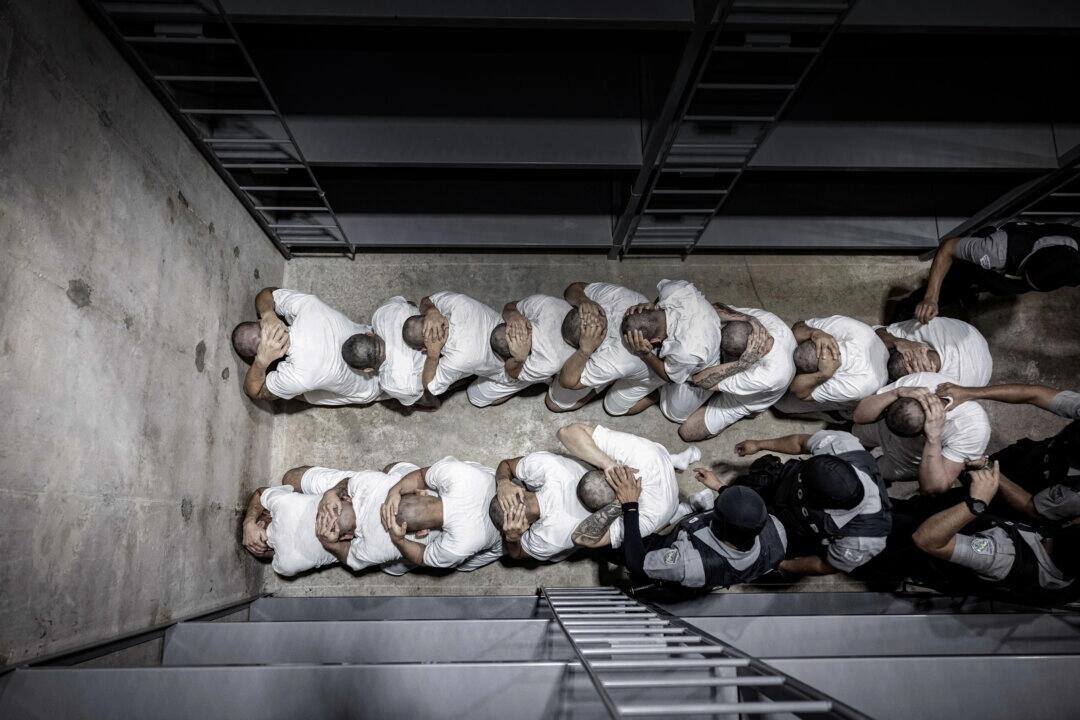 ?itok=Q9vYBrNN
In an https://storage.courtlistener.com/recap/gov.uscourts.dcd.278436/gov.uscourts.dcd.278436.53.0.pdf
on March 24, U.S. District Judge James Boasberg said he had jurisdiction to adjudicate the issue and that the plaintiffs were likely to succeed in their argument that they are entitled to an individualized hearing to determine whether the Alien Enemies Act of 1798 applies to them.
Boasberg also said the plaintiffs who challenged the Trump administration’s action couldn’t be deported until a court had ruled on the merits of their challenge. He noted that they disputed that they were, in fact, members of the Tren de Aragua terrorist group.
Boasberg’s decision follows a contentious hearing on Friday, when he said the administration had used “intemperate” and “disrespectful” language.
At one point, he advised Department of Justice (DOJ) attorney Drew Ensign to ensure that his team at the DOJ retained a lesson about their reputation and credibility being the most valuable treasure they possess. Boasberg and the DOJ have https://www.theepochtimes.com/us/judge-orders-more-info-from-trump-admin-on-deportations-5827013
in recent days over the nature of his authority and, in particular, whether an oral order he issued on March 15 was binding.
In filings last week, the DOJ https://storage.courtlistener.com/recap/gov.uscourts.dcd.278436/gov.uscourts.dcd.278436.26.0_3.pdf
Boasberg’s orders as “an affront to the President’s broad constitutional and statutory authority to protect the United States from dangerous aliens who pose grave threats to the American people.”
Another https://storage.courtlistener.com/recap/gov.uscourts.dcd.278436/gov.uscourts.dcd.278436.37.0_2.pdf
on March 19 showed the administration suggesting that the case had “devolved into a picayune dispute over the micromanagement of immaterial factfinding.”
“In a series of orders this Court has requested the Government to provide it details about the movements of aircraft outside of the United States and interactions with foreign nations which have no bearing on any legal issue at stake in the case,” it said.
Trump, meanwhile, has called for Boasberg’s impeachment. Chief Justice John Roberts appeared to https://www.theepochtimes.com/us/chief-justice-roberts-issues-rare-statement-after-trump-calls-for-judges-impeachment-5827498
just hours later in a statement last week.
“For more than two centuries, it has been established that impeachment is not an appropriate response to disagreement concerning a judicial decision,” Roberts said in a statement provided to The Epoch Times.
On March 24, the District of Columbia U.S. Circuit Court of Appeals is expected to hear oral arguments in the case. It’s just one of many testing presidential authority and making its way through the courts under the Trump administration.
https://cms.zerohedge.com/users/tyler-durden
Mon, 03/24/2025 - 15:10
Bomb Squad Finds Incendiary Devices At Tesla Showroom In Texas
Bomb Squad Finds Incendiary Devices At Tesla Showroom In Texas
Just one day after U.S. Attorney General Pam Bondi issued a https://www.zerohedge.com/markets/tread-carefully-pam-bondi-issues-warning-unhinged-rep-jasmine-crockett-over-tesla-takedown
to Representative Jasmine Crockett (D-TX) over her support for the so-called "Tesla Takedown" group of rogue NGOs — and days after the FBI flagged a wave of incidents involving arson, gunfire, and vandalism targeting Tesla EVs, dealerships, and charging stations across at least nine states, linked to political grievances and viewed as domestic terrorism — another such incident occurred Monday morning at a Tesla dealership in Austin, Texas.
"On Monday, March 24, 2025, at approximately 8:04 a.m., Austin Police Department (APD) officers responded to a Found/Abandoned Hazardous call at the Tesla dealership located at 12845 N. US 183 Hwy SVRD NB. When officers arrived on scene, they located suspicious devices and called the APD Bomb Squad to investigate. The devices, which were determined to be incendiary, were taken into police custody without incident. This is an open and ongoing investigation, and there is no further information available for release at this time," the Austin Police Department wrote in a statement on Monday.
 ?itok=sq3EUP-o
The incident follows Bondi's warning to Rep. Crockett on Sunday:
'TREAD VERY CAREFULLY': https://twitter.com/AGPamBondi?ref_src=twsrc%5Etfw
— Fox News (@FoxNews) https://twitter.com/FoxNews/status/1903994834417000759?ref_src=twsrc%5Etfw
The FBI warned on Saturday: "FBI warns of nationwide incidents—arson, gunfire, and vandalism targeting Tesla EVs, dealerships, and charging stations in 9+ states, linked to political grievances."
🚨PSA: FBI warns of nationwide incidents—arson, gunfire, and vandalism targeting Tesla EVs, dealerships, and charging stations in 9+ states, linked to political grievances. The https://twitter.com/hashtag/FBI?src=hash&ref_src=twsrc%5Etfw
— FBI (@FBI) https://twitter.com/FBI/status/1903492170734244078?ref_src=twsrc%5Etfw
Rogue NGOs have planned "Tesla Takedown" protests nationwide this weekend.
One Tesla Takedown organizer, Micah Lee, The Intercept's former Director of Information Security, described the Tesla Takedown as a protest to kill the "Tesla brand" and "drive down the stock price low."
🚨EXCLUSIVE🚨
Micah Lee, https://twitter.com/theintercept?ref_src=twsrc%5Etfw
’s former Director of Information Security, participated in the Tesla Takedown call to action tonight.
Interesting. Check this out! https://twitter.com/ggreenwald?ref_src=twsrc%5Etfw
The former Director of Information Security for the Intercept was on the call to action for… https://t.co/rQKz658JeZ
— Laura Loomer (@LauraLoomer) https://twitter.com/LauraLoomer/status/1902608329458794995?ref_src=twsrc%5Etfw
Soros-funded NGOs have been plotting.
Rogue Soros-Funded NGO Plots Multi-City Assault On Tesla As Domestic Terrorism Escalates https://t.co/fWK6bxZTfg
— zerohedge (@zerohedge) https://twitter.com/zerohedge/status/1902731902693372380?ref_src=twsrc%5Etfw
Tesla adds a new Sentry Mode security feature to vehicles to combat unhinged leftist attacks.
"Max Volume If Threat Detected": Tesla Adds New Sentry Mode Security Feature To Deter Unhinged Leftist Attacks https://t.co/iw2arJVcLA
— zerohedge (@zerohedge) https://twitter.com/zerohedge/status/1903860583990190310?ref_src=twsrc%5Etfw
Domestic terrorism attacks against Tesla are optically damaging for the imploding Democratic Party and are likely to haunt it in the next election.
https://cms.zerohedge.com/users/tyler-durden
Mon, 03/24/2025 - 14:50
https://www.zerohedge.com/markets/bomb-squad-finds-incendiary-devices-tesla-showroom-texas
Waltz Reveals Topics Of US-Russia Meeting As It Kicks Off In Riyadh
Waltz Reveals Topics Of US-Russia Meeting As It Kicks Off In Riyadh
Trump's national security adviser Mike Walz has previewed what will be a main topic of discussion for Monday's next round of talks with Russia in Saudi Arabia. At this point the talks between the US and Ukrainian delegations have concluded (as of Sunday night), and up next is the separate meeting with the Russians, which has begun Monday.
"We're moving closer and we're closer to peace than we ever have been," Walz told CBS' Face the Nation. "And now we have technical teams, actually, with Ukrainians and Russians at the same facility, conducting proximity talks."
That's when he revealed a major new focus of negotiations for the Monday talks. "We now going to talk about a Black Sea maritime ceasefire so that both sides can move grain fuel and start conducting trade again in the Black Sea," Walz described.
 ?itok=x8Z0Z_HD
Reaching a lasting ceasefire deal would allow both warring countries to "move grain, fuel, and start conducting trade" in the sea again, he said.
Also high on the agenda https://www.msn.com/en-gb/news/world/us-security-advisor-on-proximity-talks-between-ukraine-and-russia-closer-to-peace-than-ever-before/ar-AA1Bv7rw
discussions of the front line, the issue of territories, and the achievement and maintenance of sustainable peace. "We’ll talk the line of control… details of verification mechanisms, peace keeping, you know, freezing the lines where they are," Walz noted.
The issue of "broader and permanent peace" and "security guarantees" are also on the table as the diplomatic engagements proceed.
As the talks in Riyadh have reportedly begun Monday, the Russian ruble has continued to strengthen on to the expectation of a peace deal, by 09:30 GMT gaining over 1% against the US dollar in the over-the-counter market.
Meanwhile, Ukraine's president Volodymyr Zelensky has condemned the continued aerial attacks on Ukraine. Overnight Ukraine's military says it shot down nearly 60 inbound Russian drones. Both sides say they've agreed to a US-brokered pause on attacks against energy infrastructure - both other attacks have persisted.
Zelensky called on allies put more pressure on Russia "to stop this terror". He said in a fresh televised statement that "since March 11, a proposal for an unconditional ceasefire has been on the table, and these attacks could have already stopped. But it is Russia that continues all this."
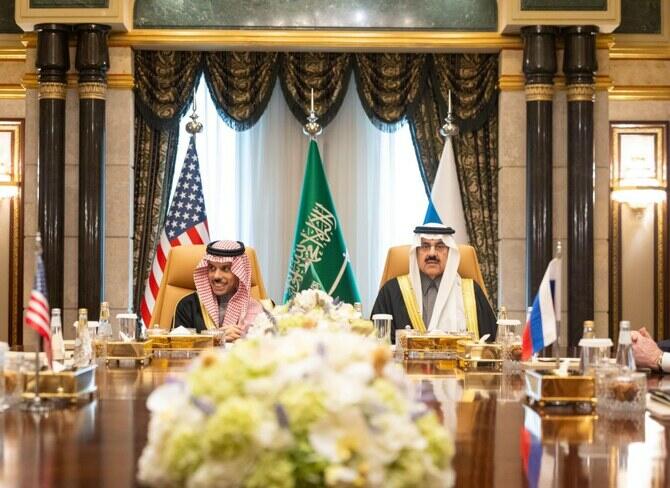 ?itok=oh_pbaxe
"Our team is working in a fully constructive manner, and the discussion is quite useful. The work of the delegations continues," Zelensky said in reference to the Sunday Riyadh meeting with the US delegation.
"But no matter what we’re discussing with our partners right now, Putin must be pushed to issue a real order to stop the strikes, because the one who brought this war must be the one to take it back," he added.
* * *
Al Jazeera has the following brief backgrounder on the national security officials leading the Russian delegation for Monday's meeting with the US https://www.aljazeera.com/news/liveblog/2025/3/24/russia-ukraine-war-live-us-russia-start-ceasefire-talks-in-saudi-arabia
:
Sergei Beseda
The 70-year-old is an adviser to FSB chief Alexander Bortnikov.
From 2009 to last year, he was heading the FSB’s 5th service, which runs agents in former Soviet countries. Some experts believe he was closely involved in intelligence preparations for Russia’s full-scale invasion of Ukraine in 2022.
According to Reuters, Beseda’s position appeared precarious after Ukraine fought back much more strongly than expected and Russia’s initial assault on Kyiv was beaten back, but he remained in his post.
Ex-US Ambassador John Sullivan wrote in his memoir that Beseda also took part in negotiations with the US in 2021 on exchanging prisoners held in each other’s prisons.
Grigory Karasin
The 75-year-old is a former long-serving diplomat whose past posts include deputy foreign minister and ambassador to the UK.
He is now a member of the Federation Council, the upper house of Russia’s parliament, and chairs its international affairs committee.
Both he and Beseda have been placed under Western sanctions.
* * *
Below are more developing Monday geopolitical headlines via Newsquawk:
Middle East
"Israeli Channel 12 on government sources: The military operation will be expanded and what we have done so far has not pushed Hamas to any understandings towards reaching a deal", according to Al Jazeera.
AP said Egypt has put forward a new proposal to try to put the ceasefire between Israel and Hamas back on track.
"There are positive indications about a new Egyptian proposal in the negotiations, but the gaps are still large", according to Israel's N12.
Israeli PM Netanyahu spoke with US Secretary of State Rubio and discussed regional developments including the release of hostages and resumption of fighting in Gaza.
Israel’s military said a projectile was launched from Yemen towards Israel which was intercepted and it conducted strikes on Rafah and Khan Younis, while Israel’s military also said the division that operated in Lebanon is preparing for Gaza activity.
Israel conducted an air strike which killed Hamas political leader Salah Al-Bardaweel in the southern Gaza Strip and targeted the surgery department at Gaza’s Nasser Hospital which killed Hamas political bureau member Ismail Baarhoum.
US peacekeepers said an escalation of the volatile situation at the Lebanon-Israel border could have serious consequences for the region, while it was reported that Israeli PM Netanyahu ordered strikes against dozens of targets in Lebanon in response to rocket fire although Hezbollah denied any link to rocket launches from southern Lebanon on Saturday.
White House National Security Adviser Waltz said the US took out key Houthi leadership during strikes in Yemen, as well as weapons factories and some drone facilities, while he added that the US is seeking full dismantlement of the Iranian nuclear program in a way the entire world can see.
US envoy Witkoff said Hamas is the aggressor here and had every opportunity to demilitarise and accept the bridging proposal but they elected not to. Witkoff also stated that their signal to Iran is let’s sit down and see if we can get to the right place through diplomacy, while he added that Iran cannot have a nuclear bomb which cannot and will not happen.
Iran’s Foreign Minister Araqchi said talks with the US are impossible unless Washington changes its pressure policy.
Iranian Foreign Ministry warned of the repercussions of the new Israeli escalation against Lebanon, according to Sky News Arabia.
Ukraine
Negotiations between the delegations of the Russian Federation and the US last about two hours; "the parties do not plan to complete the meeting in the near future", according to TASS.
Russia's Kremlin said Saudi Arabia negotiations are underway on technical issues, there are many different aspects related to a settlement in Ukraine that need to be worked out. The Black Sea initiative is on the agenda in these talks. There is a common understanding with the US on the willingness to move towards a settlement
Russia's Defence Ministry says Ukraine attempted to attack an oil pumping station in Russia's Krasnodar region, according to IFAX; the station is out of operation for repairs.
Russia's Kremlin, on energy strike moratorium, said they are monitoring the situation after attacks by Ukraine.
Ukraine and US delegations began talks in Saudi Arabia, while Ukrainian President Zelensky said the Ukrainian delegation is working in a completely constructive way and the conversation is quite useful. There were also comments from the Ukrainian Defence Minister that the agenda for talks included proposals to protect energy facilities and critical infrastructure.
White House National Security Adviser Waltz said the US is talking through a number of confidence-building measures to end the Russia-Ukraine war including the future of Ukrainian children taken into Russia.
US envoy Witkoff said the US expects a lot more progress on the Russia-Ukraine conflict and that Russian President Putin does not want to take all of Europe with the situation much more different than WW2.
White House is aiming for a Russia-Ukraine truce agreement by April 20th, according to Bloomberg.
Russia’s Kremlin said the Putin-Trump call was a step towards a face-to-face meeting and talks in Saudi Arabia will be as well. It was also reported that the Russian Defence Ministry said Russian forces took control of Sribne in eastern Ukraine, according to IFAX.
Other
South Korea’s Foreign Minister said sanctions against North Korea must be carried out faithfully and that North Korea should not be rewarded for its wrongdoing in the course of the war in Ukraine.
Venezuela’s government said it will resume repatriation flights of migrants from the US beginning on March 23rd.
https://cms.zerohedge.com/users/tyler-durden
Mon, 03/24/2025 - 08:40
https://www.zerohedge.com/geopolitical/waltz-reveals-topics-us-russia-talks-they-kick-riyadh
US Stock Futures Surge On Hopes Trump April 2 Tariffs Will Be "Targeted"
US Stock Futures Surge On Hopes Trump April 2 Tariffs Will Be "Targeted"
US equity futures have extended gains throughout the European morning, with the Nasdaq 100 outperforming compared to when https://www.zerohedge.com/markets/futures-jump-report-trump-reciprocal-tariffs-be-more-targeted-feared
that Trump’s April 2 tariff package may be more “targeted” than feared. The WSJ added that the admin will "likely omit a set of industry-specific tariffs while applying reciprocal levies on a targeted set of nations...Those sector-specific tariffs, however, are now not likely to be announced on April 2, said an administration official, who said the White House is still planning to unveil the reciprocal tariff action on that day." That news was enough to send S&P futures 1.2% higher and Nasdaq futures 1.5% with all Mag 7 stocks higher this morning led by TSLA (+3.8%), META (+2.1%) and AMZN (+1.5%). Still, we are not fully in the clear because as Goldman Delta 1 trader Rich Privorotsky writes, "my presumption was that the opening salvo would have been maximalist, this seems a step back from that approach. Objectively positive if tariffs are smaller in magnitude/scope but the bigger issue is the perpetual uncertainty…seems that is not going away." Bond yields were 3-5bps higher on the flight away from safety. Commodities are mostly lower this morning, with Aluminum and Copper being down 1.4% and 0.8%, respectively. This week, the key macro focus will be flash PMIs (today) and PCE (Friday), with investors anticipating major tariff announcement next Wednesday (April 2).
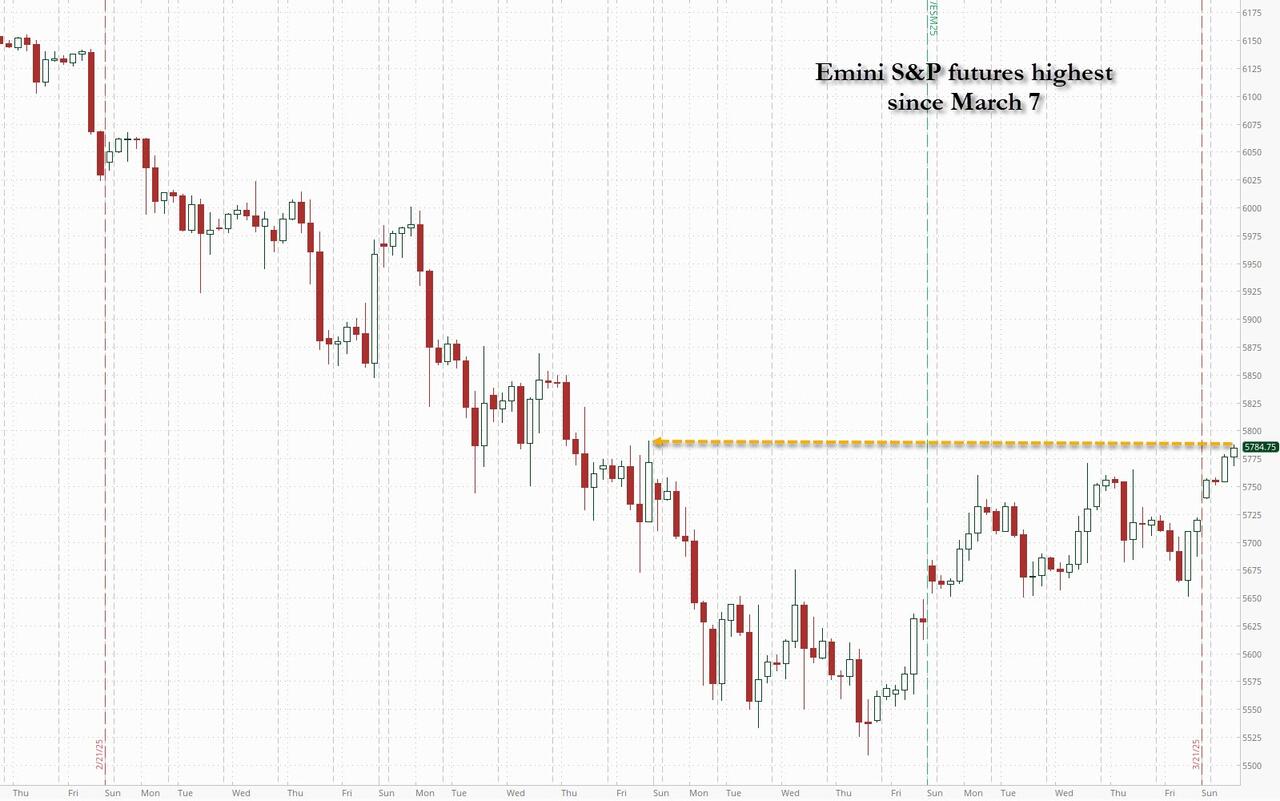 ?itok=vyyJ_kNL
In premarket trading, Tesla led gains among the Mag 7 stocks (Alphabet +1.7%, Amazon +1.7%, Apple +0.9%, Microsoft +1%, Meta +2.7%, Nvidia +1.9% and Tesla +3.7%). Nvidia and Palantir rose amid news that https://www.zerohedge.com/technology/jack-ma-backed-ant-slashes-ai-training-costs-chinese-chips
that could cut costs by 20%.
Cryptocurrency-exposed stocks advance as Bitcoin gains for a second straight session. Among shares gaining: Coinbase Global +4.4%, Riot Platforms +4.4%, Mara Holdings +4.6%
Azek (AZEK) jumps 19% after the Australian building-materials company James Hardie Industries agreed to buy the home-decking provider in a deal that valued the business at $8.75 billion in cash and stock.
FedEx (FDX) climbs nearly 1% after Jefferies turned bullish, confident in the parcel delivery company’s ability to continue to grow earnings regardless of top-line trends as it executes on its cost-cutting plans.
Lumentum Holdings (LITE) rises 4% after Raymond James upgraded the optical and photonic products company, saying that recent events from Nvidia and Corning suggest that concerns over co-packaged optics products are overblown.
Super Micro Computer (SMCI) falls about 1% as Goldman Sachs cuts its recommendation on the beleaguered chipmaker to sell amid AI server competition and margin pressures.
Viasat Inc. (VSAT) climbs 4% after Deutsche Bank upgraded the satellite communications company to buy, citing multiple paths for the company unlock value.
Investors are taking comfort from reports by both BBG and WSJ that President Donald Trump’s coming wave of tariffs is poised to be more targeted than the barrage he has occasionally threatened. The administration is not planning separate, sectoral-specific tariffs to be unveiled at the same event on April 2, officials said.
“This raises the possibility that some sectors and countries may fare better than others, helping explain market optimism,” said Daniel Murray, chief executive officer of EFG Asset Management in Zurich.
With much of Wall Street hitting peak bear in recent weeks, Morgan Stanley strategists were among those who see a turnaround on the horizon for US stocks. A dollar that’s down 3.8% from its January peak and signs of a bottoming out for Magnificent Seven earnings could attract flows back to the US, they told clients.
Elsewhere, investors were keeping an eye on Turkey where the arrest of Ekrem Imamoglu, President Recep Tayyip Erdogan’s main political rival, could spark nationwide protests. The lira fell 0.6% against the dollar, trading near record lows. Meanwhile, the dollar weakened and Treasury yields ticked higher (see more below).
Clues on the state of the US economy will come later from purchasing managers indexes. The US print is expected to show the economy remains in expansion mode.
European indexes were little changed. The Stoxx 600 rose 0.1% to 550.19 erasing earlier gains with health care, food and beverages and real estate sectors lagging, while tariff-sensitive miners outperformed. German software developer SAP SE took the spot as Europe’s most-valuable public company, unseating Danish weight-loss drug maker Novo Nordisk A/S, whose shares have declined 18% this year. Here are some of the biggest movers on Monday:
European mining stocks are the best performers as industrial metal prices climb on hopes US President Donald Trump’s next round of tariffs will be more targeted than previously suggested.
Saab gains as much as 6.5% as UBS upgrades the defense firm to buy, along with Thales, which rises as much as 3.8%.
S4 Capital rises as much as 15% after the advertising and marketing firm’s full-year results beat estimates, with the decline in like-for-like sales decelerating significantly in the final quarter.
Wood Group shares rise as much as 11%, before paring gains, after the engineering company agreed to extend the deadline by which Sidara must table a firm offer or walk away.
Deutsche Bank shares climb as much as 3.6% after RBC Capital Markets raised the price target on the German lender to match a street-high of €26.
EQT shares gain as much as 4.3% after the Swedish private equity firm was upgraded to buy from hold at ABG Sundal Collier.
RWE gains as much as 3.8% after activist investor Elliott Investment Management disclosed it has bought a sizable stake in the German utility company and called on management to increase and accelerate its share buyback program.
Wilhelmsen gains as much as 8.2% after the Norwegian shipping company announced strengthening its partnership with an established auto original equipment manufacturer and enters a 10-year contract extension.
Bayer shares drop as much as 8.9% in German trading after a jury in the US state of Georgia ordered the company to pay about $2.1 billion to a plaintiff who claimed its Roundup weedkiller caused cancer.
Kering shares fall as much as 3.8% as analysts cut their estimates ahead of the luxury firm’s first-quarter earnings due April 23, citing lack of momentum at key brand Gucci.
Hochtief shares drop as much as 4.6% after BofA Global Research downgraded the construction company, warning that the “tide could be turning” after a strong run.
Vodafone falls as much as 3.4% as BofA Global Research cuts its recommendation to neutral, citing a dilutive UK deal and competition in Germany.
Earlier in the session, Asian equities erased losses, boosted by surge in the region’s heavyweight markets of China and India. The MSCI Asia Pacific Index traded little changed after falling as much as 0.5%. Chinese technology firms gave the biggest boosts to benchmark, with Alibaba and Xiaomi among the top contributers. Mainland China and Hong Kong benchmarks rose, boosted by a rotation from small-cap stocks to their larger peers as concerns rise over earnings.
India’s NSE Nifty 50 Index was on pace to erase its loss for the year after rallying more than 1% amid early signs of a pickup in government spending and monetary easing. Japan’s Topix fell for the first time in eight sessions, after soft domestic economic data dented sentiment. Indonesia’s JCI Index recouped most of its losses after sliding to its lowest level since 2021 early in the session. Stock benchmarks also closed lower in Taiwan and South Korea. Despite the recovery, investors remain cautious ahead US reciprocal levies scheduled to go into effect next week, even after President Donald Trump indicated a more targeted approach than previously threatened.
In FX, the Bloomberg Dollar spot index fell 0.2%, while Treasury yields rose across the curve; as 10-year yield pushed 5bps higher to 4.29%. Havens JPY and CHF are the weakest performers in G-10 FX. The pound rose to session high after March PMIs indicated the UK economy showed signs of improvement. The euro stayed higher after business activity in the euro area reached its highest level in seven months as manufacturers recovered more than expected. The yen dropped as much as 0.4% to 149.85 after BOJ Deputy Governor Shinichi Uchida said on Monday that the bank will keep monitoring the economy and financial markets and raise interest rates if the bank’s economic outlook is realized. There’s a chance that “US tariff policy, which is scheduled for April 2, may be revised to a more flexible content,” says Hiroyuki Machida, director of Japan FX and commodities sales at Australia & New Zealand Banking Group in Tokyo.
In rates, US bonds underperformed gilts and bunds across the curve, with the 10-year Treasuries yield up more than 4 bps to 4.29%. Treasuries were pressured lower as US stock futures advanced after report that President Donald Trump’s coming wave of tariffs is poised to be more targeted. Intermediates lead losses on the day, steepening 2s10s spread which remains near top of Friday’s range. This week also includes duration risk through 2-, 5- and 7-year auctions starting Tuesday. Around $30 billion of corporate issuance is also expected. Treasury yields cheaper by 3bp to 4.5bp across the curve, with the 2s10s spread steeper by around 1bp on the day; US 10-year yields around 4.285% with bunds and gilts outperforming by 2bp and 6bp in the sector. Gilts notably outperform following earlier manufacturing PMI data, while Bank of England Governor Andrew Bailey will speak at 2 p.m. New York time on “growth in the UK economy.” Peripheral spreads tightened to Germany with 10y BTP/Bund narrowing ~2bps to 110bps
In commodities, spot gold is little changed at $3,023/oz. WTI trades within Friday’s range, adding 0.4% to trade around $68.53. Most base metals trade in the green; LME lead rises 2%, outperforming peers.
Looking at today's calendar, the US data slate includes February Chicago Fed national activity index (8:30am) and March manufacturing PMI (9:45am); Fed speaker slate includes Bostic (1:45pm) and Barr (3:10pm). This Week: SPX implied move through 3/28 is 2.23%. Less catalysts to watch into next week; focus will be on Consumer Confidence (Tues), final 4Q GDP reading (Thurs), and PCE/U Mich data (Fri), as well as $183bn in Treasury supply across 2, 5, and 7-year notes.
Market Snapshot
S&P 500 futures up 1.2% to 5,783
STOXX Europe 600 up 0.3% to 551.48
MXAP up 0.1% to 189.22
MXAPJ up 0.6% to 591.91
Nikkei down 0.2% to 37,608.49
Topix down 0.5% to 2,790.88
Hang Seng Index up 0.9% to 23,905.56
Shanghai Composite up 0.2% to 3,370.03
Sensex up 1.4% to 77,985.57
Australia S&P/ASX 200 little changed at 7,936.89
Kospi down 0.4% to 2,632.07
German 10Y yield little changed at 2.77%
Euro up 0.2% to $1.0844
Brent Futures little changed at $72.11/bbl
Brent Futures little changed at $72.13/bbl
Gold spot up 0.1% to $3,025.66
US Dollar Index down 0.13% to 103.96
Top Overnight News
President Trump reportedly plans his tariff 'Liberation Day' with a more targeted push, according to Bloomberg citing officials, while it was noted that Trump will announce widespread reciprocal tariffs on nations or blocs but is set to exclude some and the administration is currently not planning separate, sectoral-specific tariffs to be unveiled at the same event as Trump had once signalled. Furthermore, WSJ also reported that the "White House Narrows April 2 Tariffs" and that tariffs on industrial sectors such as cars and microchips are no longer expected to be announced although major trading partners will still be hit with reciprocal tariffs. The news has been a relief for markets gripped by anxiety about an all-out tariff war.
Trump signed a memorandum aimed at preventing abuses of the legal system and federal courts and directed the Attorney General to seek sanctions against lawyers and law firms that engage in frivolous unreasonable and vexatious litigation against the US government or departments and agencies of the government.
US President Trump’s administration revoked temporary legal status for 530k Cubans, Haitians, Nicaraguans and Venezuelans in the US effective April 24th.
US Treasury is considering streamlining bank regulators, according to Semafor; Treasury is drafting recommendations on OCC and FDIC.
A US proposal to levy Chinese-built ships docking in America would spark a trade “apocalypse” and has the potential to be devastating for the US economy, maritime experts warned. A two-day USTR hearing in Washington starts today. BBG
Ant built AI models that cost 20% less using Chinese-made chips with results similar to those from Nvidia. BBG
China said it was ready for any “unexpected shocks” ahead of US President Donald Trump imposing higher tariffs on the world’s second-biggest economy. FT
The PBOC will inject 450 billion yuan ($62 billion) of liquidity into the market through one-year medium-term lending facility tomorrow. BBG
Japan’s services PMI sank in Mar, with manufacturing coming in at 48.3 (down from 49 in Feb) and services at 49.5 (down from 53.7 in Feb). RTRS
India’s equity rout is starting to worry its legion of retail investors. Inflows into domestic mutual funds have dropped about 30% from October’s record and the influx of new entrants has slowed to a two-year low. BBG
Eurozone flash PMIs for Mar are mixed, with decent performance on manufacturing (48.7, up from 47.6 in Feb and above the Street’s 48.2) but weakness in services (50.3, down from 50.6 in Feb and below the Street’s 51.1). BBG
The UK economy showed signs of improvement, with S&P Global’s purchasing managers’ index jumping to a six-month high of 52 in March. BBG
Turkish court formally arrested Istanbul Mayor Imamoglu after prosecutors asked the court to keep Imamoglu and four aides in jail pending their trial on terrorism and corruption charges. It was also reported that Turkey’s Central Bank Governor said in a meeting with bank executives that the central bank will do whatever is necessary within market rules, while the Capital Markets Board announced a ban on short selling on the Istanbul Stock Exchange until April 25th, eased the equity ratio requirement for credit capital markets transactions and removed the maximum limit for the total amount to be used for share buybacks of listed companies.
Tariffs/Trade
US President Trump reportedly plans his tariff 'Liberation Day' with a more targeted push, according to Bloomberg citing officials, while it was noted that Trump will announce widespread reciprocal tariffs on nations or blocs but is set to exclude some and the administration is currently not planning separate, sectoral-specific tariffs to be unveiled at the same event as Trump had once signalled. Furthermore, WSJ also reported that the "White House Narrows April 2 Tariffs" and that tariffs on industrial sectors such as cars and microchips are no longer expected to be announced although major trading partners will still be hit with reciprocal tariffs.
Canadian PM Carney said they aim to have free internal trade by Canada Day on July 1st and can increase GDP by CAD 150bln by reducing internal trade barriers between provinces, while he added they will allow businesses to defer corporate income tax payments and GST and HST remittance due to new US tariffs. Furthermore, PM Carney called for a general election on April 28th and proposed a middle-class tax cut to reduce the lowest tax bracket by 1%, as well as noted that Trump’s tariffs and threat actions create the most significant crisis of our lifetime and said Trump wants to break them so the US can own them.
China reportedly explores limiting exports to mollify US President Trump and may offer to curb the quantity of certain goods exported to the US, according to WSJ citing advisers to the Chinese government. Furthermore, it was also reported that Trump directed US federal agencies to assess the economic relationship between the US and China with the review due in early April.
China’s Foreign Minister Wang said China wants to pursue trade talks with other countries.
Malaysia is to crack down on NVIDIA (NVDA) chip flows under US pressure, while Malaysia's Trade Minister said Washington suspects high-end semiconductors are making it to China despite trade controls, according to FT.
A more detailed look at global markets courtesy of Newsquawk
APAC stocks traded mixed in a rangebound fashion amid tariff and trade-related uncertainty, while weekend newflow was mostly centred around geopolitics although there were some reports that suggested the potential for a more focused approach by US President Trump regarding April 2nd 'Liberation Day' reciprocal tariffs. ASX 200 was little changed as strength in financials and consumer discretionary offset the underperformance in consumer staples and tech, while the latest flash PMI data from Australia accelerated. Nikkei 225 swung between gains and losses with price action indecisive amid a weaker currency and a deterioration in Japanese flash PMIs which all printed in contraction territory. Hang Seng and Shanghai Comp conformed to the lacklustre mood amid lingering frictions although Chinese Premier Li stated at a business forum it is necessary for countries to open up their markets in an increasingly fragmented world and that China was ready for any unexpected shocks, while the PBoC reiterated its pledge to cut rates and RRR at an appropriate time during its quarterly meeting on Friday.
Top Asian News
PBoC to conduct CNY 450bln of 1-year MLF operation on Tuesday. MLF operation to be carried out by adopting a fixed quantity, interest rate bidding, and multiple price bidding method.
Chinese Premier Li said at a business forum it is necessary for countries to open up their markets in an increasingly fragmented world and countries must work to resist risks and challenges from rising instability and uncertainty. Li also stated that China was ready for bigger than expected external shocks and will focus on combining policy intensification with stimulating market forces, as well as deepening reform of the economic system and will strive to open up chokepoints of the economic cycle.
US GOP Senator Daines met with Chinese Vice Premier He Lifeng on Saturday and noted that they are at a time when they have important issues to discuss between the two countries, while Senator Daines also met with Premier Li Qiang on Sunday in Beijing.
BoJ Governor Ueda said they cannot sell long-term JGB holdings immediately and have been gradually tapering long-term JGB holdings now. Ueda said the purpose of BoJ policy is to achieve stable prices and will not be disturbed by consideration for state finances, while he reiterated that the BoJ will adjust the degree of monetary easing if the 2% inflation target is likely to be achieved. Ueda said will not rule out the possibility of selling BoJ's government bond holdings.
Japanese Finance Minister Kato said it is important for currencies to move in a stable manner reflecting fundamentals and they will take appropriate action against excessive moves.
South Korea's Constitutional Court overturned the impeachment of Prime Minister Han, while Han stated he will address urgent issues of trade as a priority after being reinstated as the acting President.
STOXX 600 began the week on a firmer footing before trimming opening gains after a mixed APAC handover, which saw the Hang Seng close higher by almost 1% ahead of BYD earnings, the company holding a 2.8% weighting in the index, and other indices uneventful. Sentiment in Europe remains capped by ongoing geopolitics, with Russia-US talks in Ukraine ongoing in Riyadh, while Israel increases its offensive in Gaza and Lebanon. Sectors are mixed, after opening almost entirely in the green. Healthcare is the clear underperformer, led by losses in Bayer, which is down -7.4% at the time of writing. On the flip side, the best performing sector is Basic Resources, after JPMorgan gave a “Double Upgrade" to the Mining sector, which sees the likes of London-listed Antofagasta and Anglo American up 2.6% and 3.7% respectively.
Top European News
UK Chancellor Reeves ordered GBP 2bln of Whitehall cuts to help fix the nation’s finances, according to FT. It was separately reported that Reeves said the UK will cut 10,000 civil service jobs, according to Bloomberg. Furthermore, Reeves will stick to fiscal rules despite global turmoil which raises the prospect of belt-tightening measures in the budget update this week, according to Reuters.
ECB's Cipollone said key elements strengthen the case for further interest rate cuts; "recent data suggests we might reach the inflation target sooner than expected", via Expansion.
Czech Republic is to rescue Radio Free Europe after US President Trump’s funding cuts, according to FT.
Geopolitics: Middle East
"Israeli Channel 12 on government sources: The military operation will be expanded and what we have done so far has not pushed Hamas to any understandings towards reaching a deal", according to Al Jazeera.
AP said Egypt has put forward a new proposal to try to put the ceasefire between Israel and Hamas back on track.
"There are positive indications about a new Egyptian proposal in the negotiations, but the gaps are still large", according to Israel's N12.
Israeli PM Netanyahu spoke with US Secretary of State Rubio and discussed regional developments including the release of hostages and resumption of fighting in Gaza.
Israel’s military said a projectile was launched from Yemen towards Israel which was intercepted and it conducted strikes on Rafah and Khan Younis, while Israel’s military also said the division that operated in Lebanon is preparing for Gaza activity.
Israel conducted an air strike which killed Hamas political leader Salah Al-Bardaweel in the southern Gaza Strip and targeted the surgery department at Gaza’s Nasser Hospital which killed Hamas political bureau member Ismail Baarhoum.
US peacekeepers said an escalation of the volatile situation at the Lebanon-Israel border could have serious consequences for the region, while it was reported that Israeli PM Netanyahu ordered strikes against dozens of targets in Lebanon in response to rocket fire although Hezbollah denied any link to rocket launches from southern Lebanon on Saturday.
White House National Security Adviser Waltz said the US took out key Houthi leadership during strikes in Yemen, as well as weapons factories and some drone facilities, while he added that the US is seeking full dismantlement of the Iranian nuclear program in a way the entire world can see.
US envoy Witkoff said Hamas is the aggressor here and had every opportunity to demilitarise and accept the bridging proposal but they elected not to. Witkoff also stated that their signal to Iran is let’s sit down and see if we can get to the right place through diplomacy, while he added that Iran cannot have a nuclear bomb which cannot and will not happen.
Iran’s Foreign Minister Araqchi said talks with the US are impossible unless Washington changes its pressure policy.
Iranian Foreign Ministry warned of the repercussions of the new Israeli escalation against Lebanon, according to Sky News Arabia.
Geopolitics: Ukraine
Negotiations between the delegations of the Russian Federation and the US last about two hours; "the parties do not plan to complete the meeting in the near future", according to TASS.
Russia's Kremlin said Saudi Arabia negotiations are underway on technical issues, there are many different aspects related to a settlement in Ukraine that need to be worked out. The Black Sea initiative is on the agenda in these talks. There is a common understanding with the US on the willingness to move towards a settlement
Russia's Defence Ministry says Ukraine attempted to attack an oil pumping station in Russia's Krasnodar region, according to IFAX; the station is out of operation for repairs.
Russia's Kremlin, on energy strike moratorium, said they are monitoring the situation after attacks by Ukraine.
Ukraine and US delegations began talks in Saudi Arabia, while Ukrainian President Zelensky said the Ukrainian delegation is working in a completely constructive way and the conversation is quite useful. There were also comments from the Ukrainian Defence Minister that the agenda for talks included proposals to protect energy facilities and critical infrastructure.
White House National Security Adviser Waltz said the US is talking through a number of confidence-building measures to end the Russia-Ukraine war including the future of Ukrainian children taken into Russia.
US envoy Witkoff said the US expects a lot more progress on the Russia-Ukraine conflict and that Russian President Putin does not want to take all of Europe with the situation much more different than WW2.
White House is aiming for a Russia-Ukraine truce agreement by April 20th, according to Bloomberg.
Russia’s Kremlin said the Putin-Trump call was a step towards a face-to-face meeting and talks in Saudi Arabia will be as well. It was also reported that the Russian Defence Ministry said Russian forces took control of Sribne in eastern Ukraine, according to IFAX.
Geopolitics: Other
South Korea’s Foreign Minister said sanctions against North Korea must be carried out faithfully and that North Korea should not be rewarded for its wrongdoing in the course of the war in Ukraine.
Venezuela’s government said it will resume repatriation flights of migrants from the US beginning on March 23rd.
US Event Calendar
08:30: Feb. Chicago Fed Nat Activity Index, est. -0.17, prior -0.03
09:45: March S&P Global US Composite PMI, est. 51.3, prior 51.6
09:45: March S&P Global US Services PMI, est. 51.0, prior 51.0
09:45: March S&P Global US Manufacturing PM, est. 51.8, prior 52.7
DB's Jim Reid concludes the overnight wrap
I hope you had a good weekend. I'm off to New York after sending this to print, assuming Heathrow is open. I thought I had a proud parenting moment to share this morning. Maisie entered a poetry competition across several schools a few weeks ago and on Friday we got a letter saying that her poem is going to be published in a book. I helped her with one line of it and I nodded with approval at the judge's verdict. My suspicions were raised when the letter also said you could buy as many copies of the book as you wanted for relatives at £20 a pop. I then heard from other parents that unless the poem was truly awful or contained profanities then virtually all get published. Sounds like a great business model.
Talking of great publications, our German economics team have now updated their economic forecasts (link here) after the debt break reform passed its final legislative challenge in the Bundesrat on Friday. There remains a lot of uncertainty on the magnitude and timing of the fiscal expansion to come but they now expect real GDP growth to accelerate to 1.5% in 2026 and 2.0% in 2027 even as they lower 2025 two-tenths to 0.3%. A point we already stressed in the inaugural paper for the DBRI (see here) is that we would expect a deficit-fuelled growth spurt to fizzle out after 2027. While productivity-enhancing investments in defence and infrastructure could raise potential growth, it would take deep structural reforms to get German growth rates back to 2% sustainably. So the trillion-euro question is whether Germany will use the sugar rush recovery to implement much needed reforms or whether the stronger growth will actually make it feel less pressing and politically more difficult. My view is that we will probably see the positive growth impacts before we know if they will fail to do the reforms. So momentum still remains in the German risk trade for now in my opinion.
Looking to this week now, it will be the last full week before the April 2nd US tariff announcement. So expect lots of headlines on this. Indeed US equity futures are higher this morning on Friday's story that tariffs will be more targeted than the worst fears.
Outside of trade, inflation will take centre stage with the all-important US core PCE on Friday. Before that, UK and Australian inflation are out on Wednesday with flash French and Spanish CPI out on Friday, alongside Tokyo CPI. In terms of other highlights, today’s global flash PMIs will be interesting. US and Europe bounced last month but since then the tariff rhetoric has aggressively stepped-up, but on the other hand Germany has reversed decades of fiscal conservatism. So, it’ll be interesting to see how the surveys respond to those developments. Other notable US economic indicators due include the Conference Board’s consumer confidence index tomorrow following a slide in the University of Michigan gauges last week (we have the final reading for this on Friday). Talking of confidence tomorrow sees the latest German IFO so we’ll get another chance to see if the fiscal package has changed the outlook or whether the threat of tariffs dominate. The IFO is only decimals off the recent lows which were only weaker at the height of the GFC and briefly at the start of Covid. Wednesday then sees US Durable Goods and the latest Spring statement from the UK with the fiscal finances precariously balanced given the self-imposed fiscal rules. See our economists’ preview here. Thursday will see the final Q4 US GDP print and latest trade data which will both impact Q1 GDP trackers. The trade data may see an import surge ahead of likely increases in tariffs. Also of note will be the latest Congressional Budget Office Federal debt and statutory limit report as well as the long-term budget outlook (all the way to 2055) on Wednesday and Thursday, respectively.
With regards to central banks, highlights include the summary of opinions from the March BoJ meeting on Thursday. In Europe, the ECB will publish its consumer expectations survey on Friday, the same day as Norway’s central bank will decide on rates. In China, highlights include the 1-yr MLF rate fixings tomorrow as well as industrial profits for February on Thursday. Focus will also be on the annual China Development Forum ending today in Beijing. Many CEOs of blue-chip American and European corporates are attending.
The full day-by-day week ahead is at the end as usual but let's preview the core US PCE on Friday. Personal income (+0.2% vs. +0.9%) and consumption (+0.3% vs. -0.2%) should normalise in opposite directions but the core PCE deflator (+0.37% vs. +0.28%) is likely to edge up and if we're correct that will push the YoY rate up a tenth to 2.8%. The recent stronger-than-expected inflation readings have caused our economists to mark up their 2025 inflation forecasts. They now see Q4/Q4 core CPI and core PCE inflation at 3.0% and 2.7%, respectively.
Over the weekend the news flow intensified in Türkiye with key opposition leader, and Istanbul mayor, Ekrem Imamoglu being jailed on corruption charges after being detained by police last week. The fact that he wasn't charged with terrorism means the news isn't as extreme as it could have been as such a move would have led to the appointment of a trustee to the Istanbul Municipality, risking more protests and unrest. The Bloomberg TRL equity index fell -17.59% last week and the central bank hiked overnight lending rates by 200bps to 46%. Last night the regulator broadened a short-selling equity ban and relaxed company share buy-back rules to try to help stabilise markets. So one to watch this morning.
Asian equity markets are generally lower this morning with US equity futures the bigger movers on tariffs hopes. S&P (+0.66%) and Nasdaq (+0.79%) contracts are leading the way. Elsewhere the Shanghai Comp (-0.40%), KOSPI (-0.27%), Hang Seng (-0.12%) and the Nikkei (-0.07%) are slightly lower. Yields on 10yr USTs (+3.4bps) have climbed to 4.28%.
Early morning data showed that the Japanese au Jibun Bank manufacturing PMI fell to 48.3 in March from 49.0 in February, contracting for a ninth consecutive month. The decline was led by softer overseas demand for goods. At the same time, service activity shrank for the first time in 5 months, falling to 49.5 in March from 53.7 in the prior month. Following the data release, the Japanese yen (-0.34%) is drifting lower for the third successive day trading at 149.83 against the dollar.
Looking back at last week now, and a more positive market tone just about dominated with the S&P 500 (+0.51%) rising for the first time in five weeks. Earlier in Friday’s session, the index had been on course to post another weekly decline but recovered to close +0.08% higher on the day in part thanks to more sanguine comments from President Trump who said that “there’ll be flexibility” in the upcoming reciprocal tariff plans though he appeared to oppose any outright exemptions. Sectorally, rotation away from tech mega caps continued, with the Mag-7 down -0.63% on the week, though it did see a sizeable +1.41% jump on Friday.
In Europe, equities also saw modest gains with the Stoxx 600 +0.56% higher on the week, despite Friday’s -0.60% retreat. Southern Europe led the weekly gains with Italy’ FSTEMIB (+0.98%) and Spain’s IBEX (+2.65%) reaching their highest levels since 2007 and 2008 respectively. Germany’s DAX (-0.41% on the week due to a -0.47% fall on Friday) saw a modest decline for a second week running, though it is still +14.98% higher YTD.
Bond markets mostly posted steady gains, with 10yr Treasury yields falling -6.6bps to 4.25% (+0.9bps Friday), supported by Powell’s dovish undertones at the latest Fed meeting. Money markets ended the week pricing 70bps of Fed cuts by year end, up +5.6bps on the week. In Europe, bonds saw a similar rally with 10yr bund yields falling -11.0bps to 2.76% (-1.5bps Friday) even as the outgoing German parliament approved the constitutional amendment to loosen the debt brake.
Finally, commodities posted gains, with Brent crude oil seeing its largest rise in ten weeks (+2.24% to $72.16/bbl) amid increased supply uncertainty, while copper rose +4.48% to within 1% of its May 2024 record high. And gold again touched new record highs, up +1.27% to $3,022/oz (-0.75% Friday).
https://cms.zerohedge.com/users/tyler-durden
Mon, 03/24/2025 - 08:22
There's An iPhone Moment Happening With Humanoids
There's An iPhone Moment Happening With Humanoids
By Eric Peters, CIO of One River Asset Management
“There’s an iPhone moment happening with humanoids,” said Brett Adcock, founder of Figure, a humanoid robotics company in California. “It’s going to happen right now,” added the serial entrepreneur, his robots already working on the production line in BMW’s Spartanburg factory. Another major corporate customer is trialing his robots for warehouse work. “To succeed at this, you have to do three things that have never been done before. And you have to get all three of them right within the next 5yrs or you’re going to fail for sure.”
“The first thing is you have to build hardware for humanoids that’s incredibly complex and can never fail, and it’s got to work at human speeds with human range of motion,” explained Adcock. “The second thing is a neural net problem, not a control systems problem. You can’t code your way out of this problem. You need to have a robot that can ingest human-like data through a neural net and it has to be able to imitate what humans do. Humanoid robots are not like arms bolted to a factory table. None of those robots have AI.”
“The third problem is that you then have to generalize. This is the holy grail of robotics,” explained Adcock. “To have a robot look at something it’s never seen before, or heard through speech, and to be able to tell a robot how to do it, and then have it be able to complete that task end to end with one neural net,” he said. “If you can solve those three things, then you’re in the right decade and you’re at the iPhone moment,” he said. “And we can confidently say we have solved or are making major progress on all three problems.”
“If we had 100,000 robots today that all worked, our two commercial customers would take them all,” said Adcock, not able to leverage scaled up supply chains because they do not yet exist, it’s still early. Which nation wins remains up for grabs. “And we could sign on fifty Fortune 100 companies by the weekend. We are bombarded by demand. The supply of humans is going down.” The working age population is in steep decline across the developed world. “There is unbounded demand. We could ship 1-million robots this month if they were all ready to go.”
I asked Perplexity to tell me about the leading companies that are producing humanoid robots. Perplexity is an AI that excels in searching the web for the most up-to-date information. I now use different robots depending on the type of task. I’d guess that someday soon we’ll all have multiple robots. Anyhow, Perplexity gave me the top ten companies. Brett Adcock’s Figure, Boston Dynamics, many others I’d never heard of. Tesla made the list of course, its Optimus humanoid robot, run on a proprietary AI, getting smarter every day I drive.
https://cms.zerohedge.com/users/tyler-durden
Mon, 03/24/2025 - 08:05
https://www.zerohedge.com/markets/theres-iphone-moment-happening-humanoids
Is The EU's New Army The Final Nail In The Project's Coffin?
Is The EU's New Army The Final Nail In The Project's Coffin?
Authored by Martin Jay,
The EU army idea is actually more complicated than you might think...
 ?itok=4AKcuBZu
It used to be quite a common thing for people in polite society to say “imagine if women ran the world…we would certainly have less wars, right?”. Wrong. Women are running the world, well, at least the EU world. Three women to be precise. Ursula von der Leyen, EU commission boss, Annalena Baerbock, Germany’s foreign minister and of course, last but not least, the EU’s own foreign affairs chief, Kaja Kallas. And what do all three of these women have in common, apart from having names which sound like sexually transmitted diseases? They all want war.
In line with spectacularly poor decision making right from the beginning of the Ukraine war, with probably Russian sanctions at the top of the list of stupid ideas, the EU has only one way forward in Ukraine. At whatever cost, it must come out at least not looking like it lost. The EU project is very much like an old man on a bike moving very slowly along a Dutch cyclists’ path. The fear from the elites in the EU is that if he falls off the bike, he will never get back on. The constant worry from top EU figures is that if the EU loses its momentum with press coverage and relevance in general, then a pause – any pause – could be devastating. This, you might be surprised to hear, is what EU officials themselves confided in me when I was based in the Belgian capital. Such an expression gives you an idea of how little confidence the EU has in itself as a worthy, stable long-term project.
And so the madness escalates now to such a point where we are actually looking at draining the wallets and purses of our own very poorest people to fund the ultimate EU sex toy going: an EU army.
The idea of an EU army is not new. As a notion, it’s as old as the hills as hard core federalists in Brussels have been arguing for the EU to have its own army for at least twenty years, but until now failed. The main reason for the idea not getting off the ground is that it created too many new, worrying political problems for the EU to wrangle with. In a nutshell, there was always a risk of a new political crisis that an EU army would create as member states argue over which country gets to run it, which nationality is its head, where it would be based and how politically would it be run, based on what decision making structure? (existing EU council, EU commission, member states themselves in a new set up via defence ministries). The concern was always that Germany would have too much power and then this would open an old wound about the country re-arming and rekindling memories of 1939. And we all know where that led.
The EU army idea is actually more complicated than you might think. One of the reasons why it never got off the ground despite several serious attempts is that both the EU and member states are both confused and lack confidence about such a bold plan. They are literally concerned the idea could blow up in their faces. It’s what Americans call ‘blowback’. No, that’s nothing to do with the German foreign minister or even innuendo. It’s a military term for when a gun throws back energy in your face when it discharges and wounds whoever is holding the weapon.
For a long time the EU itself wanted the army to be very much controlled by Brussels but knew that the big guns would not wear that. And so, for them, like those in the European Commission it was about giving power away to a new body, a new layer of EU power, as though there aren’t enough institutions in Brussels which already sap away power from member states. The attitude was somewhat self-defeating. ‘If we (the commission) don’t create this entity, then Germany may well do it on their own anyway, and then we will lose the power’ is the mentality in Brussels. Indeed, Germany for at least a decade has been toying with the idea of having its own EU army, which creates a real headache for Brussels as it gives crucial power to one member state who many would argue already wields quite enough in the first place. The German parliament a few years ago leaked a document suggesting a new international army which Germany would run, which would be sent to troubled hotspots around the world and would be joined by a few allies who would play a supporting role.
The problem with this is twofold.
One, a good number of Germans would be very unhappy about his and believe that Germany should never be allowed to return to its former military power of the 1930s.
Secondly, under such a set-up, the EU would suffer considerably as it would throw a spotlight on its own weakness and underline how ineffective Brussels is, given that it has no military edge and that one member state has gone rogue with a geo-military policy.
And so two scenarios present themselves:
Germany being the main player in an EU army created and apparently run from Brussels – at least in appearance; or
Berlin running its own EU army which isn’t called an EU army but the rest of the world will consider it to be one.
Neither of these scenarios really does the EU any favours.
But it would seem this is what these three ladies have their eye on.
Which is why they have put so much emphasis on 800 billion euros being found among EU member states contributions, so that it will have an EU badge and its centre of power would be Brussels. France, Germany, Italy, Poland and the UK would be part of such a new, shiny EU pillar of NATO. And yet, it is Britain’s role, considered crucial, which will dilute the EU dream of it being entirely a Brussels wet dream project. In many ways, the reaction from these three women follows last year’s conference set up by Macron to create a coalition of EU member states, plus the UK, for big foreign policy ideas which would run parallel to the EU’s foreign thingy in Brussels. Defence spending and sending an EU army – which included the UK and Turkey – to places where the EU felt it could confidently flex its muscles was part of the whole plan.
For these three wicked witches to conjure up such a Macbethian plan to slay Macron and his big idea is worrying on a Shakespearian level, to say the least. It’s hard to say at the moment of writing whether it’s a real plan, as it’s already been blocked by the Netherlands, or it’s a plan on paper designed to impress Trump at a critical moment of negotiations. Does the EU believe that these talks could go on for months, perhaps even a year or more and so therefore to send a few hundred tanks to Kiev would only bolster both Zelenksy’s and the EU’s credibility as players when neither are actually even sitting on the reserves’ bench? Possibly. Have the tanks even been built? Nope.
One witty pundit for RT, a former anchor, opined quite amusingly about the role of the UK, suggesting that London’s ability to be a global military player is out of touch with reality.
“The British defense secretary claims that the need for a weapons shopping spree actually comes from a place of deep, inner hippie-ness” Rachel Marsden wrote.
“The Ukrainians want peace. We all want peace. And as defense ministers, we have been discussing and we are working to strengthen the push for peace, John Healey said, probably itching to get back home to squeeze into some bell bottoms and smash the bongo drums”.
It reminded me of the 1980s satire puppet show in the UK called ‘Spitting Images’ which cruelly depicted Ronald Reagan muttering “We want peace…a piece of Nicaragua, a piece of El Salvador”.
And what’s wrong with bell bottoms?
https://cms.zerohedge.com/users/tyler-durden
Mon, 03/24/2025 - 02:00
https://www.zerohedge.com/geopolitical/eus-new-army-final-nail-projects-coffin
DHS Revokes Temporary Legal Status Of 530,000 Immigrants
DHS Revokes Temporary Legal Status Of 530,000 Immigrants
(emphasis ours),
More than 530,000 immigrants who entered the United States under the former Biden administration’s humanitarian parole program will have their legal status revoked late next month, according to a notice by the Department of Homeland Security (DHS) on March 21.
 ?itok=JZagP9lA
DHS Secretary Kristi Noem stated in the https://public-inspection.federalregister.gov/2025-05128.pdf
that the department will end the two-year parole program, known as CHNV program, launched in 2022 by then-President Joe Biden to allow entry of people from Cuba, Haiti, Nicaragua, and Venezuela, who had U.S. sponsors.
Noem said that DHS will revoke the parole status of those immigrants on April 24, or within 30 days of the notice’s publication in the Federal Register. The notice is scheduled for formal publication on March 25.
“Parolees without a lawful basis to remain in the United States following this termination of the CHNV parole programs must depart the United States before their parole termination date,” she stated.
The notice states that Noem may terminate parole if she determines that “neither urgent humanitarian reasons nor significant public benefit warrants the continued presence of the alien in the United States” or when “the purpose for which it was authorized has been accomplished.”
Biden launched the https://www.uscis.gov/CHNV
program for Venezuelans in October 2022 to reduce illegal border crossings by flying eligible immigrants directly to the United States. It was expanded in January 2023 to include immigrants from Cuba, Haiti, and Nicaragua.
The program allows up to 30,000 immigrants from the four countries into the United States each month, provided they meet certain conditions, including having a sponsor in the United States who will provide them financial support.
According to the DHS notice, about 532,000 immigrants have been allowed entry into the country under the CHNV parole program since 2022, but it remains unclear how many still hold valid parole status.
In August 2024, the Biden administration https://www.theepochtimes.com/us/dhs-puts-migrant-parole-program-on-hold-amid-alleged-fraud-in-application-process-5699040
parole program after authorities discovered fraudulent information in thousands of application forms filed by sponsors.
An internal report by the U.S. Citizenship and Immigration Services (USCIS) uncovered sponsors using fake Social Security numbers, Social Security numbers of dead people, and false phone numbers.
Later that year, the Biden administration https://www.theepochtimes.com/us/us-will-not-extend-legal-status-of-migrants-who-entered-via-parole-program-5735764
parole recipients from extending their legal status but continued accepting new applications for the parole program.
After taking office on Jan. 20, President Donald Trump signed several executive https://www.theepochtimes.com/us/homeland-security-ad-campaign-warns-illegal-immigrants-to-self-deport-5812058
, which was established by the Biden administration to allow those without legal entry papers to schedule appointments at U.S. ports of entry.
Following Trump’s order, acting DHS secretary Benjamine Huffman https://www.dhs.gov/news/2025/01/21/statement-dhs-spokesperson-directives-expanding-law-enforcement-and-ending-abuse
a directive to end “the broad abuse of humanitarian parole” and phase out any parole programs that do not align with Trump’s policy.
“The Biden-Harris Administration abused the humanitarian parole program to indiscriminately allow 1.5 million migrants to enter our country,” Huffman stated on Jan. 21. “This was all stopped on day one of the Trump Administration.”
Karen Tumlin, founder and director at Justice Action Center (JAC), a nonprofit organization advocating immigrant rights, called the Trump administration’s move to end the CHNV program “reckless” and “cruel.”
that the DHS’s sudden revocation of the legal status of CHNV parole recipients could cause “needless chaos and heartbreak for families and communities across the country.”
“Justice Action Center will continue to stand alongside beneficiaries and their sponsors to protect humanitarian parole in court, where we will defend humanitarian parole on Monday at 11 a.m. in Boston,” Tumlin said.
JAC is representing a group of beneficiaries, sponsors, and the Haitian Bridge Alliance in a https://justiceactioncenter.org/news/u-s-sponsors-and-beneficiaries-sue-over-trumps-attempt-to-end-humanitarian-parole/
filed against the Trump administration on Feb. 28, challenging the termination of the humanitarian parole program and efforts to halt all pending applications.
https://cms.zerohedge.com/users/tyler-durden
Sun, 03/23/2025 - 15:10
https://www.zerohedge.com/political/dhs-revokes-temporary-legal-status-530000-immigrants
Hegseth Orders Additional Carrier To Middle East Amid Yemen Escalation
Hegseth Orders Additional Carrier To Middle East Amid Yemen Escalation
Renewed conflicts are popping off in Gaza, in Yemen, and possibly next in Lebanon https://www.zerohedge.com/geopolitical/new-rocket-launches-put-israel-hezbollah-brink-war-once-again
. US Central Command has this month restarted air raids against Houthi positions in Yemen, having launched at least three successive waves of attacks last week, in operations which soon after were dubbed 'continuing'.
Now the Pentagon is beefing up the Navy's warship presence in the region. The Associated Press has reported that "Defense Secretary Pete Hegseth, in a rare move, is beefing up the Navy warship presence in the Middle East, ordering two aircraft carriers to be there next month as the US increases strikes on the Yemen-based Houthi rebels, according to a US official."
Typically there is only one carrier in the region, with two signifying a much greater war-readiness. As part of the move Hegseth signed orders to keep the USS Harry S. Truman in the Middle East for an additional month.
 ?itok=9uYaSFWy
This despite the Houthis (Ansarallah movement) seeking to target the carrier as it traverses the Red Sea and regional waters. The Pentagon has yet to ever say that the carrier has been hit, or been close to getting struck - though the Houthis have claimed some five attempted recent drone and missile attacks on it.
"And Hegseth has ordered the USS Carl Vinson, which has been operating in the Pacific, to begin steaming toward the Middle East, which will extend its scheduled deployment by three months," the https://www.navytimes.com/news/your-navy/2025/03/21/hegseth-beefs-up-middle-east-warship-presence-with-2-aircraft-carriers/
continues.
"The Vinson is expected to arrive in the region early next month. It had been conducting exercises with Japanese and South Korean forces near the Yellow Sea and the Sea of Japan and was slated to head home to port in San Diego in three weeks," it adds.
This new carrier show of force in the Middle East region came within days of President Trump freshly warning that the Houthis will be completely annihilated if they don't immediately halt their drone and missile attacks in the Red Sea, and also as CENTCOM confirmed it is engaged in "continuous operations against Iran-back Houthi terrorists."
Below is a map showing the current distribution of US naval assets around the globe, courtesy of Stratfor.
 ?itok=Gc2LHOtF
Trump's warning on Truth Social had https://www.zerohedge.com/geopolitical/trump-threatens-houthis-complete-annihilation-us-continuous-bombing-yemen
, "Tremendous damage has been inflicted upon the Houthi barbarians, and watch how it will get progressively worse — It’s not even a fair fight, and never will be. They will be completely annihilated!"
Yet the Houthis have vowed they will not back down. According to an earlier Houthi statement in https://thecradle.co/articles/new-us-airstrikes-hit-yemen-as-ansarallah-pledges-to-meet-escalation-with-escalation
to American military action:
“After engaging with our armed forces, US aircraft carrier retreated as far as 1,300 km north of the Red Sea,” Ansarallah leader https://www.saba.ye/en/news3452433.htm
said on Monday.
“We are confronting US aggression by targeting its aircraft carrier, warships, and naval vessels, with greater escalation options if it persists. If the situation and responsibility require us to take a bigger step or bigger action, we will not hesitate, and we are ready for this option,” Houthi said during a televised speech.
The Defense Minister in the Ansarallah-led National Salvation Government, Major General Mohammed al-Atifi, also https://sarabic.ae/20250317/%D8%A3%D9%86%D8%B5%D8%A7%D8%B1-%D8%A7%D9%84%D9%84%D9%87-%D8%AA%D8%B1%D8%AF-%D8%B9%D9%84%D9%89-%D8%AA%D8%B1%D8%A7%D9%85%D8%A8-%D8%B3%D9%86%D9%82%D8%A7%D8%A8%D9%84-%D8%A7%D9%84%D8%AD%D8%B5%D8%A7%D8%B1-%D8%A8%D8%A7%D9%84%D8%AD%D8%B5%D8%A7%D8%B1-%D9%88%D8%A7%D9%84%D8%AA%D8%B5%D8%B9%D9%8A%D8%AF-%D8%A8%D8%A7%D9%84%D8%AA%D8%B5%D8%B9%D9%8A%D8%AF-%D9%88%D8%A7%D9%84%D8%A8%D8%A7%D8%AF%D8%A6-%D8%A3%D8%B8%D9%84%D9%85-1098725588.html
that the YAF “[is] ready to develop the confrontation in a manner commensurate with the scale of the challenge and any emergency.”
"The naval battle against the Israeli enemy, following its violation of the ceasefire agreement in Gaza, is not like before," Atifi said.
🚨🇺🇸SECOND U.S. AIRCRAFT CARRIER SENT AS MIDDLE EAST ERUPTS
The Pentagon is sending the USS Carl Vinson to join the Harry S. Truman in the Middle East, boosting firepower as war spreads beyond Gaza.
Trump says the Houthis will be “completely annihilated” and warned Iran of… https://t.co/8EhW119Bym
— Mario Nawfal (@MarioNawfal) https://twitter.com/MarioNawfal/status/1903590011972571238?ref_src=twsrc%5Etfw
One question for Americans which remains is: where's Congress? One regional Mideast publication has observed there's a growing divide in Trump's base over the Yemen response - https://www.aljazeera.com/news/longform/2025/3/21/discordant-how-trumps-attacks-on-the-houthis-split-his-republican-base
.
https://cms.zerohedge.com/users/tyler-durden
Sun, 03/23/2025 - 14:35
Worry More About "Certainty" Than "Uncertainty"
Worry More About "Certainty" Than "Uncertainty"
By Peter Tchir of Academy Securities
Worry More About "Certainty" than "Uncertainty"
Uncertainty seemed to be the word of the week on Wall Street. Uncertainty this. Uncertainty that. Everywhere you turned, it was about uncertainty.
We should be more worried about certainty than uncertainty.
Uncertainty seemed to give courage to the bulls, who seem to claim that everyone is bearish, yet I see little evidence of that (we will tackle that at the end of today’s report).
April 2nd is now being designated as Liberation Day.
Presumably, we will get “certainty” on Liberation Day of what the U.S. tariff strategy is, and then markets can “rally” as we will now have “certainty” and a plan.
As much as that would be nice if true, there are a LOT of reasons to doubt that “certainty” will be a good thing. It reminds me very much of trading through the GFC and the European Debt Crisis. The market would focus on an issue. The government (or central bank) would finally get around to addressing that issue or concern. Yet, the relief rally, if any, would be muted since the market had already moved on to the next issue.
If Liberation Day gets watered down, I can be more aggressive on taking risk, but for now, the “certainty” of what we get may force us to really think through it, and I suspect many will start leaning towards more downside risk to markets even if the plans work out over time (which I think, is a big IF).
We Already Have Some Evidence that the Plan Isn’t Well Thought Out
There are many things we could point to, but let’s just take a look at tariffs with Canada and Mexico.
The tariffs were going to be 25% across the board, but tariffs on energy were only 10% (makes some sense, though if you subtract Canada’s energy exports to the U.S. from the total, Canada is a net importer from the U.S., but we can ignore that).
Almost immediately, there was a carve out for the auto industry. Anyone with any scant bit of knowledge about the North American auto industry could have foreseen that. Yet the government didn’t.
Shortly after, the exemption was for anything USMCA compliant. Since this was a reasonably newly signed deal and one signed by the current president, it seems logical that this exemption would make sense. Why wasn’t it caught?
The USDA Expediting $10 Billion in Direct Economic Assistance to Agricultural Producers. I missed this https://www.usda.gov/about-usda/news/press-releases/2025/03/18/usda-expediting-10-billion-direct-economic-assistance-agricultural-producers
on March 18th. The stated rationale, by Secretary Rollins, is that “Producers are facing higher costs and market uncertainty.” What is the cost? As one example, out of many possibilities, let’s look at potash. Using Grok (since it seems most likely to be aligned/used by the administration) it turns out that the U.S. imports about 90% of its potash, with 85% to 90% of that coming from Canada.
Is this aid just circular? The farmers pay the government tariffs (yes, the importer does pay the tariff) and then the money works its way through the system and gets paid back to the farmers via this aid? But wasn’t the point of tariffs to raise money? Wasn’t the point of DOGE to cut government spending? Not saying any of this is wrong, but it does seem like there could have been better planning around this.
How much potash is available in the U.S.? No idea, and no idea what cost it comes at. With 25% tariffs, will it be better to find it domestically? Maybe, maybe not. Domestic sources certainly won’t be ready for this year, and will it even be ready (if feasible) by next year? This will be another theme/concern that plays out regularly today. Could some come cheaper from Ukraine? Presumably, but I have no idea who their potash is contracted to (though maybe existing contracts may get overridden by the minerals deal once signed?). Also, I have to wonder how it gets transported here efficiently, at the best of times, let alone when the entire world might be scrambling to change supply chains?
We know in theory what the tariffs are supposed to do, but in the early, simplest round, it is far from clear that they worked. To me, at least, there is evidence that they haven’t been planned out as well as they could have been. See last weekend’s section on https://academysecurities.com/macro-strategy-insights/when-blue-jeans-were-a-symbol-of-freedom/?asmac=41142166-0367-487b-ad64-c2b0e3610a60
.
Short Staffed, 100 vs 1, on 3 Fronts
The president has been able to get his secretaries confirmed at a good clip. Yet many undersecretaries are yet to be confirmed, and it is unclear whether all of the staff positions have been filled. As good of a job as this administration has done at getting up to speed, they are still a bit understaffed and have many who are just getting familiar with their roles, and the tools at their disposal. Normally this is not an issue, as administrations ease into their first 100 days, but that is not the case here.
With Reciprocal Tariffs, there is some element of “negotiation” at work. But every country we are targeting presumably has a team to analyze the tariffs they impose and any that the U.S. imposes. In a one versus one negotiation I’d have complete confidence that we understood the tariffs, what mattered, and what didn’t, as well as the other side. Heck, if the U.S. was negotiating with 3 or 4 countries, I’d expect the U.S. to have as much insight into the existing scenarios as the other countries. But every country on earth? The risk that countries “give” concessions on things that don’t really help the U.S. (things the U.S. doesn’t make, or doesn’t make for that market, or even with tariffs, isn’t really competitive) is high. And vice versa. There is a lot of talk out of D.C. about holding cards, but you need to at least look at the cards and it might be very difficult when playing 100 hands simultaneously.
The 3 fronts as I see them are:
Peace/War. Syria. Iran/Israel and the proxies. Russia and Ukraine. I won’t address these today as we’ve covered them quite a bit at Academy Securities, but they do take time away from senior government officials and are impacting how the world sees the U.S.
DOGE. We all know what DOGE is intended to do, but how it is playing out is somewhat curious. We will examine this later today as it is a key part of our overall concern.
Tariffs. We’ve already hit on this, but will come back for more.
Price Levels, not Inflation, Matter
While we all talk about inflation, and the Fed (and even the administration) seems to think very academically about the subject (rate of change), I don’t think that is how it plays out in the real world. We can talk about “inflation” from tariffs as being “transitory,” and that is correct, but the changes to price levels will be anything but transitory. A bunch of economists quietly celebrating the transitory nature of tariffs may well be missing the point, and that could be making them overly optimistic about the economy.
Keeping the Current Tax Rates is NOT a Tax Cut
If the administration fails to keep the existing tax code from sunsetting. that will be a tax HIKE. Extending is not the same as a tax cut for the economy. No one is out there spending less today because they are worried that their take home pay next year might decline. That might happen if it looks like the extension won’t occur.
A big part of the need to get the deficit down and to extend the tax rules in place is only to keep the status quo.
I think this is incredibly important when thinking about the deficit and the economy.
The Middle Class is not the Stock Market
The administration has been very consistent on their messaging. If you wrote it as a computer program it would look something like this.
Make the Middle Class Great Again.
Tariffs to encourage manufacturing to return to the U.S. and to raise revenue.
If 1 has been achieved go to step 5.
If 1 has not been achieved go to step 2.
Celebrate.
Nowhere is there a “check the S&P 500 level” before going back to step 2. The messaging seems clear to me:
We believe our policies will work.
If they don’t work initially, they will eventually work.
If they don’t eventually work, then we didn’t do enough.
I have absolutely no problem with their goal and support it wholeheartedly!
My problem is that while I still see some possibility of the policies working as advertised, I’m increasingly seeing paths to a much worse outcome.
DOGE, Immigration, and Jobs
We labelled this “front” as DOGE, but it might be easier to think of DOGE, Immigration, and Jobs on one level.
The Federal government is firing people. The number remains a bit of a mystery, but this is occurring.
Immigration is down and presumably some illegal immigrants have left or are not working in the same capacity as they were before.
I find it difficult to believe that many of the government workers will fill jobs that had been filled by illegal migrants. The skill sets don’t match very well.
So, one thing that will weigh on the economy is that in this job market, many of those let go may have difficulty in finding new jobs easily with similar pay in the same geographic location.
Having jobs freed up because people not eligible to work in the U.S. have left seems in line with the goals of this administration.
But who will fill those jobs?
Probably not people getting laid off from “white collar” jobs.
Can we get the labor participation rate higher? It hovered above 66% from 2000 until the GFC. Only after the GFC did is start declining, but it was above 63% coming into COVID. It is currently just 62.4% so there is room to get people back into the labor force.
Do you entice them with higher wages? Presumably, these jobs would have been available to citizens or those here legally, but people chose not to fill those jobs. So, the “carrot” would be higher wages, increasing inflation.
Do you “force” people into the job market by cutting benefits? The “stick” side of the equation would be to slash benefits because it seems likely that there are some people who choose benefits over work. By reducing benefits, it would force people back to work. That would be very much in line with the efforts by DOGE.
These jobs, with a combination of tactics, might get filled with little inflation pressure. There is likely to be some, but part of the bargain of creating a strong middle class is to not provide as much support to those who could work but aren’t.
Having said all that, it doesn’t really create new jobs, it just changes who is getting the jobs, so there won’t be a lot of new spending, just different people spending. Which tells me that if the economy is going to benefit, it is from the reduced government spending side that lets the administration fund other projects (like tax cuts).
Any way I cut it, I see weakness for the economy in the coming months and I don’t think that we see any benefits unless we can really change taxes with the savings, and we can get actual tax cuts rather than just extensions.
Housing Gluts!
Housing gluts! I don’t think that is a term that has been in a macro report in a long time. But there seems to be some evidence that the number of listings are increasing dramatically in some areas, even to pre-Covid levels. The https://fred.stlouisfed.org/series/ACTLISCOUFL
There are likely a lot of factors at work here, but it does seem likely that the changes in immigration rules and enforcement could be one of those factors.
I’m torn on what this means:
On the one hand, more affordable housing would ease the burden for many families.
On the other hand, for many families, their biggest asset is their home’s appreciation, and that might be problematic for the economy.
I suspect that there were a number of “buy to rent” type of properties out there (based on where inventory is increasing the most) which might then hurt the pocket of investors who were involved, but overall, it will benefit the communities as affordable housing helps.
Again, I haven’t got a strong opinion on this, but it is a new dynamic, and one we need to digest.
Tariffs
Here is why I’m increasingly nervous (terrified) about the tariffs:
It is far from clear that we have a coordinated plan to maximize the benefits without hurting the economy (see the early examples).
It will disrupt global supply chains, hurting everyone. With over 1/3 of the S&P 500 earnings coming from overseas, there is a risk purely on the economic side.
I don’t see evidence of excess capacity in the U.S. Whether it was steel last weekend, or any other product we wind up discussing, there is very little evidence that there is a lot of excess capacity that can get turned on. For big things, the timeframe is years not months, to build out manufacturing at scale in the U.S. Anything that has a hope of being competitive will need to be done at scale and will require a lot of resources (including advanced robotics). These are not done quickly. It will take a leap of faith by even the most aggressive companies to spend massively in the U.S. based on tariffs – especially if the global economy is shaky. Jobs will be created during the build out, if that occurs, which would be good.
This might be the lynchpin of my concern with the government plan. If we see rapid efforts to build plants, those jobs alone could get us through the hump (along with the tariff income), but I think neither the global economy, nor the domestic economy will warrant that. It would help on the regulatory front (in particular, but also on many fronts) to get Congress to pass legislation rather than relying so heavily on executive orders.
This is all predicated on the https://academysecurities.com/macro-strategy-insights/the-american-brand/?asmac=18e0c066-16dc-4787-bc88-aa8d8530190a
but it might give a taste of what is to come.
According to Grok, global GDP was $110 trillion in 2024 – which lines up with World Bank estimates. US GDP is almost $30 trillion and far bigger than any other country. But the administration doesn’t seem to be picking a fight with any one country, it seems to be going against them all. That is a risk.
Domestic Politics
I’m loath to bring this up, but domestic politics are likely to play a role in the success of these programs. If there was bipartisan support to get the U.S. through the difficult times (that even those who fully believe the strategies will work admit to), then seeing a positive outcome would be easier. There will be much dissent as the politicians continue to divide and much of the country is divided. While the electoral college win was large, many key states came down to the wire, so we will also have to watch how public support plays out, from those “middle” voters who went Republican in the last election. While there may not be a Trump Put for the stock market, there might be one on the political popularity side.
Again, much of this comes down to the “how” and not the “what,” but this time around the “how” may really affect the “what” (which it didn’t really do during Trump 1.0).
Remembering Japan
I remember growing up being worried about Japan “dominating the world” – at least economically. Their brands were soaring in popularity. Car brands that you had never heard of suddenly were all over the road. Allegedly better quality at a lower price.
Their TVs were everywhere (I believe that TV glass is still priced in YEN, despite the fact that the manufacturing of TVs is heavily dominated by China and South Korea now).
What the heck happened to Japan?
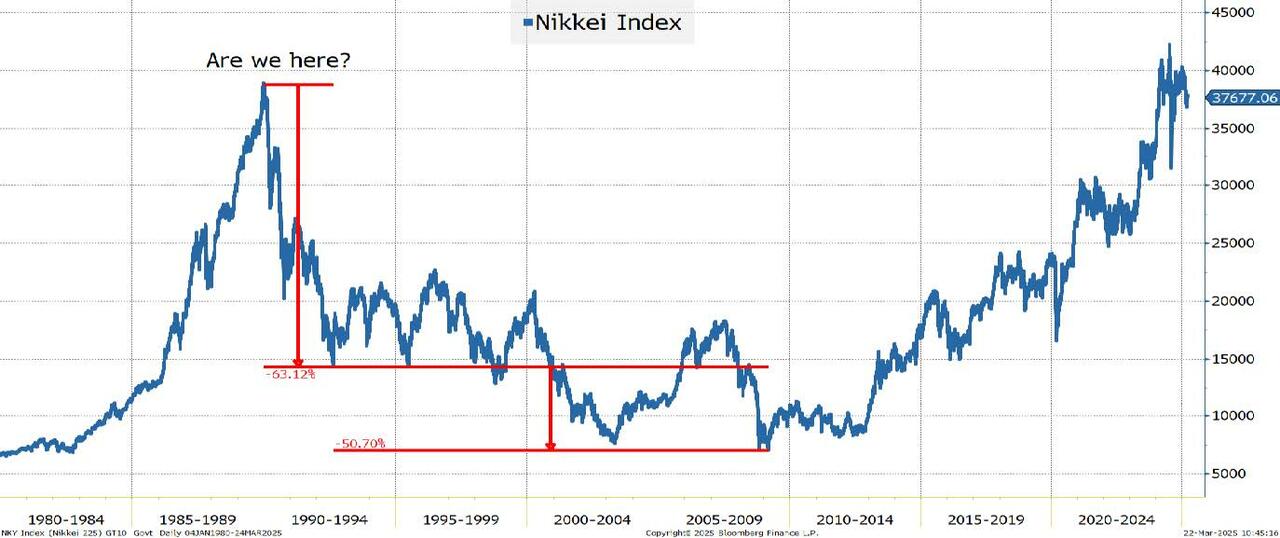 ?itok=VyBBtnn0
I’m not as bearish as this graph implies, but it deserves at least a moment of your time.
Did anyone wake up on January 1st, 1990, thinking – it is over for Japan?
Was it obvious at the time that the market would fall 60% in 2.5 years? Sure, there were some big bounces, but the declines were quite ugly and relentless. Would anyone have bet on January 1, 1990, that it would take over 30 years to recoup the losses?
Maybe it was “obvious” in hindsight, but I suspect not.
So here we are, trying to change the world order in supply chains, and domestic government spending, in a short time and we have no fear that we are overstating our power and ability?
I’m not lying awake at night thinking about this, there are plenty of other things keeping me awake at night, but it does crop up in my mind periodically.
U.S. Stocks So Oversold!
I’m not sure how to make the title of this section ooze with sarcasm, so I will just run with it.
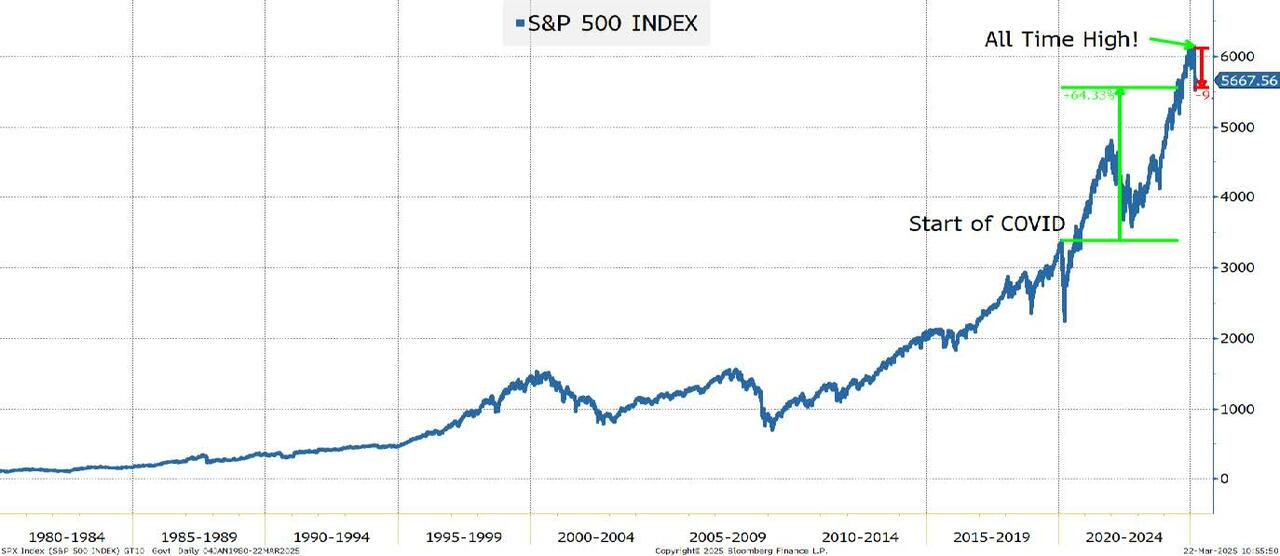 ?itok=mooA6NiY
We were at an all-time, like highest level ever, as recently as February 19th. The S&P 500 is down 5.7% in a month and 3.5% year to date.
Check out the shares outstanding of these funds
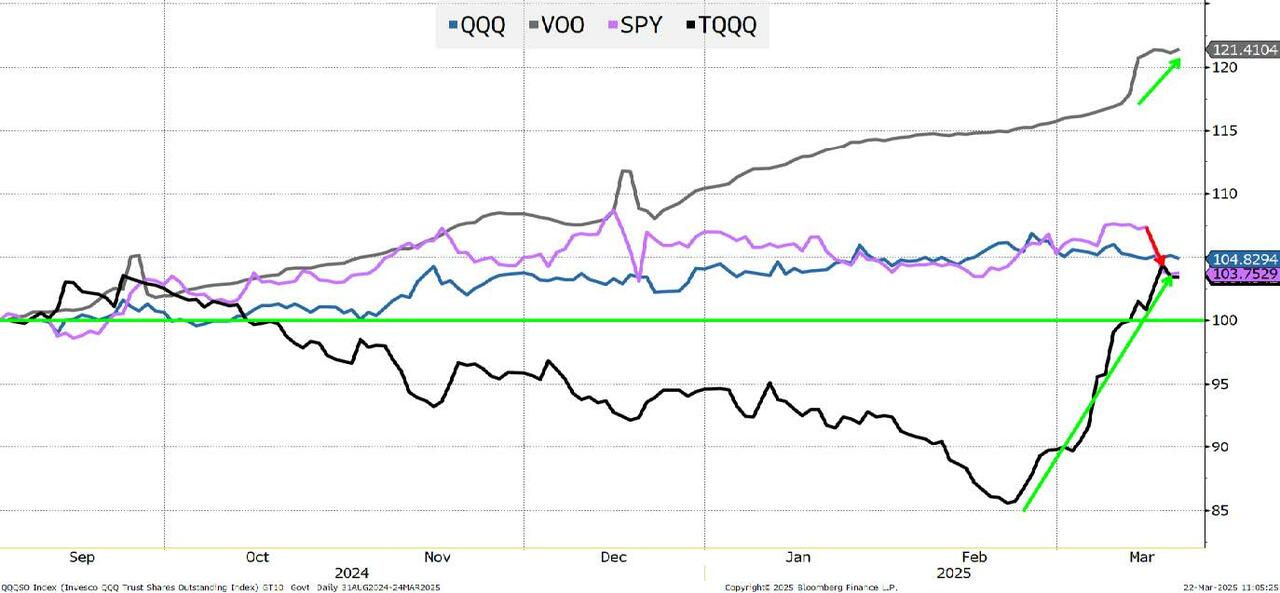 ?itok=folNWW5n
We chose to start at August 31st, as there was enough time for the Democratic Convention in Chicago’s “halo” effect to wear off.
VOO – is a $620 billion S&P 500 ETF. Steady like a rock in terms of inflows (the recent spike likely due to annual contributions to 401k accounts as it is less of a trading vehicle than others).
SPY – a $585 billion S&P 500 ETF has barely budged in terms of share count.
QQQ – a $301 billion Nasdaq 100 ETF has seen some small outflows, but pretty negligible and still more shares outstanding than before the election.
TQQQ – a $21 billion 3x Nasdaq 100 ETF has seen inflows surge. I do have to give the “degens” who trade TQQQ (I use the term affectionately) credit for selling out during the rally, but they are showing the exact opposite of capitulation. People seem to want to mock this fund, despite it controlling $63 billion of Nasdaq 100 risk in a risky form, while celebrating the potential for pension fund rebalancing, which is a similar size. Just because something is weird and quirky, doesn’t mean it isn’t useful.
I understand all the hopes for a big rally and some of the rationale, but it seems like a lot of people are long risk “because everyone else is short risk” when the evidence that everyone else is short or underweight isn’t as compelling as I’d like to see.
Bottom Line
Too Much, Too Fast, Too Poorly Planned.
I guess I could have saved you a lot of time and just written that for today’s T-Report (though I hope walking through what is behind that synopsis is helpful).
I’m now bearish on global risk. I won’t be as bearish on the U.S. because I’m being convinced by so many people that we are due for a big bounce, but I think for now, risky assets across the globe are likely to suffer (though I still lean long China as they seem poised to benefit from the disruption in global supply chains). Probably a different story if China was targeted by itself, but that’s not what we’ve got so far.
Difficult to hate rates here, when I’m this bearish on the economy, but given my concern about global capital flows and the ability to drive the deficits down by finding purely wasteful spending or increased income from tariffs, I cannot love the 10-year at 4.25% either. I still think the range is 4.1% to 4.5%.
Maybe everyone will love the “certainty” when we get the Liberation Day announcement (though I expect we will see hints dropped all week on Truth Social), but I think we should be careful what we wish for.
When we transition from speculating what could happen, to figuring out the likely consequences of what happened, I expect another round of selling pressure on equities – likely across the globe.
If Liberation Day gets watered down, I can be more aggressive on taking risk, but for now, the “certainty” of what we get may force us to really think through it, and I suspect many will start leaning towards more downside risk to markets even if the plans work out over time (which I think, is a big IF).
On that positive note, hopefully you are crushing it in your NCAA brackets! I’m looking forward to this week as we hit Dublin, London, and Paris and should get a good take on their perspectives on what is happening.
https://cms.zerohedge.com/users/tyler-durden
Sun, 03/23/2025 - 14:00
https://www.zerohedge.com/markets/worry-more-about-certainty-uncertainty
Sudan's Army Retakes Control Of Presidential Palace After Two Years
Sudan's Army Retakes Control Of Presidential Palace After Two Years
Sudan's army has taken full control of the country's presidential palace in Khartoum, two years after it was seized by the paramilitary Rapid Support Forces (RSF). After closing in on the building on the Blue Nile in recent days, the army-aligned government announced its capture on Friday.
"Today the flag is raised, the palace is back and the journey continues until victory is complete," Khaled al-Aiser, Sudan’s information minister, https://x.com/aleisir/status/1902962553963057350?s=48
on X.
 ?itok=I865ifiD
Footage posted on social media showed armed troops cheering inside the palace complex. The RSF seized the palace complex, and large swathes of the capital in April 2023, when its war with Sudan's army began.
It forced the government, which is led by army chief Abdel Fattah al-Burhan, to flee to Port Sudan on the Red Sea coast.
The palace complex consists of two buildings: the original Ottoman-Egyptian republican palace built in 1825, and a much larger structure built in 2015 by former head of state, Omar al-Bashir.
The older building is a highly symbolic structure. In 1885, followers of Muhammad Ahmad bin Abd Allah famously killed the British major-general Charles George Gordon on the Republican Palace's stairs. The death of "Gordon Pasha" and the fall of Khartoum marked the end of Ottoman-Egyptian rule in Sudan.
Both the new and old buildings https://www.middleeasteye.net/news/sudan-crisis-army-destroy-khartoum-republican-palace
at the beginning of the fighting two years ago. On Friday, the army said it had also taken control of ministries and other key buildings in central Khartoum.
Jihad Mashamoun, a Sudanese researcher and political analyst, said the victory at the palace paved the way for the army to make further gains in the capital, “and to encourage it to mostly delegate the conflict in Darfur to the allied armed movements”.
"It also allows the de-facto government of Burhan to impose itself as the legitimate government of Sudan to the international community," Mashamoun told Middle East Eye.
Drone strike
An unnamed Sudanese army source told AFP that hours after the recapture, an RSF drone strike on the palace killed three journalists. The journalists had been reporting for Sudanese state television when an attack drone targeted the site.
The RSF said that it remained in the vicinity of the palace, and that the battle was "not over". The army has made key gains in central Sudan in recent months, capturing swathes of territory back from the paramilitary force.
However, the RSF has consolidated its grip over the western Darfur region, where it has been accused of committing genocide.
(commonly known as Hemeti). Burhan has also been sanctioned.
BREAKING: Sudan's Army retakes control of the Presidential Palace in central Khartoum from RSF militias after two years. https://t.co/MWGaeLtHB5
— Clash Report (@clashreport) https://twitter.com/clashreport/status/1902962993010254310?ref_src=twsrc%5Etfw
Last month, RSF leaders convened in Kenya to announce that the group was launching a https://www.middleeasteye.net/news/rsf-parallel-government-divide-sudan-africa
. Mashamoun said the army gains in Khartoum would “further unravel some of the political parties allied to the RSF who signed the charter to form the parallel government”.
It would also undermine the legitimacy of the RSF in trying to “impose itself as partners in any transition period with the de-facto government”, he added.
There are fears the rival government could lead to the so-called https://www.middleeasteye.net/news/sudan-libya-crisis-talks-resume-split-looms-large
, where Sudan is split into two or more different entities.
The two-year conflict has displaced more than 10 million people, and left over 12 million https://www.middleeasteye.net/news/half-sudans-population-faces-acute-food-insecurity-msf-warns
. Thousands have been killed.
https://cms.zerohedge.com/users/tyler-durden
Sun, 03/23/2025 - 08:45
Hungary's Orban Continues Blocking EU's 'Pro-War' Stance On Ukraine In Key Vote
Hungary's Orban Continues Blocking EU's 'Pro-War' Stance On Ukraine In Key Vote
Hungary continued this past week being a lone EU voice blocking the European Union's collective efforts to ramp up more financial and military aid to Ukraine, at a moment Prime Minister Viktor Orbán has a powerful backer in Washington - the Trump administration.
Hungary in a Thursday European Council summit vote refused to endorse a statement reaffirming the bloc’s commitment to Ukraine’s sovereignty and territorial integrity. The Orbán government slammed the 'pro-war' stance of the EU, despite 26 out of 27 EU nations signing off on it.
While the statement had only largely symbolic significance, saying Europe backs the "continued and unwavering support for Ukraine’s independence, sovereignty and territorial integrity" - Orban described that this only prolongs the war and brings the conflict no closer to peaceful resolution.
 ?itok=tU9_R4v4
"Once again, they wanted to adopt a common position in which we want to give Ukraine even more money and even more weapons, and we are committed to the war," the Hungarian leader explained after the veto.
"Over the past three years, Hungarian families have lost around 2.5 million forints (approximately €6,268) per household as a result of the war. I must stop this, and we must not allow Hungarian families to continue to pay the economic consequences," Orbán stated.
He urged European capitals to get in Trump's corner, who is seeking a diplomatic solution. But here's how The Associated Press and other outlets characterized Hungary's stubborn refusal to go along with https://apnews.com/article/eu-hungary-ukraine-trump-politics-orban-aid-4428d8e43049d4ac53c392905eea9378
:
At the same time, Orbán is also emboldened by U.S. President Donald Trump, who is pushing for a ceasefire in Ukraine. Trump has blamed Ukraine for Russia’s unprovoked invasion, all while accusing Kyiv of unnecessarily prolonging the biggest land war in Europe since World War II.
Orban described further in an interview with https://rmx.news/article/hungary-holds-the-line-for-peace-as-orban-vetoes-eu-position-on-ukraine-at-european-council-summit/
...
"There is one way to achieve this: if we get Europe to support the president of the United States in his peace efforts, instead of embarking on war adventures, and then there will be peace. This debate took place, but we were unable to convince each other."
He continued, "I vetoed the common position, and therefore the European Union has no common position. What will be made public here today is nothing more than the private position of 26 member states, not the common position of the European Union, because without Hungary such a position cannot be accepted."
"The president of Ukraine is confused about his role, he is behaving as if he were in the European Union and therefore could afford to take a sharper tone when he cannot do so. He is an applicant who wants to join the European Union, about which opinions are divided," Orbán remarked.
Parrel to all of this, NATO is seeking to 'Trump-proof' the alliance for the long-term, which reports of https://www.zerohedge.com/geopolitical/europes-lead-militaries-drafting-5-10-year-plan-replace-us-nato
on how to replace United States leadership in the alliance some five to ten years down the road, amid fears that Washington will retreat from leadership, and its majority financial and weapons support to NATO.
https://cms.zerohedge.com/users/tyler-durden
Sun, 03/23/2025 - 07:35