
Futures Erase Losses As Markets Brace For Earnings Avalanche
Futures Erase Losses As Markets Brace For Earnings Avalanche
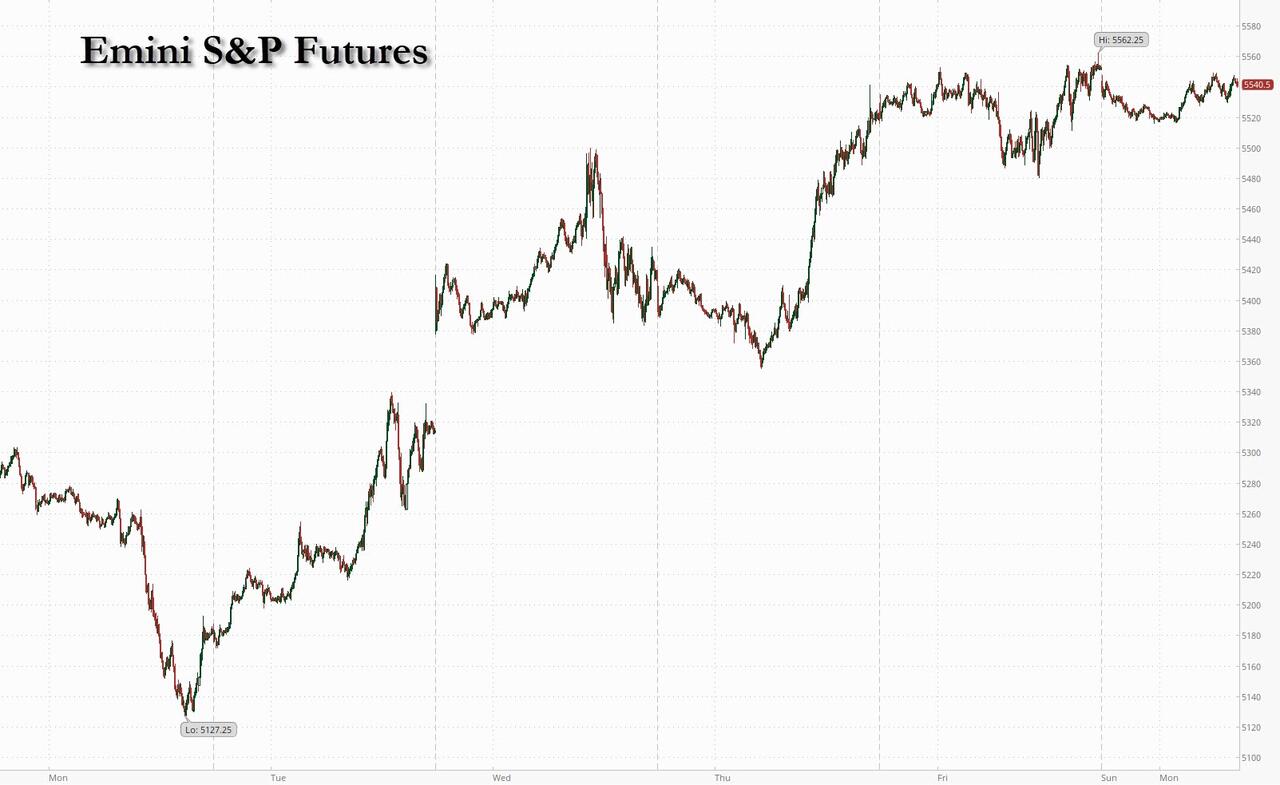
US equity futures are little changed, reversing earlier losses as much as 0.5%, as global markets are broadly in the green amid a burst of positive sentiment, which even pushed JPM's recently bearish trading desk to turn tactically bullish this morning (more in a subsequent post). As of 8:00am ET, S&P and Nasdaq futures are down 0.1%, but well off session lows. Nvidia shares fell 1% in premarket after the Wall Street Journal reported China’s Huawei Technologies is getting ready to test a new and powerful artificial intelligence processor that the company hopes can replace some products made by Nvidia; other Mag7 names are mixed with Cyclicals/Semis under pressure and Defensives catching a bid. Europe's Estoxx advanced 0.5% over early London session with gains led by info tech and consumer staples; Asian stocks were also broadly higher with Japan erasing all post-Liberation day losses. US equities are focused this week on the tech sector, with Microsoft, Apple, Meta and Amazon all reporting earnings. The week also includes the April US jobs report, due Friday. Bond yields are higher as the curve bear steepens and the USD starts the session stronger. This is a data-heavy week but today’s focus is on regional Fed activity but the key’s this week are NFP, JOLTS, ISM-Mfg, and 25Q1 metrics.
 ?itok=JKo2pNQs
In premarket trading, Nvidia shares slip after the WSJ reported that Huawei is getting ready to test an artificial intelligence processor that the Chinese tech giant hopes can replace some Nvidia products; others Mag7 stocks are Alphabet 0.06%, Meta Platforms +1%, Amazon +0.1%, Tesla +0.8%, Nvidia -1.5%, Microsoft -0.2%, Apple 0.6%. Boeing rises 1.5% as Airbus SE agreed to take over some assets and sites from Spirit AeroSystems, clearing the way for Spirit to be acquired by Boeing. Also, Bernstein upgraded Boeing to outperform, noting that the aircraft maker is now “making the progress it needed for the growth trajectory.” Eli Lilly slips 1.6% after HSBC double downgraded the stock to reduce — a sell-equivalent rating — from buy, saying the drugmaker’s risk-reward “is not attractive.” Here are some other notable premarket movers:
CG Oncology (CGON) soars 40% after presenting data on cretostimogene grenadenorepvec monotherapy data at the American Urological Association annual meeting.
Jack in the Box (JACK) rises 4% after Stifel upgrades to buy, saying new CEO Lance Tucker “has created a viable plan to strengthen the balance sheet.”
Peloton Interactive (PTON) gains 6% after Truist Securities upgraded the fitness company to buy, saying the stock is finally nearing a point where the company’s improving fundamentals should support a recovery in shares.
Revolution Medicines (RVMD) climbs 5% after presenting initial data from a Zoldonrasib study in patients with non-small cell lung cancer.
US futures posted modest moves as investors awaited reports from American companies worth $20 trillion, including four https://www.zerohedge.com/markets/we-enter-eye-tech-earnings-hurricane-heres-good-news-and-bad-news
AAPL, AMZN, MSFT and META, and watched for progress in US trade talks with Asian partners. Wild gyrations sparked by Trump’s April 2 tariff announcements have eased somewhat, but investors will be scrutinizing this week’s key company reports for the earnings impact of US trade policies. Fresh readings on the state of the American economy may support hopes of earlier-than-expected Federal Reserve interest-rate cuts.
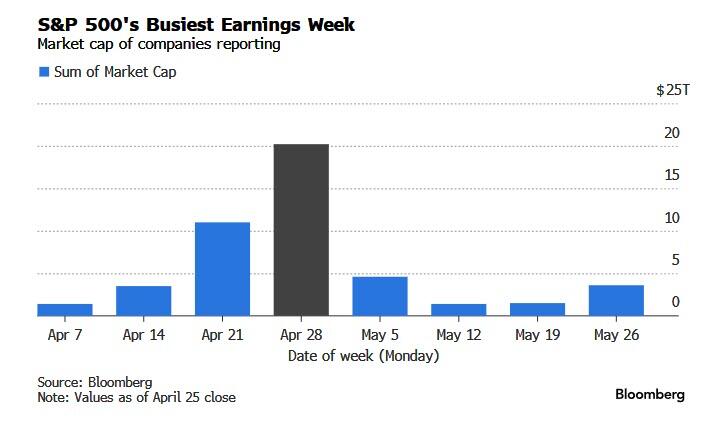
Four of the Mag 7, Microsoft, Apple, Meta and Amazon, are due to report earnings this week. Analysts expect the group to deliver an average of 15% profit growth in 2025, a forecast that’s barely budged since the start of March despite the flareup in trade tensions. In terms of market capitalization, it’s the busiest week of the year for earnings, with S&P 500-listed companies worth $20 trillion reporting.
 ?itok=qRUeANiI
Investors are also watching for any signs of progress in US trade negotiations after Trump suggested another delay to his higher tariffs was unlikely. Asian economies, facing some of the highest US “reciprocal” tariffs, are leading the way over their western counterparts in talks with the administration.
“Ultimately, it seems that we’re moving towards a place where these policies start to make a little more sense,” Themistoklis Fiotakis, global head of FX strategy at Barclays Plc, told Bloomberg TV. “If this starts shaping up in a place where markets can understand it, can quantify it, then I think that things are going to normalize.”
To help manage the next steps, the Trump team has drafted a framework to handle negotiations with about 18 countries, including a template that lays out common areas of concern to guide the discussions. US Treasury Secretary Scott Bessent said the administration is working on bilateral trade deals with 17 key partners, not including China. Bessent reiterated the administration’s argument that Beijing will be forced to the negotiating table because China can’t sustain Trump’s latest tariff level of 145% on Chinese goods. Its standoff with China will likewise limit the potential benefits the US can reap from deals with Asian trading partners, according to Phoenix Kalen, global head of emerging markets research at Societe Generale SA.
“Already there has been a lot of investor sentiment and positioning for some deals to be done, especially with Japan, especially with South Korea,” Kalen told Bloomberg TV. “But the scope is going to be relatively limited and hampered. The concern especially for Asian trade partners around how China will respond to the terms will limit the extent to which they can agree to certain terms with the Trump administration.”
Meanwhile, Friday’s US non-farm payrolls figures will also turn attention to the health of the American economy. “In general I think this week’s data won’t be too bad for the economy because it really precedes the announcement of tariffs,” Kathy Jones, chief fixed income strategist at Charles Schwab & Co., told Bloomberg TV. “The inflation numbers shouldn’t be too bad. But I’ll really be watching the ISM numbers at the end of the week and of course, the jobs data where we could see some softness.”
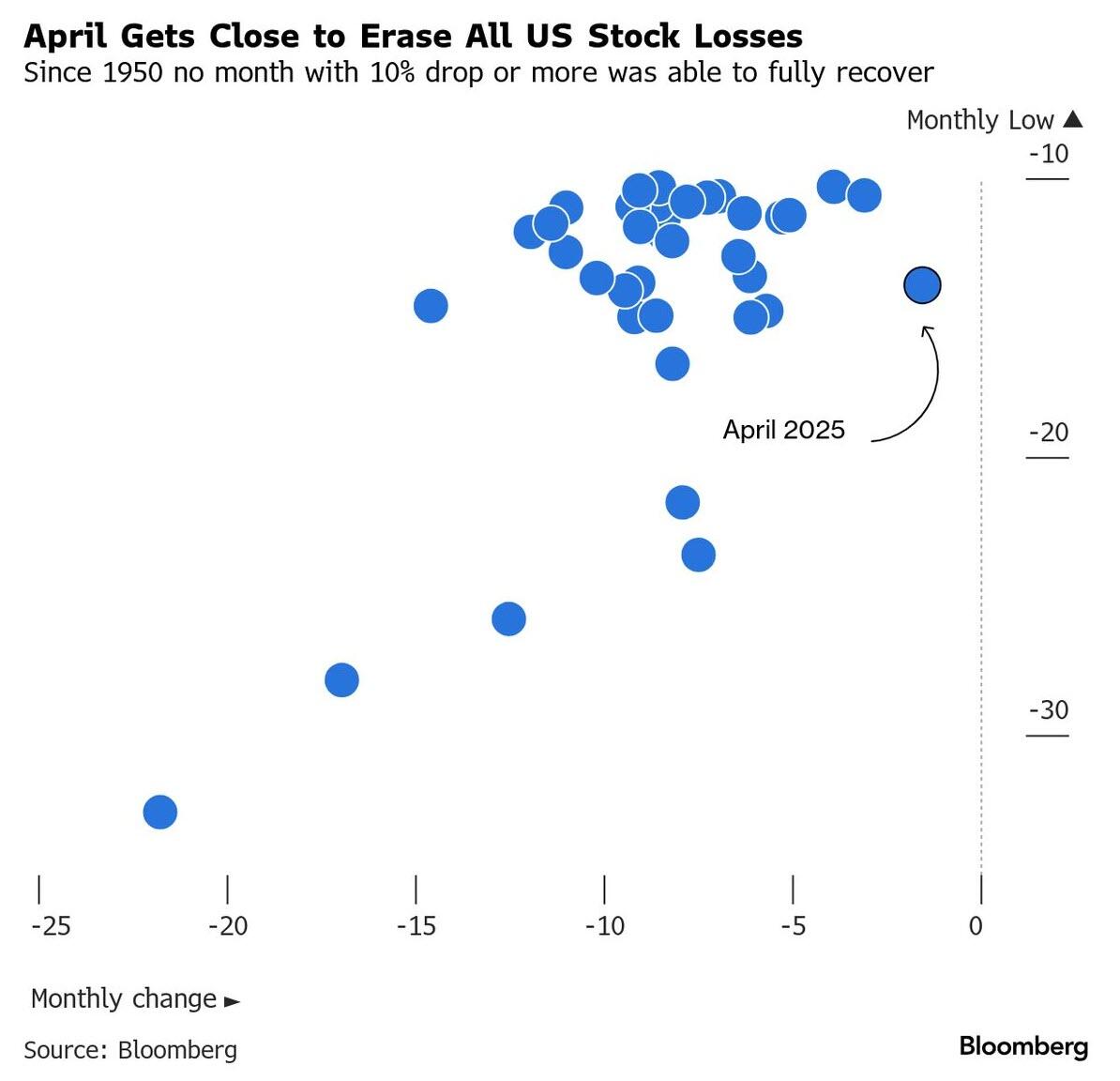
The S&P 500’s recovery month-to-date from a 14% drop to -1.5% as of Friday’s close is one of the best rebounds since 1950. Still, the bounce has been too narrow to instill much confidence in a sustainable longer-term rally. Traders may stay cautious as gains have been largely headline and short-covering driven. Volatility is abating but remains elevated. It’s also coming up to the 100-day mark for Trump’s presidency.
 ?itok=pHOF2RDN
In Europe, the Stoxx 600 is set to extend its winning streak to a fifth session as it climbs 0.7%, boosted by M&A news out of Italy as Mediobanca made a €6.3 billion ($7.1 billion) offer for the wealth management arm of Italian insurer Assicurazioni Generali SpA. Food & beverage, travel & leisure and bank stocks are leading gains while real estate and industrials lag. Here are some of the biggest movers on Monday:
Deliveroo stock soars as much as 18% to 173p after the food-delivery firm said that DoorDash has made a cash takeover proposal at 180p a share, and it would be “minded to recommend such an offer” to shareholders.
Traton shares rise as much as 5.5% after the German truckmaker posted first-quarter results, with analysts welcoming a strong order intake.
Interpump shares rise as much as 4.1% in Milan trading after BNP Paribas Exane analysts upgraded the Italian hydraulics and pumps manufacturer, saying it is “an overlooked M&A story with positive risk/reward.”
ITV shares drop as much as 3.8% after a report that France’s Banijay Group is working on plans for a takeover offer for the entire broadcaster or its studio arm. Analysts note reports of interested bidders are building, but a deal isn’t a certainty.
Fraport drops as much as 4.5% after Jefferies downgrades the airport services provider to underperform from hold, saying it’s overexposed to slowing transatlantic and business traffic.
Nagarro shares fall as much as 16%, to a record low, after the German IT services firm postponed the publication of its full-year results.
BoneSupport falls as much as much as 6.6% after the company announced its CEO Emil Billback is stepping down after more than seven years in the role.
Valneva shares drop as much as 20% after French regulators decided to suspend the use of its chikungunya vaccine Ixchiq for people aged 65 years and older.
Earlier in the session, Asian shares also rose as focus shifted to a slew of major earnings from the region, while signs that trade tensions may have peaked, at least for now, helped sentiment. The MSCI Asia Pacific Index rose as much as 0.8%, adding to last week’s 2.2% gain. Japanese benchmarks outperformed following a report on Toyota Motor Corp. chairman’s proposal to buy out Toyota Industries. Indian shares resumed their climb amid foreign inflows, while Chinese stocks were range-bound as officials reiterated their plan to strengthen support for employment and the economy. The flood of tariff-related headlines has slowed somewhat, and investors are turning their attention to earnings to gauge how Asian firms are prepared to tackle higher levies. The region is facing its busiest earnings week this season, with China’s biggest banks including Industrial & Commercial Bank of China Ltd. and Bank of China Ltd. set to release results.
“Broadly, we’re seeing some relief positioning as there is some refocusing on fundamentals, which I would say is tariff fatigue,” said Billy Leung, senior investment strategist at Global X ETFs in Australia. On China’s earnings, markets want to see more commentary from corporates on domestic confidence, he added.
In rates, treasuries were cheaper across the curve, with futures extending a drop into the early US session as investors digest news around US trade talks with Asian partners. US yields were cheaper by 2bp to 5bp across the curve, with intermediates underperforming slightly, flattening 5s30s spread by 2bp on the day. US 10-year yields traded around 4.27%, down 4 bps from Friday's close; European bonds also decline with bunds lagging by 1bp and gilts outperforming 1bp. Next Treasury coupon auction is scheduled for May 5.
In FX, the Bloomberg Dollar Spot Index is flat; New Zealand dollar lags G-10 peers and the pound leads gains, rising 0.3% against the greenback.
In commodities, spot gold falls $42 to around $3,278/oz. Oil prices are steady with WTI just below $63 a barrel.
In crypto, bitcoin rose 1.1% to $95,344.86; ether rose 0.9% to $1,819.53.
Looking at the US economic calendar, it's quiet - we only have the April Dallas Fed manufacturing activity at 10:30am. Fed officials are quiet due to blackout period. This week also includes JOLTS, consumer confidence, PCE, GDP, ISM manufacturing and April payrolls. Fed’s external communications blackout ahead of the May FOMC meeting started Saturday.
Market Snapshot
S&P 500 mini -0.2%
Nasdaq 100 mini -0.2%
Russell 2000 mini -0.3%
Stoxx Europe 600 +0.6%
DAX +0.7%
CAC 40 +0.8%
10-year Treasury yield +3 basis points at 4.26%
VIX +0.7 points at 25.51
Bloomberg Dollar Index little changed at 1226.26
Euro -0.2% at $1.1347
WTI crude -0.2% at $62.92/barrel
Top Overnight News
Trump posted on Truth that “When Tariffs cut in, many people’s Income Taxes will be substantially reduced, maybe even completely eliminated. Focus will be on people making less than $200,000 a year. Also, massive numbers of jobs are already being created, with new plants and factories currently being built or planned. It will be a BONANZA FOR AMERICA!!! THE EXTERNAL REVENUE SERVICE IS HAPPENING!!!”. Trump also posted that “…this is a crucial week to work on “THE ONE, BIG, BEAUTIFUL BILL,” which will contain Massive Tax Cuts, Strong Border Security Measures, Major Military Advancements, Dramatic Deregulation, Powerful Spending Reforms, and more!”
Trump will meet with House Speaker Johnson at 2pm ET and will be signing executive orders focused on restoring law and order and securing the homeland at 5pm ET on Monday.
Mark Carney is seeking a fourth Liberal win in Canada in today’s election. Pierre Poilievre’s Conservatives chipped away at his lead in the final days of the campaign, but surveys still point to a probable Liberal victory. BBG
Ukraine’s Volodymyr Zelenskiy said he’s hopeful for a lasting peace after talking with Trump, who questioned whether Vladimir Putin genuinely wants to end the war, and floated further sanctions. BBG
Huawei is developing an AI processor that it hopes may replace some Nvidia products, the WSJ reported. BBG
Trump’s trade war with Beijing is starting to affect the wider US economy as container port operators and air freight managers report sharp declines in goods transported from China. FT
The drastic reduction in goods from China hasn’t been felt by many Americans yet, but that’s about to change. By the middle of May, thousands of companies — big and small — will be needing to replenish inventories. Giant retailers such as Walmart Inc. and Target Corp. told Trump in a meeting last week that shoppers are likely to see empty shelves and higher prices. BBG
China’s top economic officials said the country could do without American farm and energy imports as they vowed to achieve a 5% GDP growth target for the year despite the trade war with the US. FT
China has rejected US President Donald Trump’s claims that he received a phone call from Chinese leader Xi Jinping. The Trump administration has repeatedly asserted over the past week that the US president had spoken by phone with Xi and trade talks took place. SCMP
A senior South Korean government official ruled out on Monday that Seoul would agree to a trade package with Washington by the time the country holds a presidential election on June 3, and flagged challenges to reaching a deal even before early July. RTRS
Tariffs/Trade
Chinese President Xi and US President Trump have not had a call recently, according to China's Foreign Ministry; says the US and China have not conducted negotiations and consultations on tariffs.
USTR’s office was reported on Friday to have prepared a framework for staggered reciprocal trade negotiations aimed at streamlining talks with 18 partners on a rolling basis over the next 2 months until the US’s July 8th deadline, according to WSJ.
US Treasury Secretary Bessent said he had interaction with his Chinese counterpart in Washington last week and thinks the Chinese will see the tariff level as unsustainable and he also thinks there is a path to an agreement with China on tariffs, according to ABC News. It was separately reported that Bessent had met with Japanese Finance Minister Kato on Thursday and held productive discussions across a broad range of bilateral issues including reciprocal trade, while he was said to be encouraged by discussions with South Korean officials that focused on an ‘expanded equilibrium’ which encourages rather than restricts trade.
US Agriculture Secretary said the US is holding daily conversations with China over tariffs.
China has reportedly quietly exempted some US-made products from tariffs with Beijing said to have been canvassing companies and waiving duties on US goods in sectors where there is a lack of alternatives, according to WSJ.
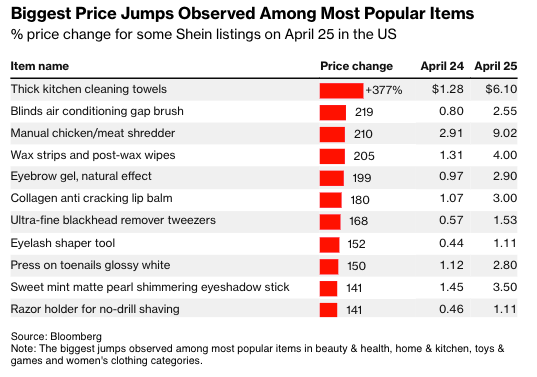
Shein is said to have raised US prices on some items by as much as 377% ahead of tariff increases, according to Bloomberg.
Fox’s Gasparino posted on X that the Trump Administration would like to roll out trade deals this week, at least the outlines that have been agreed upon, citing sources close to the matter.” However, he also noted there are a lot of moving targets that could delay matters, while the deals on deck include India, Japan and maybe South Korea and Australia, although the White House spokesperson didn’t respond to a request for comment.
Pershing Square CEO Ackman posted on X that the US could choose to unilaterally pause China tariffs to better facilitate US companies transitioning supply chains out of China, while he believes the US and China are incentivised to take tariffs down to more reasonable levels of 10%-20% as quickly as possible.
South Korean's Vice Industry Minister says no chance of reaching an agreement on a trade package with the US before the June 3rd snap elections.
A more detailed look at global markets courtesy of Newsquawk
APAC stocks were mixed amid a lack of major catalysts from over the weekend and with a very quiet calendar to start a busy week of earnings results and key data releases including the latest US NFP report. ASX 200 was led higher by outperformance in tech, healthcare and energy, while miners lagged after mixed production updates. Nikkei 225 advanced at the open as participants digested earnings releases and M&A news in which Toyota Motor's chairman and founding family made a takeover proposal for Toyota Industries. However, the index has since pulled back from today's peak after failing to sustain a brief return above the 36,000 level. Hang Seng and Shanghai Comp lagged amid some disappointment from Beijing's press conference on policies and measures for stabilising employment, ensuring stable growth and promoting high-quality development which was conducted by the deputy heads of government agencies and the PBoC and lacked any major concrete policy measures. Japan's TOPIX Index erases all losses since the April 2nd US tariff announcement.
Top Asian News
China held a press conference about policies and measures on stabilising employment, ensuring stable growth and promoting high-quality development which was attended by deputy heads of Chinese government departments and the PBoC.
PBoC Deputy Governor said China will cut RRR and interest rates at an appropriate time, as well as guide financial institutions to guarantee financing demand for foreign trade firms. Furthermore, the PBoC is studying plans to enrich policy kits and will roll out new policies when needed, while it will boost financing support for private firms, allowing private firms to issue more debts.
MOFCOM Vice Minister Sheng said China will further improve the second-hand car markets and will smooth consumption of used car market this year, while China will push the expansion of healthcare and childcare services and actively expand imports.
China NDRC vice chief said will closely monitor domestic and external changes and improve policy toolkits, while they will unveil new policies based on changes in the economic situation and some new policies will be rolled out in Q2.
China’s Finance Minister said China will adopt more proactive macroeconomic policies to promote the realisation of the growth target and that China is willing to further open up its super large markets to the world to achieve mutual benefits.
China’s Cabinet passed the draft law of China’s medical security and will submit it to the NPC Standing Committee for deliberation, while it also approved the Sanmen nuclear power plant in Zhejiang province.
China issued a notice on further improving tax refund policies for foreign tourists to boost inbound consumption and will promote the expansion of tax refund stores at shopping centres, scenic spots, airports and hotels.
Chinese President Xi said China will use various policies to support development, while he urged for the healthy and orderly development of AI.
China’s top market regulator said regarding a media report of separating the Panama Port from the CK Hutchison (1 HK) deal, that they are paying close attention to the transaction and will review it in accordance with the law. Furthermore, the regulator said parties to the transaction must not use any means to avoid a review.
TikTok owner ByteDance plans to enter online shopping in Japan as it seeks to expand outside of the US.
Huawei approached some Chinese tech companies about testing the technical feasibility of the new chip called Ascend 910D, according to WSJ.
Rumours were circulating in social media that DeepSeek’s R2 AI model is nearing release which is set to feature double the parameters of R1.
Following the Politburo statement on Friday, which flagged further interest rate cuts, a Reuters source close to the PBoC said it was in no rush to trim rates as the impact of tariffs is still unclear.
BoJ Quarterly Schedule of Outright Purchases of JGBs: pace maintained for May.
European bourses (STOXX 600 +0.4%) opened modestly firmer across the board, and have traded rangebound throughout the morning thus far given limited fresh macro drivers. European sectors hold a strong positive bias, but with the breadth of the market fairly narrow. Food Beverage & Tobacco takes the top spot, joined closely by Autos. Real Estate sits at the foot of the pile, given the relatively higher yield environment today.
Top European News
BoE Governor Bailey and US Treasury Secretary Bessent held discussions on financial markets and the regulatory environment.
ECB’s Centeno said uncertainty is dominating economic analysis which was largely being caused by US trade policy.
ECB’s Kazaks urged cautious steps and said the ECB should only lower interest rates into accommodative territory if the growth outlook continues to deteriorate much further, according to Bloomberg.
ECB's Knot said the ECB June meeting is going to be really complicated, according to European press cited by Bloomberg.
ECB’s Simkus said the ECB may have to cut rates a couple of more times as US tariffs weigh on economic growth and as inflation continues to slow, according to Bloomberg.
ECB's Villeroy says he "does note see any extra inflation for Europe; says we still have margin for rate cuts in Europe".
ECB policymakers reportedly are becoming increasingly confident about a rate cut in June although there is little to no appetite for a big move, according to six sources cited by Reuters. It was also reported that the central bank established a task force to simplify banking regulation.
SNB adjusts the remuneration of sight deposits; lowers the threshold factor to 18 (prev. 20), effective June 1st.
FX
A choppy session for the Dollar, but ultimately flat on spot month end in what has been the quiet before the storm in terms of news flow thus far, with the rest of the week packed with risk events including the first look at Q1 USD GDP and the US labour market report. There was minimal major and new tariff news, but US consumers may soon feel the impact (e.g. Shein raising prices by up to 377%, logistics slowdown in air freight and imports). DXY currently resides in a relatively tight 99.46-99.84 range.
EUR is subdued, albeit marginally, against the backdrop of a string of relatively dovish ECB rhetoric, whereby policymakers are becoming increasingly confident about a rate cut in June. EUR/USD resides in a 1.1330-80 range.
Flat trade for the JPY amidst a lack of major updates over the weekend. US Treasury Secretary Bessent met with Japanese Finance Minister Kato on Thursday and held productive discussions across a broad range of bilateral issues including reciprocal trade. USD/JPY resides in a 143.29-143.90 range.
GBP is slightly firmer in a quiet session thus far to start the week. In terms of UK trade headlines, UK Chancellor Reeves said she met with US Treasury Secretary Bessent, says the goal is reaching an agreement that is in both their national interests. GBP/USD trades in a 1.3280-1.3346 range.
Antipodeans are lower intraday amid the cautious risk tone alongside ongoing tariff uncertainty between the world's two largest economies, whilst domestic updates have been light. AUD/USD dipped under Friday's trough in a 0.6369-0.6406 intraday range.
Fixed Income
USTs are contained, but do hold a downward bias. Newsflow on the tariff/trade front included indications of a potential path to a US-China agreement, however, specifics have been light with major catalysts ex-geopols a touch light. Amidst this, USTs find themselves in a thin 111-14+ to 111-22+ band. Ahead, the docket is focussed on the Dallas Fed Manufacturing Business Index before the Treasury Financing Estimates ahead of Wednesday’s Quarterly Refunding.
Bunds are in-fitting with USTs and as such are also in a relatively modest 131.32 to 131.76 band. Developments for the bloc, ex-earnings, have been light. The slight underperformance seen in EGBs vs USTs/Gilts is likely a function of some concession into upcoming EZ supply where over EUR 5bln is expected to be sold across three lines. On the ECB front, Reuters reported that officials are increasingly confident on a June move, though there is little/no appetite for a big move.
Gilts are essentially unchanged in a very narrow 93.10 to 93.33 band. As above, updates light as we await further details on the meeting between US Treasury Secretary Bessent and BoE Governor Bailey, a discussion on regulation and financial markets which was reported as being “good”.
Commodities
Crude benchmarks have been trading very choppy on either side of the unchanged mark, as traders digest the latest US-Iran talks and Ukraine peace talks. On the former, talks are reportedly progressing, but there is still a lot of work to do. WTI and Brent trade at USD and 63.50 and 65.70/bbl respectively.
Gold is softer, and underperforms within the metals space in a continuation of the sell-off from record highs, printed Tuesday at USD 3500/oz, currently, the yellow metal is trading either side of the USD 3,280/oz mark, with eyes on the USD 3300/oz mark, a level which it retreated from overnight.
Base metals are mixed, given the flimsy risk tone and after China's press briefing on policy underwhelmed. 3M LME Copper sits in a busy USD 9,316.15-9,402.85/t range.
China is stockpiling oil amid Trump tariff shocks impacting crude prices as imports of crude to China surged in March and continued to accelerate in April with imports at nearly 11mln BPD vs 8.9mln BPD in January, according to FT citing Kpler data.
China Q1 gold consumption fell around 6% Y/Y to 290.5 metric tons and gold production rose 1.5% Y/Y to 87.2 metric tons, according to the China Gold Association.
Geopolitics: Middle East
Israel's Defence Minister said Israel conducted an attack on a site in Lebanon’s capital of Beirut which stored precision missiles.
Qatar’s PM said he saw some progress in Thursday’s Gaza talks.
Iran’s Foreign Minister Araqchi said the next round of nuclear talks with the US could occur next Saturday with the venue to be decided by Oman, while he added that both sides are showing seriousness and determination. Furthermore, a senior US official said the third round of nuclear talks with Iran were positive and productive with progress made on getting a deal but noted there is still much to do.
Oman’s Foreign Minister said US-Iran talks will continue with a further high-level meeting provisionally scheduled for May 3rd and core principles, objectives and technical concerns were all addressed in US-Iran talks on Saturday.
Israeli PM Netanyahu called for the complete dismantling of Iran's nuclear programme, insisting that any deal with Tehran must also address its ballistic missile capabilities, according to AFP News Agency.
A huge explosion at a key Iranian port killed at least 40 and injured around 800 others. It was separately reported that an Iranian Defence Ministry spokesperson said there was no military material in the port affected by the blast, while - Russia will send several planes to Iran to help extinguish the fire at Iran’s port.
Geopolitics: Ukraine
US President Trump met with Ukrainian President Zelensky at the Vatican for 15 minutes which Zelensky’s staff said was constructive, covered a lot of ground and they agreed to meet again, while the White House said the meeting was very productive.
US President Trump said the meeting with Ukrainian President Zelensky went well and we'll see what happens in the next days, while Trump is very disappointed with Russia and wants Russian President Putin to stop shooting and reach a deal. Furthermore, Trump said the confines of a deal are there and that Zelensky is calmer now and wants to make a deal, while it was separately reported that President Trump said he thinks Ukrainian President Zelensky is ready to give up Crimea, according to Al Arabiya.
US President Trump said there was no reason for Russian President Putin to be shooting missiles into civilian areas, cities and towns over the last few days which makes him think that Putin doesn’t want to stop the war and is just ‘tapping’ him along, while Trump added too many people are dying and this has to be dealt with differently through banking or secondary sanctions.
US Secretary of State Rubio said Russia and Ukraine are generally closer to a peace deal than in the last three years and a peace deal needs to happen soon, while he added that the US has options to hold responsible those that don’t want a Ukraine peace deal, according to NBC.
Russian President Putin confirmed Russia’s readiness to negotiate with Ukraine without preconditions during a meeting with US envoy Witkoff, according to IFAX.
Russian President Putin said Kyiv’s adventure in the Kursk region completely failed and Chief of General Staff Gerasimov said Ukrainian saboteurs in Russia’s Belgorod region have been liquidated. Furthermore, Russia’s military commander told Russian President Putin that scattered remnants of Ukrainian forces in Russia’s Kursk region will be destroyed soon, according to RIA.
Russian Foreign Minister Lavrov said Russia will continue to target sites used by Ukraine’s military, foreign fighters and military instructors sent by Europe, while he added that Russia would be willing to store Iran’s enriched nuclear material if both the US and Iran believe that was useful.
Ukrainian military said Moscow’s assertion it has ended Ukraine’s incursion into the Kursk region is not true and operations inside Kursk continue, while its forces are still on active operations in the Belgorod region.
French President Macron said he had a very positive exchange with Ukrainian President Zelensky and that Ukraine is ready for an unconditional ceasefire, while the coalition of the willing will continue working on a ceasefire and lasting peace in Ukraine.
German Defence Minister Pistorius said US demands for Ukraine to cede territory to Russia are going too far.
North Korea confirmed troop deployment to Russia and said it will faithfully implement its agreement with Russia, according to Yonhap. Furthermore, South Korea said North Korea's confirmation of Russia troop deployment is an admission of a criminal act and the US State Department noted it is concerned by North Korea's direct involvement in Russia's war in Ukraine, while it added that North Korea's military deployment to Russia and any support provided by Russia to it in return must end.
Geopolitics: Other
US President Trump said American military and commercial ships should be allowed to travel free of charge through the Panama and Suez Canals, while he asked Secretary of State Marco Rubio to immediately take care of and memorialise this situation.
India test-fired missiles on Sunday as tensions rise with Pakistan following the Kashmir attack.
China’s move to claim sovereignty over a disputed reef in the Spratly Islands by planting a flag triggered a stand-off with the Philippines in which the latter sent navy, coastguard and maritime police officers to Sandy Cay and two neighbouring sandbanks to uphold its sovereignty, rights and jurisdiction and displayed the national flag there, according to FT.
US Event Calendar
DB's Jim Reid concludes the overnight wrap
It was a joyous but painful weekend as Liverpool won the Premier League for only the second time in my adult life but I broke a toe cooking the kids’ dinner! Given you’re no doubt wondering how, I basically caught my right little toe on the kitchen island as I was walking round it. It was extremely painful and ballooned up to nearly the size of a golf ball.
While trying to take my mind off the pain, this week will be the first for a while where data and earnings will compete with tariff headlines as it’s a bumper week on this front. In terms of data the main highlights in the US are payrolls (Friday), core PCE inflation and US GDP (Wednesday), ISM manufacturing (Thursday) and the latest JOLTS and consumer confidence tomorrow. In Europe flash CPI numbers get released from Spain tomorrow, Germany, France and Italy on Wednesday, with the Eurozone aggregate on Friday (our economists’ preview is here). On Wednesday, Q1 GDP reports are due for Germany, France, Italy and the Eurozone. In Asia, the focus will be on the BoJ meeting (Thursday - our preview here) and April PMIs in China (Wednesday).
An avalanche of corporate earnings will centre around results from Microsoft and Meta on Wednesday and Apple and Amazon on Thursday. This will contribute to a whopping 40% of S&P 500 market cap reporting this week. It's fair to say that these Mag-7 earnings will go a long way to dictating the tone of the week. As I mentioned last week remember that before Liberation Day the main theme bubbling in the background was the Mag-7 underperforming due to DeepSeek, worries about extreme levels of Capex needed to power AI forward, valuations and a disappointing Q4 reporting season around the end of January. Three months on we'll see what earnings look like.
Elsewhere we see the federal election in Canada today. Remember the ruling Liberal Party were frequently 25pp behind in the polls in early-mid January even after Trudeau had announced his resignation as leader. However after the "51st state" rhetoric and aggressive tariffs, the rally round the flag movement has propelled the Liberals into a 3-4pp lead in current poll of polls which if replicated today would likely give them a small majority. So a remarkable turnaround. Elsewhere in politics, Wednesday will mark President Trump’s first 100 days in office. So expect lots of reflections on this landmark. The UK holds local elections on Thursday with the main point of interest being how well the populist Reform Party does given they have recently edged ahead of the ruling Labour Party in national polls.
So its fair to say its a busy week. Let's go into more detail on some of the main data points. Firstly, in terms of payrolls, our economists forecast that headline (+125k forecast vs. +228k previously) and private (+125k vs. +209k) payrolls will mean revert after a strong March, particularly within the leisure/hospitality and retail sectors. Our econ team point out that March and April can get whipped around due to the timing of Easter and school spring breaks. Unemployment should remain steady at 4.2% though.
Wednesday's advance Q1 GDP will be interesting as the consensus suggests only +0.4% annualised growth in the quarter (+1.1% expected at DB vs. +2.4% in Q4) so that will raise some concerns if it materialises. At the same time we see March personal income (+0.5% DB vs. +0.4% last month) and spending (+0.6% DB vs. +0.4%) data. This will also contain the latest reading on the core PCE deflator (+0.1% vs. +0.4%) which is expected to be on the softer side this month. This will be welcome but remember this is all largely pre-tariffs.
The day by day week ahead is at the end as usual, including the highlights from a busy week for earnings on both sides of the Atlantic. One final thing to note is the US Treasury’s updated borrowing estimates (today) and the subsequent refunding announcement (Wednesday). This normally gets released without too much fuss but remember that in Summer 2023 (end July/early August) this quarterly announcement helped cause brief but great stress in markets due to higher than expected borrowing and more long-dated issuance. Since then the Treasury has managed the process with a view to minimising market fears but in an era of large borrowings these events are always worth keeping an eye out for. Our strategists’ preview and forecasts are here.
Asian equity markets are mixed this morning with local markets mostly higher but US futures notably lower. As I check my screens, the S&P/ASX 200 (+0.81%), the Nikkei (+0.51%) are comfortably higher with the KOSPI (+0.15%) seeing more minor gains. Chinese equities are mostly trading around the flatline but S&P 500 (-0.52%) and NASDAQ 100 (-0.60%) futures are lower.
Recapping last week now and markets put in a strong performance thanks to several factors. First, Trump signalled that he wanted to make a deal with China, and he said that tariffs on China could fall “substantially” from the 145% level at present. Second, Trump rowed back on his previous criticisms of Fed Chair Powell, saying that he had “no intention” of firing him, which reassured investors concerned about central bank independence. And third, there were increasing signs that the US economy was still holding up relatively well in the circumstances, as data like the weekly jobless claims and the April flash PMIs weren’t signalling a recession.
Against that backdrop, the S&P 500 recovered +4.59% over the week (+0.74% Friday) to close at its highest level since Liberation Day. In fact, the latest moves now leave the index just -2.57% beneath its level on April 2. That move was supported by a very strong performance for the Magnificent 7, which surged +9.17% (+2.86% Friday). And that strength wasn’t just confined to the US, as last week also saw gains for the STOXX 600 (+2.77%), the Nikkei (+2.81%) and the MSCI EM index (+2.67%).
That easing in market stress was evident from several other indicators last week. For instance, US HY credit spreads tightened for a third consecutive week, falling -38bps (-8bps Friday) to 360bps. US real yields also fell back, with the 10yr real yield down -12.3bps (-4.8bps Friday) to 1.97%, closing beneath 2% for the first time in over two weeks. In addition, the VIX index of volatility was down for a third consecutive week, ultimately falling -4.81pts (-1.98pts Friday) to 26.33pts, marking its lowest closing level since Liberation Day.
With the more positive headlines on tariffs and the economy, US assets more broadly began to stabilise, including the US Dollar itself. That saw the dollar index finally post a modest weekly gain after 4 consecutive declines, up +0.24% (+0.09% Friday). Similarly, US Treasury yields moved lower, particularly at the long-end of the curve, and the 10yr yield fell -8.9bps over the week (-8.0bps Friday) to 4.24%, marking its second consecutive weekly decline.
https://cms.zerohedge.com/users/tyler-durden
Mon, 04/28/2025 - 08:26
https://www.zerohedge.com/market-recaps/futures-erase-losses-markets-brace-earnings-avalanche
Worse Than Trudeau: Canadians Should Expect Disaster With Carney In Charge
Worse Than Trudeau: Canadians Should Expect Disaster With Carney In Charge
Justin Trudeau's far-left regime in Canada has finally come to an end as the politician exits leadership in disgrace. His legacy includes authoritarian governance during the pandemic, whereby he threw Christian church goers and pastors in prison for refusing to stop congregations. He called for mass forced vaccinations, and he locked the bank accounts of protesters speaking out against the covid mandates. His admin compared people donating to the cause to "terrorists".
His socialist economic policies helped to exacerbate Canada's inflation crisis and his open immigration policies greatly expanded the the flood of third-world foreigners, driving up housing prices, crushing the labor market and straining social services. By most accounts, the majority of Canadians were ecstatic to see Trudeau exit the stage.
But what if they still haven't learned their lesson? How is that even possible?
According to https://www.reuters.com/world/americas/carney-ahead-polls-canada-enters-last-week-election-campaign-2025-04-21/
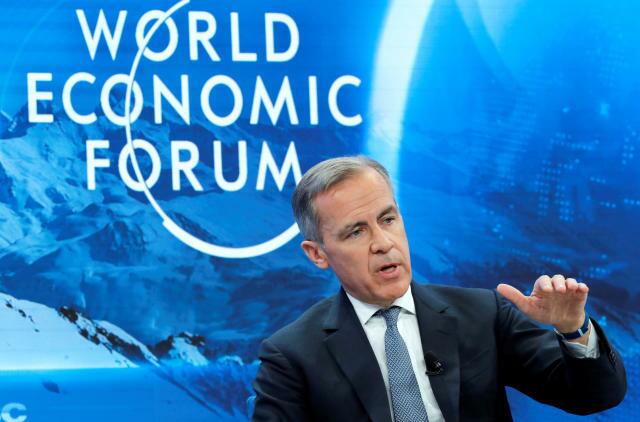
set for April 28th, it is likely that Canadians have very short memories or they're gluttons for punishment. Why? Because Mark Carney and the Liberal Party are projected to make considerable gains. Carney has rebranded himself as a "centrist" in order to win public favor, but nothing could be further from the truth. Mark Carney is, in fact, worse than Trudeau on every level.
 ?itok=cEWUJRQq
What should Canadians expect under a Carney regime? More mass immigration, not less. Higher inflation and a suffocating housing market. Increasing political and economic tensions with the US, which Canada is dependent on for 75% of its export market (and there is no replacement). Policies pressuring Canadians into a cashless system. The detrimental institution of carbon controls and climate change rules for industry and energy. And, even less national sovereignty as Canada is made more beholden to the EU.
Lets start with immigration...
While Carney claims he wants caps on immigration, his advisor choices suggest Canadians will get more of the same. The central banker has https://www.ipolitics.ca/2025/03/20/carney-adds-century-initiative-co-founder-to-canada-u-s-council/
, co-founder of the Century Initiative lobby group as part of his policy council. The Century Initiative under the former BlackRock executive publicly endorsed the Trudeau government’s moves to take in 500,000 new immigrants per year by 2025.
It should be noted that as Canada increased immigration their economy suffered exponential decline. Between 2015 and 2024, Canada’s ranking in the Human Development Index plummeted from 9th to 18th, while the country fell behind Italy in the average growth of real GDP per capita. Canada's housing market and social services are essentially broken.
And how about individual freedom?
It's no secret that the Liberal Party widely supported the lockdowns and https://liberal.ca/our-platform/mandatory-vaccination/
. However, where did Carney stand on the issue?
Carney acted as an "informal adviser" to Trudeau throughout the covid event and supported the mandates wholeheartedly. In an opinion article for The Globe And Mail titled https://www.theglobeandmail.com/opinion/article-mark-carney-end-freedom-convoy-ottawa-state-of-emergency/
, Carney wrote in reference to the Trucker Protests against the mandates:
"No one should have any doubt...This is sedition. That’s a word I never thought I’d use in Canada. It means incitement of resistance to or insurrection against lawful authority.”
“The constant blaring of horns at all hours, the harassment of people, the culture of fear have been making residents’ lives hell, will bankrupt our businesses and if left unchecked would help achieve the Convoy’s goal of undermining our democracy...Anyone sending money to the Convoy should be in no doubt: you are funding sedition. Foreign funders of an insurrection interfered in our domestic affairs.”
These are the words of an authoritarian, using "democracy" as a cover to institute a sweeping crackdown on public freedoms.
Where does Carney stand on the economy?
Mark Carney is a long time Davo elitist, and as such he is an adherent of Klaus Schwab's "4th Industrial Revolution" theory and the concept of the "Great Reset". Specifically, Carney is an avid champion of the https://www.weforum.org/stories/2021/01/mark-carney-interview-climate-finance/
. Meaning, Carney will undoubtedly bury Canada in climate controls and carbon taxes, snuffing out their industry and energy base just as the globalists have been doing in Europe.
Furthermore, Carney is deeply involved in the push for national and global Central Bank Digital Currencies (CBDCs). In his 2021 book 'Values", Carney calls for revolutionary centralization of the global monetary system and the launch of CBDCs as the new standard. He has actively campaigned against cryptocurrencies like Bitcoin and any form of decentralized money, claiming instead that the future requires a global digital currency to replace the dollar system (NOTE: Carney did not come up with this idea, this has been a ongoing plan within the BIS and IMF for decades).
“If properly designed, a CBDC could serve all the functions to which private cryptocurrencies and stablecoins aspire while addressing the fundamental legal and governance issues that will, in time, undermine those alternatives...”
At bottom, Carney is calling for a cashless society controlled by the banking oligarchy. Without cash or an independent form of trade, all personal economic freedom dies. Carney licks his chops over this prospect when he states (in reference to the covid crisis):
“With fear on the march, people were willing to surrender to Hobbes’ ‘Leviathan’ such basic rights as the freedom to leave their homes. And so it is with money. People will support the delegation to independent central banks of the tough decisions that are necessary to maintain the value of money provided the authorities deliver monetary and financial stability..."
This is not the man Canadians should be voting for if they have any interest in changing the current Orwellian path their country is on. Critics claim that it's Donald Trump's tariffs that are to blame for the shift in the polls in Carney's favor. Yet, if Carney is elected he would be the most disastrous choice in negotiating a settlement with the US. The situation will only become more ugly for Canada in every way.
This is not a "new boss, same as the old boss" scenario. Carney is far higher up on the totem pole of degradation than Trudeau and much more devious.
https://cms.zerohedge.com/users/tyler-durden
Mon, 04/28/2025 - 08:00
https://www.zerohedge.com/geopolitical/worse-trudeau-canadians-should-expect-disaster-carney-charge
Spain Hit By "Massive, Really, Massive" Power Blackout
Spain Hit By "Massive, Really, Massive" Power Blackout
Large swaths of Spain and Portugal plunged into darkness on Monday.
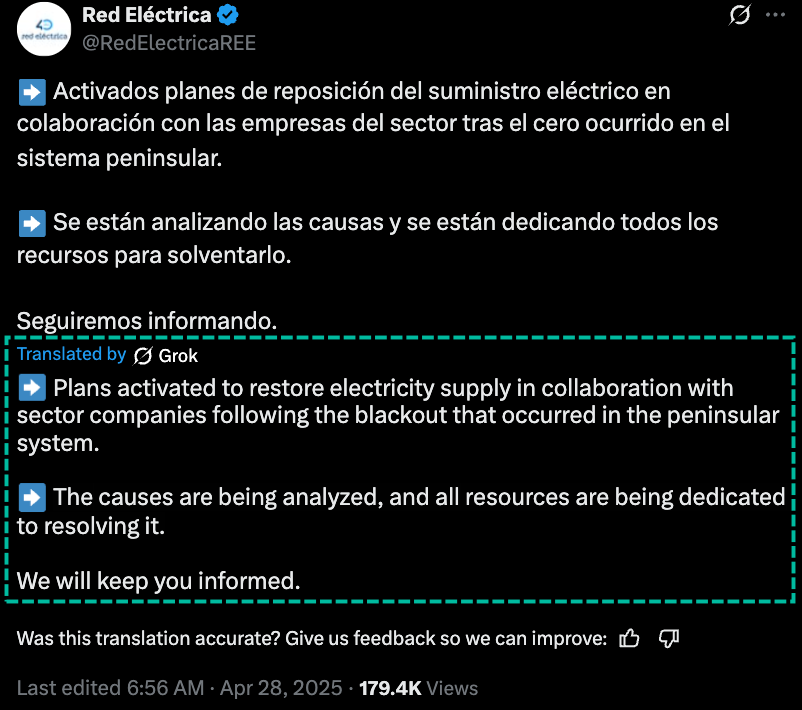
Spanish power grid operator Red Electrica wrote on X:
Plans activated to restore electricity supply in collaboration with sector companies following the blackout that occurred in the peninsular system.
The causes are being analyzed, and all resources are being dedicated to resolving it.
 ?itok=ZrQpBkl8
"Parts of France also appear to be affected, according to Spanish media reports, which said Seville, Barcelona and Valencia were hit by the outage," SKY News reported.
Bloomberg's Javier Blas called the power outage "Massive -- really, massive."
"Massive -- really, massive -- electricity outage hits Spain, which large part of the country suffering blackouts (including Madrid and Barcelona). Data from Spain's national grid shows a lost of >10 GW of demand, from ~26GW to ~12GW in a few seconds. Reason unknonw."
BREAKING: Massive -- really, massive -- electricity outage hits Spain, which large part of the country suffering blackouts (including Madrid and Barcelona).
Data from Spain's national grid shows a lost of >10 GW of demand, from ~26GW to ~12GW in a few seconds. Reason unknonw. https://t.co/KwvDxOOLQJ
— Javier Blas (@JavierBlas) https://twitter.com/JavierBlas/status/1916811180296880419?ref_src=twsrc%5Etfw
Cloudflare reported that internet connectivity dropped "by as much as 30% in Portugal and 37% in Spain" due to the power outages.
Ongoing nationwide power outages in Portugal and Spain are impacting Internet traffic. Traffic dropped by as much as 30% in Portugal and 37% in Spain at 10:30 UTC. We are continuing to monitor the situation. https://t.co/7yD2V48Ybj
— Cloudflare Radar (@CloudflareRadar) https://twitter.com/CloudflareRadar/status/1916811587408536055?ref_src=twsrc%5Etfw
Outages have begun to affect air travel.
Diversions have begun https://twitter.com/hashtag/power?src=hash&ref_src=twsrc%5Etfw
— Alex Krstanovic (@acabgd) https://twitter.com/acabgd/status/1916811311876378927?ref_src=twsrc%5Etfw
Footage:
Major power outage across parts of France, Spain and Portugal.
Causing some chaos at the Madrid Open.
Fans streaming for the practice courts (which have now hit capacity), food stalls operating with torches and cash, portions of the venue in complete darkness. https://t.co/4B1NAPX13A
— Connor Joyce (@connorjoyceb) https://twitter.com/connorjoyceb/status/1916815001093865914?ref_src=twsrc%5Etfw
Total power outage across Spain and Portugal. Currently waiting for a train and all trains suspended. https://t.co/tF9Feo1lRr
— Crypto Trader Simon (@cryptotrader_si) https://twitter.com/cryptotrader_si/status/1916811862655537429?ref_src=twsrc%5Etfw
is this what caused the spain and portugal power outage? https://twitter.com/hashtag/spain?src=hash&ref_src=twsrc%5Etfw
— Josh2809 (@Josh28091) https://twitter.com/Josh28091/status/1916811831756157216?ref_src=twsrc%5Etfw
Red Electrica provided no details about what caused the nationwide blackout.
How long until Brussels blames the Russians?
* Developing
https://cms.zerohedge.com/users/tyler-durden
Mon, 04/28/2025 - 07:35
https://www.zerohedge.com/geopolitical/spain-hit-massive-really-massive-power-blackout
Did Someone Call The COMEX Bluff?
Did Someone Call The COMEX Bluff?
https://www.schiffgold.com/exploring-finance/did-someone-call-the-comex-bluff
The CME Comex is the Exchange where futures are traded for gold, silver, and other commodities. The CME also allows futures buyers to turn their contracts into physical metal through delivery. You can find more detail on the CME https://schiffgold.com/exploring-finance/what-is-comex/
(e.g., vault types, major/minor months, delivery explanation, historical data, etc.).
 ?itok=GpjCxxo5
The data below looks at contract delivery where the ownership of physical metal changes hands within CME vaults. It also shows data that details the movement of metal in and out of CME vaults. It is very possible that if there is a run on the dollar, and a flight into gold, this is the data that will show early warning signs.
Gold
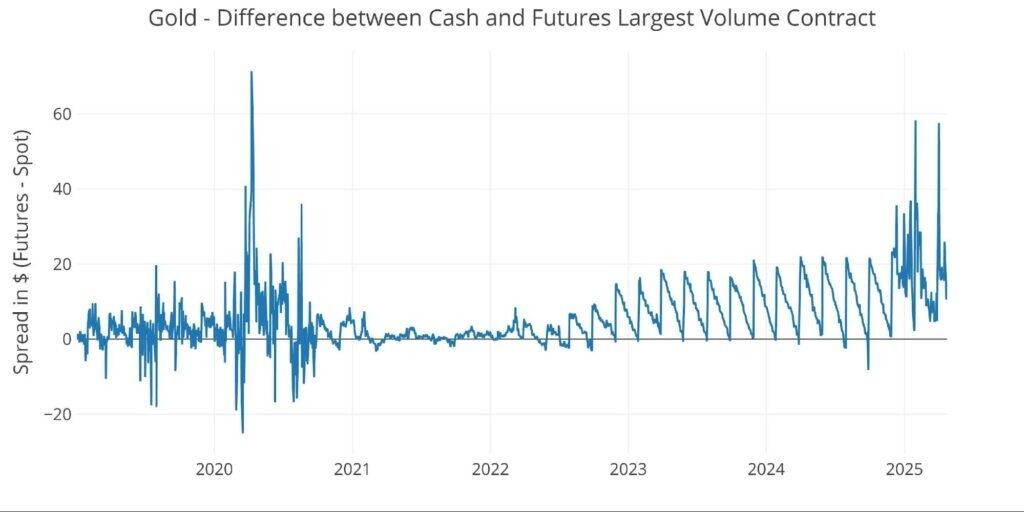
The Comex has seen unprecedented delivery volume in gold since the election as highlighted https://www.schiffgold.com/exploring-finance/comex-delivery-volumes-remain-at-very-high-levels
. This has been driven by an arbitrage between the spot and futures market. This can be seen in the chart below. It has normalized some, but is still showing erratic behavior.
 ?itok=pegcTCqZ
Figure: 1 Spot vs Futures
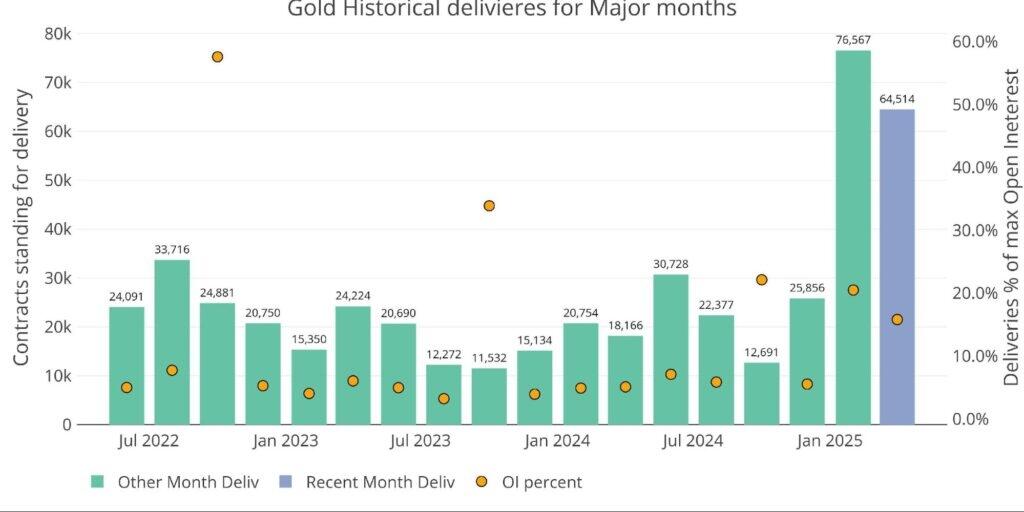
The chart below shows the total delivery volume for major months in gold. As can be seen, April had the second highest delivery volume on record, clocking in at 64,514 contracts delivered, equivalent to $21.3B!
 ?itok=dxNt4K0Y
Figure: 2 Recent like-month delivery volume
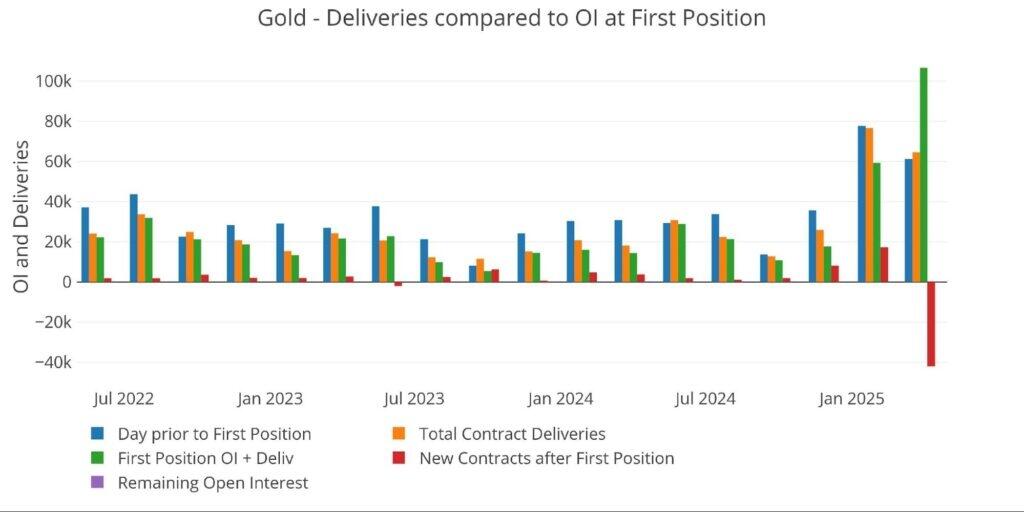
There was something particularly wild about April. The chart below shows a few metrics:
The contracts outstanding the day before delivery starts (blue)
The contracts on delivery day (green)
This is usually a big step down from the day before as contracts roll
This number is the sum of contracts open + delivered on day 1 to show what the outstanding amount was on day 1 of delivery
Net new contracts opened during the month for immediate delivery (red)
Delivered contracts (orange)
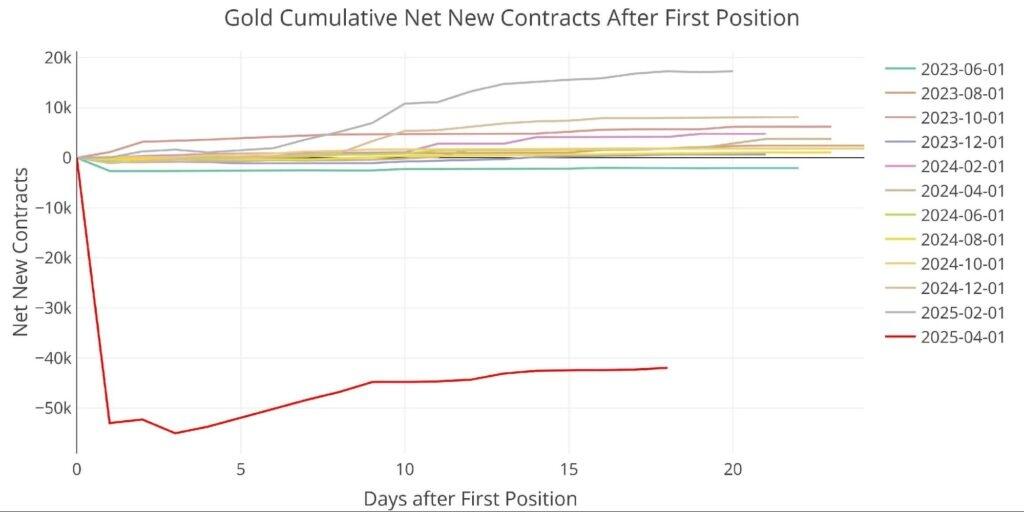
As highlighted above, you typically see a big drop in contracts from the day before to the day of, presented by the blue and green bars respectively. This month the opposite happened! On the final day, someone took on a huge position. The next day, they then settled these without delivery. This is represented by the negative red bar as the contracts were cash settled rather than delivered.
 ?itok=aoO79xkO
Figure: 3 24-month delivery and first notice
This activity can also be seen below. A huge number of contracts came into the first delivery day but then cash settled.
Why? What happened? Is it possible someone was smelling blood in the water and wanted to test the Comex? Did someone get incentivized to cash settle since there might not have been enough physical gold to satisfy demand? If so, I bet they got paid a big premium to do cash settle.
Unfortunately, the data can only tell us so much. We can conclude that something happened behind the scenes in a way that has never happened before. The pressure continues to build!
 ?itok=RoPUA4bw
Figure: 4 Cumulative Net New Contracts
Even with the large cash settlement, we then saw over 10k contracts open for immediate delivery (upward slop the in the red line above). This would have ranked second all-time behind only the large amount from February ~17k contracts.
Switching to physical inventories….
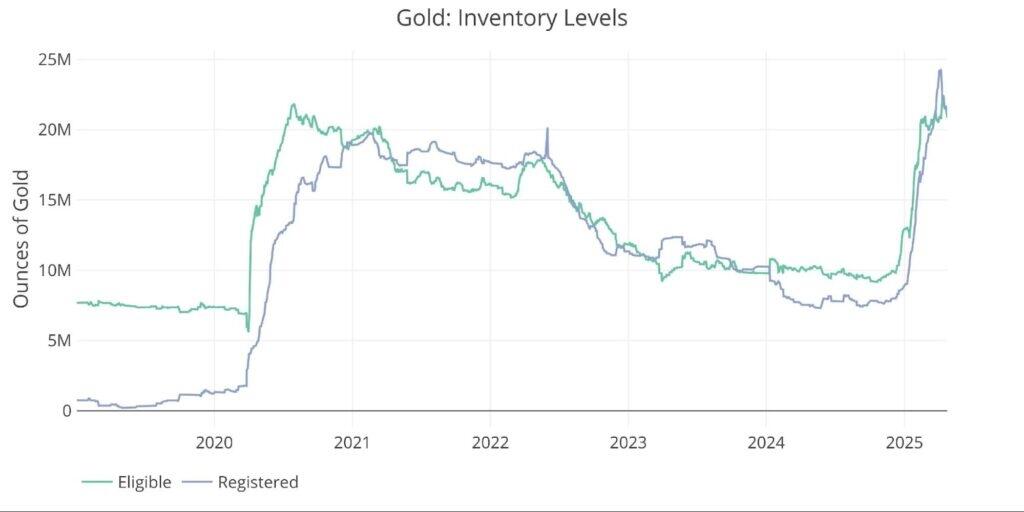
Inventory levels have actually dropped since the beginning of April. This could be tied to the event from above. Maybe someone was promised some gold and some cash for cash settling. That suspected investor(s) apparently pulled the physical right out of the vault.
 ?itok=NA2f2cfo
Figure: 5 Inventory Data
Once gold and silver were announced to be excluded from tariffs, people started suggesting that the arbitrage would collapse and movement of gold https://www.bloomberg.com/news/articles/2025-04-03/rush-to-get-gold-to-the-us-halts-abruptly-with-tariff-exemption?embedded-checkout=true
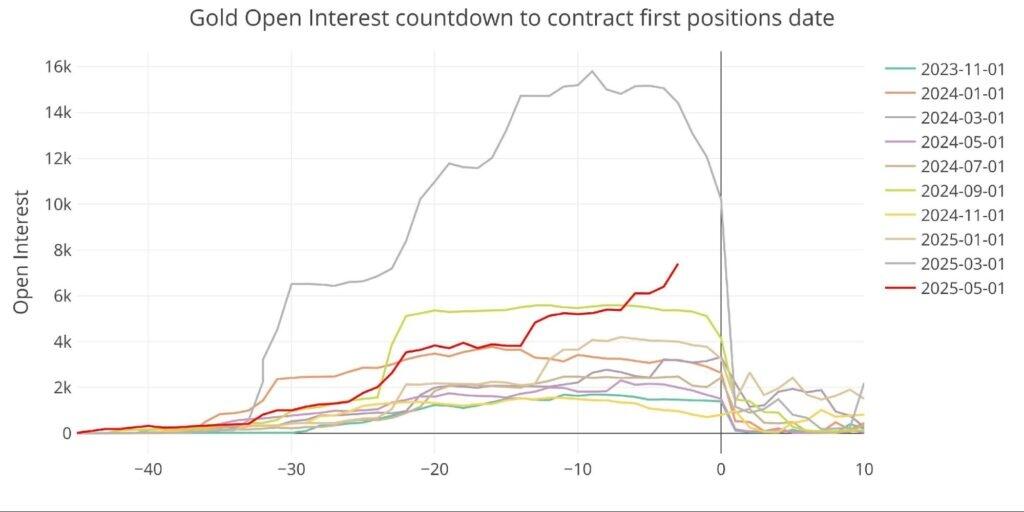
. While inventory levels have stabilized and even dropped some, demand for futures and physical delivery is not slowing. First, as shown above, April was a huge month. As we approach May, we are seeing an increase of demand into the delivery period. See chart below.
 ?itok=O5VG0xHd
Figure: 6 Open Interest Countdown
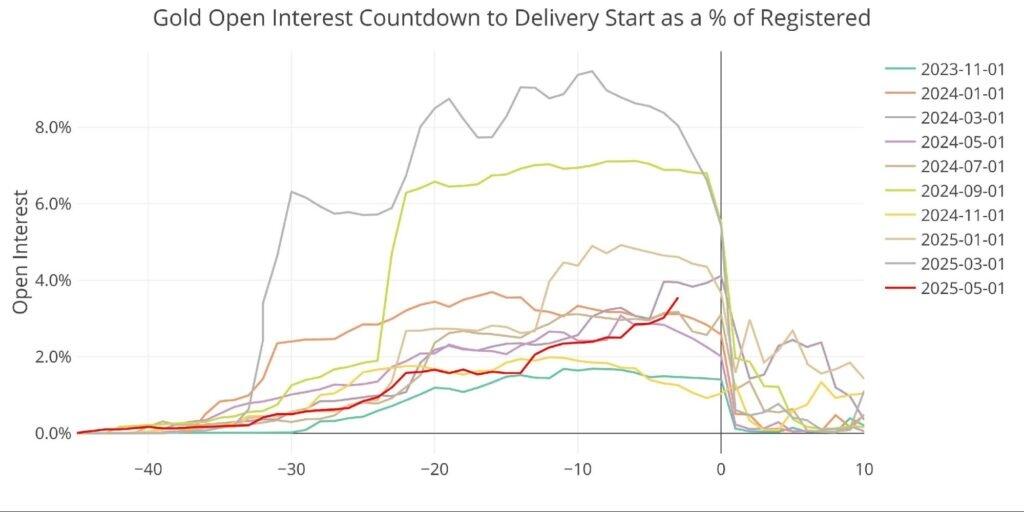
With the massive surge in inventory the open interest relative to physical stocks is not as massive as the raw number.
 ?itok=acImF9jR
Figure: 7 Open Interest Countdown Percent
Silver
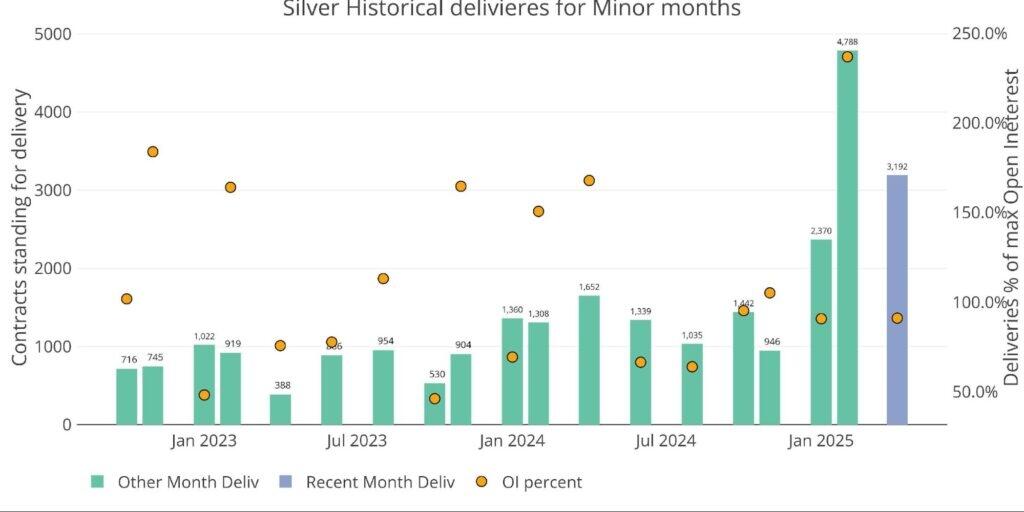
Silver is a minor month in April. While delivery volume was elevated (second only to February), it was a big step down from where it was in April.
 ?itok=0SVZUhL5
Figure: 8 Recent like-month delivery volume
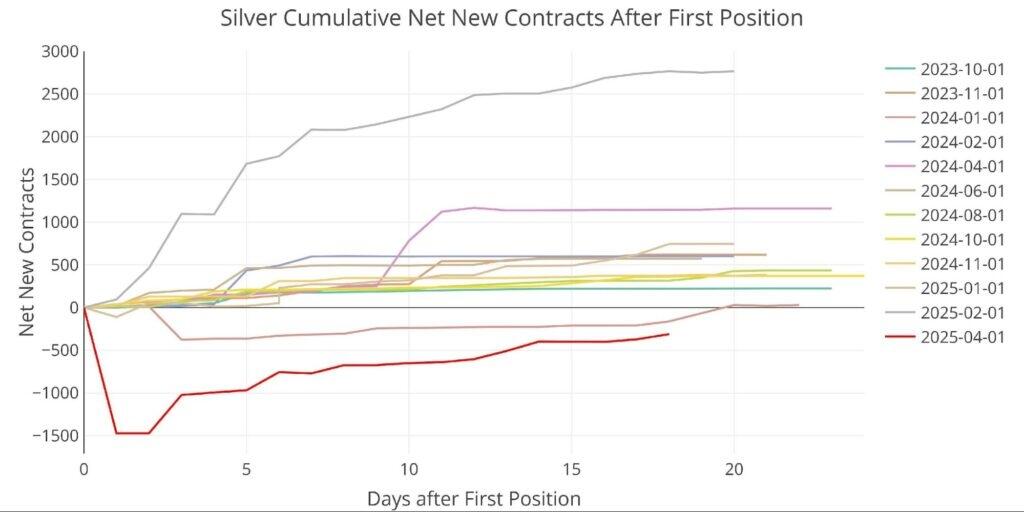
A similar situation took hold in silver with the large cash settlement (albeit on a smaller scale).
 ?itok=rn-94wYV
Figure: 9 Cumulative Net New Contracts
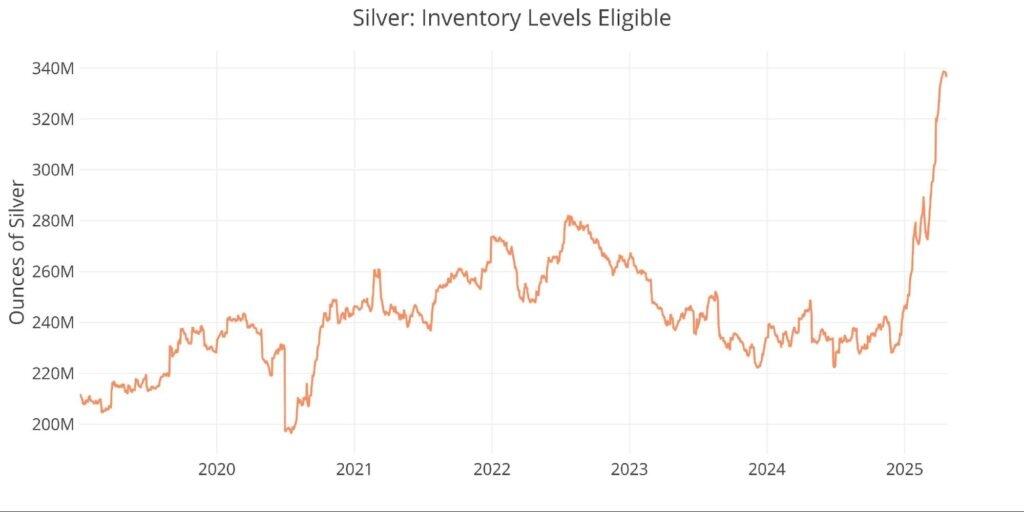
Silver inventories have continued to increase unlike gold which has leveled off.
 ?itok=PwEXoyNH
Figure: 10 Inventory Data
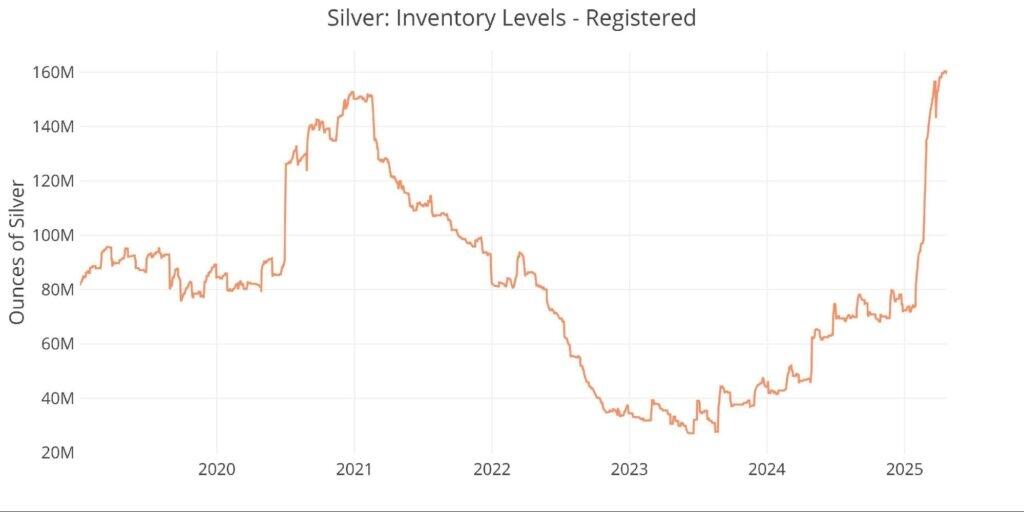
Registered silver is also seeing a massive increase.
 ?itok=L02Lv1AY
Figure: 11 Inventory Data
As we approach April, the silver contract is right in line with recent trends.
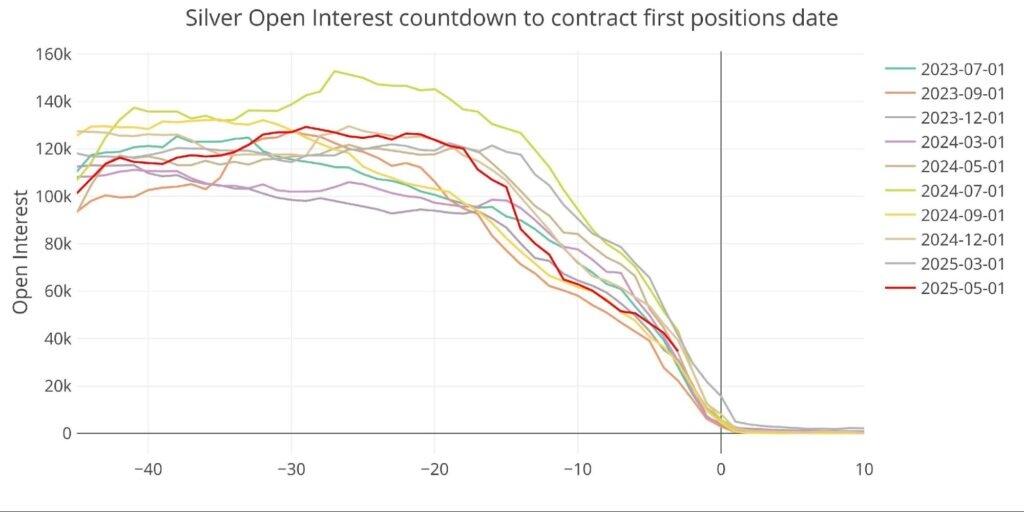 ?itok=z_Eu04jf
Figure: 12 Open Interest Countdown
On a relative basis, open interest is actually quite low because of how much the Comex has restocked silver inventories.
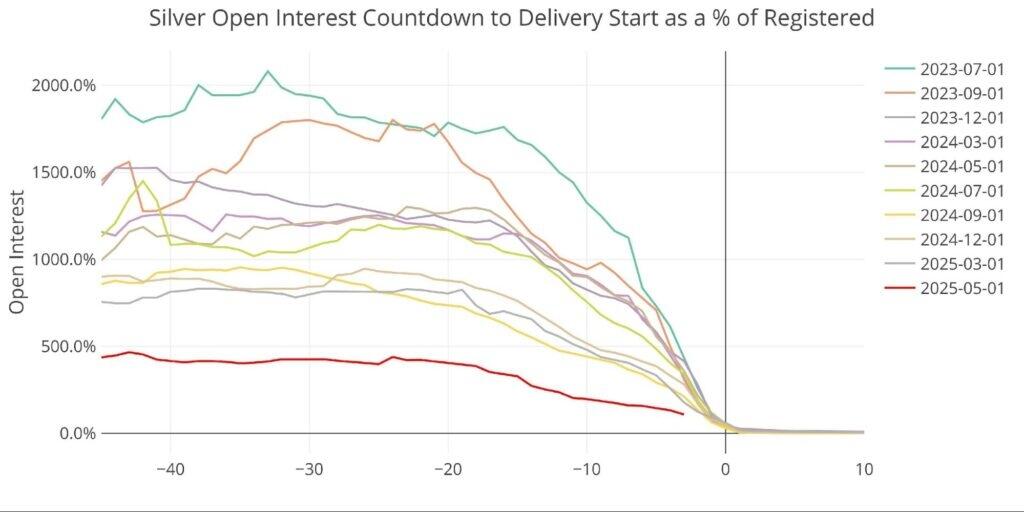 ?itok=Qqg-Lv-U
Figure: 13 Open Interest Countdown Percent
Conclusion
The data continues to show that there is a lot of movement going on behind the scenes in the gold market. The price of gold has reflected this, hitting new all-time highs multiple times in April before seeing some profit taking.
This is not your ordinary gold market. The market is under pressure and there are a lot of people fighting over limited supply of physical gold. The tariff exclusion did not seem to slow the demand of physical.
It may take several more months for all this to play out, but one thing is for sure… the fireworks are not slowing. The Comex data is sending up loud signals. Physical gold is in demand. Do you have enough?
https://cms.zerohedge.com/users/tyler-durden
Mon, 04/28/2025 - 07:20
https://www.zerohedge.com/precious-metals/did-someone-call-comex-bluff
Elon Musk's xAI In Talks For $20 Billion Funding Round
Elon Musk's xAI In Talks For $20 Billion Funding Round
About a month after Elon Musk's xAI Holdings https://www.zerohedge.com/markets/did-musks-xai-x-merger-neutralize-tesla-takedown-color-revolution
the X platform in an all-stock deal valuing the social media company at $33 billion, whispers have emerged that xAI is in talks with investors to raise $20 billion — a move that could push the startup's valuation north of $120 billion.
Citing anonymous sources, https://www.bloomberg.com/news/articles/2025-04-26/elon-musk-s-xai-holdings-is-in-discussions-to-raise-20-billion
reported Friday that xAI is in talks with investors to raise $20 billion. According to PitchBook data, the deal would mark the second-largest startup funding round on record, behind only OpenAI's $40 billion raise earlier this year. The funding would push xAI's valuation north of $120 billion if successful.
Last week, sources told https://www.cnbc.com/2025/04/26/elon-musks-xai-holdings-in-talks-to-raise-20-billion.html
that Musk was seeking to place a "proper value" on xAI.
 ?itok=pLwCCBEt
Here's more color on Faber's conversation with sources:
The comments came during a call with xAI investors last week, sources familiar with the matter told Faber. While the Tesla CEO didn't explicitly address an upcoming funding round, the sources interpreted the comments as a sign that xAI is getting set up for a significant capital raise in the near future.
. . .
The sources also said the company discussed revenue at a potential run rate of $1 billion or more on the call.
Back to the Bloomberg report, Musk and xAI executives have been probing investors about their appetite for a $20 billion funding round. One source said the funding round could be much higher.
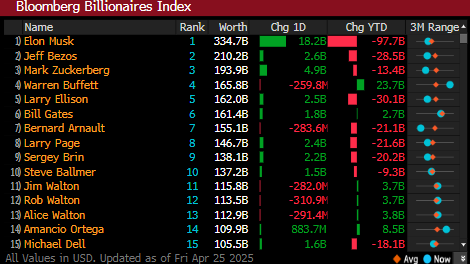
The latest Bloomberg data shows Musk's net worth at around $335 billion. Year-to-date, his net worth has declined by about $100 billion, with Tesla's market capitalization halving due to gloomy sales figures and Democrats' war on the company.
 ?itok=rvS_Ok3s
Late last year, Musk's rocket company, SpaceX, became the most valuable startup after a private transaction valued the company at $350 billion.
Musk's companies include many of the https://www.zerohedge.com/technology/goldmans-china-tech-tour-underscores-one-message-america-must-reclaim-these-supply
and may even determine the fate of the US empire as the great power fight with China rages on.
https://cms.zerohedge.com/users/tyler-durden
Mon, 04/28/2025 - 06:55
https://www.zerohedge.com/technology/elon-musks-xai-talks-20-billion-funding-round
"Stop The Digital Control Grid..."
"Stop The Digital Control Grid..."
Via Greg Hunter’s https://usawatchdog.com/
,
Catherine Austin Fitts (CAF), publisher of “The Solari Report,” is back to update us about the “Fast-Approaching Digital Control Grid.” (CAF) told us last time here on USAW, “There is no bigger ongoing battle for lovers of freedom than the battle taking place over the freedom killing idea of digital ID.”
But it’s more that just ID, it’s an entire control grid that is being quietly built that is like a frog being put into pot and the water being brought to a boil.
 ?itok=M-sb3lP8
CAF explains, “You know our goal at Solari is each person has a free and inspired life. So, we have been working for several years to stop financial transaction control."
" If you get the ability to track each person and control their transactions, so if they don’t do what you say, they can turn off your money. That is game over for the Constitution and for human liberty. If you look at how the control grid is coming together, there are many different pieces. There is digital ID, all digital currency or transaction system to a social credit system to the management to certain kinds of data and back-up energy. There are many different pieces. We look at the pieces, and we look at them as one-off things such as, oh, I don’t mind having a ‘Real ID’ because I can see why they might want a federal ID, or a passport or whatever. Each one of these things looks nonthreatening and even convenient, but when they snap together, they are in a control grid, and it’s completely something else. When Trump was elected, I was shocked to see, almost immediately, the President announce the Stargate AI initiative with the mRNA vaccines, which to me is the internet of bodies.”
CAF put together a long list of Trump Administration actions that are speeding up what looks like a control grid. It’s called https://solari.com/the-fast-approaching-digital-control-grid-a-checklist-of-trump-administration-actions-to-date/
It lists things such as crypto friendly currency actions, private Central Bank Digital Currency, shrinking banking sector, DOGE, undisclosed Epstein files and many more red flag items that could be used to allow crime to continue and build a digital prison for “We the People.” While the Trump Administration brings change at a record pace, not a single thing has been done to find out about the “$21 Trillion Missing Money” that has been well documented by CAF and Michigan State Professor Dr. Mark Skidmore. The money has been stolen from America, and the silence about this is deafening. CAF says,
“We know there has been tremendous fraud in the financials of the US government. We know that has happened. If you look at all the things that you or I would do to figure out what had happened, where the money went and how do we get it back, that’s not what they are doing. . . . If you look at how we would do a successful operation to reengineer government and identify the real fraud and stop it, I don’t see any indication that they are doing that. I do see some selected efforts that are probably sincere. . . . They are shutting things down lots of us would like to see shut down. . . . We know how to stop the death and disabilities that come from the Covid 19 vax injection, but you go the CDC website, and they are still recommending the Covid injections.”
The massive crime going on with government accounting makes it necessary for the control grid. CAF explains, “What happened in the last https://solari.com/fasab-statement-56-understanding-new-government-financial-accounting-loopholes/
FASAB 56 basically said they could take the books of the US government dark."
"A secret group of people, by a secret process, could remove operations from the financial statement, and they don’t have to tell people what they removed.
So, we have no idea what is in the financials. . . . This includes the big banks and contractors who do business with the government.
So, looking at the US stock market and bond market, I have no idea what is true or not. . . . We are flying blind.”
CAF still likes gold for an investment. She is also very bullish on silver as it takes about 100 ounces of silver to buy a single ounce of gold. The gold/silver ratio is at record spreads. CAF says, “At some point, the gold/silver ratio will revert to something more sensible.”
In closing, CAF says, “Everyone tell your Senator and Congressman and President Trump on X or Truth Social stop the control grid. Stop with the control grid, and we can do this. . . . If we can face it, God can fix it all.”
There is much more in the 44-minute interview.
Join Greg Hunter of USAWatchdog.com as he goes One-on-One with the https://solari.com/
Catherine Austin Fitts, as she looks ahead for what’s coming in 2025 for 4.26.25.
* * *
https://usawatchdog.com/donations/
There is a lot of free information on https://solari.com/
https://cms.zerohedge.com/users/tyler-durden
Mon, 04/28/2025 - 06:30
https://www.zerohedge.com/geopolitical/stop-digital-control-grid
Chinese Sellers In US Market Begin Hiking Prices
Chinese Sellers In US Market Begin Hiking Prices
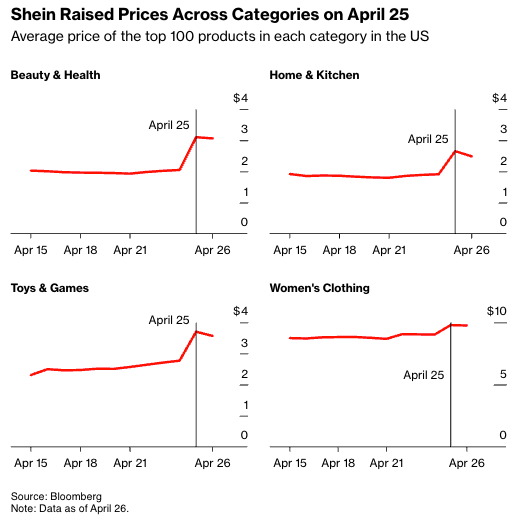
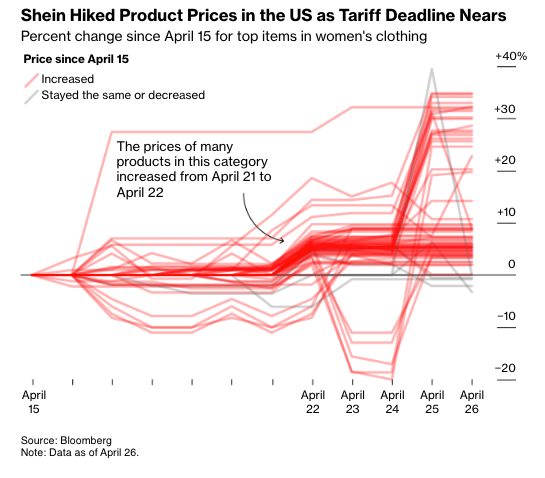
President Trump's tariff war on China has forced Singapore-based Shein Group Ltd. — whose supply chain is heavily concentrated in Guangzhou, China, with over 3,000 suppliers — to raise prices on low-cost Chinese goods for American consumers. The era of China flooding the U.S. market with cheap, low-quality goods may soon come to an end.
reports that Shein raised the prices of all goods for the U.S. market, with markups much higher in some categories than others.
 ?itok=HpX21byo
Data showed the average prices for the top 100 products in the beauty and health category jumped 51% at the end of last week. For home and kitchen products and toys, prices rose by 30%, led by a massive 377% increase for a 10-piece set of kitchen towels. Women's clothing grew by 8%.
 ?itok=o4xoON-l
Keep in mind these are the same cheap Chinese goods that have flooded the U.S. market over the past decade, crippling American manufacturers. The quality is often subpar, fueling America's plastic throwaway culture — not exactly the "green" future cheerleaded by climate radicals in the Democratic Party.
Shein's price hike...
 ?itok=SoVJ_TKM
In a separate report, CBS News found that nearly 1,000 products sold on Amazon — mainly sourced from China — experienced price increases in the second half of April, with the average hike around 30%, according to data from SmartScout.
Trump's 145% tariff on Chinese goods forced China-based Anker Innovations to increase the prices of mobile charging devices by over 25% in recent weeks.
 ?itok=EazL7iWb
The Trump administration's goal is to break America's dependence on cheap Chinese goods that have flooded U.S. markets through e-commerce platforms like Temu, Shein, and Amazon. The aim is to shift production out of China to friendlier countries (friend-shoring) — or, if the supply chain is critical (https://www.zerohedge.com/technology/goldmans-china-tech-tour-underscores-one-message-america-must-reclaim-these-supply
), to re-shore it entirely. Fifteen years ago, there weren't hundreds of different options for Bluetooth speakers on Amazon. It's time to break America's addiction to Chinese junk.
Here's the late George Carlin on "American consumption"...
Avoid the tariffs, buy American. Very simple. Already beginning: https://www.zerohedge.com/personal-finance/americans-are-searching-usa-products-never
...
https://cms.zerohedge.com/users/tyler-durden
Mon, 04/28/2025 - 05:45
https://www.zerohedge.com/markets/chinese-sellers-us-market-begin-hiking-prices
The AI–Robotics Combo: Will All Employees Be Replaced?
The AI–Robotics Combo: Will All Employees Be Replaced?
On April 14, a local government administrator in the United States sent my relative a letter that she suspected of including artificial intelligence (AI) content. Sure enough, an AI detector found 83 percent generated by AI GPT.
 ?itok=uCfcNfJB
She said it was the best letter she had ever received from a politician—and she writes to her representatives frequently. She praised the letter for responding to every single point she raised in her own letter, something no unaided politician had ever done.
We toyed with the idea of confronting the administrator publicly. If AI wrote a better letter than the administrator himself, perhaps he could be replaced with the technology, and his salary redeployed for more substantive taxpayer benefits. It was a tongue-in-cheek idea. But the logic is nevertheless disturbing.
If artificial intelligence is now better than one politician for one task, according to one constituent, is it plausible that in 10 or 20 years, AI could be better than all politicians for all their tasks, according to most constituents?
At that point, voters might just vote for an AI politician rather than a human one. Human politicians are, after all, time-constrained by their need to sleep, eat, and hobnob with their elite donors and other benefactors.
My relative decided not to confront the politician at his next public meeting. She wants to influence his decisions in the future, and public shaming is probably not the best way to do this. So he gets a pass to continue using AI on unsuspecting constituents. Even his tiny hold on power at the local level protected him from the truth.
If he can get away with it, perhaps many other politicians are doing the same. This https://www.theepochtimes.com/opinion/politicians-risk-ai-dependency-5358405
AI-using politicians at the expense of the old-fashioned types who simply do not have enough time to respond to every point of every letter of every constituent, but try anyway. AI politicians then gain an advantage in the next election, and over time, due to natural selection, all politicians will use AI, as those who don’t get voted out.
The United Arab Emirates (https://www.ft.com/content/9019cd51-2b55-4175-81a6-eafcf28609c3
), a small autocratic country in the Middle East, is already way “ahead” of this slow “democratic” transition to AI. In a world first, the UAE is using AI to both track the effects of existing legislation and write drafts of new legislation. Presumably, the president of the UAE will review the legislation prior to enacting it. Let’s hope so, as there would then be at least one human in the loop.
The UAE considers using AI to write legislation to be 70 percent more efficient than relying on human legislators to write laws. How that remarkably round number was arrived at is unclear. But as UAE citizens cannot vote, they could essentially become forced laborers working not only for the president of the UAE but also for AI, given that nobody understands exactly how AI comes up with its recommendations.
Now, consider expanding this to everything. A new startup in Silicon Valley, called https://techcrunch.com/2025/04/19/famed-ai-researcher-launches-controversial-startup-to-replace-all-human-workers-everywhere/
, audaciously wants to use AI to automate all jobs. The startup, launched on April 17, expects to start replacing white-collar jobs, such as those of accountants, lawyers, and authors (full disclosure: this author is an author, so may be biased in favor of humans).
But the company also envisions pairing AI with robots to mechanize other jobs, for example, in agriculture, construction, and manufacturing. Companies like https://www.sfchronicle.com/projects/2025/robotaxis-glossary/
are already well on their way to populating our streets with robotaxis that could eventually lead most of us to dump our cars, perhaps in compliance with a government fiat written by AI.
That the military could also be automated, despite the promises of AI companies to do no such thing, is obvious given the rise of armed drones on the battlefields of Ukraine, and the interest of the U.S. and https://www.theepochtimes.com/opinion/china-exploits-us-ai-5563749
militaries in matching AI with drone warfare. One reason the United States denies the fastest AI semiconductors to China is that they are needed for the small AI devices onboard military drones that must learn from the adversary’s strategies mid-flight. The drone that learns the fastest and adapts its tactics to enemy drones before returning to base will survive.
The Israel Defense Forces reportedly used AI to target as many as 37,000 https://www.theguardian.com/world/2024/apr/03/israel-gaza-ai-database-hamas-airstrikes
suspects with a 90 percent accuracy rate. This was paired with some “acceptable” level of civilian casualties per target to arrive at those approved for aerial bombing, with not-too-accurate dumb bombs. AI saved a lot of time for the targeters, though.
Communists have long promoted the idea of full mechanization to “free” humans of the need to labor. In their “utopian” schemes, full mechanization would allow humans the free time to pursue whatever they want, including leisure, art, and family. With the rise of mechanization, automation, robots, and AI, a new utopianism is coming that will appeal to the “https://www.reddit.com/r/Marxism/comments/1bhkc5f/tech_workers_could_represent_the_communist/
” of coders, programmers, and other tech workers.
With AI, this coming “tech vanguard” can seek an AI communism, in which humans frolic in nature while being watched over by the machine. It sounds dystopian and easily manipulable by Leninists if not Stalinists. But its rosy-glassed adherents will see it the other way around. They have likely read Richard Brautigan’s 1967 https://allpoetry.com/All-Watched-Over-By-Machines-Of-Loving-Grace
envisioning a “cybernetic ecology”:
where we are free of our labors and joined back to nature, returned to our mammal brothers and sisters, and all watched over by machines of loving grace.
Brautigan was not specifically communist, though he was counter-culture.
In the mid-2000s, a British movement developed a concept similar to being “watched over by machines of loving grace” that would become known as “https://www.theguardian.com/sustainable-business/2015/mar/18/fully-automated-luxury-communism-robots-employment
.” It was described by The Guardian in 2015 as “an opportunity to realise a post-work society, where machines do the heavy lifting and employment as we know it is a thing of the past.” This was before AI became popular. With AI, even the white collar workers will be “free.”
AI is being touted, by even those who know its https://www.darioamodei.com/essay/machines-of-loving-grace
more than others, as a carrot and stick, a necessary evil, like nuclear weapons, in the competition with China. This could be considered an “anti-communist” or “anti-authoritarian” use of AI. The idea is that, if the United States does not deploy the most sophisticated AI to both entice Beijing to reform, and deter Beijing from attack, market democracy could be at a disadvantage.
In any conflict that occurs, Beijing will certainly deploy all technologies at its disposal. This puts those who would prefer to go slowly and carefully, or avoid any future of AI, in a bind. Use AI fire to fight fire, or not? And what if the fire blows back on the freedom of the individual in a market democracy, after burning the authoritarian adversary?
Handing over so much power, up to and including “AI communism,” whether in the form of political power to legislate or industrial power that replaces trillions of dollars worth of human labor, is an immense concentration of power in the hands of whoever controls AI. That could be a dictator, an oligarchy, an elected official who accrues too much power, or a hacker. It could even be AI itself, if it goes rogue or is irretrievably granted that power at some point in the future.
The advent of AI is likely a https://www.theepochtimes.com/opinion/the-ai-threat-to-america-and-democracy-4956925
for human agency, especially if it later develops malign rather than benign attitudes toward humanity. A benign AI is in no way guaranteed if we relinquish power to an immensely powerful technology that even its creators do not fully understand, and are not confident they can control.
Views expressed in this article are opinions of the author and do not necessarily reflect the views of The Epoch Times or ZeroHedge.
https://cms.zerohedge.com/users/tyler-durden
Mon, 04/28/2025 - 05:00
https://www.zerohedge.com/markets/ai-robotics-combo-will-all-employees-be-replaced
A CIA Director's Son Joined Russia's Army To 'Defeat The Military-Industrial Complex' & Was Killed In Ukraine
A CIA Director's Son Joined Russia's Army To 'Defeat The Military-Industrial Complex' & Was Killed In Ukraine
Russian as well as independent regional media sources have revealed that a high-ranking CIA official's son was killed while fighting alongside Russian forces in Ukraine last year.
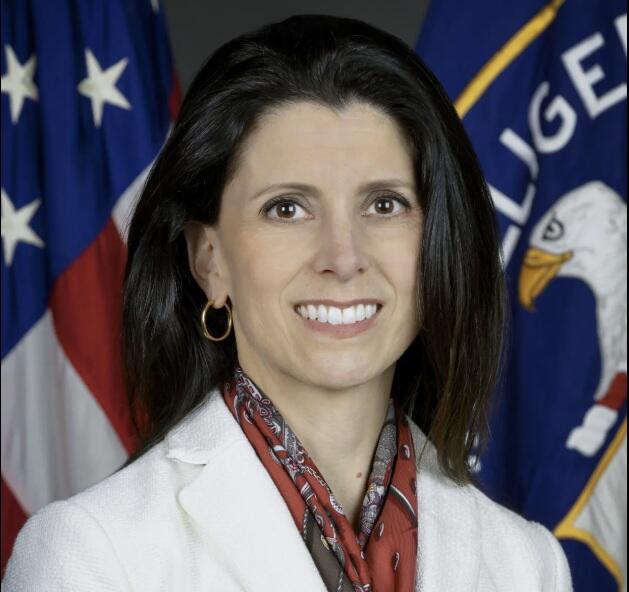
The news and story of the young man's death is highly unusual, given his mother is a US intelligence information warfare and 'disinfo' expert: the CIA’s Deputy Director for Digital Innovation Juliane Gallina Gloss.
 ?itok=6H8N5yAT
The New York Post among other US media outlets https://nypost.com/2025/04/25/world-news/son-of-a-cia-leader-killed-fighting-for-russia-in-ukraine-report/
the CIA official's son, a longtime global traveler and activist, as having been 'radicalized' against the US and its foreign policy.
Michael Alexander Gloss, 21, died on April 4, 2024 - based on a family https://www.fairfaxmemorialfuneralhome.com/obituaries/Michael-Alexander-Gloss?obId=34085063
posted by a funeral home in Fairfax, Virginia - but on Friday investigative outlet IStories reported that Russian authorities only informed his family of his death in October. His official obituary only related that he was "tragically killed in Eastern Europe."
IStories apparently had access to his phone records, given that it published a live recording of Gloss informing his parents that he traveled to Russia, along with many photos including showing life in a Russian barracks with fellow soldier friends who appear to be foreign fighters.
Juliane Gallina Gloss has been the CIA's deputy director for digital innovation since being appointed in February 2024, and is a career CIA and US Naval intelligence officer.
It is reported that the son of CIA deputy director Julianne Gallina Gloss, 21-year-old Michael Gloss died in Ukraine as a Russian soldier. He signed a contract with Russia’s MoD. His father, Iraq vet Larry Gloss, develops secure software for U.S. and NATO forces https://t.co/HmMyAnym5N
— WarTranslated (@wartranslated) https://twitter.com/wartranslated/status/1915695269749919874?ref_src=twsrc%5Etfw
Among the more interesting parts of the story is how the young man https://istories.media/en/stories/2025/04/25/michael-gloss-story/
"defeat the military-industrial complex":
In the same message, Michael vaguely described his future in which he would “defeat mortality and the military-industrial complex:” “I find myself more and more alive by the minute. Hungry for blood and glory. And basking in the pleasure of knowing that it all is still to be done... But as of now. I might have just incarnated in time to defeat mortality AND the military industrial complex.”
When asked exactly how he plans to defeat the military-industrial complex, Michael replied: “If I told you my real plan you wouldn’t believe me anyway.”
The Amsterdam-based https://www.themoscowtimes.com/2025/04/25/cia-deputy-directors-son-killed-fighting-for-russia-in-ukraine-istories-a88874
writes that "Gloss was one of more than 1,500 foreign nationals from 48 countries listed in the leaked recruitment database since Russia’s invasion of Ukraine in 2022."
The highly detailed IStories Russian investigative report begins below...
 ?itok=GCiVQnp1
In a video, a thin young man with long hair tied in a messy bun carefully releases three tiny chicks from a box onto the grass. A tattoo of a peace sign — the emblem of the anti-war movement — is visible on his finger.
“We found some baby chicken in the [Turkish] local market and Itthobaal had the idea to get a few of them and maybe he will travel with them. He bought maybe three or four chickens and put them in a nice little box with straw and everything he could find. But the next one of the chickens died and the second one too. He was quite sad about it and felt very stupid that he had this dream of a whole journey together with this little new family.”
A year later, Itthobaal — one of the many names that 21-year-old American Michael Gloss used to introduce himself — signed a contract with the Russian Defense Ministry and died in Ukraine. IStories has reconstructed his final route.
This is the story about how a young anti-fascist, environmental activist and women’s rights advocate from the family of a CIA deputy director dreamed of traveling light around the world, but ended up in the Russian army.
Michael Gloss is one of more than 1,500 foreigners who passed through the Russian military recruitment center during the war in Ukraine, whose identities were established by IStories.
 ?itok=o1YtjBoO
.
https://cms.zerohedge.com/users/tyler-durden
Mon, 04/28/2025 - 04:15
Rat Infestation Disrupts UK Nuclear Plant Construction
Rat Infestation Disrupts UK Nuclear Plant Construction
Workers at the Hinkley Point C nuclear power plant construction site in the UK have reported a significant rat infestation, raising health and safety concerns.
The rat problem is causing disruption to the major energy project and prompting calls for immediate action from trade unions to address the issue.
Despite assurances about the safety of nuclear power plants, this incident highlights challenges and public perception issues related to nuclear facilities.
The U.K. has ambitious nuclear power plans and is developing several small- and large-scale projects. While opposition, high costs, and other factors have slowed development in the past, EDF has been facing another problem at its Hinkley Point C construction – a rat infestation.
 ?itok=x3IvFdr3
In early April, the Unite and GMB trade unions for workers at Hinkley Point C in Somerset, in the south of England, informed the developer, French energy giant EDF, that the facility was overrun with rats. The unions said that immediate action was needed as the rodents were “everywhere” and the rapidly expanding rat population prompted health and safety concerns for the workforce.
One source https://www.somersetlive.co.uk/news/somerset-news/edf-urged-tackle-nuclear-rats-10094730
, “They’re all over. You see them just sat there, looking at you. It is worse near the canteens, where I guess it started. But they are everywhere now.” Another source said, “The more men working on the site, the more rubbish on the site – and the canteens are not clean either. It has just become worse over time.”
The development of Hinkley Point C is expected to support the creation of 15,000 jobs. Once complete, the plant is expected to power around 6 million U.K. homes and contribute 7 percent of the country’s electricity needs. It is planned to launch in the early 2030s, following several years of delays and spiralling costs. However, many believe this is an unrealistic aim. In recent months, workers have complained about poor working conditions and low pay, potentially because of EDF’s financial pressures. Hundreds of project staff also went on strike in November over the inadequate security access to the site.
A Hinkley Point C spokesperson https://www.theguardian.com/world/2025/apr/06/theyre-everywhere-workers-warn-of-rat-infestation-at-somerset-nuclear-plant
, “As is common across all large construction sites, there will be occasions when the presence of vermin is noted. A specialist company has carried out a survey and measures are in place to address the issue. We are committed to working alongside our trades union partners to provide the best environment for all of our workers.”
Even though the U.S. government has previously assured the public that the TV show The Simpsons was wrong about potential rat infestations, this is not the first time the problem has been seen in recent years. The U.S. Department of Energy published an article in 2018 aiming to debunk several nuclear myths. It https://www.energy.gov/ne/articles/7-things-simpsons-got-wrong-about-nuclear
:
“Nuclear power plants are well-maintained.
The Springfield plant is notorious on the show for its safety violations. They range from rat infestations and cracked cooling towers (held together with chewing gum) to leaky pipes that spill out radioactive waste.
This simply does not happen. The nuclear industry is one of the safest to work in and to live near.”
However, rat problems have been seen in the past, such as during the Fukushima 2013 power cut. In March 2013, the Tokyo Electric Power Co (Tepco) https://www.bbc.com/news/world-asia-21867705
that rats may have caused a short circuit in a switchboard, triggering the power cut. Tepco announced that it had found burn marks on a makeshift power switchboard and a 15 cm dead rodent nearby. The outage shut down cooling systems for four spent fuel ponds at reactors 1, 3 and 4, however cooling to the reactors was not affected. Following the incident, engineers spent around 30 hours repairing the damage. This came just two years after a giant earthquake-triggered tsunami caused meltdowns at the plant, which was in the decommissioning stage during the rodent incident.
Despite the rodent infestation in the construction phase of Hinkley Point C and during the decommissioning period of Fukushima, rats are, indeed, not a common sight in nuclear power plants thanks to the enforcement of strict safety regulations. For decades the https://ojs.stanford.edu/ojs/index.php/intersect/article/view/3111/1647
, due to three separate nuclear disasters – Chernobyl, Three Mile Island, and Fukushima. However, nuclear experts have repeatedly tried to reassure the public that nuclear power is one of the safest forms of energy.
The International Atomic Energy Agency https://www.iaea.org/resources/safety-standards
, “In the 60-year history of civil nuclear power generation, with over 18,500 cumulative reactor-years across 36 countries, there have been only three significant accidents at nuclear power plants.” While these incidents stuck in the minds of people worldwide, this ratio is extremely low when compared to other forms of energy.
Rigorous international standards and regulations, as well as significant improvements to nuclear technology, have helped make nuclear power one of the safest forms of clean energy production. As the public perception of nuclear energy begins to shift to more positive, and countries worldwide look for ways to support a transition away from fossil fuels to green alternatives, we can expect to see a massive https://oilprice.com/Alternative-Energy/Nuclear-Power/Europes-Nuclear-Power-Renaissance.html
in the coming years.
https://cms.zerohedge.com/users/tyler-durden
Mon, 04/28/2025 - 03:30
https://www.zerohedge.com/energy/rat-infestation-disrupts-uk-nuclear-plant-construction
These Are Most Air-Polluted Cities In The World
These Are Most Air-Polluted Cities In The World
Air pollution remains one of the deadliest environmental threats, contributing to millions of premature deaths each year.
of cities worldwide met the World Health Organization’s annual PM2.5 guideline of less than 5 µg/m3, indicating that the vast majority of urban populations are exposed to unhealthy air.
This map, https://www.visualcapitalist.com/mapped-most-air-polluted-cities-in-the-world/#google_vignette
.
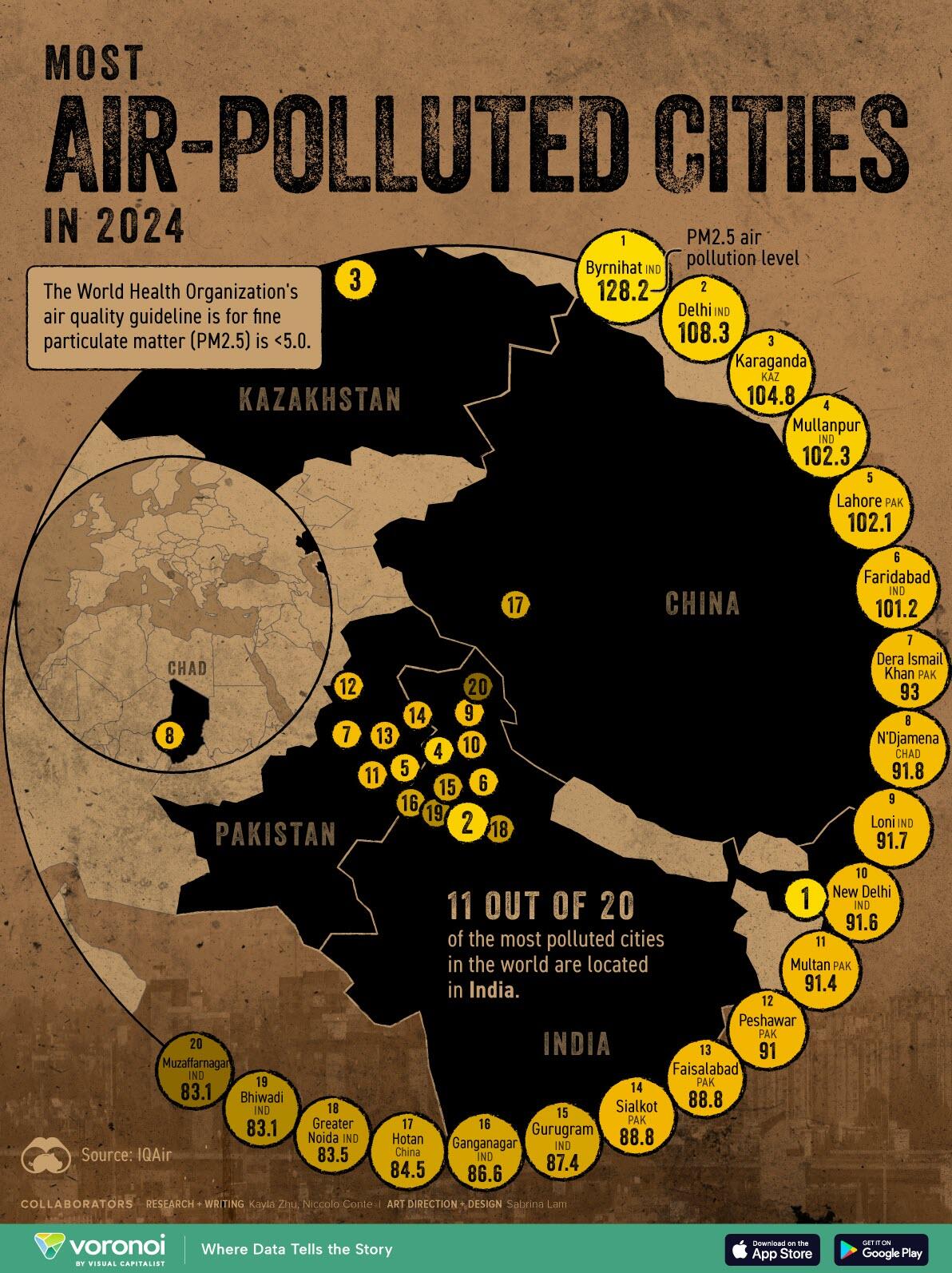 ?itok=VZwsNe8L
Which Cities Have the Worst Air Pollution?
Below, we show the top 20 cities with the worst PM2.5 levels in 2024.
Rank
City
Country
2024 PM2.5 (µg/m³)
1
Byrnihat
🇮🇳 India
128.2
2
Delhi
🇮🇳 India
108.3
3
Karaganda
🇰🇿 Kazakhstan
104.8
4
Mullanpur
🇮🇳 India
102.3
5
Lahore
🇵🇰 Pakistan
102.1
6
Faridabad
🇮🇳 India
101.2
7
Dera Ismail Khan
🇵🇰 Pakistan
93.0
8
N'Djamena
🇹🇩 Chad
91.8
9
Loni
🇮🇳 India
91.7
10
New Delhi
🇮🇳 India
91.6
11
Multan
🇵🇰 Pakistan
91.4
12
Peshawar
🇵🇰 Pakistan
91.0
13
Faisalabad
🇵🇰 Pakistan
88.8
14
Sialkot
🇵🇰 Pakistan
88.8
15
Gurugram
🇮🇳 India
87.4
16
Ganganagar
🇮🇳 India
86.6
17
Hotan
🇨🇳 China
84.5
18
Greater Noida
🇮🇳 India
83.5
19
Bhiwadi
🇮🇳 India
83.1
20
Muzaffarnagar
🇮🇳 India
83.1
India is home to some of the world’s most air-polluted cities, accounting for 11 of the top 20 in 2024.
Byrnihat, a city in northeastern India, recorded the worst air pollution globally last year, with a PM2.5 concentration of 128.2 micrograms per cubic meter—over 25 times higher than the World Health Organization’s recommended limit.
Delhi, a metropolis of over 30 million people and the capital territory of India, recorded the second-worst air pollution levels in 2024.
The city https://www.visualcapitalist.com/mapped-cities-with-the-worst-winter-air-pollution/
of any major city, driven by crop burning in nearby states, stagnant cold air, and weak wind patterns that trap and concentrate smog over the capital.
Many Indian cities struggle with https://www.theguardian.com/world/2024/nov/22/the-air-is-killing-us-why-delhi-india-pollution-problem-runs-deeper-than-smog-season
due to a mix of industrial emissions, vehicle exhaust, and reliance on fossil fuels, all worsened by weak regulation and seasonal weather patterns.
Most of the cities with the worst air pollution in 2024 are located in https://www.visualcapitalist.com/sp/ranked-air-pollution-by-economy/
, Pakistan, or other parts of Asia. N’Djamena, Chad, was the only non-Asian city to rank among the top 20.
To see which countries have the worst air pollution, check out this https://www.voronoiapp.com/climate/South-Asian-Countries-Lead-the-World-in-PM25-Pollution--979
that visualizes the world’s most polluted countries by their annual average PM2.5 concentration.
https://cms.zerohedge.com/users/tyler-durden
Mon, 04/28/2025 - 02:45
https://www.zerohedge.com/geopolitical/these-are-most-air-polluted-cities-world
International Institutions Must Abandon "Wokeism"
International Institutions Must Abandon "Wokeism"
https://www.dlacalle.com/en/international-institutions-must-abandon-wokeism
The scandal over the alleged corruption of the founder of the World Economic Forum (WEF) in Davos would be just an anecdote were it not another example of what has happened recently with many international institutions. The Financial Times reveals that the WEF founder faces accusations of manipulating the organization’s analysis to gain favour with governments.
For years, many of us have watched with sadness as an important forum like Davos shifted from being a centre for debate and confrontation of ideas in defence of free enterprise to becoming a loudspeaker for the most interventionist ideas, the most damaging statism, and a whitewasher of authoritarian governments, spreading the destructive ideas of inflationism, socialism, and wokeism— which, in reality, are all the same.
Davos went from being a forum for debate to a congregation for repeating interventionist dogmas and whitewashing a single, extractive mindset; those who defended economic freedom, attractive taxes, and control over public spending were gradually ostracised. We have heard enthusiastic applause for those demanding more taxes and greater assaults on job creators, and one-sided debates in which all participants repeated clichés and words like “resilience” and “sustainability” as Trojan horses for predatory statism, where the idea of creating value and wealth was repudiated.
Do you remember the aberration of “you will own nothing and be happy”, abandoning profit generation as a goal, or the suggestion that coffee cultivation should be banned because it contributes to climate change? With phrases like “equal rights to economic resources, as well as access to basic services, ownership and control over land and other forms of property, inheritance, and natural resources”, the most absurd and obsolete collectivism was being sold.
It hasn’t just happened in Davos. This week, Scott Bessent, the U.S. Treasury Secretary, confronted the International Monetary Fund (IMF) and the World Bank, exposing their complicity in selling the flawed products of socialist interventionism.
“The IMF and the World Bank have enduring value, but their mission has drifted off course.”
It was very frustrating to see how these institutions whitewashed the constant increase in the weight of governments in the economy, confiscatory taxes, and inflationism through fiscal and monetary excess. They have forgotten their role as guarantors of economic logic, defenders of wealth creators, enforcers of fiscal responsibility, and enforcers of tax prudence. Instead, they became increasingly permissive with authoritarian, exploitative, and wasteful governments.
Bessent stated:
“The IMF has suffered from mission creep. The IMF was once unwavering in its mission of promoting global monetary cooperation and financial stability. Now it devotes disproportionate time and resources to work on climate change, gender, and social issues.”
Just like other institutions, such as the European Central Bank, which also set climate change as a goal while abandoning its true aim of price stability, they focus on cosmetic and ideological issues unrelated to monetary policy, financial stability, and fiscal responsibility, as these are matters for government social policy. Moreover, many of these supposed social concerns only serve to hide the whitewashing of a constant increase in government excesses, uncontrolled spending, debt, and rising taxes.
Bessent added:
“The International Monetary Fund should be a brutal revealer of the truth. Instead, it is ‘whistling past the graveyard.’”
This statement from Bessent mirrors the perception of any freedom defender in many of the IMF’s reports: it acquiesces as governments push their countries, companies, and self-employed workers towards financial ruin.
Do you remember the IMF’s 2020 call to “do whatever it takes and keep the receipts”? Governments happily rushed to spend without control, printing money recklessly, leaving poverty, inflation, runaway debt, and suffocating taxes in their wake. However, in 2024, when over seventy countries were spending uncontrollably due to elections and the public debt was rapidly increasing, the IMF declared a strategy of “safe but slow growth: resilience with divergence”. Incredible.
Regarding the World Bank, Bessent stated:
“The bank should no longer expect blank cheques for vapid, buzzword-centric marketing accompanied by half-hearted commitments to reform.”
If the institutions that should guarantee financial stability, economic logic, fiscal responsibility, and business growth focus on disguising fiscal and monetary imbalances or ignoring attacks on private property, financial and monetary stability, or free enterprise in countries with totalitarian regimes and interventionist governments, they cease to fulfil their functions and become the orchestra on the Titanic.
It is time to abandon propaganda, excuses, and cosmetics. It is time to stop whitewashing interventionism and recover the essential role these institutions play in preserving and strengthening growth. It is time to stop justifying wasteful governments and return to defending businesses and wealth creators.
We cannot forget the importance of the IMF, World Bank, ECB, or WEF as guarantors of economic and financial stability and monetary soundness.
Their work is essential. Do not forget it. They must return to defending what creates wealth, reduces poverty, and improves the lives of citizens: business growth, the free market, economic freedom, and fiscal and monetary prudence. Their association with predatory authoritarian governments has led to a significant loss of their former prestige.
If Davos, the IMF and mainstream economists had been half as blunt about China and other nations’ tariffs and trade barriers in the past decade as they are today about US trade policy, we would not need forced negotiations to level the playing field.
Dear institutions: It is time to remind the world that progress comes from saving, economic freedom, and prudent investment, not from political spending, debt, and monetary inflationism. The great institutions have much to contribute, but they must know they face two alternatives: recover their mission as defenders of fiscal and monetary responsibility and economic freedom or disappear.
https://cms.zerohedge.com/users/tyler-durden
Mon, 04/28/2025 - 02:00
https://www.zerohedge.com/geopolitical/international-institutions-must-abandon-wokeism
The World Economy Is Reaching 'Limits Of Growth'
The World Economy Is Reaching 'Limits Of Growth'
The world economy is at a major turning point, which is why we should brace for rapid changes in the economy. The world is moving from having enough goods and services to go around, to not having enough to go around. The dynamics of the economy are very different with not enough to go around. The hoped-for solution of higher prices doesn’t fix the situation; after a point, adding more buying-power mostly produces inflation. Other solutions are needed. The world economy is reaching what has been called “Limits to Growth.”
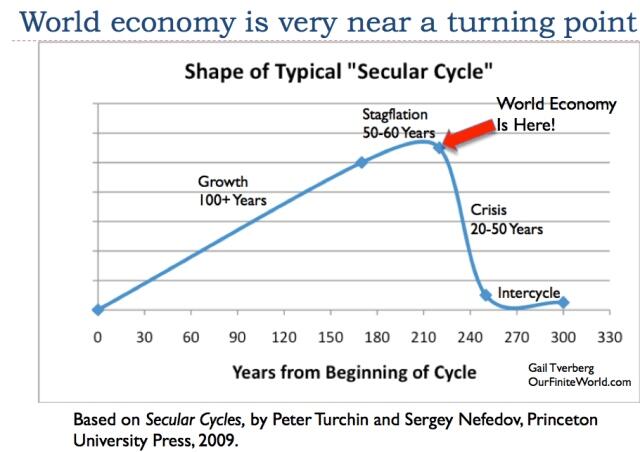 ?itok=9HM6Gh0T
Figure 1. Chart made by Gail Tverberg showing the general pattern of secular cycles based on information given in the book https://www.amazon.com/Secular-Cycles-Peter-Turchin/dp/0691136963
.
Economies throughout the ages have grown until their populations grew too large for resource availability. Researcher Peter Turchin has studied the general pattern of overshoot and collapse scenarios. The chart shown in Figure 1 is based on analyzing eight such cycles in the book https://www.amazon.com/Secular-Cycles-Peter-Turchin/dp/0691136963
. The fossil fuel age began over 200 years ago, and it now seems to be reaching its end.
I doubt that President Trump thinks in terms such as secular cycles or overshoot and collapse. But tariffs and government cutbacks engineered by the Department of Government Efficiency (DOGE) seem like they might be approaches that will allow the world economy to contract in a way that could be helpful in keeping the collapse from taking place excessively fast.
In this post, I will try to explain the situation further. The issue we are facing is really a physics problem. Governments can print money, but they cannot print resources, especially energy resources. Our bodies are accustomed to having a certain amount of cooked foods in our diets. This, by itself, encourages population growth and eventual overshoot of the resource base. The self-organizing system somehow chooses its own downward path, not falling further or more quickly than necessary, under the https://en.wikipedia.org/wiki/Maximum_power_principle
. This is what we are encountering now.
[1] In physics terms, the https://www.researchgate.net/publication/236149834_Economy_as_a_Dissipative_Structure
. Dissipative structures are self-organizing structures that require energy to grow but are only temporary.
The universe is filled with dissipative structures. Humans are dissipative structures, as are all plants and animals. Hurricanes are dissipative structures, as are star systems. Ecosystems are dissipative structures. All these things are temporary. Even economies are temporary, but no one tells us this detail.
The kind of energy that is required varies with the dissipative structure. Green plants use sunshine. Animals require plant or animal food. Humans have evolved to eat a mixture of https://en.wikipedia.org/wiki/Catching_Fire:_How_Cooking_Made_Us_Human
and raw food. While a few raw food enthusiasts can get along using a blender to break up food into small particles, the general pattern is that our modern brains require the nourishment that cooked food can provide. Thus, humans need both food and some type of fuel for cooking at least a portion of the food. Fuel is also helpful for heating homes, ridding water of pathogens, and providing transportation.
Many things that we think of as man-made are dissipative structures. Governments are dissipative structures. Governments grow and often become too expensive for their citizens to support. The energy governments use is indirectly obtained through the use of taxes. A little of the energy used by the governments is purchased directly by governments to power their vehicles, and to heat and light their buildings.
Much more of the energy required by governments is indirectly consumed. For example, a portion of the taxes collected goes to pay public officials. This pay is used for things the public officials use, such as food, transportation, and housing. All three of these things require energy at many places in their “lives.”
Food – Sunshine to grow; oil to cultivate and transport it to the store; electricity for refrigeration; natural gas or electricity for cooking; human labor for many tasks.
Transportation – Fuel to make the metal and other materials used in making the vehicle; human labor to construct the vehicle; fuel to operate the vehicle.
Housing – Diesel to prepare the lot where the house is built; energy of many kinds to create and transport materials such as lumber and wiring; human energy to put the pieces together; electricity for lights after it is built; natural gas or electricity to heat the home after it is built.
In fact, every part of GDP requires energy. In some cases, this is “only” human energy. Of course, human energy requires food, some of it cooked (or broken into tiny pieces with an electric blender).
Businesses in general are dissipative structures. So are international organizations of any kind. Cities seem to be dissipative structures. Religious organizations are dissipative structures. Any organization that seems to grow, pretty much on its own, is a dissipative structure.
[2] If the energy sources needed by a dissipative structure become scarce, this can badly disrupt the dissipative structure.
Hurricanes that pass over warm water tend to maintain their strength, but if they go over land, they quickly dissipate. If an animal is deprived of food, it will become weak and eventually die. If a government is deprived of revenue (and the energy sources that this revenue indirectly buys), it will no longer be able to provide the services it has promised. It may default on its debt or collapse.
[3] Many dissipative structures seem to be programmed to eventually go downhill and collapse, even when plenty of energy seems to be available.
Obviously, running out of energy isn’t the only way a dissipative structure comes to an end. Most humans don’t starve to death. Instead, when humans get to be 70 or 80 or so years old, they lose some of their strength. They more easily succumb to illnesses. Other animals are similar. Tomato plants in our gardens seem to be more prone to infestation by pests after a month or two of bearing fruit.
[4] Even economies seem to be programmed to go downhill and collapse.
Economies have a problem with their populations becoming too large for available resources. For many years, it appears that added debt (money supply) can be used to temporarily work around a resource problem. For example, a dam purchased with debt may allow irrigation so more food can be produced for a given population.
The problem with this approach is that the benefits of added debt reach diminishing returns. At some point, an economy discovers that adding debt doesn’t add much energy supply; instead, it simply leads to inflation (and, indirectly, higher interest rates to compensate for this inflation). Also, for governments, the interest on debt becomes a greater and greater burden.
The US government seems to have reached the point of having too much debt. The US Congressional Budget Office (CBO) recently published this chart related to US debt:
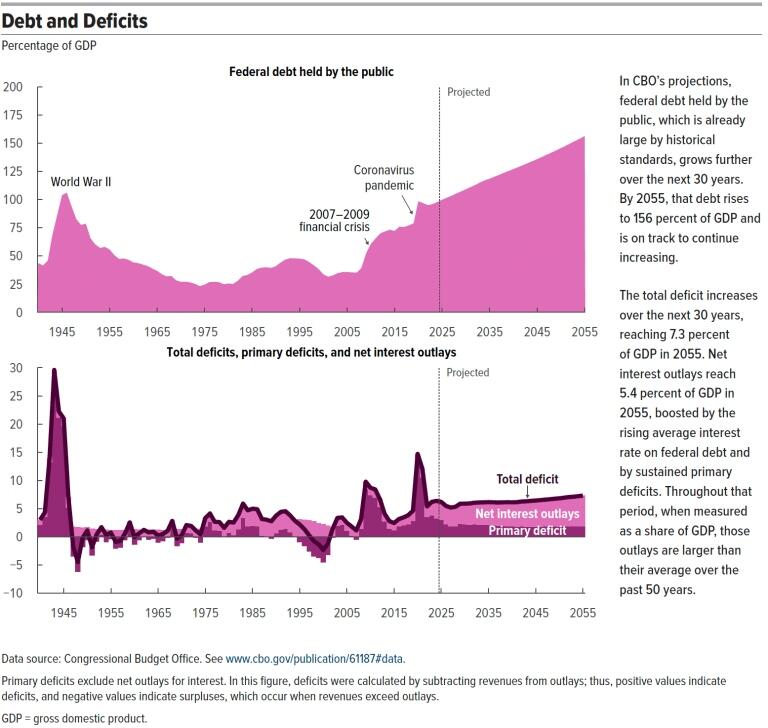 ?itok=W-tAIOD8
Figure 2. Figure from page 10 of https://www.cbo.gov/system/files/2025-03/61187-Long-Term-Outlook-2025.pdf
, published in March 2025 by the CBO.
US taxes need to keep rising, as a percentage of GDP, just to repay US government debt with interest. This is a path that can lead to hyperinflation. This seems to be the underlying reason for DOGE and the tariffs.
Adding infrastructure such as roads, pipelines, and railroads can be helpful in the beginning. The additional infrastructure enables new businesses to be built that make use of this infrastructure. Initially, the tax revenue from new businesses makes it easy to repay the debt with interest.
But additional roads, pipelines, railroads and other infrastructure are not nearly as helpful. They may add capacity, but they don’t materially change the transportation options. The tax revenue added is less.
At some point, simply maintaining and replacing all the infrastructure becomes burdensome. Adding debt for the replacement of infrastructure becomes burdensome because the new replacement infrastructure adds no new functionality. It just maintains the old functionality. The interest on the debt must come from somewhere, but it is not built into the system the way it was when totally new infrastructure was built. Today’s approach is simply to increase the debt level and hope that the revenue will come from somewhere else.
A related issue is that old factories tend to be less productive than newly built ones that benefited from the latest advances. This allows new factories (perhaps in another part of the world) to make goods in a more cost-efficient way. An older factory is likely to lose out in price competition against a newer, more productive factory elsewhere.
[5] The analysis of Turchin and Nefedov in Secular Cycles suggests that economies often go through the pattern shown in Figure 1.
Economies discover a new resource. Perhaps they have conquered a new land, and they have eliminated the old inhabitants. Or they have cut down trees, allowing more area for farming. At a given level of technology (and fuel for the technology), a given area of arable land can support a particular number of inhabitants. If the population gets too high, the size of farms tends to fall too low to support the farmers and their families. This pattern happens if families allow multiple sons to each inherit a share of the family farm.
Alternatively (and more likely), if the population gets too high, the younger sons don’t inherit any farmland. They start working in services and or on crafts of various kinds. But these alternatives to farming generally don’t pay very well. The many workers with low wages become less able to pay taxes, creating a problem for government funding.
As the population rises, wages of these lower-paid workers become increasingly less adequate to cover the necessities of life. With inadequate nutrition, populations become more subject to epidemics.
According to Secular Cycles, as these problems arise, debt is increasingly used to work around the problems. Slow population growth and increasing debt are characteristics of the Stagflation period shown in Figure 1.
Eventually, economies fail. Governments can fail due to a lack of adequate tax revenue or by being overthrown by unhappy citizens. Alternatively, they may lose a war against another country with better weapons (made with energy supplies). All governments, as dissipative structures, can be expected to eventually fail, one way or another.
[6] The world economy now seems to be headed on a path similar to that shown in Figure 1.
The world economy now seems to be reaching the end of the age of fossil fuels. I believe that the world first entered the stagflation era in 1973, when oil prices first rose dramatically. At that time, it became clear that oil must be used more sparingly. To help economize on oil, smaller, more fuel-efficient cars began to be imported from Japan and Europe. In some places, oil was being burned to generate electricity; this electricity could sometimes be replaced by electricity from nuclear power plants.
In the 1980s, added debt became more important. Companies were told to use “leverage” to become more competitive with producers around the world. Instead of fearing credit, it should be embraced. Computers were increasingly used, and world trade was expanded. World trade very much facilitated the production of complex goods, such as automobiles and computers, because it allowed a very wide array of raw materials to be used in manufacturing.
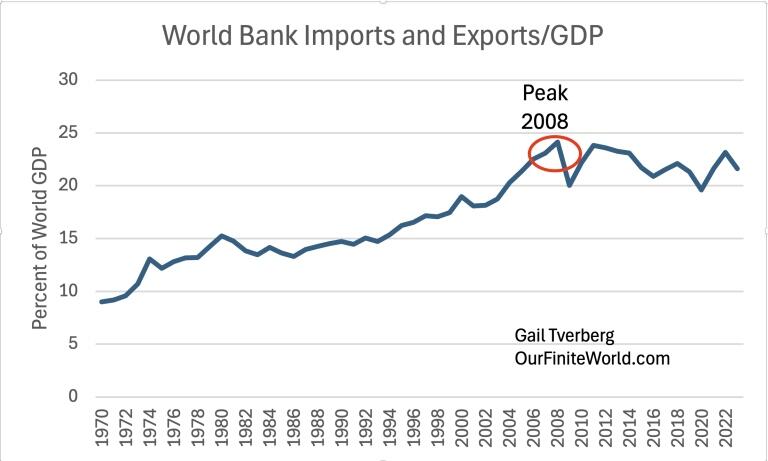 ?itok=ogeP4D3y
Figure 3. World trade based on World Bank data. Amount shown are the average of (worldwide imports/world GDP) and (worldwide exports/world GDP). Amounts shown are through 2023.
Figure 3 suggests that world trade stalled in 2008. There has been a slight downward trend since that date. With tariffs, world trade will likely fall more quickly in the future.
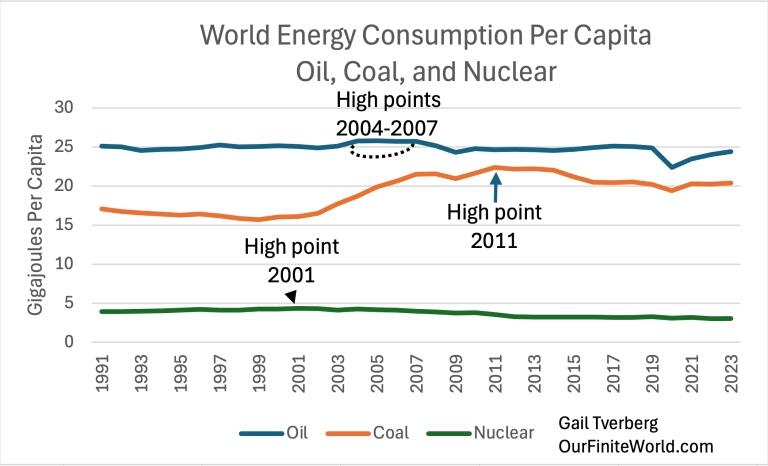 ?itok=R0AFn6OM
Figure 4. Energy consumption per capita, separately, for oil, coal, and nuclear based on data of the 2024 Statistical Review of World Energy, published by the Energy Institute.
One of the underlying problems facing the world economy is the fact that major types of energy supply have been falling relative to world population for a long time. The high points seem to have been in 2004-2007 for oil, in 2011 for coal, and in 2001 for nuclear (Figure 4).
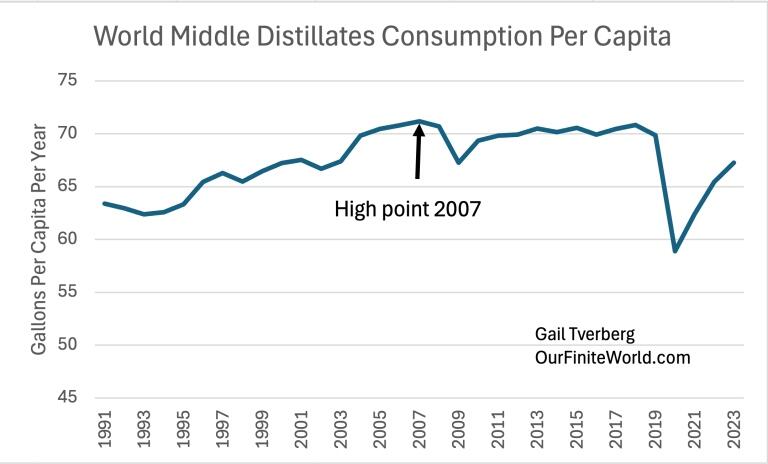 ?itok=AZeXyxkX
Figure 5. World middle distillates consumption per capita, based on data of the 2024 Statistical Review of World Energy, published by the Energy Institute. Middle distillates are diesel oil and jet fuel.
Middle distillates (diesel oil and jet fuel) are particularly important in world trade. Middle distillates are plentiful in heavy oil, such as that found in Russia, the oil sands of Canada, and Venezuela. Diesel is important for operating farm equipment, large trucks and ships, and construction equipment.
Middle distillates are in short supply because it is hard to get the price up high enough, for long enough, to compensate for the high cost of extraction, distillation, and transport. If the price of diesel rises much, the price of food tends to rise. Voters don’t like high food prices. This seems to be a major reason that both Russia’s oil exports and Venezuela’s oil exports are subject to sanctions.
Without an adequate supply of middle distillates, world trade needs to be scaled back. I believe that this shortfall is the physics reason underlying the push for increased tariffs. The fact that these tariffs are particularly high against China means that long distance transport across the Pacific Ocean will be scaled back. Shelves in US stores will increasingly lack goods made with Chinese inputs.
[7] Modeling of the overshoot and collapse problem has been done since the 1950s. A recent model suggests that world industrial output is likely to fall quickly, about now.
In 1957, US Navy Rear Admiral Hyman Rickover https://ourfiniteworld.com/2007/07/02/speech-from-1957-predicting-peak-oil/
explaining the importance of fossil fuels to the economy and to the military. He then explained that we could not expect fossil fuel extraction to last very long:
It is an unpleasant fact that according to our best estimates, total fossil fuel reserves recoverable at not over twice today’s unit cost are likely to run out at some time between the years 2000 and 2050, if present standards of living and population growth rates are taken into account.
Much modeling has been done since that time. Researchers at Massachusetts Institute of Technology did a series of analyses which they published in 1972 in the book, https://donellameadows.org/the-limits-to-growth-now-available-to-read-online/
. The most recent update to this analysis shows the following summary exhibit.
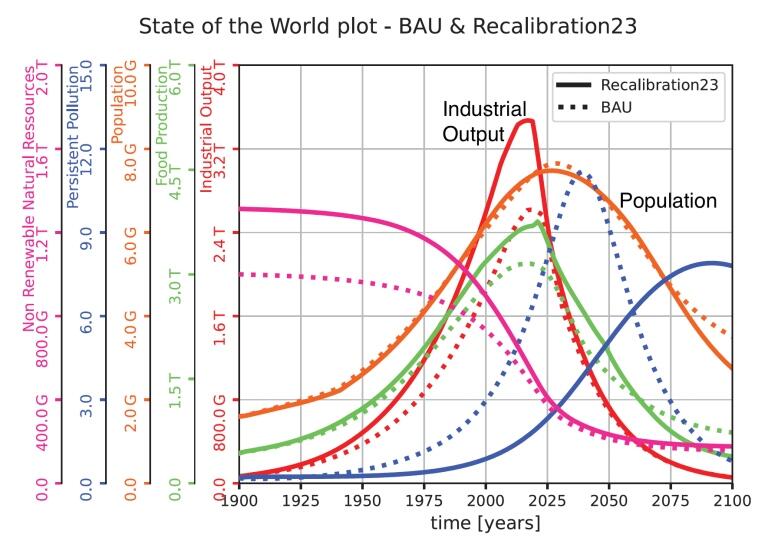 ?itok=VhWimaKF
Figure 6. Output of the recalibrated Limits to Growth model by Arjuna Nebel and others, published in 2023, with Gail Tverberg’s labels showing which lines are “Industrial Output” and which are “Population.” https://onlinelibrary.wiley.com/doi/10.1111/jiec.13442
.
The 1972 model and its update both look at the world economy from an engineering point of view. The analyses ignore the roles of governments, debt, and many other things important to the economy. The original authors of the 1972 Limits to Growth analysis said that they didn’t have much confidence in the accuracy of their forecasts after the decline had begun because of the many omitted factors.
The disturbing thing from the 2023 analysis is that it shows industrial output dropping about now. This is what I would expect to happen if there is a big drop in world trade.
[8] The world economy is self-organizing. It doesn’t seem to depend on the actions of any one person or group.
The Universe keeps growing and expanding. Many people believe that the Universe spontaneously sprang out of nothing and began to grow. I believe that there was a Creator.
An intricate system of evolution is taking place, with new dissipative structures arising and old dissipative structures coming to an end. The dissipative structures that last are the ones best adapted to the Earth’s ever-changing environment at that time.
Somehow, the world economy (and other ecosystems) maximize the total output of each part of the system, under the https://en.wikipedia.org/wiki/Maximum_power_principle
. This isn’t dependent on any one system being more efficient or working better than another. Instead, the world economy tends to maximize the total output of the system, given the energy supplies (and other resources, such as water) available. Thus, the world output of goods and services is unlikely to fall so catastrophically that it quickly wipes out most of the world’s human population. For example, if industrial output is limited, it may be concentrated especially on replacement parts for current machinery and on machines needed for food production.
The intricate nature of evolution and the many dissipative structures formed, together with the Maximum Power Principle, leads me to believe that the Creator is still active today.
It seems to me that the self-organizing economy utilizes whatever leaders are available. They don’t need to have good motives for their actions. It isn’t that Donald Trump is a better leader than others, or that his ideas, as promulgated, will take a hold. The system works through many leaders of various political parties. Each leader is somewhat replaceable by other leaders. The underlying physics of the system is what leads to the changes that take place.
Religions seem all to be created by the same Creator. They seem to have many functions, including binding groups together, teaching “best practices” regarding getting along within a group here on earth, and (when resources are short), fighting against other religious groups. Religious organizations seem to be part of the self-organizing economy, as well.
[9] What I see ahead.
(a) Recession seems likely, starting out as being barely perceptible, but getting worse and worse over time.
(b) World output of physical goods and services will begin to decline almost immediately. In particular, products manufactured in the US using inputs from China will become difficult to obtain, as will goods imported into the US from China.
(c) I expect that commodity prices will fall. Deflation seems more likely than inflation. If inflation does take place, I expect that it will take the form of hyperinflation, with central banks issuing huge amounts of money, but there not being very many goods and services to purchase with this money.
(d) I expect that many banks, insurance companies, and pension plans will fail. I expect that governments will not be able to bail them all out. If governments do try to bail out all these failing institutions, the result is likely to be hyperinflation, with not much to buy.
(e) Many governments have plans for digital currencies to replace the currencies we have today. I am doubtful that these plans will work. For one thing, intermittent electricity is likely to become an increasing problem. For another, government organizations, such as the European Union, the World Trade Organization, the World Bank, and the United Nations are likely to start falling apart. Even the United States is likely to become less “united,” or it may comprise fewer states.
(f) I do not see gold as being very helpful for the long term. It seems like small silver coins will be much more tradable in the future. What we will really need is food, water, and shelter. I expect that these will go mostly to workers producing these essentials, rather than to hangers-on to the system.
(g) A few businesses may do well. Figuring out how to produce food in quantity, locally, may be helpful. Converting unused buildings to shelters for poor people may also be helpful. Private “protection” services may also do well.
(h) The stock market provided great returns for US investors in the 2008 to 2024 period, but this cannot be expected to continue. A likely result is that returns will fall very low or will turn negative.
(i) Borrowing is likely to remain challenging, or get worse. Lenders will increasingly recognize the default risk. Some lenders may go out of business.
(j) Over a period of years, trade will change to be more local. The US will lose its status as the holder of the reserve currency. It will no longer try to be the policeman of the world.
[10] There are a lot of things we really don’t know.
The Creator may be creating a religious ending that we are not aware of. In fact, such an ending could come very soon.
Otherwise, dissipative structures are very often replaced by other dissipative structures. New economies may gradually grow up in different parts of the world. Perhaps the new economies will figure out new energy sources that we are not aware of, or make better use of declining energy types. According to Physicist Eric Chaisson, the long-term trend is toward more complex, energy-intense dissipative structures being formed.
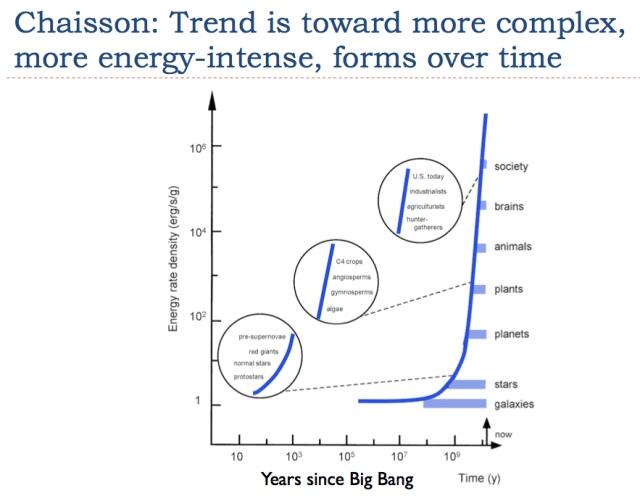 ?itok=4reY8xlQ
Figure 7. Image similar to ones shown in Eric Chaisson’s 2001 book, Cosmic Evolution: The Rise of Complexity in Nature.
“Societies” in Figure 7 seem to be similar to today’s economy.
https://cms.zerohedge.com/users/tyler-durden
Sun, 04/27/2025 - 23:20
https://www.zerohedge.com/geopolitical/world-economy-reaching-limits-growth
NYT Hack Goes Mask-Off Defending Judge Protecting Illegal Alien: 'Sometimes Civil Disobedience Is Necessary'
NYT Hack Goes Mask-Off Defending Judge Protecting Illegal Alien: 'Sometimes Civil Disobedience Is Necessary'
New York Times opinion writer David Brooks suggested Friday that Milwaukee County Circuit Judge Hannah Dugan’s alleged assistance of an illegal alien in evading federal immigration authorities was justified, despite his (albeit tepid) acknowledgment that her actions were illegal.
 ?itok=gja52tO5
“Especially on the issue of immigration, there are a lot of people who are appalled by what the administration is doing,” Brooks said on PBS’s NewsHour regarding President Trump’s fulfill his campaign promise of cracking down on illegal immigration. “And there will be times for civil disobedience. And to me, let’s say she did escort this guy out the door. If federal enforcement agencies come to your courtroom and you help a guy escape, that is two things. One, it strikes me as maybe something illegal, but it also strikes me something heroic.”
🚨NYT’s David Brooks doesn’t "know the specific details" of the Judge Dugan case — but says she was “heroic."
“If the federal enforcement agencies come to your courtroom and you help a guy escape, that is two things..."
“One, it strikes me as maybe something illegal, but it… https://t.co/1Ia7BaxW7R
— Western Lensman (@WesternLensman) https://twitter.com/WesternLensman/status/1916478245513625698?ref_src=twsrc%5Etfw
“And in times of trouble, then people are sometimes called to do civil disobedience. And in my view, when people do civil disobeying, they have to pay the price,” Brooks added. “That’s part of the heroism of it, frankly. And so you can both think that she shouldn’t have. Legally done this, and that morally protecting somebody against, maybe not even in this case, but in other cases, frankly, a predatory enforcement agency, sometimes civil disobedience is necessary.”
FBI Director Kash Patel shocked both the left and right Friday when he announced the arrest of Dugan, charging the judge with two felonies on allegations of trying to help an illegal aliens avoid arrest after he appeared in her courtroom.
reports:
According tohttps://www.documentcloud.org/documents/25919655-1034-001-1-1/
, Dugan, 65, is accused of obstructing a U.S. agency and concealing an individual to prevent an arrest. The two charges carry a maximum penalty of six years in prison and a $350,000 fine, but sentences in cases involving nonviolent offenses typically are much shorter.
Specifically, the complaint says Dugan assisted Eduardo Flores-Ruiz, an undocumented Mexican immigrant, avoid being arrested by federal immigration officials at the Milwaukee County Courthouse after he appeared in her courtroom for a pretrial conference on April 18. Flores-Ruiz is facing three misdemeanor battery counts.
Dugan’s arrest unsurprisingly drew sharp criticism from Wisconsin Democrats, who labeled the FBI’s actions as government overreach. Conversely, Wisconsin Republicans stressed accountability, asserting that breaking the law leads to consequences.
“I would advise everyone to cooperate with federal law enforcement and not endanger them and the public by obstructing their efforts to arrest criminals and illegal aliens,” Sen. Ron Johnson https://www.jsonline.com/story/news/breaking/2025/04/25/milwaukee-county-judge-hannah-dugan-arrested-by-feds-at-courthouse/83270885007/
.
Rep. Tom Tiffany, eyeing a gubernatorial bid in 2026, https://www.jsonline.com/story/news/breaking/2025/04/25/milwaukee-county-judge-hannah-dugan-arrested-by-feds-at-courthouse/83270885007/
bluntly: “If you help illegal aliens evade arrest, you will be arrested.”
Legal expert Jonathan Turley had this to https://www.zerohedge.com/political/not-normal-democrats-miss-obvious-problem-arrest-wisconsin-judge
: “Judges have to reinforce respect for the judiciary in their own conduct. That includes showing restraint and respect in relation to the countervailing powers of the Executive Branch. It certainly includes avoiding actions that could be viewed as criminal or unethical in resisting this Administration.”
https://cms.zerohedge.com/users/tyler-durden
Sun, 04/27/2025 - 22:45
Israel Extends Compulsory Service As Manpower Crisis Plagues Army
Israel Extends Compulsory Service As Manpower Crisis Plagues Army
https://thecradle.co/articles/israel-extends-compulsory-service-as-manpower-crisis-plagues-army
The Israeli army hashttps://www.ynetnews.com/article/hy7qfusjll
that it will extend mandatory service by four months due to a growing manpower crisis, coinciding with an intensification of battles in Gaza and the resurgence of deadly resistance operations against invading troops.
The additional four months will be classified as reserve duty, allowing soldiers to complete a total of three years of military service. The military will also cancel pre-release leave for soldiers. Troops will have to serve a full three years before being discharged.
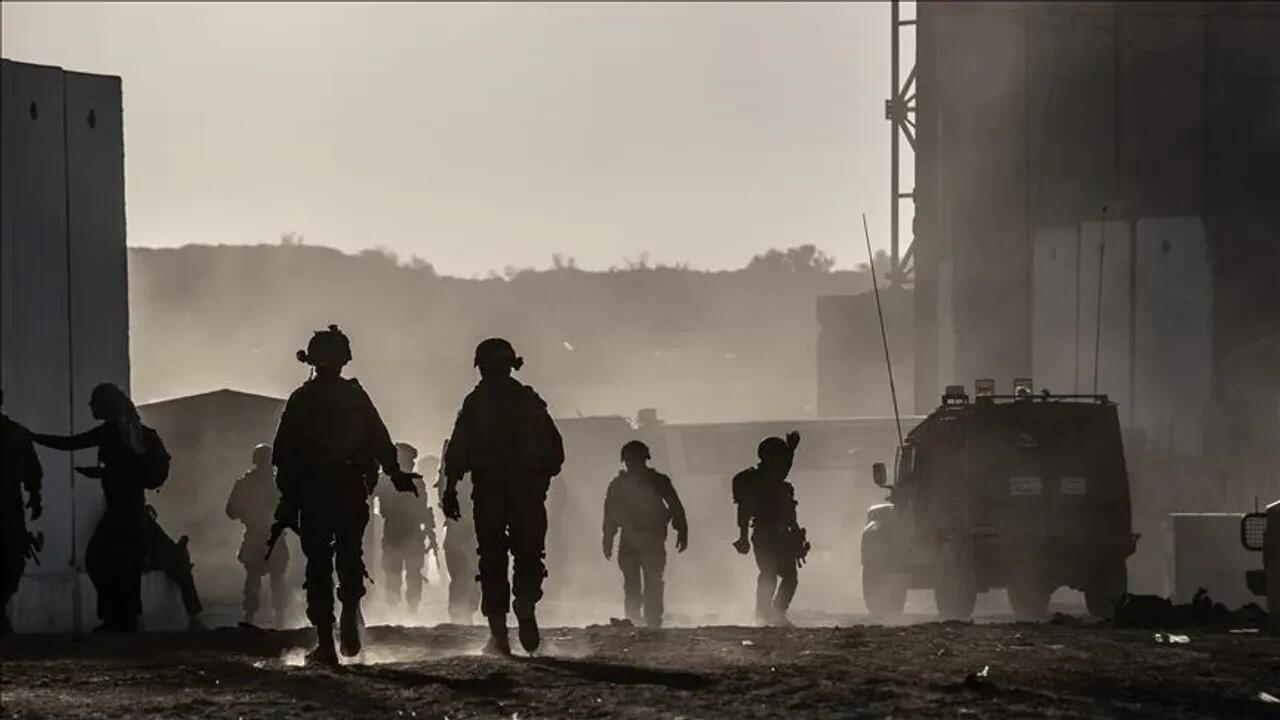 ?itok=ksdN3rdL
This decision follows months of intense fighting and rising casualties, which have strained troop levels.
The extra four months will provide benefits for the soldiers, given that reserve duty is usually compensated by the Israeli government. The army states that its decision is temporary and aims to help alleviate the current troop shortages.
"At the moment, we are short 10,000 troops, 7,000 of them in combat units," the army https://www.ynetnews.com/article/hy7qfusjll
. Israel announced on Saturday the death of Staff Sergeant Neta Yitzhak Kahana, an undercover operative with the Southern Border Police, who was killed during clashes with militants in Gaza.
His death marked the second Israeli soldier to be killed over the weekend. Both were https://www.timesofisrael.com/soldier-and-cop-killed-in-gaza-city-fighting-as-idf-prepares-to-ramp-up-offensive/
in Gaza City’s Shujaiya neighborhood.
Israel has said that it will launch a major offensive across Gaza if no progress is made in truce negotiations. According to Tel Aviv, current operations in Gaza – which have seen the army seize at least 50 percent of the strip’s territory – aim to pressure Hamas in talks, not bring about a complete defeat of the resistance group.
An expanded assault on Gaza would include a massive call-up of reservists and operations in new areas of the strip, the army has said.
Last month, Israeli media reported that the army is facing ahttps://thecradle.co/articles/growing-number-of-israeli-reservists-unwilling-to-serve-report
in its reserves as a growing number of soldiers have indicated a lack of motivation and an unwillingness to serve. A senior commander in the reserves told Haaretz that there are numerous cases of reservist soldiers refusing to report for duty.
According to estimates, the response rate for the upcoming reservist call-up is expected to be no more than 50 percent. This would mark a 50 percent drop since the start of the war in 2023.
Meetings of the Israeli Security Cabinet revealed “major disagreements” between the political and the military ranks regarding the policies of Prime Minister Benjamin Netanyahu’s government on the genocidal war against the Gaza Strip.
Read: https://t.co/RSWsBIiV95
— Middle East Monitor (@MiddleEastMnt) https://twitter.com/MiddleEastMnt/status/1916478667422564415?ref_src=twsrc%5Etfw
The manpower crisis Israel is facing coincides with growing tension between Israel’s political and security establishments. Former Shin Bet chief Ami Ayalon https://ground.news/article/former-shin-bet-chief-ami-ayalon-called-for-civil-disobedience-at-protest-rally
for civil disobedience against Prime Minister Benjamin Netanyahu following his dismissal of Shin Bet chief Ronen Bar. This came during a protest in Tel Aviv on Saturday.
Israeli protesters have also taken to the streets to demand an immediate exchange agreement in Gaza, where relentless airstrikes are endangering the lives of captives still held by the resistance.
https://cms.zerohedge.com/users/tyler-durden
Sun, 04/27/2025 - 22:10
Schweizer: Chinese Chemists Working With Mexican Cartels Creating Fentanyl To Kill Americans
Schweizer: Chinese Chemists Working With Mexican Cartels Creating Fentanyl To Kill Americans
New York Times bestselling author Peter Schweizer is once again speaking out against China's sinister role in fueling America's deadly fentanyl crisis, as President Donald Trump seeks to punish the communist regime for its involvement.
 ?itok=v3p7DQPd
"There are 2000 Chinese nationals in northern Mexico working for the Sinaloa drug cartel," Schweizer, citing DEA data, told https://wabcradio.com/episode/peter-schweizer-there-are-2000-chinese-chemists-working-in-mexico-creating-fentanyl-to-kill-americans-04-25-25/
on Friday. "They’re basically chemists."
"They take the precursor chemicals that, of course, arrive from China and they turn it into the deadly cocktail, which is what people are dying from. They produce pills. People who die of fentanyl overdose, they think they’re talking a Vicodin or Adderall,” he added.
Although fentanyl-related deaths in the U.S. are declining, the crisis remains a grim reality. According to the https://www.cdc.gov/nchs/products/databriefs/db522.htm
figures estimate approximately 55,126 deaths from synthetic opioids in the 12 months ending September 2024—a significant and hopeful drop, but still a sobering reminder of fentanyl’s ongoing toll.
President Donald Trump has repeatedly pointed the finger at China as a key culprit in America’s fentanyl crisis, accusing Beijing of fueling the epidemic by allowing precursor chemicals to flow to Mexican cartels. In a February 2025 White House statement, Trump accused China of subsidizing companies to export fentanyl-related chemicals, https://www.whitehouse.gov/presidential-actions/2025/02/imposing-duties-to-address-the-synthetic-opioid-supply-chain-in-the-peoples-republic-of-china/
“Fentanyl continues to pour into our Country from China, through Mexico and Canada, killing hundreds of thousands of our people, and it better stop, NOW!”
China has consistently denied accusations that it is a primary driver of the U.S. fentanyl crisis. Chinese officials argue that the crisis is a U.S. domestic issue rooted in demand, not their supply of precursor chemicals. In March 2025, Foreign Ministry spokesperson Lin Jianhttps://english.news.cn/20250304/c583242839fe4d84aafd36d400ad91d6/c.html
the U.S. for imposing tariffs under the pretext of the fentanyl issue, calling such actions unjustified and counterproductive.
https://cms.zerohedge.com/users/tyler-durden
Sun, 04/27/2025 - 21:35
USDA Withdraws Proposed Rule To Limit Salmonella In Raw Poultry
USDA Withdraws Proposed Rule To Limit Salmonella In Raw Poultry
(emphasis ours),
The U.S. Department of Agriculture announced on Thursday that it is withdrawing a proposed rule that would have required poultry companies to limit the presence of salmonella bacteria in their products, ending an effort by the past Biden administration to reduce foodborne illnesses linked to contaminated meat.
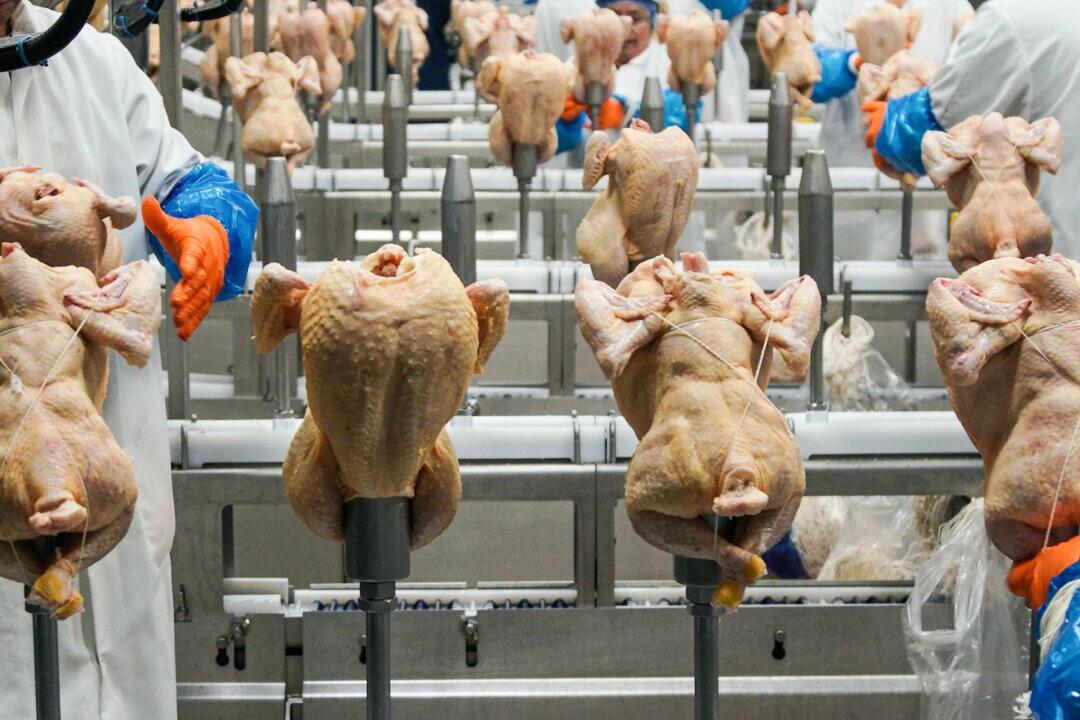 ?itok=CD6ucG5o
The USDA’s Food Safety and Inspection Service (FSIS) said the decision follows the review of more than 7,000 public comments submitted in response to the proposed rule, which was published in August 2024.
The department stated it will “evaluate whether it should update” current salmonella regulations, according to a Thursday https://public-inspection.federalregister.gov/2025-07187.pdf
from FSIS, which is pending publication in the Federal Register.
The withdrawn rule would have required poultry companies to keep salmonella bacteria below a specific threshold and test for six strains most associated with it, with three found in turkey and three in chicken. Any products exceeding the standard or containing any of those strains would have been forbidden from sale and subject to recall.
.
FSIS explained that the proposed framework targeted raw chicken carcasses, chicken parts, comminuted chicken, and comminuted turkey products contaminated with certain salmonella levels and serotypes, which would have been classified as adulterated under the Poultry Products Inspection Act, according to the agency’s April 24 notice. The agency also proposed stricter monitoring, sampling, and recordkeeping requirements for poultry processors, according to the same notice.
The agency said it received 7,089 comments on the proposal, including feedback from industry trade associations, small and large poultry processors, consumer advocacy groups, academics, and state officials.
Decision to Withdraw
Key issues raised included questions about FSIS’s legal authority, the scientific basis for the proposed standards, economic impacts, and the potential burden on small producers, according to the FSIS notice.
“While FSIS continues to support the goal of reducing Salmonella illnesses associated with poultry products, the Agency believes that the comments have raised several important issues that warrant further consideration,” FSIS stated in its withdrawal notice.
The decision to withdraw the rule was welcomed by the National Chicken Council, an industry trade group. “We remain committed to further reducing Salmonella and fully support food safety regulations and policies that are based on sound science, robust data, and are demonstrated to meaningfully impact public health,” said Ashley Peterson, the council’s senior vice president of scientific and regulatory affairs, according to the group’s https://www.nationalchickencouncil.org/ncc-statement-on-withdrawal-of-salmonellaframework/
on Thursday.
Peterson criticized the proposed framework as “legally unsound,” based on “misinterpretations of the science,” and likely to have “no meaningful impact on public health.”
She added that it would have led to “an extraordinary amount of food waste” and higher costs for producers and consumers, according to the National Chicken Council.
“We appreciate today’s announcement by FSIS and share their goal of protecting public health,” Peterson said, adding that the council looks forward to working with the agency on future policy.
Sandra Eskin, a former USDA official who helped draft the plan, said the withdrawal “sends the clear message that the Make America Healthy Again initiative does not care about the thousands of people who get sick from preventable foodborne salmonella infections linked to poultry,” according to the Associated Press.
Sarah Sorscher of the Center for Science in the Public Interest compared the proposed rule to the 1994 ban on certain E. coli strains in ground beef, calling it a missed opportunity for a significant food safety victory. “Make no mistake: Shipping more salmonella to restaurants and grocery stores is certain to make Americans sicker,” Sorscher said, according to the Associated Press.
Earlier this month, the USDA https://www.fsis.usda.gov/policy/federal-register-rulemaking/federal-register-notices/delayed-verification-sampling-not-ready
outbreaks and over 200 illnesses since 1998, according to the CDC.
From https://www.ntd.com/usda-withdraws-proposed-rule-to-limit-salmonella-in-raw-poultry_1062759.html
https://cms.zerohedge.com/users/tyler-durden
Sun, 04/27/2025 - 21:00
https://www.zerohedge.com/political/usda-withdraws-proposed-rule-limit-salmonella-raw-poultry
Trump Floats Plan To Slash Or Eliminate Income Taxes For Millions Using "BONANZA" Tariff Cash
Trump Floats Plan To Slash Or Eliminate Income Taxes For Millions Using "BONANZA" Tariff Cash
President Donald Trump doubled down Sunday on his plan to use tariff revenue to slash - and possibly eliminate - income taxes for millions of Americans.
 ?itok=TvQNghl1
The former president took to Truth Social to tout his vision, claiming that his sweeping tariffs could lead to big tax breaks for workers making under $200,000 a year.
“When Tariffs cut in, many people’s Income Taxes will be substantially reduced, maybe even completely eliminated. Focus will be on people making less than $200,000 a year,” Trump wrote.
https://truthsocial.com/@realDonaldTrump/114410073592204291
The bold pledge comes as public anxiety grows over the economic fallout from Trump’s aggressive trade policies, which have rattled global markets and fueled fears of higher prices at home.
In the weeks since Trump slapped so-called reciprocal tariffs on dozens of countries - including a staggering 145% levy on Chinese goods, economists have sounded the alarm that the tariffs could backfire, hurting American consumers more than foreign rivals.
That said - not everyone's excited after Trump told TIME Magazine in the April 25 edition that he “love[s] the concept” of raising taxes on millionaires as a means of paying for an extension of the 2017 tax cuts.
“I certainly don’t mind having a tax increase,” Trump told TIME.
“I would be honored to pay more, but I don’t want to be in a position where we lose an election because I was generous, but me, as a rich person, would not mind paying and you know, we’re talking about very little.”
He said it would involve raising taxes on the wealthy to “take care of [the] middle class.”
“But I don’t want it to be used against me politically, because I’ve seen people lose elections for less, especially with the fake news.”
Former White House strategist Steve Bannon told News Nation’s “CUOMO” on Friday that he supported the idea.
“This is being fought behind closed doors right now, and I’m telling you, with the massive tax cut, in addition, he’s going to give the working class and the middle class, the math only works out if you actually increase taxes on the wealthy,” Bannon said.
The former White House strategist said it could help Trump politically if he decided to run again in 2028, despite the Constitution preventing a third term in the Oval Office.
However, on April 23, the day after he sat down with TIME, Trump https://www.theepochtimes.com/us/trump-johnson-pour-cold-water-on-proposal-to-raise-top-marginal-rates-5846680
reporters at the White House that raising taxes on the wealthy could be “very disruptive” and could lead to a loss of money for the United States.
House Speaker Mike Johnson dismissed the idea in an interview with Fox News.
“I’m not in favor of raising the tax rates because our party is the party that stands against that,” Johnson said on April 23.
He acknowledged that the proposal had been discussed as one of many possible ways to permanently implement personal income tax cuts in the Republicans’ final funding package.
“There were lots of ideas thrown out on the table along this process over the last year, but I would just say for everybody, just wait and see,” Johnson said.
A CBS News poll released Sunday found 69% of Americans believe the Trump administration isn't focused enough on lowering prices. Approval of Trump’s handling of the economy dropped to 42%, down from 51% in early March, https://www.bloomberg.com/news/articles/2025-04-27/trump-floats-new-income-tax-cut-in-bid-to-ease-bite-of-tariffs
reports.
Still, Trump’s team insists their strategy will pay off - eventually.
Treasury Secretary Scott Bessent, appearing on ABC’s “This Week,” defended the president’s approach, saying consumers are still spending and talks are underway with 17 key trading partners to hammer out bilateral deals.
“We have a process in place, over the next 90 days, to negotiate with them,” Bessent said. “Some of those are moving along very well, especially with the Asian countries.”
Bessent also insisted China would have no choice but to return to the negotiating table under pressure from Trump’s new tariff wall.
“Their business model is predicated on selling cheap, subsidized goods to the US,” Bessent said. “And if there’s a sudden stop in that, they will have a sudden stop in the economy, so they will negotiate.”
Treasury Sec. Scott Bessent on China: “Their business model is predicated on selling cheap, subsidized goods to the U.S., and if there is a sudden stop in that, they will have a sudden stop in the economy. So they will negotiate.” https://t.co/DDuPIh4dI1
— This Week (@ThisWeekABC) https://twitter.com/ThisWeekABC/status/1916492221555093891?ref_src=twsrc%5Etfw
Bessent also explained America's "barbell" economy - in which there is a "financial system and tech sector that is the envy of the world" on one hand, and "a natural resource-economy led by energy" on the other end.
The U.S. has a barbell economy.
On one end, we have a financial system and tech sector that is the envy of the world.
On the other end, we have a natural resource-economy led by energy.
In between is where working-class Americans have lost out—and we want to fix that. https://t.co/ysVxibNIQ7
— Treasury Secretary Scott Bessent (@SecScottBessent) https://twitter.com/SecScottBessent/status/1916530279625154569?ref_src=twsrc%5Etfw
Trump has claimed that talks with China are ongoing - a claim Beijing has flatly denied. Bessent admitted he didn’t know if Trump and Chinese President Xi Jinping had spoken directly, noting that Chinese officials he saw during a global finance summit last week stuck to safer topics like “financial stability” and “early warnings.”
Despite the rocky start, Bessent said he’s optimistic that a path forward could emerge, starting with a “de-escalation” and leading to an “agreement in principle” - even if a full trade deal takes longer.
Meanwhile, Trump is eyeing sweeping tax changes at home. His 2017 tax cuts are set to expire at the end of 2025, and he has vowed to not only extend them but expand them, exempting workers’ tips, slashing the corporate tax rate to 15%, and possibly wiping out income taxes for working-class Americans.
The House GOP's early-April framework allows for up to $5.3 trillion in tax cuts over the next decade. Trade adviser Peter Navarro has suggested tariff revenue could more than cover that - a claim most economists dismiss as wildly optimistic.
Reports already show that Trump’s tariffs are expected to hit lower-income Americans harder than the wealthy, potentially complicating the president’s pitch to working families.
But Trump, undeterred, appears ready to bet that tariff-fueled tax cuts will give him a powerful message heading into the 2026 midterms, even if voters are feeling the pinch now.
https://cms.zerohedge.com/users/tyler-durden
Sun, 04/27/2025 - 20:25
Trump Wants US Ships To Travel Through Panama, Suez Canals for Free
Trump Wants US Ships To Travel Through Panama, Suez Canals for Free
President Donald Trump said on April 26 that America’s military and commercial ships should be allowed to pass through the Panama and Suez canals “free of charge.”
“Those Canals would not exist without the United States of America,” Trump https://truthsocial.com/@realDonaldTrump/posts/114406185820566958
on his Truth Social platform.
“I’ve asked Secretary of State Marco Rubio to immediately take care of, and memorialize, this situation!”
Stretching across the isthmus that connects North to South America, the Panama Canal allows ships to quickly traverse between the Atlantic and Pacific oceans, carrying roughly 40 percent of U.S. container traffic yearly.
 ?itok=tRoyIWy6
American and British leaders and businessmen discussed plans for building the canal throughout the 1800s as a way to quickly and cheaply transport goods without having to travel around the southern tip of South America to get between the Pacific and Atlantic oceans. The United States https://history.state.gov/milestones/1899-1913/panama-canal
the canal between 1903 and 1914.
President Jimmy Carter https://history.state.gov/milestones/1977-1980/panama-canal
the Torrijos-Carter Treaties, ratified by the Senate in 1978, that would set in motion the relinquishing of control of the canal to Panama.
That finally came to fruition in 1999.
Trump has previously said that he wants to “take back” the canal and bring it under U.S. control, suggesting that he would not exclude economic or military force from regaining the shipping passageway.
Earlier this month, Defense Secretary Pete Hegseth https://www.theepochtimes.com/world/us-signs-deal-with-panama-to-secure-canal-deter-chinas-maligned-influence-5839646
the United States was partnering with Panama to secure the Panama Canal while countering China’s “malign influence.”
“The Panama Canal is key terrain that must be secured by Panama, with America and not China,” Hegseth https://www.defense.gov/News/News-Stories/Article/Article/4150935/hegseth-says-us-partnering-with-panama-to-secure-canal-deter-china/
at a joint press conference with Panamanian Public Security Minister Frank Abrego.
The two nations signed a memorandum of understanding on bilateral security matters in the region that will see an expansion of joint training exercises between the United States and Panama while improving interoperability between their militaries, the secretary said.
The Suez Canal, which connects the Mediterranean to the Red Sea, was https://www.suezcanal.gov.eg/English/About/SuezCanal/Pages/CanalHistory.aspx
in the late 1800s after plans to build the shipping corridor had been discussed since the time of Ancient Egypt.
However, recent military conflicts and terrorist attacks in the area have disrupted shipping traffic moving through the Suez Canal, forcing some ships to reroute around Africa’s southern Cape of Good Hope instead of using the corridor.
The Houthi terrorist group, backed by Iran, have caused repeated shipping disruptions in the area, https://www.atlanticcouncil.org/in-depth-research-reports/issue-brief/a-lifeline-under-threat-why-the-suez-canals-security-matters-for-the-world/#:~:text=Impact%20on%20global%20trade%20and,or%20more%20in%20prior%20months.
to the Atlantic Council, which estimates that the canal generated roughly $9.4 billion in revenue for Egypt in 2022–2023.
The Trump administration has approved multiple targeted strikes on the Houthis this year. Trump said the strikes would continue until the group no longer disrupts shipping between the Mediterranean and the Red Sea.
https://cms.zerohedge.com/users/tyler-durden
Sun, 04/27/2025 - 19:50
https://www.zerohedge.com/geopolitical/trump-wants-us-ships-travel-through-panama-suez-canals-free
India's Modi Vows 'Harshest Response' To Terror Attack Amid 'Unprovoked' Gunfire 'Initiated By Pakistan'
India's Modi Vows 'Harshest Response' To Terror Attack Amid 'Unprovoked' Gunfire 'Initiated By Pakistan'
Indian and Pakistani relations are once again in full crisis mode, and Sunday marks the https://www.zerohedge.com/geopolitical/pakistan-india-exchange-2nd-straight-day-border-fire-brink
of reports of sporadic border fire at army outposts between the nuclear-armed neighbors and historic enemies, following last Tuesday's terror attack in India-administrated Kashmir, which killed 26 Indian tourists in the mountainous, remote region.
Indian Prime Minister Narendra Modi has issued a new statement vowing that the terrorists widely being referred to as Pahalgam attackers "will be served with the harshest response" and that India will seek justice "to the ends of the earth".
 ?itok=IkEW5EBr
The Indian army over the weekend https://www.aljazeera.com/news/liveblog/2025/4/27/kashmir-attack-live-india-pakistan-troops-exchange-fire-for-third-day
there has been "unprovoked" firing "initiated by Pakistan" along the Line of Control (LOC)_ which divides Kashmir into two. Pakistan in the aftermath of the accusation neither confirmed nor denied.
The New York Times https://www.nytimes.com/2025/04/25/world/asia/india-pakistan-kashmir.html
Saturday that "Pakistani solders fired at an Indian position first and India responded in kind, according to local news reports, which said that "the exchange was brief and that there were no casualties." Precise locations of these live fire incidents have not been disclosed.
Days into the crisis and land borders have been shut, visas and military exchange programs mutually canceled, and a landmark water treaty has been suspended.
Pakistan’s PM Sharif meanwhile said his country is ready to defend its sovereignty but offered willingness to establish a "neutral" international investigation into the attack.
Sharif is further scrambling to get major global powers in Pakistan's corner, as he calls for the independent investigation. He has welcomed China and Russia's participation, as well as Iran.
Pakistani Defence Minister Khawaja Asif has told RIA Novosti "I think that Russia or China or even Western countries can play a very positive role in this crisis, and they can even create an investigation team … to investigate whether India is lying or Modi is telling the truth." He added, "Let the international team find out."
Shariff's office also issued the following: "The prime minister of Pakistan said that his country seeks peace in the region and that if Iran wishes to play a role in this regard, Islamabad will welcome it."
Pakistani Kashmiris play cricket unfazed by gunfire echoing from the India-Pakistan Line of Control https://t.co/A376w9qGKZ
— RT (@RT_com) https://twitter.com/RT_com/status/1916472393716924811?ref_src=twsrc%5Etfw
But if gunfire continues to be exchanged between the two militaries, also amid reports that Pakistani visa holders are being promptly booted from the country amid the diplomatic crisis - clashes could accelerate toward open war. The two rivals are one more major incident away, after India accused Pakistan of harboring the terrorists that massacred the civilians in Kashmir last week.
Chief Minister of Jammu and Kashmir Omar Abdullah has meanwhile said there must be a "decisive fight against terrorism and its origin."
Unverified videos of gunfire along disputed Line of Control have been widely circulating...
Video circulating of gunfire reportedly heard between India and Pakistan: https://t.co/ML0pGbaiLS
— BRICS News (@BRICSinfo) https://twitter.com/BRICSinfo/status/1916235942375133602?ref_src=twsrc%5Etfw
"People of Kashmir have come out openly against terrorism and the murder of innocent people, they did this freely & spontaneously. It’s time to build on this support and avoid any misplaced action that alienates people," Abdullah wrote on X.
"Punish the guilty, show them no mercy but don’t let innocent people become collateral damage," he added, voicing fears that the local population is being subject to brutal tactics by India's police and military as they hunt for the culprits of Tuesday's attack. Will this crisis explode? The United Nations and international countries are urging both sides to walk back from the brink.
https://cms.zerohedge.com/users/tyler-durden
Sun, 04/27/2025 - 18:05
Canada Votes On New Government Monday After Shock Poll Reversal
Canada Votes On New Government Monday After Shock Poll Reversal
Canada will elect a new government on Monday, with former central banker Mark Carney's liberal party vying to extend their hold on power against Pierre Poilievere's conservatives. The first results are expected to come in just after 7 p.m. ET after voting hours end in the four Atlantic provinces, with the majority of results expected to be released at 9:30 p.m. when voting ends in most of the country, including in seat-rich Ontario and Quebec.
 %282%29_0.jpg?itok=mKPqdzHe
In January, it seemed Poilievere was a lock over the center-left Liberals, who had been in power for a decade under the leadership of unpopular PM Justin Trudeau. Conservatives had a double-digit lead in polls amid public outcry over Trudeau, inflation, and steep housing costs - leading Trudeau to bow out for a Liberal party leadership contest that saw Carney take pole position.
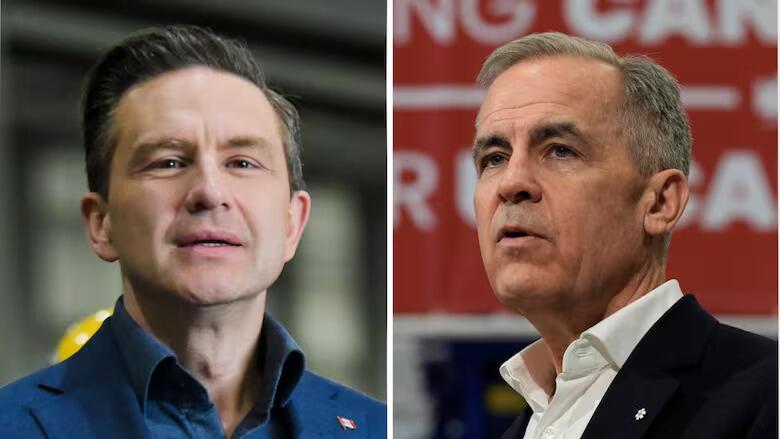 ?itok=SRWkyX24
Then, after US President Donal Trump began threatening - and imposed, 25% tariffs on many goods from Canada, Carney's fortunes shifted and he called an early election.
Carney, a former governor of the Bank of Canada and Bank of England, declared that Canada's "old relationship with the United States, based on deepening integration of our economies and tight security and military cooperation, is over."
"President Trump is trying to break us so that America could own us," he told a crowd at a London, Ontario rally on Friday.
Poilievere, meanwhile, had positioned himself as the ultimate candidate for change - vowing to deregulate vast swaths of the Canadian economy, and cracking down on the "woke" liberal establishment.
By mid-March, when the election was called, Carney's liberals were polling neck and neck - and now maintain a narrow lead into the home stretch.
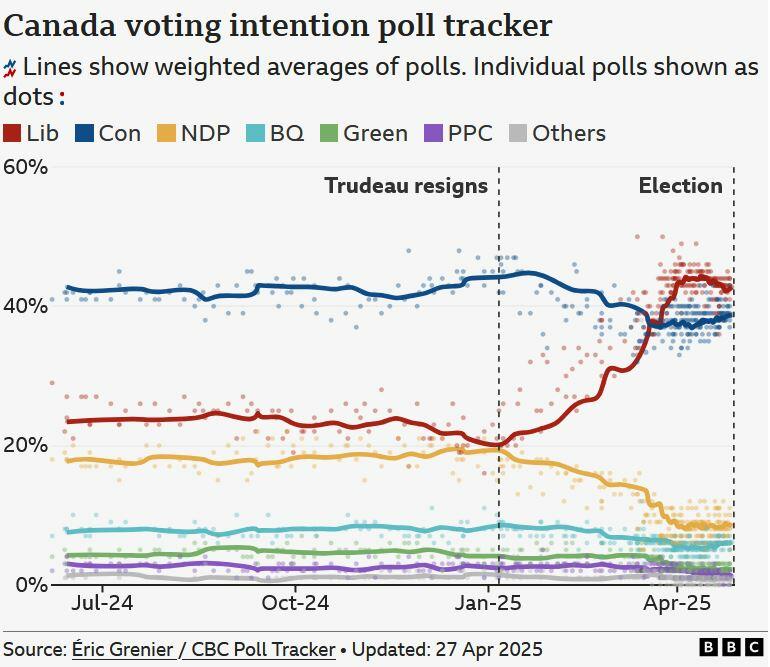 ?itok=FKX1LmFb
Carney has now positioned himself as the man most ready to counter Trump's tariffs - with his supporters pointing to his strong resume.
"I'm very impressed by the stability and the serious thought process of Mark Carney," Mike Brennan of Kitchener, Ontario told the BBC outside a Carney event at a Cambridge coffee shop, about an hour outside Toronto.
Brennan, a "lifelong Liberal," says he initially wasn't going to vote in the election over his hatred of Trudeau, however the departure of the former PM has reignited support for the Liberal party.
Stay tuned...
https://cms.zerohedge.com/users/tyler-durden
Sun, 04/27/2025 - 13:25
https://www.zerohedge.com/geopolitical/canada-votes-new-government-monday-after-shock-poll-reversal
Share Of European Cardinals Declines Ahead Of New Pope Vote
Share Of European Cardinals Declines Ahead Of New Pope Vote
With the funeral out of the way, the conclave begins and every vote will count.
During the pontificate of the late Francis, the number of cardinals worldwide shifted somewhat away from a heavy focus on Europe. However, https://www.statista.com/topics/3977/religion-in-europe/
continue to be overrepresented when considering the share of the world's Catholics that live on the continent. The change could have implications in the vote for the next pope, which could start in a few weeks' time.
Statista's Katharina Buchholz reports that, https://www.pewresearch.org/short-reads/2025/04/21/under-pope-francis-the-college-of-cardinals-became-less-european/
, 41 percent of cardinals eligible to vote for a new pope upon Francis' death Monday are from Europe. This is down from 50 percent in 2013, the time of the last vote.
https://www.statista.com/chart/34329/share-of-cardinals-worldwide-by-national-origin/
You will find more infographics at https://www.statista.com/chartoftheday/
The pope appoints cardinals and under Francis, the number of cardinals from the Asia-Pacific region grew from 10 percent to 18 percent.
The relative share of cardinals from Sub-Saharan Africa also grew from 8 percent to 12 percent.
While the share of the world's Catholics that lives in Africa is even higher, at 19 percent, it is Latin America and the Caribbean which is the most underrepresented in terms of cardinals.
According to Vatican records, 41 percent of the world's Catholics live in the region. Under Francis, the share of Latin American and Caribbean cardinals only rose slightly, from 17 percent to 18 percent.
https://cms.zerohedge.com/users/tyler-durden
Sun, 04/27/2025 - 07:35
https://www.zerohedge.com/geopolitical/share-european-cardinals-declines-ahead-new-pope-vote
Orbán Hits Back At Tusk's Disinformation Over Hungary Leaving The EU
Orbán Hits Back At Tusk's Disinformation Over Hungary Leaving The EU
Hungarian Prime Minister Viktor Orbán firmly denied allegations made by Polish opposition leader Donald Tusk that Hungary might leave the European Union, clarifying that his intent is to reform, not abandon, the bloc.
 ?itok=I1yGnBSH
Orbán’s comments came in response to an X post from Tusk, who suggested Orbán was openly considering a Hungarian exit from the EU — a claim that Orbán labeled as misleading.
“Prime Minister Orbán is speaking openly today about Hungary’s exit from the European Union. It was worth winning the elections so that Kaczyński’s dream of “Budapest in Warsaw” would never come true. This is also at stake in the upcoming elections,” Tusk tweeted, referencing the famous remarks made by the leader of the Polish opposition Conservatives (PiS), Jarosław Kaczyński, after his party lost the 2011 Polish election.
Addressing Tusk directly, Orbán replied on the same platform:
“Dear Donald, don’t raise your hopes too high. Hungary will not leave the EU. We will transform it with the Patriots for Europe, to restore it to what it once was when Poland and Hungary joined.”
Dear Donald,
Don’t raise your hopes too high. Hungary will not leave the EU. We will transform it with the https://twitter.com/PatriotsEU?ref_src=twsrc%5Etfw
, to restore it to what it once was when Poland and Hungary joined.
Back then, Brussels bureaucrats served the people instead of themselves. Back then,… https://t.co/AmbCyl6Q9d
— Orbán Viktor (@PM_ViktorOrban) https://twitter.com/PM_ViktorOrban/status/1915743451427098856?ref_src=twsrc%5Etfw
He emphasized that the EU at that time was focused on serving the interests of its member states, rather than interfering in their internal politics, a criticism he frequently directs at current EU officials.
Tusk’s statement was based on Orbán’s recent appearance at a public forum, where the Hungarian leader discussed ongoing tensions with Brussels but explicitly stated that exiting the EU would be irrational. “It is not reasonable to quit,” Orbán stressed, reminding the audience of his own support for Hungary’s accession in the 2003 referendum.
Orbán also shared an anecdote of former U.S. President Donald Trump repeatedly asking when Hungary would leave the EU, to which he joked in response, “Mr. President, we need a better offer.”
Orbán made clear that Hungary’s interest in EU membership extends far beyond financial benefits, pointing out the importance of a single market of 400 million consumers to Hungarian exports, 85 percent of which flow to EU member states. Instead, he advocated for substantial reforms, suggesting that his newly formed group in the European Parliament, Patriots for Europe (PfE), would eventually become influential enough to “dictate” terms for the bloc’s transformation.
Tusk’s comments drew fierce criticism from Poland’s conservative politicians. PiS MEP Arkadiusz Mularczyk accused Tusk of “scaring people” instead of engaging in meaningful discussions about the EU’s challenges. Konrad Berkowicz, vice president of the right-wing Confederation party, went further, asserting that Tusk was once again embarrassing himself by needlessly antagonizing influential leaders and countries.
The debate between Tusk and Orbán comes at a sensitive political moment in Poland, ahead of the presidential elections scheduled for May 18. Rafał Trzaskowski, mayor of Warsaw and a close ally of Tusk, is seen as the frontrunner but faces growing competition from conservative rivals Karol Nawrocki of PiS and Sławomir Mentzen from Confederation.
https://cms.zerohedge.com/users/tyler-durden
Sun, 04/27/2025 - 07:00
https://www.zerohedge.com/geopolitical/orban-hits-back-tusks-disinformation-over-hungary-leaving-eu
Escobar: China, Hong Kong, & The Art Of Blinking
Escobar: China, Hong Kong, & The Art Of Blinking
Authored by Pepe Escobar,
So, predictably, Captain Chaos did blink first. As much as he – and his sprawling media circus – https://www.guancha.cn/internation/2025_04_24_773424.shtml
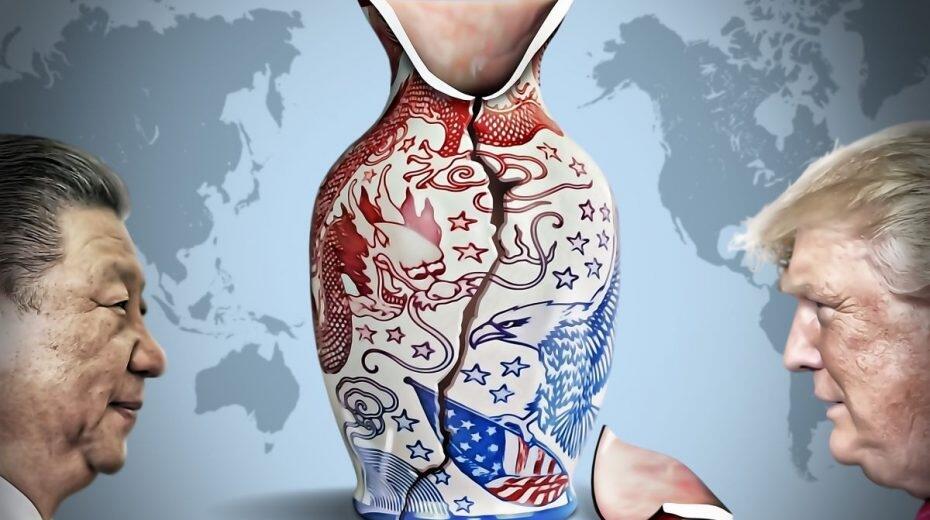 ?itok=hUuKVqm-
It all started with “tariff exemptions” – from smartphones and computers to auto parts – on products imported from China. Then it veered towards carefully manicured leaks implying tariffs “could” be reduced to a range between 50% and 65%. And finally a terse admission that if there’s no deal, a “tariff number” will be unilaterally set.
China’s Ministry of Commerce was unforgiving: “Trying to trade away others’ interests for temporary gains is like bargaining with a tiger for its skin – it will only backfire”.
And it got fiercer. The Ministry was adamant that any Trump 2.0 claims of any progress on bilateral negotiations have “no factual basis” – de facto depicting the US President as a purveyor of fake news.
Tigers, tigers burning bright: the image does not recall poetry superstar William Blake, but Mao’s legendary depiction of the US Empire as a “paper tiger” – a flashback that struck me over and over again last week in Shanghai. If the US Empire was a paper tiger already in the 1960s, the Chinese argue, imagine now.
And the pain will increase, not only for the paper tiger: any dodgy deals made by foreign – vassal – pussycat governments at the expense of Chinese interests simply will be not be tolerated by Beijing.
Last week in Shanghai I was reminded over and over again – by academics and business people – that the weaponized Trump Tariff Tizzy (TTT) goes way beyond China: it is a desperate offense ordered by the US ruling classes against a peer competitor that scares the hell out of them.
The best Chinese analytical minds know exactly what’s going on in Washington. Take for instance https://user.guancha.cn/main/content?id=1427903
originally published by the influential Cultural Horizon magazine breaking down the “triangular power structure” of Trump 2.0.
We have all-power Trump forming a “super-establishment”; Silicon Valley money politics, represented by Elon Musk; and the new right-wing elite represented by VP J.D. Vance. End result: a “governance system that is almost parallel to the federal government.”
European chihuahuas – caught in the crossfire of Trump 2.0 – are simply incapable of such synthetic and precise conceptualization.
Paper tiger meets fiery dragon
What a deep dive in Shanghai has revealed is that China has been handed over a rare earth-like opportunity by Trump 2.0 to consolidate its strategic initiative solidifying the role of leader of the Global South/Global Majority, at the same time carefully managing the risk of a New Cold War.
Call it a Sun Tzu move that may paralyze the Empire in its tracks. Professor Zhang Weiwei, with whom I had the pleasure to share a seminar in Shanghai on the Russia-China strategic partnership, https://www.guancha.cn/ZhangWeiWei/2025_04_24_773414.shtml
China is on the move across the spectrum. Chinese Premier Li Qiang sent a letter to Japanese Prime Minister Shigeru Ishibe urging a joint drive, right now, to counteract the tariff dementia.
President Xi’s top message in his Southeast Asia tour last week was to stand up against “unilateral bullying”.
Xi deftly moved between Malaysia – current rotating chair of ASEAN, always avoiding taking sides – and Vietnam – with its “bamboo diplomacy” always hedging between US and China.
Xi told Malaysia’s Prime Minister Anwar Ibrahim, directly: “We must safeguard the bright prospects of our Asian family”. Translation: let’s create an exclusive sphere of influence close to the ‘community of shared destiny’ but that does not include outside powers such as the US.
In parallel, there has been a strong debate – from Shanghai to Hong Kong – that transcends the role of China as the world’s factory: what matters now is how to redirect some of China’s astonishing manufacturing capacity towards the domestic market.
Of course there are problems – such as the lack of purchasing power among scores of Chinese domestic consumers, even as the bulk of national China income is directed to fixed-asset investments. A great deal of China’s rural elderly population survives on a monthly pension of roughly $30 a month, and the hourly rate for the gig economy has stagnated at around $4.
Meanwhile, in several high-tech fronts, China just built the fastest high-speed train on the planet: 400km/h, soon to run between Beijing and Shanghai. China is already receiving orders for the C919 commercial wide-bodied airliner. And China has come up with the world’s first thorium-powered nuclear reactor. Translation: unlimited cheap and clean energy is at hand.
The Mafia way of doing business
Hong Kong is a very special case. HSBC executives, for instance, worry about a possible decoupling between US and China – and wonder whether Hong Kong may survive without US trade.
Yes, it can. The US is Hong Kong’s third largest trade partner; yet Hong Kong’s export and import to the US are only 6,5% and 4%, respectively, of its total global exports and imports, including transshipment of goods back and forth from the mainland.
HK is a world-class logistics hub and free port. So as long as Trump 2.0 does not forbid trade with Hong Kong – well, anything can happen – imports should not be affected. Anyway, most of what HK exports – electronics, luxury goods, clothes, toys – can easily find alternative markets in Southeast Asia, West Asia and Europe.
The crucial point is that over half of Hong Kong trade is with the mainland. And the key fact is that China can easily survive without US trade. Beijing has been carefully preparing for it since Trump 1.0.
From Shanghai to Hong Kong, the best analytical minds are in tune with the inestimable Michael Hudson, who has emphasized, over and over again, how “the United States is the only country in the world that has weaponized its foreign trade; weaponized its foreign currency, the dollar; weaponized the international financial system; and treated every economic relationship in an adversarial way, to weaponize it.”
A self-confident, high-tech savvy China, from academics and business people to xiao long bao and pulled noodles vendors, graphically understands that the Empire of Chaos, in its drive to “isolate” China, is only isolating itself (and its chihuahuas).
Moreover it’s such a joy to see Michael Hudson also referring to the same “paper tiger” syndrome that I witnessed in Shanghai these past few days: “Well, America has become a paper tiger financially today. It doesn’t really have anything to offer except the threat of tariffs, the threat of suddenly disrupting all of the trade patterns that have been put in place over the last few decades.”
In Shanghai, I heard serial implacable dismissals of the so-called “Miran plan” – as in the paper published last November by Trump’s economic advisor “restructuring the global trading system”. Miran is the brain behind the Mar-a-Lago accord – whose rationale is to weaken the US dollar by forcing major economies – from China to Japan and the EU – to sell US dollar assets and swap short-term US Treasuries for 100-year bonds with zero interest.
Miran’s brilliant idea boils down to nations having only two options:
1.Meekly accept these US tariffs, without retaliation.
2. Write cheques to the US Treasury.
Zhao Xijun, co-dean of the China Capital Market Research Institute at Renmin University, destroyed the scheme succinctly: transferring money to the US Treasury like this is like “collecting protection money on the streets”. Translation: that’s the Mafia way, “a thuggish and domineering act, merely dressed up with the lofty justification of providing public goods”.
Meanwhile, in the Grand Chessboard, Beijing keeps working steadily side by side with Russia towards a Eurasian-wide security architecture anchored on a balance of powers: it’s all about the new Primakov triangle (RIC – Russia, Iran and China).
Top BRICS members Russia and China will not allow the Empire to attack fellow BRICS member Iran. And support comes in more ways than one. Example: more imperial energy sanctions on Iran? China will increase imports via Malaysia, and invest even more in Iran’s infrastructure, in tandem with Russia in respect to the International North South Transportation Corridor (INSTC).
In a nutshell: Captain Chaos definitely does not have the cards – which as even South Pacific penguins know, are all made in China.
* * *
Views expressed in this article are opinions of the author and do not necessarily reflect the views of ZeroHedge.
https://cms.zerohedge.com/users/tyler-durden
Sat, 04/26/2025 - 23:20
https://www.zerohedge.com/geopolitical/escobar-china-hong-kong-art-blinking
Major Iranian Port Paralyzed: 700 Injured, 5 Dead After Massive Explosion
Major Iranian Port Paralyzed: 700 Injured, 5 Dead After Massive Explosion
Update (1338ET):
Iranian state-owned news media Press TV reported that at least four people died and 700 were injured after a fuel tanker exploded for unknown reasons at Shahid Rajaee port in Hormozgan Province.
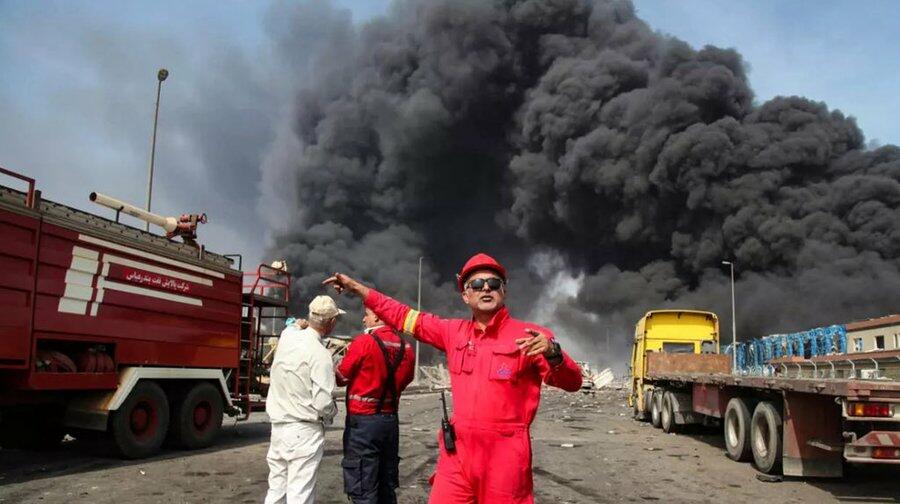 ?itok=97Yz5byV
A separate report from the Associated Press said the explosion that rocked Iran's second-largest container port—located on the Strait of Hormuz, a critical maritime chokepoint—originated from containers reportedly linked to chemical ingredients linked to missile propellant.
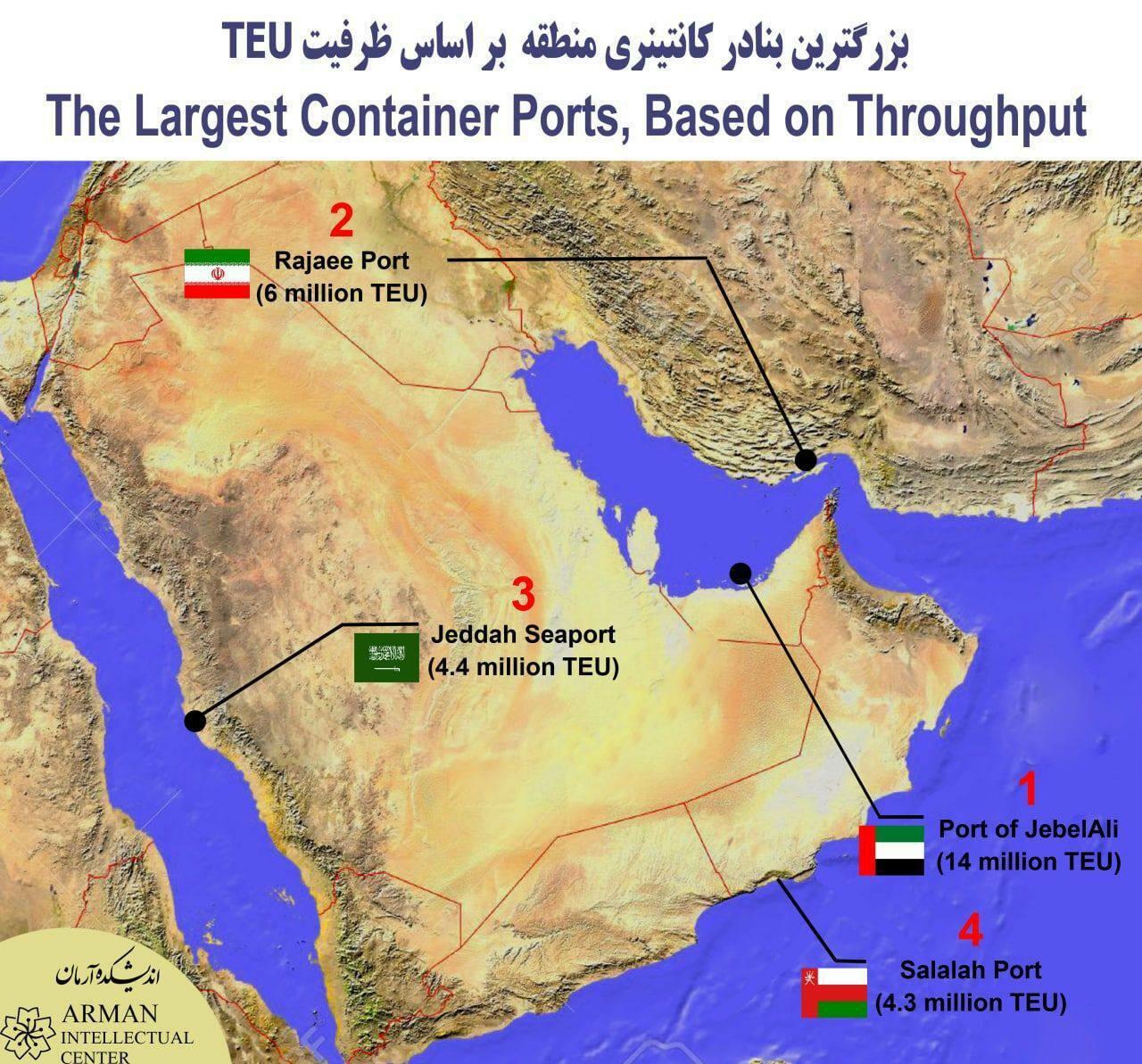 ?itok=3-waCjFZ
The state-run IRNA news agency said that the Customs Administration of Iran blamed a "stockpile of hazardous goods and chemical materials stored in the port area" for the explosion at the port. The outlet did not provide details on the chemical ingredients.
In this aerial footage of the Iran port explosion there are three locations- with some distant from one another- burning. Iran says investigations are pending. https://t.co/44dNYYE1Gz
— Farnaz Fassihi (@farnazfassihi) https://twitter.com/farnazfassihi/status/1916173398427795614?ref_src=twsrc%5Etfw
With one of Iran's largest commercial ports paralyzed, the economic disruption could be devastating for Tehran:
Trade Disruption:
Shahid Rajaee handles 85% of Iran's total cargo traffic.
Disruption would effectively spark supply chain disruptions for Iran's import-export economy, causing shortages of consumer goods, industrial equipment, food, and medicines.
Iran's limited alternative ports (like Chabahar) would have trouble absorbing even a fraction of that volume quickly.
Oil and Fuel Export Disruption
The port is a major terminal for refined oil products (gasoline, naphtha, gas condensate, etc.).
Iran already faces sanctions on crude oil; losing its refined product export capacity would cut off a key source of hard currency.
This would intensify Iran's already precarious foreign exchange crisis, sending the rial lower.
With Shahid Rajaee Port in chaos and closed, the question now is: What will be Tehran's economic fallout?
Also keep in mind, this blast occurred just as Iran and U.S. officials wrapped up the third round of negotiations in Oman's capital of Muscat.
* * *
At least 500 people were injured after a massive explosion rocked Iran's largest and most strategically significant maritime hub in the southern Hormozgan Province on the Strait of Hormuz.
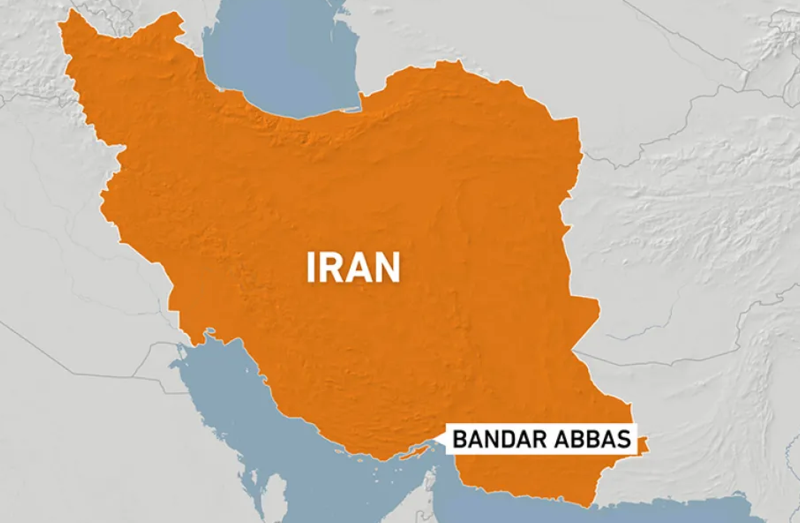 ?itok=CZxRZNLD
Iranian state media outlet Tasnim reported that the blast occurred on Saturday at the Shahid Rajaee Port. The outlet said, "The port remains in a state of chaos," and many buildings have been destroyed.
https://twitter.com/hashtag/Iran?src=hash&ref_src=twsrc%5Etfw
— Iran Nuances (@IranNuances) https://twitter.com/IranNuances/status/1916098612276142232?ref_src=twsrc%5Etfw
Visual confirmation that the explosion at Rajaiee port of https://twitter.com/hashtag/BandarAbbas?src=hash&ref_src=twsrc%5Etfw
— Babak Taghvaee - The Crisis Watch (@BabakTaghvaee1) https://twitter.com/BabakTaghvaee1/status/1916125904214057424?ref_src=twsrc%5Etfw
Tasnim reported that a fuel tank had "exploded for an unknown reason," and port operations had been shuttered. A report from the state media outlet IRIB stated that the explosion occurred in the port's chemical and sulfur area.
Footage shows the moment a powerful blast struck Iran’s Shahid Rajaee port in Bandar Abbas.
Follow our live blog for the latest updates on the explosion at Iran’s southern port:https://t.co/oNw2zJ2IAl
— Iran International English (@IranIntl_En) https://twitter.com/IranIntl_En/status/1916071587758952468?ref_src=twsrc%5Etfw
BREAKING | A massive explosion has been reported at the Port of Shahid Rajaee, one of two sections within the Port of Bandar Abbas, located on the north shore of the Strait of Hormuz in southern Iran.
According to Mehr News Agency, a fuel tank in the port exploded due to unknown… https://t.co/vN8r4yHyCT
— The Cradle (@TheCradleMedia) https://twitter.com/TheCradleMedia/status/1916065567242441123?ref_src=twsrc%5Etfw
Designated as a Special Economic Zone, Shahid Rajaee Port handles about 85% of Iran's total port cargo operations. Its annual capacity is about 70 million tons, including 6 million TEUs of containerized cargo. The port spans 2,400 hectares and features 40 berths and 19 hectares of warehouses.
The port also serves as a critical node for Iran's oil exports, equipped with docks that can accommodate large tankers. These facilities enable the annual export of around 34 million tons of oil products, including gasoline, naphtha, gas condensate, marine fuel, and mazut.
At the same time, Iran and U.S. officials began the third round of negotiations in Oman's capital of Muscat about the fate of the Islamic Republic's nuclear program. https://www.zerohedge.com/geopolitical/us-and-iran-conclude-second-round-nuclear-talks-agree-third
.
aim to suppress Iran's nuclear program in exchange for the U.S. lifting some economic sanctions it has imposed on the Islamic Republic.
President Trump has threatened to launch airstrikes targeting Iran's critical infrastructure if a deal is not reached.
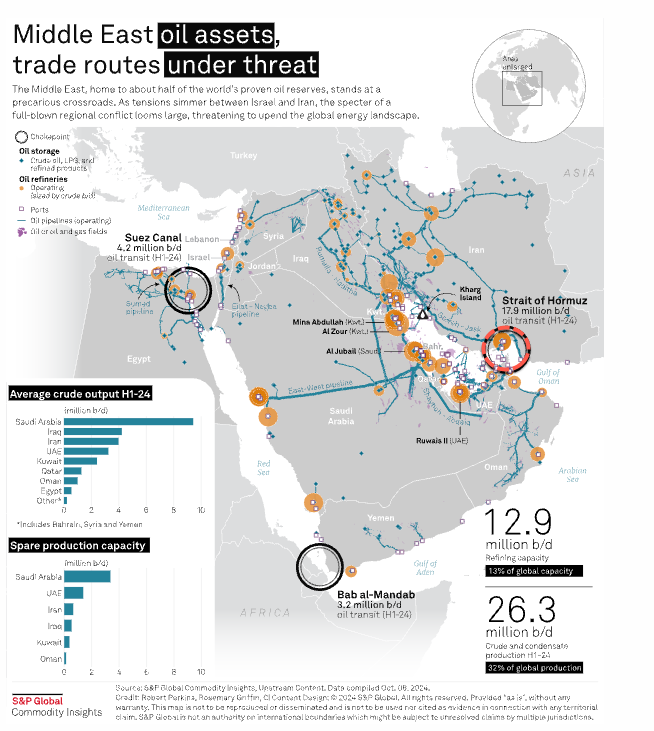 ?itok=OXquyvMb
Last month, the U.S. began deploying stealth bombers to https://www.zerohedge.com/military/stealth-bombers-reportedly-deploying-americas-unsinkable-carrier
—often referred to as Washington's "unsinkable aircraft carrier"—located between Africa and Indonesia, about 1,000 miles south of India. The island serves as a critical launch point for stealth bombers in the event of a war with Iran. Staging the bombers on the island, well within striking distance, has made Tehran deeply uncomfortable.
Let's take a step back to an October op-ed in The Wall Street Journal, penned by David Asher—a senior fellow at the Hudson Institute and a former U.S. State Department official who worked on counterterrorism operations in the Middle East—who https://www.zerohedge.com/markets/ex-state-department-official-who-blew-isiss-central-bank-reveals-roadmap-striking-iran
for neutering the Iranian regime's "oil-export capacity to deprive the regime of its financial lifeblood."
Any event on the critical maritime chokepoint of the Strait of Hormuz—such as an explosion at a major port—could spark uncertainty among energy traders and push Brent crude futures higher on Sunday evening.
https://cms.zerohedge.com/users/tyler-durden
Sat, 04/26/2025 - 13:38
https://www.zerohedge.com/geopolitical/massive-explosion-rocks-port-strait-hormuz
House GOP Seeks Federal Pension Cuts, Including Lavish Benefit For Early Retirees
House GOP Seeks Federal Pension Cuts, Including Lavish Benefit For Early Retirees
Already rattled by the Trump administration's efforts to slash its bloated ranks, the US government employee workforce is about to be hit with a new source of agitation, as House Republicans are proposing to cut benefits and increase premiums associated with federal employee pensions. As is typically the case where the timing of potentially controversial news is concerned, the announcement of the proposed cost-cutting moves came on Friday night, via House Oversight Committee and Government Reform Committee Chairman James Comer.
House Republicans are working to identify at least $2 trillion in spending cuts to put a dent in the price of extending the broad tax cuts instituted by 2017's Tax Cuts and Jobs Act (https://tax.thomsonreuters.com/blog/what-to-know-about-tcja-expiration/
circulating on Capitol Hill, we conclude he's talking about savings over a 10-year period.
 ?itok=gzbnRIsl
The most substantial of the proposed changes would increase pension premiums that longer-tenured employees pay into the Federal Employee Retirement System (FERS). Today, those premiums, which are automatically deducted from salary payments, vary by the year in which an employee entered federal service:
2012 and earlier: 0.8%
2013: 3.1%
2014 and after: 4.4%
The Oversight Committee proposal does away with that distinction, seeking to charge all employees in the FERS system a uniform 4.4%, raising $30.7 billion in revenue over the next 10 years. https://www.fedweek.com/fedweek/budget-outline-clears-way-for-move-to-reduce-value-of-federal-workforce-benefits/
, according to FEDweek. The rate hike is projected to boost revenue by $30.7 billion over 10 years.
Another proposal takes aim at one of those rich government benefits that are virtually unheard-of in the private sector. Believe it or not, long-serving federal employees who retire with a full pension before Social Security age currently receive a supplemental payment on top of that calculated pension. The "https://www.govexec.com/pay-benefits/2024/11/primer-fers-supplement/400777/
" is supposed to approximate their age-62 Social Security income attributable to their federal employment. The head-scratchingly lavish goal: Saving early retirees from having to make do with less total money than they'll eventually rake in at age 62 -- even though they're receiving a full federal pension in the interim. Oversight Committee Republicans want to kill the supplement -- except for federal employees in jobs subject to mandatory early retirement, such as federal cops and firefighters. (God forbid we apply austerity measures to these "heroes" retiring at 57 on a hefty, inflation-adjusted federal pension.) Projected savings from this move: $10.1 billion over 10 years.
 ?itok=0cA3Ek-w
A third move would change how pension payments are calculated in both FERS and the Civil Service Retirement System (CSRS), the latter of which generally covers some employees hired before Jan. 1. 1984. Today's formula keys off the average of a given employee's highest three years of earnings; the committee wants to change that to the highest five years, projecting $4.75 billion in savings in 10 years.
In a non-pension move, the House GOP proposal also has a provision requiring a "comprehensive audit" of employee dependents currently enrolled in Federal Employees Health Benefits (FEHB) plans. By dis-enrolling ineligible relatives, it's hoped the audit will save $1.5 billion over 10 years.
The Oversight Committee will have a full markup meeting to consider, debate and potentially amend these and other cost-cutting proposals at 10am on Wednesday. Once finalized, they'll be added to President Trump's promised "big, beautiful bill" that Republicans hope to pass by summertime.
In the meantime, here comes another round of leftist wailing and gnashing of teeth...
https://cms.zerohedge.com/users/tyler-durden
Sat, 04/26/2025 - 13:25
Soldiers Deny Former Defense Minister's Claim That Israel Faked Gaza Tunnel Photo To Delay Hostage Deal
Soldiers Deny Former Defense Minister's Claim That Israel Faked Gaza Tunnel Photo To Delay Hostage Deal
The Israeli government deliberately misrepresented the nature of a tunnel in Gaza's Philadelphi Corridor to derail a hostage deal with Hamas, according to a former Israeli defense minister in an interview aired by an Israeli public television network. While two soldiers who claim to have seen the tunnel say he's wrong, the Israeli Defense Forces (IDF) have not yet issued a public denial.
The alleged deception happened last August, amid https://www.zerohedge.com/geopolitical/record-anti-netanyahu-protests-labor-strikes-bring-israel-standstill
by Israeli citizens pressing the Israeli government to make a deal to secure the release of the remaining hostages held by Hamas. At the time, the status of the Philadelphi Corridor -- a 100-meter-wide strip running 14 miles along Gaza's border with Egypt -- was a major obstruction to a hostage deal. (The corridor is a geopolitically important buffer zone that figures in security agreements between Israel and Egypt.) Hamas was demanding a withdrawal of IDF forces from the strip as a condition of a hostage release, while Netanyahu insisted the IDF would continue operating in it.
 ?itok=6clZtL_w
It was against that backdrop that the IDF released a photo that was supposed to show a Hamas tunnel in the Philadelphi Corridor used to smuggle weapons from Egypt. Israeli-government-sympathetic news outlets and pro-Israel organizations inside the United States seized upon the narrative to defend Netanyahu's deal-precluding insistence on keeping troops in the corridor. The Times of Israel trumpeted the discovery of https://www.timesofisrael.com/liveblog_entry/idf-releases-photos-of-unusually-large-smuggling-tunnel-uncovered-on-gaza-egypt-border-last-week/
that Hamas assembled in southern Gaza. This is important work and should continue."
This week, however, Israeli public television network Kan 11 https://www.haaretz.com/israel-news/2025-04-23/ty-article/.premium/former-israeli-defense-minister-says-gaza-water-channel-photo-misrepresented-as-tunnel/00000196-61c0-de3a-afd6-efcd886e0000
said the report. The scheme's purpose "was to exaggerate the importance of the Philadelphi Corridor and delay a hostage deal."
 ?itok=5CFPY5U9
The source of the accusation is a former member of Netanyahu's government: Yoav Gallant, who was defense minister from 2022 until https://thesoufancenter.org/intelbrief-2024-november-8/
Kan 11:
"What the public cannot see is that this channel is not 30 meters underground, but just one meter underground. It is a covered water conduit…https://www.middleeastmonitor.com/20250422-israeli-broadcaster-army-fabricated-gaza-tunnel-discovery-to-stall-ceasefire-deal/
...Someone took the picture, and a big fuss was made about it, a lot of headlines... weapons did not pass beneath the Philadelphi corridor."
NEW | Israeli Army Fabricated Gaza Tunnel Discovery to Stall Ceasefire Talks
Israel’s public broadcaster KAN 11 reports the Israeli military fabricated claims of discovering a tunnel in Gaza’s Philadelphi Corridor to stall ceasefire negotiations and delay a hostage deal.
➤ The… https://t.co/NEU7tJoWsI
— Drop Site (@DropSiteNews) https://twitter.com/DropSiteNews/status/1914769284061864397?ref_src=twsrc%5Etfw
Gallant has been one of Israel's foremost hostage-deal advocates and a Netanyahu critic. In September, sources said Gallant confronted Netanyahu in a contentious evening security cabinet meeting. "The decision made Thursday [to refuse to withdraw from the corridor] was reached under the assumption that there is time, but if we want the hostages alive, there’s no time,” he https://www.timesofisrael.com/gallant-said-to-call-philadelphi-demand-a-disgrace-drawing-fury-from-pm-ministers/
said. "The fact that we prioritize the Philadelphi corridor at the cost of the lives of the hostages is a serious moral disgrace." Netanyahu was said to have countered with the questionable claim that, if the IDF left the corridor, "the hostages will be taken to Sinai, and then to Iran."
Ahead of the airing of the Kan 11 report, two IDF soldiers said Gallant's claims are false. "This famous photo is a photo of my battalion commander here in a Hummer entering a very significant tunnel, not some small tunnel as you published," said Yehuda Bartov, a reserve soldier from the 605th Engineering Battalion. Their assertions were reported by https://www.israelnationalnews.com/news/407235
, a network associated with the settler movement and extremist Religious Zionism party -- the latter of which is part of Netanyahu's ruling coalition.
https://cms.zerohedge.com/users/tyler-durden
Sat, 04/26/2025 - 07:35
Europe's Anti-American Shift: Now Globalists Are The Saviors Of The West?
Europe's Anti-American Shift: Now Globalists Are The Saviors Of The West?
https://alt-market.us/europes-anti-american-shift-globalists-are-the-good-guys-now/
Nationalism is villainous and globalists are the heroes? It’s a propaganda message that has been building since the end of World War II and the creation of globalist institutions like the UN, the IMF, World Banks, etc. By the 1970s there was a concerted and dangerous agenda to acclimate the western world to interdependency; not just dependency on imports and exports, but dependency of currency trading, treasury purchases and interbank wealth transfer systems like SWIFT.
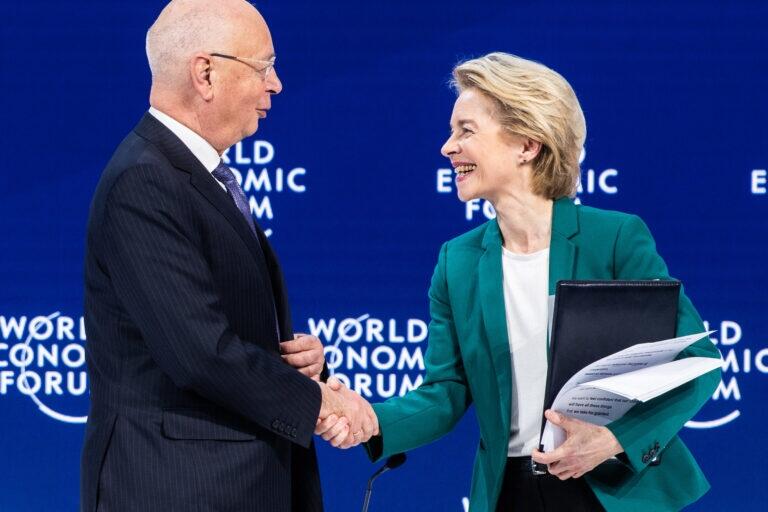 ?itok=BFEmrnFk
This was the era when corporations began outsourcing western manufacturing to third world countries. This is when the dollar was fully decoupled from gold. When the IMF introduced the SDR basket system. When the decade long stagflationary crisis began.
This was when the World Economic Forum was founded. The Club of Rome and their climate change agenda. When numerous globalists started talking within elitist publications and white papers talking about a one world economy and a one world government (under their control, of course). By the 1990s everything was essentially out in the open and the plan was clear:
Their intention was to destroy national sovereignty and bring in an age of total global centralization. One of the most revealing quotes on the plan comes from Clinton Administration Deputy Secretary of State Strobe Talbot, who stated in https://content.time.com/time/subscriber/article/0,33009,976015-1,00.html
that:
“In the next century, nations as we know it will be obsolete; all states will recognize a single, global authority… National sovereignty wasn’t such a great idea after all.”
He adds in the same article:
“…The free world formed multilateral financial institutions that depend on member states’ willingness to give up a degree of sovereignty. The International Monetary Fund can virtually dictate fiscal policies, even including how much tax a government should levy on its citizens. The General Agreement on Tariffs and Trade regulates how much duty a nation can charge on imports. These organizations can be seen as the protoministries of trade, finance and development for a united world.”
The globalists use international trade controls as a way to ensnare competing economies, forcing them to become homogeneous. They take away the self reliance of nations and pressure them to conform to global trade standards. It’s important to understand that they view centralized dominance of trade as a primary tool for eventually obtaining their new world order.
The idea of a country going off the plantation and initiating unilateral tariffs is unheard of. The notion of countries producing their own necessities is absurd. As least, until 2025.
One of the most humorous and bewildering side effects of the Trump Administration’s policy rollout is the scramble by the political left (especially in Europe) to portray themselves as “rebel heroes fighting for freedom” in the face of a supposedly tyrannical dictatorship. Of course, these are globalists and cultural Marxists we’re dealing with, so their definitions of “freedom” and “tyranny” are going to be irreparably skewed.
The EU elites have truly lost the plot when it comes to their message on “democracy”. Today, many European nations are spiraling into classical authoritarianism, yet they’re pretending as if they’re in a desperate fight for freedom.
I’ve heard it said that authoritarianism is the pathology of recognition. One could also say that it’s the pathology of affirmation – It’s not enough for the offending movement to be recognized as dominant, the population must embrace it, joyfully, as if it is the only thing they care about. This is the underlying goal of globalism: To force the masses to love it like a religion.
But to be loved by the people, they have to believe that globalism is their savior. They have to believe that globalists are somehow saving the world. Enter the new world order theater brought to us by The Economist. The magazine, partially owned by the Rothschild family, has long been a propaganda hub for globalism. They recently published an article titled https://www.economist.com/europe/2025/04/10/the-thing-about-europe-its-the-actual-land-of-the-free-now
.
Yes, this is laughable given the fact that many European governments are currently hunting down and jailing people for online dissent. Mass open immigration is suffocating western culture on the continent. Violent crime is skyrocketing. Not to mention, the new trend among EU governments is to arrest right leaning political opponents to stop them from winning elections.
Hell, in Europe you can be arrested for silently praying within the vicinity of an abortion clinic. We all understand how absurd The Economist’s claims are. Their argument boils down to this: If it hurts globalism, it’s a threat to democracy. That’s the tall tale being formulated in the media today.
The Trump Administration instituting “America First” policies is being called authoritarian by the elites because these things interfere with THEIR agenda, not because Americans are being oppressed.
In many ways the European shift in rhetoric is merely a reflection of the long running globalist strategy: To rewrite nationalists as agents of chaos and paint the internationalists as defenders of order.
In a recent interview with the https://www.zeit.de/politik/2025-04/ursula-von-der-leyen-eu-usa-donald-trump-english/komplettansicht
, EU President Ursula von der Leyen took the disinformation even further with her claim that there “Is no oligarchy in Europe”. In other words, European leaders are innocent victims under attack by the rich and dastardly nationalists. Frankly, this is news to most of us because the EU government has long been considered the very definition of faceless and unaccountable oligarchy. She argues:
“…History is back, and so are geopolitics. And we see that what we had perceived as a world order is becoming a world disorder, triggered not least by the power struggle between China and the United States, but of course also by Putin’s imperialist ambitions. That is why we need another, new European Union that is ready to go out into the big wide world and to play a very active role in shaping this new world order that is coming.”
Notice the attempt to paint Europe as the virtuous bystander caught up in the geopolitical turmoil of the US, China and Russia. No mention of their ongoing roll in fomenting a wider war in Ukraine, their interference with peace negotiations or the fact that globalism has made them dependent on energy imports for their very survival. This isn’t a lack of awareness, this is carefully crafted propaganda. The EU President continues:
“The readiness of all 27 Member States to strengthen our common defense industry would have been inconceivable without the developments of recent weeks and months. The same applies to the economy. Everyone wants to emulate our common plan for greater competitiveness, because everyone has understood: We need to stand firm in today’s globalized world…”
The EU has been peddling the idea of a unified European army for some time. It makes sense – In order to erase national boundaries even further in Europe, a singular defense structure would have to be established. They’re simply using the war in Ukraine and America’s economic decoupling as an excuse. She continues:
“For me, it is crucial that Europe plays a strong role in shaping the new world order that is slowly emerging. And I firmly believe that Europe can do that. Let’s look back at the last decade: the banking crisis, migration crisis, Brexit, pandemic, energy crisis, Russia’s war against Ukraine. All these are serious crises that have really challenged us, but Europe has emerged bigger and stronger from every crisis…”
Economically, socially, spiritually, culturally, the continent is in a death spiral. No one wants to fight for what Europe is today, including the millions of third world immigrants they’ve invited in. If they do try to institute a centralized military they will have to turn to forced conscription, which means even more tyranny. In terms of the economy she states:
“The West as we knew it no longer exists. The world has become a globe also geopolitically, and today our networks of friendship span the globe…”
“Everyone is asking for more trade with Europe – and it’s not just about economic ties. It is also about establishing common rules and it is about predictability. Europe is known for its predictability and reliability, which is once again starting to be seen as something very valuable. On the one hand, this is very gratifying; on the other hand, there is also of course a huge responsibility that we have to live up to…”
The US makes up 30%-35% of all global consumer spending and is the largest consumer market in the world. There are no clear numbers for the whole of Europe, but Germany, Europe’s largest economy makes up only 3% of global consumer spending. Germany is also the third largest economy in the world next to China. In other words, Europe has NO capacity whatsoever to fill the void in trade left behind by the US. If the US economy detaches from Europe, or if the US economy crashes, Europe would crash also. This is a fact.
Von der Leyen then dismisses the role of globalism in driving populist movements against the EU. She claims:
“There is one thing we should not underestimate: the polarisation is, in part, heavily orchestrated from outside. Via social media, Russia as well as other autocratic states are deliberately interfering in our society…”
“Views on both sides are being amplified because the real goal is to polarize and divide our open societies. But the European Union also has a big advantage. Inequalities are less pronounced here, in part because we have a social market economy and because the levers of power are more widely distributed.”
Russia is to blame for millions of Europeans wanting an end to globalist multicultural policies? Taking a rather Marxist stance, she asserts that populist divisions must be artificial because Europe is economically “equitable”. But the populists are not fighting for economic parity, they’re fighting for European identity which is being systematically erased.
Finally, she comes to the issue of oligarchy:
“Europe is still a peace project. We don’t have bros or oligarchs making the rules. We don’t invade our neighbors, and we don’t punish them…”
“Controversial debates are allowed at our universities. This and more are all values that must be defended, and which show that Europe is more than a union. Europe is our home.”
The EU government is a pure oligarchy with near zero accountability and it is actively trying to suppress and destroy any national party with conservative views. They support silencing any dissent among the peasants, only allowing for debate behind the closed doors of academia because they know academics police their own. The more a society moves towards globalism the less free it’s going to be.
I see this messaging as a kind of crude rough draft for the theatrics to come. They haven’t fine-tuned their story yet, but they have the fundamental pieces in place. The allegation is that national sovereignty is a threat to “democracy”; not freedom, but democracy. And the globalist notion of democracy is progressive rulership in the name of a subjective greater good that they can’t really define.
I feel sympathy for the common European, many of them are hungry for a free society built on traditional western principles. It’s a future that will never materialize, at least not without revolution. These people are at the epicenter of the death of the western world and many of them don’t even know it. In the meantime they’re being told that America is ruining them. I can’t speak for everyone, but many of us would like to save them. The fall of the west to globalism cannot be allowed to continue.
* * *
If you would like to support the work that Alt-Market does while also receiving content on advanced tactics for defeating the globalist agenda, subscribe to our exclusive newsletter The Wild Bunch Dispatch. Learn more about it https://alt-market.us/styles-2/
.
https://cms.zerohedge.com/users/tyler-durden
Sat, 04/26/2025 - 07:00
https://www.zerohedge.com/geopolitical/europes-anti-american-shift-now-globalists-are-saviors-west
All Quiet On The Western Ports... Is This The Calm Before The Trade War Storm?
All Quiet On The Western Ports... Is This The Calm Before The Trade War Storm?
All is quiet on the American front as the week comes to a close, even as Korea JoongAng Daily reports that a https://www.zerohedge.com/markets/chinese-delegation-spotted-entering-treasury-department-demands-photos-be-deleted-report
from the Ministry of Finance was spotted at the U.S. Treasury Department headquarters in Washington, D.C. earlier today. The meeting between Chinese and U.S. officials comes on the eve of a trade war shock now ripping across the Pacific, with the Port of Los Angeles set to be the first hit. High-frequency data suggests the impact will begin at some point next week and intensify with each passing week.
 ?itok=8mAhFMtC
On the eve of a trade war shock, data from Port Optimizer—a tracking system used by vessel operators—shows that scheduled import volumes into the Port of Los Angeles are set to begin plunging next week and could collapse by mid-month.
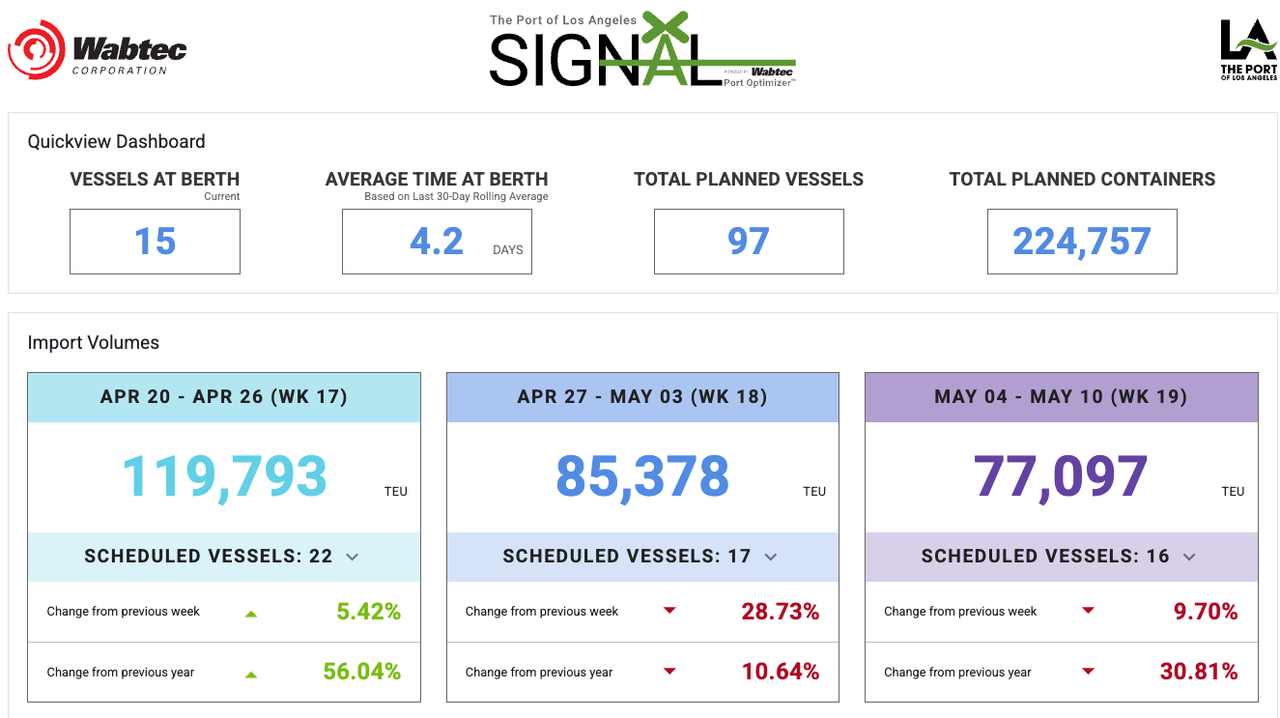 ?itok=hRISEMSC
Goldman analyst Jacob Malmstrom has a few charts for us to end the week:
Geopolitical tensions easing leading markets higher for the week but where the effective tariff rate currently is the highest it's been in 100 years.
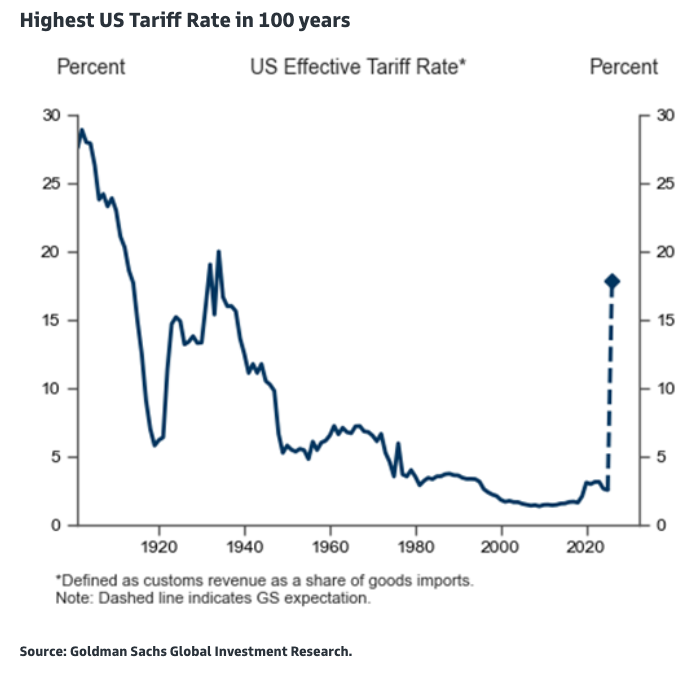 ?itok=uQrEbJKx
With globalisation the trade growth has grown substantially in the last 60 year but looking at current U.S. imports from Europe they have hovered around 15% in recent decades.
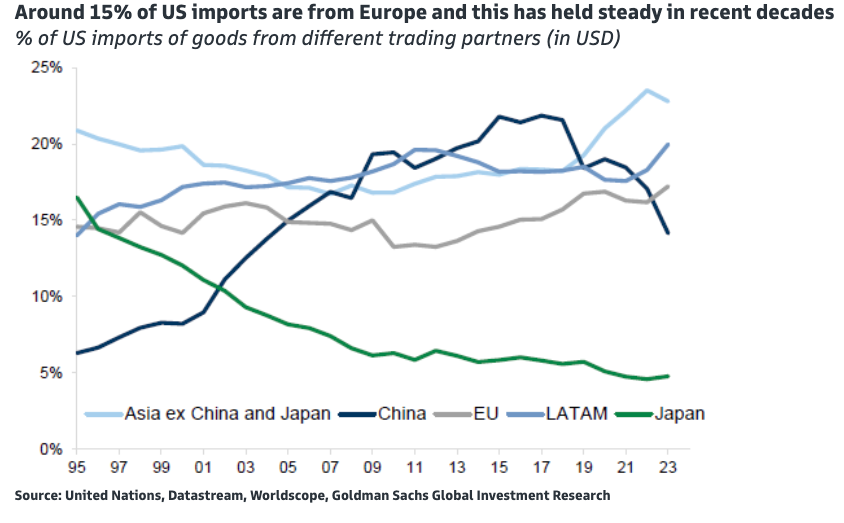 ?itok=gO6l6r8F
World trade growth has increased dramatically in the period of globalisation
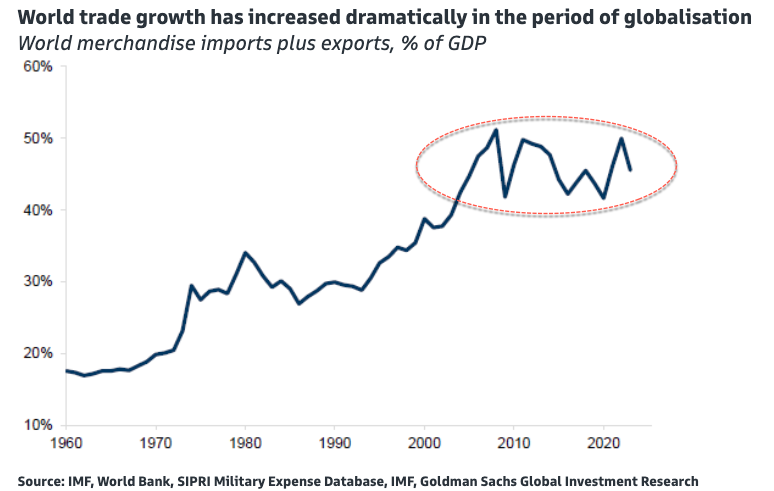 ?itok=-YwZQ29x
In markets, Malmstrom warned:
Difficult to come up with a fundamental bull-case from here longer term. Still need to see any of these four conditions met for a sustainable recovery: 1) Attractive valuations ,2) Extreme positioning easing, 3) Policy Support, 4) Sense that the second derivative of growth is improving. When looking at valuations in the U.S. they look more justified when comparing to ROE. Banks sold-off in the beginning of the year but has rebounded whereas Mega-cap tech has continued its decline. Finally earnings so far has been in-line with the historical average.
Our coverage details the events that have unfolded this month in trigger the trade war shock—one that's already hitting China and is now set to wash ashore momentarily in the U.S.:
https://www.zerohedge.com/markets/amazon-cancels-orders-walmart-pulls-forecast-tariffs-take-hold
https://www.zerohedge.com/markets/chinese-sellers-amazon-panic-after-trumps-tariff-bazooka
https://www.zerohedge.com/markets/chinese-plastics-factories-face-mass-closure-us-ethane-disappears
https://www.zerohedge.com/markets/it-begins-brace-first-wave-tariff-shock-port-los-angeles
High-frequency data from the Port of Los Angeles suggests a substantial impact on Chinese exports to the U.S. will begin next week, mainly due to the lag between factory shutdowns or halted shipments in China—triggered by the 145% tariffs—and the time it takes for containerized freight to cross the Pacific on massive cargo ships.
The bulleted list above outlines what might come next: downward pressure across the trucking industry in Southern California and the Empire Inland warehouse district. As Goldman noted earlier, inventories for many companies are in the 2–3 month range but could be depleted quickly if panic buying sets in once consumers become aware of Port of Los Angeles disruptions. There could even be a short-term spike in inflation this summer, though it would likely prove transitory.
https://cms.zerohedge.com/users/tyler-durden
Fri, 04/25/2025 - 23:34
https://www.zerohedge.com/markets/all-quiet-american-front-trade-war-shock
LA To Institute Mass Layoffs Of City Workers In Wake Of $1 Billion Deficit
LA To Institute Mass Layoffs Of City Workers In Wake Of $1 Billion Deficit
For many years now the narrative on California is that it is a country unto itself and it generates so many tax dollars the federal government and red states should be throwing a garden party in its honor. In reality, California is not a "donor state" as the Rockefeller Institute claims. It can't even support itself, let alone bolster the rest of the country.
This problem has become more evident in the past year as Los Angeles hits a budget deficit of a billion dollars and, the state government doesn't have the funds to help the city recover because of it's https://lao.ca.gov/reports/2023/4819/2024-25-Fiscal-Outlook-120723.pdf
.
In response to the lack of aid from the state or federal government, Los Angeles Mayor Karen Bass unveiled a proposed $13.9 billion municipal budget for fiscal year 2025-26, which includes more than 1,600 layoffs and the consolidation of four city departments in an effort to eliminate the overdraft. Though LA employs around 50,000 people in total and the layoffs might seem minor in comparison, the city's expansive programs require employee growth this year, not cuts.
Furthermore, it is likely that the 1600 fired workers are just the beginning. The city removed at least 2000 positions from its employee roster at the end of last year and is already moving to make cuts to existing workers.
It's no coincidence that LA is in fiscal trouble in 2025, and it's not only because of the $2 billion in damages associated with the recent wildfires. After decades of decadent debt spending CA is deeply dependent on federal funds. Federal budget cuts and the shutdown of agencies like USAID are having far reaching consequences, especially in progressive states with a heavy emphasis on socialized programs.
For example, the federal Department of Health and Human Services recently terminated $12 billion in grants intended for infectious disease response, mental health services and other public health issues. At least $1 billion of this cash was supposed to go to California in 2025. Covid money is funneled into various health departments and other projects and California was the biggest recipient of pandemic funds by far with https://pandemicoversight.gov/data-interactive-tools/states/ca
. Some critics argue that covid relief in California was wrongly exploited as a financial boon for various state agencies, politicians and employees.
Now the pandemic funding is finally cut off after 5 years. $45 million of the $1 billion lost was supposed to go to Los Angeles.
The LAPD is also losing https://www.nbclosangeles.com/investigations/lapd-in-jeopardy-of-losing-millions-in-federal-funds/3629308/
due to federal funding cuts. The agency and city officials are trying to sort out the potential impact of being cut-off from millions of dollars in law enforcement and homeland security grants, following the US Justice Department’s announcement such programs would be suspended for any municipality that considered itself a so-called, “sanctuary city,” that bars local officers from playing a role in immigration enforcement.
 ?itok=RC32GcUJ
The Orange County Register reported last month that Orange County will lose out on https://www.sfgate.com/bayarea/article/california-coastal-bluff-funding-20242812.php
in federal earmarks for 2025, money that was previously approved for community projects.
California schools have been warned by the Trump Administration that if they don't stop instituting DEI programs and indoctrination, they will lose at https://www.latimes.com/california/story/2025-04-03/schools-have-10-days-to-comply-with-trump-anti-dei-policy-or-faces-losing-federal-funds
in funding, with $1.26 billion of that going to the Los Angeles Unified School District.
The sheer enormity of federal funds floating around California should be taken into account, but also the fact that despite access to so much money California and LA are still facing a massive budget shortfalls. The chances of this dilemma being solved through layoffs and department consolidation is next to nil. The real root of the problem is policy driven; Democrat welfare programs, social programs and their open border mentality have resulted in a never ending drain on their finances, slowing destroying what was once one of the greatest states in the nation.
https://cms.zerohedge.com/users/tyler-durden
Fri, 04/25/2025 - 17:20
https://www.zerohedge.com/political/la-institute-mass-layoffs-city-workers-wake-1-billion-deficit
Where Things Stand
Where Things Stand
https://www.kunstler.com/p/where-things-stand
“In order for a system to be stabIe, it requires negative feedback, also known as consequences.”
- Barrie Drain
“Fighting fascism,” for the American Jacobins who lead the Democratic Party, means opposing any attempt to flush the corruption out of the entrenched bureaucracy, just as their pet phrase “our democracy” actually refers to the matrix of grift and despotic activism that drives their political operating system. That is exactly how and why the USAID was so crucial to spread captured taxpayer spoils as NGO salaries for the gender studies grads to play “activist,” so as to inflict their special brand of sadistic power madness over the land — to keep the game going.
Now, USAID is scattered to the winds and all they have left is their installed base of federal judges and the horde of lawfare lawyers who feed them bogus cases to halt the remaining work of Mr. Trump’s executive branch clean-up operation.
Remember: Robespierre, leader of the Jacobins in the French Revolution, was a lawyer.
Their version of defending “our democracy” in 1793 was the Reign of Terror that sent at least 17,000 political opponents to the guillotine.
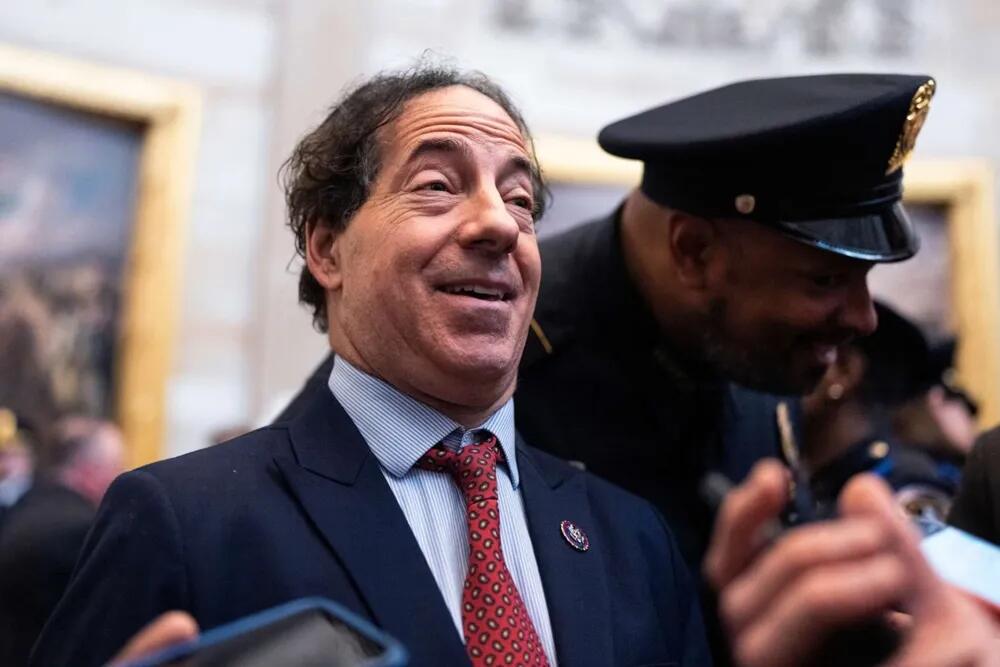 ?itok=XKpmVJmp
Rep. Jamie Raskin (D-MD)
Rep. Jamie Raskin (D-MD) is the Democrats’ Robespierre. He is promising his own reign of terror when his party recaptures Congress in the 2026 “midterm” election.
Norm Eisen is his chief lawyer and legal strategist. His sole aim is recapture power in order to restore the Democrats’ sadistic regime of thought-control and the money-flows that feed it. That’s where things stand for the moment. You can sense how this tension is tending toward something that looks like civil war.
Someone needs to investigate the relationship between the lawfare squad and the judges to see how closely they worked together.
It appears that Norm would write prosecution memos, articles, etc., (as well as go on CNN) to act as an analyst when in reality he was running the… https://t.co/hdkDggzlt4
— The Researcher (@listen_2learn) https://twitter.com/listen_2learn/status/1903985333827445125?ref_src=twsrc%5Etfw
The game now is to goad President Trump into any kind of executive action in defiance of this legal insurrection that would subject him to impeachment after January 2027, when a new Congress is seated, theoretically with a Democratic majority. There are several flaws in the Raskin / Eisen plan-of-action. One is their supposition that the Democratic Party is popular enough to win a Congressional majority in 2026, or that they will enjoy the installed devices of electoral cheating to achieve victory no matter what.
The party is currently blundering wildly in support of obviously insane actions that a vast majority voters oppose, such as stopping the deportation of illegal immigrants, allowing men to compete in women’s sports, and opposing proof of citizenship in federal elections. Which is to say that the voters are onto exactly how crazy and destructive the Democratic Party has become.
The question is: what can be done about this lawfare insurrection. An easy solution would be for Congress to pass a law restricting the power of federal judges to issue orders that affect the nation as a whole outside their own designated districts. Senate Judiciary Committee Chair Charles Grassley has introduced the Judicial Relief Clarification Act of 2025. Grassley argues that nationwide injunctions, which allow a single district judge to block federal policies across the country, represent judicial overreach and disrupt the constitutional balance of powers.
In the House, Rep. Darrel Issa (R-CA) has introduced the No Rogue Rulings Act of 2025 (HR 1526, passed on April 9) to complement Sen. Grassley’s bill. The Constitution is somewhat vague about the composition of a federal judiciary below the Supreme Court, and essentially leaves the matter to Congress to set parameters for the power of federal judges. Congress can also alter or abolish districts, such as the DC federal district from which so much partisan Democratic Party lawfare has emanated under political activist Judges James Boasberg, Amy Berman Jackson, Tanya Chutkan, and Beryl Howell (all of them involved in the sadistic prosecutions of J-6 defendants).
The bills from each house next must go through a reconciliation process that boils them down to a single piece of legislation that can be sent to Mr. Trump for the presidential signature. The House passage is likely assured. The hang-up is that under Senate rules, the Democrats could mount a filibuster that would require 60 votes to break. The Republicans only control the chamber by a 53 to 47 majority, and no Democrats have signaled any intention to vote in favor of such a bill. In any case, the entire process would take months and might not succeed at all.
A much simpler remedy would be for the Supreme Court (SCOTUS) to rule in any of a number of cases now on their docket that the lawfare antics of the federal judges amount to interference with an independent executive branch — in short, that the judiciary can’t usurp the executive powers of the President, which include the conduct of foreign policy, the ability to manage personnel in executive agencies, and certain issues around the spending of taxpayer dollars.
A different sort of remedy would be the application by the DOJ of federal statute 18 USC 371, Conspiracy to Defraud the United States against Norm Eisen and his colleagues-in-lawfare for attempting to maliciously bury the executive branch in litigation for the purpose of nullifying the executive powers of the president. Beyond all that is the abyss: a nullified election, a paralyzed chief executive, and a constitutional crisis that has the potential to lead to civil violence. The Democrats seem willing to go there, perhaps even avid for it.
The Jacobins of 1793 were mad for blood, too, and they spilled a whole lot of it. By the summer of 1794, the blood was finally spouting out of their own necks. . . and then the Jacobin reign of terror came to a sudden and complete end. Heed their example.
https://cms.zerohedge.com/users/tyler-durden
Fri, 04/25/2025 - 16:20
USDA Directs States To Make Sure Illegal Immigrants Don't Receive Food Stamps
USDA Directs States To Make Sure Illegal Immigrants Don't Receive Food Stamps
The Department of Agriculture (USDA) told states on April 24 to take steps to make sure illegal immigrants do not receive benefits under the Supplemental Nutrition Assistance Program (SNAP), colloquially known as food stamps.
 ?itok=Esn8OF-n
States must at a minimum verify the identity of program applicants, collect applicants’ Social Security numbers, compare the Social Security numbers to the federal government’s Social Security death data, and check whether the applicants are listed in a Department of Homeland Security database as being in the country illegally, John Walk, the USDA’s acting deputy undersecretary for food, nutrition, and consumer services, https://fns-prod.azureedge.us/sites/default/files/resource-files/snap-letter-enhanced-vetting.pdf
in a memorandum to states.
The USDA released a letter from Homeland Security Secretary Kristi Noem that https://fns-prod.azureedge.us/sites/default/files/media/file/snap-DHSLetter041525.pdf
states that they can now use the Department of Homeland Security’s database for free.
State agencies must also verify U.S. citizenship for applicants “for whom there is an indicia that the applicant’s claim to United States citizenship (whether natural born, naturalized, acquired, or derivative) is questionable,” Walk wrote.
Federal law allows U.S. citizens and some legal immigrants to receive SNAP benefits but prohibits illegal immigrants from receiving food stamps. About 11.7 percent—approximately $10.5 billion—of the SNAP benefits paid by the USDA in fiscal year 2023 were improper, including improper payments to illegal immigrants, the Government Accountability Office https://www.gao.gov/assets/gao-24-107461.pdf
in a 2024 report.
States “did not always verify certain program eligibility requirements,” including citizenship, the report stated.
USDA officials are also encouraging states to require the verification of U.S. citizenship for each SNAP applicant, as the law https://www.ecfr.gov/current/title-7/subtitle-B/chapter-II/subchapter-C/part-273/subpart-A/section-273.2#p-273.2(f)(3)
states to mandate verification of certain factors and increase the number of in-person interviews of applicants.
“Benefit fraud is unacceptable in all forms, including use by illegal aliens. This guidance serves as a foundation for future compliance endeavors that will not only deter, but end access to benefits by illegal aliens. I appreciate your attention and assistance in making certain only those eligible receive SNAP benefits,” Walk said in the memo.
Walk cited President Donald Trump’s Feb. 19 executive order https://www.federalregister.gov/documents/2025/02/25/2025-03137/ending-taxpayer-subsidization-of-open-borders
the USDA to “enhance eligibility verification systems, to the maximum extent possible, to ensure that taxpayer-funded benefits exclude any ineligible alien who entered the United States illegally or is otherwise unlawfully present in the United States.”
USDA Secretary Brooke Rollins earlier this year sent a letter to states that said her guiding principles for SNAP included taking action to minimize fraud and waste while enforcing legal requirements.
“The days in which taxpayer dollars are used to subsidize illegal immigration are over,” Rollins https://www.fns.usda.gov/newsroom/usda-0034.25
in a statement on Thursday. “Today’s directive affirms that the U.S. Department of Agriculture will follow the law—full stop.”
https://cms.zerohedge.com/users/tyler-durden
Fri, 04/25/2025 - 13:40
Amid Worst Start To A Year On Record, Scott Bessent Affirms The Dollar Is Not Dying
Amid Worst Start To A Year On Record, Scott Bessent Affirms The Dollar Is Not Dying
Despite a growing chorus of pundits claiming the “death of the dollar” is imminent, Treasury Secretary Scott Bessent said the dollar will remain the world’s reserve currency.
The dollar is in the midst of its worst start to a year on record...
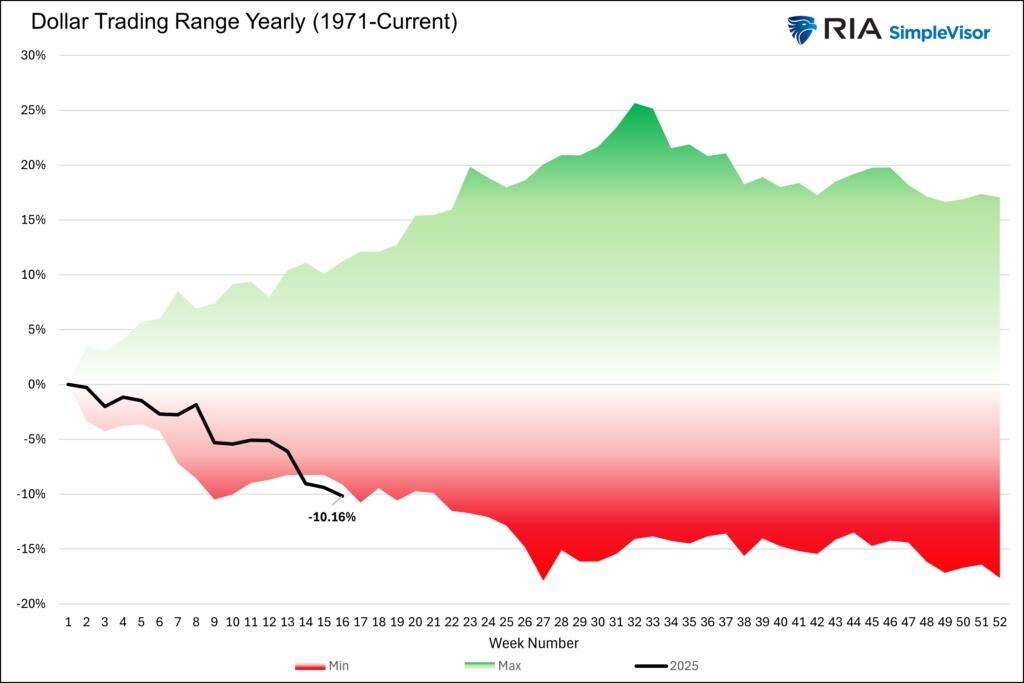 ?itok=5yQbIrhj
The following clip from https://www.bloomberg.com/news/newsletters/2025-04-24/us-endorsement-of-imf-and-world-bank-spurs-a-sigh-of-relief
was based on a speech Scott Bessent gave Thursday morning to the IMF and World Bank:
More broadly, the Treasury secretary reinforced backing for the central role of the US and its dollar in the global financial system.
“I think that the US will always, for my lifetime, be the reserve currency,” said Bessent, age 62.
He also quipped of the global reserve role, saying “I am actually not sure that anyone else wants it.”
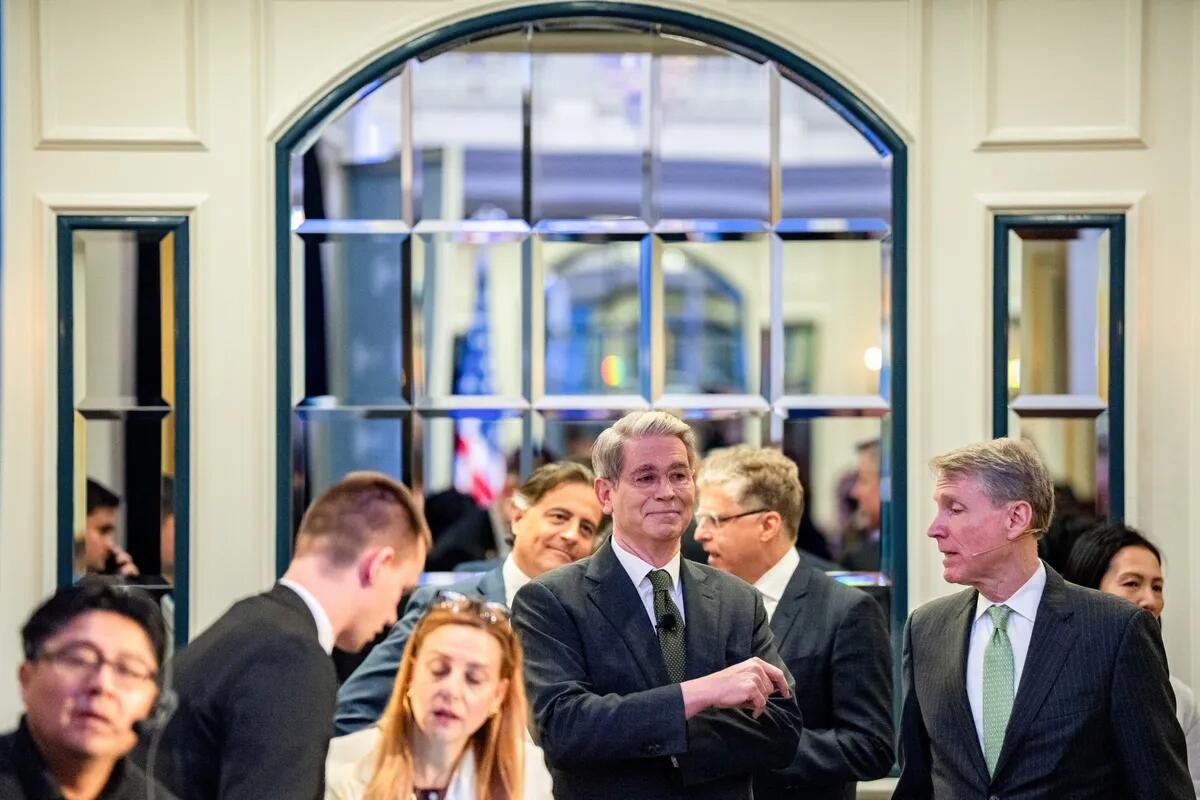 ?itok=DAvRED3U
https://realinvestmentadvice.com/resources/blog/scott-bessent-affirms-the-dollar-is-not-dying/
some believe Donald Trump’s economic policies are designed to end the dollar’s role as the world’s reserve currency.
Scott Bessent clears up such misinformation, affirming the dollar’s status as the reserve currency.
, we opined on the long-standing Bretton Woods Agreement that made the dollar the reserve currency and how Trump may be steering away from some of the “rules” that evolved since the agreement was signed in 1944.
The agreement and its unwritten rules are economically unsustainable. Trump is rightfully taking action to change them.
However, that doesn’t mean he intends to change the dollar’s status as the reserve currency.
As we summarized in the article mentioned above:
The dollar will likely remain the world’s reserve currency as no reasonable alternative exists. However, the unspoken agreements and promises surrounding the global economy may change drastically.
https://cms.zerohedge.com/users/tyler-durden
Fri, 04/25/2025 - 13:20
DNC Chair Rebukes Vice Chair David Hogg's Push To Unseat Incumbent Democrats
DNC Chair Rebukes Vice Chair David Hogg's Push To Unseat Incumbent Democrats
Democratic National Committee (DNC) Chairman Ken Martin on Thursday rebuked DNC Vice Chair David Hogg’s plan to fund primary challenges against some incumbents within his own party.
 ?itok=v1d8rjid
Hogg, a 25-year-old survivor of the Parkland High School shooting and one of the best-known DNC officials, and Leaders We Deserve, a progressive political organization founded by Hogg and others in 2023, announced the intention to primary Democrats on their website on April 15.
After Hogg came out as a leading proponent of the push, Martin was critical, saying that the DNC needed to be a “referee” with its officials remaining neutral on primary contests.
“Let me be unequivocal: No DNC officer should ever attempt to influence the outcome of a primary election, whether on behalf of an incumbent or a challenger,” Martin said during an appearance on Fox News.
“If you want to challenge incumbents, you’re more than free to do that, but just not as an officer of the DNC, because our job is to be neutral arbiters. We can’t be both the referee and also the player at the same time.”
Hogg took the opposite stance in an X https://x.com/davidhogg111/status/1915497315088970059
on Thursday defending the push, saying that he could remain affiliated with the DNC in his official capacity while also working against Democratic incumbents that progressives perceive as weak.
“This moment requires us to have the strongest opposition party possible to stop [President Donald] Trump ... and to provide a real alternative to the Republican Party for voters that we simply do not have right now,” Hogg said.
“As we’re seeing law firms, tech companies, and so many others bowing to Trump, we all must use whatever position of power we have to fight back. And that’s exactly what I’m doing.”
Hogg also said he isn’t breaking any rules by targeting certain Democratic incumbents for replacement.
“The role of the DNC is to set the Presidential primary calendar, set the Presidential debate schedule, to help strengthen our state parties, play a key role in building our data infrastructure for the party, and to be the campaign in waiting for whoever the next Democratic nominee is,” Hogg wrote.
“Nothing I’m doing is at odds with any of that.”
 ?itok=rGaHW8G9
David Hogg talks to people after speaking at the 60th Anniversary of the March on Washington at the Lincoln Memorial in Washington on Aug. 26, 2023. Andrew Harnik/AP Photo
Leaders We Deserve announced the push earlier this month, indicating that they were seeking a change in the status quo.
“Too many elected leaders in the Democratic Party are either unwilling or unable to meet the moment and are asleep at the wheel while Trump is demolishing the economy, challenging the foundations of our democracy, and creating new existential crises for our country by the day,” a https://leaderswedeserve.com/primarying-democrats/
dedicated to the topic reads.
The group said Washington has an incumbent-favoring culture.
“Today’s party politics has an unwritten rule: if you win a seat, it’s yours for life. No one serious in your party will challenge you. That is a culture that we have to break.”
The organization is seeking to replace long-serving incumbents with new, younger Democrats—and have committed $20 million to that end.
“Younger leaders simply bring a different level of urgency that we just aren’t seeing in our politics right now,” the statement said, referencing young Democrats’ perception of urgency on issues like climate or gun control.
“Our politicians have failed to make [democracy] work for the people, and instead made it work for the special interests destroying our future.”
Democrats Search for Identity Post-Trump
The escalating feud fits into a larger identity crisis for the Democratic Party in the wake of Trump’s sweeping 2024 electoral victory, when he took all seven swing states as well as the popular vote.
Since then, Democrats have been scrambling to articulate their platform and stances amid Trump’s much more aggressive second term.
Meanwhile, young progressive Democrats—including figures like Hogg and Rep. Alexandria Ocasio-Cortez (D-N.Y.)—have increasingly sought to assert a presence over the party.
At the end of the 117th Congress, mounting pressure from younger Democrats led three longtime House leaders—Speaker Nancy Pelosi (D-Calif.), Majority Leader Steny Hoyer (D-Md.), and Majority Whip Jim Clyburn (D-S.C.), all of whom were octogenarians—to step down, making way for the ascent of House Minority Leader Hakeem Jeffries (D-N.Y.) and other younger Democrats.
https://cms.zerohedge.com/users/tyler-durden
Fri, 04/25/2025 - 13:00
Who Blinks First? China May Exempt Tariffs On US Ethane & Other Goods
Who Blinks First? China May Exempt Tariffs On US Ethane & Other Goods
By now it's become increasingly clear that both the U.S. and China are eager to de-escalate the trade war, yet neither is willing to make the first move. In China, export orders are drying up, and https://www.zerohedge.com/economics/our-export-orders-disappeared-chinese-factories-shutting-down-laying-workers-ft-finds?commentId=680ad698b2d1ba001cbf0fa5
of a very sharp decline, threatening to send shockwaves through Southern California's economy and beyond.
Early Friday, several media outlets reported that China's government has either considered or exempted some U.S. imports from a 125% tariff rate.
Let's begin with https://www.bloomberg.com/news/articles/2025-04-25/china-weighs-exempting-some-us-goods-from-tariffs-as-costs-rise
, which cited people familiar with the matter who said Beijing is considering removing tariffs on medical equipment and certain industrial chemicals, including ethane.
As we noted earlier this week, the U.S. is a major supplier of ethane—a petrochemical feedstock and component of natural gas. Ethane is a critical input for China's plastics industry, with few alternative suppliers outside the U.S. Needless to say, any disruption to ethane shipments would https://www.zerohedge.com/markets/chinese-plastics-factories-face-mass-closure-us-ethane-disappears
.
Those sources continued down Beijing's laundry list of potential tariffs to be removed, including waiving the tariff for plane leases... https://www.zerohedge.com/markets/boeing-ceo-confirms-china-halted-orders-goldman-notes-improved-earnings-results-planemaker?ref=biztoc.com
.
"It's another step toward a de-escalation of the trade war," said Kok Hoong Wong of Maybank Securities, adding that a trade deal might not be imminent, but certainly, "it would appear the worst may truly be over."
 ?itok=gAclW3sE
Bloomberg Economics analysts Chang Shu and Eric Zhu commented on the BBG headline:
"Exempting critical, hard-to-replace U.S. products from tariffs would be a pragmatic approach that could ease tensions with the U.S. and serve the interests of Chinese industry. Anything that helps lower the temperature in the trade war is also beneficial from the perspective of avoiding broader clashes with the U.S."
In a separate report, https://www.reuters.com/world/china/china-considers-exempting-some-goods-us-tariffs-source-says-2025-04-25/
stated that instead of merely considering exemptions, Beijing has already "exempted" certain U.S. imports from the 125% tariff, citing businesses that were notified by authorities about the change.
"As a quid-pro-quo move, it could provide a potential way to de-escalate tensions," said Alfredo Montufar-Helu, a senior adviser to the Conference Board's China Center.
Montufar-Helu warned: "It's clear that neither the U.S. nor China want to be the first in reaching out for a deal."
Earlier in the week, U.S. Treasury Secretary Scott Bessent warned a US-China trade deal could take 2 to 3 years to finalize.
Bessent emphasized at a closed-door investor meeting on Tuesday: "No one thinks the current status quo is sustainable, at 145% and 125%, so I would posit that over the very near future, there will be a de-escalation. We have an embargo now on both sides."
Both sides may want a deal to avoid further tariff fallout in their respective economies, but neither wants to appear desperate on the global stage. China is grappling with shuttered factories and possible ethane supply woes that threaten to roil its core manufacturing economy, while in the U.S., containerized volumes through the Port of Los Angeles are poised for a steep decline in the coming week
https://cms.zerohedge.com/users/tyler-durden
Fri, 04/25/2025 - 07:20
https://www.zerohedge.com/markets/who-blinks-first-china-may-exempt-ethane-tariffs-other-goods