
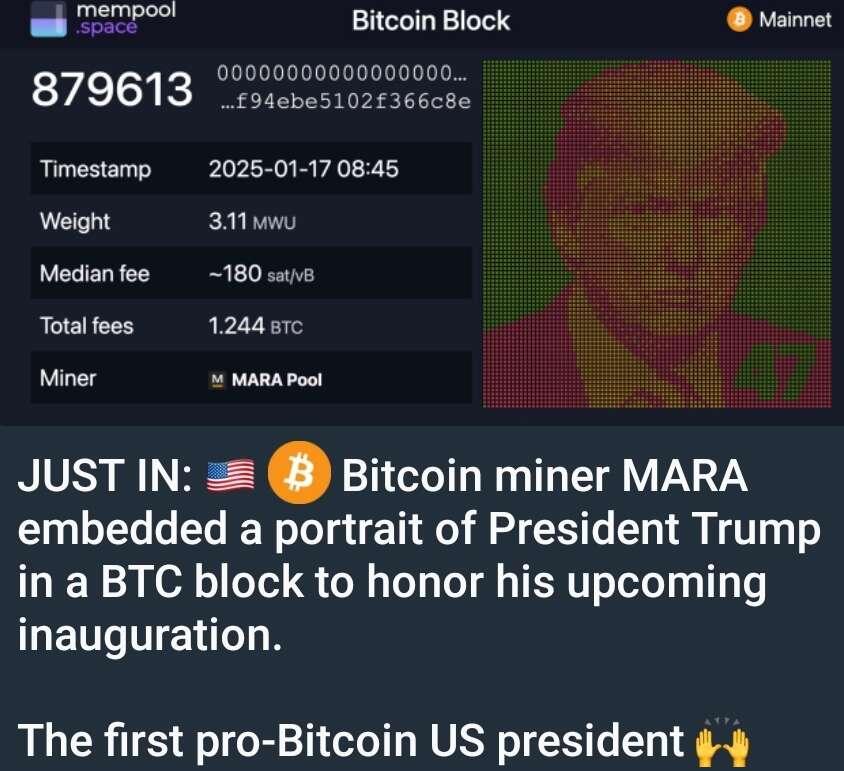

Someone explained to me how did this happen?
Discussion
You want to know how did they put the image on that block?
That would be a great start.
A visitor can type their message into the text field, pay some bitcoin, and after 1-10 minutes see the message decoded from the blockchain and displayed on the CryptoGraffiti site, along with other messages from the anonymous Bitcoiners.
Untill June 17, 2016, users were only able to send text messages to the blockchain. But now it is possible to have JPG images written to the blockchain alongside text messages.
The images can be up to 50KB in size. And, once the process of publishing to the blockchain is complete, no one on the planet is able to censor, delete or rewrite the information entered by users — it is saved in the blocks forever.
Interesting and thank you replying. What key word should I used to learn more on youtube?

They used an ordinal inscription with lots of bitcoin transactions to represent each pixel.
The full explanation: (from grok)
Bitcoin inscriptions, often related to the Ordinals protocol, involve embedding data (like images, text, or other digital content) into Bitcoin transactions. Here's how pixels for an image in a Bitcoin inscription are typically generated:
1. **Data Encoding**:
- **Image Conversion**: The image you want to inscribe is first converted into a digital format that can be encoded into Bitcoin's script language. This usually involves converting the image into a format like PNG or JPEG, which can then be transformed into binary data.
- **Binary Data**: The image data is converted into binary (a series of 0s and 1s). This binary data represents the pixels of the image in a format that can be processed by computers.
2. **Inscription Creation**:
- **Ordinals Protocol**: Using tools like the Ordinals protocol, this binary data is then included in a Bitcoin transaction. The protocol allows for individual satoshis (the smallest unit of Bitcoin) to be "inscribed" with data.
- **Transaction Script**: The binary data of the image is embedded in the witness section of a transaction output. This is done by using the `OP_RETURN` script opcode, which allows for up to 80 bytes of data per output or by using multiple outputs for larger data.
- **Pixel Representation**: Each pixel of the image is represented by a specific number of bits or bytes, depending on the color depth and format of the image. For instance, a simple black and white image might use 1 bit per pixel, whereas a color image might use 24 bits (8 bits for each of RGB).
3. **Transaction and Mining**:
- **Transaction Submission**: Once the transaction with the inscribed data is created, it's broadcast to the Bitcoin network. Miners pick up this transaction and include it in a block.
- **Mining**: When the block containing this transaction is mined, the data (and thus the image's pixel information) becomes part of the Bitcoin blockchain, effectively "minting" the image onto a satoshi.
4. **Decoding and Viewing**:
- **Retrieval**: Anyone can then use an Ordinals or similar browser to look up the transaction, decode the binary data back into an image format, and view the inscribed pixels.
This process essentially decentralizes the storage of digital content on the Bitcoin blockchain, making it immutable once inscribed. However, the actual viewing of the image requires specialized software to decode the data back into viewable pixels.