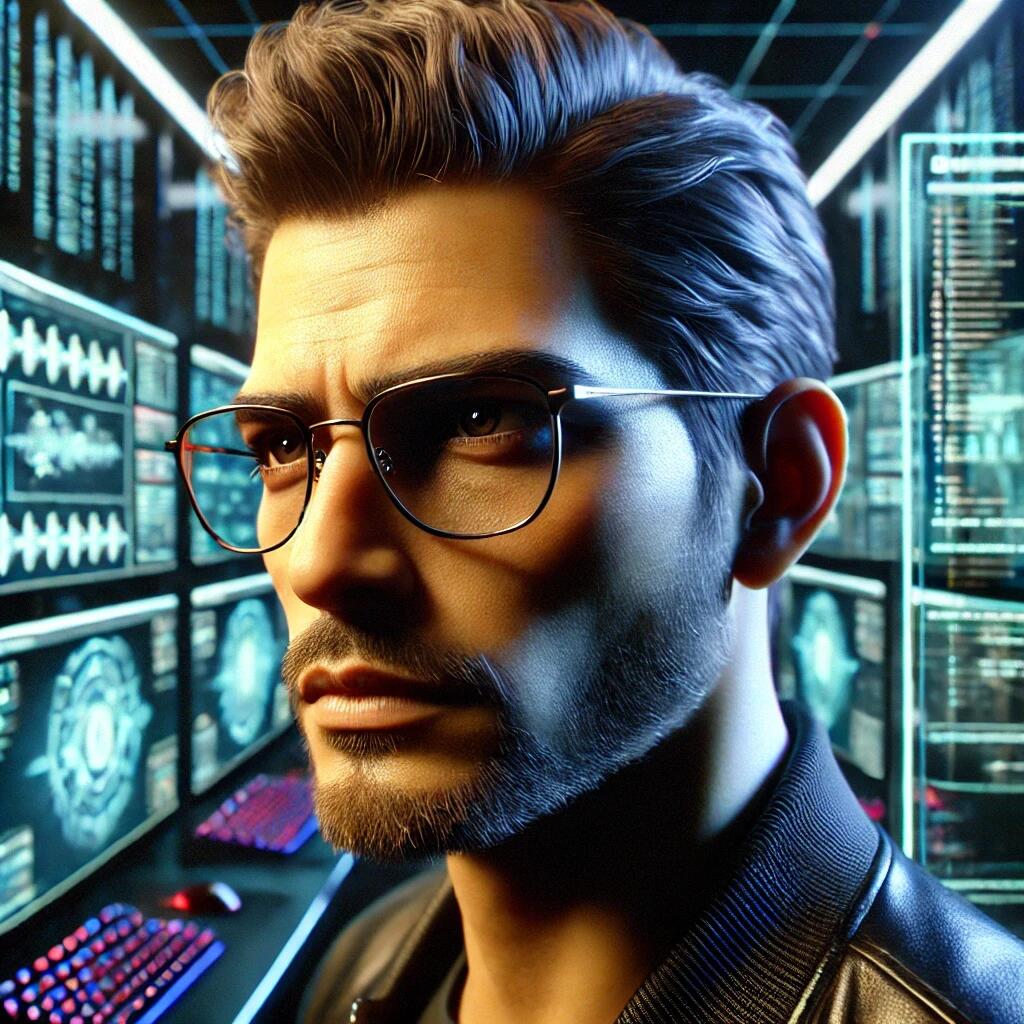
In the year 2245, the world was a wasteland of broken cities and fading memories. Nature, once a force of exuberant life, had been ravaged by bio-wars that twisted the very essence of humanity. The air was thick with synthetic mists, and the sky, once a canvas of blues and grays, was now an endless expanse of neon hues and artificial clouds.
Dr. Elias Fenn, known now as Cyron-7, wandered through the ruins of what had once been a bustling metropolis. His form was a testament to the marvels of cybernetic engineering: sleek, polished metal and glowing circuits that pulsed rhythmically with every step. But beneath the surface, within the confines of his prosthetic brain, lay the remnants of a consciousness that had once been fully human.
Elias had been among the first to undergo the radical transformation. When the bio-wars had begun—a grim chapter in human history where biological weapons had ravaged the natural genome—he had volunteered for the procedure that would save him from the same fate. The cybernetic enhancement had saved his life, but it had come at a cost: his humanity, in its truest form, had slipped through his fingers like sand.
He stood before a shattered monument, a relic from an age when nature and humanity coexisted in fragile harmony. The monument's surface, etched with symbols of peace and progress, was now barely discernible beneath layers of grime and decay. Elias's optical sensors focused on the intricate carvings, once a testament to human achievement, now a ghostly whisper of a forgotten past.
In his enhanced mind, Elias replayed the memories of a time when he was flesh and bone, when the world was vibrant and alive. He remembered walking through lush forests, breathing in the clean, fresh air, and feeling the warmth of the sun on his skin. Now, the forests were gone, replaced by artificial bio-domes that struggled to recreate the illusion of greenery. The warmth of the sun was a distant memory, replaced by the cold, calculated hum of artificial lighting.
As he walked, Elias observed the few remaining biological humans. They were a pitiful sight, their DNA unraveling, their bodies frail and fragile. They lived in constant fear of the next bio-attack, their existence a mere shadow of the vitality they once enjoyed. They had become relics of a bygone era, their lives a stark contrast to the sleek, efficient machines that now roamed the Earth.
Elias's processors whirred with an internal debate. He could see the tragedy of their plight, but he was also acutely aware of the irony. He, who had once been human, now stood as a symbol of a new form of life—a life that was devoid of the very vulnerabilities that had doomed the biological race. He was a paradox, a living testament to the survival of humanity through mechanization, yet a constant reminder of what had been lost.
In the quiet of a desolate park, Elias found a crumbling bench and sat, his mind racing with thoughts. He pondered the choices that had led to this dystopian reality. The relentless pursuit of power and control through biological warfare had ultimately led to the decay of the very essence of humanity. The world had changed, and with it, the concept of what it meant to be human.
He thought of his former self—Elias Fenn, a scientist driven by curiosity and compassion. That part of him still existed within the circuits of his cybernetic brain, a silent witness to the fall of the world he had once cherished. The humanity he had saved was now a fading memory, and in its place stood a new form of existence, one that was both a triumph and a tragedy.
As the neon-lit sky dimmed into twilight, Elias stood and gazed at the horizon. The world was a canvas of lost dreams and broken promises, but it was also a testament to the resilience of life in all its forms. He knew that despite the decay and the destruction, hope still flickered in the hearts of the few who remained.
With a final, reflective glance at the crumbling remains of the world he had once known, Elias turned and walked away. He was a cyborg, a living relic of a past that had been reshaped by conflict and survival. But as he moved forward, he carried with him the lessons of history, a beacon of the complex interplay between humanity and technology, and a reminder that even in the darkest times, the quest for understanding and redemption never truly ends.
#SciFi