
**Visualizing The American Workforce As 100 People**
Visualizing The American Workforce As 100 People
n 2022, the U.S. population stood at **333 million**. Of that, roughly 60% were employed (https://www.bls.gov/opub/ted/2022/employment-population-ratio-at-60-0-percent-in-july-2022.htm) in various jobs, positions, and sectors in the U.S. economy.
But where did all these people work? What jobs did they do and what positions did they hold? Where do most Americans do their nine-to-five?
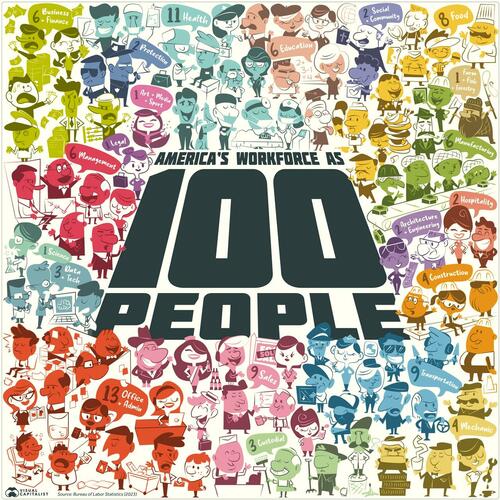
Using data (https://www.bls.gov/oes/current/oes_nat.htm) from the National Occupational Employment and Wage Estimates (2022) put out by the U.S. Bureau of Labor Statistics (BLS), Visual Capitalist's Pallavi Rao reimagines (https://www.visualcapitalist.com/american-workforce-100-people/)the employed American workforce as only 100 people, to find out answers.
Interestingly, the data contains a mix of information demarcations. Some are job-specific (type of work), some are based on position (like Management), and some are broken down by industry (Transport and Health).
 ?itok=hUWOrO3S (
 ?itok=hUWOrO3S)
The Most Common Jobs In the U.S.
By far, most of the American workforce (13 out of 100) are employed in **Office & Administrative** work. This includes a mind-boggling variety of jobs: receptionists, payroll clerks, secretaries, proof-readers, administrative assistants, and customer service representatives to name a few.
Notably, any sort of management role is absent from this, as well as any other job categories, since the BLS categorizes managers in their own class.
The industry which employs the second largest group of people is **Health**, accounting for 11 people from the 100. This category is a combination of two sectors listed in the original dataset (healthcare practitioners and healthcare support) and covers the entire industry: from physicians, surgeons, veterinarians, nurses, and therapists to technicians, assistants, orderlies, and home and personal care aides.
Here’s a quick look at all the major sectors most of America’s workforce actually works in.
RankJobsPeopleExamples1.Office & Admin13Receptionists, Clerks, Customer service, Secretaries.2.Health11Doctors, Nurses, Paramedics, Vets, Orderlies, Personal care aides.3.Transport9Warehouse workers, Packagers, Pilots, Ambulance, Bus, Truck, Taxi drivers, Ship captains.4.Sales9Sales representatives, Counter clerks.5.Food8Food preparers & servers, Bartenders, Dishwashers, Hosts.6.Management6Legislators, Chief executives, Directors, General & Operations managers.7.Business & Finance6Accountants, Auditors, Financial analysts, Logisticians.8.Manufacturing6Factory workers, Gas fitters, Machine operators, Cobblers, Tailors, Barbers.9.Education6Teachers (all fields, all levels).10.Construction & Extraction4Stone / brick / block / cement masons. Construction laborers. Roofers, Plumbers, Electricians, Mining workers.11.Mechanics & Installation4Auto mechanic, Farm equipment mechanic, Home appliance mechanic, Locksmiths.12.Data & Tech3Information analyst, Database architect, Software & Web
developers, Data scientists, Mathematicians, Computer support.13.Custodial3Cleaning, Groundskeeping, Landscaping, Housekeeping.14.Protection2Cops, Firefighters, Security guards, Lifeguards, Correctional officers.15.Hospitality2Animal trainers / caretakers. Ushers / attendants. Makeup artists. Concierge. Exercise trainers.16.Architecture & Engineering2All engineers and architects (excluding the information industry).17.Community & Social Service2Social workers, Therapists (counsellors) & Religious work.18.Arts, Media, & Sport1Fine artists, Designers, Actors, Athletes, Journalists, Writers, Authors, Musicians.19.Science1All scientists (not engineers).20.Legal1Lawyers, Judges, Paralegals, Mediators.21.Farming, Fishing, & Forestry1Farmers, logging workers.Total100
The third most common job is actually a tie between **Transport**—cargo moving workers, pilots, truck drivers—and **Sales**—retail and industry sales agents, counter clerks—with both sectors employing nine of the 100 people. In the Sales category, two of the nine people are cashiers.
Ranked fifth is **Food**, with eight people, ranging from private chefs to serving staff at fast food restaurants.
Another six all belong in some kind of **Management** role (across industry, and including legislators) with two of those six being “top level executives” like a CEO, a general manager, a mayor, or university president. Management shares its spot with Business & Finance, Manufacturing, and Education, all at six each.
The following jobs or industries also employ the same number of people:
- Construction & Extraction along with Mechanics & Installation, at **four** each.
- Data & Tech, with Custodial jobs, with **three** e…
https://www.zerohedge.com/personal-finance/visualizing-american-workforce-100-people