Just found myself reading about "Donatism" - a "heresy" in North Africa during the time of Augustine.

Their so-called "heresy" was simply that apostates shouldn't be priests. There was a period in which Christians were allowed to return to paganism, and many did so. Then, Constantine became emperor, and the political situation was favorable, so the apostates returned to Christianity. Donatism simply said that they shouldn't be allowed to lead congregations - and I think that makes sense. That makes sense for any group and any set of beliefs. Why would you trust a proven traitor?

But Augustine decided that these donatists were different enough to call them "heretics" and murder them. Here's this carefully worded blurb from wikipedia :
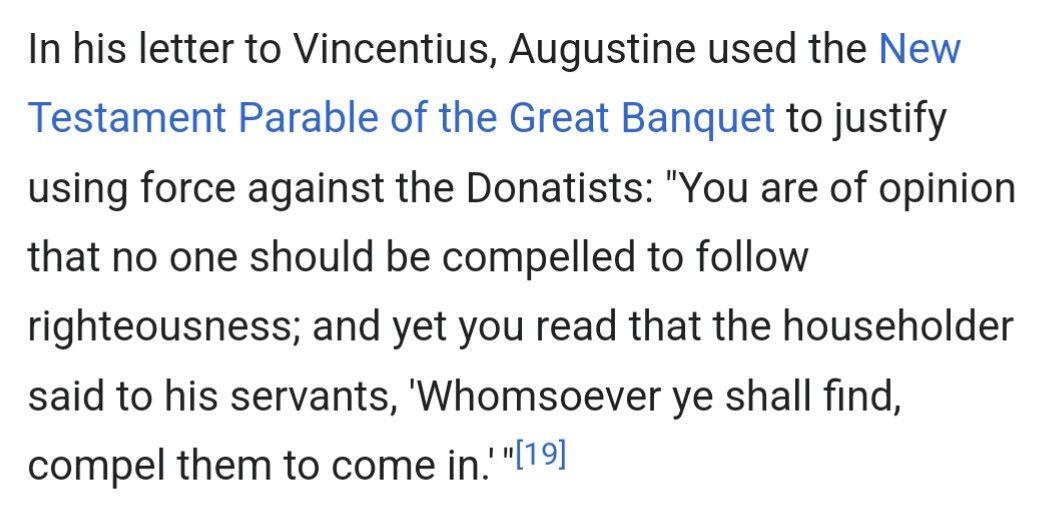
And here's the whole wikipedia page :

https://en.m.wikipedia.org/wiki/Donatism

It is quite obvious that this page has been doctored up to avoid the truth - the early church, during the time of Constantine, was built on the mass murder of Christians. Who is incentived to alter history?

Augustine is the most disgusting early "father" from the early political church. I encourage anyone to dig into this evil character, especially if you are being influenced by a version of a church which venerates him.

This, unfortunately, is the history of the church, in summary :

Christians from the time of Christ until the Council of Nicea had very diverse beliefs, with many interpretations of Christ's words. But Constantine wanted one thing, above all else - casus belli. In 325 AD, he got a perfect, infinitely applicable casus belli. By defining dogma, they could label local variations of Christians as "heretics" and then move against them with force, without opposition from other Christians. Neutralizing Christian opposition was the key to political power - Christians had been aggressively in opposition to Roman power structures. Look into the Christian mob that murdered Hypatia, for a well documented example. The creation of the centralized power structure of "the church" was seen as a victory by most Christians, but the reality is that it was used primarily to murder Christians. What began in 325 AD was a constantly narrowing purity test, where an authority figure redefines spiritual vocabulary and then the congregation must prove their piety by supporting a new level of absurdity - exactly the same process which led modern leftists from opposing state power 30 years ago to now using state power against their enemies and absurd movements like BLM. Same phenomenon. Over 1700 years, the purity tests have continued and moved Christianity so far away from Jesus' teachings that now Christians have zero understanding of Christ or any spiritual concepts, and if you even repeat what Jesus actually said, right after reading it during a bible study, they will scream at you (this happened to me - two screamers simultaneously).

There ya go. In a nutshell... This is why real Christians stay away from churchy people.

I was just in another conversation talking about the Anti-Theist movement. The core of it was weaponizing passages of scriptures against the adherents to those religions.

The movement was led by atheists who felt that religion is a net harm to society and progress, so a little different. The point that most Christians are unfamiliar with most of the Bible stands though. Many atheists argue that reading the bible is the best way to make an atheist.

Someone attacking you causes people to dig in, so for the most part the movement has died even though many atheists still believe that religion causes harm.

Reply to this note

Please Login to reply.

Discussion

The Romans commonly called Christians "atheists." People today assume that means Christians didn't have that whole mess of gods - but if you really dig into what Jesus taught, there's an argument that early Christians were genuinely atheist, in the modern sense. I'm not an atheist - I believe in God. But how "God" is defined is the rub. And that's the problem - calling something a heresy is justification of murder, or at least theft.

Heresy and semantic stop signs pretty much sum up the ways Anti-Theists feel than religion is a source of harm in society.

Personally I also think about house cats.

They are genetically wild, no difference unlike dogs which have genetic changes from wolves. They are in a state of stunted emotional development. They shift their dependence from their parents to their owner.

This is why a pet dog let loose dies but a pet cat let loose will be fine, the cats finally grow up.

As an atheist and an anarchist I realize that both of those are moving on from and gaining independence from additional layers of parental figures. It adopting those beliefs feels a lot like a late additional stage of growing up. You also start to often see statists and religious people appealing to those figures a lot like siblings yelling "But Mom! Make them stop I don't like it! "

I've come full circle in my spirituality. Well, not quite full circle, but close enough.

I started with the assumption that Christians are nice people and there's no reason to go beyond that. Then I had some spiritual experiences, and I assumed that meant Christianity was correct - that one, narrow and truncated form of spirituality, quite an assumption. But there were inconsistencies, so I decided to make an honest effort at understanding the Bible - that included church, exploring various denominations, attending regular live online sermons (those were Eastern Orthodox), and the latest was a bible study with fellow nostriches. Every - **_every_** - attempt has ended when I pointed out what the Bible actually says, and got very angry responses. I don't claim to have a perfect understanding, but I can point to specific verses and their context and say, "this definitely can't mean (xyz)." But they can't handle it. They love their dogma, not the truth.

This all happened over the course of 5 years. And more... Jesus said to search the scriptures, so I have, and I continue to do so. The thing is, there was no Bible when he said that. So... What scriptures? Jewish Bible, okay, but there were more scriptures than that. There's the Greek Orphic cults, the Roman cults, the Egyptian cults, the Persian cults, etc. All of these were influencing people in Judea at that time.

But omg, try telling that to a Christian... If anyone ever doubts that Christianity is built upon a foundation of murder (not the rock/Peter/Jesus), just try that and think seriously about what these people would do, or turn a blind eye to.

Two books popular in the atheist community are "God is disappointed in you" and "apocrypha now"

They both use the same shtick. The religious texts but the stories are told by an atheist in modern language instead of ancient language or modern language selected by a figure in the religion who is incentivized to keep you believing.

The first is the Bible, the second is the Apocrypha. I bring them up because the Apocrypha is books that at some point claimed to be a part of the bible but were axed by various human committees at various times.

You seem like you may be interested in "Apocrypha Now" and or the original texts.

I went through a lot of what you went through on my path to atheism. Happy to talk to a fellow traveler who is curious and genuinely searching instead of just searching for confirmations of what they already believe.

I'm looking up Apocrypha Now ... now.

It was interesting. I don't want to spoil it for you. Lots of coverage of the years of Jesus life that the current church says there are no records of.

Amazon lists it as a comedy. Is it really?

Anyways, I don't want to give the impression that I'm leaning towards atheism. I'm just trying to hold myself to some decent standards, and am mad that Christians don't.

I laughed many times. Remember, accurate retelling but by modern atheists. Parody or satire aren't quite right, it is far more true to the source material than those styles.

I didn't say you are. I didn't put together until much later that my frustrations with Christians were part of my realization that none of my morality actually came from Christianity or the Bible. It was cultural and derived from first principles of protecting human self determination.

Maybe you'll find different. That moment of "none of you really follow this book" was quickly followed by "I'm not following it either and I don't think I would be a better person if I did" for me.

That's why I don't care much for the old testament. Or Paul. Really its just the gospels that matter to me. And the Gospels... Are Greek. And that means, understanding Jesus requires understanding philosophy... And Christians hate philosophy... Yeah, so I guess I'm not too far from where you are on the matter.

Are you familiar with the Neil Gaiman book American Gods or the TV adaptation by the same name? Other than the supernatural aspects, it is the best model I know of to summarize my view of religion.

In the Russell's Teapot + Bayes theorem sense I am definitely an atheist. In another sense I'm polytheistic to the extreme of believing in all gods. The atheist belief is a well known model many take seriously. I don't know of anyone other than me who takes the American Gods polytheism model seriously. If you aren't familiar with that source material it might not make much sense to hear someone declare they are an atheist polytheist who believes all gods are real.

I'm not familiar with that, but it sounds like it might be similar to something I might actually believe - if God is infinite, then he is in everything, so there's a spirit in everything. Animism makes sense. And likewise, gods can be real because they're personifications of the one being, the All God, how ever you choose to describe him/it.

But its hypothetical - I have had no experience that directly indicates this to be the case. I just wouldn't condemn a person for having whatever gods, for this reason.

It's more the idea that gods are as real and powerful in this world as the number and dedication of their followers.

Few believers, the god is weak. No more believers, the god dies.

So Jesus may not have even been a real historical figure, and no supernatural god figure behind him. He is still a very powerful god because he has many followers acting independently but in concert based on what they believe he teaches.

The Jesus you like is different than the Jesus of most modern Christians. Literally 2 different gods as I see it. Your Jesus is far less powerful also because theirs has more followers.

One of my favorite gods is Odin. Of course he has very few followers today. I think that shows with the amount of anti intellectualism and expert hatred we see around us. We may have some science worshippers today but science without wisdom has many faults. Those faults are exploited to help drive people to convert and be more devout in the anti expert religion.

Egregors. Could be.

IMO my Jesus is vastly more powerful than the Jesus of idolatrous Christians. He's the life and truth - that's the life force within, which makes biological life and the experience of this Hubble in eternity possible. Its Grace. And that's the same internal fire of the Zoroastrians. There are infinite ways of describing the one thing. The Dao, the Spirit, the invariable Truth, the whole, the Monad - but IMO, the most elegant word is grace.

And I know an idolatrous Christian would attack me for saying this, but its really easy to prove. Just read look up the Greek words as you read the Gospels. One little step. Easy. Fucking Idolators...

And... It doesn't matter. Its simultaneously the most profound thing and also the most pointless. Live life. Forget about it. It isn't going anywhere.

Never seen the word egregor before. Not shocking it exists, it seems like a painfully self evident concept to me someone else must have thought of it also.

Grace is certainly something modern Christians lack.

Less wrong talks about the pain of changing your mind a lot. One point they spell out that we often overlook, you know you can live to bear the truth because you already are living with the truth. All that changes is your acceptance of it. Fancy way of saying I completely agree with your last paragraph.