
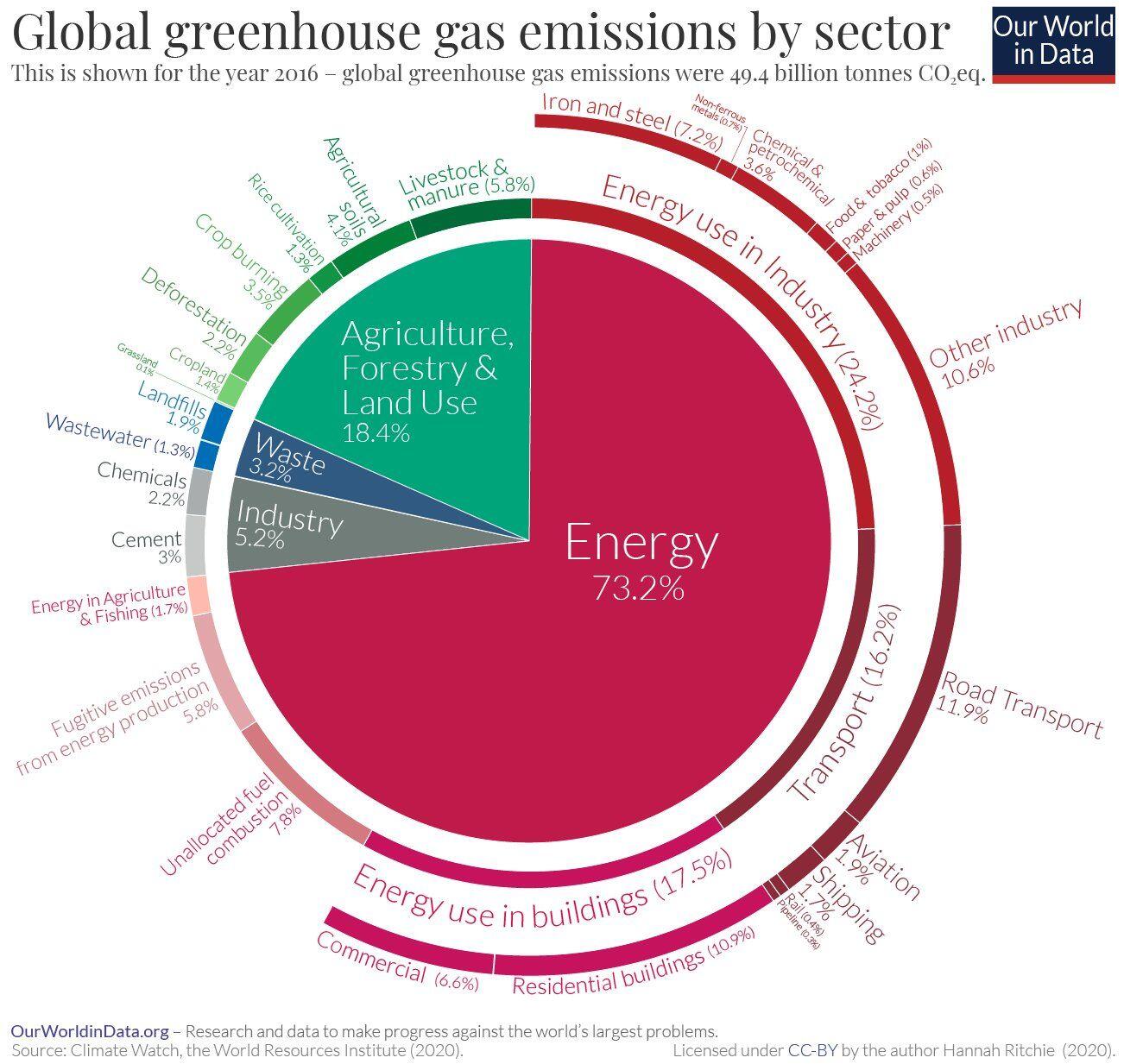

That's a really dubious chart, as comparing organic methane emissions to fossile fuel CO2 is misleading. Organic methane from livestock, rice, etc is not a long-term problem. The methane decays back to CO2 on relatively short time scales, and the CO2 is turned back into plants to complete the cycle.
Discussion
There is a certain amount of methane present in the atmosphere. Surely, even if it all will be converted into CO2, you must factor in the production rate of it as well in order to assess its CO2 equivalent greenhouse gas effect?
The reason why there even is a "CO2 equivalent" is because methane itself traps heat in the atmosphere much more strongly than CO2.
But the half life of methane in the atmosphere is believed to be just 10.5 years; CO2 is stable. So calculations of CO2 equivalent have to define a time period, and usually the time period defined is relatively short (eg 100 years, or even as short as 25 years) to get a scary CO2 equivalent.
Over a longer time frame, organic methane sources simply aren't important.