
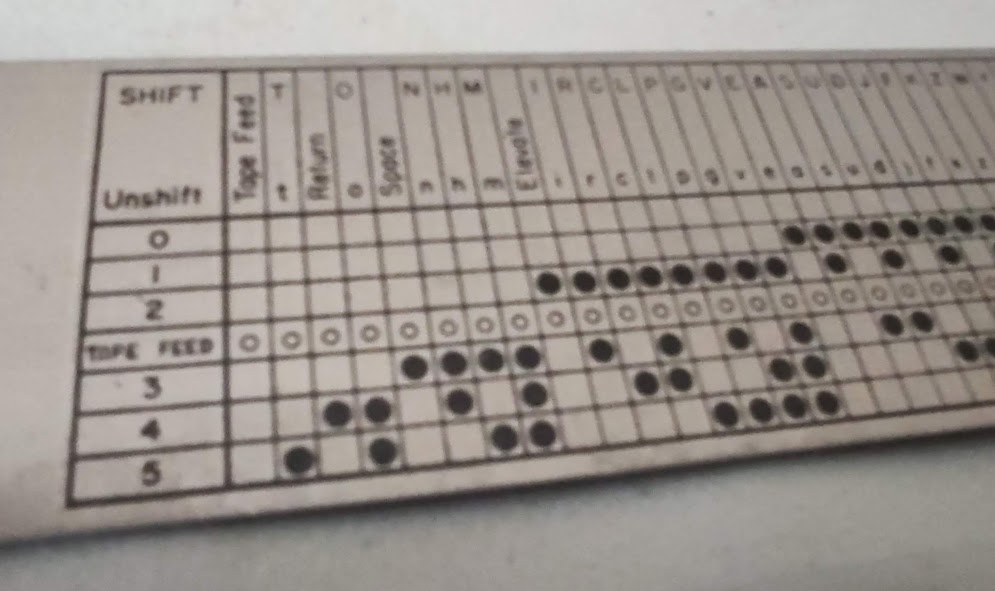
Gannett used tape-punching tech to separate keyboarding from Linotype machine operation, speed up the system, cut costs, and allow centralization of what we would now call data entry. Wire services eventually followed, setting up Teletypesetting services that sent stories as data neatly formatted for standard column widths, including hyphenation and justification.

There were no computers then, of course. The data was transmitted over phone lines using signals broken into 6-bit codes in a standard called TTS. At the receiving end, the signals generated both typewritten copy readable by humans, and punched tape that could be fed to the Linotypes.

You may know that 6 bits can only represent 64 possibilities (2 to the 6th power). That's not enough characters. Shift, Unshift, Upper Rail and Lower Rail were used to enable majuscule (capital) and minuscule (little bitty) letters, and font changes such as bold or italic.

Accents? Diacritics? Nope. Not in the codeset. Not in the font magazine either. A Linotype could cast them, if properly equipped for the task, but they weren't in the least-common-denominator world where newspaper production lived.

So stylebooks of wire services and major newspapers simply said: don't use them.

/2

Reply to this note

Please Login to reply.

Discussion

When computers came along, they did not immediately solve the problem. The 7-bit ASCII computer code set offered more possibilities, but it assumed you were writing in English. (The "A" stood for American.)

If you're older than 30 you may remember what a mess the Web was before the evolution of Unicode and widespread support for decent fonts. In theory, Unicode solves everything, but i still occasionally see text show up with junk characters where my browser can't figure out what was intended.

So what does this have to do with Vietnamese? The language is written in chữ Quốc ngữ (let's hope the diacritics stay put). It is a script based on the Latin alphabet with diacritics used to indicate pronunciation tone.

Vietnam's Lao, Thai and Khmer neighbors stuck with their own Sanskrit-based scripts, which you're not likely to see dropped into an English-language text. Instead, you'll see romanized transliterations (poorly standardized, which is the subject of an entirely different rant).

Most wire services have moved on from the 6/7-bit era, and in theory can easily represent text with rich diacritics. But print toolchains still may contain obsolescent pieces that don't understand the modern world, and font can be quite limited in what they can display.

/3