
**The Disruptive Military Technologies The Pentagon Is Spending Nearly $150 Billion On**
The Disruptive Military Technologies The Pentagon Is Spending Nearly $150 Billion On
_Authored by John Haughey via The Epoch Times (https://www.theepochtimes.com/pentagon-officials-say-integrating-new-weapons-systems-can-cause-battlefield-disruption_5193557.html?utm_source=partner&utm_campaign=ZeroHedge&src_src=partner&src_cmp=ZeroHedge) (emphasis ours),_
President Joe Biden’s **$886.3 billion Fiscal Year 2024 (FY24) defense budget** request includes $145 billion for research and development into emerging technologies to create **new weapons systems using Artificial Intelligence (AI), hypersonic munitions, and electromagnetic swarms.**
 ?itok=Nr3zGrrP\
_The U.S. Department of Defense launches a sounding rocket from NASA's launch range at Wallops Flight Facility on Wallops Island, Va., on Oct. 26, 2022. (Evelyn Hockstein/Reuters)_ (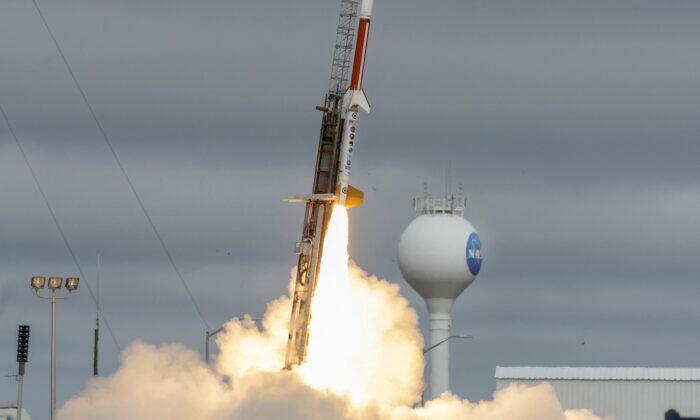 ?itok=Nr3zGrrP)
The Department of Defense (DOD) and its subsidiary military branch technology laboratories, working in tandem with universities and high-tech contractors that increasingly include small businesses, have produced such big-ticket splashes as newly deployed directed-energy weapons systems and hypersonic/ballistic sensors.
Among prospective products and systems seeking funding in the FY24 spending request is **a ‘Rocket Cargo’ transport that can move 100 tons of cargo anywhere on Earth within an hour;** a **counter-swarm electromagnetic weapon** that can disable drones and be powered from a wall plug; **a rotating detonation engine** without moving parts; a “pop-up hide” **that can make Marines disappear in plain sight**; a Predictive Vehicle Activity for Identification and Location (PreVAIL) program that “ **will bring a novel approach to automated target detection and recognition**.”
There are also less sexy utilitarian products being tested in the budget, such as a Portable Fluid Analyzer, a ship-to-ship system that converts Morse code into text messages, and an assembly line of bigger, faster, better-armed unmanned aircraft, from micro-drones to the latest Unmanned Long-endurance Tactical Reconnaissance Aircraft (ULTRA.)
**All have survived, or must soon traverse, “The Valley of Death.”**
Unlike notable valleys in American military history—Valley Forge, the Chosin, Khe Sanh, the Korengal—this “Valley of Death” is not a place on a map but that dreaded moment of realization on a military product development timeline when a cutting-edge weapon that will deliver a decisive battlefield advantage cannot advance out of prototype to production and get onto the battlefield in time.
 ?itok=IODm63Ym\
_An operational version of the Active Denial System, a military counter-personnel directed energy weapon that is the equivalent of science fiction’s heat ray. (Unlisted USAF personnel/Public domain/ Wikimedia Commons )_ (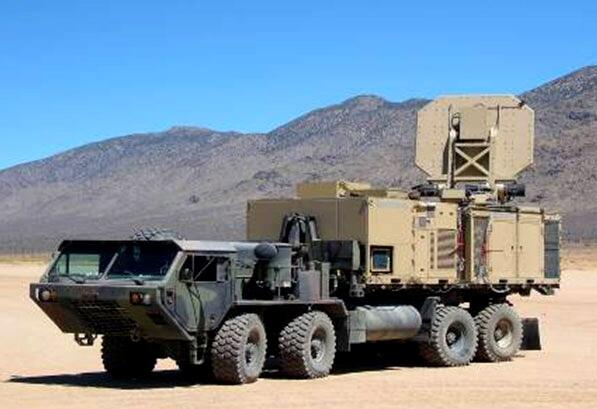 ?itok=IODm63Ym)‘The Valley of Death’
Integrating new, still-maturing technologies into existing programs and platforms without “radical disruption” to multi-year procurement and acquisitions systems is among the most tweaky of challenges confronting the military, Pentagon officials said during a two-hour April 13 webinar presented by the National Defense Industrial Association (NDIA).
The DOD’s Under Secretary of Defense for Research & Engineering Heidi Shyu and the DOD’s Defense Advanced Research Projects Agency (DARPA) Director, Dr. Stefanie Tompkins, noted the proposed $145 billion Research, Development, Test, and Evaluation (RDT&E) budget is up 12 percent from this year with the Air Force receiving one-third of the requested outlay.
Shyu said the Science and Technology component of the RDT&E budget request is $17.8 billion, up 8.3 percent over this year’s $16.5 billion budget.
The annually updated National Defense Science & Technology Strategy is on Secretary of Defense Lloyd Austin’s desk, she said.
Shyu said the strategy will focus on joint mission; creation and deployment of capabilities at speed and scale; establishment of an enduring advantage in talent, infrastructure, research, and collaboration; directed energy weapons; and hypersonic/ballistic sensors.
Technology leaders for three military branches—Army Deputy Assistant Secretary for Research & Technology William Nelson, Naval Research Chief Rear Adm. Lorin Selby, Air Force Research Laboratory Commander Maj. Gen. Heather Pringle—outlined cooperative ventures with industry and workforce development plans, especially in currying bids a…