
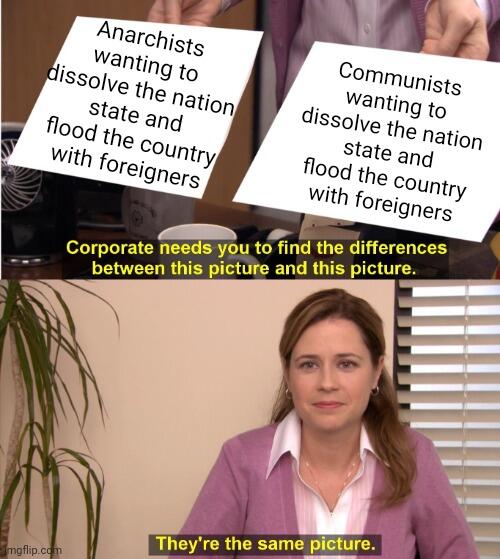

There's a difference between anarco-communists and anarco-capitalists, in the latter, property rights are a thing. I wouldn't let random people with different values and mindsets onto my property for obvious reasons and I'm sure most people feel the same way.
Discussion
But you both have no concept of communally-held property, which would afford a group property rights. No "ethnic homeland" or "regional territory".
Just one guy and his apartment or country house, or whatnot.
You mean public land?
From what I understand, and correct me if I'm wrong, you're arguing that we need a government to protect a region of land and secure the borders, because individuals cannot do it as efficiently. So anyone arguing for anarchy, is going to get that piece of land invaded or overrun by immigrants. Is that correct?
Also some questions to understand the context:
-You mention "just one guy", are we talking about 1 anarchist living amongst statists or a hypothecal area of land inhabited by anarcho-capitalists? I wouldn't demolish a nation at the snap of a finger right now if I could, people don't understand economics and property rights, so it would all devolve into chaos and you'd most likely get another state to replace the previous one. I'm more for slowly defanging the state initially (minarchism or libertarianism), parallel economies, separating money and state, monarchies replacing democracies would be interesting, etc. Then and only then do I think that anarchism over an area of land makes sense.
-What are group property rights? Who decides what happens or is done with the property in the group? Can you take your property within this group property along with you if want to opt out?
Yes, that is correct. At least, at the present time in the West.
Area of land inhabited by anarchists
At the moment, the disposal and management of common property is decided by representatives elected by majority vote. You can take some of the property with you, but not the immobile bits. You can't take a supporting column of a bridge with you, for instance, or a school, but you can have your pension paid out while living in a foreign country.
There's a lot to unpack here, and there's no way to fully express the ideas of Murray Rothbard, Saifedean Ammous, Hoppe, etc in one post but I'll do my best. Also, your meme is describing what's going on with the current system around the world, no anarchism necessary.
I don't know your background on Austrian economics, but basically, it has been seen time and time again that government is unable to perform economic calculation over production decisions, because of the economic calculation problem. Yet...government can protect property and protect against foreign enemies, right? But, isn't protecting property just another market good? Why can government produce property protection but not apples? Defense is an economic good, it has utility and it is scarce. Individuals can produce it for themselves or acquire it from others on the market. The market for defense is highly developed, from safety locks, alarms and surveillance cameras to drones, guns, security guards and armored vehicles. Also, there are more private security personnel than state security personnel in the world.
There is no satisfactory answer to the allocation of defense resources without private property and economic calculation. Without property rights, there is no objective unit against which to measure the utility from individual allocation decisions. There is no way to allocate scarce resources to where they would produce the most value.
The reality is that defense is provided on the market already. Government defense is mostly about defending the government, not the people. They really couldn't stop the BLM riots or January 6th? Yet they managed to force thousands of businesses to close during the pandemic and lock up millions in their homes.
In a free market individuals would be able to calculate the best allocation of resources and property to meet these needs in the best way they can. Without a free market in these resources, allocation is made without calculation. Tax-funded security providers have no incentive to care about customer satisfaction or resource conservation.
Security and defense are like any other good: best provided through division of labor, capital accumulation, and entrepreneurial calculation in an extended market order. In practice, most security is provided by the market. But it would be a lot better if we didn't have a monopoly (the government). Americans pay enormous sums to police and military, but they are very unsafe. Imagine if the people of Chicago or New York had all their wealth that goes to the police and army available to them to spend on security services that were responsible to them, had no monopoly, no special legal protections under the law, no right to initiate aggression, and no ability to extract tax.
Long story short, if you can't trust the government in running things like the economy, education, transportation, etc. Why would you entrust them with something as important and necessary as defense? Also, voting harder doesn't work.
I highly recommend Saifedean Ammous' book, Principles of Economics, a great read and something I plan my children on reading too one day.

I consider myself anarcho-communist but I think under anarchy there would ultimately be property rights in the form of people defending what they have laid claim to. Anarchy would be kinda good for property owners because there wouldn't be a tax man to take your home by force. But anarchy means there can't be any communist force controlling land distribution to make sure it's communally equitable. Just stuff like the food supply could be communist considering how much food we throw out, people could just share enough food without a controlling force
Communism implies there has to be a central planner in some area of life, you just mentioned food. If people didn't sign up to follow the food laws of this commissar and are coerced to obey, that's not anarchy. If they can opt out and are not coerced, then it can be anarchy, but not really communism as individuals are given priority. You could, as an individual, sign into a community with these rules though. But can communism work as a whole? I don't see a way around the economic calculation problem to be honest.
Communist rules about food can work without a central authority but land use laws can't in my view. Anarchy could come with everyone just agreeing they don't allow restaurants to throw food away and farmers agreeing they won't allow anyone to starve to death. No authority forces everyone to stay in line except the collective of everyone else, which isn't organized in a central way.
The question is, how would this society enforce the "don't allow" part?
I can see this food scenario becoming more of a societal norm in some places (ie. Germans don't like littering but it's very common in poorer countries) and in other areas you'd probably sign an agreement. That's the rules without rulers part of anarchy and I agree that is something plausible, to have almost everyone handle their food responsibly *and* voluntarily. The important thing is avoiding control of the food supply and how it is used by some central authority, maybe some people would want to "throw away" food to make compost. Would they be punished and how would that go about? The free market would end up offering the best solutions.
Yeah, social norms basically become the closest thing to statute under anarchy. I don't think it would ever become a social norm to punish composters; more like if you get caught wasting food to pad profits as a restaurant, you get targeted with some theft and people are less keen on protecting you or eating at your restaurant, and if you keep doing it your reputation becomes inherently unprofitable in that community. When it comes to farmers it would just be that most farmers negotiate far too generously to let anyone starve to death and there's no tax man coming to say "your prices are undercutting Walmart so we're taking your farm if you don't cough up money for us"
The scenario you're describing with the restaurant is a free market scenario, where the restaurant stops wasting food not because a law made it so but because of profit motives. People look down upon certain actions and if they become aware of it, they vote with their money and go somewhere else. The restaurant either gets it or goes out of business.
I lot of farmers would probably have better yields as well if they would leave all the monocrop Fiat agriculture behind, sure it might be profitable in the short term, but long term you destroy your own soil and are therefore reducing yield in the long term. With time, many are forced to pay for expensive fertilizers and pesticides to grow and protect their weak crops. Now, these monocrop agricultural tendencies exist because of government intervention; wheat, corn and soy are heavily subsidized by the US government in the USA, for example. Farmers have a guaranteed price on this these crops and humans love certainty, so that's what a lot choose to grow. If the free market wasn't being manipulated by government intervention, then you probably wouldn't see a lot of people growing things that make them poorer over time.
Also, people are generally more generous the less they are stolen/taxed from. I can see charities working in an anarchic society, better than they work now, and people being taken care of if needed. So without a government to "take responsibility" for the poor and to steal from productive people, those with some money would probably be self-interested in helping out locally to take care of the homeless in their neighborhoods.
So basically, I don't see the need for the adjective of communism in anarchy. Left to their own devices, humans naturally cooperate and trade with one another, and those who respect property rights the most, develop civilization the most. Human action and property rights are the cornerstone of capitalism. It's not some greedy entrepreneur with a big hat, they become a problem (corporations) when they get in bed with the government and that has an actual name, fascism (which stems from socialist ideology). Unfortunately, people toss that word around so much that they don't even know what it means.
Posted this reply from snort.social and it doesn't seem to be showing up anywhere else -
nevent1qqsquf58sgm7hk6u0jedzpj8thczeqejwgtzvhxj430p52l8x5z2raszypmhdsedfvw3azlj4946h66r4kddu9tm6d3a3xu8ld37du292kygsqcyqqqqqqgcue9ah
Copying and pasting with an extra paragraph at the end I thought of later:
The key thing about it that makes it communist in my view is the adherence to the principles of fairness, equality, making sure everyone has what they need, etc.
The key thing about capitalism that makes it capitalist in my view is people being obsessed with money.
The two aren't opposite ends of a spectrum as people treat them - the opposite of communism is allowing slave owners and the opposite of capitalism is having no currency at all. You could abolish currency and allow slave owners and have very-not-communism and very-not-capitalism at the same time. You could also have the system I described but with "profit" not existing and it all just being a matter of people wanting or not wanting to share needed goods and labor. In the system I described, social norms include both a capitalist way of doing trade and a communist way of handling the trade of food.
I believe the main reason communism and capitalism get compared as counterparts because they have names and the actual counterparts to them don't really have names. There probably is a word for a society without currency, but I don't know what it is.
On that last part I added - looks like there isn't even a word, just a descriptive phrase https://en.wikipedia.org/wiki/Non-monetary_economy