Gauge theory and music - who knew?
My friend Mike Weiss said that 'commas' in music - those annoying glitches where you don't come back to the note you expect - are examples of 'holonomies' in gauge theory. And it's true if we use ideas from lattice gauge theory!
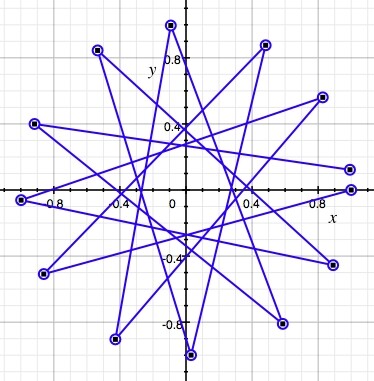
Since the Pythagorean comma is the simplest let's do that. Think of the circle of fifths as a graph X with 12 nodes and 12 edges. As we move along each edge, suppose the frequency goes up by a factor of 3/2. The issue is that when we go all the way around we are not 'back where we started'.
So, we want to assign some group element to each edge of X which records the fact that the frequency gets multiplied by 3/2 as we move along that edge.
But we need to think about frequency ratios modulo octaves. We can do it as follows: take the multiplicative group of positive real numbers ℝ₊ and mod out by 2, getting the group
G = ℝ₊/2
Note that we're modding out by 2 multiplicatively, not additively as more commonly done! So G is the group of frequency ratios mod octaves. It's isomorphic to the circle group, often called U(1) by physicists.
To put a connection on the graph X means that we assign an element of G to each oriented edge of X. We take all these elements to be [3/2] ∈ G.
This says mathematically that each time we move up a fifth on the circle of fifths, the frequency gets multiplied by 3/2, but we only care about frequencies mod octaves.
The 'holonomy' as we go all the way around the circle of fifths is defined to be the product of the group elements labeling all the edges. This is
[(3/2)¹²] ∈ G
and this is *not* the identity, though it's very close. This is called the Pythagorean comma! You can see it here: