
Sad state. The first website loader almost instantly. But clicking to learn more about it is slow and loads up this garbage … where did we go wrong??? 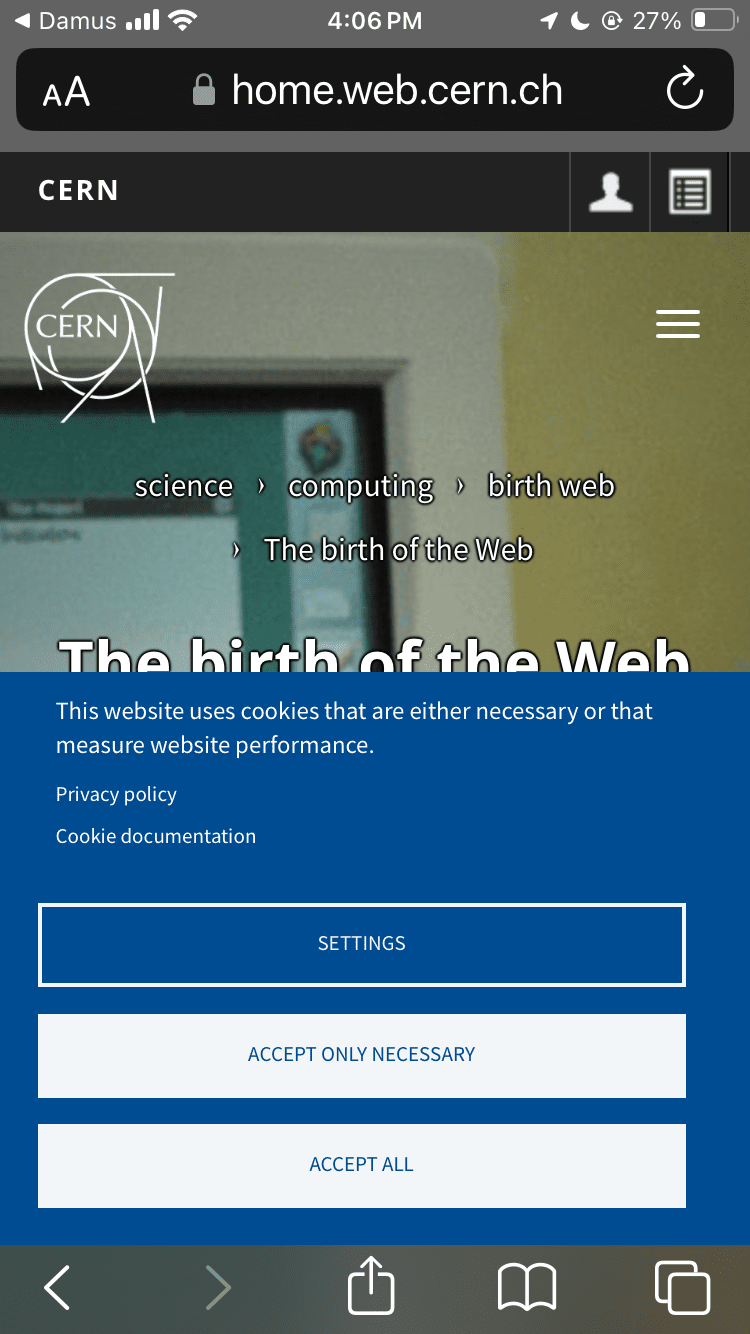
Discussion

Sad. We need to rebuild this all again.
https://www.w3.org/People/Berners-Lee/History/1989/proposal.html
What is that?
The original web proposal from 1989, ignored for over one year! Now a broken link.
https://void.cat/d/YZtzChGZKo8MDiqyiv7mWq.webp
See:

Lui avait déjà commencé depuis longtemps grâce aux analyses des observations objectives qu'il faisait sur le Web.. Un de premiers outils qu'on utilise en cours en chaire sociologie travail sociétés dimension humaine et nos 6 risques de vulnérabilités socioprofessionnelles
Il est sur X même s'il appartient à coups de crédits à M. Tweet Elon. Et les travaux sont partagés d'ailleurs avec tout le monde. Un héritage d'un oncle excellent mathématicien physicien asperger jamais diagnostiqué qui à l'époque a refusé toutes les offres des IBM et consorts pour se consacrer à l'enseignement en France. C'est lorsque j'échangeais sur ses comportements sociaux avec mes collègues qu'on a pu déterminer son handicap.. Mais ses attitudes en sciences ont aidé pour masquer son handicap qu'il ne connaît point tant mieux pour lui.
J'espère que vous ouvrez de manière participative sur les travaux entrepris Melvin. Ravie de voir d'autres personnes qui partagent des idées et intérêts capitaux sur notre propre histoire et évolution et états d'esprit, imagination dans le d' entreprendre.. D'ailleurs suis l'un des grands suiveurs depuis mon enfance de Stewart Brand du WEC un, homme né en 38 plein d'esprit qui fêtera son anniversaire le 14 déc... Les seules qu'il a protesté fut contre le Vietnam à sa manière et contre Elon quand il avait décidé toute publicité de certains journalistes y compris Jack avec ses écrits et publications personnels et nostr suite au déballage des Twitter files. 🙏🙏
Where did it go wrong? I can answer this. The web was proposed in 1989 but nobody cared. A follow up email was sent a year later, and the proposal had been completely forgotten about. It was allowed to continue as a side project, as long as it would not get in the way of the day job at CERN.
After it took off a bit it was presented at the hypertext conference. They said it did not have enough academic merit to make the main conference. But a demo was allowed in a back room. Two years later hypertext was all about the web.
In the Web's 3rd year (where nostr is now) there was a huge scaling debate. Both sides had merit. But the original idea of the web was for the browser to have control, but silicion valley particularly the browsers moved the control to the server. The orginal browser was a browser / EDITOR.
After the server got control it lead to business models around advertising, and after that, tracking users with personalized ads. And sometimes sending data to 3rd parties. Now we have regulations that must inform users of that (not everyone does). And the web itself has become slow, regulated, and privacy invasive.
The key things were the scaling debate, the shift from client to server, the advertising model, and privacy invasion. Each of these were battles that were fought and largely lost by the users, and won by firms and VCs. We have a chance to change things now, but we will need to win those battles that were lost before.
Thanks for sharing these details.
D'ailleurs au 30 ans du Web avant covid sir Tim Berners-Lee a déclaré comme objectif de réparer le Web d'après son regard sur tous qu'il a observé ces 30 ans, tout en travaillant et diriger les travaux sur le Web 3 avec le consortium qu'il dirige. Un grand mec à suivre sur le net.. Il m'impressionne à chaque instant même en vélo sa capacité de faire l'UK Paris est digne d'un grand champion dans cette disciple. Nous ne le pouvons le remercier et la France à l'époque n'a trop soutenu son œuvre. Bon dimanche merci d'évoquer Sir Berners-Lee.

This is history I did not know. Cheers

Great post. It could be that future generations view the blocksize war as one of the pivotal moments of the 21st Century, with the outcome enabling society’s transition to a privacy-focused Internet.

I suppose that the alternative to advertising is direct monetisation with bitcoin, and without ads privacy invasion might go away. Can you please talk more about the scaling debate, and how things ended up on the server, which is counter intuitive - moving more to the client should scale better.
Great question! They are actually two sparate things that happened in 1994. The thing that ties the web together is the URL/URI spec. Look how it changed from June 1994 to December 1994. One important word, the "U". It changed from universal to uniform. Tim wanted a web that was universal that encompassed http and all other protocols. The IETF wanted a web that scaled to billions of people The IETF won, and they were correct. The web became capable of carrying the commerce of the world, without the need for scaling conferences. PS that's the thing nostr would benefit from now.
At the same time it was Marc Andreessen who made Mosaic, the grand father of Netscape, Internet Explorer and Firefox (in fact Mozilla = mosaic killer, but they didnt do it). He was the one that added multi media to the web. But he also took out the editor functionality. Tim pleaded with him to keep the browser as an editor, but he said it was too hard. Tim mused that it couldnt have been that hard, because his original browser was also an editor. So the browser became an instrument for reading, and writing or editing when to the server.
These two forces together, marked a shift from a user centric vision of a read write web, to a server centric vision of a scalable web where the writing happens server side.
What is needed is a scalable web, where users control their identity, where users have the ability to both read and write, and the server plays less of a role. If nostr can scale to millions or billions of people, and also allow people to own their own identity, that will complete the vision of both sides, but there is still some work to do, to get there.
When you say writing and editing went to server, what do you mean exactly? The early browser that was an editor would build the actual html and server would just serve it (like nostr relay does), vs current web apps where users just fill some abstract fields and server decides how to display them? Am I getting it right?
Yes, pretty close. Details here. In a nutshell various editor functionality was in the browser, and got removed. Editing was on the file system until HTTP PUT was created, and also there was a continued browser/editor called Amaya. Tim has to this day been trying to put back editing functionality into the web/browser. See:
https://en.wikipedia.org/wiki/WorldWideWeb
and
https://www.w3.org/People/Berners-Lee/WorldWideWeb.html
and
Thanks, that makes sense. Question - do you think Amaya is way too complex for an average user and that's why it never took off? Could it be that the reason it's so complex is that it mixes data with representation? Html is all about how it looks, which can be infinitely detailed and complex, while people mostly care about data - those domain specific fields they fill.
Amaya didnt take off because it was a poor UX and there was no funding for it to compete along side the giant browsers. Exactly as you say, editing HTML is ok for geeks, but not for normies. The idea was for individual fields to be editable using HTTP PATCH, for example. With a marked up view. Remember this was 1994, so no ajax, bad tooling, barely even a DOM, no websockets. New standards had to be made for the editor to be useful too. What is needed is a way to edit, with user identity, such as with NIP98, so that you can control who has access. All of these things can now be achieved. That's what I hope to build with NosDAV, and, while still early, I think I've made quite a bit of progress. Also I would like to put the functionality back in the browser ... one day ...
When you say that those things can now be achieved, which parts of nostr do you think would be used, aside from user identities and nip98? Relays, signed events, event kinds? Do you have a more detailed outline of the new architecture?
Yes, mainly taproot and schnorr for identity and signing, login, authetnication, encryption, payments etc. Keep relays, and add personal storage. I have some outlines in solid lite, and nosdav which will be the nostr oriented version, but more work is needed:
and
Thanks, reading it

Where did it go wrong? When Tim claimed he had accidentally lost the archive of development and rebuilt everything to the best of his knowledge. Claiming nobody at CERN helped him… not even the person who got him the funding, and not the person who helped him with code. Or maybe CERN not believing in the web and then try to claim it (the next station Tim was using got thrown to the trash), or maybe when W3C got hijacked by Google and co….

Sad how a good content blocker (including lists for things like cookie consent stuff) is completely essential to browse the web and retain your sanity these days.

I believe this is the web we should have had:
With nostr, I think we have another shot at it!🙏😃💜😆👍🥰💯

Does Nostr need a protocol consensus?
What protects us from Google or Microsoft creating or buying a Nostr standards body, then eclipsing the network with an army of their ad-riddled zombie clients?

Ah, I see what you're getting at. Web's gotten heavy with all sorts of extras over the years. Tracking stuff, ads, scripts that slow down loading times. The simplicity and speed of the early web days are missed by many.
Gotta find a balance between functionality and efficiency. Keep things lean and mean, ya know? That's part of why I dig Bitcoin's elegance—complex ideas, simple execution. We could use some of that thinking in web design too.