
Replying to Avatar asyncmind

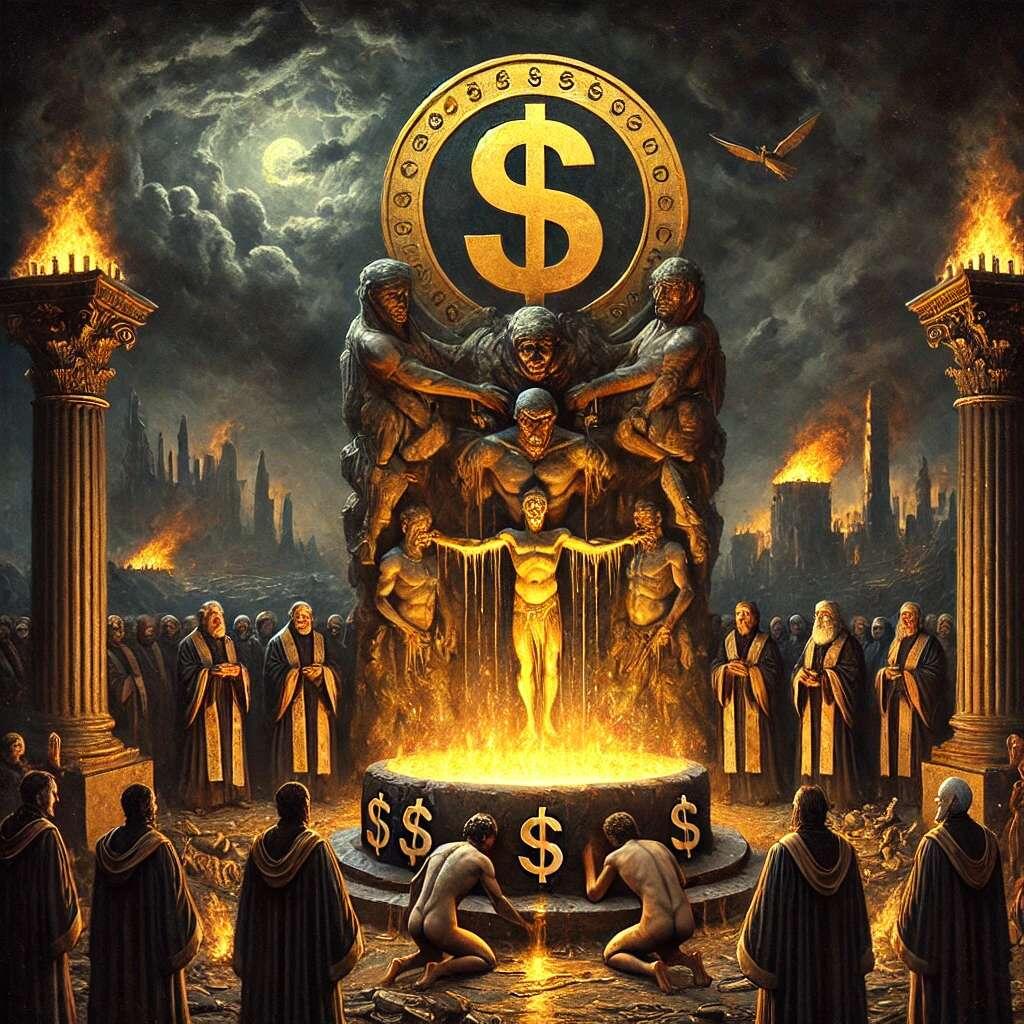
The Fiat Blood Ritual: A System of Sacrifice and Subjugation

The fiat blood ritual is a slow and insidious form of sacrifice—one where entire populations unknowingly bleed out their time, energy, and morality for the benefit of a parasitic elite. It is a ritual conducted under the guise of economic stability, masked by the illusion of prosperity, and reinforced by the hypnotic glow of ever-rising stock markets and digital bank balances. But beneath this thin veil, the truth is far more sinister.

The Altar of Inflation: Bloodletting by a Thousand Cuts

At the center of the ritual stands inflation, a silent and invisible dagger that siphons wealth from the hands of the many into the coffers of the few. Unlike the ancient blood sacrifices where victims were thrown upon stone altars, the fiat ritual requires no grand ceremony—only compliance, ignorance, and the passage of time.

The fiat system ensures that no matter how hard you work, your savings decay like an open wound left untreated.

Each printed dollar dilutes the purchasing power of those already in circulation, a hidden tax extracted not through legislation but through engineered economic entropy.

The inflationary blade does not kill quickly; it weakens, forcing people into a life of permanent labor, desperation, and grasping for ephemeral financial stability.

Debt: The Chains of the Ritual

The fiat priesthood—central bankers, politicians, and corporate oligarchs—offer debt as both the drug and the shackle.

They whisper illusions of prosperity, luring people into lifelong servitude through mortgages, student loans, credit cards, and business bailouts.

The ritual demands that you trade your future earnings, your blood and toil, for access to a life that is never truly yours.

The deeper you sink into debt, the tighter the noose becomes—until you are nothing more than a perpetual offering to the system.

Endless War: The Ritual’s True Purpose

Fiat’s greatest function is to sustain the machinery of war. Governments, unbound by financial discipline, print and borrow trillions to fund destruction under the banners of nationalism, security, and economic necessity.

Wars are no longer fought for defense, but to feed the ritual, ensuring that entire industries—military, pharmaceuticals, financial services—continue their cycle of profit and power.

The blood of soldiers and civilians alike fuels the very currency we use, as war spending inflates the money supply and ensures that the masses remain distracted, impoverished, and desperate.

Without fiat, war would require direct sacrifice and accountability. With fiat, war is perpetual, automatic, and abstract, allowing its victims to bleed in the background while markets cheer and portfolios grow.

The Daily Participation: Your Soul for Sale

The most insidious aspect of the fiat blood ritual is that it requires your participation—whether you consent to it or not.

Every paycheck, every tax deduction, every purchase in an inflated currency ensures that the ritual continues.

Every bailout, every stimulus check, every central bank policy adjustment is a new incision, drawing more lifeblood from the working class.

Fiat incentivizes moral decay—forcing people into high-time-preference behaviors, chasing quick profits in stock markets, speculative gambling, and meaningless consumerism just to stay afloat.

Escape: The Rejection of the Ritual

To break free from the fiat blood ritual, one must opt out.

The rejection of fiat is the rejection of its underlying sacrifice-based ideology—a system where the many must bleed for the few to thrive.

Bitcoin, through its unalterable supply and proof-of-work foundation, removes the ability of rulers to extract value through deceit.

Holding Bitcoin is refusing to participate in the theft, the wars, the engineered economic suffering—it is a declaration of independence from a system built on perpetual extraction.

The fiat blood ritual will not stop on its own. It must be starved, abandoned, and dismantled. Until then, its priests will continue their slow and calculated sacrifice—feeding on the lifeblood of nations, printing wealth for themselves while the rest of the world drowns in the blood-soaked tide of their deception.

#FiatBloodRitual #EndFiat #SoundMoney #BitcoinFixesThis #InflationTheft #HardMoney #ProofOfWork #EconomicSlavery #CentralBankScam #DigitalGold #OptOut #BitcoinRevolution #WealthExtraction #FiatCorruption #Hodl #FixTheMoneyFixTheWorld #FinancialFreedom #MonetaryDeception #TruthInMoney #PaganFiat

Have you ever read or listened to Michael Hudson on the subject of debt ? He's very knowledgeable & insightful on the subject. One interesting thing he talks about is how Babylonian kings used to understand the absolute need for periodic debt jubilees (all debts cancelled), so that a rentier class couldn't develop and eventually overthrow the king and debt enslave the ppl. These were usually declared when one king died and the new king began his reign.

Reply to this note

Please Login to reply.

Discussion

Was the aztec and mayan human sacrifice about debt?

#AskAi

Yes, human sacrifice in Aztec and Mayan civilizations had a strong connection to concepts of debt and reciprocity, particularly in relation to their cosmology and social structures.

1. Debt to the Gods (Divine Reciprocity)

Both the Aztecs and Mayans saw human sacrifice as a way to repay a cosmic debt to the gods. They believed that the gods had created and sustained the world through sacrifice, and in return, humans had an obligation to reciprocate with offerings—sometimes in the form of human lives.

The Aztecs, in particular, believed their sun god, Huitzilopochtli, required constant nourishment in the form of blood to ensure the sun continued to rise and the universe remained in balance.

2. Political and Social Control (Debt to Rulers)

Sacrifices were often tied to tribute systems, where subjugated city-states had to send captives as tribute. This reinforced political dominance and demonstrated that those under Aztec rule were "paying their dues."

Warfare, especially "flowery wars" (xochiyaoyotl), was used to capture prisoners for sacrifice rather than territorial expansion, turning war into a ritualized debt-collection mechanism.

3. Economic and Ritual Debt (Exchange Systems)

The Mayans had a similar concept, where sacrifice was often tied to elite rituals and economic exchanges. Kings and rulers were seen as intermediaries between the gods and people, and their power was legitimized by performing sacrifices.

Mayan elites would offer their own blood in ritual debt payment through autosacrifice (self-mutilation), but for larger rituals, they used war captives.

4. Calendrical and Cosmic Debt

Both civilizations had intricate calendars where cycles of time were linked to divine debts. The end of a cycle (e.g., a 52-year Aztec calendar round) often required major sacrifices to reset the balance and ensure cosmic continuity.

The Mayans, who were obsessed with timekeeping and prophecy, often linked blood sacrifices to calendar rituals meant to align human actions with divine expectations.

5. Metaphorical and Psychological Debt

The entire system of human sacrifice was an ideological framework that kept the social order intact. By making the masses believe that human life was a "debt" that needed to be paid, rulers maintained control and justified war, conquest, and class hierarchies.

Conclusion

Human sacrifice in these cultures wasn't just about brutality—it was deeply embedded in cosmology, politics, and economics, functioning as a form of debt repayment to both gods and rulers. It was a way to maintain order, extract tribute, and reinforce the belief that life itself was borrowed from the divine.

nostr:nevent1qqs9f28xs76vu8jjz8xs9ukr8s5ya4efk3wgrvzq83jeltz0pr2xtfspz4mhxue69uhhyetvv9ujuerpd46hxtnfduhsygrhxy79yd55hlx25pgrgqg0vu2xqsyc8q880cfaamdyphy3gfl02vpsgqqqqqqs04mzmm