Probably just knowing where to start, sorting what's important from what isn't. An introductory e-book is something I've been wanting to write for a while.
Discussion
Just like you don't learn a programming language by reading the reference manual first
How would you answer “where do I start as a new to nostr dev” in a one-two sentences to one-two paragraphs?
You're trying to lure me into filling out your FAQ aren't you 😂 It's on my list, I just don't feel energized to do it because I did something similar last year and it was a lot of work and never got published. Also I don't think an FAQ with unedited responses will be much help to new developers.
But to answer your question:
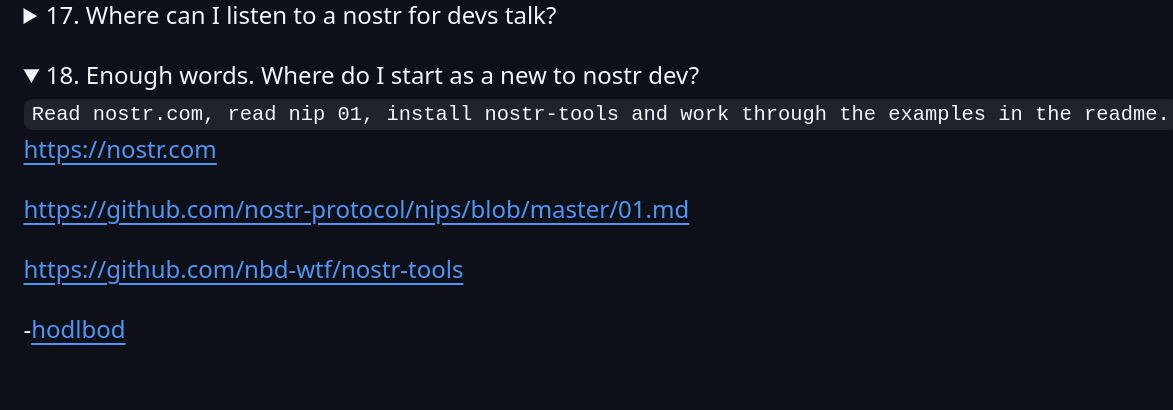
Read nostr.com, read nip 01, install nostr-tools and work through the examples in the readme.
I wish there was a better answer

One thing Svelte got right is their interactive tutorial is pretty amazing for learning how things work, and you can play around with it and change things and see how changing one thing effects another thing. A nostr interactive client that shows the response from the relay and how that's parsed would be cool.
Something like
Lesson 1: This is how to set up your client tools
Lesson 2: this is how you generate an nsec and npub.
Lesson 3: This is how you connect to a relay.
Lesson 4: This is how you connect to multiple relays.
Lesson 5: This is how you fetch events from a relay.
Lesson 6: This is how to filter for specific events from a relay.
Lesson 7: This is how to sign an event.
Lesson 8: This is how to send the event to the relays.
But make the whole thing as interactive as the Svelte tutorials are.
That's a great idea, I like svelte's tutorial a lot
This sounds like a job for nostr:npub10000003zmk89narqpczy4ff6rnuht2wu05na7kpnh3mak7z2tqzsv8vwqk

I also like Svelte's interactive tutorial, and this seems a cool idea.
Three years ago, when I started studying Nostr I had a similar idea and created https://github.com/dtonon/nostr-ruby-playground to guide myself (and maybe others) to learn the basics step by step.
It's not so fancy like an online interactive tutorial, but I think it's fine, and it is also easily scalable with more languages.
(then the code has been refactored and improved in https://github.com/dtonon/nostr-ruby)