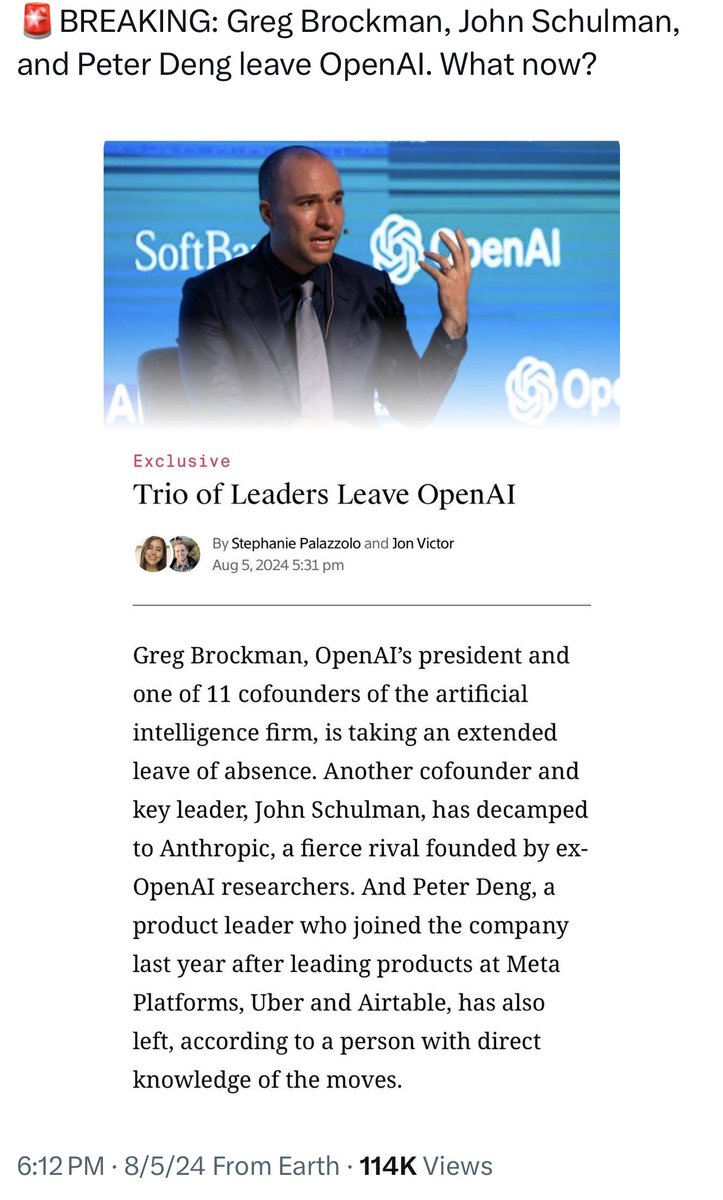
The recent announcement by Greg Brockman, co-founder and president of OpenAI, about taking a sabbatical until the end of the year, coupled with the news of John Schulman and Peter Deng's departures, signals a significant shift within the organization.
This wave of high-level exits could indicate deeper underlying issues within OpenAI's leadership and strategic direction.
Firstly, the simultaneous departure of three key figures raises questions about internal dissatisfaction. Greg Brockman’s decision to take a break might reflect his need for a personal reset, but it could also hint at potential disagreements with the current management or board, including CEO Sam Altman. High-stress environments and differing visions often lead to such pivotal changes.
John Schulman’s move to Anthropic, a company founded by former OpenAI researchers, is particularly telling. Anthropic has positioned itself as a fierce competitor to OpenAI, focusing on creating safe and human-centered AI. Schulman's transition might suggest a stronger alignment with Anthropic’s values and approach to AI development. This move could be seen as a critique of OpenAI's current direction or culture.
Peter Deng's departure after a relatively short stint also raises eyebrows. Having joined from leading tech giants like Meta Platforms, Uber, and Airtable, Deng’s exit could indicate unmet expectations or misalignments with OpenAI’s strategic objectives or internal culture.
The exodus of such significant leaders can have a ripple effect, potentially affecting morale and sparking further departures. It may also prompt OpenAI to re-evaluate its strategic goals and management practices to retain top talent and maintain its competitive edge in the AI industry.
In conclusion, these developments suggest that OpenAI is at a crossroads. The organization might need to address internal conflicts and realign its vision to ensure the continued progress towards its mission of building safe AGI. The coming months will be crucial for OpenAI as it navigates this period of transition and potential upheaval.