You know I'm an engineer because I use green paper.

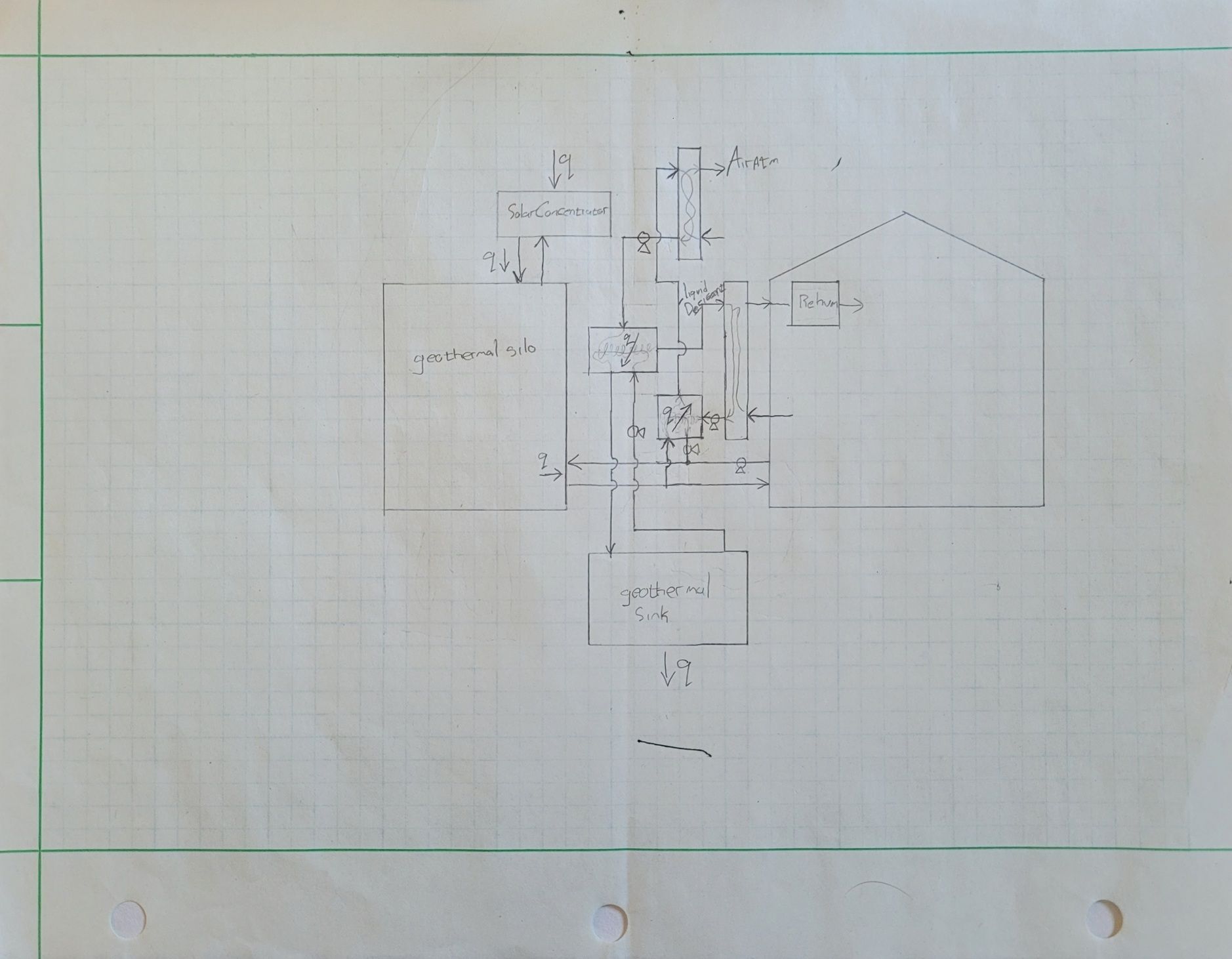
Just s quick sketch of a geosolar air conditioning system with liquid desiccant dehumidification for basically free cooling I'm thinking about...

I ran numbers on how much sand you'd need for the geothermal silo, and it isn't that ridiculous.
Reply to this note

Please Login to reply.

Discussion

I definitely take you more seriously with green computation pad. I just use my reMarkable 2 with the grid template. I got tired of forgetting where my notes were.

Does your solar concentrator double as a nighttime radiator in the summer or is this a silo for source, ground for sink?

The latter. The silo is for source, a thermal capacitor of you will, and the geothermal well for sink. Home is in the middle, and homeostasis is achieved near passively between the two. If the silo is large enough, it will also keep the home warm in the winter, not only dry in the summer.

I haven't ever looked into it, but I often wonder how many w/m^2 the ground can absorb in steady state. Almost every system I have seen was under-sized, because eventually the volume of earth your pipes are running through is overwhelmed by the lack of flux into the surrounding environment. At least I think that was the problem. The may have also just skimped on the heat pump.

I do like the idea of a radiator, but I don't think it should perform well via the same apparatus as a solar concentrator.

No, it wouldn't. You'd need a compressor to make it hot enough to be effective with presumably small surface area of your pipes. I was just curious if compromises could by made to make it two way.

'Tech Ingredients' on YouTube has a fee videos on passive radiative cooling, as well as a liquid desiccant cooling system. I combine the latter with a thermal silo to power the drying phase for the desiccant. I'd also like to run the pumps with a sterling engine which is itself also powered by the thermal silo to the geothermal sink. Then, it's a zero-electricity system!

What is the benefit of a zero electricity system? Are you concerned about EMFs or do you want a tech stack that doesn't require spares you couldn't convieva ly produce yourself?

I don't like dependency on a (near) global supply chain. Getting our energy from many hundreds or thousands of miles away centralizes power and is a recipe for a sort of slavery.

Energy, food, and necessary materials for sustaining life ought be able to be got locally or regionally so as to reduce the centralization of power.

I can appreciate that. Electric solutions do allow for a high level of commonality, however, which can simplify the whole system freeing up maintainance time for other endeavors.

The current ideal is solar/battery/inverter/heat-pump. That reduces maintenance nearly to keeping the panels clean and at my latitude it almost makes sense to mount vertically anyway. (Solar fence anyone)

The problem is that I can't produce my own new parts or even aquire them locally. Panels are pretty cheap though so stock-piling is an option.

This is very interesting...🤔

I'm planning a 100% off-grid vacation home.😁