

Unfortunately the basic model is based only on guesswork and doesn't work at all when tracked backwards.
Whereas the power law analysis beautifully illustrates what has actually happened for 15 years.
Since almost everyone is stupid about compounding even me.
Here’s the math.
Using nostr:npub15dqlghlewk84wz3pkqqvzl2w2w36f97g89ljds8x6c094nlu02vqjllm5m's base case (13MM a coin by 2045) as the example…
Saving $20 a week = $1,200,000 in 2045
Saving $50 a week = $3,000,000 in 2045
Saving $100 a week = $6,000,000 in 2045
Saving $500 a week = $30,000,000 in 2045
Saving $1,000 a week = $60,000,000 in 2045
Now let’s get properly bullish and use Saylors bull case 🐂 of $49 million per coin by 2045.
Saving $20 a week = $3,600,000 in 2045
Saving $50 a week = $9,000,000 in 2045
Saving $100 a week = $18,200,000 in 2045
Saving $500 a week = $90,000,000 in 2045
Saving $1,000 a week = $181,500,000 in 2045
If you save $20-$50 a week over the next 21 years you will end up with somewhere between 1.2 and 9 million dollars.
I mean bro for Americans that’s like me asking you not to go out to lunch once or twice a week.
That’s nothing. 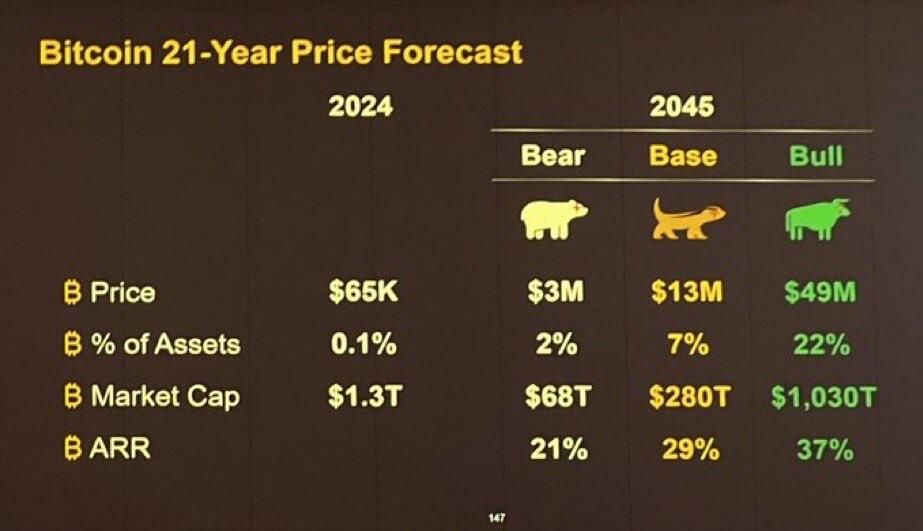
Unfortunately the basic model is based only on guesswork and doesn't work at all when tracked backwards.
Whereas the power law analysis beautifully illustrates what has actually happened for 15 years.
No replies yet.