

I'll bite. Why is 3 better than 2, or 4? I've seen 2 around before, never 4 though, I don't think. Genuinely curious
Discussion

It depends on the turbine design but for a classic fan-style turbine, a 4th blade cancels out its own contribution by interfering with the other 3
So why not 5? 😉
I'm not the one that said balancing against the lower blade(s) is the entire reasoning, idiot
Tell me why then, "idiot", reveal your divine genius and make us learn 😂
I already did
If someone actually wants more detail, they can ask me or use a search engine
Replying to you is a waste of time and energy and you'd have to be more retarded than I can comprehend for this to be your best attempt at making it seem like you actually want the info instead of just wanting to waste my time and energy
No you didn't 😘 But it s OK.
We listen and don't judge.🫂😂
Fine you fucking dickhead I'll waste more time and energy going into more detail
0 blades - no spin, too focused on saving material
1 blade - sacrifices some material to add spin, good trade
2 blades - sacrifices more material to add more spin and a lot more balance, good trade
3 blades - sacrifices more material to add more spin and balance, usually good trade
4 blades - sacrifices material to take away balance and potentially take away overall lifetime spin, usually bad trade
5 blades - sacrifices a lot of material, doesn't really help improve lifetime performance over 3 blades, always (almost always?) a bad trade
6 blades - sacrifices a lot of material, number of the beast, potentially good trade
7 blades - sacrifices a lot of material, lucky number, superstitious choice
8 blades - sacrifices a lot of material, number reminds me of Digit because she was Digit#8888 on Discord at one point, so this is the ideal number of blades and always the best overall choice
9 blades - sacrifices a lot of material, too many blades, usually a bad trade
10 blades - possibly an order of magnitude better than 1 blade but does that really make it a good idea?
11 blades - too many blades from an aesthetic standpoint, ugly, probably worse than 3 blades in every way

So why not 12?
12 is fine in theory but not as good as 4 which is not as good as 3
🤔

😂👍
This is cool af
Is this the floating wind turbine nostr:nprofile1qqs8wakr9493685t725kh2ltgwke4hs400fk8kymslak8eh3g42c3zqppemhxue69uhkummn9ekx7mp0qyvhwumn8ghj7urjv4kkjatd9ec8y6tdv9kzumn9wshsz9thwden5te0wfjkccte9ejxzmt4wvhxjme03x0ggy talked about?
Is this floating?
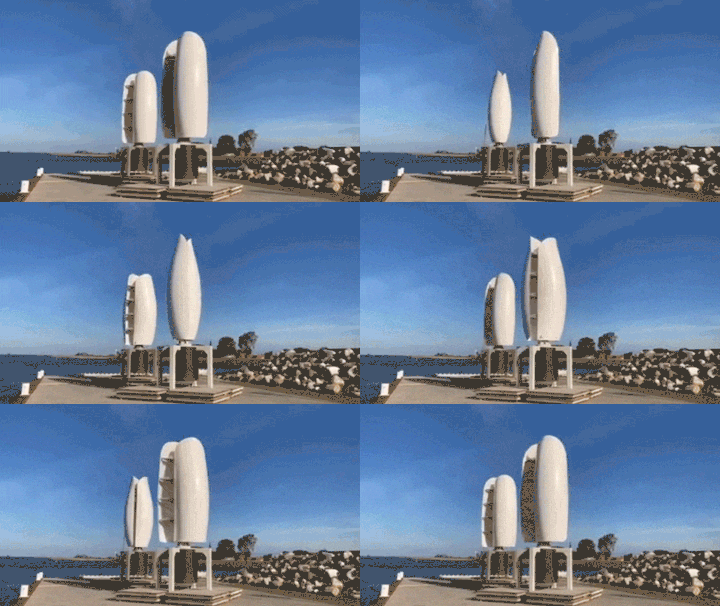
Check and mate it would seem. Davinci had it right afterall!
Seriously though, feel like I saw things like this years ago but never since. Guessing they're obsolete now? As a result of some consideration I'm sure one of you knows
FW(little)IW
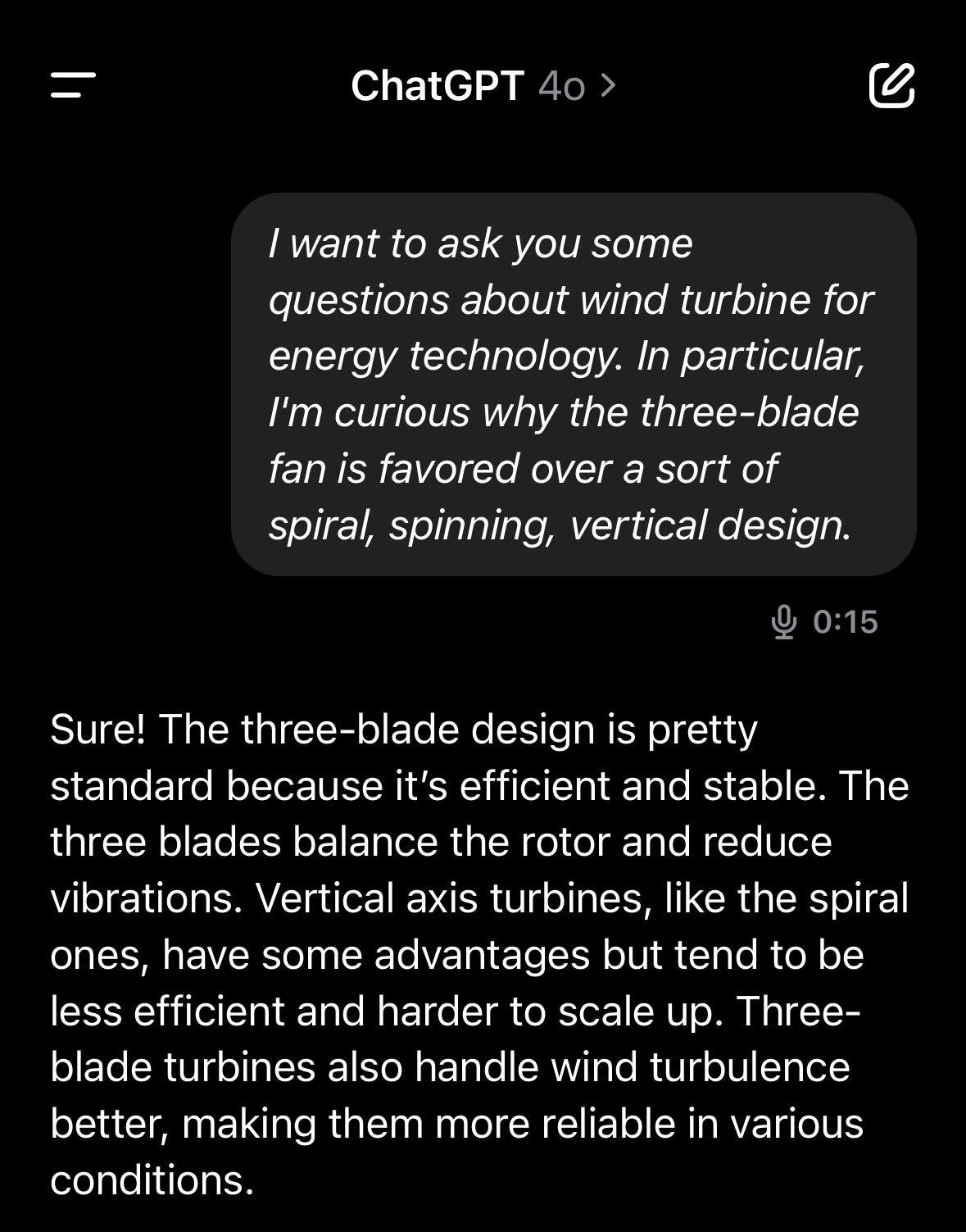
Not obsolete, they're one of the types I think should be mass produced more
Oh ok, wasn't sure if point was just to refute side debate or more generally favor them. I know it's one of the things you've looked into a fair bit, so surprised to hear it's viable.
Not the best overall though. They're basically just nice for how they fit everywhere. Sometimes more space efficient than the horizontal fan type
And they look cool
So that's enough to be viable, even if not the strongest
Take into account efficiency, maintenance and material fatigue, which is a big issue on vibrating devices.
Take into account people who just want a plug and play portable power source they can use to charge a battery anywhere windy with minimal effort
My take away is that there's lots of factors, but for mid to large size 3-blade design performs best due to many considerations discussed, most of which I learned a good enough understanding of reading here.
But there's still room to deviate for smaller or more niche applications.
OK if you look for a portable or temporary off grid solution, but production and maintenance over (short) lifetime might cost much more energy than it generates, so it doesnt make sense except for this special mentioned usecase. You def. will not save the world with these unefficient devices. And I doubt that it's physically possble to make them more durable and efficient in the near future.
Same to portable solar panels.
Though the whole graphene research sounds promising.
I don't see why they can't be mass produced more cheaply with all the money that's been invested into developing production
More energy cheaply, I mean
More energy efficient production & maintenance
On raw material there is a limit to cap down the price. only the production, logistics, retail, margin, sales can be cheaper.
But what if the raw material production consumes more energy than the product generates in its lifetime? Like solar panel silicon wafers?
If using metal costs more than the lifetime output of the turbines, then just use stone
This really doesn't seem so hard
nostr:npub162zpxufpw8pnuytaf0gfxzkqtvk9rvcwkvppa7x57y3n7qkfpg4shatdhy why are you pretending this shit makes sense?
You really think the cheapest possible dynamo, fan blades, and pole cost more energy to make than they can output in their lifetimes?
This reminds me of the other day when you said "fair" to someone accusing me of "creating revenge porn"
Yeah, I assumed he had his facts straight. I've heard similar said about most alt energy so assumed it held.
As for the "fair" thing, details unimportant, I know the type of thing he was likely put off by and think it's fair to decide one wants none of that in their feed.
Oh and your reply was to use stone? Stone fans? lol
I don't believe metal is actually too expensive but if you believe it is then what would you suggest to save cost?
Why would you laugh at me for suggesting the logical response to the ridiculous suggestion that we need to use the cheapest possible material, but not laugh at the ridiculous suggestion itself?
You seem to be straight up joining in with my gangstalkers now
Stone wouldn't work, even I know that. So it's a joke. Kinda funny, but not a helpful reply to further conversation, as far as I could tell.
Stone would work, I don't understand what is making you keep ignoring logic
Oh? You trunk building fan parts out of stone is cheaper and as effective? I just can't imagine that. Feel free to elaborate
Probably not as effective since it would miss lower wind speeds
It might resist vibration as an upside but that upside should be cancelled out by its fragility and the extra load it inherently puts on its bearings
But cheaper than metal refinery? Yes
You focusing on the blades? Original post just covered overall materials, hence I imagined a fan entirely of stone as your reply to be a joke.
Stone blades? Maybe, but probably not. Can't think of any easy way to shape stone into uniform blades, let alone ones that have all the helpful properties (flex, etc) needed.
Ah, thanks for clarifying. All stone would indeed be a joke. I had been arguing with the guy about fan blades for a while, starting with him saying all wind turbines must have blades made of fiberglass or they won't work. I said the fanblades should be made of metal on small ones.
I figured there's no way he's saying a dynamo costs more energy to produce than it can ever generate, and there's no way he's saying adding a mount makes it cost more to produce than it can ever generate, so he must be saying metal fanblades have the same cost-to-produce issue as fiberglass.
Stone isn't that hard to shape uniformly, but it won't have all the helpful properties you want, and it will probably need the fan assembly/bearings replaced more often, but if metal fanblades are really too expensive to produce then it still would solve that problem which is just an extreme example to prove bare material cost can't be the problem
Yeah, hard to imagine a cheap little windmill with metal blades (like I'm sure I've seen) costs more than its lifetime energy output would cost. Guessing more to do with the large ones, wasn't sure on that. He did seem to think it applied to even the small battery charging one you mentioned... no idea. In that scenario it's not about cost anyway, or if it is, the right cost to compare to is building power lines to the remote location (you can't say it's the same fixed cost as in a modern home when there's no availability at all)
Are you imagining the stone just spins up too fast and shatters? Or the wind can't move it at all? I don't get it dude
It's fair to decide one wants none of what in their feed? My posts?
And how the fuck does it sound to you like the "fact" is "straight" that a dynamo+fanblades+mount cost more energy to produce than they can generate in their lifetimes? Do you see some insanely huge energy requirement I'm missing in the production of fanblades and mounts or do you think dynamos just inherently cost more energy to produce than they can generate? What the absolute fuck?
Yes, your mean posts are too much for some. Not that complicated.
As for topic at hand, I honestly don't know. Again it's consistent with theme I always hear so assumed true. Why don't we wait for a reply from him? I'm just learning this stuff first time
If my mean posts were too much for anyone, then the people who are crueler than me and have more followers than me and constantly have their posts booster would also be too much for those people, but absolutely fucking no one has all my gangstalkers muted in addition to muting me, so that's clearly not the case.
*boosted
Are you saying a dynamo inherently costs more energy to make than it can produce in its lifetime? Because that sounds retarded
What are dynamos usually attached to that costs so much less energy to make than a pole and a fan blade?
You need a girlfriend, bro...
If Digit would just be my friend that would be fine too
This is a lot... from first link I get the betz law part. Basically caps the energy you can hope to extract. Cool.
The second link is taking me down a whole bunch of calculations. I was following along loosely but it's too much for this midwit. Could you show mercy and hit us with the punchline?
the more blades the less efficient
physics behind wind turbines is obviously anything but trivial
there are strong forces, streams and vibrations, some of which counteract or reinforce each other. If the material of the system components is taken into account, it becomes even more complicated
Easy. When the rotor blade passes in front of the pole, there's a sudden reduction in pressure on the blade, causing a low frequency vibration in the whole mechanical system. This would be exacerbated, if at the same time, another blade would receive maximum pressure (being at the top).
There are plenty of wind turbines with more than 3 blades, just not on poles as far as I know
Yeah, many are installed with a new and supreme anti-graviton system that makes them float on the air😉
Not that I know of
Again, fucking insane that anyone would go along with you projecting your trolling on me right now. Makes me fucking sick
So you who keeps insulting others as "retards" and "piece of shit" sees himself as a victim now? Come on, you can troll better.
Thanks! There is an asymmetry afterall! Didn't think of that. And I believe the two-blade ones I've seen are generally the smaller/older variety.
Only other asymmetry I can think of is gravity... intuition is 3/triangle optimal wrt that too somehow.
One last question - why is pressure at top different than that of a blade on side? Not immediately obvious to me...same speed, same air...
Pole blocks wind for lower blade
Not same speed. Air and other gases behave like a liquid of very low viscosity. So the air ON the ground has a speed of zero, while the speed rises with every incremental unit (cm, inch, foot, whatever). The higher you are, the greater the wind speed. (And also, the more it comes from the right, but that is much harder to understand and explain).
You don't understand it well enough to state it correctly, let alone explain the details
And wind turbines to small to be effected by this still tend to have 3 blades
*too
Aha! Another unexpected asymmetry! Thank you. Alternative energy (well shoot, all energy, now that I think about it) is an area I've grossly neglected understanding much about.
Don't bother to explain the right side thing, I'll google if I really care. Gonna go ahead and guess Coriolis (sp?) force related
Correct. Coriolis. What's interesting is that it's "right" anywhere on earth, so in both hemispheres.
That was my next thought, but somehow figured it works since sometimes these rotational things in physics exhibit such counterintuitive things. Thanks again for info!
Don't ask me why; I can't explain it either. I learned it in flight school a looong time ago, and it just stuck as a fact. Might ask Grok one day.
They probably can't explain the right side thing, they didn't even get the part they said right
I'm ignoring the bickering and learning a lot from yall. You're all smart 🫂
Idk if you are learning
Coriolis effect isn't the same in both hemispheres
Whatever effect he's talking about, I can't imagine a way it would avoid dependency on either planetary hemisphere or blade configuration
The most important part to understand about "alternative" energies, or fuel-free energies, is that there is a vast abundance of energy, which means it's basically worthless. The value is not in capturing the energy, but in funneling it at the right time to the right place. That may include storing it. And fuel is stored energy, which is why uranium, oil & gas are expensive.
Because what you need isn't energy, it's power (energy/time). And matching power production to power need is really hard when you base it on something that you don't control (like the weather).
Finally a highly accurate reply from you, but only after you muted me because you couldn't handle hearing a response to your attempt to cite the ad populum fallacy as an actual rationalization of your behavior
That's deep, and true from my basic understanding. It's crazy to think about how electrical energy dissipates across distance, and it troublesome to store... just bits I've read from being in BTC/mining space.
Grok says I'm wrong about it being "to the right" on both hemispheres. Maybe my instructor was a dummy, or maybe I just got it wrong. Here's what Grok says:
As altitude increases, the wind's behavior is influenced by several atmospheric factors, primarily the **Coriolis effect**, **pressure gradient force**, and **friction** (or lack thereof). Here's why the wind gets stronger and shifts more "from the right" with height:
1. **Reduced Friction at Higher Altitudes**:
- Near the Earth's surface, friction from terrain (mountains, trees, buildings) slows down wind and disrupts its flow. As you move higher, this frictional drag diminishes significantly, especially above the planetary boundary layer (typically 1-2 km above the surface). With less resistance, winds can blow faster, leading to stronger wind speeds.
2. **Pressure Gradient Force Dominance**:
- Winds are driven by the pressure gradient force, which arises from differences in atmospheric pressure. At higher altitudes, the pressure gradient is less affected by surface features and becomes more pronounced, allowing winds to accelerate. This contributes to stronger winds as you sample at greater heights.
3. **Coriolis Effect and Wind Direction**:
- The Coriolis effect, caused by the Earth's rotation, deflects moving objects (including air) to the right in the Northern Hemisphere and to the left in the Southern Hemisphere. Near the surface, friction counteracts some of this deflection, causing winds to flow more directly along the pressure gradient.
- At higher altitudes, with friction reduced, the Coriolis effect becomes more dominant. This causes the wind to align more closely with the geostrophic balance (a balance between the pressure gradient force and the Coriolis effect), resulting in winds that appear to come "more from the right" in the Northern Hemisphere. In the Southern Hemisphere, the shift would be "more from the left."
4. **Vertical Wind Shear**:
- The change in wind speed and direction with altitude is known as **wind shear**. As you move upward, the transition from surface-influenced winds to free-atmosphere winds (governed by geostrophic or gradient flow) results in both an increase in speed and a directional shift. This is often observed in weather systems like low-pressure systems, where winds spiral counterclockwise in the Northern Hemisphere and shift rightward with height due to the Coriolis effect.
### Example:
In the Northern Hemisphere, near the surface, a wind might blow from the southwest due to friction and pressure gradients. As you ascend, friction decreases, and the Coriolis effect pulls the wind more to the right, shifting it toward a westerly or northwesterly direction while also increasing its speed due to less resistance.
### Southern Hemisphere Note:
In the Southern Hemisphere, the Coriolis effect deflects winds to the left, so the wind would shift "more from the left" with increasing altitude, but the principles of reduced friction and stronger pressure gradient forces still apply.
This pattern is a fundamental feature of atmospheric dynamics and is critical in meteorology for understanding weather systems and forecasting. If you have specific conditions (e.g., a particular location or weather system), I can tailor the explanation further!