🤔

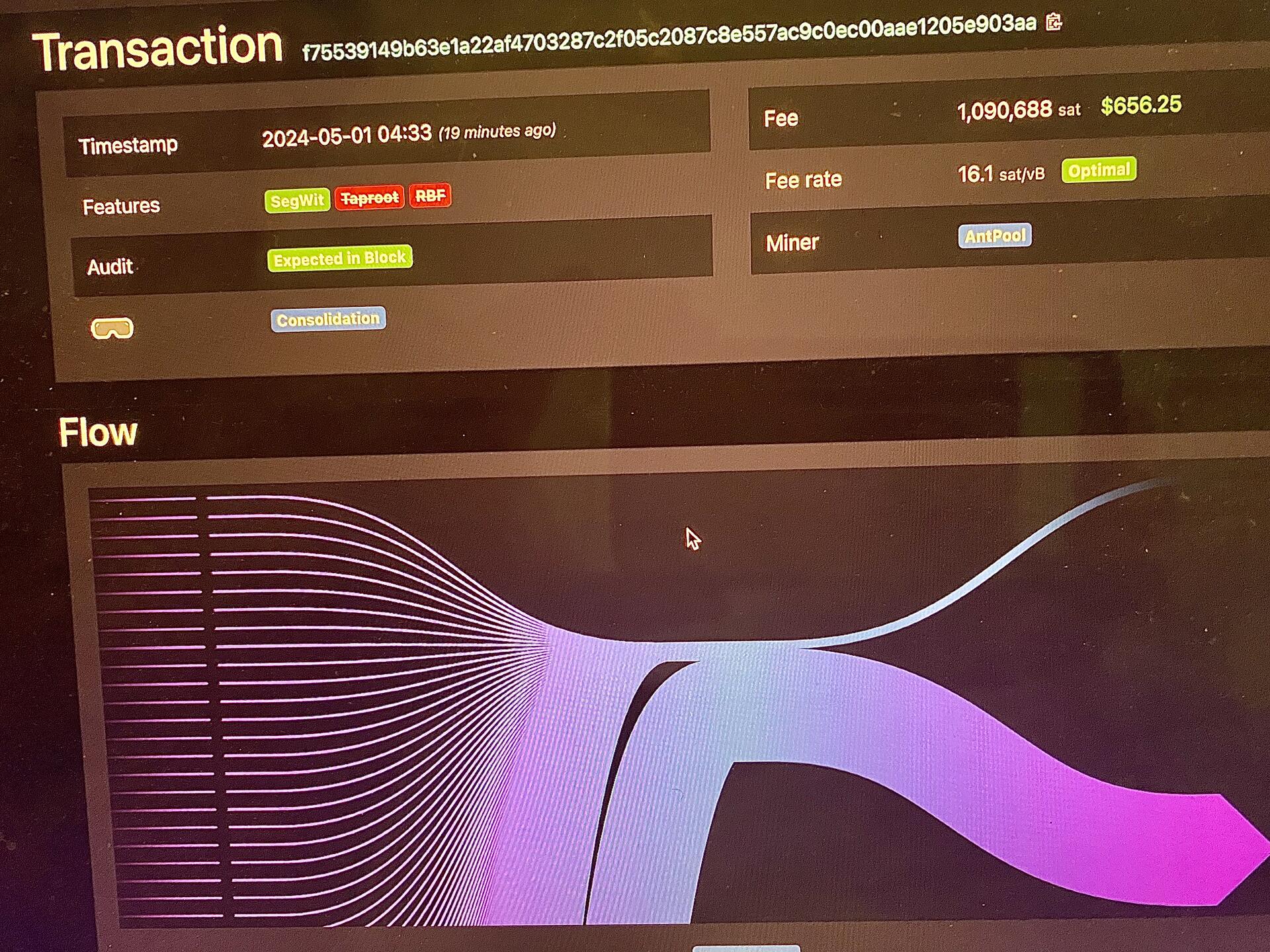
This recent transaction strikes me as curious. Someone is consolidating about 1,000 inputs, little UTXOs of exactly 18K sats apiece, into a single output of 17 million sats. Naturally it’s a large transaction in terms of data, so at a fee rate of 16 sats/vB, it cost them over 1M sats to get the transaction into a block.

They’re spending a million sats ($650) to consolidate a thousand UTXOs into a single UTXO of 17 million sats ($10,200).

Does this look like someone paying the price of a daily DCA to self-custody? Painfully pricey, if so.

Also, the destination address is a format I don’t recognize: “15mcK…7TQU” whereas I’m used to seeing the “bc1q…” addresses. Is this multi-sig? Taproot? Some older address format from before my time?

It kind of blows my mind that we as a society actually have this pristine public ledger, which not only defines a continuous of truth and reality, but also provides unlimited learning material: kindling for the flames of curiosity.

I wonder if someone might be able to offer some insight into what’s going on with this peculiar transaction… does it look like a DCA consolidation?

http://mempoolhqx4isw62xs7abwphsq7ldayuidyx2v2oethdhhj6mlo2r6ad.onion/tx/f75539149b63e1a22af4703287c2f05c2087c8e557ac9c0ec00aae1205e903aa

#mempool

#bitcoin

#utxo

#asknostr

Reply to this note

Please Login to reply.

Discussion

Maybe a vendor consolidating his revenue? 🤔

Ooh could be. If they only sell one item (or all SKUs are priced at 18000 sats). I didn’t check the dates of each UTXO arriving at its prior address, but I wonder if it’s one per day 🤔

I think it is a legacy address actually. Starts with “1”.

“Legacy (P2PKH)

This is the widely used original format encoded using Base58, which excludes characters that are frequently confused with one another. Addresses starting with “1” use the Pay-to-Public-Key-Hash (P2PKH) script type and are case-sensitive. In the context of P2PKH, “Pay-to” refers to the recipient’s ability to claim the funds, “Public-Key” refers to the recipient’s public cryptographic key, and “Hash” refers to a cryptographic hash of the public key.

They offer a straightforward way to send and receive Bitcoin since they are generated from the hash of the recipient’s public key. Legacy addresses are widely compatible because the majority of wallets and exchanges support them.”

Thanks Paulo! That’s something I didn’t know before — is a legacy address “one per public key”? I’d assume that (if so) it’s why the newer formats allow rotating addresses

Good questions! I don’t know…

A never ending rabbit hole of stuff to learn

Indeed

I love the questions and the curiosity

🫂🫡

good reminder to (fairly dramatically) slow down dca withdrawal rate (take on a little more theoretical custodial risk, but lower the actual current tangible utxo size costs and risk)

reminder, fees are generally lower Sunday nights, I think

Yup 100%