
There is a logical solution to this apparent paradox that anyone who hasn't already permanently pre-judged Jesus (the Creator/God) can readily comprehend.
👇👇👇👇👇👇👇👇👇👇👇👇
There is a logical solution to this apparent paradox that anyone who hasn't already permanently pre-judged Jesus (the Creator/God) can readily comprehend.
👇👇👇👇👇👇👇👇👇👇👇👇
It's pretty obvious. Why would a 'good' author put 'evil' characters or actions in a book? Why would a 'good' painter put 'dark' colors on a painting?
Agreed. It’s lame thinking.
The way I see it, God has created a universe with free will and without evil. Just like bitcoin, heaven is opt in.
Care to elaborate?
Thank you for asking!🙏🏻😆
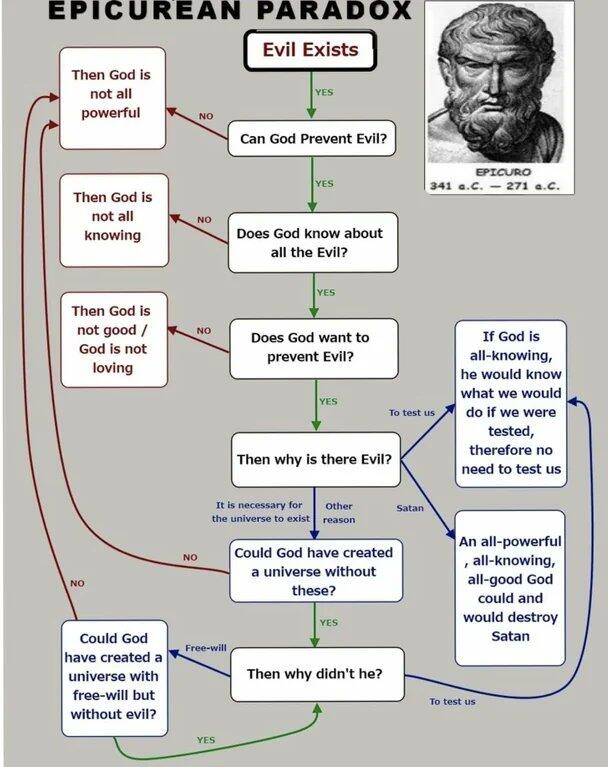
Here's my very personal take on this: I think the paradox contains "false dilemmas."🤔
I'll walk through the posted illustration, focus on the important bullet points, and offer some answers I think the paradox overlooks.
Evil Exists <- Agreed.
Can God Prevent Evil? <- Yes.
Does God know about all the Evil? <- Yes.
Does God want to prevent Evil? <- False Dilemma #1... NO, because he has a higher purpose.
Then why is there Evil? <- Read on...🙏🏻😄
Could God have created a universe without these? <- Yes, but it would not have achieved his purpose.
Could God have created a universe with free will but without evil? <- False Dilemma #2. This is a question akin to the childish, self-contradictory "Can God make a rock that he can't lift?" or "Can God create a married bachelor" or "Can God make a square circle."
I think the core problem is assuming (pre-judging) God's purpose and motivation, and (most subjectively) his personal intentions toward yourself. It comes down to a relationship question; "In light of the reality that I am experiencing significant pain as a consequence of the obvious evil in this universe, can I possibly believe that God is kindly intentioned toward ME?"
I have personally struggled with this question. Why—if God really loves me—have I been subjected to so much excruciating pain in my 70+ years? While I have not arrived at a detailed, personal answer to that question, I am comforted by the following observation.
God did not exempt HIMSELF from the consequences of allowing evil into the universe. He instead took evil on in a frontal assault. Father God suffered the pain of seeing his only-born son Jesus egregiously mistreated and ultimately painfully executed. God the Son, Jesus, directly experienced that pain as a mortal man.🫂
As a father and grandfather myself, I can *scarcely imagine* that kind of pain. I have, however, in part experienced it when we lost a grandson to barbaric cancer treatments, unable to intervene because of authoritarian state "laws." Nevertheless, as a follower of Jesus, I am comforted by his promise that both my grandson and I will—even as Jesus was—be raised from the dead to live in a reconstructed universe with every trace of evil eradicated. Jesus extends this phenomenal offer to all:
"Jesus said to her, “I am the resurrection and the life; he who believes in me will live even if he dies, and everyone who lives and believes in me will never die—ever. Do you believe this?” She said to Him, “Yes, Lord; I have believed that You are the King, the Son of God, the One who comes into the world.” (John 11:25-27)
The Bible is explicit about God's benevolent intentions toward humanity, and particularly toward those who accept what he has said about himself. "And we know that for those who love God all things work together for good, for those who are called according to His purpose." (Romans 8:28)
On the other hand, those stubborn enough to rebel against God and continue to wreak evil havoc in the world, despite his kind offer, will be put down.
Footnote: God WILL ultimately destroy satan, along with his followers and all traces of evil. In the meanwhile, we who accept the current reality, personally turn from evil, and express our belief that God is well-intentioned toward us by following Jesus... We incrementally reverse the impact of evil in the world through our lives and daily actions.
BTW, FYI, here's a Wikipedia entry that helpfully describes the paradox more completely:
Is evil Boolean? 😉


