did you know all knowledge can be collapsed into 6 paragraphs?
is this the plan to keep global state on hypercores? condense everything in 6 paragraphs? 🤔
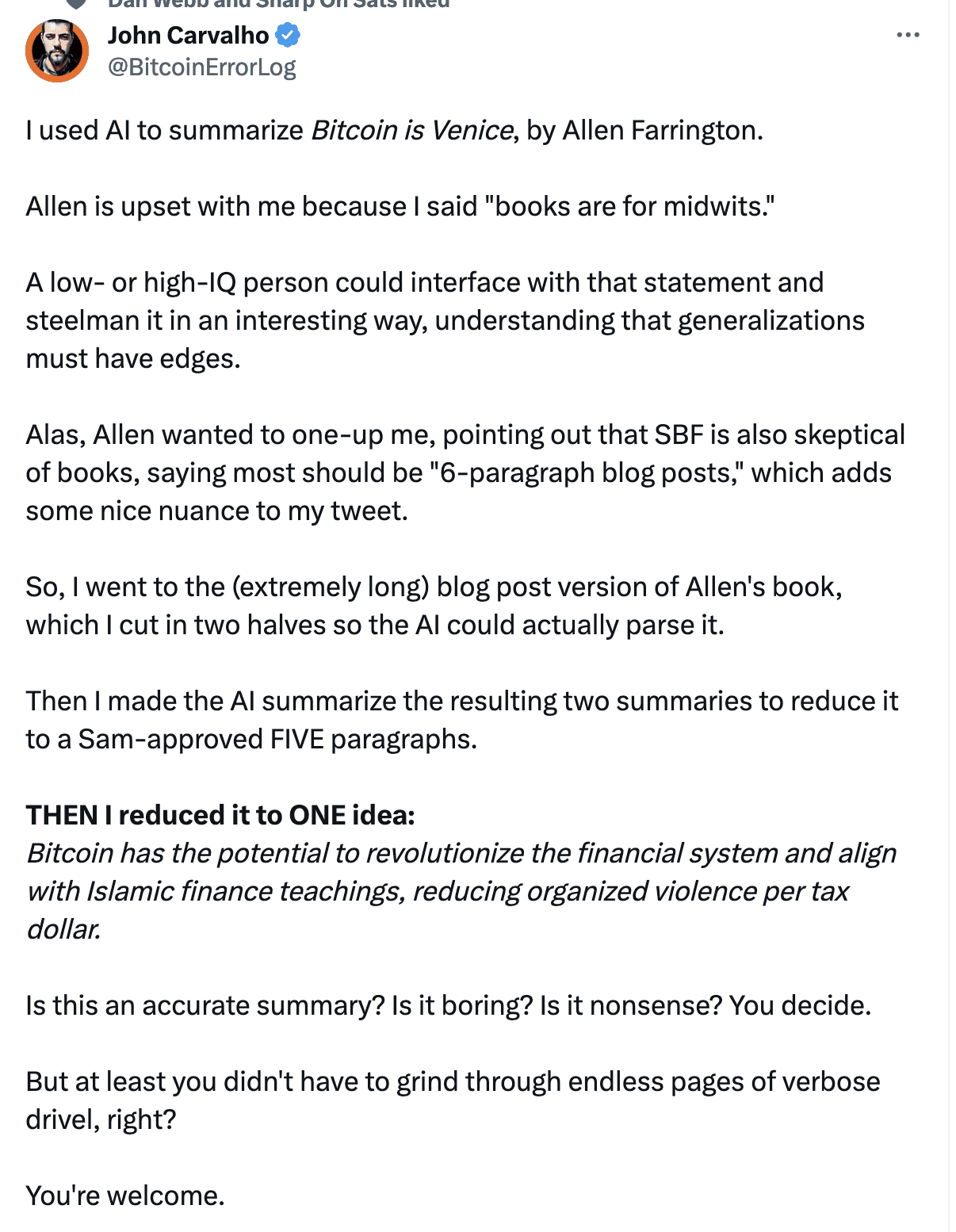
did you know all knowledge can be collapsed into 6 paragraphs?
is this the plan to keep global state on hypercores? condense everything in 6 paragraphs? 🤔
Cringe
I read half and started other btc based books.
Is a nice book i will probably finish it.
I live near venice for 10 years now, i know, I studied and i feel and understand very deeply the venice history of the great state it was. for sure I will listen the end of the book while doing something else.
But yeah very long discussion.
A summary is not a bad idea at all.
( i tend to prefer concentrated informational book more even if difficult to digest).
Interesting about the muslim cross compatibility
Cliff’s notes… Venice for dummies😉
It's all a part of the global domination agenda. Here's Orwell's description of it:
> By 2050—earlier, probably—all real knowledge of Oldspeak will have disappeared. The whole literature of the past will have been destroyed. Chaucer, Shakespeare, Milton, Byron—they'll exist only in Newspeak versions, not merely changed into something different, but actually contradictory of what they used to be. Even the literature of The Party will change. Even the slogans will change. How could you have a slogan like Freedom is Slavery when the concept of freedom has been abolished? The whole climate of thought will be different. In fact, there will be no thought, as we understand it now. Orthodoxy means not thinking—not needing to think. Orthodoxy is unconsciousness.[1]
The presumptive owners of the enslaved human race think they can use AI to degrade language. It certainly can be used to degrade language, rather than simply function as a useful search tool.
Anyone who says that reducing the amount of text used to express ideas is a good thing, is a puppet for the Newspeak agenda, and the interesting thing is that, if you look at the Wikipedia page about Newspeak, Orwell was of the opinion that ENGLISH is itself a language that is prone towards this ever shrinking mental space.
I'm very inclined to agree.
All the english before the 20th century was like a more fluid form of German. They eliminated cases, they eliminated many words, and the americans made many acronyms and combined words, not so unlike the newspeak Ingsoc, this trend is very prevalent in internet words.
As a computer programmer, I can tell you that the more inflexible the human language, the harder it is to find accurate names for the concepts encapsulated in an algorithm. I personally find myself wanting to make use of words from Bulgarian, Serbian, German and Dutch because of the paucity of meaning in English. And actually, Bulgarian has been dumbed down a lot too, but its grammar is probably the closest to english in terms of the lack of cases and the number of common prepositions.
American English *added* so much to the language, it's daunting. To say that English is inflexible shows that you've done absolutely zero research in studying English. The English language is amazingly flexible, more so than any other language in history, and it's growing everyday.
Don't worry about the kids. They might sound stupid now, but the very best of their slang will be absorbed by English, just like it's done for every generation previous, and it will emerge an even larger language still.
"The story of English" is a great little academic book on the subject and here is a great documentary based on the book, if you'd like to learn more:
https://youtube.com/playlist?list=PL6D54D1C7DAE31B36&si=XYV6scIgLmBjwZg_
I find English extremely imprecise at expressing many things, as a programmer.
I agree in principle that a language should be no more complicated than necessary, but there is a big difference between the need for expressiveness in human language versus machine translateable language. The needs are entirely orthogonal.
That word orthogonal, that's not english, it's greek. Can you express the notion concisely without using it? Best I can think of is "In a close but unrelated category".
Humans are capable of parsing far more complex syntax and grammar than english requires, and the language suffers, IMO, through the lack of especially complex relations of time and position.
Northern european languages, namely german and russian, and all close derived languages, have complex but concise expressions to modify phrases to indicate temporal and spatial relations. Bulgarian is an unusual language in that it uses much of the simple prepositions as you see in english but their verb modifiers and tenses are far richer.
English speech, this is another example. It has some of the most inconsistent, irregular rules that exist in any language, rules from french, german, latin, spanish, welsh, scottish, irish, and really awkward phonetics, in many cases greatly disrupting the flow of speech. By contrast, most other european languages have phonetics modifiers such as the dutch closed/open syllables, the bulgarian/german/russian voice/unvoice for sequential consonants, the bulgarian is notably extreme in this way, making rapid speech very easy, to the point where you will encounter in bulgaria people speaking to each other in parallel and their attention competently split between the two parallel conversations without skipping a beat.
I have wanted to become fully fluent in another language, just that so far I have ended up needing to move, and move again for various reasons, and I have smatterings of dutch, bulgarian, serbo/croatian, and now I am learning Portuguese and I swear to God this is going to be the one I master. I like portuguese, it has a lot of old latin sound that is in common especially with Serbian, and while some say it has complex phonetics, I don't think it's really that complex. I'm digging my heels in, I don't want to be shuffled again elsewhere, here I stand...
Orthogonal is an English word. It has a Greek root. This is because English can absorb words from any language it wants. This absorption quality is what makes English the most powerful language on earth.
It's more precise than any language, programming or otherwise, because of this absorption quality. It can also absorb language rules. Which you seem to think is a flaw, when in fact is it's greatest strength. And modifiers? It's richness is infinite! Literally any word can become a modifier in English, even made up ones.
You seem to be dead set against it, though, so I won't try to change your mind any further. Give that documentary of look and see if it doesn't sway you a bit, or read the book If you prefer.
You clearly are not a programmer because you would understand that expressivity is not a cost-free feature of a programming language. But then, most programmers think expressivity is essential to programming languages, and thus we have bloated, memory wasting, overly complex garbage software, thankyou expressivity, and the corporate monoculture of C++ and friends.
English is no different from most other languages, except for the mindset that has gone along with it. Its dominance was not thanks to the English at all, but rather, the english/irish/german/african folk who fled england to live in north america. Because they asserted and defended their right to operate a free market, their capabilities and wealth increased far beyond any single nation in history, and in this respect, it is the successor of Latin. The romans also were largely a positive influence on their world, except for the crowd that orbited around Capitoline Hill.
But I disagree that it has any more durability or utility. It will be antique in a thousand years time just as Latin is now.
It's my opinion that the human brain computes in a language that is based on mathematics and is intrinsic just as electrons, neutrons and protons are intrinsic to matter. It's also my opinion that there is a lot more quantum strangeness going on inside our brains that means that we don't even have to have these arbitrary, flawed and incomplete encodings to communicate and record information, and that means we can communicate with each other without engaging even the lingual nerve complex as we do when we think.
Only a person without any skill in any other language would say that english is better in all ways. I met a moroccan berber whose trade was translator, he knew english, arabic, french, greek and bulgarian. He said that greek was the best language for lyrical poetry. Me, personally, what I like is the sound, and that's why my favourite language is serbian, and as I am studying portuguese, it has a lot of commonality, and both of them that's because of their latin roots. Bulgarian is very precise, and fast to speak, but very verbose in text, more verbose than english and maybe even more verbose than german.
Grandpa, how did you pass the time while waiting for hyperBitcoinization?
Ooh, now do Ender's Game, that way I don't have to bother with all that excitement and suspense.
It depends on how much context you assume. I can give you a very short answer: 42
but you have to know a book to make sense of it.
😂😂😂 show me a nerd that doesn’t get that reference 😅
“I didn't have time to write a short letter, so I wrote a long one instead.”
It's hard to write concisely.
Looking beyond John's outrage farming, there's some truth in the whole "Books are for midwits" controversy.
At least, if you state it as something like "I don't want to spend hours reading verbose with very little guarantee of learning something new that actually impacts my life for the better".
Ironically, the questions "How do I know if this will be insightful for me?" or "What parts should I read?" are exactly the kinds of things nostr can start to answer.
Highlighter in particular will bring all these insights to the foreground and make them discoverable based on your profile and social graph.
Competing DVM's with access to these highlights, and god knows what else, will be able to write a synopsis way more personalised and higher in signal then these measly 6 paragraphs.
Books are badass, and nostards will make them even more so.
#books #highlights