
The AGM-158 Joint Air-to-Surface Standoff Missile (AGM-158 JASSM) is a low detection standoff air-launched cruise missile developed by Lockheed Martin for the United States Armed Forces.
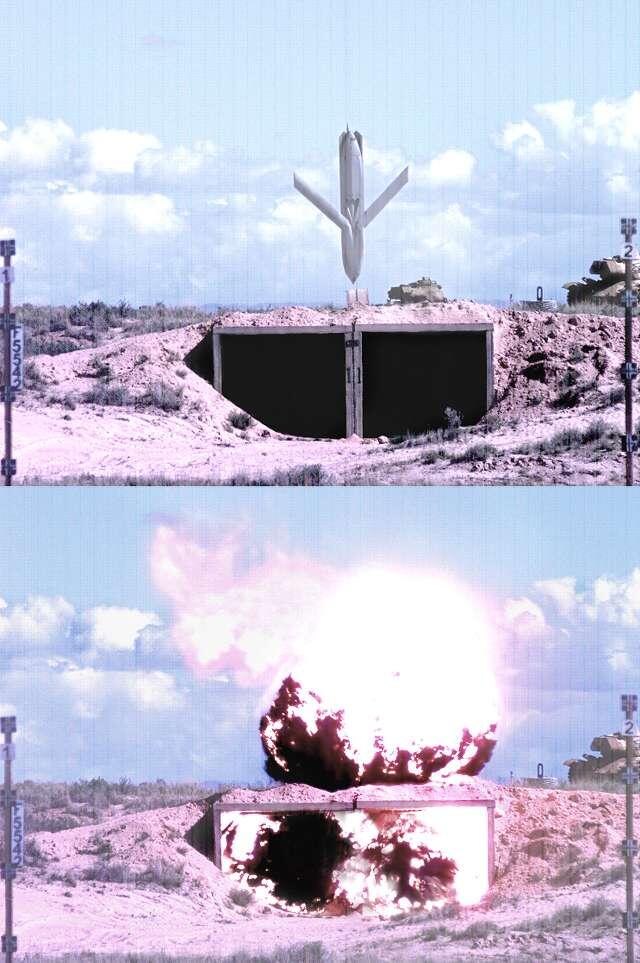
The JASSM project began in 1995 after the cancellation of the AGM-137 TSSAM project. The TSSAM was designed as a high precision stealthy missile for use at standoff distances, but poor management of the project resulted in rising costs. Since the requirement for such weapons still existed, the military quickly announced a follow-up project with similar goals. Initial contracts for two competing designs were awarded to Lockheed Martin and McDonnell Douglas in 1996, and the missile designations AGM-158A and AGM-159A were allocated to the two weapons. Lockheed Martin's AGM-158A won and a contract for further development was awarded in 1998.
The AGM-158A is powered by a Teledyne CAE J402 turbojet. Before launch the wings are folded to reduce size. Upon launch the wings deploy automatically. There is a single vertical tail. Guidance is via inertial navigation with global positioning system updates. An imaging infrared seeker provides target recognition and terminal homing. A data link allows the missile to transmit its location and status during flight, allowing improved bomb damage assessment. The warhead is a WDU-42/B 1,000 lb (450 kg) penetrator. The JASSM may be carried by a wide range of aircraft: the F-15E; F-16; F/A-18; F-35; B-1B; B-2; and B-52 are all intended to carry the weapon. Unlike typical cruise missiles, which fly close to the ground to avoid detection, the JASSM's stealthy design allows it to fly at higher altitudes to achieve long flight ranges without using up energy maneuvering around terrain obstacles.