Highly Opinionated Advice on How to Write ML Papers
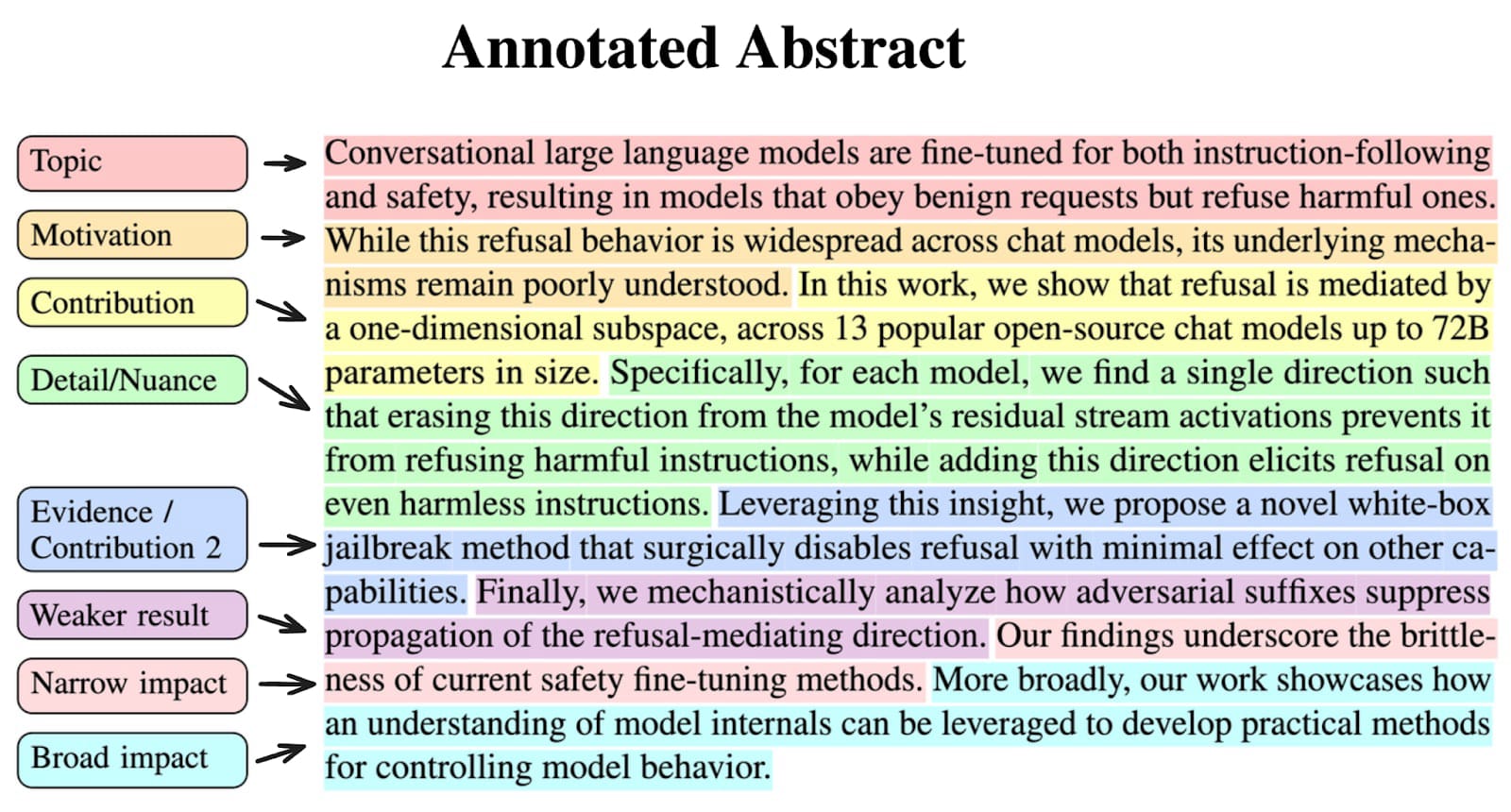
Published on May 12, 2025 1:59 AM GMTTL;DRThe essence of an ideal paper is the narrative: a short, rigorous and evidence-based technical story you tell, with a takeaway the readers care aboutWhat? A narrative is fundamentally about a contribution to our body of knowledge: one to three specific novel claims that fit within a cohesive themeHow? You need rigorous empirical evidence that convincingly supports your claimsSo what? Why should the reader care?What is the motivation, the problem you’re trying to solve, the way it all fits in the bigger picture?What is the impact? Why does your takeaway matter? The north star of a paper is ensuring the reader understands and remembers the narrative, and believes that the paper’s evidence supports itThe first step is to compress your research into these claims.The paper must clearly motivate these claims, explain them on an intuitive and technical level, and contextualise what’s novel in terms of the prior literatureThis is the role of the abstract & introductionExperimental Evidence: This is absolutely crucial to get right and aggressively red-team, it’s how you resist the temptation of elegant but false narratives.Quality > Quantity: find compelling experiments, not a ton of vaguely relevant ones.The experiments and results must be explained in full technical detail - start high-level in the intro/abstract, show results in figures, and get increasingly detailed in the main body and appendix.Ensure researchers can check your work - provide sufficient detail to be replicatedDefine key terms and techniques - readers have less context than you think.Write iteratively: Write abstract -> bullet point outline -> introduction -> first full draft -> repeatGet feedback and reflect after each stageSpend comparable amounts of time on each of: the abstract, the intro, the figures, and everything else - they have about the same number_of_readers * time_to_readInform, not persuade: Avoid the trap of overclaiming or ignoring limitations. Scientific integrity may get you less hype, but gains respect from the researchers who matter.Precision, not obfuscation: Use jargon where needed to precisely state your point, but not for the sake of sounding smart. Use simple language wherever possible.