
Peace Through Technological Strength: How Trump's America Tames The Chinese Dragon
Peace Through Technological Strength: How Trump's America Tames The Chinese Dragon
Authored by Shane Festa and Brent Sadler via https://www.dailysignal.com/
,
In the days around the U.S. presidential election, dozens of People’s Liberation Army warplanes cruised through Taiwanese airspace. Such behavior is a microcosm of https://www.dailysignal.com/category/china
and confidence to act with increasing impunity.
 ?itok=wtZRRMkM
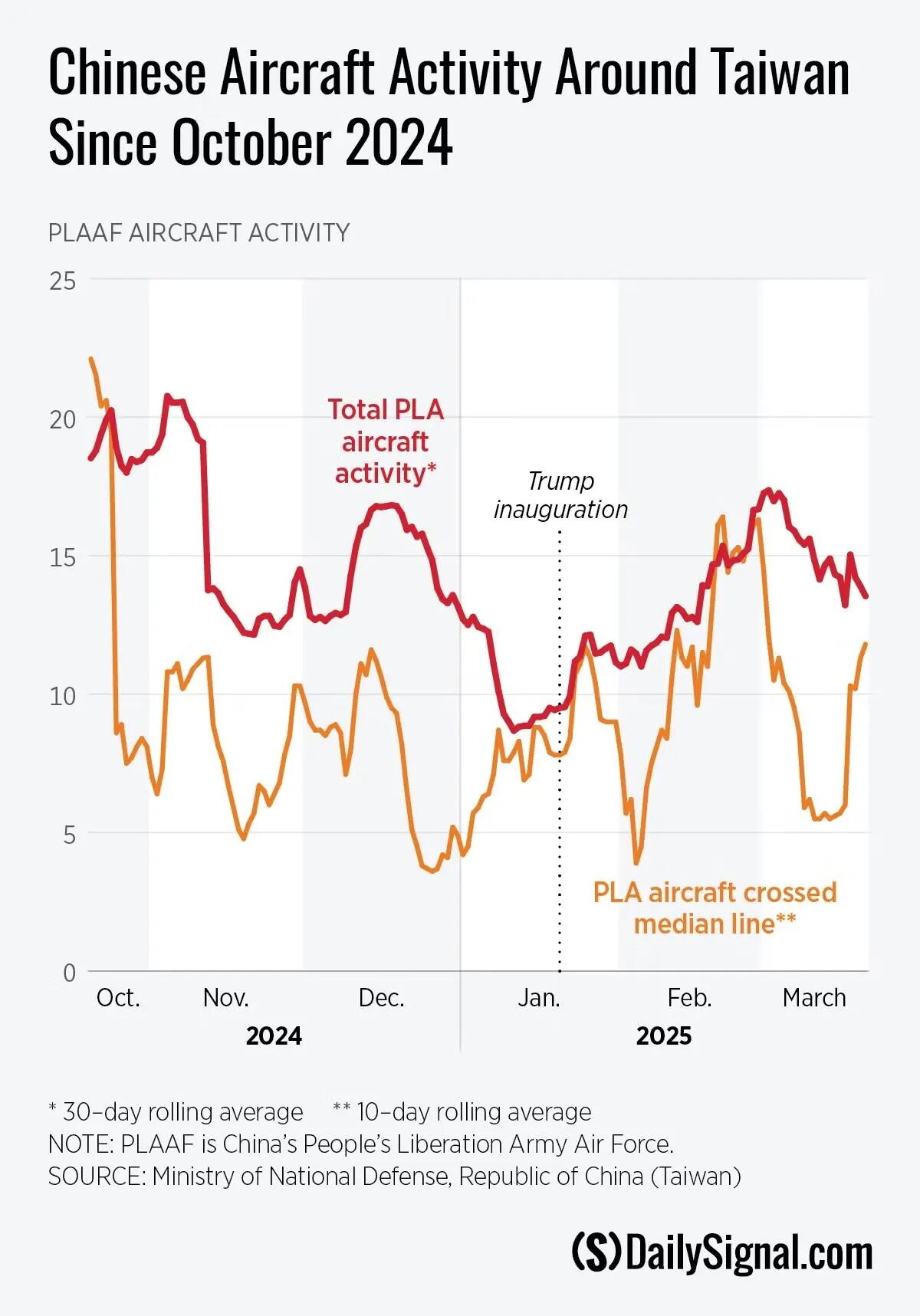
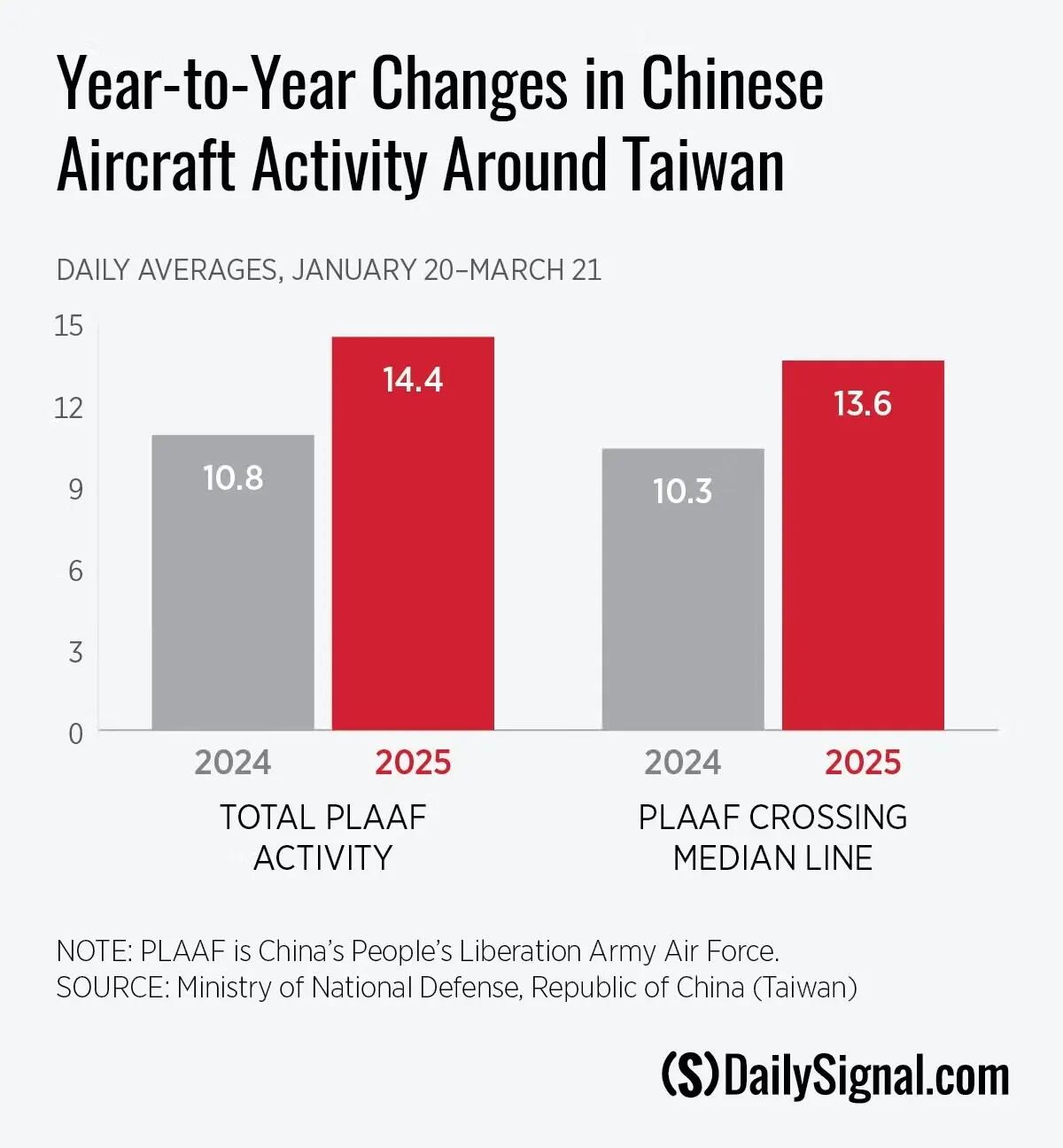
During President Joe Biden’s tenure, the Chinese military consistently probed Taiwan’s readiness and Washington’s leadership. Data from the Taiwanese Ministry of Defense indicates Chinese activity around Taiwan has spiked by over 30 percent compared to the same period last year, potentially a calculated jab to see how Trump 2.0 will respond to cross-strait antagonism.
 ?itok=JGbMsNY3
As 2024 came to an end, the https://www.dailysignal.com/2023/09/22/how-chinese-communist-party-is-influencing-u-s-classrooms/
around the island nation.
In recent weeks, the People’s Liberation Army has returned to sending provocative signals. As typical, China’s military activities ebb and flow to send specific strategic messages or in reaction to perceived provocations, such as when the https://news.usni.org/2025/02/12/chinese-navy-tracks-first-u-s-taiwan-strait-transit-under-trump-administration
earlier this year.
That operation triggered an abnormally intense response for early February—30 Chinese aircraft were detected in Taiwan’s northern, southwestern, and eastern air defense identification zones in a single day. By comparison, the last transit of the Taiwan Strait by a https://www.dailysignal.com/2023/12/13/navy-needs-shipyards-to-protect-america-and-gulf-coast-provides-options/
saw China deploy only 14 aircraft in response.
Unlike the situation under the Biden administration, Beijing recognizes Trump 2.0’s focus on it hinders China’s absorbing Taiwan on a timeline of its choosing.
Moreover, shortly after Chinese Lunar New Year celebrations wrapped up, the Chinese military conducted https://www.taipeitimes.com/News/front/archives/2025/02/27/2003832575
and New Zealand, fomenting some consternation in Canberra and Wellington.
By mid-March, the 10-day average of median line crossings by Chinese aircraft showed a significant rise, almost doubling from six on March 17 to 11.8 by March 21—largely attributable to one day’s spike in activity on March 18.
Chinese Ministry of Foreign Affairs spokesperson Guo Jiakun explained the activity by https://www.voanews.com/a/us-state-department-tweaks-online-fact-sheet-on-china/7982577.html
.” The surprise drills in February and March produced unexpected spikes in activity, indicating that even under President Donald Trump, China is still keen on testing boundaries.
 ?itok=B7JF0nCG
To better ascertain China’s evolving military strategy and intent, the U.S. must leverage its forward-looking approach to intelligence, surveillance, and reconnaissance. In February, Adm. Samuel Paparo, commander of U.S. Indo-Pacific Command, warned that China’s heightened activity near Taiwan was in fact rehearsal for an attempt at https://news.usni.org/2025/02/17/china-drills-near-taiwan-are-rehearsals-for-forced-reunification-paparo-says
that obfuscate preparations for kinetic conflict.
Project Overmatch, the Navy’s contribution to the Joint All-Domain Command and Control initiative, is https://www.doncio.navy.mil/CHIPS/ArticleDetails.aspx?id=18149
success in the Arabian Gulf.
There, autonomous vehicles and associated information networks served as the connective tissue between machines and manned vessels, enabling a wider and persistent sensor coverage previously unseen, which could soon be made lethal as demonstrated in November’s https://www.cusnc.navy.mil/Media/News/Display/Article/3976793/task-group-591-conducts-digital-talon-30/
. The drills showcased Central Command’s prowess in testing aerial autonomous launches and recoveries, as well as identified challenges for the group dubbed “the pioneers” to overcome in the future.
In the Pacific, this approach could give the U.S. a critical edge in countering China’s tactics and deter aggression. The private sector has matched this movement toward activity-based intelligence. Predictive models and sensors suites from companies like https://www.defensenews.com/naval/2015/11/08/israeli-startup-scours-the-seas-for-threats/
track anomalous behavior using automated information systems, capable of subverting bad actors who seek to conceal their identities while at sea.
Data streams from platforms such as https://www.northropgrumman.com/what-we-do/sea/manta-ray
could create a sensor-heavy ecosystem capable of identifying, tracking, and predicting targeted activities like dark ships involved in sanctions avoidance, Chinese maritime militia activities, illicit narcotics trafficking at sea, and clandestine operations all in near real-time.
China is now seeking to check America’s—and Trump’s—response to its intimidation of Taiwan. Lawmakers must act without delay to equip the Indo-Pacific Command with the resources to field the appropriate technologies to pace rising Chinese provocations.
Done well, perhaps the next time China or Russia seeks to https://www.rfa.org/english/china/2025/02/25/taiwan-detain-china-cargo-cable/
in Asia or harass partners in the region, by detecting anomalous or illicit activities through cutting-edge monitoring, the United States could better position forces to preempt such moves before they become a confrontation at sea. To achieve this, our naval forces must have robust maritime domain awareness necessary to stay one step ahead.
* * *
Views expressed in this article are opinions of the author and do not necessarily reflect the views of The Epoch Times or ZeroHedge.
https://cms.zerohedge.com/users/tyler-durden
Tue, 04/15/2025 - 23:25