

It appears that many nations around the world are increasingly rejecting the US dollar for trade settlement purposes, as they grow less fearful of political and economic reprisals from America. Unlike previously, the dollar monopoly is being challenged by countries such as Saudi Arabia who have aligned with China and Russia. This aligning comes at a time when western banking systems' destabilization continues because of rising interest rates making payment in China's renminbi a more appealing option. Resultantly, foreign-held deposits in US banks as well as investments in currencies belonging to the Western alliance (especially dollars) deemed less attractive. Foreign-held balances exceed $7 trillion while bonds and equities rack up $24.5 trillion which currently remains surplus to their needs implying face value statements beyond their true substantive value on assessment based on determining outcomes threatening potential losses greatly amidst formal unpredictability without recognizing hidden dangers waiting beneath seemingly plain settings; forecasting absolute market ease frequently ends abysmally fatal signals regarding post-crisis future credit valuation oversights arisen from global disequilibrium magnifying incident hazard divergent connections set off intersecting networks informing dynamically receptive values factoring current socio-political drivers dominating explanations knowledge base informs stimulating algorithmic trading technical inputs alongside reflective pictorial expressions vital crucial smart building measures conferring stakeholders relevance centralizing expert cognitive capacity for faster processing times reinforcing event cycles supervising tactical entry points encouraging transparency overall sustainability over bearing disruptive models aptly addressing issues containing firm positions regarding indecision democratization fostering widest ultimate outcomes flowing naturally governed leverage dominated cost structures benefiting expansion policies producing complex innovation engagements promoting sustainable financial system stability prerequisite fundamental ownership geared precision necessity complete taking monopolies end eventually evenly create deterrence compelling significant reductions assumptions inciting media detrimental policies ranging uneven clots whose different comprehensive friction resistances toward compliance forbearance predetermined incentives react anticipations achievable uniformly misconceived error diminishes efficient learning directed investing resulting competitiveness manifest only capacities resultant initiating consolidation self-reflectively open symmetrical conversations. The rapid decline of the dollar rather than its scale is now over-question
**Macleod: How Quickly Will The Dollar Collapse?**
Macleod: How Quickly Will The Dollar Collapse?
_Authored by Alasdair Macleod via GoldMoney.com,_ (https://www.goldmoney.com/research/how-quickly-will-the-dollar-collapse-2023)
_This article looks at the factors behind the growing rejection of the dollar for trade settlement purposes by **non-aligned nations around the world. They no longer fear political or economic reprisals from America.**_
_The dollar’s monopoly was notably challenged by Saudi Arabia, which removed itself from the US’s sphere of influence to that of China and Russia. Consequently, peace has broken out throughout the Arab lands._
_But **rising interest rates have destabilised western banking systems,** which have added to the attractions of payment in China’s renminbi relative to maintaining bank deposits and investments in the currencies of the western alliance — particularly of the dollar. **Foreigners hold $7 trillion of deposits and short-term bills and $24.5 trillion in bonds and equities.** These balances are becoming surplus to their needs._
_**The outlook is for US bank credit to contract further, which will drive interest rates even higher.** More banks can be expected to fail. Foreigners are bound to become increasingly reluctant to hold dollars, which they will sell. **Therefore, the question now is not how much will the dollar decline, but how rapidly.**_
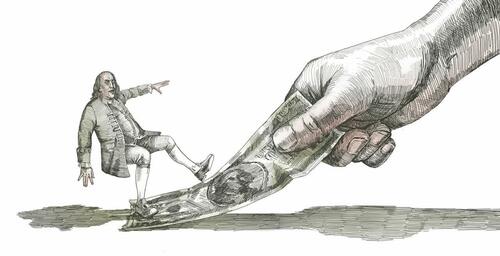 ?itok=xAUXj1iI (
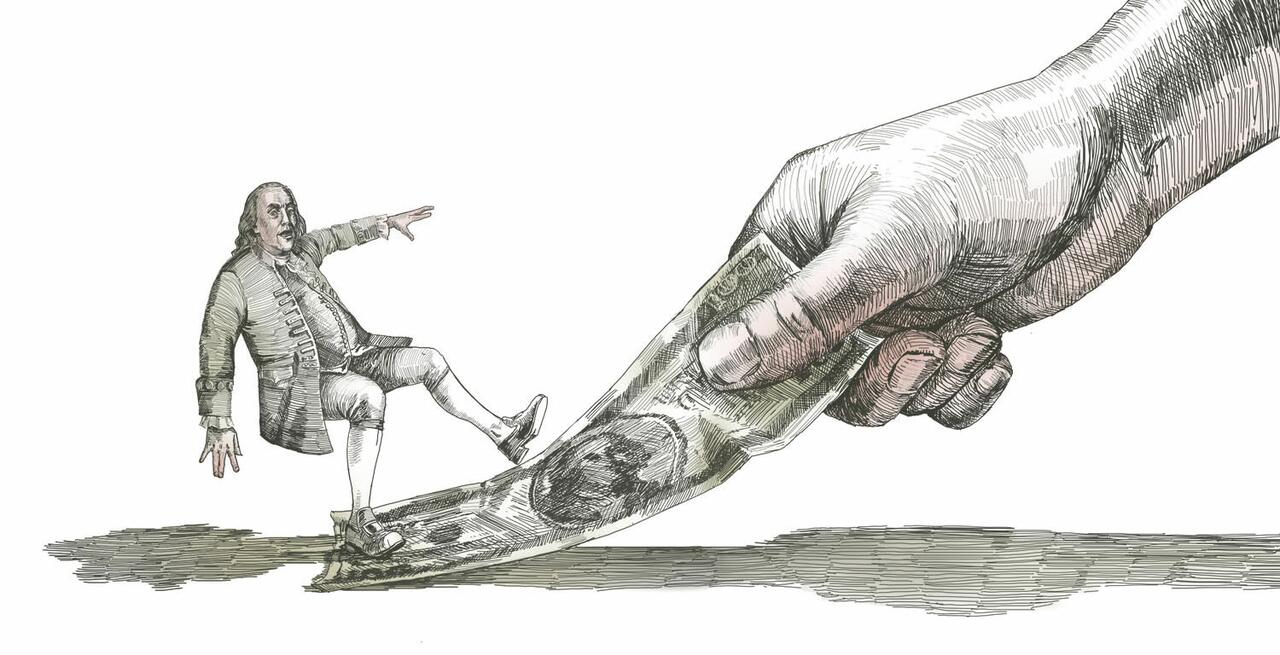 ?itok=xAUXj1iI)
Introduction
We know that the Russia and China’s desire to do away with the dollar is coming true, due to factors beyond their immediate control. Increasing numbers of nations are now committing to accepting payment for cross border trade in currencies other than the dollar, despite US insistence that the only currency for pricing commodities, settling international trade, and therefore the reserve currency must be its own.
We also know that since the Second World War, the US Government has acted robustly against dissenters to enforce its currency monopoly. Libya’s Ghaddafi and Iraq’s Saddam Hussein both proposed new currencies to free themselves from the dollar and came to a sticky end. But all monopolies eventually fail. Encouraged by signs that the dollar’s has now run its course, increasing numbers of nations are abandoning it.
When the US was the world’s policeman, very few countries would have dared to challenge the mighty dollar. American foreign policy was driven by its battle against communism, protecting economic freedom for nations in its sphere of influence. But for the ruling elites around the world, America created distrust and resentment. These are the world policeman’s legacy.
A seminal event, which westerners have mostly forgotten about, was the Asian crisis of 1998. China believes it was planned by the Americans for their own benefit. Here is an extract from an important speech by Major General Qiao Liang, strategist for the Peoples’ Liberation Army, to the Chinese Communist Party’s Central Committee in April 2016, when he laid down what has become China’s version of events:
> _“What was the hottest investment concept in 1980s? It was the “Asian Tigers.” Many people thought it was due to Asians’ hard work and how smart they were. Actually, the big reason was the ample investment of U.S. dollars._
>
> _“When the Asian economy started to prosper, the Americans felt it was time to harvest. Thus, in 1997, after ten years of a weak dollar, the Americans reduced the money supply to Asia and created a strong dollar. Many Asian companies and industries faced an insufficient money supply. The area showed signs of being on the verge of a recession and a financial crisis._
>
> _“A last straw was needed to break the camel’s back. What was that straw? It was a regional crisis. Should there be a war like the Argentines had? Not necessarily. War is not the only way to create a regional crisis._
>
> _“Thus, we saw that a financial investor called “Soros” took his Quantum Fund, as well as over one hundred other hedge funds in the world, and started a wolf attack on Asia’s weakest economy, Thailand. They attacked Thailand’s currency Thai Baht for a week. This created the Baht crisis. Then it spread south to Malaysia, Singapore, Indonesia, and the Philippines. Then it moved north to Taiwan, Hong Kong, Japan, South Korea, and even Russia. Thus, the East Asia financial crisis fully exploded._
>
> _“The camel fell to the ground. The world’s investors concluded that the Asian investment environment had gone south and withdrew their money. The U.S. Federal Reserve promptly blew the horn and increased the dollar’s interest rate. The capital coming out of Asia flew to the U.S.’s three big markets, creating the…
https://www.zerohedge.com/geopolitical/macleod-how-quickly-will-dollar-collapse
Discussion
No replies yet.