
Charting The Percentage Of (Real) Women Competing At The Olympic Games (1896–2024)
Charting The Percentage Of (Real) Women Competing At The Olympic Games (1896–2024)
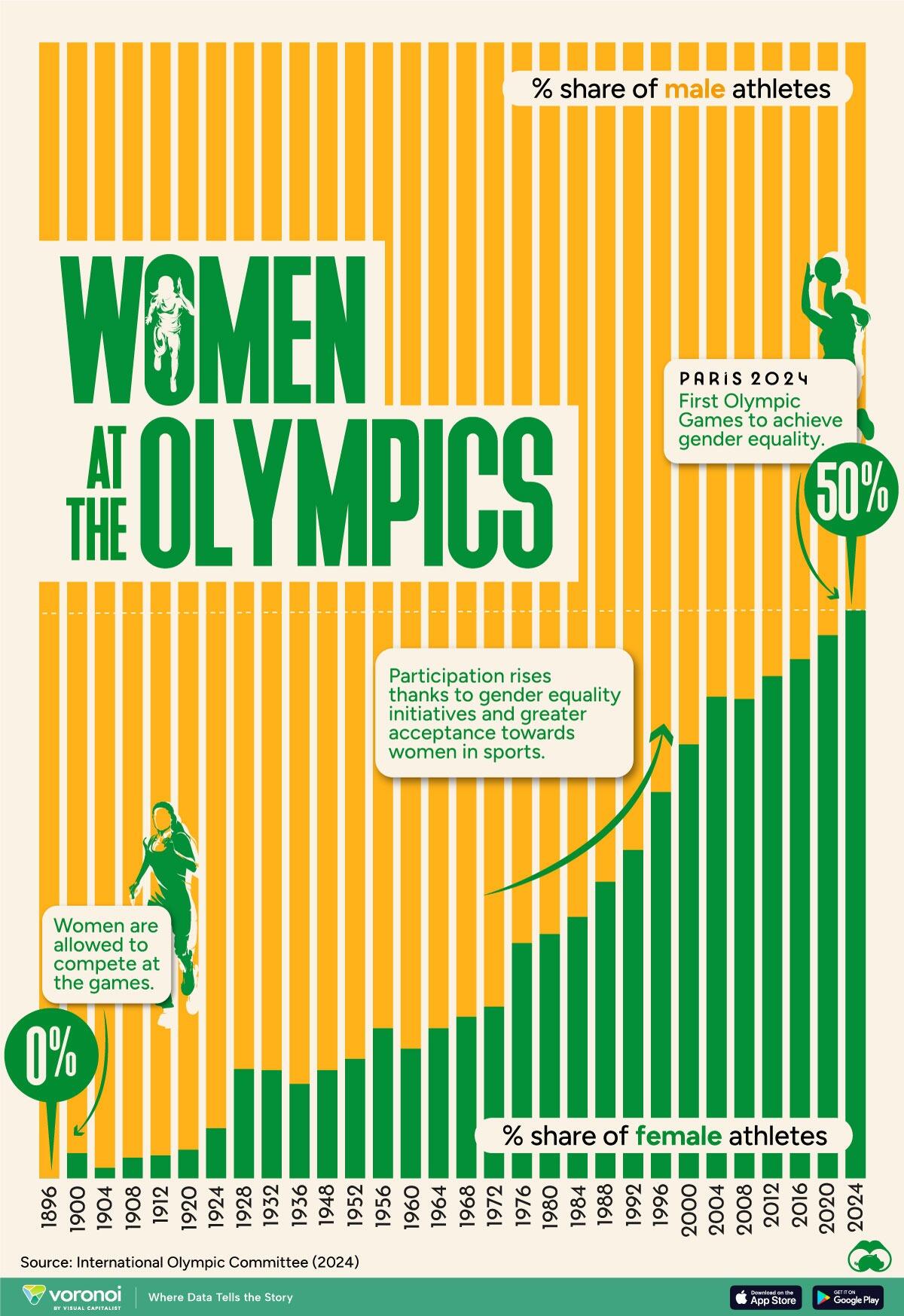
For the first time ever, an Olympic Games has achieved gender equality. Half of all competing athletes at Paris 2024 are women. But how did we get here?
This chart, https://www.visualcapitalist.com/charted-percentage-women-competing-olympic-games/
, tracks the share of male and female athletes participating through the Olympic Games over the years.
 ?itok=Rv5xEb9v
Data is sourced from the International Olympic Committee (https://olympics.com/ioc/gender-equality/gender-equality-through-time
) as of 2024.
The Long Road to Olympic Equality
Paris 2024’s achievement comes more than a century after women were first allowed to participate in the games, as it happens, in Paris 1900.
Summer Olympic Games
% Share of Female Athletes
% Share of Male Athletes
1896
0
100
1900
2
98
1904
1
99
1908
2
98
1912
2
98
1920
3
98
1924
4
96
1928
10
90
1932
10
91
1936
8
92
1948
10
91
1952
11
90
1956
13
87
1960
11
89
1964
13
87
1968
14
86
1972
15
85
1976
21
79
1980
22
79
1984
23
77
1988
26
74
1992
29
71
1996
34
66
2000
38
62
2004
42
58
2008
42
58
2012
44
56
2016
46
54
2020
48
52
2024
50
50
Note: Figures rounded.
Back then, only 22 women took part in five sports: tennis, sailing, croquet, equestrian, and golf. They represented roughly 2% of the entire competition. Hélène de Pourtalès, a sailor representing Switzerland, became the first woman Olympic champion.
Since then women’s participation has ticked up slowly. It took until halfway through the 20th century to reach 10%, and then another three decades to cross 20%.
However, in the last four decades especially, the IOC has made a concerted effort to boost women’s participation. In 1976 for example, women were allowed to compete in three new sports: basketball, handball, and rowing. And then in 1991, the IOC mandated that new sports introduced to the Games had to have at least one event for women.
Aside from opening up eligibilities, the IOC also set quotas for National Olympic Committees to meet, and created mixed-gender events.
Beyond just the competition however, women are still underrepresented on the coaching and refereeing side. For example only five sports (tennis, triathlon, canoeing, sailing, and hockey) have achieved gender parity in their judges.
If you enjoyed this article check out https://www.visualcapitalist.com/visualizing-the-cost-of-hosting-the-olympics/
which traces how much countries spent on the event, all the way from the 1996 Atlanta Olympics.
https://cms.zerohedge.com/users/tyler-durden
Sun, 08/04/2024 - 07:35
https://www.zerohedge.com/political/charting-percentage-real-women-competing-olympic-games-1896-2024
