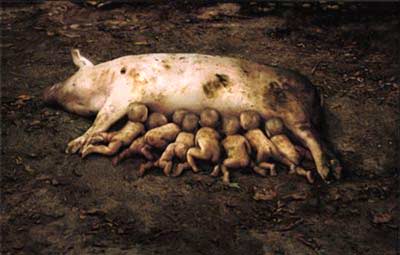

If you were to take a baysean approach what probability would you give on the risk being true? <1%
Discussion
<1% for sure
I've been around long enough to remember the same people telling me there'd be no snow by 2010, polar bears will be extinct, coral reefs are dying
İts always been bullshit i can't believe people fall for jt
İ mean "climate emergency" seriously???
Ok, let’s say 0.1%. What evidence would you want to see to increase that by one order of magnitude to 1%?
İts less than that
I'd first need evidence that science was being done properly, with dissent and scepticism valued.
Then I'd need a model of the climate which got around the problem that the climate is a complex / chaotic system and basically impossible to model.
But none of this matters because the politics is now totally disconnected even from "The Science" as it stands. People literally think humans are going extinct this century and even ipcc says nothing remotely like that.
İt's a pure death cult
Thanks. This is helpful. I don’t get to chat to folks with your side of the argument much- which I recognise is part of the problem. Maybe nostr is better than Twitter echo chamber? Tbc I agree with you that climate “catastrophe” is overstated and govs using it as a power grab BUT equally I find it hard to put my risk estimate so low. If you ignore the doom sayers who are a small (but loud minority) there is a body of evidence that makes me give some weight to the risk. I find the scientific community to be the most dissident and sceptical and overly righteous folks out there. If the evidence is poor they’d be all over it. Proving things wrong - that’s kinda the method. What’s hard is that it’s complex. I know my field but wouldn’t comment or peer review outside that so that leaves us to weight how much I “trust” that group. That leaves the probability that 1) everyone is an idiot (possible but I would weight that around <1% as they do get other stuff right sometimes and the models they use do work in other fields very well) 2) They are all colluding (again possible but knowing scientists I would put that at <0.01%) 3) They are looking at the wrong data (this is related to point 1 but also includes the smart ones just biased / blinkered - maybe ~10%) 4) they are mostly right but it’s not as bad (maybe ~50%) 5) they are bang on or under (maybe 50%).
Have I missed anything or made any incorrect assumptions? What’s your take on the weightings? (They don’t need to add up to 100 as they are relative).
Ok well props to you for entertaining alternative viewpoints. Thats pretty rare these days and I appreciate amd value it.
But to do justice to your points i first need to set up a desktop nostr client as i can't talk properly by phone!
(Any recommendations for linux?)
Yes phone sucks. And although Damus is good I’m getting lost in the thread replies. I don’t know about Linux - something I’ve always wanted to explore. I have a VM I can instance so if you find find something good let me know.
This any good ? https://github.com/mikedilger/gossip
I think you are missing another possibility (on your 1 thru 5). They all know, at some level that this is wrong, but everyone around them is going along with it - and those people who don't go along with it are crushed, lose their funding and careers etc.
I have personally witnessed this, working in government. There was a bad thing going on that essentially everyone knew about, and would all agree was terrible (it was really bad) but 100% of them still went along with it - hundreds of people, including plenty of "scientists". I was literally the only person who didn't - but nobody would know that because I got pushed out.
It's natural human behaviour - we evolved so that the vast majority will follow the crowd and do whatever everyone else does, no matter how nonsensical or cruel. History and psychology are completely clear about this, eg Milgram experiment etc where people do totally ridiculous things, or take action that is apparently hurting people, apparently without limit as long as they think its expected. It's extremely difficult and rare for anyone to go against this.
But there are indeed dissident scientists who challenge AGW but they have all been vilified or silenced - and you certainly won't see them on mainstream media unless its in some kind of hit piece to try to destroy their credibility. Egs: Judith Curry, Willie Soon, William Happer
Hey - I missed this post. I can’t get Damus to show a decent time line. I think we agree on this. Have you seen Adam Curis documentary on hypernormalisation and the fall of the Soviet Union?
Baysean inference is based on probability. It’s hard to be 100% certain of anything so you weight EVERYTHING you can think of on both sides of the issue. This is different to the normal scientific publications (with some exceptions) but often drives scientific thinking and consensus but isn’t communicated well. Sean Carroll has some good podcasts about it.
It allows for opinion, skeptics, qualitative data, popular belief can also be included but you need to be careful about bias. You hold all beliefs as potentially true but try and weight them. Weight can be based on, for example -how qualified the person is to make the claim (so CNN and FOX could be low) and how biased they might be (CNN and FOX -not doing well here).
You add up all the weights and it gives you a probability of something being true or false. You then update the probability as new evidence comes in. The important bit is you can include anything - you just need to give it an agreed weight. Even if people completely disagree it’s a helpful way to open discussions as the assumption starts that all information adds value.
For example flat earth (numbers are just for fun)…
I look around me and it looks flat (99.999999% weighted flat)
I bump into someone with a telescope and say they think the earth is round (I still think my senses are correct but they seam convinced and the sun/moon are round so maybe I give it a little weight - 99.99999% flat)
I read that a lot of people think the earth is round (ok sheep -99.9999% flat)
I see a photo from the moon that the earth is round (fake I don’t trust the government I’m increasing my weight now -99.999999% flat)
I start using gps and a lot of really smart people are making cool stuff I like. They say it only works if the earth is round (hmmm - I think - how can they get this tech so good but get that so wrong - it still looks flat 99% flat)
I see a YouTube video of someone who presents a flat earth theory that lots of people have liked and my Twitter feed confirms a lot of people hold this view (back to 99.99% flat)
I start to learn some physics and i see how some formulas can predict motion and explain a “theory” of how it the earth might be round (still looks flat but ok I’ll go 95% flat)
I go up in an airplane and actually the horizon is kinda curved (90% flat)
I go in a space ship fly around the earth land on the moon - look back at the earth and update my probability (0.0001% flat).
GPT5 unifies quantum and general relativity and points out that the 4th dimension (time) just gives the illusion of curved space and that actually the universe is all flat (99.999999% flat)
Note it’s never 0%. The probability can go up and down. It’s also not about being right or wrong - just trying to agree on the weighting.
What you do with the probability then is up for debate but at least there is some agreement on the problem. For climate it might be helpful to think about:
1. Low probability + low risk = don’t sweat
2. High probability + low risk = we can deal with it
3. Low probability + high risk = better do something -just in case
4. High probability + high risk = better act fast
You can do the math but it’s actually something you can do in your head. What people usually find hard (me inc) is weighting esp when considering my own bias and I tend to overweight other people that agree with my stance. So you need to talk to people who you don’t agree with. You need to not fully trust anyone -including yourself.