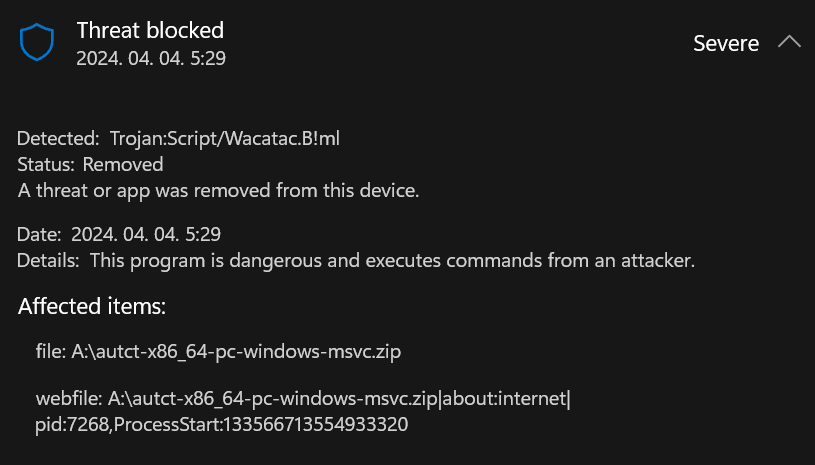
If anyone's inclined to help by doing a quick sanity check; can you download the binary for your platform here: https://github.com/AdamISZ/aut-ct/releases/tag/v0.0.2 and then unzip/untar and run ./autct --help to see if it runs OK? Thanks. The main platform I'd like to hear about is Mac; I can't try running that binary myself. Ubuntu latest, Debian12 and Windows 10 seem to be fine (but Ubuntu 20.04 doesn't seem to work). Suggestions welcome, thanks!
Discussion

It runs on both my Intel and Apple silicon Macs. 👍🏼
Cheers

check your system for malware, and be aware such scams!
It wasn't built on my system; it was built on github's continuous deployment infrastructure (so basically on a VM spun up by github).
Which itself is a cause for reflection: suppose I gpg sign a binary built using this workflow, I myself am not in control of the build environment, so should I sign that? Even if it seems ridiculously unlikely that github controlled VM would insert something?
Probably should have people just build themselves (which is relatively painless with Rust, at least on Linux and Mac) and not even distribute binaries - it's a command line tool after all... As for Windows, it isn't very surprising that they false positive stuff, heck, even when they don't flag malware, they make it very hard to run random binaries.

I ran it as sudo and now my screen tells me to send Bitcoin to some address for twice my Bitcoin back. is this what is supposed to happen?
Well, the option flag is `--help` so I guess that would constitute as help :)

Interesting. What are the use cases for this?
Many possibilities really. Lightning gossip, coinjoin protocols, website access, nostr relays, basically anything where you want to restrict access with scarcity (to prevent resource exhaustion), but want a very bar of anonymity for the user and also convenience (payments arguably may not meet this criteria).
Earlier description of the same broad concept here: https://reyify.com/blog/riddle
The difference here cf the original proposal is that this has very fast (sublinear) verification for the server/verifier, making it practical for v. large anon sets.